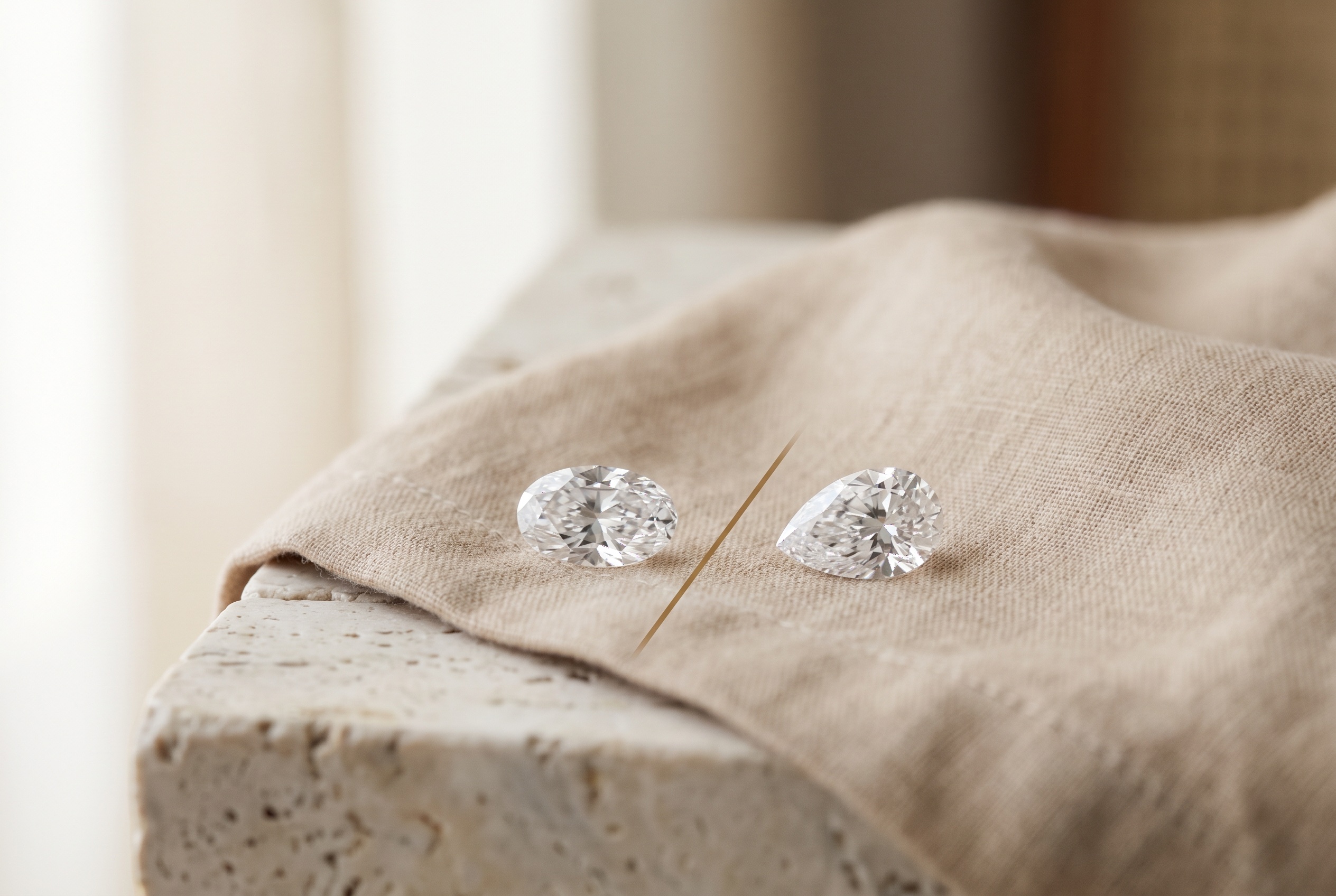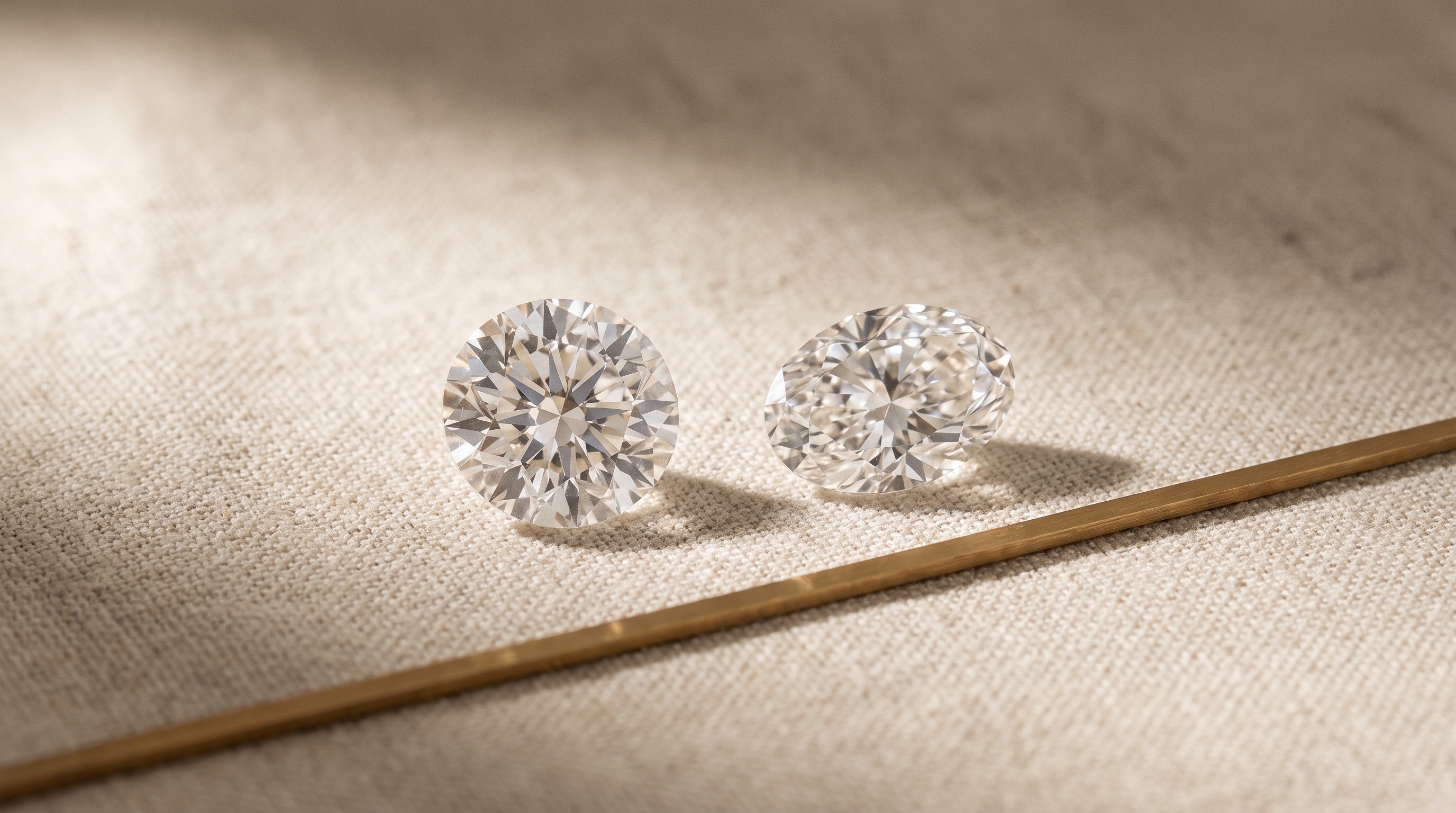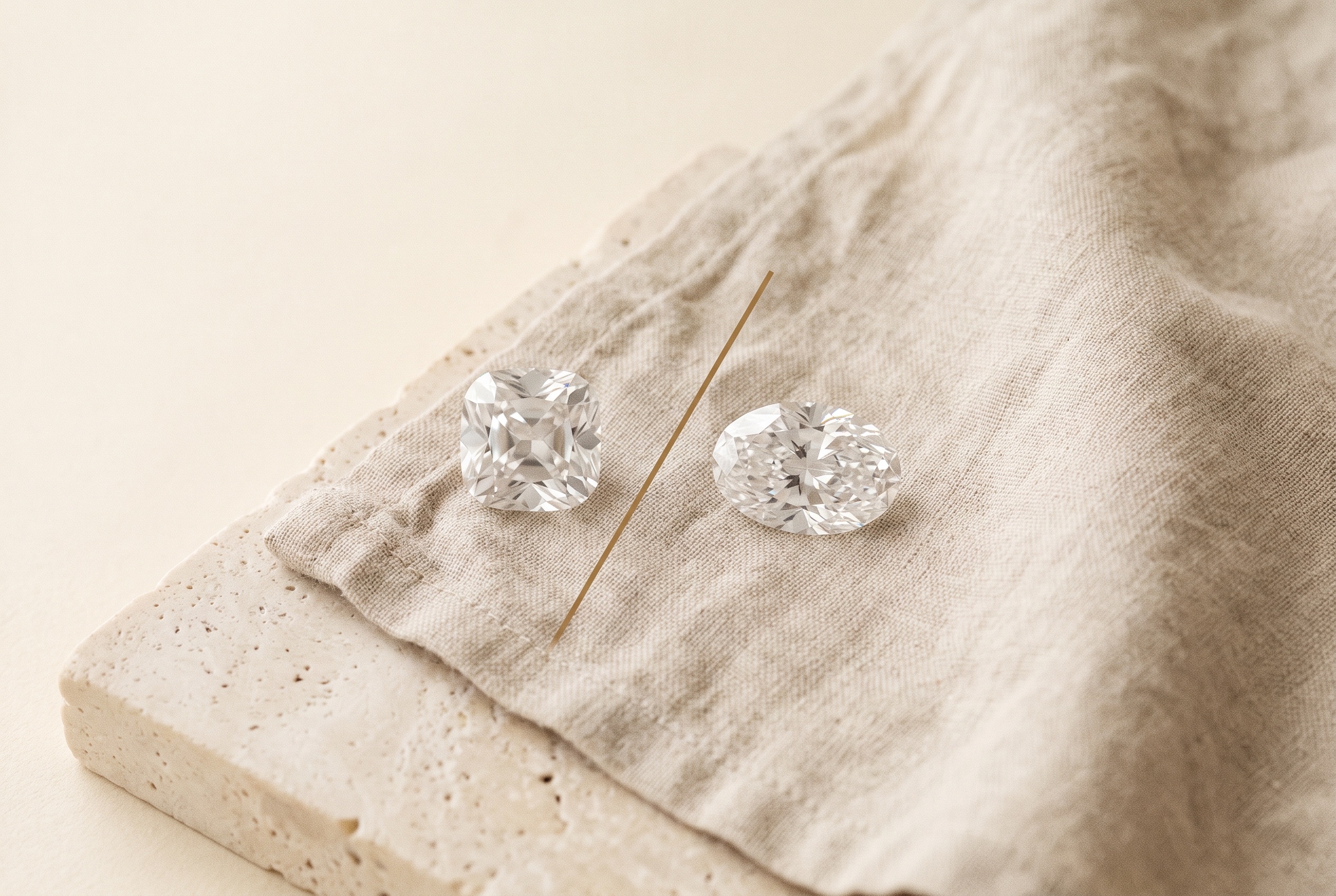

What Is an Oval Diamond?
The oval is a modern elongated brilliant cut — essentially a round brilliant stretched into an ellipse while keeping the same faceting logic: a table, a crown of triangular and kite facets, a pavilion of triangular facets meeting at a culet or small point, all arranged to maximize brightness and scintillation. There are no points anywhere on the outline. Both ends are smoothly rounded, and the whole shape is symmetrical along its long axis. Ovals sit in Guru Diam's regular fancy (mid-market) tier alongside cuts like cushion, pear, radiant, and marquise — modern shapes with standardized proportions, broad cutting supply, and pricing that tracks closely with round brilliants at comparable carat, color, and clarity. Buyers reach for oval because it's instantly recognizable, flatters most hand shapes with a finger-lengthening illusion, and carries none of the chip risk that comes with a pointed outline. It's the safe, high-velocity elongated shape in almost every case.What Is a Moval Diamond?
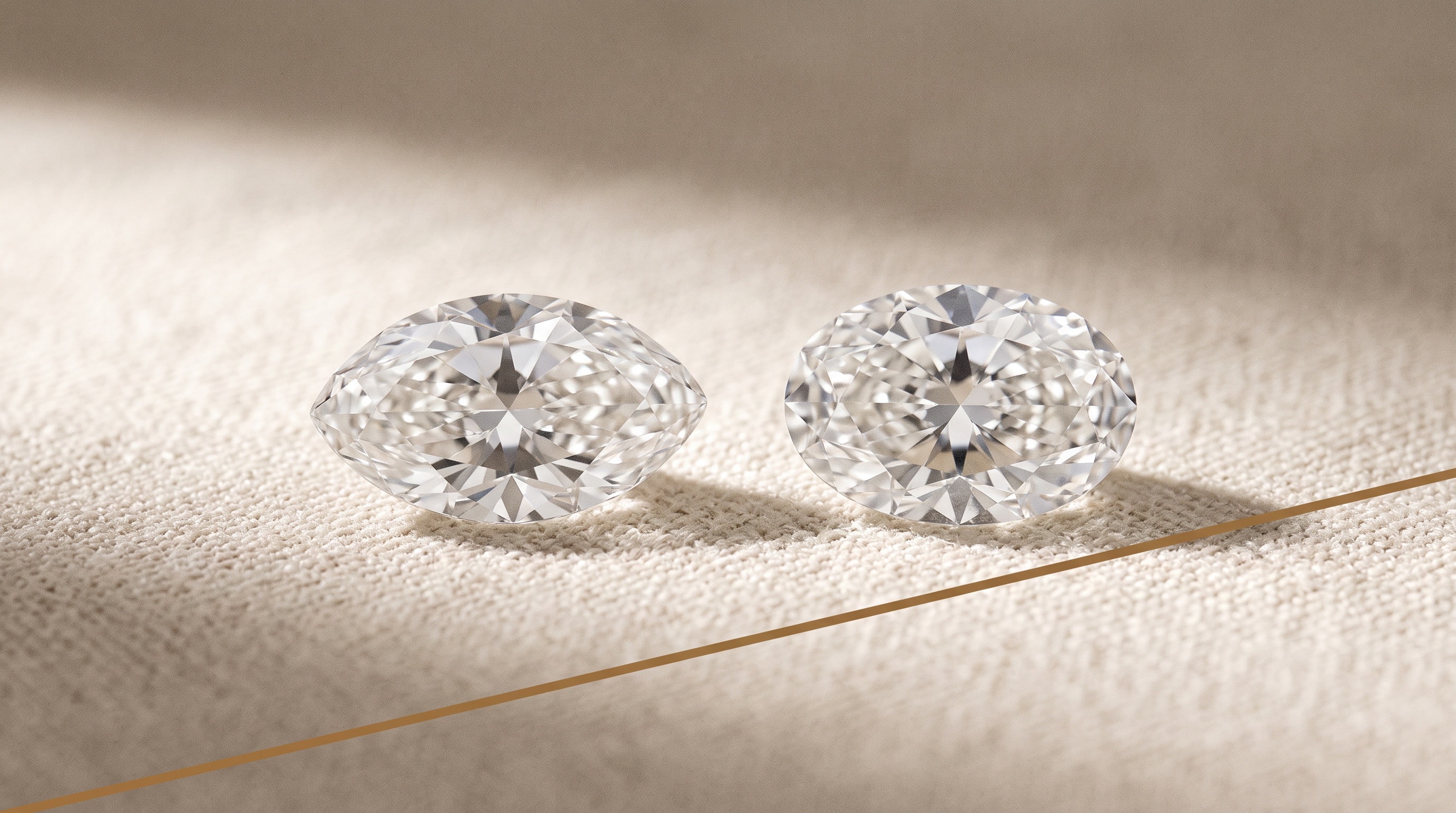
Moval is a genuine antique-tier cut, not a marketing name for "oval with extra steps." It belongs in the same premium bracket as Old Mine, Old European, Hexagonal, Lozenge, Kite, and Trillion — shapes with real cutting-craft history and real scarcity, not shapes cut for volume. Most buyers, even experienced ones, have simply never encountered it by name, which is exactly why it gets typed into search engines next to "oval." Buyers researching an old mine cut diamond often land on moval next, and the connection is real: both come out of the same antique-cutting tradition, and a case that stocks one usually has reason to stock the other. Where an old mine cut diamond keeps its cushion-like outline and high crown, moval borrows its elongated body from marquise instead — two different antique silhouettes solving the same problem: proportions and faceting that read as hand-cut history rather than machine-standard modern geometry. Visually, a moval reads as an oval body with two soft points worked into the ends — enough of a point to register as a shape decision, not enough to create the sharp, vulnerable tips of a true marquise. Think of it as the midpoint on a spectrum: marquise on one end (fully pointed), oval on the other (fully rounded), moval sitting between them. The faceting can be brilliant-cut, mixed-cut, or step-cut depending on the individual stone and cutter, which is part of what gives moval its antique, hand-finished character compared to the highly standardized modern oval.The Portmanteau, Explained
The name itself tells you what the shape is. "Moval" is a literal portmanteau of marquise and oval — cutters and antique-jewelry dealers coined it because there wasn't an existing word for a shape that borrows the elongated silhouette and tapered ends of a marquise but softens them into something closer to an oval's proportions. It's not a certification-lab term and won't show up as a distinct shape code on most grading reports the way "oval" or "marquise" will — reports typically describe it as a fancy or modified cut, which is one more reason retail buyers get confused about what they're actually looking at.A Brief Note on Cutting History
Marquise is the older of the two parent shapes by centuries — cutting lore traces it back to 18th-century France, cut long and pointed to imitate the shape of a smile, or in some tellings a monarch's lips. Oval as a standardized modern cut is much younger; it was refined in the mid-20th century by adapting round-brilliant faceting math to an elongated outline, which is why it reads as clean and mathematically consistent rather than antique. Moval sits at the intersection because it developed the way most hybrid cuts do in the trade: cutters working antique parcels — old marquise-cut and early oval-adjacent stones recut from period jewelry — found a middle proportion that preserved more carat weight than a full marquise recut while keeping more of the elongated drama than a plain oval. That practical, antique-parcel origin is part of why moval still reads as a period shape today, even on a newly cut stone: the proportions themselves carry the history, independent of any individual stone's actual age.Carat Weight and Length-to-Width Ratio: Sizing Considerations
Length-to-width ratio matters more for these two shapes than it does for round or square cuts, because it's the ratio — not just the carat weight — that determines how elongated and how dramatic the stone looks on the hand. For oval, most buyers gravitate toward a 1.35–1.50 length-to-width ratio as the "classic" proportion — elongated enough to read as oval rather than round-ish, but not so stretched that it looks narrow. Ovals cut outside that range (shorter and stockier, or longer and thinner) are available and have their own following, but the 1.35–1.50 band is what moves fastest in a general case. Moval doesn't have the same decades of standardized consensus behind it, which is both the appeal and the sourcing complication. A given moval parcel might run anywhere from a moderately elongated proportion closer to a wide oval, to a longer, more marquise-leaning ratio with more pronounced points. Buyers should expect to evaluate moval stone-by-stone on ratio rather than ordering to a fixed spec the way they might for a standardized oval — and should communicate ratio preference explicitly when placing a wholesale order, since "moval" alone doesn't pin down the silhouette as precisely as "oval" does. Carat-for-carat, an elongated shape like either of these also tends to face up larger than a round of the same weight, because more of the weight is distributed across visible surface area rather than depth — a genuinely useful selling point for both shapes, and one more reason oval remains a case staple even outside the antique-shopping customer.Fancy Color Options: Moval and Oval Beyond White Diamonds
Both shapes are cut in fancy color as well as colorless-to-near-colorless stones, and it's worth stocking both angles if the case supports it. A fancy color oval reads as a modern, statement piece — clean lines, saturated color, no antique framing required. A fancy color moval leans into the same vintage character as its white-diamond counterpart, and the combination of an unusual shape with an unusual color is a genuine draw for customers who specifically want something their jeweler's competitors don't carry. Availability skews the way you'd expect from everything else in this comparison: fancy color oval is easier to source in depth than fancy color moval, which inherits the same thin-supply reality as its colorless counterpart on top of the added rarity of fancy color itself. Buyers exploring this angle should browse fancy color loose diamonds directly rather than assuming color availability mirrors white-diamond availability shape-for-shape — the two don't track evenly.Visual Distinction: How to Tell Them Apart at a Glance
The fastest way to separate the two in a photo or on a tray:- Ends: Oval ends are fully rounded, no exceptions. Moval ends taper to a soft point — visible but blunted, not knife-sharp like a marquise.
- Outline curve: Oval has a continuous, even curve along its whole perimeter. Moval's curve tightens noticeably as it approaches each end, giving the outline a more elongated, almost eye-shaped silhouette.
- Overall silhouette: Oval looks balanced and rounded even when cut long. Moval looks more dramatic and stretched at the same length-to-width ratio, because the tapering ends read as "pointier" even though they're not actually sharp.
- Antique cues: Moval stones, especially ones cut to true antique style, more often show slightly irregular faceting, a higher crown, or a step-cut pavilion — deliberate departures from the machine-precise modern oval.
Light Performance and Brilliance Comparison
Oval, cut correctly, is one of the more efficient elongated shapes for brightness and scintillation. Its rounded outline and standardized brilliant faceting spread light evenly across the stone. The one well-known risk with any elongated brilliant is the "bow-tie" — a dark shadow across the center caused by light leakage at the ends — but on a well-proportioned oval this effect is minimal and often nearly invisible. Moval carries a similar but slightly elevated bow-tie risk because of its pointed ends, which is the same geometric tradeoff marquise diamonds face: light behaves differently near a point than near a smooth curve, and can leak out rather than reflect back to the eye if the cutter doesn't manage the pavilion angles carefully. On a well-cut moval this is controlled and often not noticeable in normal viewing conditions, but it means moval quality varies more stone-to-stone than the highly standardized modern oval does. This is one more reason moval belongs in the antique tier: it rewards — and requires — more careful, individual cutting judgment rather than assembly-line proportions.Moval vs Oval: Comparison Table
| Moval | Oval | |
|---|---|---|
| Visual character | Elongated hybrid with two softly pointed ends; reads as a marquise-oval cross with a dramatic, antique silhouette | Fully rounded elongated brilliant; clean, symmetrical, modern silhouette |
| Light performance | Brilliant, mixed, or step faceting; bow-tie risk closer to marquise, more variation stone-to-stone | Standardized brilliant faceting; minimal bow-tie on well-proportioned stones |
| Price tier | Antique/premium tier — priced above regular fancy shapes at comparable carat, color, and clarity | Regular fancy (mid-market) tier — standardized pricing, broad supply |
| Best for | Vintage and Art Deco–inspired designs, statement pieces, jewelers who want a rare, conversation-starting shape in the case | Everyday bridal, finger-lengthening illusion, buyers who want a widely recognized, easy-to-sell modern shape |
Price Tier: Why Moval Costs More Than Oval
The price gap between these two shapes isn't a marketing invention — it comes from real differences in cutting complexity and cutting volume. Oval is produced at scale, with well-established proportion standards that most experienced cutters can execute consistently. That standardization keeps yield predictable and cost per carat in line with other regular fancy shapes. Moval is the opposite scenario. Because it's an antique-tier shape with less standardized proportions and a more deliberate, individually judged faceting approach, fewer cutters can produce it well and at consistent quality. Lower cutting volume, more skill required per stone, and a smaller pool of finished inventory all push moval into a higher price bracket than a comparably sized, comparably graded oval — the same dynamic that puts Old Mine, Old European, and Kite cuts above regular fancy shapes. Buyers pricing out a moval order should expect to pay a premium over oval at matched carat, color, and clarity, and should build that into markup and case pricing rather than treating the two shapes as interchangeable at the wholesale level.Sourcing and Rarity: Why Moval Is Harder to Find
This is the practical reality that separates these two shapes for a wholesale buyer. Oval is one of the easiest elongated shapes to source in depth — most suppliers carry meaningful running inventory across carat weights, color grades, and clarity tiers, because cutting volume is high and demand is broad and constant. Moval inventory is thinner everywhere in the trade. It's a genuine antique-tier cut, which means available stock skews toward whatever a given cutting run produced rather than a deep, replenishable catalog across every carat and grade combination. A buyer looking for moval in a specific size or color needs a supplier that treats antique cuts as a real category, not an afterthought bolted onto a modern-shape catalog — because thin category depth is exactly where most general-purpose suppliers fall short. This is also where certification matters: loose moval and oval diamonds at 0.30ct and above are gradeable through IGI, GIA, and GCAL, and a buyer sourcing either shape should confirm certification flexibility up front rather than after the order is placed.Where Each Fits in a Jeweler's Case
Oval earns its place as a case staple. It's the shape a walk-in customer already recognizes, it photographs well for e-commerce and social, and it moves at volume because it works for nearly every hand shape and nearly every budget tier. Most cases should carry oval in depth across common carat weights — it's a shape you sell every week, not a shape you special-order. Moval earns its place differently: as the shape that makes a case memorable rather than merely functional. It's the answer for a customer who has already seen every standard shape and wants something the jeweler down the street doesn't carry. It photographs distinctively for antique and vintage-inspired collections, and it gives a sales team a genuine story to tell — the marquise-oval portmanteau, the antique cutting tradition, the rarity — instead of reciting specs. A case built entirely on regular fancy shapes has no differentiation story; a case that adds moval, alongside other antique cuts, has one.Setting Styles That Flatter Each Shape
Oval's rounded ends make it forgiving across almost any setting style — solitaire, halo, three-stone, east-west — because there's no vulnerable point to protect and no tapering silhouette to work around. It's a low-risk shape to design around, which is part of why it's a case staple rather than a specialty item. Moval's soft points benefit from settings that echo antique jewelry conventions: elongated cathedral shanks, tapered baguette or trillion side stones that continue the shape's silhouette, and prong placement that gives the pointed ends light protection without hiding them. Bezel and half-bezel settings also work well on moval, both for protecting the ends and for reinforcing the antique aesthetic the shape is already communicating. For three-stone or side-stone designs pairing either shape with complementary accents, sourcing pre-matched stones from a matched pairs category shortens the design process considerably compared to matching loose stones one at a time.Which Should You Stock? A Buyer's Decision Framework
For most cases, the honest answer is both — they're not competing for the same customer. Oval is inventory you turn regularly; it belongs in depth, across carat weights, as a dependable revenue shape. Moval is inventory you position strategically; a smaller, curated selection alongside your other antique cuts gives you a genuine point of differentiation without requiring the same depth of stock oval demands. The buyers who get this wrong tend to do one of two things: either they skip antique shapes entirely and end up competing purely on price against every other supplier carrying the same modern-cut catalog, or they overcommit to antique inventory without the sourcing relationship to replenish it reliably. The fix for both is a supplier who treats antique-tier shapes as a real, standing category — not a one-off special order — so a jeweler can stock moval with the same confidence they stock oval.Sourcing Moval and Oval Diamonds Wholesale from Guru Diam
Guru Diam is a B2B wholesale supplier, trade-only, and our lab-grown catalog is CVD-grown exclusively — no HPHT, anywhere in the line. We carry the full range of standard, antique, and exotic diamond shapes, which means moval sits alongside oval as a standing part of the catalog rather than a special request, and both are available with IGI, GIA, and GCAL certification depending on the stone. We operate from two US locations — New York (HQ) and Los Angeles — with same-day shipping on in-stock inventory when orders come in before 6pm EST out of NYC or 4pm PST out of LA. That applies to loose moval and oval diamonds pulled directly from stock. If you're mounting either shape into a custom engagement ring, finished jewelry builds turn around in 4–6 days. For jewelers building out an antique-cut assortment, moval is worth pairing with other cuts in that same tier — Old Mine, Old European, Kite, and Lozenge all share the same sourcing logic and the same case-differentiation value. Browse the full range through our wholesale hub, or set up a trade account to see live inventory and pricing across both the antique and regular fancy tiers.Frequently Asked Questions
Is a moval diamond the same as an oval diamond?
No. They're related but distinct shapes. Oval is a fully rounded, symmetrical elongated brilliant cut with no points. Moval is an antique-tier hybrid with softly pointed ends, a cross between marquise and oval, which gives it a more elongated and dramatic outline than a plain oval.
What does "moval" mean in diamond cutting?
Moval is a portmanteau of "marquise" and "oval." It describes a shape that borrows the tapered, pointed ends of a marquise but softens them into proportions closer to an oval, rather than the marquise's sharp, fully pointed tips.
Is a moval diamond more expensive than an oval diamond?
Generally, yes, at comparable carat, color, and clarity. Moval sits in the antique-tier price bracket because it requires more individualized cutting judgment and is produced in lower volume, while oval is a standardized, high-volume modern cut with more predictable pricing.
Why is a moval diamond hard to find?
Moval is a genuine antique-tier shape, so available stock depends on individual cutting runs rather than a deep, constantly replenished catalog. Fewer cutters produce it well, which keeps supply thinner than modern shapes like oval that are cut at scale to standardized proportions.
Does a moval diamond show a bow-tie effect?
It can, more so than a well-cut oval. Moval's pointed ends carry a bow-tie risk similar to marquise diamonds, since light behaves differently near a point than near a smooth curve. A well-proportioned, carefully cut moval keeps this effect minimal, but quality varies more stone-to-stone than with a standardized oval.
What setting works best for a moval diamond?
Elongated cathedral shanks, tapered baguette or trillion side stones, and prong or bezel settings that protect the soft points while echoing the shape's antique character all work well. These settings reinforce moval's vintage aesthetic rather than fighting it.
Both moval and oval have a place in a well-stocked wholesale case — one as a dependable, high-turn staple, the other as a differentiated, story-driven specialty piece. Understanding the visual and sourcing gap between them is what lets a buyer stock each one correctly instead of treating them as interchangeable.