
Marquise vs Oval Diamond: Quick Comparison
| Criteria | Marquise | Oval |
|---|---|---|
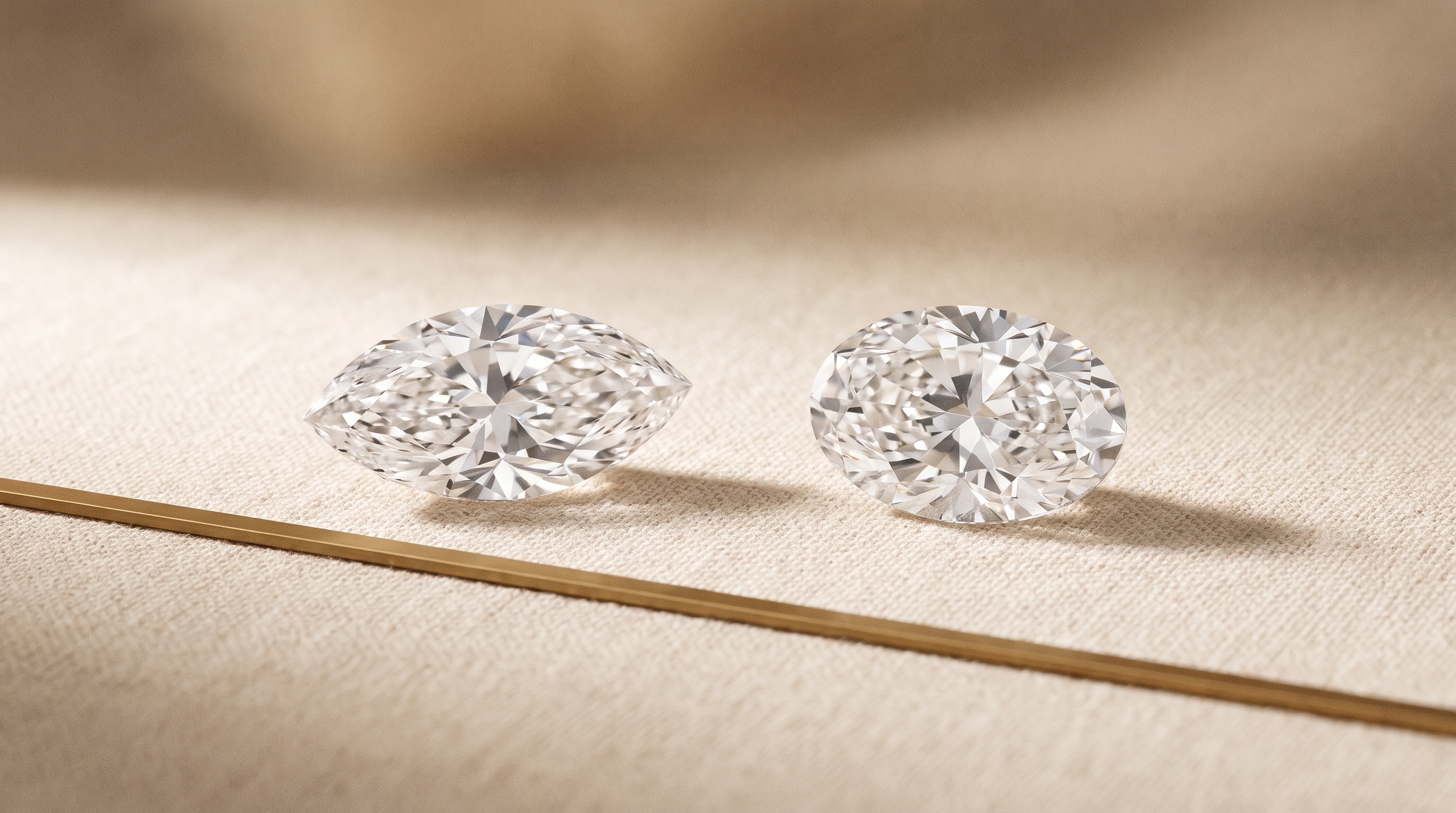
| Visual character | Pointed, boat-shaped outline; dramatic, elongated silhouette; reads vintage-forward and editorial | Fully rounded elongated outline; softer, more universally wearable silhouette |
| Light performance | High brilliance near the center; brightness can thin out toward the points if cut poorly | Strong, even brilliance across the stone; generally more forgiving of cut variation |
| Bow-tie risk | Higher — the pointed ends concentrate the effect and make it more visually obvious | Present but typically softer and less pronounced at comparable cut quality |
| Setting demands | Needs protective V-tip or double-prong protection at both points; point damage is a real risk in daily wear | Rounded ends set safely with standard prong or bezel styles; fewer weak points |
| Price tier | Guru Diam regular-fancy (mid-market) tier — priced on the 4Cs, not shape rarity | Guru Diam regular-fancy (mid-market) tier — priced on the 4Cs, not shape rarity |
| Best for | Statement rings, cocktail jewelry, buyers who want maximum visual drama per carat | Engagement rings, everyday wear, buyers who want broad customer appeal and easier resale |
What Is a Marquise Diamond?
A marquise (also spelled "marquis") is an elongated brilliant cut with two symmetrical points, one at each end, and gently curved sides in between — the classic "eye" or "boat" shape. Facet count typically runs 56–58, arranged in a brilliant pattern that radiates from the center out toward both points, similar in cutting logic to a round brilliant that's been stretched and pinched at the ends. The shape has a long trade history: it's popularly said to trace back to 18th-century France, commissioned to echo the shape of a smile — true or not, the name has stuck in the trade for centuries. What matters more for a wholesale buyer today is what the shape does on the finger: because it's elongated and comes to a point at both ends, a marquise diamond maximizes visual surface area per carat more aggressively than almost any other shape, which is why it's long been a favorite for buyers chasing "big look, smaller budget."Shape Profile and Facet Structure
Marquise cuts are judged heavily on symmetry — the two halves (split down the long axis) and the two ends (split down the short axis) need to mirror each other closely, or the stone reads visibly lopsided even to an untrained eye. Length-to-width ratio is the other major variable: a classic marquise sits around 1.75–2.25:1, though buyers increasingly ask for narrower or wider variations depending on the finger shape and setting style they're designing for.What Is an Oval Diamond?
An oval diamond is a modified brilliant cut — same 56–58 facet family as round and marquise — stretched into an elongated, fully rounded outline with no points anywhere on the stone. It was popularized in its modern brilliant form by cutter Lazare Kaplan in the 1960s, and it has spent the last several years as one of the most requested fancy shapes in bridal, largely because it delivers round-brilliant-style sparkle in a shape that looks larger and more elongating on the hand. Because an oval has no points, it doesn't carry the same structural weak spots as marquise, pear, or heart cuts. That single difference is a big part of why oval has become the safer, broader-appeal choice for buyers building an everyday-wear or bridal program rather than a statement-jewelry line.Shape Profile and Facet Structure
Oval length-to-width ratio typically runs 1.30–1.60:1 for what most buyers consider a "classic" oval — narrower ratios look closer to a rounded square, wider ratios look closer to marquise without the points. Cut quality on oval is judged on brilliance distribution and, like marquise, on bow-tie visibility, but the absence of hard points gives cutters more room to correct minor proportion issues without creating an obvious weak zone.Don't Confuse Marquise With Dutch Marquise (Hexagonal Marquise)
One naming mix-up worth flagging directly: "Dutch Marquise" (also called Hexagonal Marquise, or sometimes Rupee cut) is a completely different shape from the modern marquise this guide covers. Dutch Marquise is a trade nickname that maps to the hexagon brilliant — a true antique-tier cut in Guru Diam's taxonomy, alongside Old Mine, Old European, Moval, Lozenge, Kite, and Criss-Cut. The modern marquise covered in this guide sits in Guru Diam's regular-fancy (mid-market) tier, the same production and pricing category as oval, pear, cushion, and radiant — not the antique tier. If you're sourcing period-style or antique-inspired inventory specifically, ask for Dutch Marquise / Hexagonal Marquise by name so it doesn't get mixed up with standard marquise in a wholesale order.Brilliance and Light Performance
Both shapes are brilliant-cut, meaning they're faceted to maximize sparkle and fire rather than the broad flat flashes of a step cut like emerald or Asscher. In practice, the two shapes distribute that brilliance differently. Oval tends to show more even brilliance across its full face-up area. Because the outline is continuously curved, light re-enters and exits the stone in a more uniform pattern, and cutters have more flexibility to balance proportions without creating a visibly darker zone. Marquise brilliance is typically most intense through the broad center of the stone, tapering as it approaches the points. A well-cut marquise still reads bright end to end, but the points are inherently thinner sections of diamond, which means they can look slightly less lively than the belly of the stone — one more reason cut quality matters more on marquise than on more forgiving shapes.The Bow-Tie Effect Explained
The "bow-tie effect" is a dark, bow-tie-shaped shadow that can appear across the center of elongated diamond shapes — marquise, oval, pear, and marquise's antique cousins all show some version of it. It happens when facets in the middle of the stone don't return light back to the eye at the same angle as the rest of the stone, usually from depth or angle proportions that are slightly off. Every elongated shape has some bow-tie effect; the question is degree, not presence. On marquise, the points tend to funnel and concentrate light in a way that makes bow-tie shadows more visually obvious against the brighter belly of the stone. On oval, the fully rounded outline diffuses that contrast more evenly, so a comparable bow-tie effect often reads as softer or less noticeable. For a wholesale buyer, this means cut-quality grading matters more on marquise than it does on round or princess — face-up photos or in-person review before committing to inventory is worth the extra step, especially for larger carat weights where a bow-tie shadow is easier to spot.Carat Weight, Elongation, and Perceived Size
Both shapes owe their popularity partly to a simple optical fact: elongated shapes spread carat weight across more visible surface area than round or square shapes, so they face-up larger than their weight suggests. Marquise pushes this further than oval. Its narrower profile and pointed ends mean a marquise diamond can look meaningfully larger, finger-length-wise, than an oval or round of the same carat weight — part of why marquise has a long history as the "maximum drama per carat" shape in bridal and cocktail jewelry alike. Oval still outperforms round and square shapes on perceived size, just less dramatically than marquise. What oval buyers give up in raw size-per-carat, they gain back in a shape that reads clean and proportional across a wider range of finger types and ring styles — which is a large part of why oval has become the more broadly requested shape in current bridal demand.How to Evaluate Cut Quality When Buying Wholesale
A certificate tells a buyer color, clarity, carat, and a cut/symmetry grade — it does not show bow-tie severity, point sharpness, or how a stone actually reads face-up under normal light. That gap matters more on marquise and oval than it does on round, so it's worth building a short evaluation habit before committing to inventory, especially at larger carat weights or for a repeat wholesale order. For any elongated stone:- Ask for a face-up photo or short video under consistent, neutral lighting — not just the certificate scan — so bow-tie visibility and overall brightness can actually be judged
- Check the reported length-to-width ratio against the certificate, since two stones can carry the same carat weight and grading numbers but look noticeably different face-up
- For matched-pair or multi-stone orders, confirm ratio and outline consistency across the parcel, not just each stone individually — a mismatched pair is far more noticeable than one imperfect solitaire
- Both points should mirror each other in angle and sharpness; asymmetric points are a common flaw and are easier to spot in a photo than on a spec sheet
- Overly sharp, thin points increase chip risk before the stone is even set — a marginally softer point angle can be the more durable choice for a customer buying for daily wear
- Look for bow-tie visibility under normal indoor lighting, not just a loupe or microscope — a shadow that's invisible under a jeweler's light can still be visible to the customer wearing the ring
- Confirm the ratio matches what was ordered; "oval" covers a wide range from near-round to near-marquise, and a supplier's default cut can drift from a buyer's expectation without a stated ratio
Setting Security and Prong Protection
This is where the pointed-vs-rounded distinction has the most practical consequence for a jeweler. Marquise diamonds have two genuinely vulnerable points, and any setting that doesn't account for them is a chip risk in daily wear. Standard practice is a V-tip prong or double-prong at each point, distributing pressure across a wider contact area instead of concentrating it on the diamond's thinnest, weakest sections. A supporting basket underneath each point, or a halo that wraps the outline entirely, adds another layer of protection for customers who want the shape without babying the ring. Bezel settings on marquise need the same care — a thin, unprotected metal edge at the point does not hold up the way it does on the belly of the stone. Oval has no such structural liability. Its continuous curve sets safely in standard four- or six-prong styles, tension settings, halos, or bezels without needing specialized point protection, which simplifies both design and production for a manufacturer running volume. For any buyer building a custom ring program, this is a real cost and complexity difference, not just an aesthetic one — marquise mountings typically require more deliberate prong engineering, which is worth flagging to designers and customers up front rather than discovering after a stone chips in the field.Price Per Carat and Wholesale Tier
In Guru Diam's tier system, marquise and oval sit in the same category: regular fancy, mid-market — priced on the same 4Cs (cut, color, clarity, carat) basis as the rest of that tier, not marked up or down for shape rarity. Neither shape carries the antique-tier premium of cuts like Old European or Hexagonal, and neither is priced at round's commodity-tier baseline. Within the open market more broadly, per-carat pricing between marquise and oval tends to sit in a comparable range at equivalent 4C specs, with day-to-day movement driven more by current bridal demand trends and carat-weight retention during cutting than by any fixed shape premium. Oval has run stronger in bridal demand in recent years, which can tighten supply at popular carat weights; marquise demand skews more toward statement and antique-adjacent buyers, with steadier availability across sizes. Buyers should expect both to track rough market movement and cut-quality grading more than a fixed "shape A costs X% more than shape B" rule. Certification lab also factors into a wholesale quote, though it isn't a shape-driven variable — IGI, GIA, and GCAL each carry slightly different market positioning and buyer familiarity, and having all three available means a buyer can match certification to what their own customer base already trusts rather than being locked into one lab across an entire order.Which Shape Fits Which Buyer
Marquise fits a buyer who wants:- Maximum visual size per carat, for cocktail rings, statement pieces, or antique-revival styles
- A distinctive, editorial silhouette that stands apart from round and cushion-dominated cases
- Customers comfortable with — or specifically seeking — a more dramatic, less "safe" look
- Broad, everyday appeal for bridal and engagement programs
- A shape that resells and re-sets easily, since it avoids marquise's point-protection requirements
- Round-brilliant-style sparkle in an elongated, finger-flattering silhouette customers already recognize from current trend cycles
Sourcing Marquise and Oval Diamonds Wholesale
Guru Diam carries both marquise and oval in loose, CVD lab-grown inventory, certified through IGI, GIA, or GCAL depending on the stone and the buyer's preference — all trade-only, wholesale pricing, no HPHT anywhere in the catalog. Certified loose stones ship the same day from whichever coast has it on hand: New York before 6pm EST, Los Angeles before 4pm PST, so a jeweler placing a same-morning order isn't waiting a week on a shape that should be sitting in a case that afternoon. Browse current certified inventory in both shapes through cert diamonds. Both shapes are also available as matching pairs for earrings and side-stone work — a category where marquise's symmetry sensitivity and oval's bow-tie consistency both matter even more, since two stones need to visually mirror each other, not just look good individually. See matching pairs for current pair inventory. For buyers working in fancy color rather than white stones, marquise and oval are both available as calibrated fancy-color options through fancy color loose diamonds. For custom engagement ring builds — including the V-tip and double-prong protective settings marquise needs, or a clean halo/solitaire build for oval — Guru Diam finishes custom rings in 4–6 days, unbranded by default so jewelers can resell as their own line. Start a build through custom jewelry. Guru Diam runs as a single vendor across antique cuts, fancy shapes, fancy color melee, and finished jewelry, so a marquise-and-oval program doesn't require splitting orders across separate suppliers. New accounts can get set up through trade partner, and the full catalog structure — antique, regular fancy, round, and melee tiers — is laid out on the wholesale hub.Frequently Asked Questions
Is a marquise or oval diamond more expensive per carat?
Neither shape carries a fixed price premium over the other — both sit in the same mid-market fancy-shape tier and are priced on cut, color, clarity, and carat like any other stone. Day-to-day differences usually come down to current demand trends and cut quality rather than the shape itself.
Which shape looks bigger for the same carat weight, marquise or oval?
Marquise typically looks larger. Its narrower, pointed profile spreads carat weight across more visible surface area than oval's fuller, rounded outline, which is why marquise has a long reputation as a "maximum size per carat" shape. Oval still looks larger than round or square shapes at the same weight, just less dramatically than marquise.
Does an oval diamond have a bow-tie effect too?
Yes. Every elongated diamond shape — oval, marquise, pear, and others — can show some degree of bow-tie shadow across the center. Oval's fully rounded outline tends to diffuse that shadow more evenly than marquise's pointed ends, so it often reads as softer, but it isn't eliminated entirely on either shape.
Do marquise diamonds need special prongs to prevent chipping?
Yes. The two points on a marquise diamond are structurally thin and vulnerable to chipping in daily wear, so V-tip or double-prong protection at each point is standard practice. Oval has no equivalent weak point and sets safely in standard prong, bezel, or tension styles.
Is marquise considered an antique diamond shape?
No — at Guru Diam, standard marquise sits in the regular-fancy, mid-market tier alongside oval, pear, and cushion. It's easy to confuse with Dutch Marquise (also called Hexagonal Marquise), which is a different, antique-tier shape that actually maps to the hexagon brilliant cut. Ask for shapes by exact name when sourcing to avoid mixing the two up.
Which shape is better for an engagement ring, marquise or oval?
Oval is the more common engagement ring choice because it sets safely without specialized point protection and appeals to a broader range of customers and finger shapes. Marquise works well for buyers who want a more dramatic, distinctive look and are comfortable with a setting built specifically to protect its two points.