
A marquise cut diamond is an elongated brilliant shape with two pointed ends and curved long edges, sized to look larger per carat than almost any other shape and to visually lengthen the finger. Guru Diam stocks 249 marquise lab-grown diamonds, IGI-certified, CVD-grown, shipped same-day from New York.
What is a marquise cut diamond?
The marquise is a boat-shaped brilliant cut — smooth curved sides meeting at two sharp points, faceted like a round brilliant for maximum fire. Its elongated outline means a marquise reads noticeably bigger face-up than a round or cushion of the same carat weight, which is the shape's core commercial appeal for buyers who want size without the price tag of a heavier round stone.
Facet structure and light performance
A well-cut marquise carries the same brilliant-cut logic as a round diamond — a table facet, a ring of kite and star facets on the crown, and a pavilion of triangular facets below the girdle — just stretched and pointed to fit the elongated outline. Most marquise brilliants land in the 56–58 facet range, with two or four extra "half-moon" or kite facets clustered near each point to control how light escapes at the tips, where the outline goes from curved to sharp fastest. Because the girdle isn't a constant radius the way it is on a round stone, cutting a marquise well is a proportions problem in two directions at once — length-to-width and depth-to-width both have to land in range, or the stone either bellies out in the middle or goes dark and glassy toward the points.
Where the shape comes from
The marquise's other name in the trade is the navette — French for "little boat," which is a more literal description of the outline than "marquise" is. As the trade story goes, the cut was commissioned in 18th-century France to mirror the shape of a smile the court found particularly striking; whatever the origin, the boat-shaped brilliant has stayed in continuous production for roughly 250 years because the geometry does something no other shape does as efficiently: it stretches a given carat weight across more visible finger length than round, cushion, or princess cuts. That's a mechanical fact about the outline, not a marketing claim, and it's the reason the shape keeps cycling back into fashion every decade or so rather than disappearing like some other historical cuts.
Anatomy of a marquise: ratio, points, and the bow-tie effect
Three variables separate a well-cut marquise from a mediocre one, and none of them show up as a single number on a certificate the way a round brilliant's cut grade does.
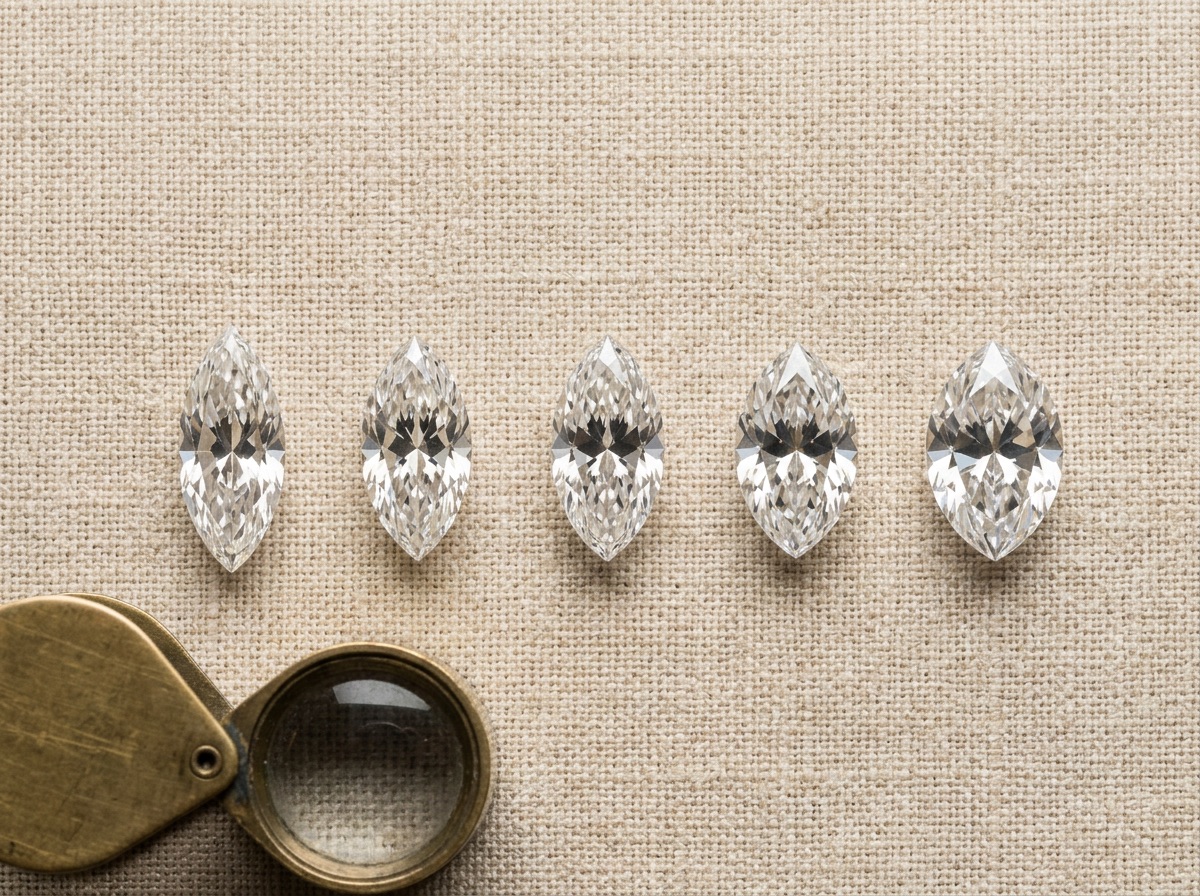
Length-to-width ratio. This is the single most important spec for how a marquise reads on the hand. A ratio in the roughly 1.75:1 to 2.25:1 range is generally considered the classic marquise silhouette — enough taper to read as elongated and pointed, not so much that the stone looks like a sliver. Buyers sourcing for a specific mounting style should ask for ratio explicitly; a 1.6:1 stone and a 2.4:1 stone are both technically "marquise" but photograph and wear very differently.
The points. The two tips are the structurally weakest part of any marquise, pear, or kite-shaped stone, and they're also where the cutter has the least room to correct for inclusions or off-center rough. A marquise with strong, symmetrical points commands a premium over one with a blunted or off-axis tip, independent of color and clarity grade.
Bow-tie effect. Every elongated brilliant shape — marquise, oval, pear, radiant — can show a bow-tie: a dark band across the widest part of the stone, caused by the viewer's own head and shoulders blocking light that would otherwise bounce back through the pavilion facets at that angle. It isn't a flaw on the certificate and it isn't graded, but it's highly visible in person and in video, and severity varies stone to stone based on pavilion depth and angle rather than color or clarity grade. This is the single most common reason a marquise looks different in a listing photo than it does in hand, and it's worth checking on video or in person before committing to a specific stone rather than relying on the cert alone.
Marquise vs. related shapes
| Spec | Marquise (brilliant) | Marquise Step Cut | Trillion |
|---|---|---|---|
| Outline | Boat-shaped, pointed ends | Boat-shaped, pointed ends | Triangular, rounded corners |
| Faceting | Brilliant, high fire | Step-cut, flatter flash | Brilliant |
| Best for | Center stone, statement rings | Alternative flatter-light look | Side stones, statement centers |
For the step-cut variant of this same outline, see our Marquise Step Cut guide. For fancy-color marquise stones across the full color palette, see Fancy Color Marquise.
The other shape marquise gets compared against constantly is oval. Both are elongated brilliants and both spread carat weight across more visible surface area than a round stone, but an oval has no points to protect and generally shows a milder bow-tie at the same proportions, which makes it the lower-maintenance sell for a buyer who wants elongation without the marquise's setting considerations. The marquise's advantage over oval is the pointed silhouette itself — it reads as more distinctly "vintage" or "statement" on the hand, and the points give a three-stone or east-west setting a sharper visual line than an oval's rounded ends allow. Jewelers stocking both shapes typically position oval as the safer everyday elongated cut and marquise as the shape a customer chooses specifically because they want the points.
How Guru Diam sources and cuts marquise diamonds
Guru Diam's marquise inventory starts as CVD-grown rough selected specifically for elongated fancy-shape yield — rough that will cut cleanly into a boat-shaped outline without excessive waste at the points. Cutting, faceting, and polishing happen in-house rather than through a jobbing cutter, which matters for a shape like marquise because the two points are where most of the value gets lost or preserved: an in-house cutter can adjust the cutting plan stone by stone to protect symmetry at the tips, where an outsourced high-volume cutting operation is optimizing for throughput across a mixed batch of shapes.
Every marquise leaving Guru Diam's cutting floor goes through symmetry and proportion review before it's added to on-hand inventory — length-to-width ratio, point alignment, and bow-tie visibility are checked visually in addition to whatever the eventual grading report captures, since (as covered below) a certification report doesn't assign an overall cut grade to fancy shapes the way it does to round brilliants. That in-house control is also what makes it possible to hold a live bench of 249+ marquise stones across a spread of ratios and sizes rather than a handful of one-off pieces.
Grading a marquise cut diamond
Color and the elongated outline
Elongated shapes like marquise, pear, and oval tend to show body color more readily than a round brilliant of the same grade, because the pavilion is shallower relative to the stone's overall footprint and the color has less material to travel through before it reaches the eye — except concentrated at the points, where the reverse happens and color can pool visibly if the grade runs low. For a marquise meant to read bright and colorless, most wholesale buyers stay in the D–H range; stepping down to I or J is a legitimate cost lever for larger carat weights, but it shows up faster on a marquise than it would on a round stone of the same grade, particularly right at the tips.
Clarity and where inclusions matter most
Clarity placement matters more on a marquise than the grade number alone. An inclusion sitting under the table on a round brilliant might be all but invisible at VS2; the same inclusion positioned near one of the marquise's points, where facets are smaller and light travels differently, can be considerably more noticeable. Buyers evaluating stones for retail resale should ask for a plot or a clear image rather than grading on the number alone, especially for stones in the SI range.
Fluorescence on an elongated shape
Fluorescence gets flagged more often on step cuts than on brilliants, but it's still worth a quick check on marquise, particularly at larger carat weights. Strong blue fluorescence can occasionally read as a faint milky or oily haze under certain lighting, and because a marquise's crown facets are broader near the center than a round's, that haze — when it shows up at all — is marginally more visible there than it would be on a smaller-faceted round stone of the same fluorescence grade. It's a minor consideration relative to color, clarity, and cut, but worth a look in person for anything above 1.50ct destined for a client who'll be examining the stone up close.
Cut grade — why there isn't one
GIA and IGI both assign an overall cut grade — Excellent through Poor — to round brilliants, based on decades of light-performance modeling for that one shape. Neither lab extends that same overall grade to fancy shapes, marquise included; a marquise report will show individual polish and symmetry grades but not a single rolled-up cut grade. That's not a gap in the grading system, it's a reflection of how many valid proportion combinations exist for a fancy shape — a marquise cut for maximum brilliance looks different from one cut for maximum face-up size, and both can be legitimate "good cuts" depending on what the buyer wants. In practice this means length-to-width ratio, symmetry grade, and a visual check for bow-tie and point strength do the job that a single cut grade does for round stones.
Carat weight and face-up size
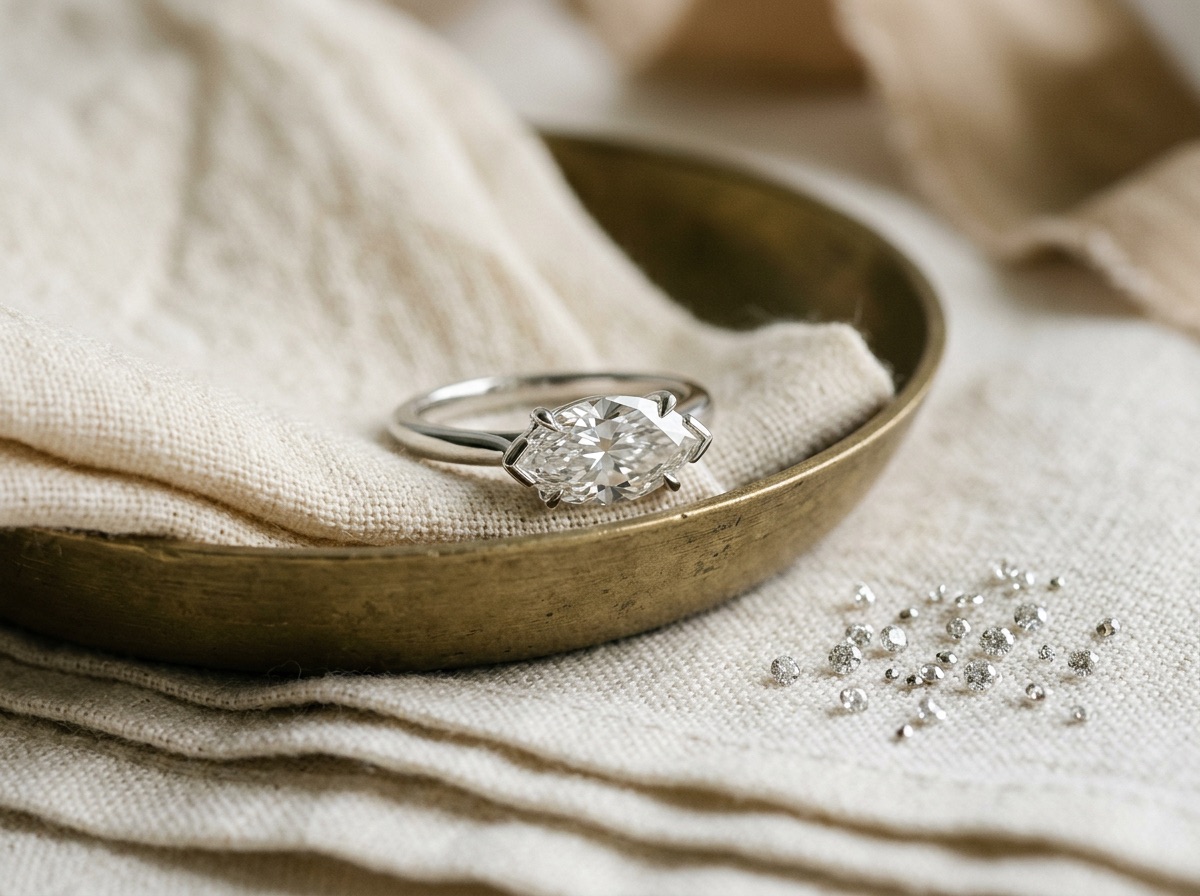
The marquise's headline commercial advantage is spread: because the outline is elongated rather than circular, a given carat weight covers more visible finger length and more table-facing surface area than the same weight in round, cushion, or princess. As a rough trade reference at a classic ~2:1 ratio, a 1.00ct marquise runs approximately 10mm x 5mm, a 1.50ct runs approximately 11.5mm x 5.75mm, and a 2.00ct runs approximately 12.5mm x 6.25mm — figures that shift with ratio, so two stones of identical carat weight can differ meaningfully in visible length depending on how elongated the cut is. For a buyer or their retail customer optimizing for apparent size at a given budget, this is the shape's whole pitch: a 1.50ct marquise can visually outsize a 1.75–2.00ct round for a lower total-carat cost, which is the framing that tends to close the sale at retail.
Pricing factors for wholesale marquise diamonds
Beyond the standard 4Cs, three marquise-specific factors move price at wholesale. Length-to-width ratio in the classic 1.75–2.25:1 range commands a premium over stones that fall outside it, since off-ratio marquise stones are harder to place with retail buyers and typically get discounted to move. Point symmetry — whether the two tips are aligned on the same axis and cut to matching sharpness — is checked stone by stone and priced accordingly; a marquise with a visibly off-axis or blunted point sells at a discount regardless of its color and clarity numbers. And bow-tie severity, while not a certificate line item, is priced into any stone a buyer has actually seen on video or in person — a marquise with minimal bow-tie at a given ratio and depth combination will move faster and hold price better than one with a heavy dark band across the center.
Relative to round brilliants of comparable color, clarity, and carat weight, fancy shapes as a category generally trade at a discount per carat — but marquise narrows that discount compared to shapes like oval or cushion, because the two acute points make cutting and polishing more labor-intensive and increase breakage risk during production. Buyers should expect marquise to price closer to round than the fancy-shape discount they might see on ovals or cushions of similar quality.
Ratio also interacts with price in a way that's easy to underestimate when quoting off a spec sheet alone. Two marquise stones of identical carat weight, color, and clarity can differ by a meaningful margin per carat purely on ratio and point quality — a stone at 1.70:1 with soft points prices below one at 2.00:1 with sharp, symmetrical tips, even though nothing on the color or clarity line changed. Buyers quoting jobs sight-unseen from a spec sheet should always confirm ratio and ask for a photo or video before finalizing price, rather than assuming two "marquise, same 4Cs" stones are interchangeable.
Matched pairs for earrings
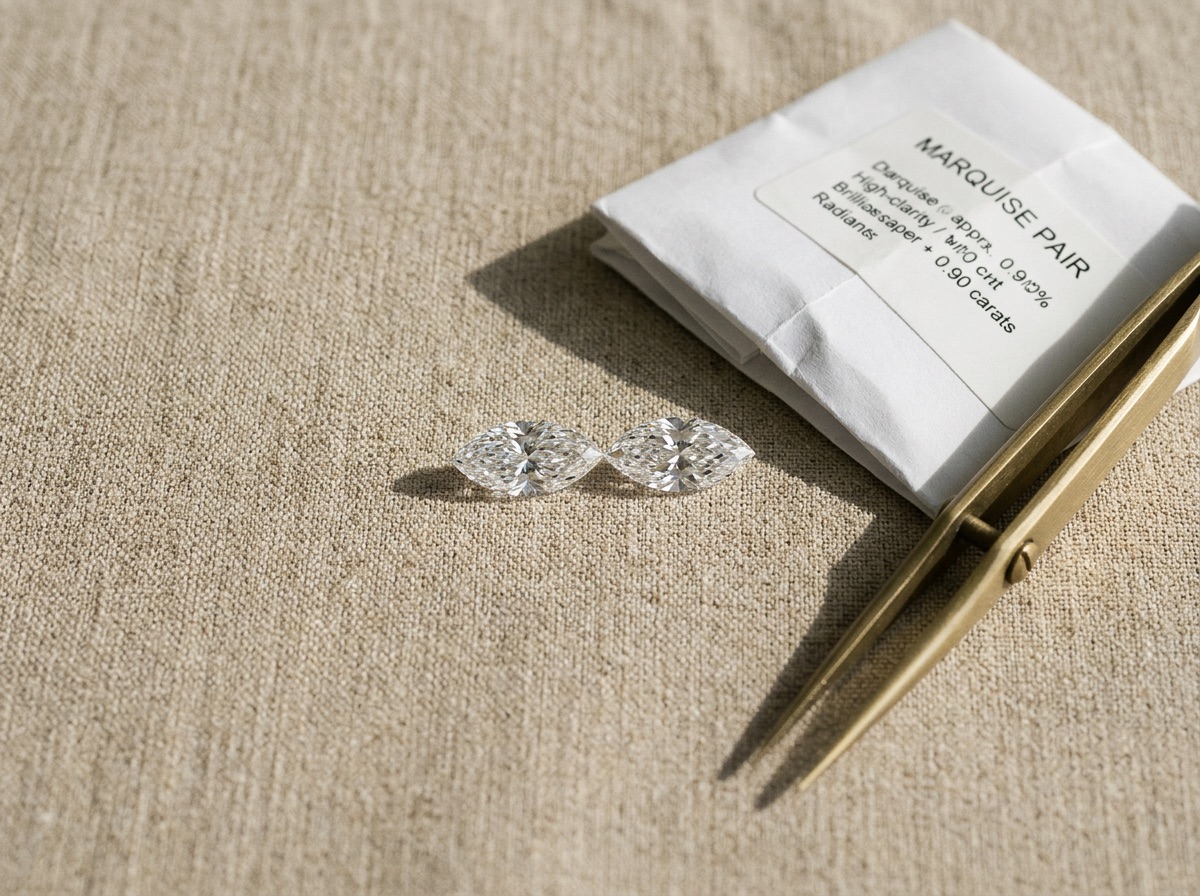
Marquise is a common earring shape — drops, studs, and huggies all use it — and matched-pair sourcing is where the shape's proportion sensitivity matters most. Two marquise stones can each individually grade well and still make a visibly mismatched pair if their ratios differ by even a small margin, since a slightly stubbier stone and a slightly more elongated one sit differently on the ear even at identical carat weight. Wholesale buyers sourcing pairs should request stones matched on ratio and point alignment, not just on color, clarity, and total carat weight — a pair matched only on the certificate numbers can still read as mismatched once it's mounted and worn. Guru Diam pulls matched pairs directly from on-hand marquise inventory rather than cutting to order, which keeps pair-matching turnaround tied to what's already in stock rather than a new cutting run.
Setting and styling guidance for jewelers
Protecting the points
The points are the shape's one real handling liability, and it's worth flagging to retail customers at the point of sale rather than after a prong bends. V-prongs or double-prong tip protection at both ends is the standard fix — a V-prong cradles the point across its full width rather than pinching it from one side, which is where chips most often originate. Bezel-tipped mountings solve the same problem more conservatively for customers who wear rings hard.
East-west and solitaire mounts
The classic north-south solitaire remains the highest-volume marquise setting, but east-west mounting — turning the stone sideways across the finger — has held steady as a strong secondary request, particularly for customers who want the elongation to read as a horizontal statement rather than a lengthening effect on the finger itself. Both orientations use the same stone; it's purely a mounting decision, which makes marquise an easy shape to offer in both configurations from the same on-hand inventory.
Three-stone and halo configurations
Three-stone settings pairing a marquise center with round or trapezoid side stones are a consistent seller because the side stones visually reinforce the elongated line rather than competing with it. Halo settings serve a more practical function on marquise specifically — a ring of small round melee tracing the outline adds perceived size and, just as importantly, gives the two points a visual anchor that reduces how exposed they look in a plain solitaire prong setting.
Marquise melee and side stones
For jewelers building three-stone, halo, or cluster pieces around a marquise center, Guru Diam also carries marquise as a calibrated fancy melee shape, alongside round, emerald, radiant, and pear, in the 0.8mm–9.0mm range at a DEF+/VS+ quality baseline, CVD-grown. Melee shapes ship as uncertified parcel goods rather than individually or parcel-certified stones — that's standard for the category, not specific to Guru Diam, and it's worth flagging to retail customers who might expect a certificate on side stones the way they'd expect one on a 0.50ct+ center stone. Marquise center stones at 0.30ct and above are certified individually (IGI standard, GIA and GCAL available), which is the meaningful line to draw for customers asking why their center stone has paperwork and the side stones don't.
Sourcing and buying guide
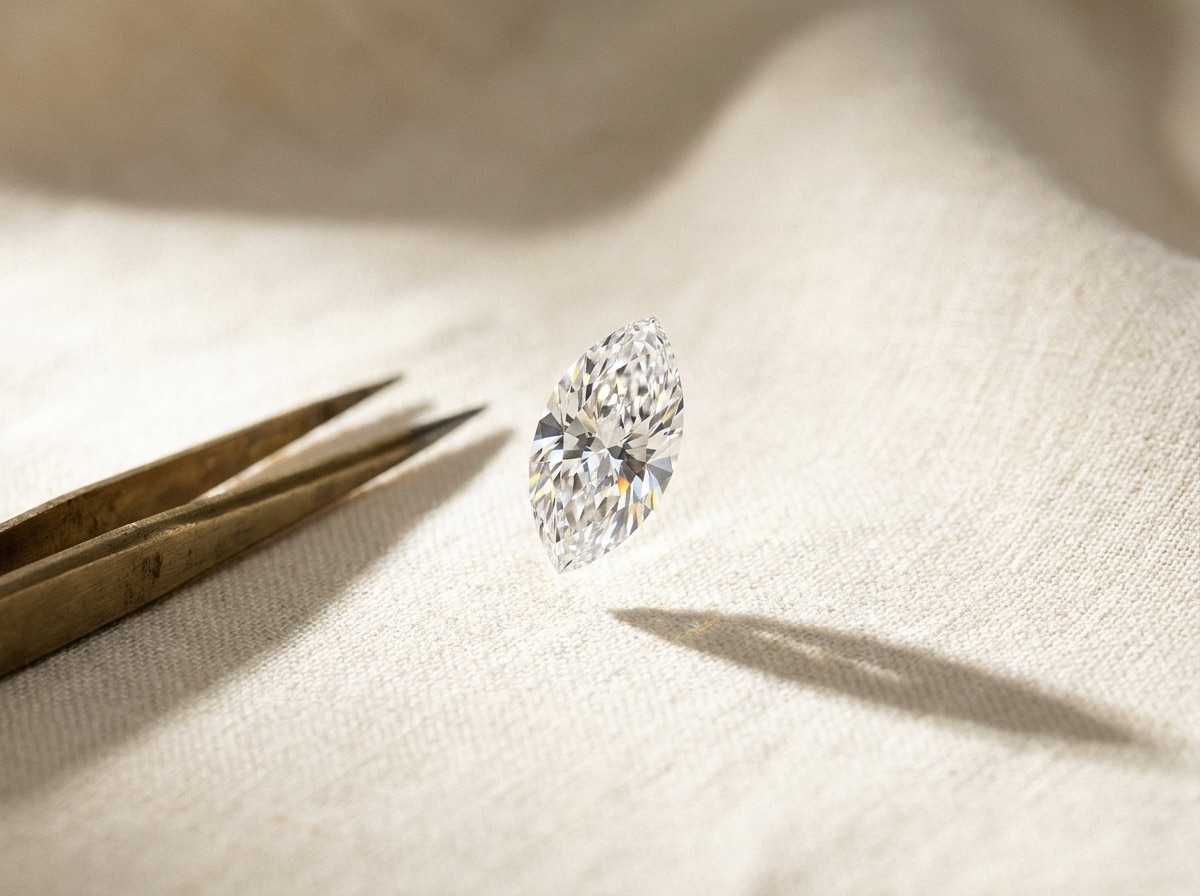
The points are the marquise's main handling risk — confirm prong protection at the tips before setting, and check bow-tie visibility (a shadow effect across the center) when comparing stones, since it varies stone to stone regardless of grade. Guru Diam's 249 on-hand marquise stones are IGI-certified as standard, GIA available on request, cut in-house from CVD rough.
Ready to buy? Open a verified wholesale account at /signup and book time with a gemologist at /book-appointment.
How to order marquise diamonds wholesale from Guru Diam
Guru Diam sells trade-only — a verified wholesale account is required before pricing and inventory are visible, which keeps the platform limited to independent jewelers, designers, and manufacturers rather than retail shoppers. Once an account is active, marquise loose stones are on-hand inventory, ready to ship same-day out of either coast: New York same-day before 6pm EST, Los Angeles same-day before 4pm PST. Certification is flexible across the three labs the trade actually uses — IGI standard, GIA and GCAL available on request — so a buyer supplying a retailer that only accepts one specific lab isn't stuck reordering. For jewelers who want to see a marquise in hand before committing to a specific stone for a client piece, booking time with a gemologist is the fastest way to compare ratio, point symmetry, and bow-tie side by side rather than working from photos alone. Buyers building a full order across multiple shapes and colors benefit from the same consolidation that applies across Guru Diam's catalog generally — one vendor, one shipment, one relationship, rather than splitting a single job across several suppliers because no one carries the full spread of antique cuts, fancy shapes, fancy color, and melee needed for one piece.
Frequently Asked Questions
What is a marquise cut diamond? A marquise is an elongated brilliant-cut diamond with two pointed ends and curved sides, designed to maximize apparent size and finger coverage relative to its carat weight.
Is marquise cut available lab-grown and certified? Yes. Guru Diam's marquise inventory is CVD-grown and IGI-certified as standard, with GIA available on request, sourced from live NYC Diamond District stock.
What should I check before buying a marquise diamond? Check the bow-tie effect (a light/dark banding across the center, varies stone to stone) and confirm the point-protection on the prong setting, since the tips are the most vulnerable part of the shape.
How is marquise different from marquise step cut? Standard marquise uses brilliant faceting for maximum fire; the step-cut version uses flat, broad facets for a different, more subdued light pattern on the same boat-shaped outline.
What length-to-width ratio should I ask for on a marquise? Most buyers target roughly 1.75:1 to 2.25:1 for the classic marquise silhouette. Stones outside that range are still technically marquise but read either stubby or overly slender on the hand, so it's worth specifying ratio rather than carat weight alone when sourcing for a specific mounting.
Can Guru Diam supply marquise melee for pavé or halo work, not just center stones? Yes. Marquise is available as a calibrated fancy melee shape in the 0.8mm–9.0mm range at a DEF+/VS+ baseline, CVD-grown, shipped as uncertified parcel goods alongside round, emerald, radiant, and pear melee — separate from the individually certified 0.30ct+ center-stone inventory.