
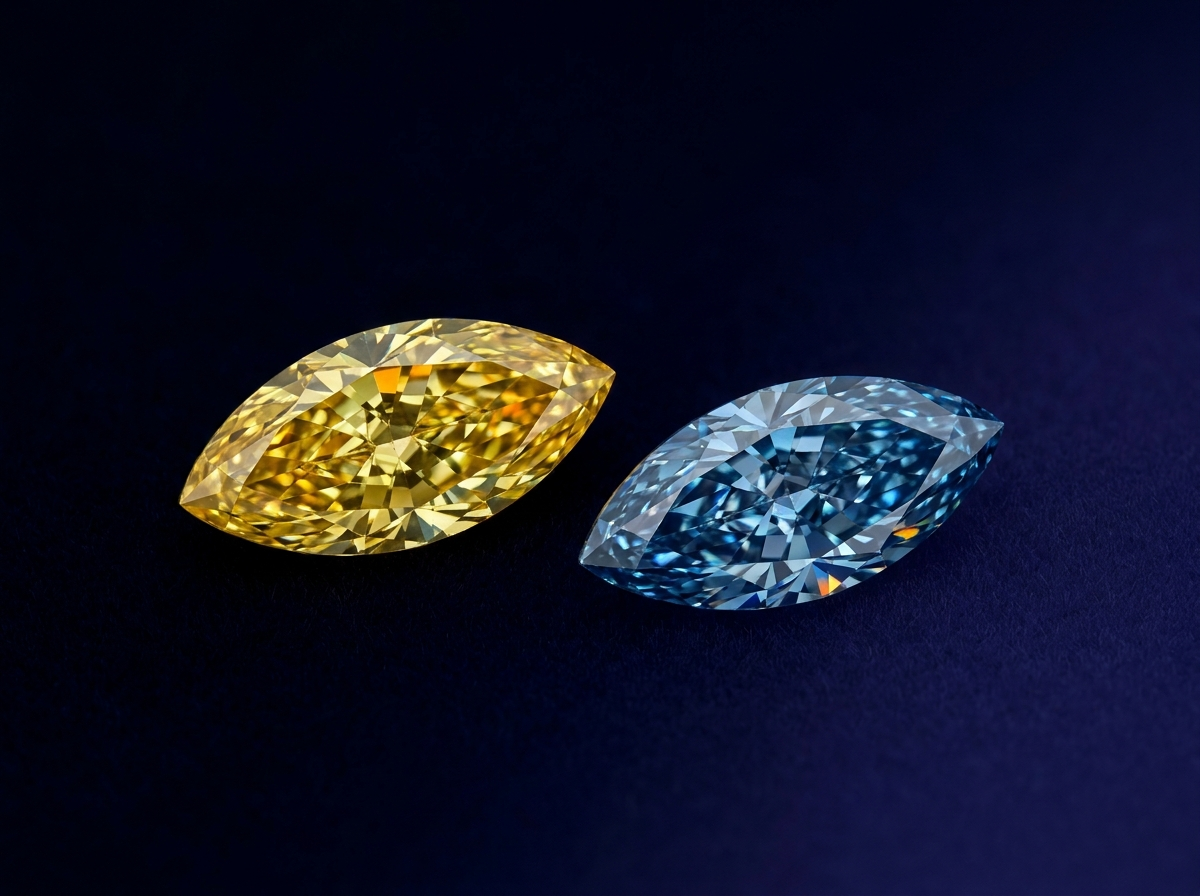
A fancy color marquise is an elongated, boat-shaped lab-grown diamond with two pointed ends, cut in an intentional hue rather than graded colorless. The elongated shape spreads color across more visible face-up area than a round of the same weight, and concentrates it noticeably toward the points. Guru Diam stocks 15 IGI-certified, CVD-grown fancy color marquise pieces, across yellow, pink, blue, and green.
What Makes a Marquise Cut Diamond "Fancy Color"?
The marquise diamond cut is one of the oldest brilliant-faceted outlines in the trade: an elongated oval body tapering to two symmetrical points, faceted with the same kite- and triangle-shaped brilliant pattern used on a round, rather than the parallel step facets of an emerald or asscher. That brilliant faceting is what lets a marquise handle color at all — a brilliant cut breaks light into many small flashes rather than the broad, mirror-like planes of a step cut, and each of those flashes carries the stone's body color with it. Cut colorless, a marquise is judged on how little color shows. Cut fancy, the same faceting becomes the mechanism that spreads color across the whole face-up surface instead of trapping it in one place.
"Fancy color" is a separate grading track from the familiar D-to-Z colorless scale. Once a diamond's body color is saturated enough to fall outside the Z range, GIA and IGI stop grading it for the absence of color and start grading it for the presence of one — hue, tone, and saturation, covered in detail below. For lab-grown stones, fancy color is simply a diamond grown and cut to show that saturated color on purpose, rather than a colorless stone that happened to pick up a tint. Guru Diam's fancy color marquise inventory spans the full locked palette — yellow, pink, blue, and green — CVD-grown and IGI-certified as standard, with GIA certification available on request.
Shape also does real optical work here. At a given carat weight, a marquise reads visibly larger face-up than a round or cushion of the same weight, because its surface area is stretched along one axis instead of concentrated in a compact outline — more color-bearing surface sits in front of the eye, which is exactly what a fancy color buyer is paying for. The marquise outline runs a keel-shaped pavilion under a table cut with kite and triangle facets radiating out toward each point — the same faceting arrangement whether the goal is showing no color or showing a specific one.
How Fancy Color Is Produced in Lab-Grown Diamonds
Color in a CVD lab-grown diamond starts inside the growth chamber, not after the fact. Chemical vapor deposition builds a diamond crystal layer by layer from a carbon-rich gas; introduce controlled trace elements into that gas alongside the carbon, and they lock into the crystal lattice as the stone grows. Nitrogen incorporation is associated with yellow tones, boron with blue, and specific lattice-level structural features with pink and green hues. The color is a property of the crystal itself, grown in, not a coating or surface effect — which is why it holds up under polishing and repolishing the same way any diamond's body color does.
Guru Diam's fancy color marquise stones are CVD-grown across the full color range — there's no separate growth process for a colored stone versus a colorless one, just a different, deliberately controlled set of growth conditions. Once the rough is grown, the resulting hue, tone, and saturation are fixed properties of that specific stone, which is why every piece gets independently graded rather than sold against a blanket color claim for the batch. That grading — covered fully in the sections below — is what turns "this looks yellow" into a verifiable, certificate-backed color grade a wholesale buyer can actually transact on.
This matters more for a wholesale buyer than it might seem at first. Because the color is a growth-stage property rather than something applied afterward, it doesn't fade, shift, or need special handling during setting, sizing, or repair the way a surface treatment would. A retail client asking "will this color last" gets a straightforward answer: it's the same body color the stone will show for as long as the diamond itself exists, which is a much easier thing to stand behind at the point of sale than a claim about a coating holding up over time.
Why Marquise Suits Fancy Color: Marquise vs. Cushion vs. Pear
Not every fancy-color shape shows saturation the same way, and the difference comes down to where each cut's facets send light. A marquise's tapering points create longer internal light paths near the tips than through the broader middle of the stone — color visibly pools and deepens right at those points. In a colorless marquise that same effect reads as an unwanted shadow and gets penalized in cut grading. In a fancy color stone, it's an asset: it draws the eye straight to the most saturated part of the diamond and makes a light-to-medium saturation grade look more intense face-up than the certificate alone would suggest.
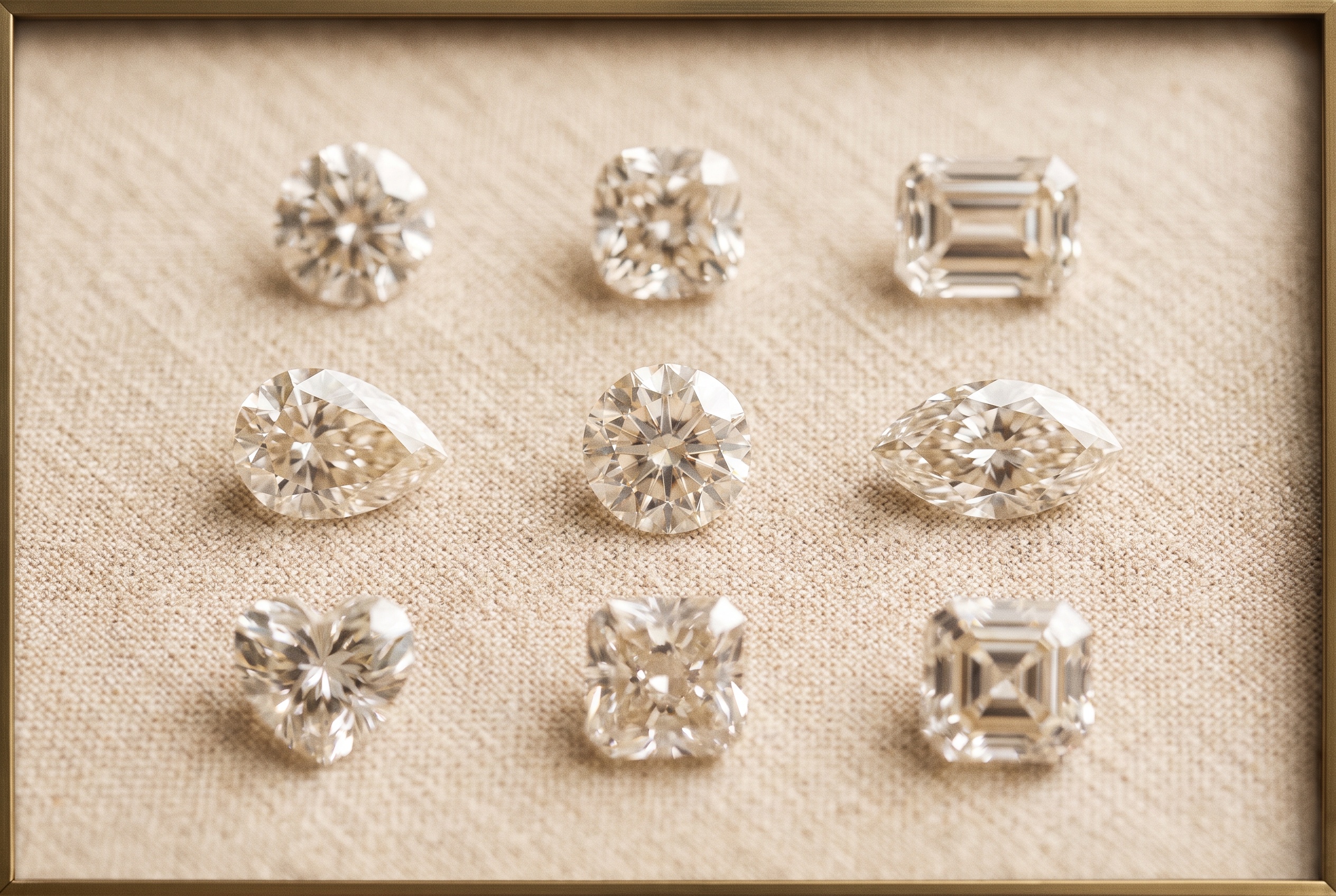
Pear shares the marquise's single-point light-pooling behavior on the tip end, but only on one side rather than two, so the color concentration effect is present but less pronounced. Cushion runs the opposite way: its larger, blockier facets and rounded outline spread light more evenly across the whole face-up area, producing a softer, more uniform color wash rather than a concentrated hot spot. That makes cushion a strong choice for a buyer who wants even, consistent color coverage, while marquise and pear suit buyers who want the color to visibly intensify toward a focal point.
| Shape | Facet style | Color behavior | Bow-tie tendency | Best for |
|---|---|---|---|---|
| Marquise | Brilliant | Color pools at both points | Present, often pronounced | East-west settings, dramatic single stones |
| Pear | Brilliant | Color pools at the single point | Present, moderate | Pendants, asymmetric drop earrings |
| Cushion | Brilliant (modified) | Even wash across the face | Minimal to none | Halo settings, uniform-color requests |
None of this makes one shape objectively better than another — it makes them different tools. A buyer chasing maximum apparent saturation from a modest color grade reaches for marquise or pear; a buyer who wants a fancy color stone to read as evenly, quietly colored across the whole surface reaches for cushion.
Grading Fancy Color: Hue, Tone, and Saturation Explained
Fancy color diamonds are graded on three separate axes, and understanding each one matters more for a wholesale buyer than memorizing the colorless D-to-Z scale ever did. Hue is the color name itself — yellow, pink, blue, green, or a modifier combination like "brownish yellow." Tone is how light or dark that color reads, independent of intensity. Saturation is the strength or purity of the color — how much of the visual field the hue actually occupies versus how washed-out or muted it looks.
GIA and IGI both use a scale of intensity terms that combine tone and saturation into a single graded label: Faint, Very Light, Light, Fancy Light, Fancy, Fancy Intense, Fancy Dark, Fancy Deep, and Fancy Vivid, in roughly ascending order of strength (Fancy Dark and Fancy Deep sit at the darker-toned end rather than the most saturated end). "Fancy Vivid" is the strongest, most saturated grade a lab issues and commands the most attention in any given hue. A stone's full color grade on a report reads as all three pieces together — for example, "Fancy Intense Yellow" or "Fancy Vivid Pink" — and that combination is what actually determines how the stone looks in hand, not the hue name alone.
| Intensity term | General strength |
|---|---|
| Faint / Very Light / Light | Color present but muted, closer to the colorless range |
| Fancy Light / Fancy | Clearly colored, moderate strength |
| Fancy Intense / Fancy Vivid | Strongest, most saturated, most sought-after |
| Fancy Dark / Fancy Deep | Darker-toned rather than more saturated |
For a marquise specifically, the shape's point-concentration effect means a stone graded Fancy or Fancy Intense can visually punch above its certificate — the color reads stronger at the tips than the average saturation across the whole stone would suggest on paper. That's useful to know when comparing a marquise against a round or cushion carrying the same lab-stated grade.
Certification and What to Check When Buying Fancy Color Marquise Wholesale
A fancy color report carries more line items than a standard colorless certificate, and a wholesale buyer should read past the headline color name to those details. The report should state hue, tone, and saturation as a combined intensity grade (not just "yellow," but "Fancy Intense Yellow"), plus color distribution comments — whether the hue reads even across the stone or concentrates unevenly, which matters more on an elongated shape like marquise than on a round. Clarity, measurements, and a length-to-width ratio should all be listed alongside the color grade, since ratio directly affects how the stone will sit in a setting.
Symmetry gets checked differently on a marquise than on a round brilliant. The two points should mirror each other in angle and length, the outline should be free of "dog-ears" or bulges at the shoulders, and the keel line running the length of the stone's underside should sit straight rather than off-axis. A marquise with uneven points is far more visually obvious than a symmetry flaw on a round stone, because the eye tracks straight to those tips — the same feature that makes marquise show color so well also makes it show a cutting mistake just as clearly.
Bow-tie effect deserves a specific look rather than a passing mention. It's the dark or shadowed band that can appear across the center of elongated brilliant shapes, including marquise, where light exits through the pavilion instead of reflecting back up. A moderate bow-tie is normal and not a defect on its own, but a severe one can visually cut the stone in half and interrupt the color's continuity from tip to tip — worth assessing in hand or via video before committing to a wholesale purchase, not just from the certificate.
It's also worth confirming the report itself is genuine and current before finalizing a wholesale order — both GIA and IGI maintain online report lookup by certificate number, and a quick cross-check against the issuing lab's own database confirms the grade on paper matches what's actually on file, not just what's printed on the stone's parcel paper. Guru Diam issues IGI reports as standard on its fancy color marquise inventory, with GIA certification available on request for buyers who need it.
Pricing Factors for Fancy Color Marquise Wholesale Buyers
Color intensity is the single biggest price driver in any fancy color diamond, marquise included — a jump from Fancy to Fancy Intense to Fancy Vivid in the same hue moves the stone into a different pricing tier well before carat weight or clarity enter the conversation. Hue itself matters too: some colors occur less often at high saturation than others, which shows up in relative pricing across a supplier's stock even at the same intensity grade.
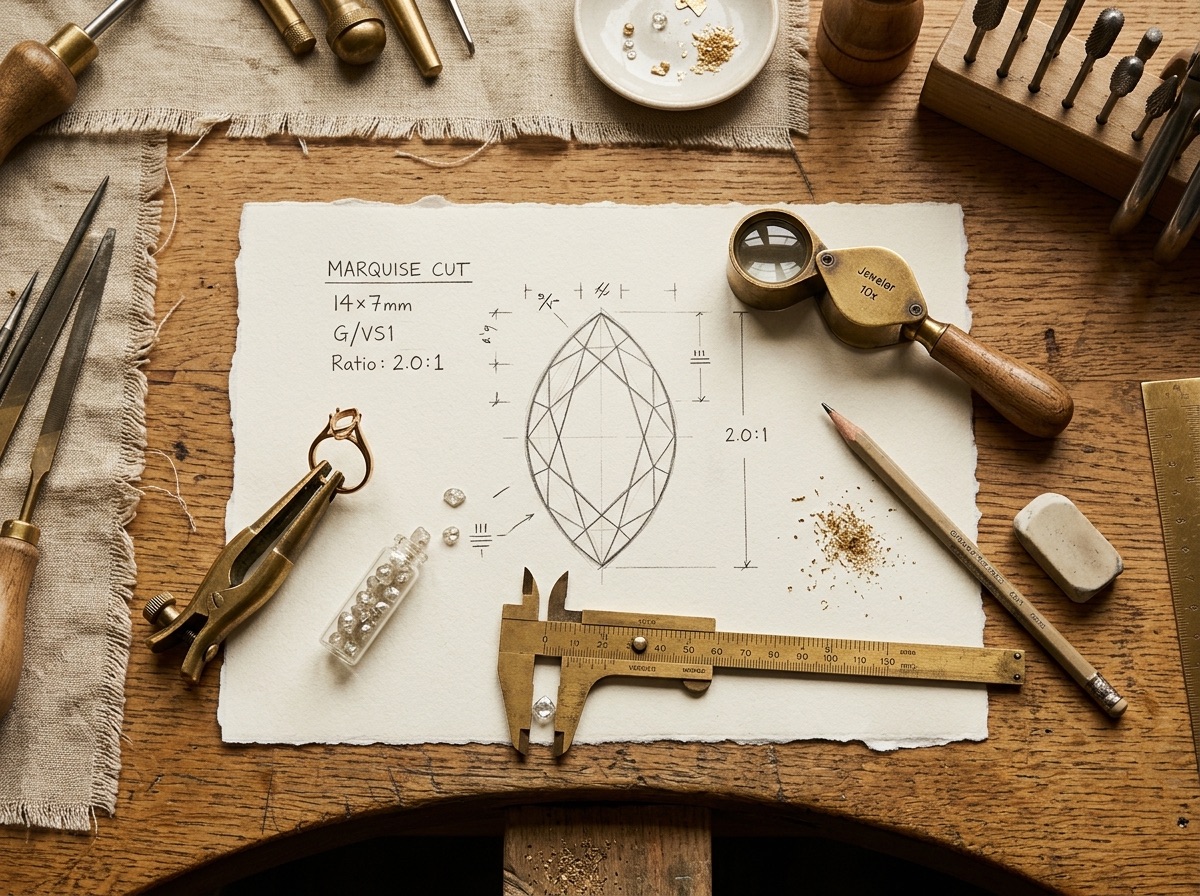
Length-to-width ratio is a marquise-specific factor that doesn't apply the same way to rounds or cushions. A ratio in the 1.75–2.25 range is generally considered the classic, most saleable proportion for a marquise; stones that run noticeably shorter and stubbier or longer and narrower than that window can be harder to place in a standard setting and often price differently as a result, independent of the stone's actual color quality. Carat weight scales price the way it does on any diamond, but because marquise reads larger face-up than other shapes at the same weight, buyers sometimes get more visual size per carat than the raw weight number implies.
Clarity plays a smaller role in fancy color pricing than it does on a colorless stone — a saturated body color can mask minor inclusions that would matter more on a white diamond, so color grade and cut symmetry tend to carry more weight in a wholesale buyer's evaluation than clarity alone. Point symmetry and bow-tie severity, covered above, function as pricing factors in practice even when they aren't broken out as a separate line item on the certificate.
Hue itself carries a market-wide pricing hierarchy that holds across both natural and lab-grown fancy color — pink and blue routinely command the steepest premiums even in lab-grown form, yellow sits in a more moderate middle tier, and warmer tones like champagne sit at the accessible end of the range. That hierarchy is useful context for a wholesale buyer building a program across multiple hues: it explains why two marquise stones with identical carat weight and similar intensity grades can land in very different price brackets once hue enters the picture.
Best Jewelry Applications for Fancy Color Marquise Diamonds
An east-west marquise cut ring — set sideways across the finger instead of point-to-point along it — is one of the most requested settings for a fancy color marquise, because turning the stone horizontally puts its full length, and the color concentrated at both points, directly in the wearer's line of sight. It's a strong differentiator for a retail client looking for a marquise cut ring that reads differently from the traditional lengthwise mount.
Halo settings work especially well on fancy color marquise centers: a ring of smaller accent stones around the perimeter both frames the elongated outline and adds perceived size and brightness around the color, which helps a lighter saturation grade look more substantial in the metal. Statement pendants take advantage of the same face-up size advantage that makes marquise attractive in rings — the elongated drop shape naturally suits a vertical pendant setting and keeps the point-concentrated color oriented toward the viewer.
Matched marquise pairs remain a standing request for color-focused drop earrings, cut to hold a consistent hue and saturation across both stones so the pair reads as a set rather than two similar-but-different diamonds. When specifying marquise cut diamond settings for any of these applications, prong placement at the points matters more than it does on a round — the two tips are the most fragile part of the stone and the most visually prominent, so a setting needs to protect them without covering the very feature the buyer is paying to show off.

Sourcing Fancy Color Marquise Diamonds Wholesale from Guru Diam
With 15 pieces on hand across the color palette, fancy color marquise carries enough breadth to cover most standard hue and size requests, with made-to-order cutting available for anything outside current stock — including matched pairs cut to hold the same hue and saturation across both stones. When placing a wholesale order, buyers should come with more than "fancy color marquise" as the spec: naming the target hue, the intensity grade range (Fancy versus Fancy Intense versus Fancy Vivid), a preferred length-to-width ratio, and whether the piece needs to match an existing stone all narrow the search to something Guru Diam can fill quickly from stock or route to cutting.
| Spec | Detail |
|---|---|
| Outline | Elongated, pointed at both ends (boat-shaped) |
| Facet style | Brilliant |
| Typical L:W ratio | 1.75–2.25 |
| Color palette | Yellow, Pink, Blue, Green |
| Growth method | CVD-grown |
| Certification | IGI standard; GIA available on request |
| Stone type | Certified single stones (not melee) |
| On-hand count | 15 pieces |
Guru Diam sources fancy color marquise diamonds as wholesale, trade-only inventory — no retail markup — from our New York Diamond District desk (36 West 47th Street, Suite 601A) and our Los Angeles office (607 South Hill Street). In-stock pieces ship same-day; a custom setting runs CAD-to-finished-piece in 4–6 days.
Because the four-color palette spans everything from the accessible end of the market to the premium pink and blue end, it's worth confirming up front which hue range a given order needs to stay within, especially for a retail client shopping across a price ladder rather than committing to one specific stone. Pairing that hue conversation with the intensity grade and L:W ratio detail above gives a much faster path to matching an order against current stock versus routing it to made-to-order cutting.
Buying Checklist: Red Flags for Wholesale Fancy Color Marquise Buyers
Before committing to a fancy color marquise purchase, it's worth running through a short list of the places a stone can quietly underperform its certificate:
- Severe bow-tie: a shadow band strong enough to visually split the stone into two halves and interrupt the color's flow between the points.
- Uneven point symmetry: tips that differ in angle, length, or sharpness from each other, or a keel line that runs off-center.
- Color zoning: patches of noticeably stronger or weaker color within the same stone rather than an even distribution, which a certificate's headline grade won't always flag on its own.
- L:W ratio outside the usable range: a stone well outside 1.75–2.25 can be harder to set and resell than the color grade alone would suggest.
- Vague or missing intensity grading: a report or listing that names a hue ("yellow") without a tone/saturation intensity term ("Fancy Intense Yellow") is withholding the information that actually drives price and appearance.
- Growth method and certification not disclosed up front: any wholesale fancy color stone should come with a clear growth method statement and a named certifying lab before price is even discussed.
None of these are reasons to avoid fancy color marquise as a category — they're the specific, checkable details that separate a stone that performs the way its certificate promises from one that technically matches the grade but disappoints in hand.
Frequently Asked Questions
Why does marquise show color so strongly toward the points?
Light travels a longer path near a marquise's tapering points than through its broader middle, so color visibly pools and deepens right at the tips. In a colorless marquise that same effect reads as an unwanted shadow; in a fancy color stone it draws the eye to the most saturated part of the diamond.
Are fancy color marquise diamonds lab-grown, and are they certified?
Yes. Guru Diam's inventory is CVD-grown and IGI-certified as standard, with GIA certification available on request, in yellow, pink, blue, and green.
Can I get a matched pair of fancy color marquise diamonds?
Yes. Matched marquise pairs are a standing request for color-focused drop earrings, cut to hold a consistent hue and saturation across both stones.
How fast can I get a fancy color marquise stone or a finished custom piece?
In-stock pieces ship same-day from New York. Made-to-order cutting plus a finished custom piece runs 4–6 days from our New York and Los Angeles desks.
How is a fancy color marquise graded differently from a colorless marquise?
A colorless marquise is graded on the D-to-Z scale for how little color it shows. A fancy color marquise is graded on hue, tone, and saturation instead, combined into an intensity term like Fancy Intense or Fancy Vivid — the grading goal flips from minimizing color to describing it precisely.
What settings work best for a fancy color marquise center stone?
East-west settings and halo settings are the most requested for fancy color marquise: east-west turns the stone sideways to put its full length and point-concentrated color in view, while a halo frames the outline and adds perceived size and brightness around the color.
Related Articles
- Lozenge Diamonds Wholesale Guide
- Fancy Color Heart Diamonds Wholesale
- Matched Pair Step Cut Diamonds Wholesale