
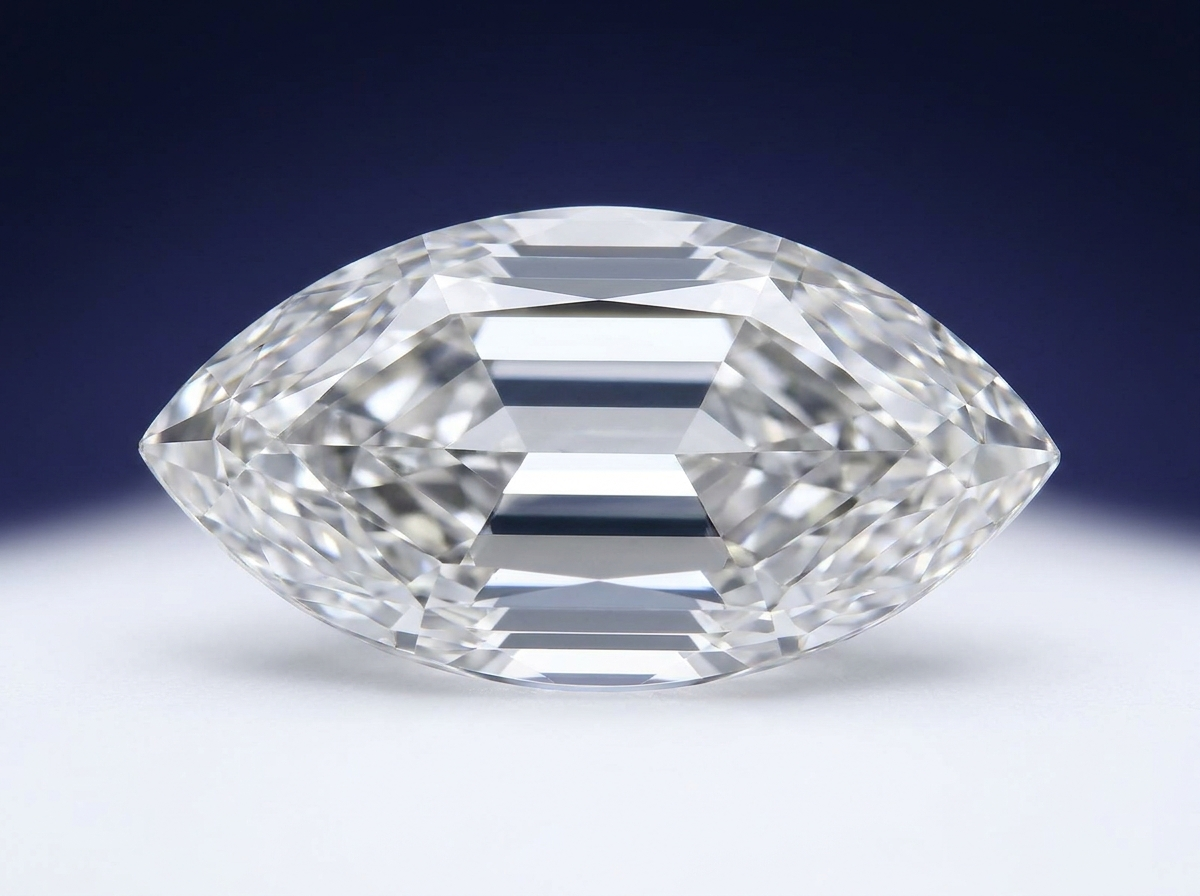
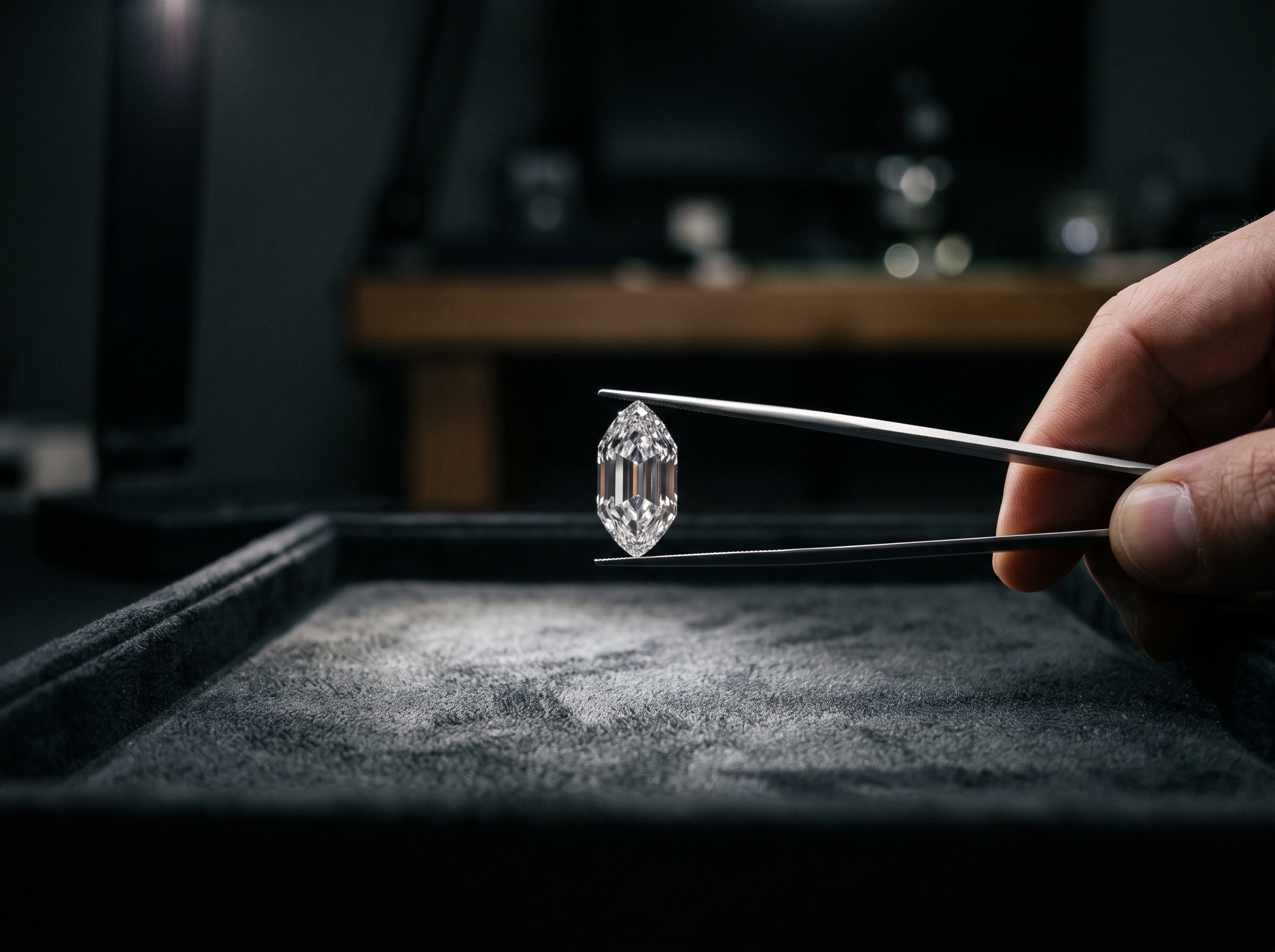
A Marquise Step Cut diamond keeps the marquise's pointed-oval outline but replaces standard brilliant faceting with broad, flat step facets — trading the marquise's usual fire for a quieter, more geometric "hall of mirrors" light pattern. Guru Diam stocks 9 Marquise Step Cut diamonds on hand, CVD lab-grown, IGI-gradable on request. ON-HAND INVENTORY — READY TO SHIP.
What a Marquise Step Cut Diamond Is
Every marquise diamond shares the same outline: an elongated shape with two symmetrical points, wider through the middle and tapering to a sharp tip at each end — sometimes called a navette (French for "little boat") in older trade literature. What changes between cutting styles is the faceting applied over that outline, and that's where "step cut" comes in.
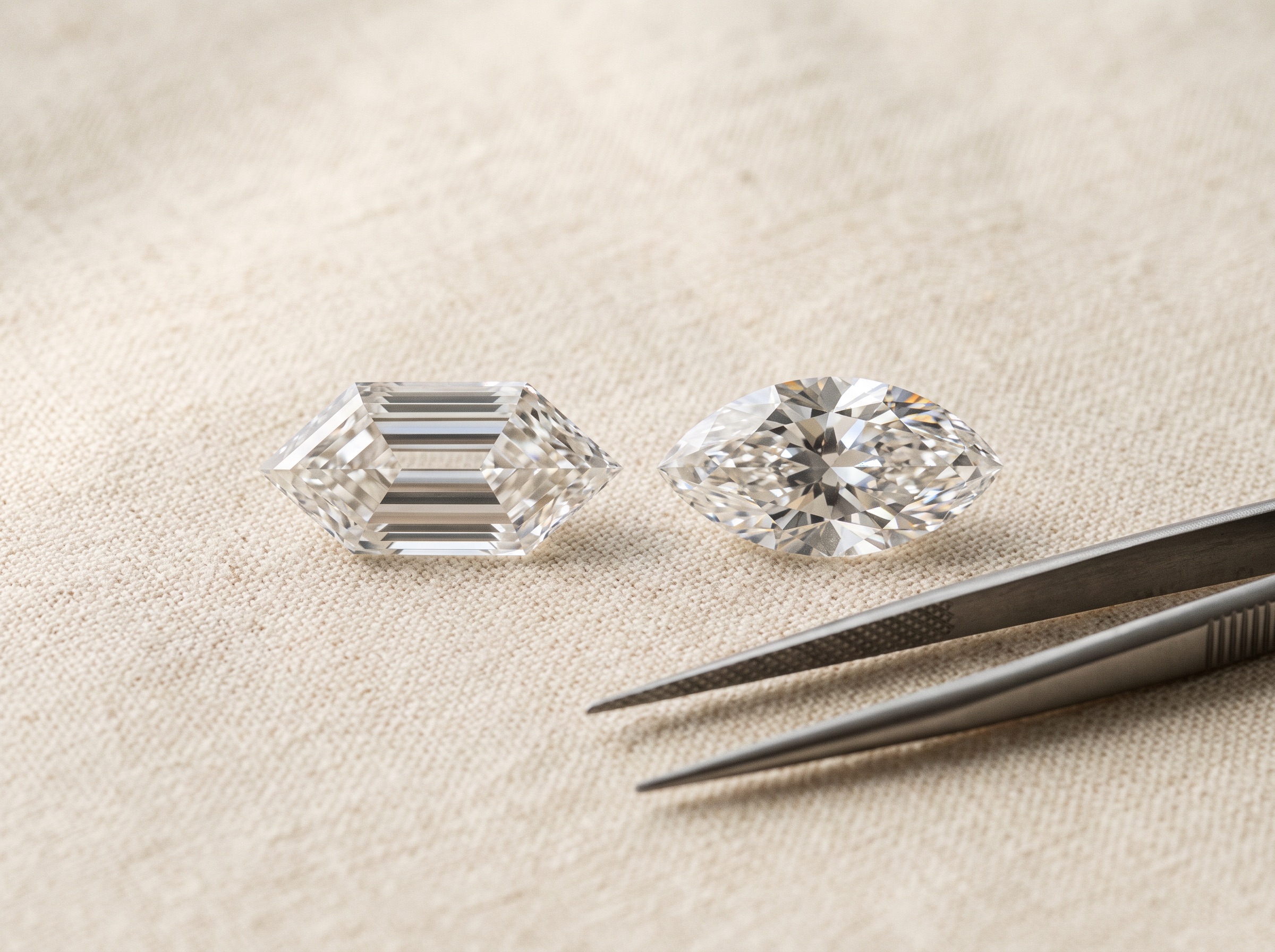
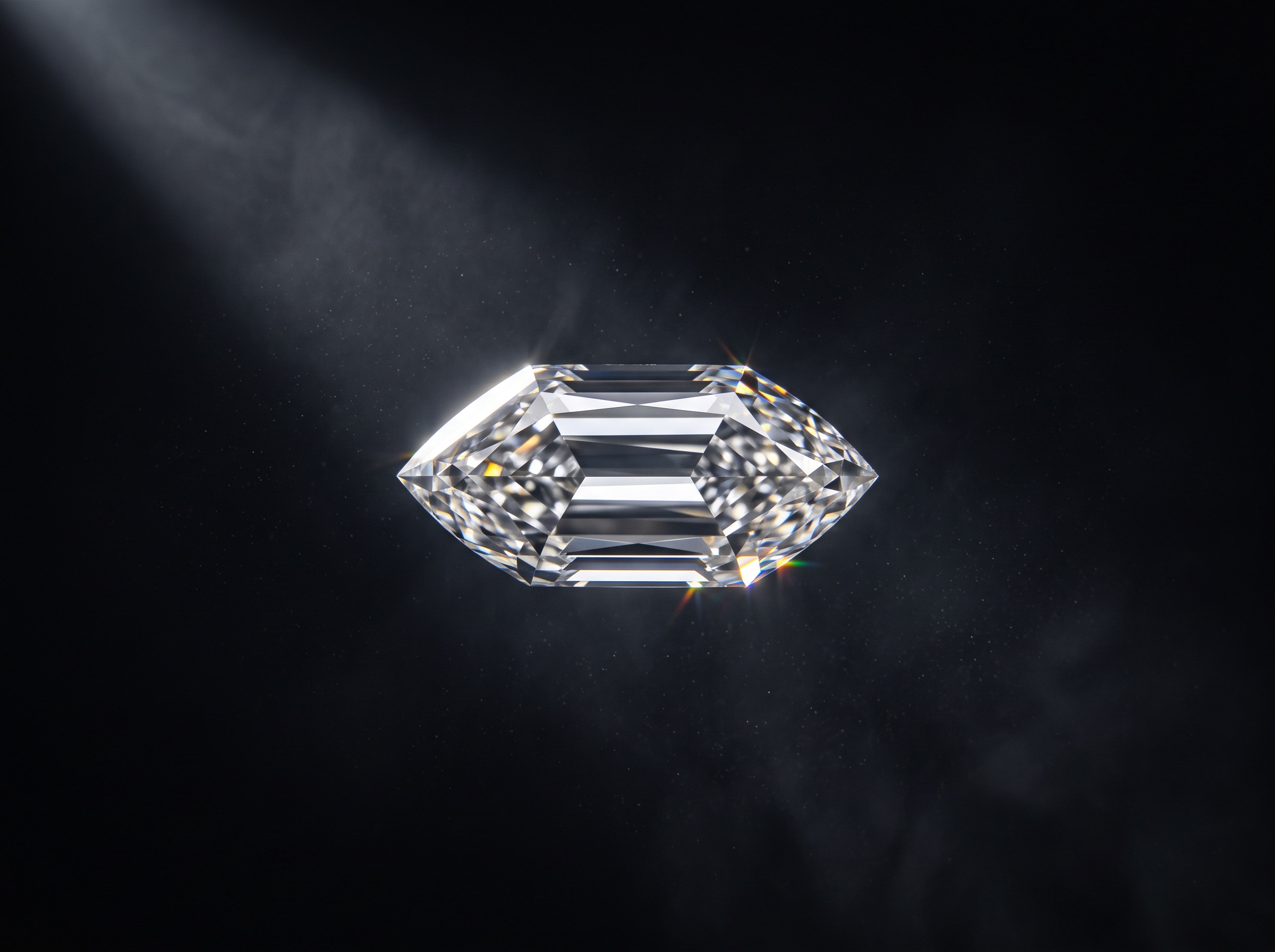
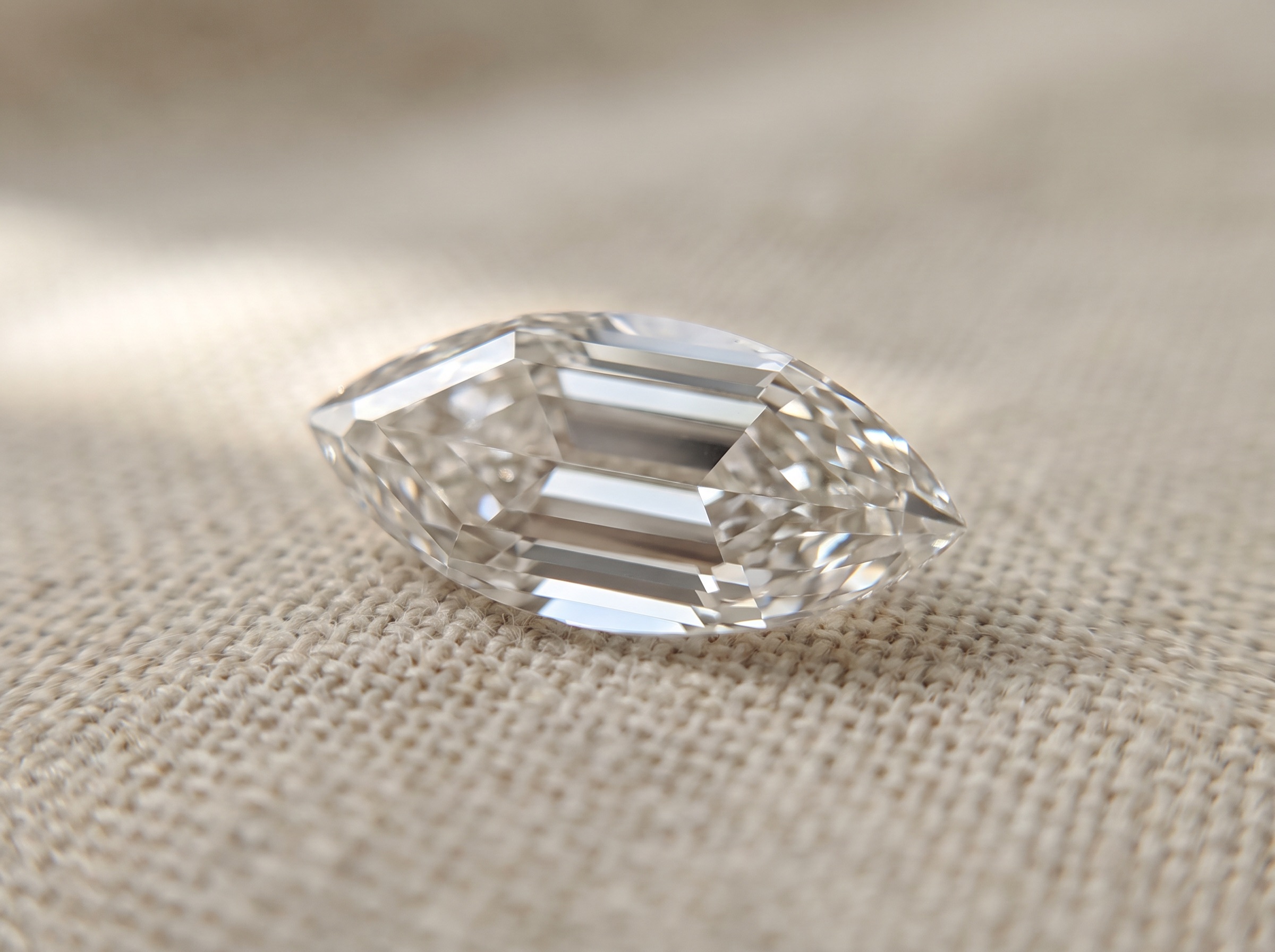
Standard marquise diamonds are cut as brilliants: dozens of small, kite- and triangle-shaped facets angled to bounce light back out in scattered flashes of fire and scintillation. A Marquise Step Cut keeps the identical pointed-oval silhouette but facets it in broad, flat, parallel bands instead — the same faceting logic used on emerald and baguette cuts, adapted to a shape that tapers to two points rather than running as a straight rectangle. The result reads differently in the hand: less flash, more clarity of reflection. Instead of a busy field of tiny sparkles, the eye sees large, mirror-like planes of light — what cutters describe as a "hall of mirrors" effect, where the stone's internal clarity is more visible because there are fewer facets breaking up the view straight down into it.
It's a specialty item, not a catalog staple. Most marquise diamonds moving through the wholesale trade are brilliant-cut; step faceting on a marquise outline is a request that comes from buyers who specifically want the geometric look rather than a substitute for what's already available in brilliant form.
Facet Anatomy: Step Faceting vs. Brilliant Faceting
The difference between the two faceting styles is structural, not cosmetic. A brilliant-cut marquise typically carries somewhere in the 56–58 facet range, arranged as kite and triangle shapes radiating out from the culet toward the girdle on the pavilion, and from the table toward the girdle on the crown — the same arrangement logic used on a round brilliant, stretched to fit a pointed-oval outline. Each small facet is angled independently to maximize the amount of light returned to the eye as scintillation.
A step-cut marquise replaces most of that facet field with rows of trapezoids and long rectangles running parallel to the girdle, stacked like stair steps up the crown and down the pavilion — hence "step cut," and its older trade name, "trap cut." Because each step facet is large and flat relative to a brilliant facet, a step-cut stone typically carries a meaningfully lower facet count than its brilliant-cut counterpart, even at the same carat weight.
The marquise outline makes this harder to execute than a rectangular step cut like an emerald or baguette. On a rectangle, the parallel step rows run straight from one end to the other. On a marquise, every row has to taper cleanly into both points without breaking the parallel logic or leaving a visible seam — which is part of why marquise step cuts take longer to cut correctly and why supply stays thin across the trade generally, not just at any one supplier.
Marquise Step Cut vs. Standard Marquise Brilliant
| Attribute | Marquise Step Cut | Marquise Brilliant |
|---|---|---|
| Outline | Pointed oval | Pointed oval |
| Faceting | Broad, flat, parallel step facets | Many small kite and triangle brilliant facets |
| Approximate facet count | Lower — broad steps replace clusters of small facets | ~56–58, typical of brilliant faceting |
| Light behavior | Large geometric flashes, "hall of mirrors" | Scattered fire and sparkle |
| Clarity visibility | More visible — fewer facets to hide inclusions | Less visible — facet pattern breaks up the view |
| Bowtie effect | Can read more visibly, since less scintillation masks it | Present but softened by scattered brilliance |
| Typical use | Vintage/Art Deco-style settings, clarity-forward buyers | General bridal and fashion settings |
Both are cut from the same rough, priced from the same carat-weight and quality inputs, and graded on the same 4Cs framework — the deciding factor is purely which light-return character a buyer is after. Neither is "better"; a jeweler stocking bridal fashion in volume wants brilliant marquise for the fire, while a jeweler building an Art Deco revival or geometric-minimalist line wants the step-cut version specifically because it reads quieter and more architectural.
Marquise Step Cut vs. Emerald, Baguette, and Other Trap-Cut Shapes
Step faceting isn't unique to the marquise outline — it's a faceting family applied across several shapes, and buyers sourcing a Marquise Step Cut are often also working in the same family for side stones or complementary pieces.
- Emerald cut — the rectangular, cut-corner reference point for step faceting. Same parallel-row logic, no points to taper around, which is why emerald cuts are the easiest step-cut shape to source and the benchmark buyers compare against.
- Baguette — a small, straight-sided rectangular step cut, almost always used as a side stone or eternity-band component rather than a center stone. Baguettes pair naturally with a Marquise Step Cut center in a three-stone or eternity build, since both share the same flat, geometric light behavior.
- Trapezoid / trap-cut side stones — step-faceted trapezoids, common as shoulder stones flanking a fancy-shape center. "Trap cut" as a trade term originally referred to this trapezoid shape specifically, though it's since become a loose synonym for step faceting generally, including on a marquise.
- Radiant / princess (mixed cuts) — for context: these combine brilliant faceting on the pavilion with a step-cut crown, a hybrid approach. A Marquise Step Cut is a full step cut top to bottom, not a hybrid.
Buyers building a cohesive line often move between these shapes deliberately — a step-cut marquise center with baguette or trapezoid shoulders reads as one designed family rather than mismatched parts.
Why the Trade Calls This a Trap Cut
"Trap cut" is the older, more precise trade term for step faceting — it describes the trapezoidal shape of the individual facets themselves, not any single outline. A trap-cut marquise, a trap-cut emerald, and a trap-cut trapezoid side stone are all describing the same faceting family applied to different outlines. "Step cut" has become the more common consumer-facing term, but buyers sourcing wholesale will hear both used interchangeably, and it's worth knowing they mean the same thing when a customer or designer specs it either way.
The look has a specific lineage: step faceting on elongated and rectangular shapes is closely associated with Art Deco jewelry design, where the flat, architectural light pattern matched the geometric, symmetry-forward aesthetic of the period. That association is why step-cut marquise demand skews heavily toward vintage-inspired and Art Deco revival settings rather than mainstream bridal fashion — buyers requesting this cut usually already know the aesthetic they're building toward.
How Guru Diam Sources and Cuts Marquise Step Cut Diamonds
Guru Diam's Marquise Step Cut inventory is CVD lab-grown, cut in-house. Cutting a clean step-cut marquise isn't a repeatable template the way a round brilliant or a standard marquise brilliant is — every stone requires the cutter to hand-fit the parallel step rows around the two points without breaking symmetry, which means more skilled labor time and more rough lost to achieve a clean result. That's the core reason this stays a specialty, low-volume item across the trade rather than something any supplier holds deep stock of.
Guru Diam holds a small on-hand count of finished Marquise Step Cut diamonds rather than deep inventory, consistent with how alternative-faceting specialty items are handled across the catalog generally — antique cuts and other rare-faceting shapes follow the same on-hand-rather-than-deep-stock model. What's listed as available is genuinely on hand: IN STOCK NOW, not a cut-to-order promise with an open-ended wait.
Grading and Quality Considerations for Step-Faceted Marquise Diamonds
Clarity matters more here than on a brilliant-cut equivalent
Because step facets act like a hall of mirrors — showing more of the stone's interior rather than breaking the view into scattered brilliance — inclusions that would be effectively invisible under brilliant faceting can be visible under step faceting. Buyers sourcing step-cut goods generally shop a clarity tier higher than they would for the equivalent brilliant cut: an SI clarity that hides cleanly under a brilliant-cut marquise's facet pattern may show under a step-cut version of the same stone. VS2 and above is the safer starting point for step-faceted center stones.
Color reads differently at the points
Step-cut stones tend to be shallower toward the tapering ends than a brilliant cut of the same outline, which means body color can concentrate and become more visible near the points. Buyers building a step-cut marquise into a piece where the points are prominently set — an East-West single-stone setting, for instance — often size up on color grade for the same reason emerald-cut buyers do: fewer facets to break up and disguise tint.
No single cut grade — proportions and symmetry instead
One thing worth knowing before ordering: GIA and IGI don't assign a single overall cut grade to fancy shapes like marquise, step-cut or brilliant. Cut grade as a single "Excellent/Very Good/Good" score is a round-brilliant-only grading feature. What a cert on a marquise step cut will show instead is measurements, proportions, and a symmetry/polish assessment — the buyer (or their cutter) has to evaluate whether the length-to-width ratio, point symmetry, and step-row alignment actually look right, rather than relying on a single grade to do that work. A classic marquise outline generally reads best in a length-to-width ratio between roughly 1.75:1 and 2.25:1 — narrower reads stubby, wider starts to look fragile at the points, and that guidance holds whether the faceting is brilliant or step-cut.
The bowtie effect
Elongated shapes — marquise, oval, pear — are prone to a "bowtie," a dark, bowtie-shaped shadow across the width of the stone where light leaks out through the pavilion instead of reflecting back to the eye. It's a function of the elongated outline itself, not a defect exclusive to step cutting. But because step faceting produces less overall scintillation to help visually mask it, a bowtie can actually read more noticeably on a step-cut marquise than on a brilliant-cut one of similar proportions. It's worth a visual check (in person or via video) on any step-cut marquise before committing to a purchase, the same way a buyer would check a brilliant-cut marquise or a pear shape.
Certification: IGI, GIA, and GCAL on Marquise Step Cut Stones
Guru Diam works with all three major labs used in the lab-grown trade — IGI, GIA, and GCAL — and Marquise Step Cut stones are gradable through any of them on request. IGI is the standard default for lab-grown certification volume; GIA and GCAL are both available where a buyer's end customer specifically wants that lab's report. What the cert documents on a fancy shape like this: carat weight, color grade, clarity grade, measurements (length, width, depth), and a proportions/symmetry/polish assessment — not a single overall cut grade, per the grading note above. Buyers reselling to end customers who ask "is it certified" can answer yes across any of the three labs; which one to request is a matter of which report format the end buyer expects.
What Drives Wholesale Pricing on Marquise Step Cut Diamonds
A handful of factors separate Marquise Step Cut pricing from a standard marquise brilliant of the same carat weight and color/clarity grade:
- Cutting labor and yield. Hand-fitting parallel step rows around two tapering points takes more skilled cutting time than repeating a brilliant facet template, and the process sacrifices more rough to hit clean symmetry. Both add cost relative to a brilliant-cut marquise from the same rough.
- Clarity tier. Because step faceting shows more into the stone, buyers typically shop a clarity grade higher than they would for an equivalent brilliant cut — and clarity is one of the steeper cost curves in the 4Cs, so that one shift compounds pricing more than it would on a brilliant-cut purchase.
- Rarity and low turnover. This is a thin-supply specialty item industry-wide, not a stocked-deep staple — scarcity plays into wholesale pricing the way it does on any low-volume specialty cut.
- Carat weight, same as any fancy shape. Price scales non-linearly with carat weight, and larger step-cut marquise stones carry a steeper premium than the equivalent jump in brilliant-cut goods, simply because larger rough suitable for a clean step-cut result is harder to source.
Guru Diam doesn't publish list pricing on specialty on-hand stones — pricing is live and quoted per stone to trade accounts, since inventory at this tier moves in single units rather than repeatable batches. Open a wholesale account for current pricing and availability on what's on hand right now.
Styling and Resale Guidance for Jewelers
A few things worth knowing before putting a Marquise Step Cut in front of a customer or building it into a design:
- Point protection is non-negotiable. Both marquise points are the most vulnerable part of the stone in any setting, and step faceting doesn't add the small facet edges near the tip that help disguise a minor chip the way brilliant faceting does. V-prong or bezel-tip protection at both points isn't optional — it's standard practice for any marquise, and it matters more here.
- It's an Art Deco and geometric-minimalist fit first. The flat, mirror-flash light pattern reads as architectural rather than sparkly, which is exactly why buyers request it — lean into that with clean-lined, symmetry-forward settings rather than trying to make it read like a brilliant-cut alternative.
- East-West setting is a strong showcase. Setting the stone horizontally rather than point-to-finger is increasingly popular for marquise generally, and it photographs well specifically because it shows the full width of the step-facet pattern rather than foreshortening it.
- Baguette or trapezoid side stones complete the family. Since both share step faceting, a three-stone build with baguette or trapezoid shoulders reads as one cohesive design rather than mismatched cutting styles — see the step-cut family comparison above.
- Eternity or wedding-band pairing. A step-cut eternity band (baguette or straight-baguette style) is the natural pairing for a step-cut marquise engagement piece — same faceting family, same light behavior, sold and built as one product category under Guru Diam's eternity/wedding band line.
- Set-to-order is available. For jewelers who want the stone delivered already set rather than reselling it loose, Guru Diam's custom engagement ring line turns a finished build around in 4–6 days — a separate service from the loose-stone inventory itself, and worth knowing if a customer wants to walk out with a finished ring rather than a stone to take to their own setter.
Who This Cut Fits (and Who Should Look Elsewhere)
Marquise Step Cut makes sense for jewelers with a specific customer already in mind: someone who wants the elongated, finger-flattering marquise silhouette but has explicitly said brilliant sparkle isn't the look they're after — often because they've described an Art Deco, vintage-revival, or minimalist-geometric aesthetic, or because they've specifically asked for a "quieter" stone that shows more of its own clarity. It's also a strong fit for designers building a step-cut family piece (marquise center with baguette or trapezoid sides) where faceting consistency across the whole build matters more than any single stone's brilliance.
It's not the right recommendation for a walk-in bridal customer who wants maximum sparkle and hasn't specified otherwise — that customer is better served by a standard marquise brilliant, which delivers the same silhouette with the fire most bridal buyers actually expect. Because it's a low-volume specialty item rather than a stocked-deep staple, it also isn't the cut to build a volume fashion line around; it's a considered, one-at-a-time sourcing decision for a buyer who already knows why they want it.
How to Order Marquise Step Cut Diamonds Wholesale from Guru Diam
Guru Diam is a trade-only wholesale supplier — independent jewelers, designers, and manufacturers placing recurring orders, not individual consumers. Ordering a Marquise Step Cut, or checking what's currently on hand, starts with a wholesale trade account:
- Open a wholesale account to see live pricing and current on-hand inventory rather than a static catalog listing — specialty items like this move fast enough that what's available can change stone by stone.
- Message the trade desk directly via WhatsApp Business at +1 347 812 2006 for a same-day answer on current Marquise Step Cut availability, carat weight, and certification options.
- One supplier for the whole build. Beyond this one specialty cut, Guru Diam covers antique cuts, fancy color diamonds, fancy color melee, custom engagement rings, and finished jewelry — useful if a step-cut marquise order is part of a larger piece that also needs baguette or trapezoid side stones, an eternity band, or a full custom setting from the same vendor.
- Two US locations. Guru Diam operates out of New York (HQ) and Los Angeles, with same-day shipping on in-stock orders placed before the daily cutoff at each location.
Guru Diam works with more than 2,000 active trade customer accounts across the lab-grown diamond and custom jewelry trade — one vendor, one shipment, one relationship, rather than sourcing a specialty cut like this from a separate one-off supplier outside an existing account.
Frequently Asked Questions
What is a Marquise Step Cut diamond? A marquise (pointed-oval) outline diamond faceted with broad, flat step facets instead of standard brilliant faceting — producing large, geometric light flashes rather than scattered fire. It's also called a trap-cut marquise, using the older trade term for step faceting.
How is it different from a regular marquise diamond? A standard marquise is cut as a brilliant, with dozens of small kite and triangle facets built for maximum sparkle. A Marquise Step Cut uses the same broad, parallel faceting as an emerald or baguette cut, adapted around the marquise's two points, giving a flatter, more mirror-like light pattern and a generally lower facet count.
Why would a buyer choose step faceting over brilliant faceting on a marquise? Step faceting suits Art Deco and vintage-revival settings and shows more of the stone's interior clarity, since fewer facets break up the view into the stone — a deliberate trade of sparkle for clarity, geometric flash, and a quieter, more architectural look.
Are Marquise Step Cut diamonds certified? Yes — IGI, GIA, and GCAL are all available on request, consistent with the rest of Guru Diam's inventory. Note that fancy shapes like marquise don't receive a single overall cut grade from any lab (that's a round-brilliant-only grading feature); the cert instead documents measurements, proportions, and symmetry/polish.
Can I get a Marquise Step Cut diamond in fancy color? Guru Diam's certified fancy color loose-stone program covers Yellow, Pink, Blue, and Green. A fancy-color step-cut marquise combines two already-rare specialty factors, so it's a special-order conversation rather than a standing on-hand item — check current availability directly with the trade desk.
How fast can I get one, and can Guru Diam set it into a ring? On-hand Marquise Step Cut stones ship same day on orders placed before the daily cutoff (6pm EST from New York, 4pm PST from Los Angeles). If you'd rather receive it already set, Guru Diam's custom engagement ring service turns a finished build around in 4–6 days as a separate offering from loose-stone shipping.