
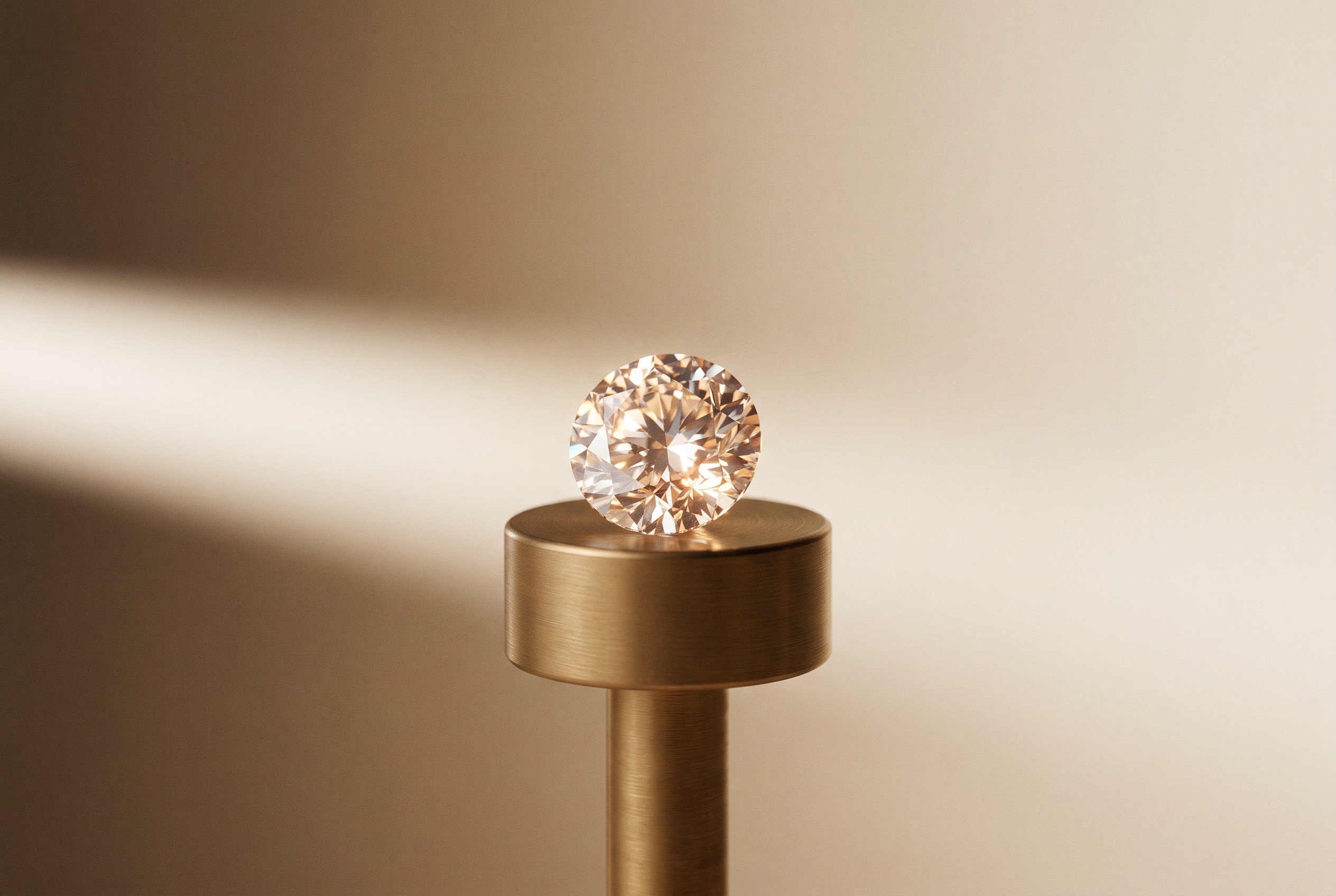
An Ideal cut diamond is a round brilliant cut to proportions that maximize light return — brilliance, fire, and scintillation — based on mathematical models of how light behaves as it enters and exits a diamond's facets. The term originated with Marcel Tolkowsky's early-20th-century calculations of optimal round brilliant proportions and today most precisely refers to AGS Laboratories' top cut grade, "Ideal," though it's also used more loosely in the trade to describe any diamond graded at the top of a lab's cut scale, including GIA's "Excellent" grade.
This guide covers what actually defines an Ideal cut, how the AGS Ideal and GIA Excellent grading systems differ, the proportion ranges that define top-tier cut quality, how Ideal cut relates to "Super Ideal" and Hearts and Arrows terminology, and what a wholesale buyer should actually check before paying an Ideal-cut premium.
What "Ideal Cut" Actually Means
Cut quality measures how well a diamond's proportions — table size, depth, crown angle, pavilion angle, and facet symmetry — work together to return light to the viewer's eye as brilliance, fire, and scintillation. A poorly proportioned stone leaks light out through the bottom or sides of the pavilion instead of reflecting it back through the top, resulting in a duller, less lively appearance even in a diamond with excellent color and clarity. "Ideal cut" describes proportions calculated to minimize that light leakage and maximize overall light performance, based on decades of both mathematical modeling and empirical light-performance testing refined since Tolkowsky's original 1919 proportion study.
AGS Ideal vs. GIA Excellent: Two Different Top Grades
The two major certification labs use different cut-grading systems, and understanding the distinction matters for anyone sourcing against the term "Ideal cut" specifically:
| Lab | Top Cut Grade | Grading Approach |
|---|---|---|
| AGS Laboratories | Ideal (AGS 0) | Uses the term "Ideal" directly as its top grade; evaluates light performance using ray-tracing technology that models actual light behavior through the stone, not just proportion measurements alone |
| GIA | Excellent | Does not use the term "Ideal" at all — "Excellent" is GIA's top cut grade, based on a proportion-and-symmetry-based grading system rather than direct light-performance ray-tracing |
In practice, the trade often uses "Ideal cut" loosely to describe any diamond graded at the top of either lab's scale — meaning a GIA Excellent stone is frequently marketed as "ideal cut" even though GIA itself doesn't issue a grade by that name. Buyers should check which lab issued a stone's certificate and which specific top grade it actually received, rather than assuming "Ideal cut" in a listing always refers to a genuine AGS Ideal grade.
Cut Grade Scale Comparison
| GIA Grade | AGS Equivalent | Light Performance |
|---|---|---|
| Excellent | Ideal (AGS 0) / Excellent (AGS 1) | Maximum brilliance, fire, and scintillation; minimal light leakage |
| Very Good | AGS 2 | Strong light performance, a small step down from top-tier; often offers meaningfully better value with minimal visible difference to most buyers |
| Good | AGS 3-4 | Noticeably reduced brilliance to a trained eye, though generally acceptable to a casual observer |
| Fair | AGS 5-6 | Visible light leakage, dull or glassy appearance in areas of the stone |
| Poor | AGS 7-10 | Substantial light leakage and a visibly lifeless appearance regardless of color or clarity grade |
Proportions That Define Ideal Cut Quality
While exact ranges vary slightly by lab and by the specific proportion-grading methodology used, top-tier cut grades generally fall within these approximate ranges for a round brilliant:
- Table percentage: roughly 53-58%, the flat top facet's width relative to the stone's total diameter.
- Total depth percentage: roughly 59-62.5%, the stone's overall height relative to its diameter.
- Crown angle: roughly 34-35 degrees, the angle of the facets above the girdle.
- Pavilion angle: roughly 40.6-41 degrees, the angle of the facets below the girdle — this proportion is especially critical, since a pavilion cut too shallow or too deep is the single most common cause of visible light leakage.
These ranges represent a tight window rather than a single fixed number, since Tolkowsky-era and modern light-performance research both confirm that a small range of proportion combinations, not one single "perfect" set of numbers, produce genuinely excellent light performance.
"Super Ideal" and Hearts and Arrows
"Super Ideal" is a trade marketing term, not an official lab grade, used to describe stones cut to proportions even tighter than the standard Ideal/Excellent range, typically verified through Hearts and Arrows imaging — a viewing technique that reveals a symmetrical pattern of hearts (viewed through the pavilion) and arrows (viewed through the crown) in a stone cut with exceptionally precise optical symmetry. Not every Ideal or Excellent-graded stone displays a clean Hearts and Arrows pattern, since that level of symmetry requires precision beyond what the standard cut grade alone certifies. Our Hearts and Arrows guide covers this specific evaluation method in more depth for buyers considering a Super Ideal purchase.
Does Ideal Cut Apply to Fancy Shapes?
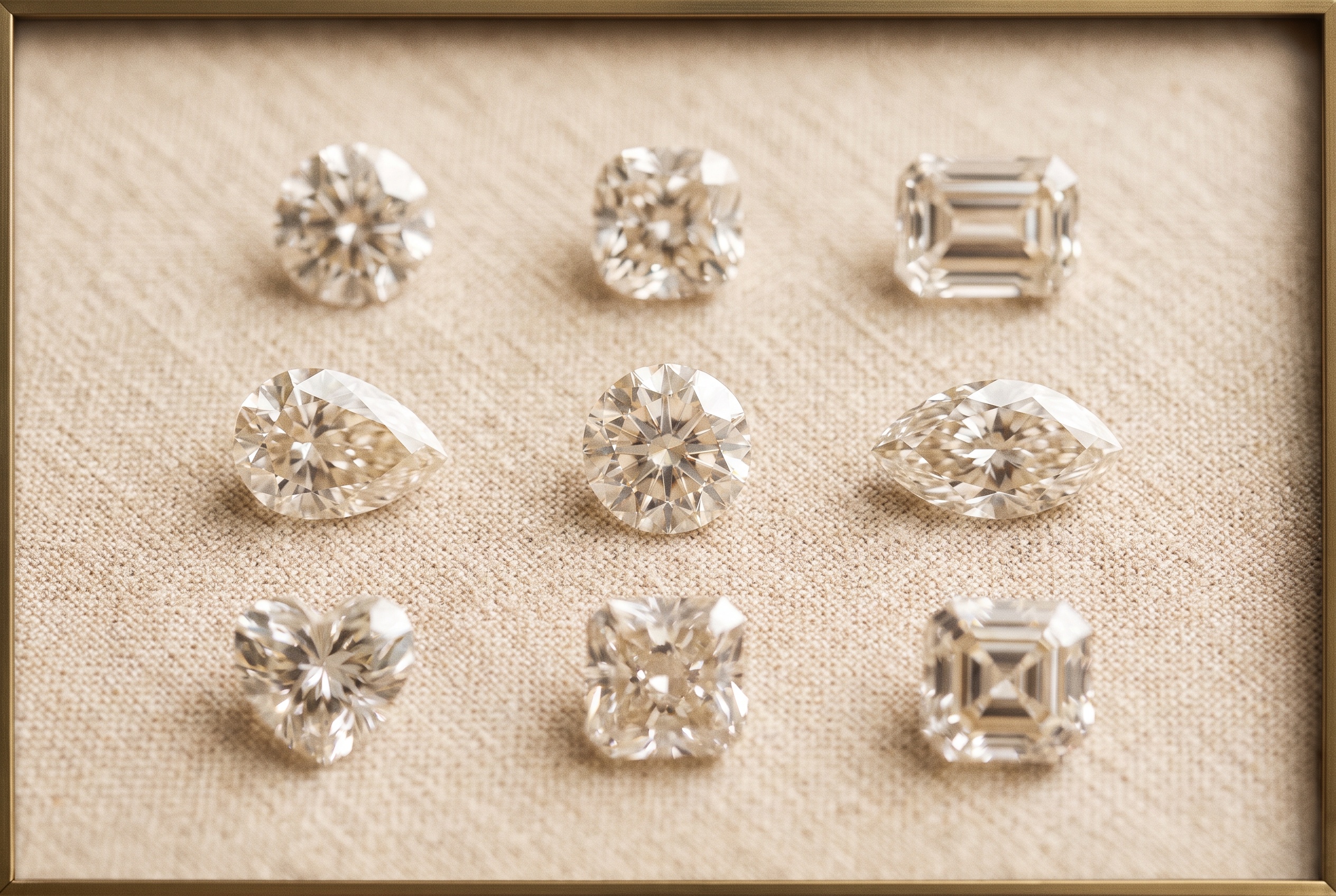
The term "Ideal cut" and its associated proportion ranges were developed specifically for the round brilliant cut and are most rigorously codified there. Fancy shapes — oval, cushion, princess, emerald, and others — don't have an equivalently standardized "Ideal" designation, since their proportions and light-performance characteristics vary too much by shape for a single universal ideal-proportion range to apply the way it does for a round brilliant. GIA and AGS both grade fancy shapes for cut quality, but buyers evaluating a fancy shape should rely on the specific grading report and, ideally, direct visual inspection, rather than looking for an "Ideal cut" label the way they might for a round stone.
Ideal Cut and the Trade-Off With Carat Retention
Cutting a piece of rough to hit tight Ideal or Excellent proportions frequently means sacrificing carat weight that a less disciplined cutting decision could have retained. A cutter facing a borderline choice — for instance, cutting a stone that would land at 0.98 carats with ideal proportions versus 1.05 carats with proportions that fall just outside the top grade — often faces genuine commercial pressure toward the larger, lower-graded outcome, since carat weight has an outsized effect on price at common weight thresholds like 1.00 carat. This dynamic is part of why a genuinely well-cut Ideal or Excellent stone commands a premium: it represents a cutting decision that prioritized light performance over maximizing retained weight, which isn't always the cutter's most immediately profitable choice from the rough. Buyers who understand this tension are better positioned to appreciate why two stones of similar carat weight and similar color and clarity can carry a meaningfully different price once cut grade is factored in.
Does Ideal Cut Cost More?
Yes — top cut grades command a real premium at both retail and wholesale, since fewer stones cut from rough achieve the tightest proportion ranges without sacrificing carat weight, and cutting to those exacting standards requires more skill and yields less finished weight from the same rough material. For a buyer prioritizing visible light performance above all else, that premium is often worth paying; for a buyer working within a tighter budget, a Very Good cut grade frequently delivers light performance close enough to Excellent/Ideal that the difference is difficult for anyone but a trained eye to detect, making it one of the more common places buyers choose to save budget without a meaningfully worse-looking stone.
CVD Lab-Grown Diamonds and Ideal Cut
CVD lab-grown rough is cut using the same equipment, techniques, and grading standards as natural diamond rough, and lab-grown stones are graded for cut quality on the identical scale by both GIA and AGS. An Ideal or Excellent cut grade means the same thing for light performance regardless of whether the diamond is lab-grown or natural — cut grade evaluates proportions and light behavior, not origin.
Reading a Certificate's Proportion Diagram
Beyond the headline cut grade, most grading certificates include a proportion diagram — a schematic cross-section showing the stone's table percentage, crown angle, pavilion depth, and girdle thickness as measured numbers rather than just a summary grade label. Learning to read this diagram directly gives a buyer or jeweler a level of insight the grade label alone doesn't fully convey, since two stones both graded Excellent or Ideal can still sit at different points within that grade's acceptable proportion range, and a buyer who cares specifically about maximizing light performance within an already-strong grade may have a preference within that range. Girdle thickness is worth particular attention on the diagram: a girdle that's too thin increases chipping risk at the diamond's most vulnerable edge, while one that's too thick adds unnecessary weight — and therefore unnecessary cost — without contributing to visible size or light performance, since the extra material sits hidden beneath the setting.
Why Trade Buyers Should Care About Cut Grade Terminology Precision
For a wholesale buyer sourcing inventory rather than a single stone for personal use, precision around cut grade terminology matters even more than it does for an individual retail shopper, since a buyer building recurring inventory around a specific cut-grade promise to their own retail customers needs sourcing consistency they can actually stand behind. A supplier who uses "Ideal cut" loosely to describe any top-graded stone, without distinguishing which lab issued the grade or whether it's a genuine AGS Ideal designation, creates downstream risk for a buyer who then repeats that same loose terminology to their own retail customers. Building sourcing relationships around precise, certificate-verified language — checking the actual issuing lab and grade on every stone rather than relying on a supplier's marketing description — protects a wholesale buyer's own credibility with their retail customer base over the long run.
What to Actually Check Before Paying an Ideal-Cut Premium
- Confirm which lab issued the certificate and which specific grade it shows — "Ideal" should mean an actual AGS Ideal grade or GIA Excellent grade, not just marketing language in a listing.
- Review the actual proportion numbers on the certificate rather than relying on the grade label alone, particularly pavilion angle, since it has the largest single effect on light leakage.
- Ask about Hearts and Arrows imaging if considering a Super Ideal purchase specifically, since that level of symmetry isn't guaranteed by the standard cut grade alone.
- Weigh the premium against a Very Good-graded alternative, especially on a budget-conscious purchase, since the visible difference at that adjacent grade is often minimal.
A Brief History: Tolkowsky's 1919 Proportion Study
The mathematical foundation for "ideal" round brilliant proportions traces back to Marcel Tolkowsky's 1919 study, published in his work "Diamond Design," which used the physics of light refraction and total internal reflection to calculate proportions theorized to maximize a round brilliant's brilliance and fire. Tolkowsky's original calculations have been refined substantially since 1919 as both computing power and empirical light-performance testing have advanced — modern ray-tracing technology can model actual light behavior through a specific stone far more precisely than the analytical geometry available a century ago — but the core insight, that a specific, relatively narrow proportion range genuinely outperforms others in light return, has held up remarkably well across a century of subsequent refinement. Understanding this history matters for buyers because it explains why "Ideal cut" isn't simply a marketing label invented to justify a price premium — it reflects a genuinely long lineage of applied optical science specific to how a round brilliant diamond interacts with light.
How Cut Grade Is Actually Measured: Proportions vs. Ray-Tracing
The two major labs take meaningfully different technical approaches to arriving at a cut grade, and understanding the distinction helps explain why AGS and GIA grades, while closely correlated, aren't identical measurement systems. GIA's cut grading system is built primarily on measured proportions and facet symmetry, cross-referenced against a large dataset of light-performance outcomes to arrive at a grade without directly ray-tracing every individual stone. AGS, by contrast, uses direct computer ray-tracing analysis for every stone it grades, modeling how light actually enters, reflects, and exits that specific stone's exact proportions and facet arrangement, and using observed light-performance results directly as the basis for the grade rather than proportions serving primarily as a proxy for expected performance. Both approaches are well-validated and produce closely correlated results at the top of each scale, but a buyer who wants a diamond's specific light-performance data — not just an overall grade label — is more likely to find that level of detail on an AGS report specifically.
Symmetry and Polish: Related but Distinct Grading Factors
Cut grade is sometimes confused with symmetry and polish grades, which appear separately on a certificate and measure related but distinct characteristics. Symmetry grade evaluates how precisely a stone's facets align — whether they meet at exact points, whether facet shapes and sizes are consistent, and whether the overall outline is evenly proportioned. Polish grade evaluates the surface finish quality of each individual facet, checking for any remaining marks, pits, or lines left over from the cutting and polishing process. A stone can carry an overall Excellent or Ideal cut grade while showing very slightly lower symmetry or polish grades, or vice versa, since the composite cut grade weighs proportions, symmetry, and polish together rather than any single factor determining the overall result on its own. A buyer scrutinizing a certificate closely should check all three — cut, symmetry, and polish — rather than assuming a strong overall cut grade guarantees top marks on the other two individually.
How Ideal Cut Affects Perceived Diamond Size
Cut proportions influence not just brilliance but also how large a diamond appears face-up relative to its actual carat weight, which matters directly to a buyer balancing budget against visual size. A diamond cut too deep concentrates more of its weight below the girdle, where it isn't visible from the top view, making the stone appear smaller face-up than its carat weight would suggest. A diamond cut too shallow can appear larger face-up but typically sacrifices light performance, often showing a visible dark area in the center known as a "fisheye" effect caused by light leaking directly through the pavilion rather than reflecting back to the viewer. A well-proportioned Ideal or Excellent-cut stone strikes the balance point that both current light-performance research and Tolkowsky's original calculations converge on — maximizing both visual size and light return simultaneously, rather than trading one for the other.
Sourcing Ideal Cut Diamonds at Wholesale
Guru Diam carries certified loose diamonds across the full cut-grade spectrum, including top-tier Ideal and Excellent cut round brilliants, with IGI, GIA, and GCAL certification available so buyers can review full proportion data alongside color and clarity before purchase. In-stock certified inventory ships same-day from Guru Diam's New York and Los Angeles locations.
Buyers can browse certified loose stones and filter by cut grade through the certified diamonds category, and review coordinated stone sets through matching pairs. For a deeper look at round brilliant cut education generally, see our round brilliant diamond cut guide, and for cut-precision evaluation specifically, our Hearts and Arrows guide. Trade accounts can review terms at the wholesale hub or apply through trade partner.
A Final Note on Evaluating Cut Grade
Of the 4Cs, cut is the one factor most directly under human control — color and clarity are determined largely by a rough stone's inherent characteristics, but cut grade reflects a deliberate decision about how that rough was shaped, and that decision has an outsized effect on how alive a finished diamond actually looks. A buyer who understands the distinction between AGS Ideal and GIA Excellent, knows to check the underlying proportion numbers rather than relying on a grade label alone, and recognizes where a Very Good grade offers genuine value relative to a top-tier grade, is positioned to make a more informed cut-grade decision than one relying solely on marketing language like "Ideal cut" without verifying what that term actually means for a specific stone's certificate.
Frequently Asked Questions
What does "Ideal cut" mean on a diamond certificate?
Most precisely, it refers to AGS Laboratories' top cut grade, "Ideal," awarded to stones with proportions that maximize light return based on ray-tracing light-performance analysis. The term is also used more loosely in the trade to describe GIA's top grade, "Excellent," even though GIA doesn't use the word "Ideal" itself.
Is "Ideal cut" the same as GIA "Excellent"?
They're closely equivalent in practice — both represent each lab's top cut grade — but they come from different grading systems using different evaluation methods, so a stone should be checked against its actual issuing lab's grade name rather than assumed to be a genuine AGS Ideal grade.
What is "Super Ideal" cut?
A trade marketing term, not an official lab grade, describing stones cut to proportions tighter than standard Ideal/Excellent, usually verified through Hearts and Arrows imaging showing exceptionally precise optical symmetry.
Does Ideal cut apply to fancy shapes like oval or cushion?
Not in the same standardized way as round brilliants. Fancy shapes don't have an equivalently codified universal "Ideal" proportion range, since their light-performance characteristics vary too much by shape; buyers should rely on the specific grading report and visual inspection instead.
Is an Ideal cut diamond worth the price premium?
It depends on priorities. Ideal and Excellent-graded stones deliver maximum light performance and command a real premium; a Very Good cut grade often delivers light performance close enough that the visible difference is hard to detect without a trained eye, making it a common place to save budget.
Does cut grade differ between lab-grown and natural diamonds?
No. CVD lab-grown rough is cut and graded using the identical standards and equipment as natural diamond rough, and an Ideal or Excellent cut grade means the same light-performance result regardless of a stone's origin.
What's the difference between cut grade and symmetry grade?
Cut grade is a composite evaluation of proportions, symmetry, and polish together, while symmetry grade specifically measures how precisely a stone's facets align and how evenly proportioned its overall outline is. A stone can carry a top overall cut grade with a very slightly different symmetry grade, since the two are graded and reported separately.
Can a diamond be cut too shallow or too deep?
Yes. A stone cut too deep hides more of its weight below the girdle, making it look smaller face-up than its carat weight suggests, while a stone cut too shallow can look larger face-up but typically leaks light through the pavilion, sometimes producing a visible dark "fisheye" effect in the center.