
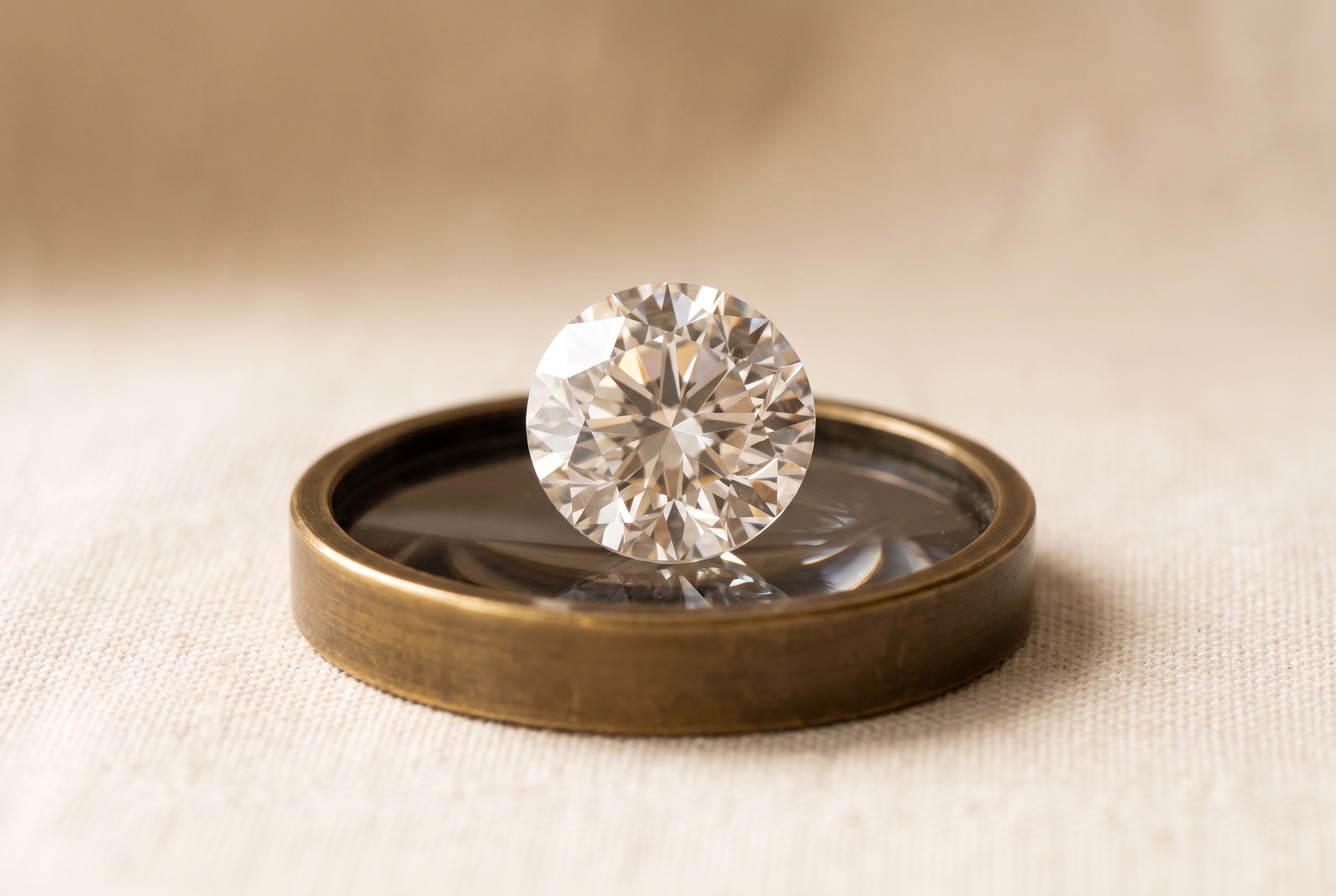
Hearts and arrows refers to a symmetrical optical pattern visible in exceptionally well-cut round brilliant diamonds: eight identical arrow shapes visible when the diamond is viewed face-up through a specialized viewer, and eight identical heart shapes visible when viewed face-down through the same tool. The pattern only appears when a diamond's facets are aligned with a level of precision well beyond a standard Excellent cut grade, making it a practical, visual way to confirm exceptional cutting quality that goes beyond what a certificate's summary cut grade tells you.
Hearts and arrows isn't a separate grading category on a standard IGI, GIA, or GCAL report — it's a technique jewelers, cutters, and increasingly buyers themselves use to visually verify optical symmetry. This guide covers how the pattern forms, how it's actually viewed, what it does and doesn't tell you about a diamond, and how to think about it when sourcing or buying.
What Is Hearts and Arrows?
Hearts and arrows (sometimes written H&A) is the name given to a specific reflective pattern produced by a round brilliant diamond's facets when the proportions, angles, and alignment of every facet are precise enough to create perfect eight-fold optical symmetry. Viewed through a hearts and arrows viewer — a handheld magnifying tool with a specific optical filter — the diamond shows eight uniform arrow shapes radiating from the center when viewed face-up (through the table), and eight uniform heart shapes when viewed face-down (through the pavilion). Any meaningful misalignment in facet angle, size, or placement breaks the symmetry of the pattern, so the presence of a clean hearts and arrows pattern is effectively a pass/fail visual test of a stone's true optical precision.
Why the Pattern Forms: The Optics Behind It
A round brilliant's 57 or 58 facets are arranged in eight-fold radial symmetry — eight kite facets, eight star facets, sixteen upper-girdle facets (in two sets of eight), sixteen lower-girdle facets (in two sets of eight), and eight pavilion mains. When every one of these facets is cut and aligned with near-identical angles and proportions relative to the others, light reflecting through the stone forms a perfectly repeating, symmetrical pattern. The hearts and arrows viewer isolates and exaggerates this pattern using a specific lighting and lens arrangement, making even small asymmetries in facet placement visually obvious — asymmetries that would be difficult or impossible to spot with the naked eye or a standard loupe.
The arrows form face-up because you're looking at the crown facets reflecting light down and back; the hearts form face-down because you're looking at the pavilion facets from the opposite direction, and the same eight-fold symmetry resolves into a different visual shape depending on which side you're viewing from and how the light interacts with the pavilion's geometry.
How Hearts and Arrows Is Actually Viewed
A hearts and arrows viewer is a small, purpose-built optical tool — distinct from a standard 10x jeweler's loupe — that combines specific lighting geometry with a magnifying lens to make the pattern visible. To check the arrows, the diamond is viewed table-up (face-up) through the viewer; to check the hearts, the diamond is flipped and viewed through the pavilion (face-down). Some viewers combine both functions in a single tool; others are single-purpose. Because the tool depends on precise, controlled lighting geometry to work, casual attempts to spot hearts and arrows under a standard jeweler's loupe or with a smartphone camera generally won't reproduce a reliable result — it requires the actual viewing tool.
Hearts and Arrows vs. Standard Cut Grade
A diamond can carry a GIA Excellent cut grade — the top grade on the standard five-tier scale — without displaying a clean hearts and arrows pattern, because Excellent cut grade allows a range of proportions and a degree of tolerance in symmetry that's still looser than what hearts and arrows requires. Hearts and arrows represents a tighter, more exacting standard sitting above Excellent cut grade rather than a formal step within it. That means the absence of a hearts and arrows pattern doesn't mean a diamond performs poorly — the large majority of well-cut, high-performing round brilliants on the market don't display it — but its presence is a reliable, visually verifiable signal that a stone's symmetry claims hold up to close inspection.
| Characteristic | Standard Excellent Cut Grade | Hearts and Arrows |
|---|---|---|
| How it's determined | Measured proportions, polish, and symmetry against grading lab tolerances | Visual pattern check through a specialized viewer |
| Appears on certificate | Yes — standard field on IGI/GIA/GCAL reports | No — not a standard certificate field |
| Symmetry tolerance | Allows minor variance within the Excellent range | Requires near-perfect eight-fold symmetry |
| Approximate share of well-cut stones | Common among top-graded round brilliants | A small minority even among Excellent-cut stones |
| Typical price premium | Standard Excellent-cut pricing | Often carries an additional premium over standard Excellent |
Does Hearts and Arrows Only Apply to Round Brilliants?
Yes, in its classic form. The eight-fold radial symmetry that produces the hearts and arrows pattern is specific to the round brilliant's facet arrangement. Some cutters and viewers have developed adapted symmetry-viewing techniques for other shapes (princess cuts in particular have an analogous concept sometimes marketed under different names), but the term "hearts and arrows" as commonly used and understood in the trade refers specifically to round brilliants.
Is a Hearts and Arrows Diamond Worth Paying More For?
Whether the premium is worth it depends on what a buyer is optimizing for. Hearts and arrows is a genuine, visually verifiable marker of exceptional cutting precision — it isn't a marketing gimmick, and stones that display it reliably back up their symmetry claims. But the practical difference in visible sparkle between a clean Excellent-cut stone and a hearts-and-arrows stone is often subtle to a casual observer, even though it's obvious under the viewer itself. Buyers who care specifically about maximum, verifiable optical precision — often for a center stone that will be examined closely — tend to find the premium worthwhile; buyers optimizing primarily for size or budget within a strong cut grade generally get excellent performance from a standard Excellent-cut stone without paying the additional premium.
Hearts and Arrows and Lab-Grown Diamonds
Hearts and arrows applies identically to lab-grown and natural round brilliants, since the pattern is purely a function of how precisely the stone was cut — not how the rough crystal formed. A CVD lab-grown diamond cut to hearts-and-arrows precision produces the exact same pattern as a natural diamond cut to the same precision, because both are the same crystalline carbon material shaped by the same cutting process. This has made hearts-and-arrows round brilliants more accessible to a wider range of buyers, since lab-grown pricing allows access to this top-tier cutting precision at a lower cost basis than an equivalent natural stone.
Common Misconceptions About Hearts and Arrows
- "No hearts and arrows means the diamond is poorly cut." False — the large majority of well-performing, Excellent-cut round brilliants don't display the pattern. Its absence is not a red flag on its own.
- "You can see hearts and arrows with the naked eye." False — the pattern requires the specific lighting geometry of a hearts and arrows viewer. It is not visible under normal viewing conditions or a standard loupe.
- "Hearts and arrows guarantees the best sparkle." Not entirely — hearts and arrows confirms exceptional symmetry specifically, which does contribute to scintillation, but overall sparkle also depends on proportions, polish, clarity, and color working together. See our broader guide to what makes a diamond sparkle for the full picture.
- "Any jeweler can verify hearts and arrows on the spot." Verifying it requires the actual specialized viewer, not a standard loupe — not every retail setting has one readily available, so buyers specifically seeking a verified hearts-and-arrows stone should confirm the viewing was done with the correct tool.
A Brief History of Hearts and Arrows Grading
Hearts and arrows viewing emerged from the Japanese diamond trade in the 1980s, where cutters and dealers developed increasingly precise cutting techniques and the specialized viewing tools to verify them, at a time when round brilliant cutting precision was becoming a genuine point of competitive differentiation among high-end cutters. The technique spread internationally through the 1990s and 2000s as cutting equipment and quality control improved broadly across the trade, making the exacting proportions required for a clean hearts and arrows pattern achievable outside the specific workshops that originally pioneered it. It remains, decades later, one of the few widely recognized ways for a buyer — rather than a lab technician with measuring equipment — to visually confirm a diamond's cutting precision for themselves.
Hearts and Arrows vs. "Ideal Cut" vs. "Super Ideal Cut"
These three terms get used loosely and sometimes interchangeably in casual conversation, but they describe distinct things. "Ideal cut" generally refers to a diamond cut close to the mathematically optimized proportions first published by Marcel Tolkowsky in 1919 and refined since — it's a proportions-based standard, and different grading bodies and vendors apply slightly different ranges to the term since it isn't a single universally standardized label the way GIA's Excellent/Very Good/Good scale is. "Super ideal cut" is an informal, higher-tier marketing term some vendors use for stones cut to a tighter proportion range than standard Ideal or Excellent, often (but not always) including hearts-and-arrows-level symmetry as part of the standard. Hearts and arrows itself is neither a proportions range nor a marketing label — it's a specific, visually verifiable optical pattern with an objective pass/fail test behind it. In practice, a stone marketed as "super ideal" often does display hearts and arrows, but the terms aren't strictly synonymous, and buyers evaluating a "super ideal" claim should still ask specifically whether the pattern has been verified through an actual viewer rather than assuming the label guarantees it.
Hearts and Arrows in Melee and Small Accent Stones
Hearts and arrows grading is almost exclusively applied to center-stone-sized round brilliants — typically 0.30ct and above, where the stone is large enough for the pattern to be meaningfully viewed and where the buyer is examining an individual stone closely enough for the distinction to matter. Melee-sized round brilliants, sourced and quality-controlled as calibrated parcel goods against a consistent color and clarity baseline rather than certified and evaluated individually, generally aren't assessed for hearts and arrows — the practical value of verifying eight-fold symmetry on stones a few tenths of a millimeter across, viewed collectively in a pavé or halo setting rather than individually, is far lower than for a single, closely examined center stone. Buyers pairing a hearts-and-arrows center stone with round brilliant melee for a halo or side-stone setting are effectively applying two different sourcing standards at once: certificate- and pattern-level scrutiny on the center stone, calibrated-parcel matching on the surrounding melee.
How to Evaluate a Hearts and Arrows Claim When Sourcing
Because hearts and arrows isn't a standard certificate field, claims need to be verified independently of the grading report. The most reliable approach is direct visual confirmation through an actual hearts and arrows viewer — either in person or via clear, dedicated video/photo documentation from the supplier showing the pattern from both the arrows (face-up) and hearts (face-down) views. Buyers should be cautious of suppliers who use "hearts and arrows" as a general marketing term for any Excellent-cut stone without providing that visual confirmation, since the term has real, specific meaning in the trade and shouldn't be applied loosely. Cross-checking the underlying certificate's proportions, polish, and symmetry grades (all should sit at or near the top of their respective scales) is a useful secondary check, though ultimately the visual pattern itself is the definitive test.
Hearts and Arrows and Price: What the Premium Actually Reflects
The added cost of a verified hearts-and-arrows diamond isn't really a premium for the pattern itself — it's a reflection of the extra cutting time, skill, and lower yield involved in achieving that level of precision. Cutting to hearts-and-arrows tolerances requires slower, more deliberate work and typically sacrifices more rough-diamond weight than cutting to a standard Excellent-cut range, since the cutter has less flexibility to prioritize carat retention over precise angle matching. That combination of skilled labor time and lower yield is what shows up as a price premium on the finished stone, rather than the hearts and arrows label carrying value on its own the way a brand name might. Buyers comparing two stones at the same carat, color, and clarity grade — one verified hearts and arrows, one standard Excellent cut — are, in practical terms, paying for that additional cutting precision and the lower rough yield behind it, not for a certificate or a marketing term.
What a Broken Hearts and Arrows Pattern Looks Like
Understanding what a flawed pattern looks like helps clarify why the test is so exacting. A diamond that falls just short of hearts-and-arrows precision typically shows arrows or hearts of visibly uneven length, width, or thickness around the eight-fold pattern — one or two arrows noticeably shorter or fatter than the rest, or hearts with asymmetric lobes rather than a clean, even shape. Sometimes the pattern shows correctly on one side (arrows face-up) but breaks down on the other (hearts face-down), which points to a specific misalignment between crown and pavilion facets rather than an overall symmetry problem. These imperfections don't necessarily mean the diamond performs poorly — a stone can still carry a genuine GIA Excellent cut grade with a slightly uneven hearts and arrows pattern — but they do mean the stone falls short of the tightest tier of cutting precision the pattern is used to identify.
Who Actually Checks for Hearts and Arrows
In practice, hearts and arrows verification happens at a few different points in the supply chain. Some specialized cutting houses check their own output as a quality control step, particularly for stones they intend to market specifically on cut precision. Independent appraisers and some retail jewelers keep a hearts and arrows viewer on hand for clients specifically requesting the highest tier of cut verification. And increasingly, buyers themselves — particularly trade buyers sourcing center stones at volume — request video or in-person verification directly from suppliers before committing to a purchase, treating it as one more data point alongside the certificate rather than relying on a supplier's unverified marketing claim. Because the standard grading labs (IGI, GIA, GCAL) don't include hearts and arrows as a certificate field, this verification step sits outside the standard certification process entirely and depends on the specific parties involved choosing to do it.
Sourcing Hearts and Arrows Diamonds at Guru Diam
Guru Diam is a trade-only wholesale diamond supplier with locations in New York and Los Angeles, carrying certified loose round brilliant diamonds — CVD lab-grown and natural — alongside every other standard, antique, and exotic shape, plus finished jewelry. Every certified loose stone ships with full proportion, polish, and symmetry documentation from IGI, GIA, or GCAL, giving buyers sourcing for maximum optical precision the underlying data needed to evaluate a stone properly before committing to a hearts-and-arrows purchase. Same-day shipping is available on in-stock loose diamond inventory from both locations, and custom pieces built around a center stone are finished in 4–6 days.
For jewelers and designers building out a full piece around a hearts-and-arrows center stone — a solitaire, halo, or three-stone setting where the center diamond is the visual focal point — pairing certificate-level scrutiny on that stone with calibrated melee for any surrounding accent diamonds is standard practice, and Guru Diam's melee inventory (0.8mm–9.0mm, round brilliant and calibrated fancy shapes, DEF+/VS+, CVD only) is sourced and QC'd specifically to support that kind of build. Buyers evaluating cut precision across a wholesale order at any volume are also welcome to request supporting proportion, polish, and symmetry documentation directly, rather than relying on a summary grade alone — the same standard of scrutiny recommended throughout this guide for verifying a hearts-and-arrows claim in the first place.
Frequently Asked Questions
What does hearts and arrows mean in a diamond?
Hearts and arrows describes a symmetrical optical pattern — eight arrows viewed face-up, eight hearts viewed face-down through a specialized viewer — that only appears in round brilliant diamonds cut with exceptionally precise facet alignment, well beyond a standard Excellent cut grade.
Can you see hearts and arrows without a special viewer?
No. The pattern depends on the specific lighting geometry built into a hearts and arrows viewer and isn't visible under normal lighting, a standard jeweler's loupe, or the naked eye.
Is hearts and arrows the same as an Excellent cut grade?
No. Excellent is the top cut grade on a standard certificate scale and allows a range of proportions within tolerance. Hearts and arrows sits above that — a tighter, visually verified standard that most Excellent-cut stones don't reach.
Do hearts and arrows diamonds cost more?
Typically yes. Because the pattern reflects a rarer, more exacting cutting standard, hearts-and-arrows stones often carry a premium over standard Excellent-cut diamonds of otherwise comparable grade.
Does hearts and arrows apply to lab-grown diamonds?
Yes. The pattern depends entirely on how precisely a diamond is cut, not on whether it's lab-grown or natural. A CVD lab-grown round brilliant cut to hearts-and-arrows precision shows the identical pattern to a natural diamond cut the same way.
Does every well-cut round brilliant show hearts and arrows?
No. The large majority of Excellent-cut round brilliants do not display a clean hearts and arrows pattern. Its absence doesn't indicate poor cutting — it simply means the stone doesn't meet the tighter symmetry threshold the pattern requires.
Is hearts and arrows on my diamond's certificate?
No. Standard IGI, GIA, and GCAL grading reports don't include a hearts and arrows field. Verification requires direct viewing through a specialized hearts and arrows viewer, either in person or through clear supplier-provided video or photo documentation.
Does hearts and arrows apply to shapes other than round brilliant?
Not in its classic form. The pattern is specific to a round brilliant's eight-fold facet symmetry. Some cutters use adapted symmetry-viewing concepts for other shapes, like princess cut, but "hearts and arrows" as a term is specific to round brilliants.
Guru Diam is a trade-only wholesale diamond supplier with locations in New York and Los Angeles, carrying certified loose diamonds, CVD lab-grown and natural stones, and finished jewelry across every standard, antique, and exotic diamond shape. Browse certified round brilliant inventory in the certified diamonds category, source calibrated pairs through matching pairs, or build a custom piece through custom jewelry. Trade accounts can review current inventory and terms at the wholesale hub or apply through trade partner. For the full anatomy of round brilliant cutting, see our round brilliant cut guide.