
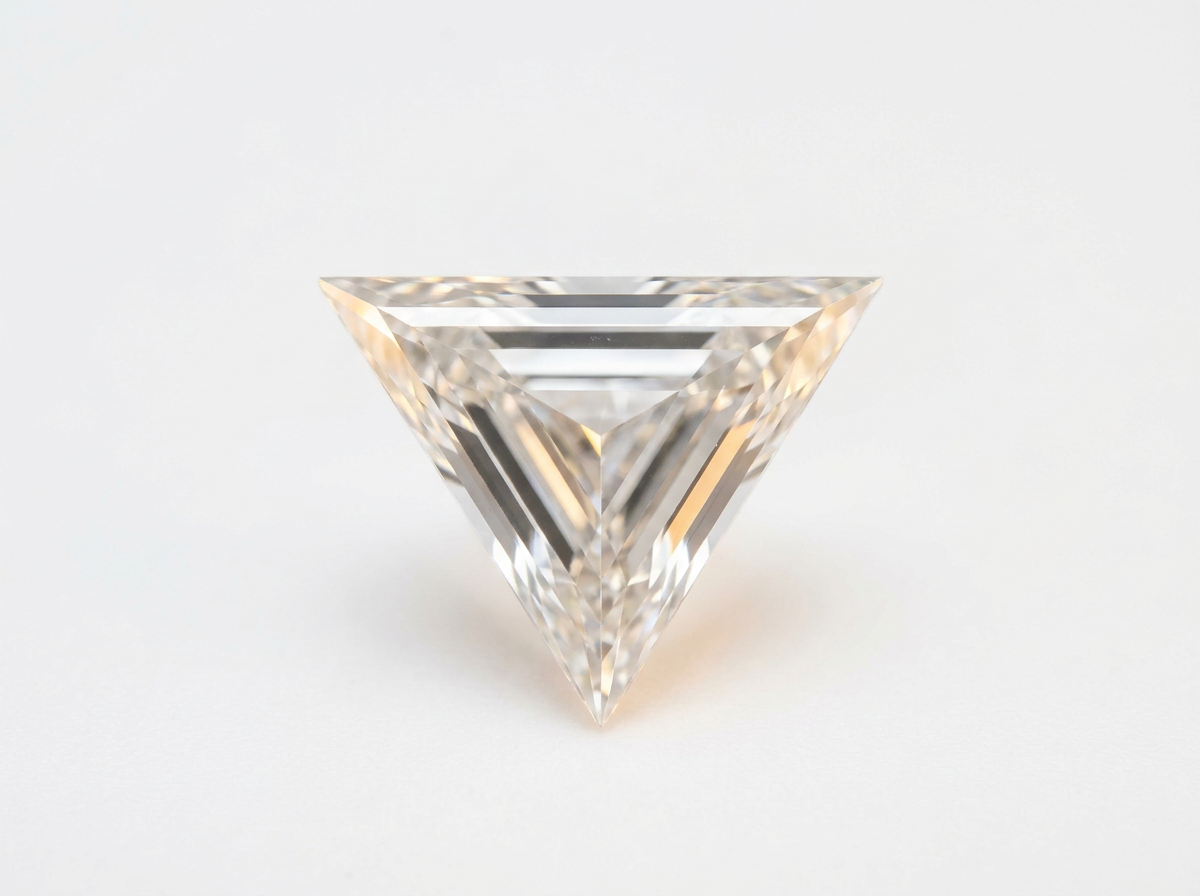
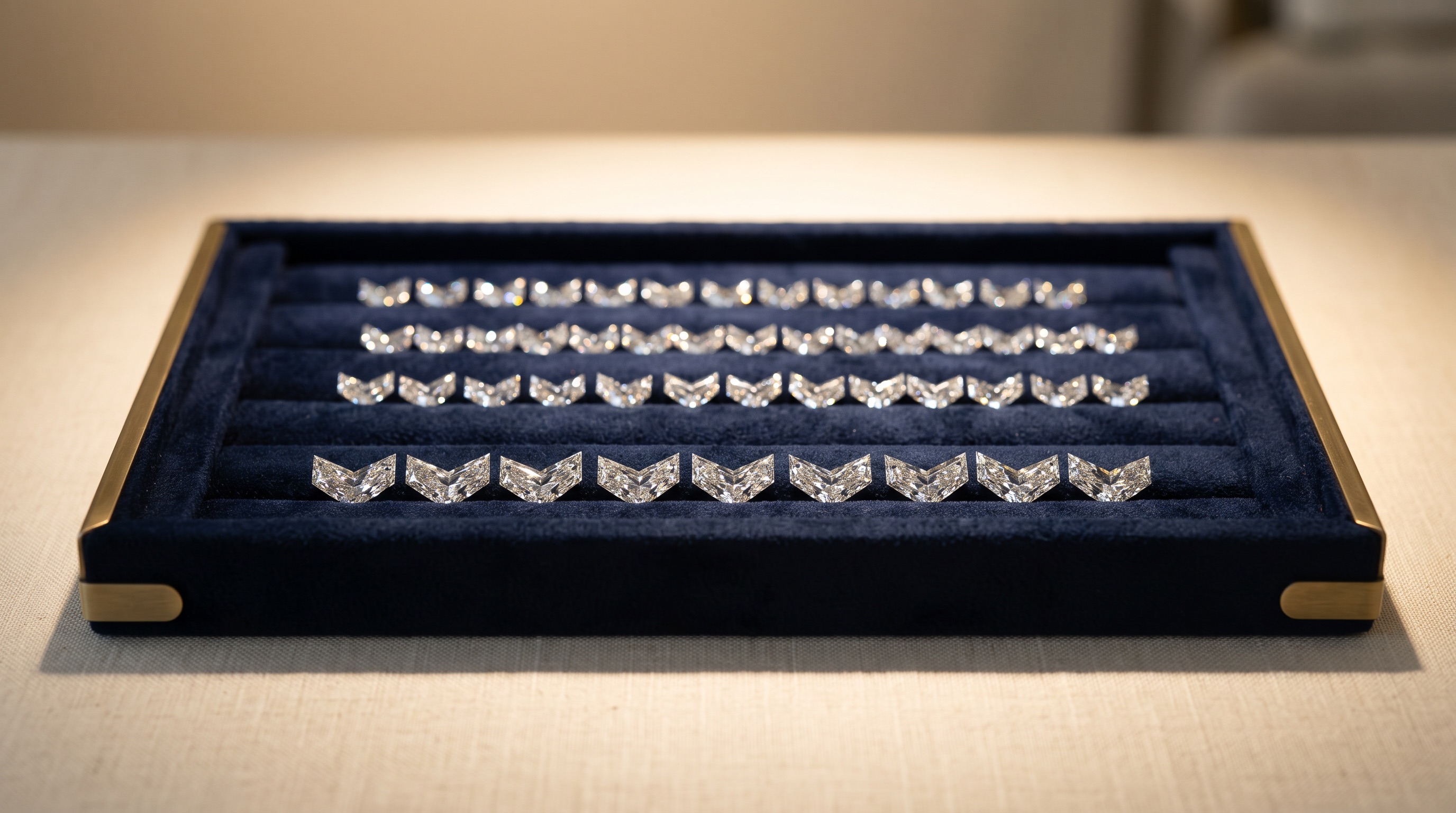
A Chevron is a calibrated triangular side-stone diamond cut with a flat, step-cut top and two straight angled edges that meet in a point — set point-to-point or side-by-side to build a continuous V-shaped pattern across a ring. Guru Diam stocks 398 Chevron diamonds on hand, calibrated and matched, gradable by IGI, GIA, or GCAL on request from our New York and Los Angeles desks.
What is a chevron cut diamond?
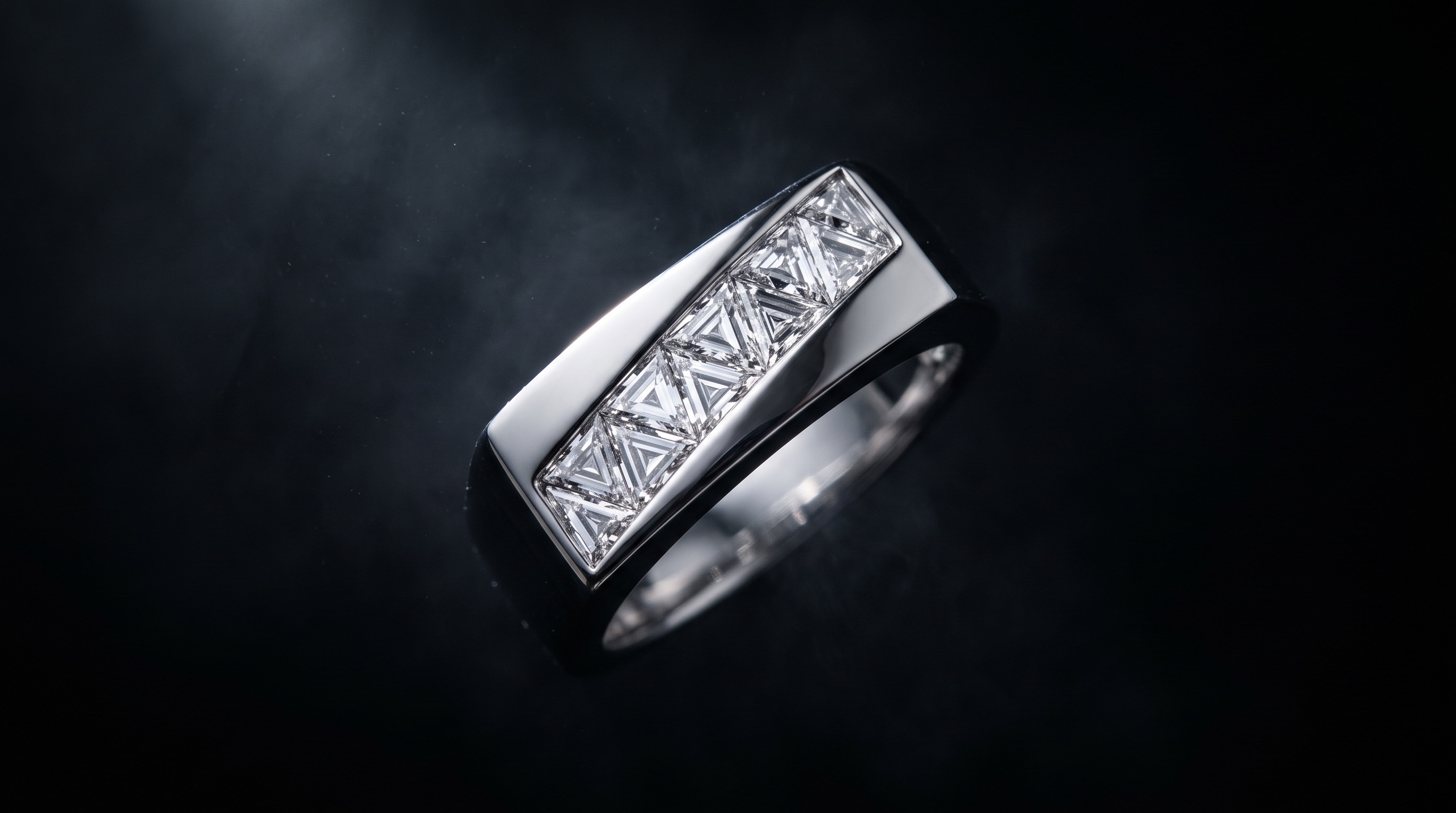
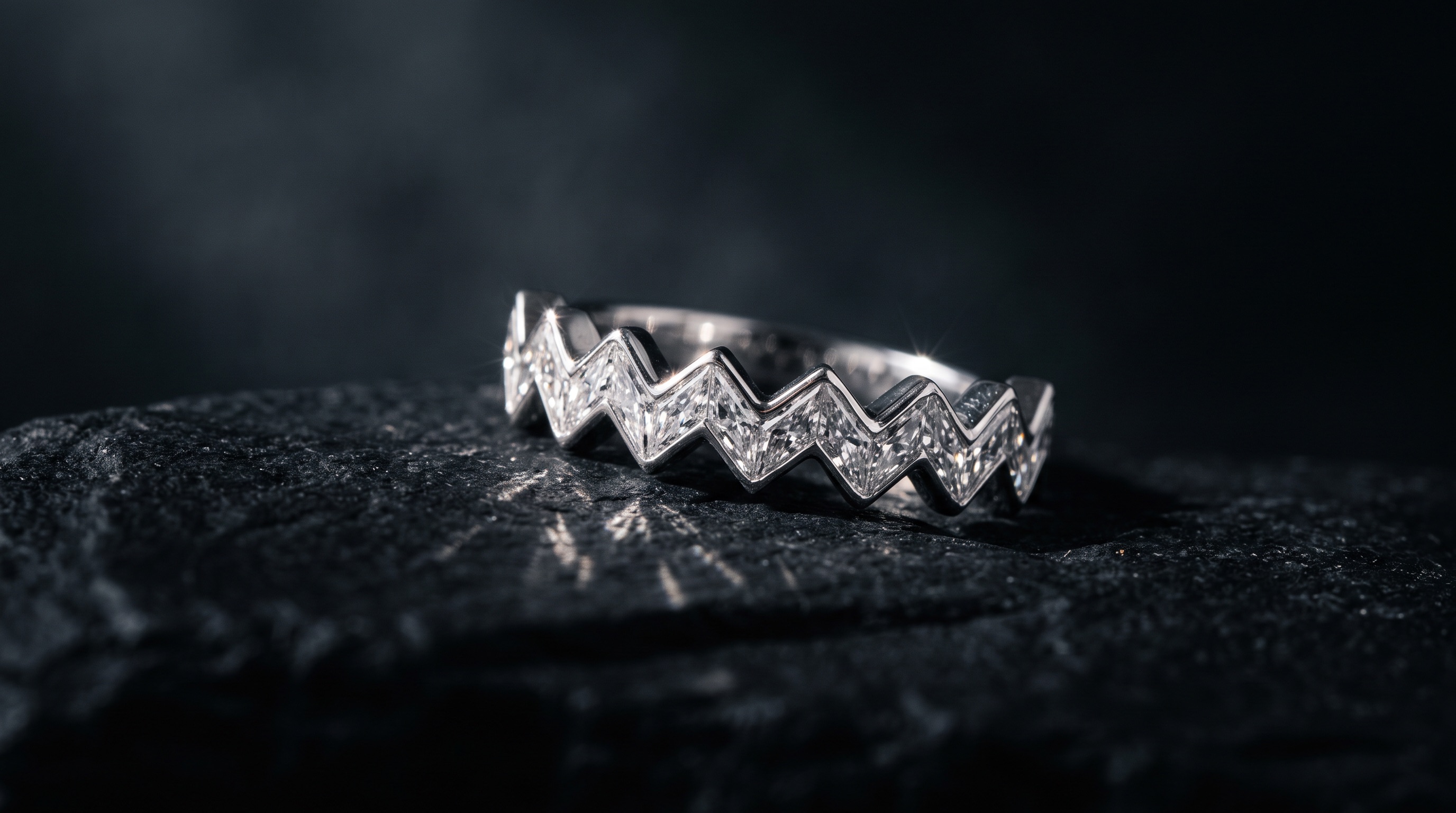
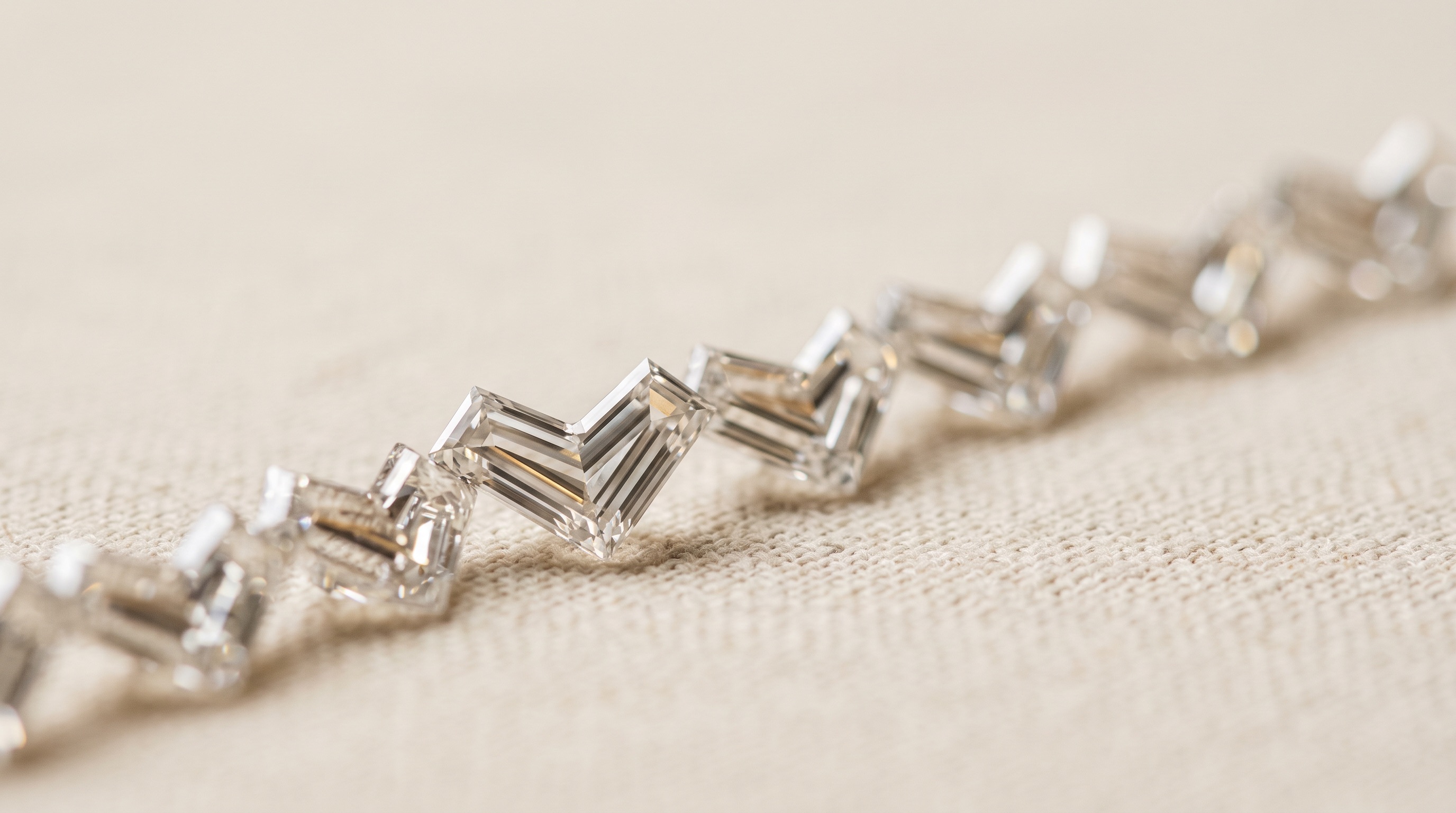
A chevron is a calibrated fancy shape, not a center-stone cut: a triangular outline with a flat step-cut table, sized and angled to repeat cleanly across a row. The step-cut faceting keeps the top flat and geometric rather than sparkly, so the visual interest comes from the pattern the stones form together, not from any single stone's fire. Set point-to-point, two chevrons form a diamond outline; set side-by-side in the same orientation, a run of them builds the continuous zigzag that gives the shape its name — the same V-repeat you'd see on a military chevron insignia or an Art Deco parquet floor, which is where the trade borrowed the name from.
That's why chevrons show up almost exclusively in graduated or repeating settings — eternity bands, channel settings, and asymmetrical band designs that use the V pattern as the whole design language rather than a background texture. It's a shape bought for the pattern it makes in a row, not for what it does sitting alone in a bezel.
Structurally, a chevron reads closer to a baguette than to a brilliant: a broad flat table, a shallow crown, and long parallel step facets running down the pavilion instead of the kite- and triangle-shaped facets that give a brilliant its scatter of fire. That faceting choice is deliberate. A brilliant-faceted triangle sparkles as an individual stone but breaks up the visual line when set in a row — each stone flashes independently, which reads as busy rather than continuous. The flat step-cut table keeps every stone in a chevron run reflecting light the same way at the same angle, so the eye reads one unbroken V-shaped ribbon of light instead of a dozen separate sparkles. The tradeoff is that step facets show inclusions and color more openly than a brilliant would — there's no scatter to hide behind — which is the main reason grading and matching carry more weight for this shape than for a comparably sized round or cushion (more on that below).
Orientation is the key spec to nail down when ordering: chevrons pointing toward the center of the finger read differently than chevrons pointing away, and a design that mixes both directions in a single row — to form a continuous diamond or zigzag outline — needs stones cut as true mirror-image pairs, not just identical triangles cut the same way and flipped. A mirror pair shares the same angle and proportions but has its facet pattern reversed left-to-right, so both halves of a diamond-outline pairing catch light identically. Confirm which orientation, or which mirrored pairing, a project needs before a set is pulled — it's the single most common spec buyers forget to state up front.
Chevron vs. other calibrated triangular and angular side stones
| Spec | Chevron | Trap Step Cut (trapezoid) | Triangle (step-cut) | Shield |
|---|---|---|---|---|
| Outline | Triangular, point-to-point set in pairs/rows | Four-sided, two parallel edges | Three straight sides, standalone | Five-sided, flat or curved crown tapering to a point |
| Faceting | Flat step-cut top | Flat step-cut top | Flat step-cut top | Flat step-cut or mixed-cut top |
| Typical placement | Graduated rows, eternity bands | Flanking a center stone | Trilogy/three-stone accents | Flanking a round or oval center stone |
| Sold as | Matched calibrated sets | Matched pairs/sets | Single or paired accents | Matched pairs |
See the Trap Step Cut wholesale guide for the trapezoid version of this same step-cut family, and the Shield Cut wholesale guide for the five-sided version most often paired with a round or oval center.
Chevron vs. triangle cut and shield cut
Chevron, plain triangle, and shield all belong to the same angular step-cut family, and buyers new to specialty side stones sometimes treat them as interchangeable. In practice, the difference is what each shape is built to do once it's set, and mixing them up on an order is a fast way to get a set that doesn't sit right in the mounting.
A plain triangle step cut is a standalone or paired accent — three straight sides, no requirement that it repeat in a row. It's most often used one or two at a time, flanking a center stone in a three-stone trilogy ring, where its job is to echo the center stone's brilliance without competing with it. A chevron is a triangle in outline too, but it's never really sold as a standalone: the whole point of the shape is that it repeats, either point-to-point to form a diamond silhouette or side-by-side to build a continuous zigzag. Order a single chevron the way you'd order a single trilogy triangle and you'll have a stone with no pattern to complete — the shape only does its job as part of a set.
A shield cut is a five-sided shape — a flat or gently curved crown tapering down to a point — built specifically to hug the curve of a round or oval center stone the way a trapezoid hugs an emerald or radiant. Where a chevron's job is to build a repeating linear pattern across a band, a shield's job is to frame a single center stone from two sides as a matched pair. The two shapes get confused because both use step-cut faceting and both come to a point, but a shield is a framing accent for one center stone and a chevron is a pattern-building unit for a row — different jobs, different quantities per order, and different tolerances for matching (a shield pair only has to match itself; a chevron run has to match every stone in the row, including the stones' own mirror images).
Why matching drives chevron sourcing
A chevron order is a matching problem before it's a grading one. Because the stones read as a continuous pattern once set, every piece in a row needs to match in size, angle, and tone — a single stone that's slightly off-angle or a shade darker breaks the pattern visibly. Unlike a solitaire, where a buyer is evaluating one stone against a grading report, a chevron buyer is really evaluating a set against itself: does stone six in a twelve-stone eternity run sit at the same angle and read the same tone as stone one, under the same light, from across a showroom counter.
That means sourcing depends on a supplier holding deep enough calibrated stock — cut from controlled rough with consistent angle and proportion targets — to pull a true matched run on demand, rather than approximating one from scattered lots bought from different cutters at different times. Mixed-lot chevrons can look fine stone-by-stone under a loupe and still read as mismatched once set in a row, because the eye is far more sensitive to relative differences across a repeating pattern than to any single stone's absolute grade. This is also why a run length matters as much as a size spec when placing an order: a supplier might have plenty of well-cut chevrons on hand in a given size but still come up short on a true 20-stone matched run if the inventory is split across several cutting batches with slightly different angle tolerances.
How Guru Diam sources and cuts chevron diamonds
Guru Diam's chevron inventory is CVD lab-grown, cut in-house to calibrated spec rather than sourced pre-cut from third-party parcels. Cutting in-house is what makes true set-matching possible: a cutter working from rough with a specific eternity band or channel run in mind can hold angle, table alignment, and tone consistent across the whole set, including true mirror-image pairs when a design calls for both orientations in the same row — a level of control that's much harder to guarantee when pulling individual stones from mixed lots bought on the open market.
Because the shape only does its job as part of a matched group, Guru Diam holds calibrated chevrons as on-hand inventory rather than cutting fresh for every request — 398 stones on hand at any given time, calibrated and matched by size and tone, organized so a graduated run or a mirrored pair can be pulled and confirmed same-day from our New York Diamond District desk, with matching capability from our Los Angeles office as well. In-stock pieces ship same-day from New York.
For buyers who need a nonstandard angle, an unusual size outside current stock, or a full graduated run that needs to be cut as one continuous lot, custom-cut chevron orders are also available — cut in-house to the exact spec the setting calls for. Because that work is made to order rather than pulled from a shelf, it's quoted against the specific size, angle, and quantity needed rather than promised on a fixed loose-stone turnaround; a project team can confirm a realistic timeline once the spec is set. If the goal is a finished ring rather than loose stones, Guru Diam's custom jewelry line takes a spec'd chevron design from CAD to a finished piece in 4–6 days.
Grading and quality considerations for chevron diamonds
How a chevron is graded depends on where it falls on the size spectrum. Smaller, melee-range chevrons — the kind used in dense eternity or channel runs — ship as calibrated matched-set goods against a DEF+/VS+ quality baseline rather than individually certified; that's standard practice across the trade for any calibrated side-stone shape at that size, since certifying each stone in a twelve- or twenty-stone run individually would multiply cost with no real benefit to the buyer, who's really buying the set's consistency rather than any one stone's paper. Larger chevrons — generally 0.30ct and up, the size range more likely to appear in a bold geometric ring where the stones read individually rather than as texture — can be individually graded and certified by IGI, GIA, or GCAL on request, the same as any other loose stone at that weight. Any center stone in a chevron-flanked design is certified separately regardless of how the side stones are handled.
Because the step-cut faceting on a chevron doesn't scatter light the way a brilliant does, clarity and tone matter more visibly here than on an equivalent round or cushion. A flat table is unforgiving — an inclusion sitting under the table reads as a visible dark or white spot rather than getting broken up by facet reflections, and any tone shift between stones in a run shows up as a visible seam in the pattern rather than blending in. That's the practical reason Guru Diam calibrates chevrons to a DEF+/VS+ baseline as standard: it's the threshold where the flat step-cut table stays clean to the eye across a full matched run, not just under magnification. Buyers sourcing chevrons for a design where the pattern is the whole visual story — a full eternity band, a geometric cluster — should hold tone-matching to a tighter tolerance than they might accept on a shape where individual stones are more visually independent, like a trilogy triangle or a shield pair.
Pricing factors for wholesale chevron diamonds
Wholesale chevron pricing runs on a different logic than pricing a single loose stone, because a buyer is really pricing a set, not a stone. The factors that move price most:
Run length and total carat weight. A two-stone mirrored pair for a small accent design prices differently than a twenty-stone graduated run for a full eternity band — not just because of the added carat weight, but because matching risk compounds with every additional stone in the set. A longer run demands a deeper pool of consistently cut stock to pull from.
Size and angle. Larger chevrons and nonstandard angles outside Guru Diam's current calibrated stock move into custom-cut territory, which is priced against the specific spec and quantity rather than off a standing price list.
Color/tone tightness. A buyer asking for a looser tone tolerance across the set has more stock to draw from than one asking for a tightly matched run — tighter tolerance narrows the usable pool and pushes price up accordingly.
Certification. Melee-range chevrons priced as calibrated matched-set goods against a DEF+/VS+ baseline cost less than a request for individual IGI, GIA, or GCAL grading on larger, 0.30ct+ stones, since individual certification adds a per-stone lab fee and lead time on top of the stone cost.
Mirror-pairing requirement. A design that needs true mirror-image pairs (both orientations, for a diamond-outline or zigzag pattern) narrows the matchable pool further than a run that only needs stones cut the same direction, since every stone effectively needs a same-batch counterpart.
Exact pricing depends on current inventory and the specific set being requested — open a wholesale account for live pricing on in-stock chevron sets or a quote on a custom run.
Styling and use-case guidance
Chevrons are a design-language shape more than a decorative accent — a jeweler chooses them because the V-repeat itself is the point, not because a customer asked for "something sparkly on the side." That makes styling guidance mostly about matching the shape to the right structural role in a piece rather than about pairing it with a particular metal or center stone.
Channel settings
Channel settings are the shape's most natural home: chevrons sit flush between two metal rails with no visible prongs, which protects the pointed tips (the most vulnerable part of any triangular cut) while keeping the flat step-cut tops perfectly aligned in a row. Because a channel setting fully encloses each stone's girdle, tone-matching across the run matters more here than on a prong- or bezel-set piece — there's no gap between stones to visually break up a mismatched tone, so any inconsistency in the run reads immediately.
Eternity bands
Full or partial chevron eternity bands use the point-to-point or side-by-side repeat as the entire design of the band — no separate center stone, no filler shape between chevrons, just the V pattern running the full circumference or a set arc of the ring. This is where run length and mirror-pairing matter most: a full-circumference band needs the deepest matched pool and, if the design alternates orientation, needs true mirror pairs rather than identically-cut stones. Half or three-quarter eternity treatments reduce the run length and therefore the matching risk, which is a reasonable option for a buyer working against a tighter budget or a supplier's current on-hand depth.
Geometric and asymmetrical rings
Outside eternity and channel work, chevrons anchor asymmetrical and geometric band designs — a diagonal row crossing the finger, a cluster forming a larger diamond or arrow motif, or a mixed-shape band pairing chevrons with baguettes or trapezoids for a stepped, architectural line. These designs tend to use shorter runs than a full eternity band, which opens room for larger individual chevrons (the 0.30ct+ range where individual IGI, GIA, or GCAL grading becomes practical) since the stones read more individually in a sparse, asymmetric layout than they do packed into a dense eternity row.
How to order chevron diamonds wholesale or custom
Start with the design, not the stone count: confirm the setting (channel, eternity, or an open geometric layout), the orientation or mirror-pairing the pattern requires, and whether the piece needs individually certified chevrons or standard calibrated matched-set goods. In-stock sizes ship same-day from New York against current on-hand inventory; a custom angle, an out-of-stock size, or a full graduated run outside current stock is cut in-house to spec and quoted against that specific order. For buyers who want the finished piece rather than loose stones — a chevron eternity band or a geometric ring built around a chevron set — Guru Diam's custom jewelry line turns a spec'd design into a finished ring in 4–6 days, unbranded by default for resale.
Open a wholesale account for live pricing and to request a matched chevron set, a custom-cut run, or a finished piece for a specific project.
FAQ
What is a chevron cut diamond used for? Chevron diamonds are calibrated triangular side stones set point-to-point or side-by-side to build a continuous V-shaped pattern, most commonly in eternity bands, channel settings, and geometric or asymmetrical ring designs. They're an accent shape built to repeat, not a standalone center stone.
How are chevron diamonds matched for a ring? Matching is done by size, angle, and color/tone across the full run needed for the piece, since the stones read as one continuous pattern once set — and, for designs mixing both point directions, matching also has to account for true mirror-image pairs. A supplier with deep on-hand calibrated stock, cut in-house from controlled rough, can pull a genuinely matched set rather than approximating one from separate lots.
What's the difference between a chevron and a trapezoid step cut? Both are flat, step-cut calibrated side stones, but a chevron is a three-sided triangular shape typically set in repeating rows, while a trapezoid has four sides with two parallel edges and is typically used to flank a center stone. See the Trap Step Cut wholesale guide for that comparison in detail.
How is a chevron different from a plain triangle or a shield cut? A plain triangle step cut is a standalone or paired accent, most often flanking a center stone in a trilogy ring. A shield is a five-sided shape built as a matched pair to frame one center stone. A chevron is built to repeat across a row as a pattern-building unit — its whole design purpose is the V-shape the set forms together, not any single stone on its own.
Are chevron diamonds certified? Melee-range chevrons are sold as calibrated matched-set goods against a DEF+/VS+ quality baseline, gradable by IGI, GIA, or GCAL on request rather than individually certified — the same convention used for other calibrated side-stone shapes at that size. Larger chevrons, generally 0.30ct and up, can be individually graded and certified on request.
Can Guru Diam cut a chevron set to a custom size or angle? Yes. Made-to-order cutting is available for sizes, angles, or run lengths outside current stock, cut in-house to the exact spec and quoted against that order. If the goal is a finished piece rather than loose stones, a chevron ring or eternity band moves from CAD to a finished piece in 4–6 days.