
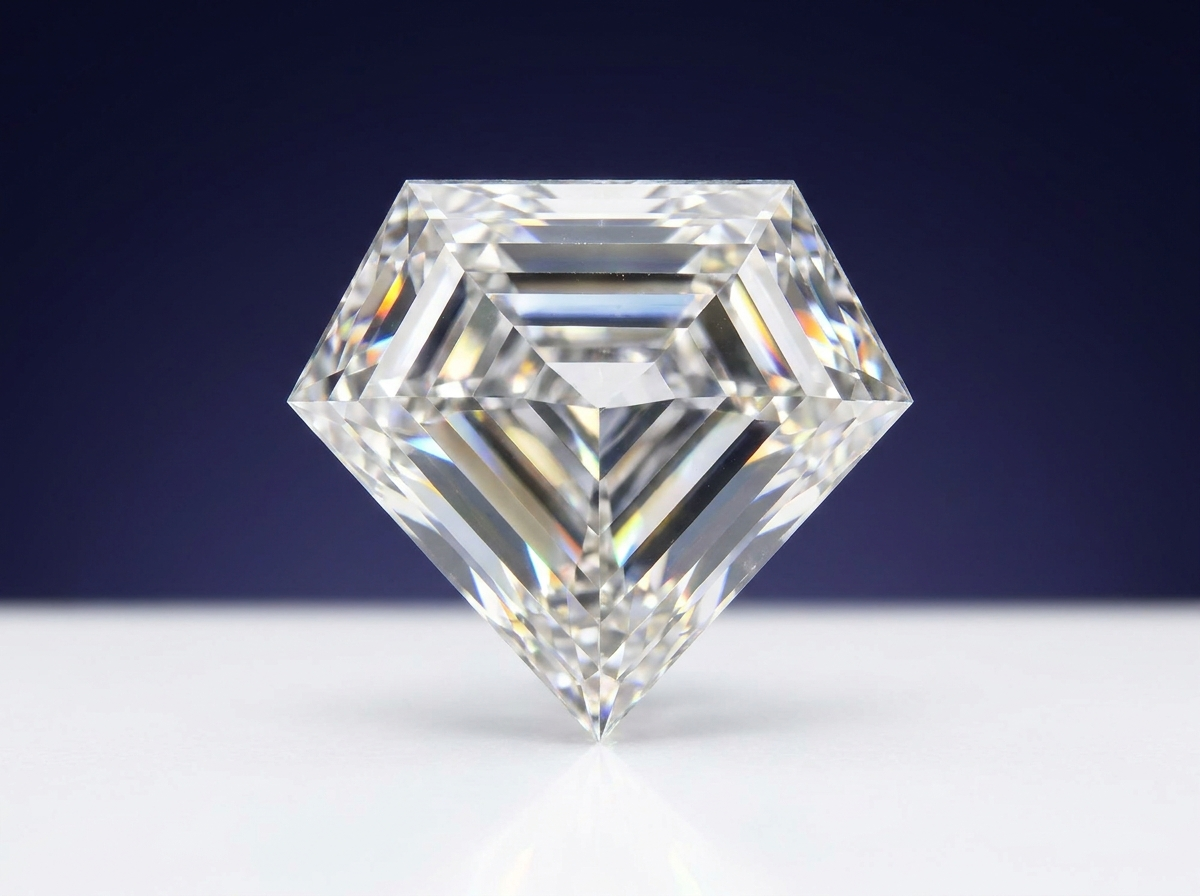
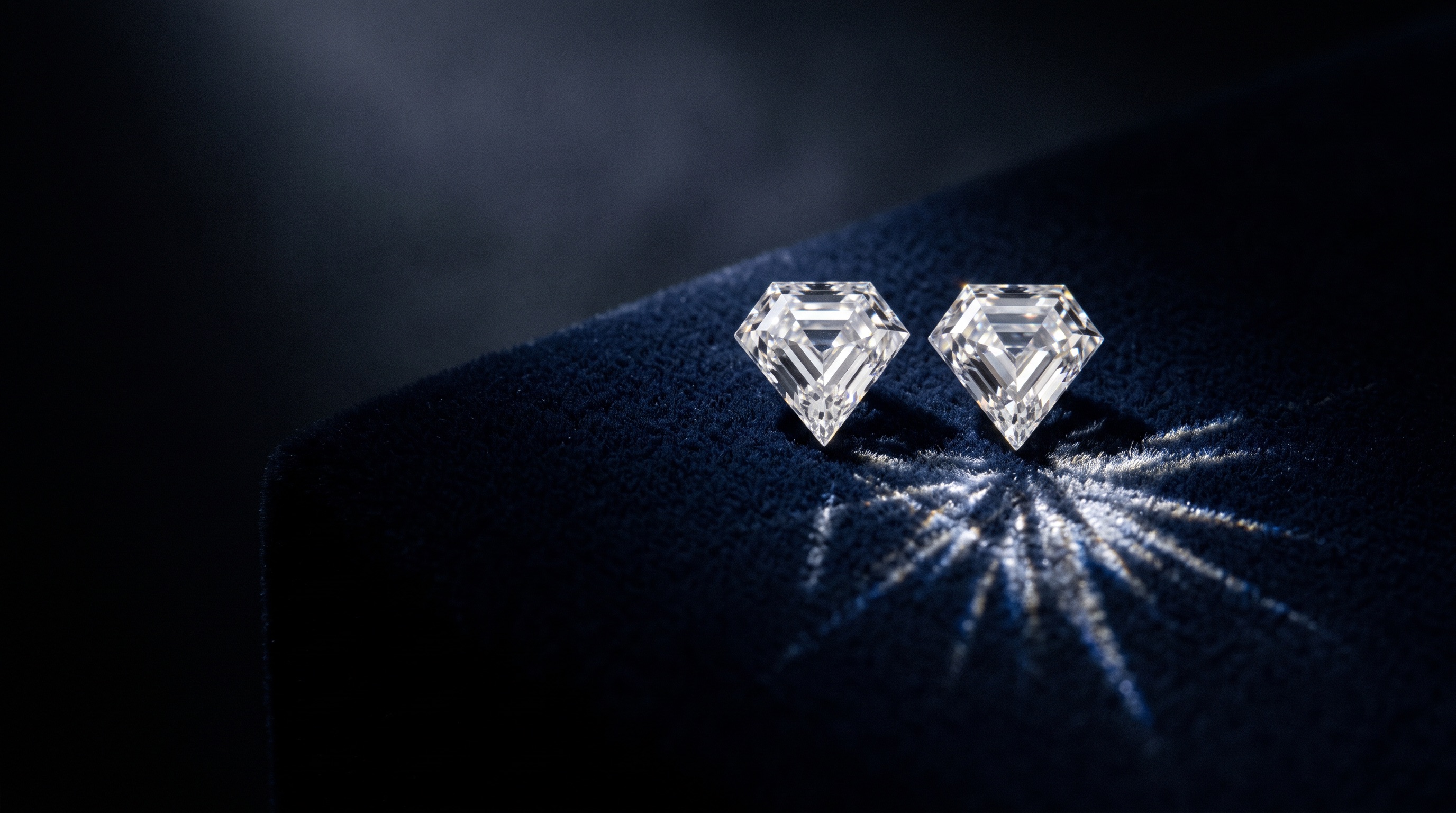
A Shield cut diamond is a calibrated five-sided side stone — a flat top edge and two angled shoulders tapering to a point or a softly curved base, shaped like a heraldic shield. It's built to flank a center stone rather than stand alone, most often paired around emerald and radiant cuts in three-stone and halo settings. Guru Diam stocks 206+ Shield diamonds, calibrated and matched, IGI-gradable on request.
For a jeweler filling a custom order, the Shield sits in a narrow but useful lane: not a headline shape, but the specific geometric answer to a design problem — a straight-edged center stone that needs a side stone with a matching straight edge, not a curve. This guide covers how a Shield is faceted, where it sits relative to other calibrated side-stone shapes, how Guru Diam sources and matches pairs and sets at wholesale scale, what drives price, how it compares to the kite and trapezoid cuts it's most often confused with, and how a trade account places an order.
What Is a Shield Cut Diamond?
A Shield is a five-sided outline: one straight edge across the top, two angled facets running down each shoulder, and either a sharp point or a rounded edge at the base — both variants exist in the trade, and which one a setting calls for depends on the design. The faceting is typically step-cut, in keeping with the other calibrated side-stone shapes in this category, which keeps the stone visually quiet next to a higher-fire center rather than competing with it.
The shape earns its name from the outline, not from any historical connection worth reading into — it's a functional geometric side stone, and the "shield" label just describes what the silhouette looks like at a glance. That's a useful thing to understand when a customer asks about it: there's no period story to sell, and the honest answer holds up better at the counter than an invented one.
In trade terms, a Shield reads as a cousin to the trapezoid and the half-moon — all three are calibrated outlines built to sit flush against a straight or curved edge of a larger center stone. What sets it apart is the combination of a flat top and a tapering base in a single five-sided shape, which gives a setter one edge to seat against the gallery and one edge to use for visual elongation, in the same stone.
Anatomy of the Cut: Facet Structure and the Two Base Variants
A Shield's facet structure follows the same logic as other step-cut side stones: a table facet at the crown, a run of parallel or near-parallel step facets down toward the girdle, and a pavilion cut to return light evenly rather than to maximize brilliance. Step-cutting keeps the stone from throwing more fire than the center it's flanking, which would pull the eye away from the piece's focal point, and reads as clean, flat planes of light rather than scattered sparkle — what makes a calibrated side stone look deliberate and matched rather than incidental.
Pointed Shield vs. Curved-Base Shield
Both variants share the same top: a flat edge and two angled shoulders. The difference is entirely at the base. A pointed Shield tapers to a sharp vertex, giving the outer edge of a three-stone ring or a halo a crisper, angular finish. A curved-base — sometimes called a rounded-base — Shield softens that taper into a gentle arc, blending more smoothly into a rounded shank or a softer design language.
Neither variant is more "correct"; the choice is a setting decision, not a grading one. A strongly geometric build — an Art Deco-influenced three-stone ring — typically calls for pointed Shields to keep every line sharp. A softer bridal design usually calls for the curved-base version. Both are standard-issue rather than a rare special order, but mixing a pointed Shield with a curved-base one in the same pair defeats the purpose of matching, so the setting decision needs to happen before the order does.
An elongated Shield — proportionally longer and narrower than standard — is also a standing request, used when a design calls for a more dramatic taper flanking an elongated center such as an emerald or radiant with a higher length-to-width ratio.
Where the Shield Sits in the Trade: A Specialty Side-Stone Shape
It's worth being precise about where the Shield fits in a wholesale catalog, because it's easy to lump every unusual outline into one bucket. A Shield is not a solitaire shape — it's rarely, if ever, set alone as a center stone. It's a specialty side-stone shape, part of a family that also includes the kite, the trapezoid, the half-moon, the bullet, and the tapered baguette, all built to solve the same problem: how to flank a larger center stone with something that sits flush against its edge instead of leaving a visible gap or an awkward mismatch of curves.
Within that family, each shape answers a slightly different version of the problem. A kite — four-sided, diamond-oriented, with a point at top and bottom — is typically set corner-to-corner alongside a round or oval center, often in a vintage-leaning build. A trapezoid, with two parallel sides of different lengths, is the standard choice for flanking a cushion, princess, or asscher center with a fully straight edge on both sides. A Shield splits the difference: one flat edge to seat against the center stone, one tapering point or curve for the visual sweep — which is why it shows up disproportionately around emerald and radiant centers rather than rounds or ovals.
None of this makes a Shield an "antique" cut the way an Old Mine or Old European stone is — it's a modern, functional calibration shape, cut to spec for a setting rather than carrying period design lineage. It sits alongside the kite in a specialty side-stone offering, but the two serve different design briefs and shouldn't be treated as interchangeable.
What Shield Side Stones Are Used For
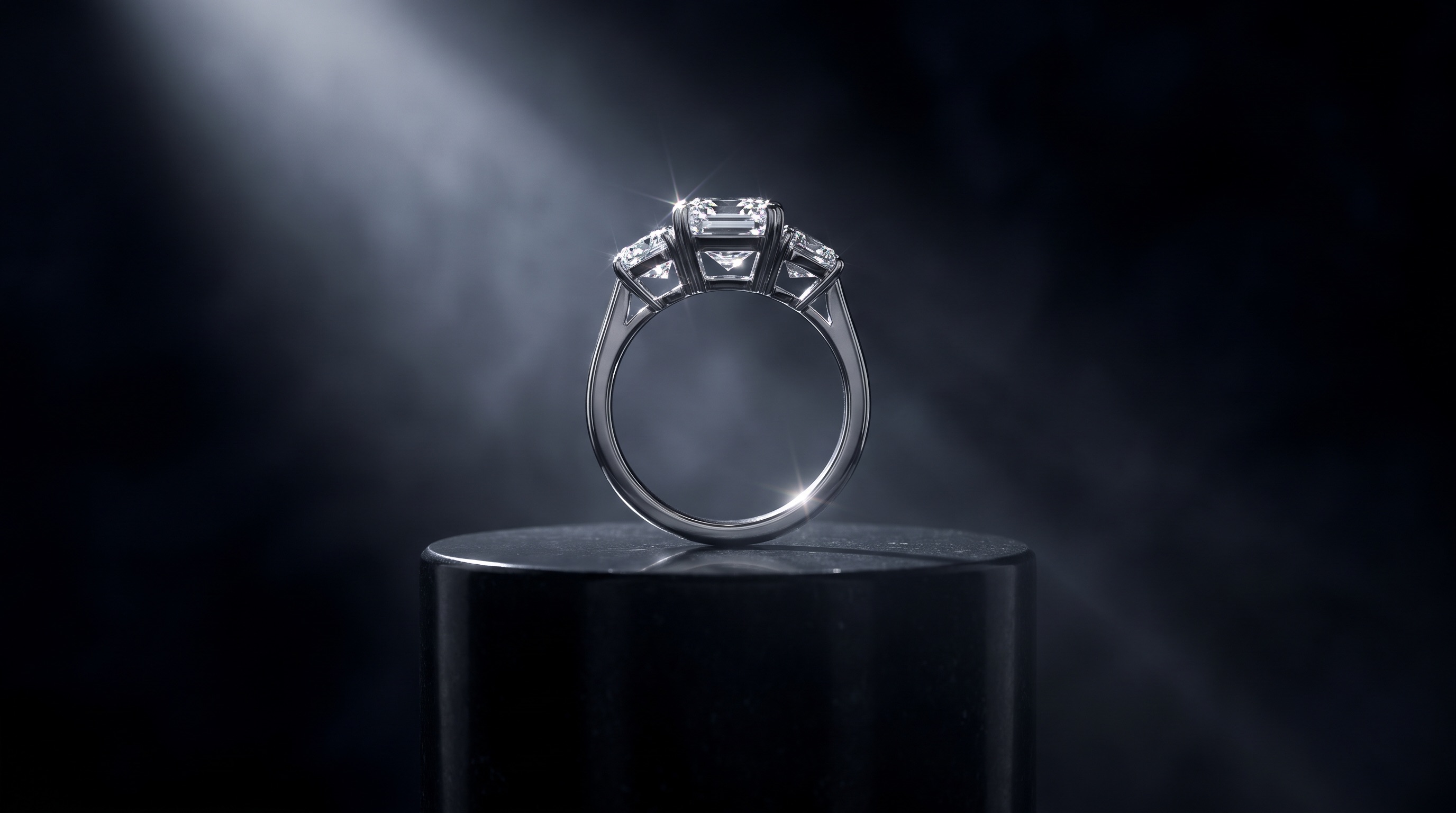
Shields are cut to flank a center stone, almost always in pairs or larger matched sets. The flat top edge is what makes the shape work in a setting: it sits flush against the gallery or the center stone's girdle, while the tapered base draws the eye outward and elongates the overall look of the ring. That geometry is why Shields show up most often around emerald and radiant centers — both shapes have straight, angular outlines a Shield's flat top edge can sit cleanly against, in a way a curved-edge side stone can't match as precisely.
Three-stone rings are the most common application: two Shields, one on each side of an emerald or radiant center, mirrored so the points (or curved bases) face outward. Halo settings use them the same way at a smaller scale, sometimes graduated around the perimeter — a larger pair near the center stone's shoulders tapering down to smaller matched Shields further around the curve.
Beyond the two dominant applications, a Shield also turns up flanking a bezel-set or East-West set center stone, and as a corner or shoulder stone on a wider band. It essentially never appears as a true solitaire — the shape's design logic depends on something for it to flank. For a jeweler taking a custom order, the practical question to ask early is which center stone the Shields need to complement, since that determines both the flat top's seating angle and whether a pointed or curved-base pair reads better against it.
Sourcing and Matching: Why a Shield Order Is a Matching Problem First
Like any calibrated side stone, a Shield order is a matching problem before it's a grading problem. A three-stone ring needs two Shields that mirror each other in size, angle, and tone; a halo build might need several, graduated and consistent. That requires a supplier holding real depth in the shape and size range needed — not one Shield pulled from a mixed lot and a second one that's close enough.
This is where most of the friction shows up in the category. A typical lab-grown wholesaler stocks a general assortment of calibrated side stones without depth in any single shape or size band, so a request for a matched Shield pair often comes back as an approximate match — close in carat weight, but off in angle or facet proportion in a way that's obvious once the two stones sit side by side. For a three-stone build especially, a visible mismatch undercuts the whole piece, since the eye reads symmetry, or the lack of it, immediately.
Matching gets harder as the order gets more specific. A single pair for a standard-size emerald center is straightforward; a graduated set of six or eight Shields for a full halo, all reading as one continuous line, requires a supplier holding enough raw material to select from a real range rather than force a match out of whatever's on hand.
Guru Diam calibrates and mirrors Shield pairs in-house, CVD lab-grown, IGI-gradable on request. Because the cutting happens in-house rather than being brokered from a third-party lot, matched sets for a specific center stone size are a standard request rather than a special one.
How Guru Diam Cuts and Matches Shield Diamonds In-House
Cutting Shields in-house, rather than sourcing pre-cut stones from a mixed parcel, changes what's possible on a matching request. When the same operation controls the rough all the way through to the finished calibrated stone, a matched pair or graduated set can be planned together from the start — same angle specification, same proportions, same finishing standard — instead of being assembled after the fact from whatever's close enough in existing inventory.
That control matters most on requests a typical wholesaler can't easily fill: a custom size to mirror an unusually large center stone, or a graduated set where six or eight stones need to read as one family — planning the order around the specific center stone it's meant to flank, rather than asking a jeweler to adjust their design to whatever's sitting in a parcel.
The stones are CVD lab-grown, consistent with the rest of Guru Diam's white diamond catalog. IGI grading is available on request for Shield side stones, and IGI, GIA, or GCAL certification can be arranged for the center stone they're matched to — handled as separate decisions, since a calibrated side stone and a certified center stone serve different documentation needs.
Grading and Quality Considerations for Shield Side Stones
Grading a calibrated side stone is a different exercise than grading a solitaire. A center stone gets graded on its own merits — cut precision, color, clarity, and how those combine to produce fire and brilliance as a stand-alone piece. A Shield side stone gets evaluated primarily on how well it does its job: does it sit flush against the center stone's edge, does it match its partner in tone and proportion, and is it eye-clean enough that no inclusion draws attention away from the center stone it supports.
That's why Shields are conventionally sold as calibrated matched-set goods rather than individually graded pieces — the same convention used across the calibrated side-stone category, whether the shape is a Shield, a trapezoid, a kite, or a baguette. IGI grading is available on a Shield order when a project calls for it, but the baseline standard a wholesale buyer should expect is consistency within the set: matched color grade, clarity tier, and cut proportions across every stone in a pair or graduated group.
A few things are worth checking specifically. Symmetry between the two shoulders matters more here than on many calibrated shapes, since any asymmetry in the flat top's angle or the base's taper is immediately visible once set. Tone consistency across a matched pair matters as much as clarity grade — two individually clean stones that read even slightly differently in body color look mismatched under normal lighting. For a graduated halo set, size progression needs to be smooth, since a visible jump between adjacent stones breaks the continuous line a halo is supposed to create.
Center stones flanked by Shields are certified separately, through whichever of IGI, GIA, or GCAL the project calls for — standard practice across the calibrated side-stone category, not specific to Guru Diam.
What Drives Wholesale Pricing on Shield Cut Diamonds
Pricing on a Shield order breaks down into a handful of factors worth understanding before requesting a quote.
- Size and carat weight. Larger Shields cost more per stone, and the relationship isn't linear — a jump into a size band that needs more raw material to hold proportions carries a proportionally larger price step.
- Set complexity. A single pair for a three-stone build is the simplest, most cost-efficient request. A graduated set of six or more for a full halo costs more per stone, since holding a consistent match across a longer run takes more raw material and selection work.
- Custom sizing. A Shield cut to mirror an unusually proportioned center stone, rather than a standard calibrated size, carries a premium over pulling from existing matched inventory.
- Quality tier. Color and clarity move price the same way they would on any diamond, though the practical threshold for a side stone is eye-clean rather than top-of-scale clarity, since its job is to complement the center stone rather than draw scrutiny of its own.
- Point vs. curved-base variant. The two base styles price comparably; neither carries a routine premium since both are standing options.
- Certification. IGI grading on the Shield stones themselves adds a line item beyond the calibrated matched-set price, worth requesting when a project specifically calls for documented grading on the side stones.
For a manufacturer pricing a custom build in advance, the most efficient path is to specify the center stone's shape and approximate size, the setting type, and whether a pointed or curved-base pair is needed — enough for a wholesale desk to return a real quote rather than a wide estimate range.
Styling Shield Cut Diamonds: Three-Stone Rings and Halo Accents
Three-Stone Settings
The three-stone ring is the Shield's primary application: two Shields, mirrored on either side of an emerald or radiant center, flat top edge seated against the center stone's girdle and the point or curved base sweeping outward toward the shoulder. The visual effect is elongation — the ring reads longer along the finger than the center stone alone would suggest, which is why Shields pair so consistently with emerald and radiant cuts, shapes that already carry a length-to-width ratio that benefits from the extra sweep.
Orientation matters. Both Shields need to mirror each other exactly — same base variant, same angle, same proportional size — or the asymmetry reads immediately once the ring is finished. That's the design reason matched-pair sourcing matters: two individually fine Shields that aren't a true mirrored pair look subtly off once pointed out.
Halo Settings
In a halo, Shields work at a smaller scale and usually in larger groups — a full perimeter built from multiple matched or graduated stones rather than a single pair, graduating larger near the center stone's shoulders and tapering down through the sides. Done well, the effect reads as a continuous frame rather than individually visible accents, which is why size progression and tone consistency matter more here than in a simple three-stone pair.
Shields also work as a smaller-scale accent on a halo's shoulders specifically — a single matched pair beside a round or cushion halo, a lower-cost way to bring the elongating effect into a design not built around an emerald or radiant center. The same logic applies to drop earrings and pendant accent work, where a paired Shield produces a similar sweep translated to a vertical line.
Shield Cut vs. Kite Cut vs. Trapezoid Cut
These three shapes get confused for each other more often than any other pairing in the calibrated side-stone category — all three are angular, typically sold as matched sets, and flank rather than stand alone. The differences matter once a design is actually being built.
Shield: Five sides. One flat top edge, two angled shoulders, and a base that either tapers to a point or curves. Built to seat its flat edge against a straight-edged center stone — emerald and radiant are the standard pairings — with the tapered base providing the elongating sweep on the outer edge.
Kite: Four sides, points at both top and bottom, oriented like a rotated square. It doesn't have a flat seating edge the way a Shield does — it's typically set corner-to-corner alongside a round, oval, or cushion center, often in a vintage-influenced build. Where the Shield sits flush against a straight edge, the kite introduces an angular accent against a curved one. Kite is treated as an antique-tier cut in Guru Diam's catalog, reflecting its more frequent use in period-influenced design work, whereas the Shield is a modern calibration shape without that lineage.
Trapezoid: Four sides, with two parallel edges of different lengths — unlike the Shield's single flat edge and tapering base, a trapezoid is flat on both the inner and outer sides, just at different widths. It's the standard choice for flanking a center stone with a fully straight profile on both sides it touches — princess, asscher, and square-cornered cushion centers most commonly.
In practice, the shape a design calls for comes down to the center stone's outline and the effect wanted at the outer edge: a sweeping, elongated look calls for a Shield; a uniformly flat, architectural frame calls for a trapezoid; an angular accent against a curved center calls for a kite. All three are available as calibrated matched sets, and the sourcing considerations above — depth of stock, in-house cutting versus brokered lots — apply equally across all three.
How to Order Shield Cut Diamonds Wholesale from Guru Diam
Ordering Shield side stones at wholesale runs through a trade account rather than a public storefront — standard for calibrated matched-set goods, since pricing depends on the specific project rather than a flat per-stone rate.
The most efficient way to move from inquiry to quote is to specify the project up front: the center stone's shape and approximate size, whether the build is a three-stone ring or a halo, how many stones the order requires, and whether a pointed or curved-base variant fits the design. With that, Guru Diam's New York Diamond District desk can return live pricing and confirm whether a matched pair is available from stock or needs to be calibrated and mirrored to spec — a made-to-order request that's standard for this shape, not an exception.
Once a Shield pair or set is matched and approved, mounting into a finished custom ring follows Guru Diam's standard build timeline — a completed ring in 4–6 days from approval. That timeline applies to the finished piece; the loose Shield stones are calibrated and matched to order, since a genuine matched set can't be pulled off a generic shelf.
Open a wholesale account for live pricing and to request a matched Shield set for a specific project from our New York Diamond District desk.
FAQ
What is a shield cut diamond used for?
Shield cut diamonds are calibrated five-sided side stones used to flank a center stone, most commonly emerald or radiant cuts, in three-stone rings and halo settings. Their flat top edge and angled shoulders are built to complement a straight-edged center stone rather than stand alone.
What's the difference between a pointed shield and a rounded shield?
Both are five-sided outlines with a flat top and angled shoulders; the difference is the base, which tapers to either a sharp point or a softly curved edge. The choice comes down to the setting design and the look wanted at the outer edge of the piece.
Can I get a matched pair of Shield diamonds for a three-stone ring?
Yes. Matched pairs are the standard request for this shape — Guru Diam calibrates and mirrors Shield stones in-house so the two side stones read as a true pair in size, angle, and tone rather than an approximate match.
Are shield cut diamonds certified?
They're sold as calibrated matched-set goods, IGI-gradable on request, the same convention used for other calibrated side-stone shapes. Center stones are certified separately from the Shield side stones flanking them, through IGI, GIA, or GCAL depending on the project.
How is a shield cut different from a kite cut or a trapezoid cut?
A Shield has five sides — a flat top and two angled shoulders tapering to a point or curve — built to seat against a straight-edged center stone. A kite has four sides with points at top and bottom, typically set corner-to-corner against a rounded or oval center. A trapezoid has four sides with two parallel flat edges of different lengths, used to flank a fully straight-edged center. All three are calibrated matched-set shapes, each answering a different setting geometry.
Can Guru Diam cut Shield diamonds to a custom size for a specific center stone?
Yes. Because Shield diamonds are calibrated and matched in-house rather than sourced from third-party parcels, a custom size — cut to mirror the exact proportions of an unusually sized center stone — is a standard request, not a special order. Provide the center stone's shape and dimensions when opening a wholesale inquiry for an accurate quote.