
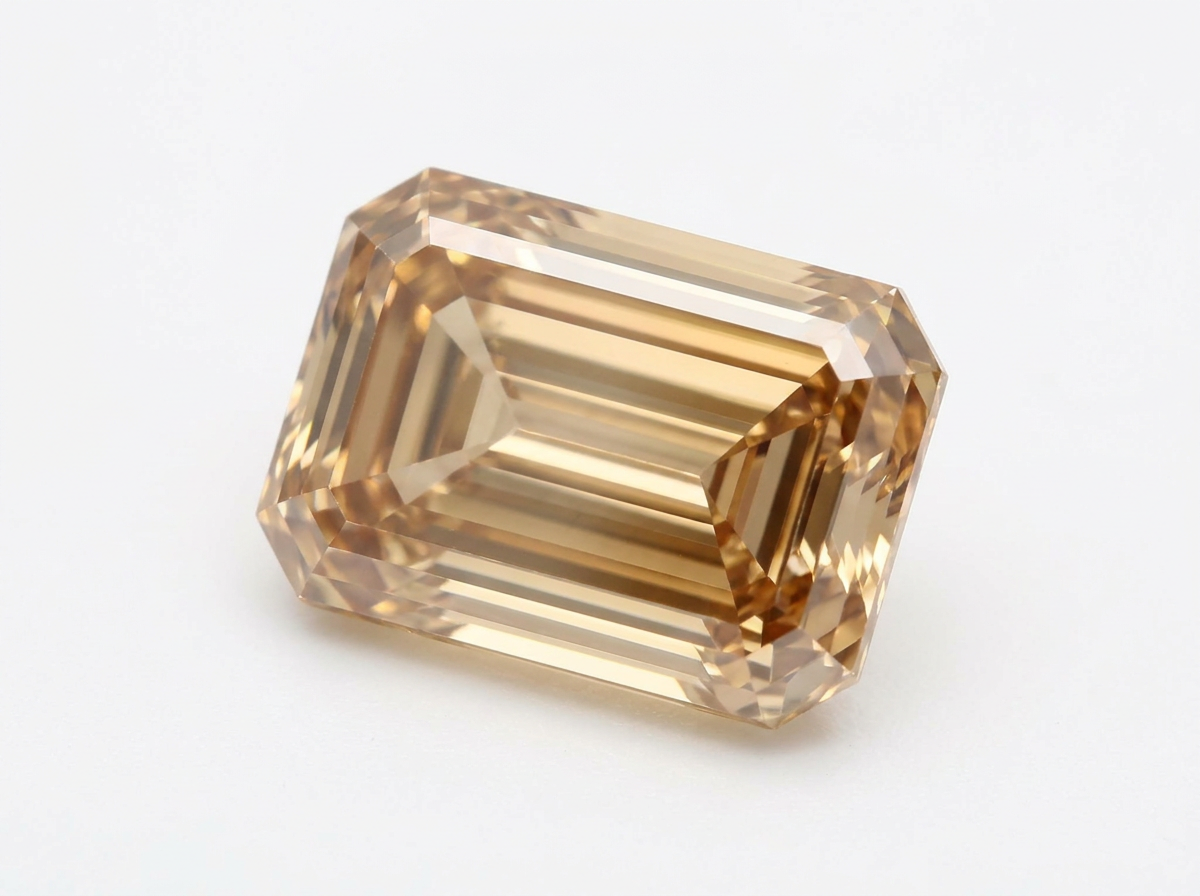
A champagne emerald cut diamond pairs a warm brown-to-golden body color with a rectangular step-cut facet pattern, which shows the color as one broad, even wash rather than scattered brilliant flashes. It's a specialty request rather than a shelf item at Guru Diam: champagne material is custom-sourced and cut in-house to the carat weight, saturation, and clarity a specific order calls for, alongside our standing certified fancy color program in yellow, pink, blue, and green.
Emerald is where champagne color performs best cosmetically, and it's also the shape buyers ask about first when they start a champagne sourcing conversation with a wholesale desk. The step-cut facet pattern holds color evenly across the open table instead of breaking it into scattered points of light, which is exactly what a warm brown-gold tone needs to read as rich rather than muddy. This guide covers what champagne color actually is, how the trade grades it, why the emerald cut suits it, what drives price, and how a custom-sourced order moves through Guru Diam.
What Is a Champagne Diamond? Color Origin Explained
Champagne is a trade and marketing name, not a formally recognized color category on its own. Grading labs classify the underlying hue as brown — champagne is simply the warmer, more palatable name the trade adopted because "brown diamond" reads as a defect to a retail buyer while "champagne diamond" reads as a deliberate color choice. Within that brown range, tone runs from a pale, almost-neutral champagne through deeper cognac and amber shades, with saturation varying stone to stone the way it does in any fancy color category.
The physics behind the color differs depending on whether the stone is natural or lab-grown. In natural diamond, brown-to-champagne color comes from plastic deformation of the crystal lattice — structural distortion that happened as the stone was pushed and sheared deep in the earth, which creates graining and lattice defects that absorb light unevenly and read as a warm brown tint. It's not caused by a trace element the way nitrogen causes yellow or boron causes blue; it's a mechanical artifact of the stone's formation, which is why natural champagne color can be inconsistent even within a single rough crystal.
In lab-grown material, the color is set deliberately rather than left to chance. CVD growth followed by controlled post-growth treatment — typically high-pressure high-temperature annealing — locks in the lattice defects responsible for the brown-to-gold hue. That's why lab-grown champagne color tends to read more even and more consistent from stone to stone than natural champagne material: the color center is engineered into the crystal rather than the product of unpredictable geological stress. Guru Diam's lab-grown catalog is CVD-grown across every color and shape — no HPHT, no HPHT-plus-treatment material, anywhere in our production.
How Champagne Diamonds Are Graded: The C1–C7 Trade Scale
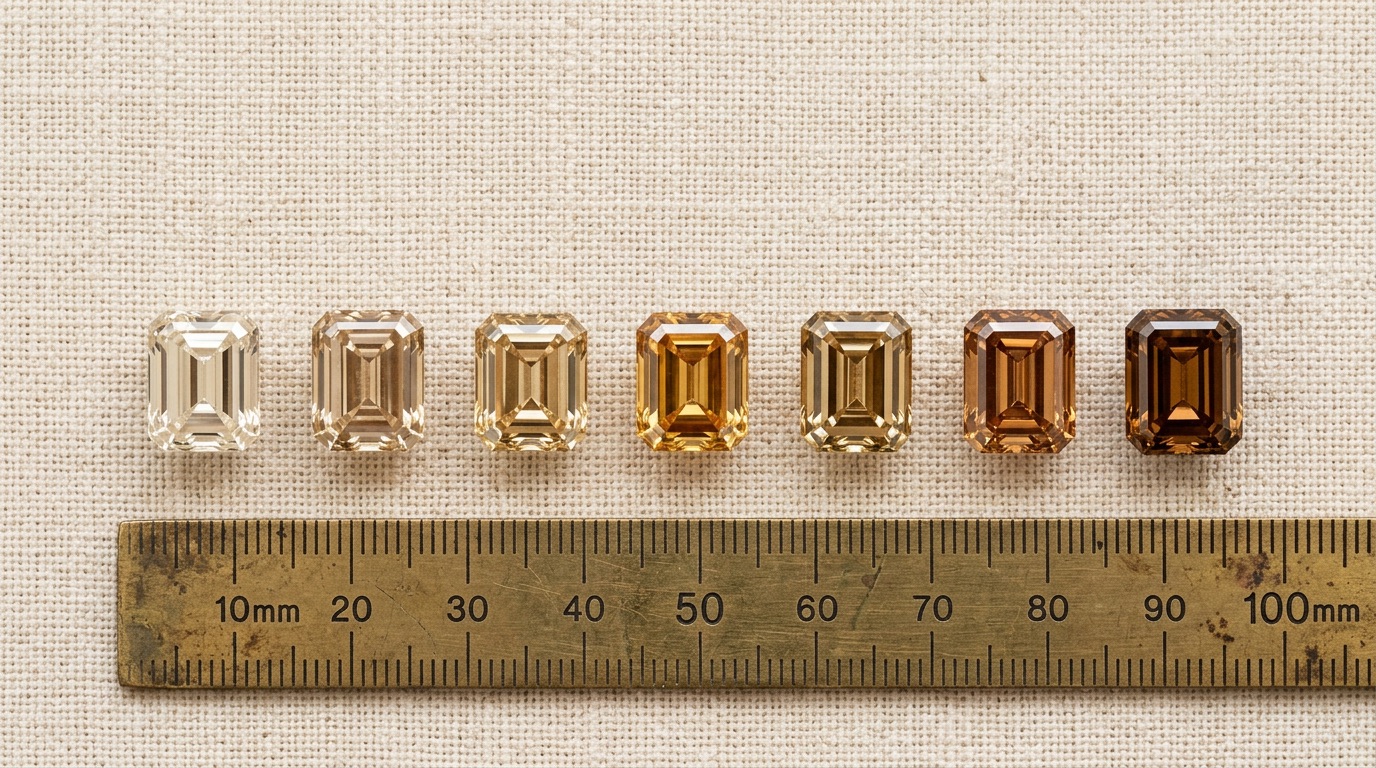
Certification labs don't print "champagne" on a report. IGI and GIA grade the stone under standard fancy-color nomenclature — hue, tone, and saturation combined into terms like Light Brown, Fancy Brown, Fancy Dark Brown, and Fancy Deep Brown — the same vocabulary used for every other fancy hue, just applied to brown. What the trade actually uses day to day is an informal shorthand: a C1 through C7 scale, popularized decades ago for marketing warm brown-toned diamonds and now the common language buyers and sellers use to talk price and depth of color without reading a full lab report line by line.
| Trade Grade | Approx. GIA/IGI Equivalent | Visual Character |
|---|---|---|
| C1 | Faint to Very Light Brown | Barely-there warmth, close to a warm-tinted near-colorless stone |
| C2 | Light Brown | Soft, pale champagne — subtle color visible face-up |
| C3 | Fancy Light Brown | Clear light champagne, the most common "engagement ring" depth |
| C4 | Fancy Brown | Medium champagne, solid warm gold-brown color |
| C5 | Fancy Dark Brown | Deeper champagne, edging toward cognac |
| C6 | Fancy Dark Brown (deep end) | Cognac — rich reddish-brown, bold and saturated |
| C7 | Fancy Deep Brown | Deepest cognac, near-espresso — dramatic, low-light performer |
Two things to flag when a client asks about the C-scale: it's a trade convention, not a standard the labs themselves issue, so two dealers can draw the C4/C5 line slightly differently — always cross-reference against the actual color description on the certificate rather than trusting a C-number alone. And saturation isn't the only variable that matters; tone (how light or dark) and any secondary hue modifier (a champagne stone can lean slightly yellow, pink, or grey) both affect how a given C-grade actually looks face-up.
Champagne vs. Cognac vs. Yellow: How the Fancy Colors Compare
Champagne, cognac, and yellow get grouped together informally because they're all warm-toned fancy colors, but they're distinct in origin, market position, and — for a wholesale buyer — availability.
| Spec | Champagne | Cognac | Yellow |
|---|---|---|---|
| Color origin | Brown color grade, light-to-medium end | Brown color grade, dark/saturated end (C5–C7) | Nitrogen-related yellow hue, separate color family |
| Typical look | Soft gold-to-tan wash | Deep amber-red-brown, bold | Bright lemon to rich canary |
| Relative price tier | Accessible, close to white diamond pricing | Accessible-to-mid, depth adds some premium | Mid-tier, below pink/blue |
| Guru Diam status | Custom-sourced on request | Custom-sourced on request | Standing certified fancy color program |
That last row is the practical distinction for a buyer placing an order. Guru Diam's standing certified fancy color loose-stone program covers yellow, pink, blue, and green — those four ship from a real on-hand spread of sizes and clarity grades. Champagne and cognac aren't part of that standing line; they're specialty colors we source and cut to order rather than hold as open stock. If a client's brief calls specifically for champagne, that's a different conversation and a different timeline than pulling a yellow stone off the shelf — worth setting that expectation with the client up front rather than after the order's placed.
What Makes a Champagne Emerald Cut Distinctive
An emerald cut is a step cut: long, parallel facets arranged in concentric rectangles around a trimmed-corner outline, instead of the small, scattered facets a brilliant cut uses. That faceting style produces a hall-of-mirrors effect — broad, flat flashes of light rather than scintillating sparkle — and for a colored stone, that's an advantage rather than a compromise. Step-cut faceting holds color across the whole open table as one continuous, even wash, so a champagne emerald cut reads as a single warm, glowing sheet of color rather than fragmenting it into scattered points of light the way a brilliant facet pattern would with the same rough. That's the same reason step cuts are the strongest color performers across the fancy color range generally, and it's especially visible in a warm tone like champagne, where an even wash reads as rich rather than muddy.
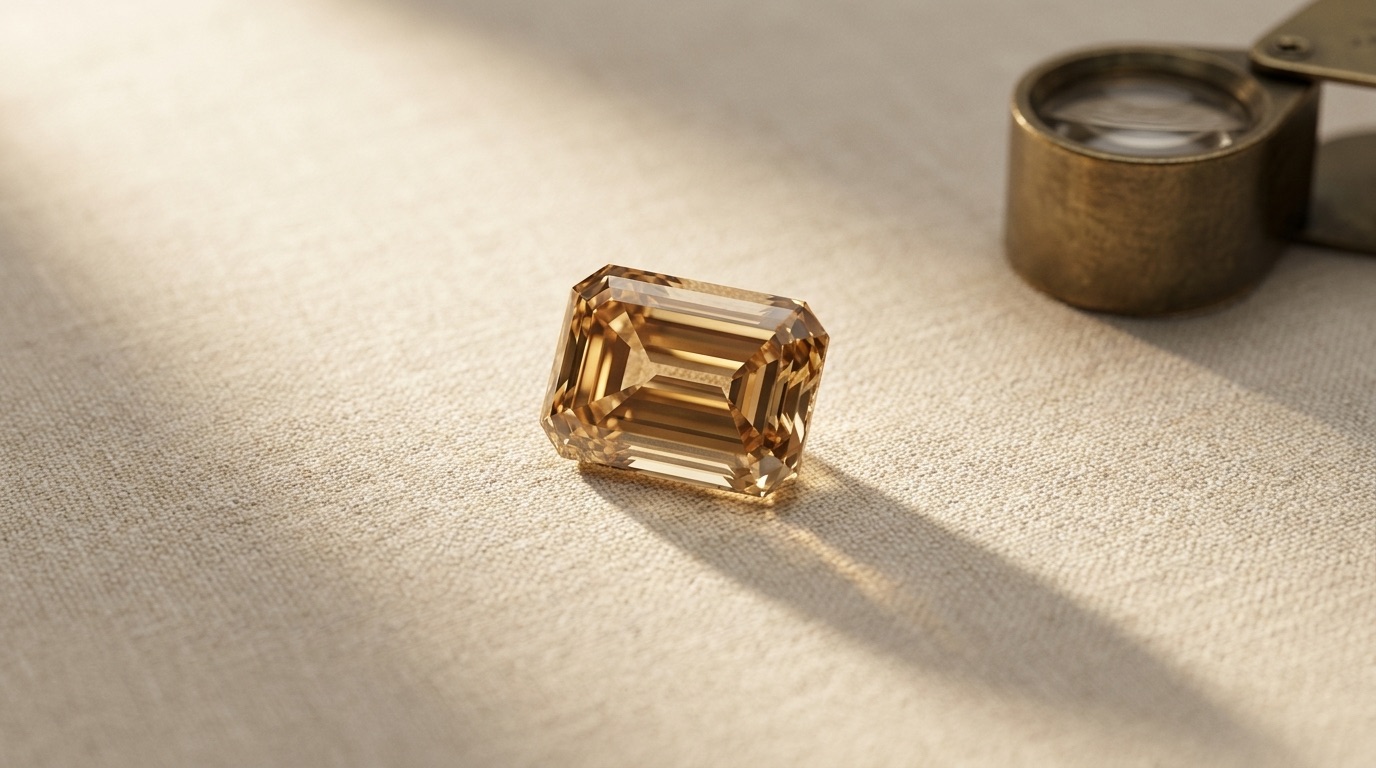
The trade-off is the same one that applies to any step cut: because there are fewer, larger facets, inclusions and color zoning are more visible to the eye than they would be in a brilliant-faceted shape of the same clarity grade. Worth checking under magnification before committing to a stone, the same discipline that applies to any emerald cut purchase regardless of color.
Why the Emerald Cut Is the Strongest Shape for Champagne Color
Shape choice matters more for a colored stone than it does for a white diamond, because the facet structure directly changes how much of the body color the eye actually registers. A brilliant round or cushion scatters light in every direction, which dilutes a light-to-medium champagne tone — the stone can read close to colorless in some lighting. An emerald cut does the opposite: the open table and long parallel facets act almost like a window onto the body color, so even a lighter C2–C3 stone shows real, visible warmth rather than fading out.
That's the mechanical reason emerald tends to be the first shape a buyer reaches for once they've decided on champagne. It's also forgiving on carat weight relative to face-up size — the elongated rectangular outline reads larger than a round or cushion of the same weight, which matters when a client is balancing color depth against budget. For a buyer building a custom center-stone request, specifying emerald cut alongside a target C-grade is the fastest way to land on a stone that actually performs the way champagne color is supposed to.
Champagne Diamonds in the Trade: 2026 Market Context
Champagne has moved from a bargain-bin fancy color to a shade buyers ask for by name. Warm, brown-to-golden diamonds have picked up renewed attention in bridal and fashion editorial coverage over the past couple of years, positioned as a soft-luxury alternative to both traditional white diamonds and the primary fancy colors. Designers point to a broader shift toward antique-inspired, individual choices over conventional ones — a client wants a stone that reads as personal, not a stone that reads as "correct."
For a wholesale buyer, that shift matters less as a style note and more as a pricing and sourcing question. Champagne solves a real price problem: pink and blue diamonds carry a steep premium even in lab-grown form, which puts them out of reach for a lot of everyday custom and bridal work. Champagne delivers visible, distinctive color at a price point close to white diamond, which makes it a much easier stone to pitch to a retail client than a novelty color with a steep markup. The catch, from a supply standpoint, is that most lab-grown wholesalers don't carry champagne as a standing certified line the way they do yellow or white — it's a color most suppliers, including Guru Diam, handle as a custom-sourcing category rather than open inventory. Confirm sourcing lead time with whichever supplier you're working with before quoting a client a delivery date.
How Guru Diam Sources Champagne Emerald Cut Diamonds
Guru Diam's certified loose fancy color inventory runs yellow, pink, blue, and green — the four colors we carry as a standing, on-hand program with a real spread of sizes and clarity grades ready to move. Champagne isn't part of that standing line. When a client needs a champagne emerald cut center stone, we treat it as a custom-sourcing request: CVD-grown material selected and cut in-house to the exact carat weight, C-grade, and clarity a specific order calls for, rather than pulled from open stock.
Certification runs the same way it does across the rest of our catalog — IGI as standard, with GIA and GCAL available on request, so a client can match whichever lab their retail market recognizes. Once a stone is sourced and confirmed, setting it into a custom piece follows our standard finished-jewelry production path: CAD approval to finished piece runs 4–6 days from our New York and Los Angeles desks. That turnaround applies to the setting and production work, not to sourcing the loose stone itself — for a buyer used to picking a champagne stone off a tray, that's a different rhythm than shopping our round or yellow program, and worth planning for as a sourced order rather than a same-day pull.
Quality Considerations When Buying Champagne Emerald Cuts
Three things determine whether a champagne emerald cut performs the way a client expects it to, beyond the basic carat-and-clarity numbers on a certificate.
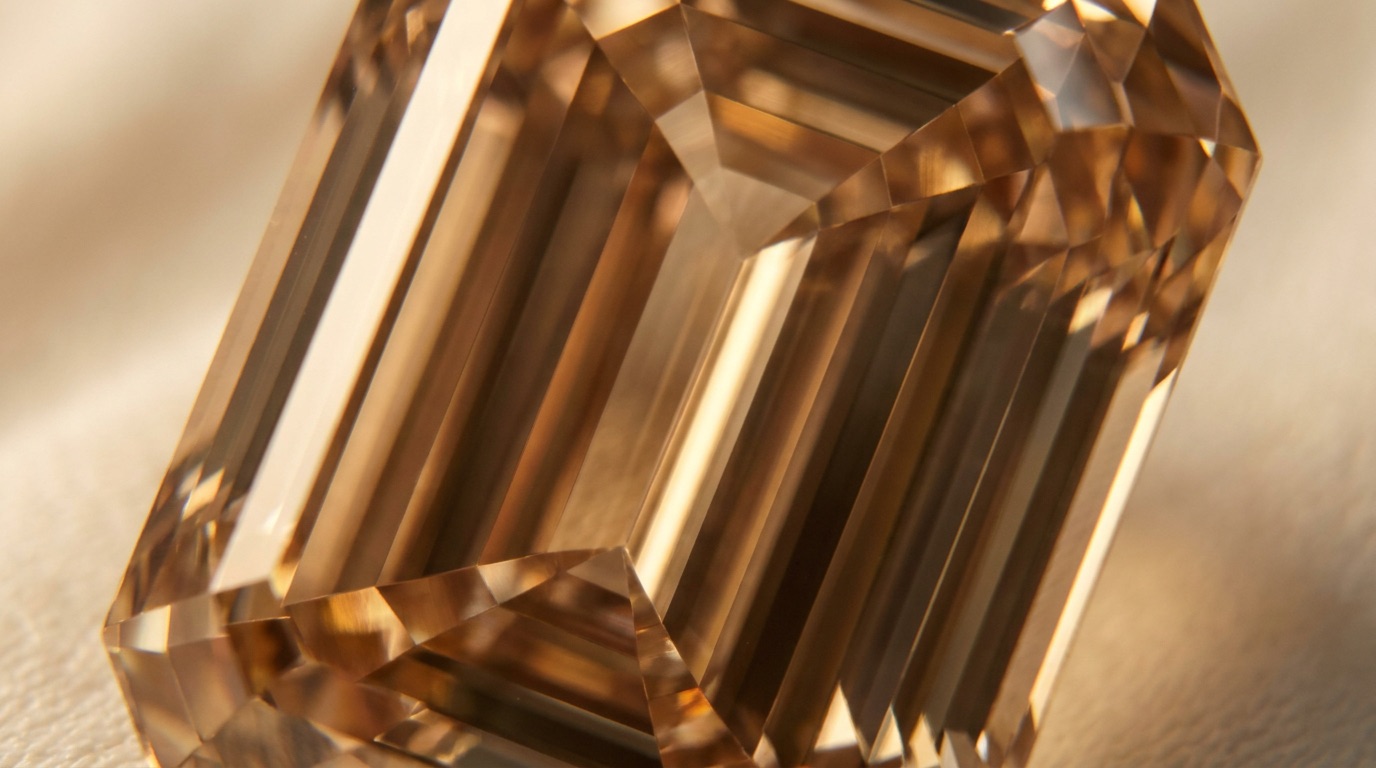
Saturation and zoning. Champagne color isn't always distributed evenly through the rough. Zoning — patches of stronger or weaker color within the same stone — is more visible in a step cut than a brilliant, because the open table doesn't break the color up the way scattered brilliant facets do. Ask to see the stone's color distribution, not just its overall grade, before committing to a specific piece.
Clarity under magnification. The same open-table structure that makes color read evenly also makes inclusions easier to spot. A clarity grade that would be nearly invisible in a round brilliant can be noticeably more visible in an emerald cut of the same grade. This matters more for champagne than for a colorless stone, because a client is already looking for a strong, clean field of color — an inclusion sitting in the middle of that field draws the eye. Always check the actual stone under 10x magnification rather than relying on the grade alone.
Cut proportions and the "window" effect. A poorly proportioned emerald cut can show a "window" — a washed-out, glassy patch in the center of the table where light passes straight through instead of reflecting color back to the eye. This is a bigger issue in a colored stone than a white one, because a window in a champagne diamond looks like a pale, dead spot right where the color should be strongest. Depth-to-width ratio and pavilion angle both affect whether a given emerald cut shows a clean, even wash of color or a washed-out center — worth asking about proportions specifically, not just the standard 4Cs, when sourcing a champagne center stone.
Pricing Factors for Champagne Emerald Cut Diamonds
Champagne sits at the accessible end of the fancy color spectrum, but price still moves with a handful of specific variables:
Carat weight. Same curve as any diamond — price scales non-linearly, with jumps at common carat breakpoints (0.50ct, 1.00ct, 1.50ct, 2.00ct).
C-grade / saturation. Deeper, more saturated stones in the C5–C7 cognac range typically command a modest premium over pale C1–C3 material, since strong, even saturation is harder to source consistently than light color.
Clarity. Because a step cut shows inclusions more readily, eye-clean clarity carries more weight in pricing a champagne emerald cut than it would in a brilliant shape — a client paying for a clean, unbroken field of color is paying to avoid the exact flaw a step cut would expose.
Certification lab. IGI, GIA, and GCAL reports are all accepted in the trade; which one a client requests is usually a market-recognition decision rather than a quality one, but it can shift price slightly depending on which lab a given retail market trusts most.
Cut precision. A well-proportioned emerald cut that avoids windowing and shows even color commands more than a shallow or overly deep cut of the same carat and clarity, because proportion directly affects how the color performs face-up.
Relative to pink or blue lab-grown diamonds, champagne remains one of the more accessible fancy colors — closer to white diamond pricing than to the steep premiums pink and blue still carry even in lab-grown form. That accessibility is a large part of why it's easier to build a custom program around than treat as a one-off novelty request.
Styling and Use-Case Guidance
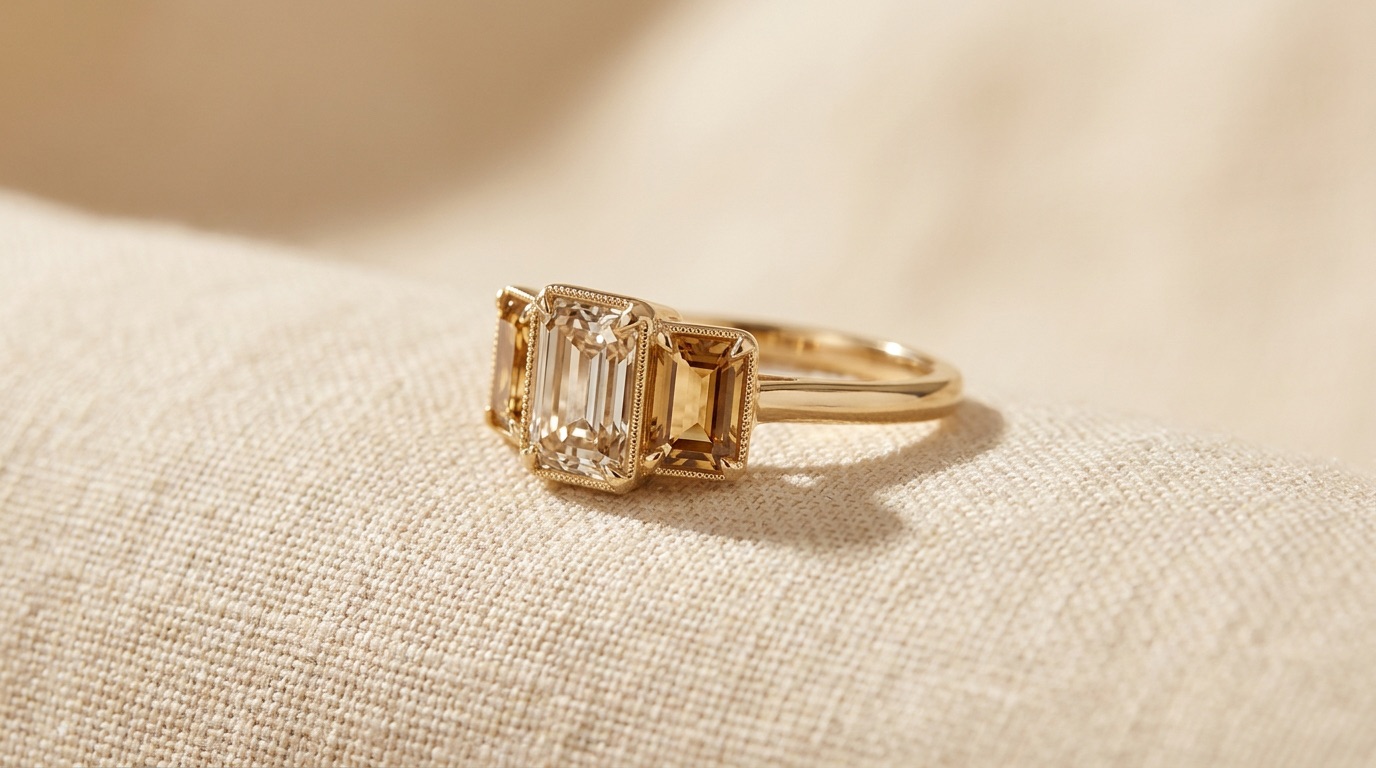
Champagne's warm, soft-gold tone is versatile across settings in a way some fancy colors aren't. A vintage-inspired setting — yellow gold, milgrain detail, antique-style prongs — leans into the warmth and reads as intentional, cohesive color pairing rather than contrast. In a black-rhodium-plated "blackened gold" setting — matte gunmetal-black collets with warm yellow-gold undertones peeking through — a champagne center stone reads high-contrast and architectural, closer to an antique-inspired statement piece than a conventional bridal look.
In a clean, modern setting — plain band, minimal prong work, white or rose gold — champagne functions as a soft, understated alternative to a traditional white center stone, which is a useful pitch for a client who wants something different without wanting an obviously "colored" stone. Emerald cut specifically pairs well with trillion or half-moon side stones for a three-stone design, or with a thin pavé shoulder that doesn't compete with the open table's color.
Outside of engagement rings, champagne emerald cuts work as statement cocktail rings, pendant centers, and — at smaller calibrated sizes — as accent stones in a broader mixed-color design. The same even-color-wash quality that makes it a strong center stone also makes it a clean match against yellow or white diamond side stones without the color reading as mismatched or muddy.
How to Order Champagne Emerald Cut Diamonds Wholesale
Because champagne is a custom-sourcing category rather than open stock, the process starts with a spec conversation rather than a catalog pull. A buyer should come with a target carat range, C-grade or saturation preference, clarity floor, and preferred certification lab (IGI, GIA, or GCAL); from there, Guru Diam sources and cuts the material in-house to match. Trade accounts get pricing and lead-time detail specific to the request — there's no fixed shelf price to quote until the parameters are set, because the stone itself doesn't exist as inventory until it's sourced.
Once a stone is confirmed, moving into a custom setting follows the same 4–6 day CAD-to-finished-piece production path as any other custom order from our New York and Los Angeles desks. Ready to start a champagne sourcing request? Open a verified wholesale account at /signup and book time with a gemologist at /book-appointment to talk through carat, color depth, and clarity targets before we source the stone. For the full champagne category across every shape, see our champagne color diamonds guide; for fancy color across all shades, see our fancy color lab-grown diamonds overview.
FAQ
What is a champagne emerald cut diamond?
A champagne emerald cut diamond is a warm brown-to-golden colored diamond cut in the rectangular, trimmed-corner step-cut style. The long, parallel facets show the color as one broad, even wash across the stone's open table rather than breaking it into scattered brilliant flashes.
Does Guru Diam stock champagne emerald cut diamonds ready to ship?
Champagne isn't part of Guru Diam's standing certified fancy color program — that program covers yellow, pink, blue, and green as on-hand inventory. Champagne emerald cut diamonds are available through custom sourcing: tell us the carat weight, C-grade, and clarity you need, and we source and cut the stone to spec rather than pull it from open stock.
Why does the emerald cut suit champagne color so well?
Step-cut faceting holds color evenly across the whole stone instead of fragmenting it the way a brilliant cut's smaller facets do. For a warm tone like champagne, that even wash reads as a rich, glowing color rather than a muddy or inconsistent one, and the open table acts almost like a window onto the body color — which is why lighter champagne grades still show visible warmth in an emerald cut.
What does the C1–C7 champagne grading scale mean?
C1–C7 is an informal trade shorthand for champagne color depth, running from C1 (faintest, barely-there warmth) to C7 (deepest cognac, near-espresso). It isn't a scale the certification labs themselves issue — IGI and GIA grade the underlying color as brown, using standard fancy-color terms like Light Brown, Fancy Brown, and Fancy Dark Brown. Always check the actual certificate description alongside any C-number a seller quotes.
Are champagne emerald cut diamonds lab-grown and certified?
Guru Diam's champagne material is CVD-grown, matching the rest of our lab-grown catalog. Certification runs IGI as standard, with GIA and GCAL available on request.
How fast can I get a champagne emerald cut stone or a finished custom piece?
There's no shelf inventory to pull from for champagne emerald cuts, so the loose stone is sourced to order rather than shipped same-day. Once the stone is in hand and a client is ready to move to a setting, the CAD-to-finished-piece build runs on our standard 4–6 day turnaround from our New York and Los Angeles desks.