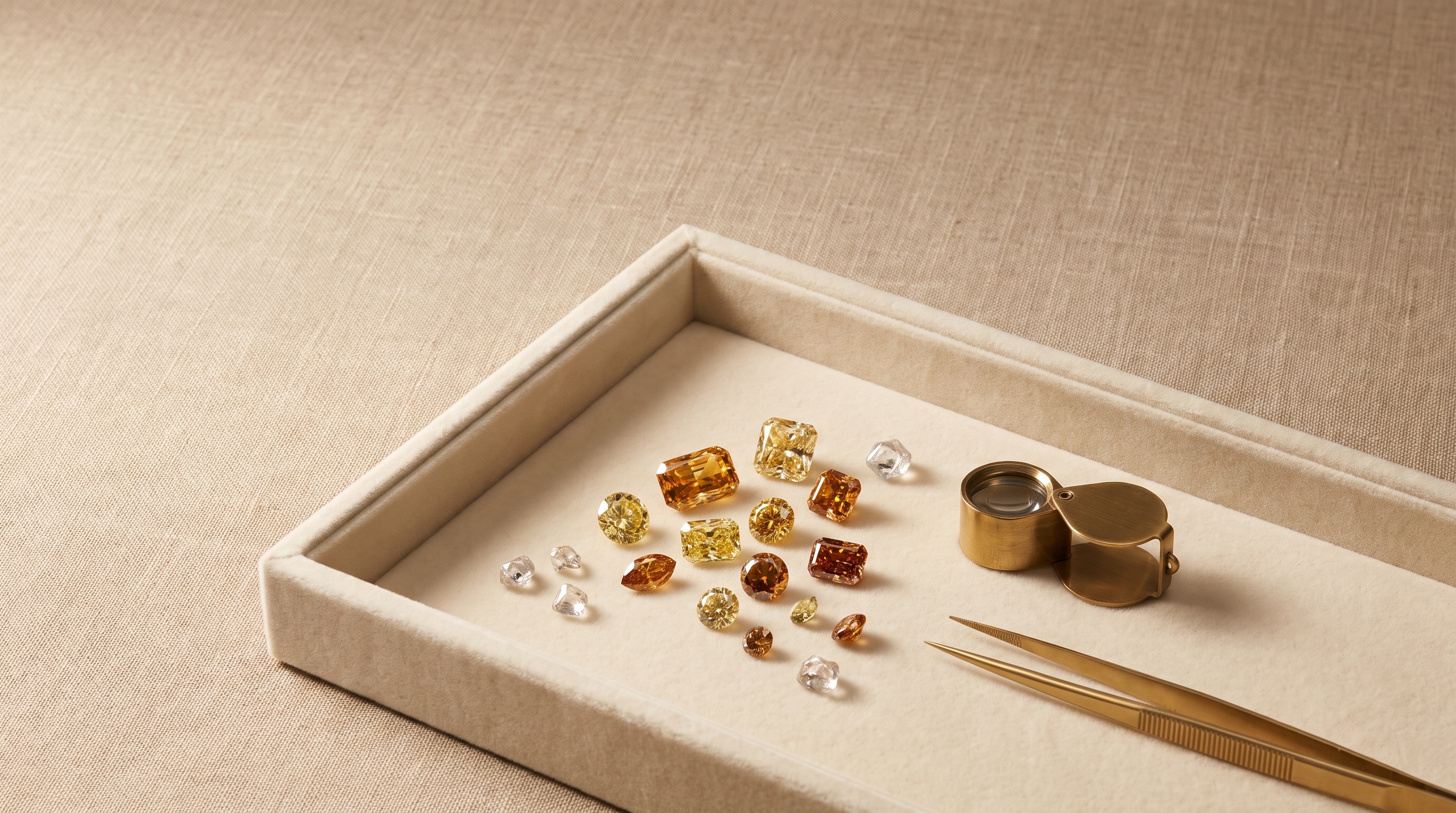
Fancy color lab-grown diamonds — yellow, pink, blue, and green being the commercially established colors — carry a narrower supplier base than standard white diamonds, since consistent, saturated color at scale requires more specialized growth and post-growth treatment expertise than white CVD production. Not every wholesale supplier that carries white lab-grown stock also carries a genuine fancy color line, and fewer still carry depth across all four established colors rather than one or two as a token offering.
This guide compares wholesale suppliers on fancy color lab-grown diamond depth specifically, along with the evaluation criteria that matter once a supplier's basic color range is confirmed.
Why Fancy Color Sourcing Is a Narrower Market Than White Diamonds
Producing a fancy color lab-grown diamond reliably requires either introducing specific trace elements during CVD growth (nitrogen for yellow, boron for blue) or applying a controlled post-growth treatment process to achieve pink or certain other colors, each of which demands tighter process control, more rejected rough, and more specialized post-growth equipment than standard white production. This is why fancy color inventory commands a real premium over comparable white stock and why supplier depth varies so much — a supplier with strong white diamond volume doesn't automatically have equivalent fancy color capability, and buyers who assume otherwise are often disappointed by thin selection or inconsistent color saturation once they actually place a fancy color order.
Evaluation Criteria for Fancy Color Suppliers
| Criterion | What to Look For |
|---|---|
| Color depth and consistency | Genuine inventory across multiple color intensities (Fancy, Fancy Intense, Fancy Vivid where applicable), not a handful of one-off stones |
| Color range | Coverage across yellow, pink, blue, and green rather than a single flagship color |
| Certification and color-origin disclosure | Certificates that clearly state whether color is as-grown or the result of a disclosed post-growth treatment |
| Shape availability | Both round and fancy calibrated shapes in fancy color melee, plus loose center-stone availability at 0.30ct and above |
| Matched-set capability | Ability to source consistent color-matched melee or side stones for a single finished piece |
| Shipping and reorder speed | Same-day shipping on confirmed in-stock fancy color inventory, and realistic lead times when a specific color/size isn't in stock |
1. Guru Diam
Guru Diam is a trade-only, B2B wholesale diamond supplier with locations in New York and Los Angeles, carrying fancy color lab-grown diamonds across yellow, pink, blue, and green — both loose center stones at 0.30ct and above and calibrated fancy color melee (round and fancy shapes) for matched-pair and pavé work. The full lab-grown catalog is CVD-only, with no HPHT anywhere, and certification is available through IGI, GIA, and GCAL. As with the rest of Guru Diam's lab-grown catalog, stones are cut and polished at the company's India workshop before final grading and shipment from the New York and Los Angeles locations. In-stock certified fancy color inventory ships same-day (before 6pm EST from New York, before 4pm PST from Los Angeles). Buyers can browse current fancy color stock at the fancy color loose diamonds category or source matched sets through the matching pairs category, and new trade accounts can apply through trade partner.
2. Kira Diamonds
Kira Diamonds is a wholesale lab-grown diamond supplier serving jewelers and manufacturers in the US trade, with fancy color stock available alongside its white diamond catalog. Buyers with a specific color and intensity requirement should confirm current inventory depth directly, since fancy color availability tends to fluctuate more than white stock across any supplier.
3. Stienhardt
Stienhardt is an established name in the wholesale lab-grown diamond trade with a New York presence, offering fancy color stock as part of its broader catalog. As with any supplier being evaluated specifically on color depth, confirming which colors and intensities are genuinely in stock — rather than available only on request — is worth doing before placing a first order.
4. Aarush Diamonds
Aarush Diamonds operates in the wholesale lab-grown diamond space serving trade buyers, with fancy color inventory available on request. Buyers should verify current color range and whether matched melee is available for the specific piece they're sourcing for, since single center-stone availability and matched-set melee availability aren't always equally deep at the same supplier.
5. White House Brothers
White House Brothers is a recognized supplier in the wholesale lab-grown diamond trade offering fancy color stones as part of its catalog. Confirming certification and color-origin disclosure directly on any fancy color stone being considered is a reasonable standard practice with this or any supplier in the category.
6. GemsNY
GemsNY is an established wholesale diamond and jewelry supplier with a presence in the New York trade, carrying fancy color lab-grown stones alongside its broader inventory. Buyers focused specifically on fancy color depth should confirm current stock levels directly, since GemsNY's broader catalog spans many categories beyond fancy color.
7. Solitaire Lab Diamond
Solitaire Lab Diamond is a wholesale lab-grown diamond supplier serving trade buyers, with fancy color stones available as part of its offering. As with the other suppliers on this list, verifying current color, intensity, and shape availability directly against a specific order is the most reliable evaluation approach.
8. CVD Diamond Inc
CVD Diamond Inc supplies lab-grown diamonds to the wholesale trade, including fancy color stock. Buyers should confirm whether the supplier's stated CVD-only positioning extends consistently across its fancy color line as well as its white diamond catalog, since growth method disclosure matters equally across both.
9. LGD USA
LGD USA is a US-based wholesale lab-grown diamond supplier serving trade buyers, with fancy color inventory available alongside white stock. Confirming current depth across the specific color a buyer needs, rather than assuming broad availability from a general catalog description, remains the most reliable approach with any supplier on this list.
Yellow, Pink, Blue, and Green: What's Commercially Established
Among lab-grown fancy colors, yellow is the most established and widely available, since nitrogen-induced yellow coloration during CVD growth is a comparatively well-understood and controllable process. Blue, achieved through boron introduction, is rarer and commands a higher premium at equivalent size and intensity. Pink, most commonly achieved through post-growth treatment of near-colorless CVD rough, has become increasingly available as treatment processes have matured. Green is the least commercially established of the four and generally the smallest share of any supplier's fancy color inventory. Champagne and cognac tones, while sometimes marketed by natural-diamond suppliers as fancy colors, aren't part of the commercially established lab-grown fancy color set and buyers shouldn't expect the same supplier depth or certification standardization for those tones.
Color Grading and Certification for Fancy Color Stones
Fancy color diamonds are graded on a different scale than white diamonds — rather than the D-to-Z near-colorless scale, fancy colors are graded on a hue, tone, and saturation basis, with intensity tiers like Fancy Light, Fancy, Fancy Intense, and Fancy Vivid describing how saturated and pure the color appears. A certificate for a fancy color lab-grown diamond should state both the color grade and, critically, whether that color is as-grown or the result of a disclosed post-growth treatment (commonly high-pressure high-temperature annealing or irradiation, both standard and expected disclosures in the fancy color trade, not something to be concerned about when properly documented). Buyers should treat an undisclosed or vague color-origin statement on any fancy color certificate as a reason to ask more questions before purchasing.
Matched-Pair and Melee Sourcing for Fancy Color Pieces
A finished piece built around a fancy color center stone — a yellow diamond halo ring or a pink diamond pendant with color-matched side stones, for instance — depends on a supplier's ability to source consistent color and intensity across multiple smaller stones, not just a single strong center stone. This is a meaningfully harder sourcing problem than matching white melee, since color consistency has to hold across hue, tone, and saturation simultaneously rather than just clarity and color-scale position. Buyers building a recurring fancy color jewelry line should evaluate a supplier specifically on matched-set capability, not just single-stone availability, since the two aren't the same skill.
Pricing Dynamics in Fancy Color Wholesale
Fancy color lab-grown diamonds carry a meaningful premium over comparable white stock, with the exact multiple depending on color, intensity, and shape — a Fancy Vivid blue commands considerably more per carat than a Fancy Light yellow of the same carat weight and clarity, reflecting both rarity of the underlying growth process and market demand. Buyers new to fancy color sourcing should request pricing broken out by color and intensity tier from any prospective supplier rather than a single blended fancy color rate, since a quote that doesn't distinguish tiers can obscure meaningful price variation within the same nominal color.
Common Mistakes When Evaluating Fancy Color Suppliers
The most common mistake is treating a supplier's white diamond reputation as a proxy for fancy color capability, when the two require different sourcing and growth expertise. A second common mistake is not requesting a color-origin disclosure statement upfront, which can lead to confusion later if a customer or appraiser asks whether a stone's color is as-grown or treated. A third mistake is assuming single center-stone availability implies equivalent melee availability for a matched-set piece, when in practice these are frequently sourced through different inventory pipelines even at the same supplier.
Natural vs. Lab-Grown Fancy Color Pricing Comparison
| Factor | Natural Fancy Color | Lab-Grown Fancy Color |
|---|---|---|
| Relative price at equal color/intensity | Significantly higher — natural fancy color rarity compounds with color rarity | Substantially lower, though still a premium over white lab-grown of the same carat weight |
| Supply consistency | Highly inconsistent; dependent on limited natural mine output | More consistent once a supplier has established growth and treatment capability |
| Color-origin disclosure | Natural color, treatment (if any) must be disclosed per trade standards | As-grown or treated color, must be disclosed per trade standards — same principle, different origin |
| Certification approach | GIA is the dominant lab for natural fancy color color-origin verification | IGI, GIA, and GCAL all grade lab-grown fancy color, with growth-method disclosure standard |
This price gap is the primary driver behind rising retail interest in lab-grown fancy color: a customer who could never realistically afford a natural Fancy Vivid blue diamond can access a comparable-looking lab-grown stone at a small fraction of the cost, which has meaningfully expanded the addressable market for fancy color jewelry beyond the ultra-high-net-worth segment that historically dominated natural fancy color buying.
Shapes and Cuts in Fancy Color Sourcing
Fancy color stones are cut somewhat differently than white diamonds in one important respect: cutters sometimes prioritize color saturation over maximum brilliance, since certain proportions concentrate and deepen visible color even at some cost to light return. A radiant or cushion cut, for example, is a common choice for fancy color center stones because its faceting pattern tends to intensify color appearance more effectively than a round brilliant cut would at the same clarity and depth. Buyers sourcing fancy color center stones should ask a supplier whether a specific stone's cut was optimized for color intensity, brilliance, or a balance of both, since this affects how the stone will actually look once set.
Common Myths About Lab-Grown Fancy Color Diamonds
A persistent myth is that lab-grown fancy color diamonds are somehow "less real" than natural fancy color stones because color is sometimes introduced through post-growth treatment — in fact, natural fancy color diamonds are also frequently treated (particularly natural pink, which is very rarely available untreated at commercial volume), and proper disclosure rather than treatment status itself is the trade standard that matters. A second myth is that all lab-grown fancy color is chemically identical to its natural counterpart regardless of color — while the underlying diamond material is chemically identical carbon in both cases, the specific trace elements or treatment process used to achieve a given color can differ between a natural and lab-grown stone of the same nominal color, which is a detail worth understanding rather than a defect in either.
Marketing Fancy Color Jewelry to Retail Customers
Retailers selling fancy color lab-grown jewelry benefit from photography and in-store presentation that shows the stone under consistent, accurate lighting, since fancy color intensity can appear to shift dramatically under different light temperatures in a way that's less noticeable with white diamonds. Customers new to fancy color buying also benefit from a plain-language explanation of the hue-tone-saturation grading system and, where relevant, the treatment-disclosure principle, since many arrive with only a vague sense that "vivid" or "intense" sounds better without understanding what those terms specifically measure. A retailer that can explain this clearly differentiates itself from competitors treating fancy color as a simple upsell.
How Certification Disclosure Protects Both Buyer and Retailer
A clear, disclosed certification isn't just a formality — it protects a retailer against a future dispute if a customer or an independent appraiser later questions a stone's color origin. A retailer who can produce a certificate explicitly stating the growth method and any treatment applied has a documented answer ready, while one relying on a supplier's verbal assurance without a matching certificate notation is exposed if that assurance is later challenged. This is one of the clearest reasons to prioritize supplier certification rigor over price alone when building a fancy color program, since the cost of a disputed sale years later far exceeds any per-carat savings from a less rigorous supplier.
Building a Fancy Color Program as a Retailer
Retailers considering a dedicated fancy color line should start with the most commercially established colors — yellow and pink typically have the deepest and most consistent supplier availability — before expanding into blue or green, which carry higher price points and thinner inventory depth across the market. A phased approach lets a retailer build customer familiarity and confirm demand before committing to inventory in the rarer, higher-cost colors. Working with a single supplier that carries genuine depth across all four colors also simplifies growth into new colors later, since the sourcing relationship and certification standards are already established.
Working With a Single Supplier Across Multiple Colors
A retailer sourcing yellow from one supplier, pink from a second, and blue from a third to chase the best per-color pricing often ends up with inconsistent certification standards, inconsistent color-origin disclosure language, and a more fragmented reorder process than sourcing all four established colors from one supplier with genuine depth across the range. Consolidating fancy color sourcing under a single relationship also simplifies building matched multi-color collections — a jewelry line featuring yellow, pink, blue, and green pieces side by side reads more cohesive to a retail customer when the underlying grading and disclosure standards are consistent across every piece, which is far easier to guarantee from one supplier than to reconcile across three or four.
Reorder and Inventory Planning for a Fancy Color Line
Because fancy color inventory is thinner and less predictable than white diamond stock across the market, retailers running a recurring fancy color program benefit from planning reorders further in advance than they would for white diamonds — a specific color, intensity, and carat-weight combination that's in stock today may take weeks to replenish once sold, particularly at the higher end of the intensity scale. Establishing a standing relationship with a supplier who can flag upcoming fancy color availability before it's publicly listed, rather than only reacting to a live catalog, gives a retailer a meaningful planning advantage over one placing ad hoc orders each time a customer requests a specific stone. This is especially relevant for a retailer building a signature fancy color collection around a consistent look, since running out of a specific color mid-collection can stall a launch or force an inconsistent substitution.
Frequently Asked Questions
What are the main fancy colors available in lab-grown diamonds?
Yellow, pink, blue, and green are the commercially established fancy colors in lab-grown diamonds. Yellow is the most widely available and typically the most affordable; blue and green are rarer and carry higher premiums.
Is fancy color lab-grown diamond color treated or natural to the growth process?
It depends on the color — yellow and blue are typically achieved through trace element introduction during growth (as-grown color), while pink is most commonly achieved through a disclosed post-growth treatment process. A proper certificate discloses which applies to a specific stone.
Do all wholesale suppliers carry fancy color lab-grown diamonds?
No — fancy color sourcing requires more specialized growth and treatment expertise than white diamond production, so supplier depth varies significantly. Many suppliers with strong white diamond inventory carry only limited or inconsistent fancy color stock.
Why is blue lab-grown diamond more expensive than yellow?
Blue color requires boron introduction during CVD growth, a more difficult and lower-yield process than the nitrogen introduction used for yellow, making genuine blue rough rarer and more expensive to produce at the same carat weight and clarity.
Can fancy color melee be color-matched for a finished piece?
Yes, but it requires a supplier with genuine matched-set sourcing capability — matching hue, tone, and saturation consistently across multiple smaller stones is a harder sourcing problem than matching white melee on clarity and color-scale position alone.
Are champagne or cognac diamonds part of the standard fancy color lab-grown lineup?
No — champagne and cognac tones aren't part of the commercially established lab-grown fancy color set (yellow, pink, blue, green). Buyers shouldn't expect the same supplier depth or certification standardization for those tones as for the four established colors.
How far in advance should a retailer plan fancy color reorders?
Further ahead than for white diamonds — fancy color inventory is thinner and less predictable, so a specific color, intensity, and carat combination that's in stock today can take weeks to replenish. A supplier who flags upcoming availability proactively is a meaningful planning advantage for a recurring program.
Guru Diam is a trade-only wholesale diamond supplier with locations in New York and Los Angeles, carrying fancy color lab-grown diamonds across yellow, pink, blue, and green, alongside its full CVD white diamond, natural diamond, and finished jewelry catalog. Browse current fancy color inventory at the fancy color loose diamonds category or apply for a trade account through trade partner.