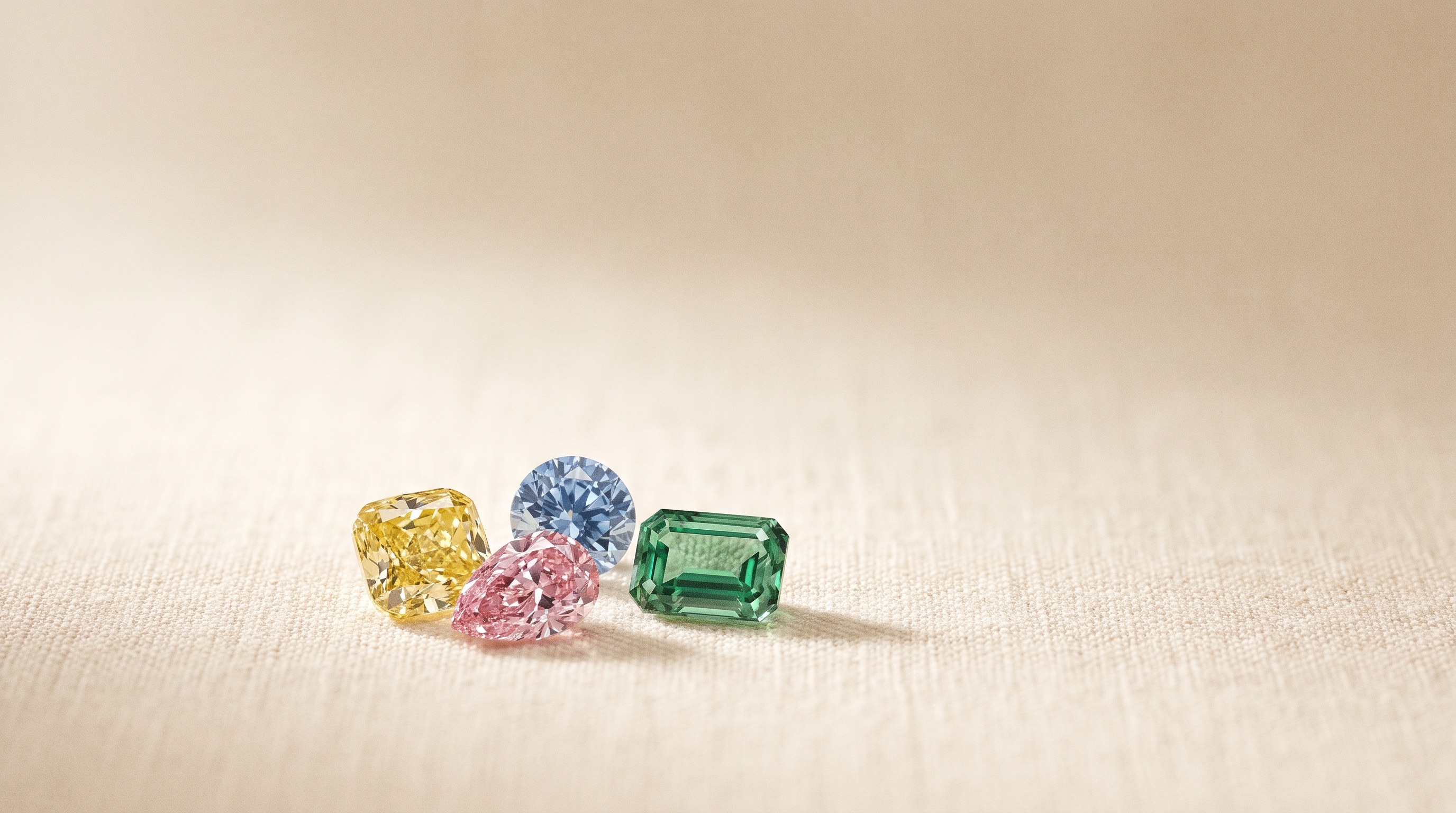
A fancy color diamond chart maps out the grading scale labs use to classify colored diamonds — yellow, pink, blue, green, and every other hue — by intensity, running from the faintest detectable tint up through Fancy Vivid, the most saturated and valuable grade. It's a completely separate system from the D-to-Z scale used for white diamonds, because fancy color grading measures how strong and desirable a color is rather than how close a stone comes to having no color at all.
This guide walks through how the fancy color scale is structured, what each named grade (Faint, Very Light, Light, Fancy Light, Fancy, Fancy Dark, Fancy Deep, Fancy Intense, and Fancy Vivid) actually looks like, how hue and secondary hue modifiers work, how the scale applies across different colors, how lab-grown fancy color diamonds are graded on the same system, and what a buyer should know when comparing two stones that share a color name but sit at different points on the chart.
Why Fancy Color Diamonds Need a Different Chart
The standard D-to-Z scale measures the absence of color in a white diamond — D is completely colorless, and Z shows a noticeable light tint. That scale breaks down once a diamond's body color becomes strong and saturated enough to read as a genuine color rather than an unwanted tint, which is why GIA built a separate fancy color grading system specifically for diamonds with color intense enough to be a deliberate, desirable feature rather than a defect to minimize. A diamond can technically sit at the boundary between the two systems — a heavily tinted Z-color white diamond and a Fancy Light colored diamond can look superficially similar — but once a stone crosses into fancy color territory, it's graded, described, and priced on an entirely different basis.
The Three Variables Behind Every Fancy Color Grade: Hue, Tone, and Saturation
Fancy color grading evaluates three separate visual properties together rather than a single scale:
- Hue — the actual color family (yellow, pink, blue, green, and so on), including secondary hue modifiers when a stone shows more than one color influence (a "brownish yellow" or "purplish pink," for example).
- Tone — how light or dark the color appears, independent of how saturated it is.
- Saturation — how strong or intense the color is, which is the variable most directly reflected in the "Fancy," "Fancy Intense," and "Fancy Vivid" naming.
Because hue, tone, and saturation combine in so many possible ways, the fancy color chart isn't a single straight line the way the D-to-Z scale is — it's closer to a two-dimensional map, with the named grades below representing bands across that map rather than single fixed points.
The Fancy Color Diamond Chart: Grades From Faintest to Most Saturated
| Grade | What It Looks Like | Where It Sits |
|---|---|---|
| Faint | Barely perceptible color, closer to a heavily tinted white diamond than a true fancy color stone | Boundary zone with the D-to-Z scale |
| Very Light | Light, soft color, still fairly subtle | Entry point into fancy color territory |
| Light | Clearly visible color, but soft rather than bold | Below the main "Fancy" tier |
| Fancy Light | A clean, clearly visible color at a soft-to-moderate saturation | First grade widely marketed as a genuine "fancy color" stone |
| Fancy | Solid, well-saturated color that reads clearly as a deliberate colored stone | Core commercial fancy color tier |
| Fancy Dark / Fancy Deep | Darker-toned color — deeper, muted, sometimes described as smoky or dusky | A tone-driven branch rather than a straight saturation step up from Fancy |
| Fancy Intense | Strong, vivid color with high saturation | The grade most commercial fancy-color jewelry is built around |
| Fancy Vivid | The most saturated, most sought-after grade | Commands the strongest per-carat premium at any given size |
Not every color reaches every grade with equal frequency. Yellow and brown diamonds are commonly found across the full range up to Fancy Vivid at commercial scale, while colors like blue, pink, and especially red or purple become dramatically rarer — and therefore far more expensive — as saturation climbs toward the Fancy Intense and Fancy Vivid end of the chart.
Secondary Hues: Reading the Full Color Description
Most fancy color diamonds carry a secondary hue modifier alongside the primary color — a "brownish yellow," a "greenish blue," or a "purplish pink," for example. The secondary hue is listed before the primary color on a report, and it meaningfully changes how a stone actually looks even when two diamonds share the same primary color name and saturation grade. A pure, unmodified hue at a given saturation level generally commands a stronger premium than the same primary color with a pronounced secondary modifier, since a cleaner single-hue stone reads as more visually direct and is typically rarer at that purity.
How the Chart Applies Differently Across Colors
The same named grades — Faint through Fancy Vivid — apply across every fancy color, but rarity and typical market availability differ enormously by hue.
Yellow and Brown
The most commonly available fancy colors in both natural and lab-grown supply, found across the full grade range including Fancy Vivid at commercial wholesale scale.
Blue and Pink
Meaningfully rarer than yellow at any given saturation, particularly once color reaches Fancy Intense or Fancy Vivid, where natural supply becomes genuinely scarce and lab-grown production, while more available than natural, is still a smaller category than lab-grown yellow.
Green
Rare in nature and technically more difficult to reproduce consistently in lab-grown production than yellow or blue, since green color mechanisms are more varied and less straightforwardly controlled during CVD growth.
Purple, Orange, and Red
Among the rarest fancy colors overall, with genuine, well-saturated stones at usable sizes representing a tiny fraction of overall fancy color supply — red diamonds specifically are considered one of the rarest color categories in the entire diamond market.
Fancy Color Grading for Lab-Grown Diamonds
CVD lab-grown fancy color diamonds are graded on the exact same Faint-through-Fancy-Vivid chart as natural fancy color stones, using the same hue, tone, and saturation criteria. The growth method doesn't create a separate color scale — a Fancy Vivid Yellow CVD diamond and a Fancy Vivid Yellow natural diamond are described with identical grading language, with the report separately and clearly stating growth origin rather than folding it into the color grade itself. This is part of why buyers should always confirm origin disclosure on a fancy color report rather than assuming a color grade alone tells them whether a stone is natural or lab-grown.
How Fancy Color Grading Differs From Fancy-Shape Diamonds
It's worth being clear that "fancy color" and "fancy shape" are unrelated uses of the word "fancy" that sometimes confuse newer buyers. Fancy color refers to a diamond's body color, graded on the chart described above. Fancy shape refers to any cut other than round brilliant — oval, cushion, emerald, pear, marquise, and the rest — graded on entirely separate cut, polish, and symmetry criteria that have nothing to do with color. A diamond can be a fancy shape without any fancy color at all, a fancy color without being a fancy shape (a round brilliant Fancy Vivid Yellow, for example), or both at once.
What Drives Price on the Fancy Color Chart
Saturation is the single biggest lever in fancy color pricing — moving from Fancy to Fancy Intense to Fancy Vivid at the same hue, carat weight, and clarity typically produces the largest jumps in per-carat price on the entire chart. Rarity of the specific hue matters just as much: a Fancy Vivid Blue commands a dramatically higher price than a Fancy Vivid Yellow of comparable size and clarity, purely because blue is so much scarcer at that saturation. Clarity and cut still factor in, but their effect on price is generally smaller relative to color than it is for standard white diamonds, since a well-saturated fancy color diamond's own body color dominates its visual appeal in a way that can make minor inclusions or a less-than-ideal cut far less noticeable to the eye.
Certification and Reading a Fancy Color Report
A trustworthy fancy color report states hue (including any secondary hue), tone, saturation, and — for lab-grown stones — growth origin together, rather than just a single color name. GIA remains the most widely referenced lab for natural fancy color grading specifically, with a fancy color system the rest of the trade has largely adopted as reference language. IGI and GCAL also grade and certify fancy color diamonds, including lab-grown fancy color stock, using comparable hue, tone, and saturation criteria. Buyers comparing stones across labs should confirm each report states the same three variables explicitly rather than relying on a shortened color name alone.
Overtones, Modifiers, and Distribution: Reading the Full Description
Beyond the primary hue, tone, and saturation grade, a full fancy color description sometimes notes distribution — whether color appears evenly across the stone when viewed face-up, or unevenly concentrated in certain zones. Uneven color distribution can affect both appearance and value even at an otherwise strong saturation grade, since a stone with color pooling unevenly toward one edge can look less impressive face-up than its overall saturation grade alone would suggest. Buyers evaluating a significant fancy color purchase should ask specifically about distribution when it isn't already noted on the report, and where possible view the stone face-up under consistent lighting to judge how evenly the color actually reads in the position it will be seen once mounted.
Fancy Color Chart Terminology That Isn't Standardized
Some fancy color descriptions used casually in the trade and in consumer-facing retail — "champagne," "cognac," "chocolate," and similar marketing terms for brown-toned stones, for instance — aren't standardized grading terms on the official fancy color chart at all, even though they're commonly used to describe diamonds whose actual lab-issued grade sits somewhere in the brown or brownish-hued range of the chart. A buyer comparing a stone marketed under one of these trade names against a formally graded fancy color report should confirm the actual hue, tone, and saturation terminology on the certificate itself, since a marketing name and an official grading description aren't always describing the exact same position on the chart with the same precision.
Common Mistakes Reading a Fancy Color Chart
- Treating the chart as a single straight line. Hue, tone, and saturation combine independently, so two stones at the same named grade can still look meaningfully different once secondary hue and tone are factored in.
- Assuming all colors reach every grade equally often. Fancy Vivid is commercially routine in yellow and increasingly available in blue, pink, and green lab-grown material, but genuinely rare in colors like purple, orange, and red at any saturation.
- Confusing fancy color with fancy shape. The two "fancy" terms describe completely different diamond properties — body color versus cut shape — and aren't related to each other.
How Labs Actually Determine a Position on the Chart
Fancy color grading is performed by comparing a diamond, viewed unmounted under controlled, standardized lighting, against a master set of reference stones and color references whose hue, tone, and saturation have already been fixed and calibrated. A trained grader evaluates the stone face-up and sometimes face-down, from multiple angles, since a diamond's apparent color can shift somewhat depending on viewing angle and how light travels through its specific cut. This comparison-based approach is why fancy color grading, more than most other diamond grading tasks, benefits from an experienced grader's trained eye working alongside instrumentation — the three-dimensional nature of hue, tone, and saturation isn't something a single spectrophotometer reading alone fully captures the way a measurement like carat weight can be captured with a simple scale.
Because grading fancy color involves this level of trained visual judgment, minor differences between labs on borderline stones are more common in fancy color grading than in standard D-to-Z grading, which is part of why buyers sourcing at any real volume in fancy color benefit from working with a supplier who can speak knowledgeably about how a specific stone's position on the chart was determined, not just cite the final grade in isolation.
GIA, IGI, and GCAL: Differences in Fancy Color Reporting
GIA is the most widely referenced lab for natural fancy color diamonds specifically, and its fancy color grading system and terminology have become the reference language the rest of the trade has largely adopted, even when a stone is actually graded by a different lab. IGI grades a large volume of fancy color material, particularly lab-grown, and uses hue, tone, and saturation terminology consistent with the broader trade standard GIA established. GCAL, known in the trade for a particular focus on cut-precision and light-performance analysis, also grades fancy color stones and issues reports documenting the same hue, tone, and saturation criteria. Buyers sourcing across more than one of these labs should confirm each report states all three variables explicitly — hue (including secondary hue), tone, and saturation — rather than assuming a shared color-name label alone guarantees an identical grading outcome across labs.
The Fancy Color Chart and Melee
Fancy color melee — small, calibrated stones used in halo, pavé, and accent settings — is generally sourced and quality-checked against a color-family and saturation baseline appropriate to the design, rather than graded stone-by-stone against the full Faint-through-Fancy-Vivid chart the way a certified loose stone would be. A jeweler ordering fancy color melee should specify the target color family (yellow, pink, blue, or green) and an acceptable saturation range up front, since consistency across the parcel — every stone reading as a cohesive, evenly saturated color — matters more for melee than pinpointing an exact position on the full chart for each individual tiny stone.
A Short History of the Fancy Color Grading System
Before GIA formalized its fancy color grading system in the 1990s, colored diamonds were often described in the trade using inconsistent, subjective language that varied significantly from one seller to another — a real obstacle for buyers trying to compare stones or establish fair pricing. GIA's system, built around consistently defined hue, tone, and saturation bands compared against a fixed master reference, gave the trade a shared, verifiable vocabulary for the first time. That standardization is part of why the fancy color category has grown into a much more actively traded, transparently priced segment of the diamond market than it was when color descriptions relied purely on individual sellers' subjective language.
Photographing and Viewing Fancy Color Diamonds Against the Chart
A stone's position on the fancy color chart is determined under controlled lab lighting, but real-world lighting — daylight, warm indoor lighting, jewelry-case spotlighting — can make the same diamond appear noticeably different in photographs or casual viewing than its certified grade might suggest. This is a genuine practical challenge for both retailers marketing fancy color inventory and buyers evaluating photos before an in-person viewing: a Fancy Intense stone photographed under warm indoor light can appear closer to Fancy Vivid in a photo, while the same stone under harsher lighting can appear to lose saturation. Buyers making any meaningful purchase decision based on fancy color should view the physical stone under multiple lighting conditions rather than relying on photography alone, and treat the certificate's stated grade — determined under standardized conditions — as the more reliable reference point than any single photograph.
Sourcing Fancy Color Diamonds by Chart Position
Guru Diam carries CVD lab-grown fancy color diamonds in yellow, pink, blue, and green — both as certified loose stones at 0.30ct and above and as calibrated fancy color melee in round and fancy shapes — with IGI, GIA, and GCAL certification available so buyers can confirm exact hue, tone, and saturation before ordering. Natural fancy color diamonds and natural fancy color melee are handled as a separate, distinct catalog from CVD material, never blended on the same product listing. Trade buyers can browse current inventory in the fancy color loose diamonds category, review certified stock generally at certified diamonds, or apply for a wholesale account through trade partner. Current terms are posted at the wholesale hub, and buyers designing a custom piece around a fancy color center stone can start at custom jewelry.
Frequently Asked Questions
What are the grades on a fancy color diamond chart?
From lightest to most saturated: Faint, Very Light, Light, Fancy Light, Fancy, Fancy Dark/Fancy Deep, Fancy Intense, and Fancy Vivid. The chart also accounts for hue and secondary hue modifiers, not just saturation alone.
What's the difference between the fancy color chart and the D-to-Z color scale?
The D-to-Z scale measures the absence of color in white diamonds. The fancy color chart measures the presence and strength of a genuine body color — hue, tone, and saturation together — in diamonds with color strong enough to be a deliberate feature rather than an unwanted tint.
What is the highest grade on the fancy color chart?
Fancy Vivid is the most saturated, most sought-after grade on the chart, commanding the strongest per-carat premium at any given size and hue, followed by Fancy Intense.
Are lab-grown fancy color diamonds graded on the same chart as natural ones?
Yes. CVD lab-grown fancy color diamonds are graded using the same Faint-through-Fancy-Vivid hue, tone, and saturation criteria as natural fancy color diamonds, with growth origin stated separately on the report.
Why do some fancy colors cost so much more than others at the same grade?
Rarity varies enormously by hue. Yellow and brown are relatively common at any saturation, while blue, pink, green, purple, orange, and red become progressively rarer — especially at Fancy Intense and Fancy Vivid — which drives dramatically different pricing even at an identical named grade.
What does a secondary hue on a fancy color report mean?
It describes a second color influence alongside the primary hue, such as "brownish yellow" or "greenish blue." A cleaner, single-hue stone at the same saturation generally commands a stronger premium than one with a pronounced secondary modifier.
Guru Diam is a trade-only wholesale diamond supplier with locations in New York and Los Angeles, carrying CVD lab-grown fancy color diamonds across the full grading chart in yellow, pink, blue, and green, alongside natural diamonds, antique and standard cuts, and finished jewelry, with IGI, GIA, and GCAL certification available. Browse current fancy color inventory in the fancy color loose diamonds category or apply for a trade account through trade partner.