
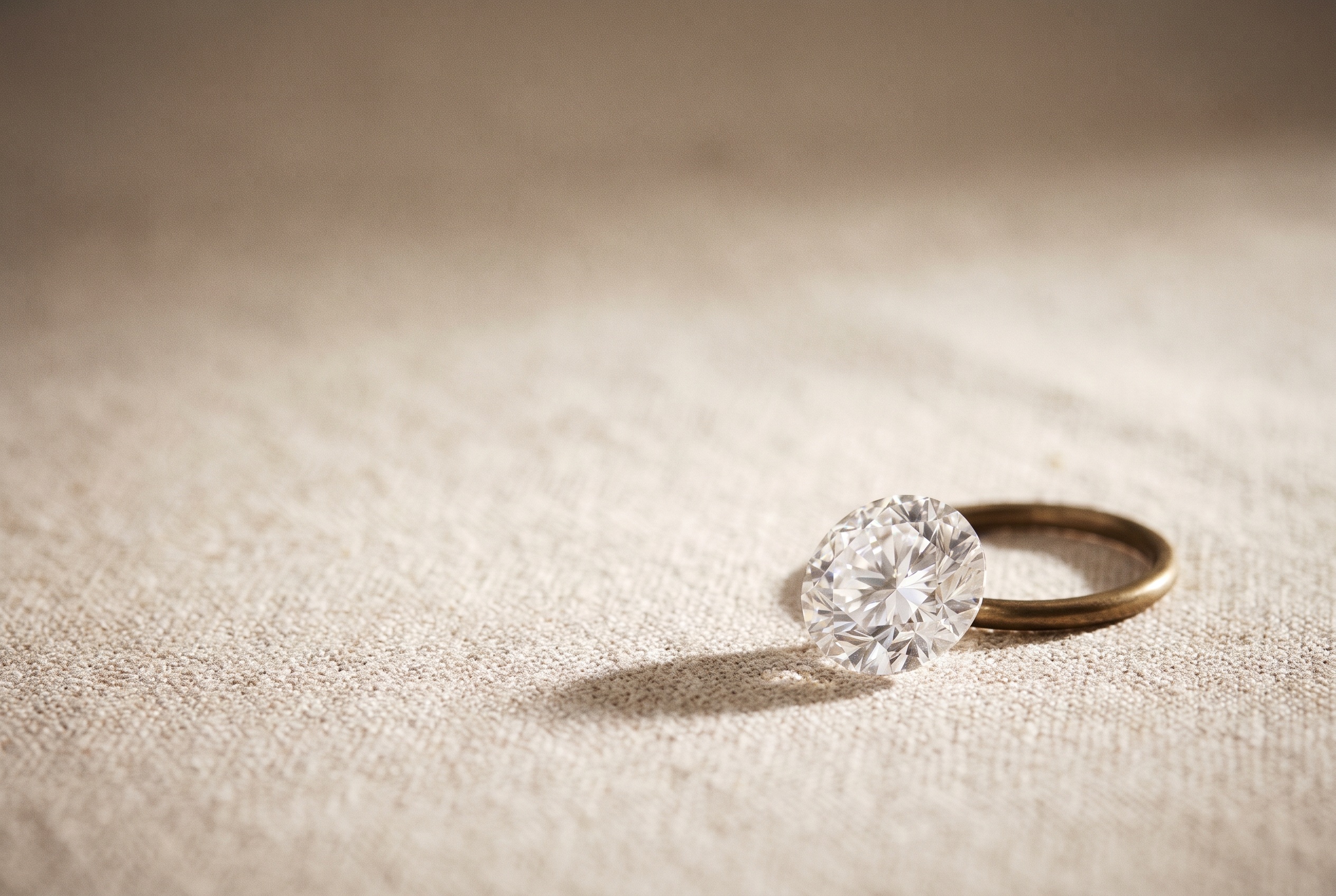
A 1 carat lab-grown diamond typically prices well below its natural counterpart of comparable quality, with the exact figure driven by the same 4Cs (cut, color, clarity, carat) that determine natural diamond pricing, plus shape and certification. One carat sits at the most common bridal center-stone weight, which makes it the size range with the deepest available inventory and the clearest pricing benchmarks across the trade.
This guide breaks down what actually moves the price of a 1-carat lab-grown diamond, how the 4Cs interact at this specific size, how shape affects cost, what certification adds, how lab-grown pricing compares to natural at the same weight, and how to buy at wholesale with confidence in what's driving the number on a quote.
What Drives 1 Carat Lab-Grown Diamond Pricing
Price at any carat weight is a function of the 4Cs multiplying against each other rather than adding up independently — a change in one factor shifts the effective value of the others. At 1 carat specifically, all four factors carry real, visible weight:
| Factor | Effect on Price at 1 Carat |
|---|---|
| Cut | Largest single driver of visible brilliance; an Excellent or Ideal cut commands a real premium over a Good or Fair cut of the same carat, color, and clarity |
| Color | D-F (colorless) commands more than G-H (near-colorless), which commands more than I-J; at 1 carat, color differences are borderline-visible to the naked eye at the lower end of this range |
| Clarity | VS1-VS2 is a common sweet spot at this size — eye-clean with meaningfully lower cost than VVS grades; SI1 can also be eye-clean depending on inclusion location |
| Shape | Round brilliant commands the highest per-carat price of common shapes; fancy shapes are typically 15-30% less per carat at comparable quality |
See our 4Cs of diamonds guide and diamond pricing guide for a fuller breakdown of how these factors interact across carat weights generally.
Why 1 Carat Specifically Is a Pricing Benchmark
One carat is the most heavily traded size in the bridal market, which means it has the deepest inventory, the tightest and most transparent pricing, and the clearest market comparables of any carat weight. It also sits right at a pricing threshold — carat weight thresholds (0.90-0.99ct vs. 1.00ct+, in particular) carry a disproportionate price jump relative to the small weight difference, since "1 carat" carries independent marketing and psychological weight beyond its literal size. A stone at 0.97ct can price meaningfully lower than a 1.00ct stone of identical color, clarity, and cut, purely because it falls just under the round-number threshold — a detail worth knowing for a buyer optimizing budget without sacrificing visible size.
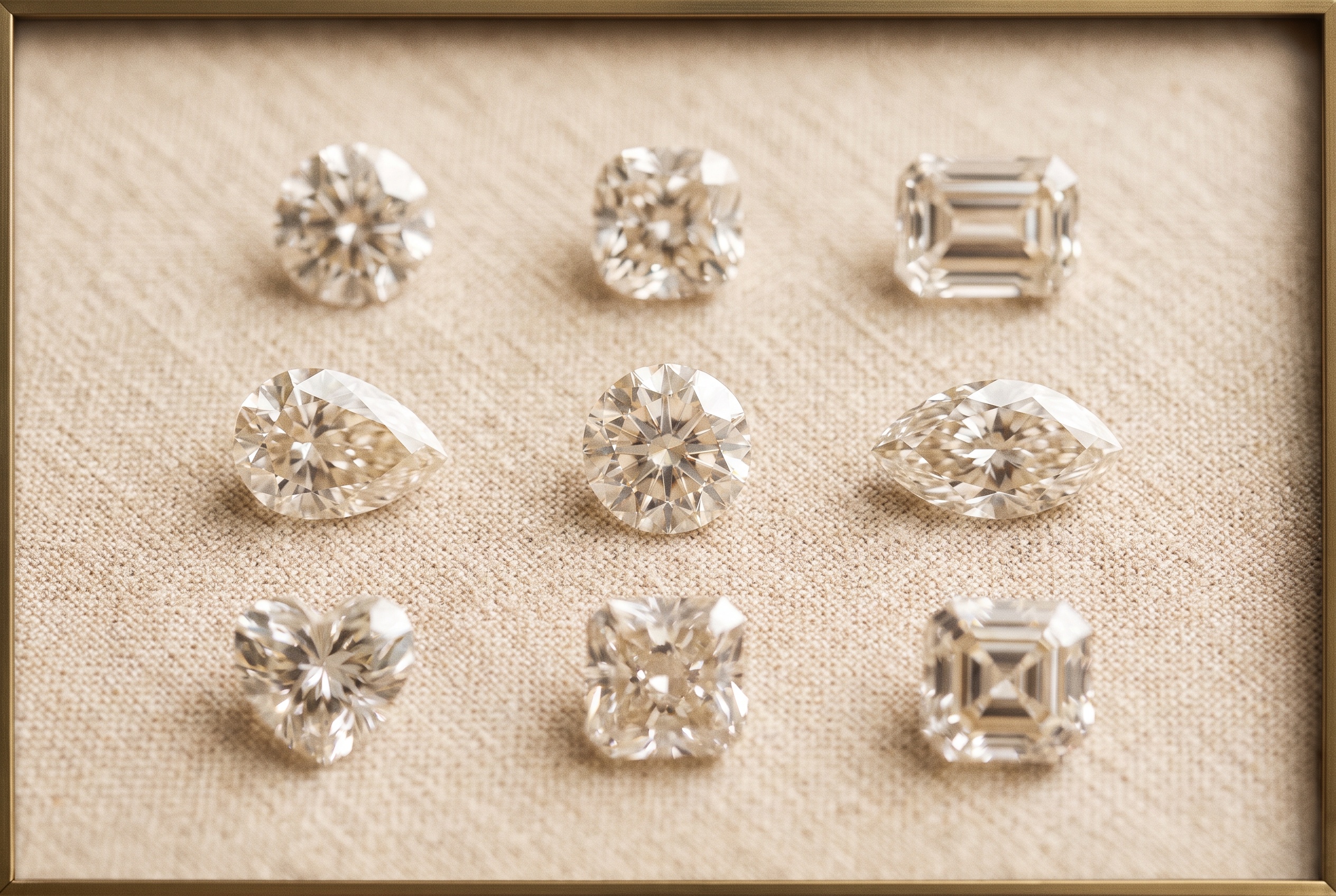
Round Brilliant vs. Fancy Shapes at 1 Carat
| Shape | Relative Per-Carat Price vs. Round | Approx. Dimensions at 1ct |
|---|---|---|
| Round brilliant | Baseline (highest) | ~6.5mm diameter |
| Oval | 15-20% less | ~8.5mm × 6.0mm |
| Cushion | 15-20% less | ~6.2mm × 6.2mm |
| Emerald | 20-25% less | ~7.0mm × 5.2mm |
| Pear | 20-25% less | ~8.7mm × 5.8mm |
| Marquise | 20-30% less | ~10.5mm × 5.2mm |
Round brilliant's premium reflects both higher rough wastage during cutting (a round wastes more of the original crystal than most fancy shapes) and consistently higher consumer demand. For buyers prioritizing visible size and stretching budget further, elongated shapes like oval, pear, and marquise deliver more visible surface area per carat than round at a lower per-carat cost — a genuine two-sided value proposition worth walking a customer through, covered further in our marquise diamond guide.
What Certification Adds to the Price
Certified 1-carat stones — graded and documented by an independent lab like IGI, GIA, or GCAL — carry a documentation premium over uncertified goods of comparable apparent quality, since the certificate is what lets a buyer (and their eventual customer) verify the 4Cs independently rather than taking a seller's word for it. At 1 carat and above, certification is close to universal in the trade-quality segment of the market; buying uncertified at this weight is a meaningful risk relative to the modest savings, since there's no independent verification of what's actually being represented.
- IGI is the most common certifying lab for lab-grown diamonds specifically, with strong international trade recognition.
- GIA carries the strongest overall trade and consumer name recognition across both natural and lab-grown, often commanding a modest premium reflecting that recognition.
- GCAL is known for particularly rigorous light-performance and cut-grade analysis, a differentiator some buyers specifically seek out.
Lab-Grown vs. Natural: 1 Carat Price Comparison
The price gap between lab-grown and natural diamonds is most dramatic at more common carat weights like 1 carat, where natural supply is comparatively deep but lab-grown production cost has fallen sharply as the industry has scaled. A natural 1-carat diamond of a given color and clarity grade will typically price at a significant multiple of a lab-grown stone of the identical grade — the exact multiple has narrowed over time as lab-grown production scales further, but the gap remains substantial and is one of the primary reasons lab-grown has captured significant bridal market share at this specific size range.
This gap reflects fundamentally different cost structures rather than a quality difference: natural diamond pricing reflects geological rarity and mining cost, while lab-grown pricing reflects CVD production time, equipment, and energy cost — a process that scales with manufacturing investment rather than being constrained by what a given mine happens to yield. Neither is inherently the "better" stone; the price gap is a structural fact of how each is produced, not a grading judgment. Our lab-grown diamond guide covers the CVD growth process in more depth.
How Color and Clarity Choices Change the Price at 1 Carat
At 1 carat, a buyer has meaningfully more flexibility on color and clarity than at larger sizes before a compromise becomes visible to the naked eye — a real advantage for margin-conscious sourcing:
- G-H color with VS1-VS2 clarity is a common trade sweet spot at this size: near-colorless and eye-clean, at a noticeably lower price point than D-F/VVS combinations that are difficult to distinguish from G-H/VS without a loupe.
- I color can still look colorless to the naked eye at 1 carat in many settings, particularly warmer metal settings, though it starts to show faint warmth under close, direct comparison against a higher grade.
- SI1 clarity is frequently eye-clean at 1 carat depending on where inclusions sit within the stone — our eye-clean diamond guide covers how to evaluate this on a specific stone rather than assuming by grade alone.
Fluorescence and Its Effect on 1 Carat Pricing
Strong fluorescence — particularly blue fluorescence — can modestly reduce price relative to a non-fluorescent stone of the same grade, reflecting a segment of buyer preference for stones without it, even though fluorescence has no negative effect on the vast majority of stones' actual face-up appearance. For a value-conscious buyer at 1 carat, a stone with strong fluorescence and otherwise strong grading can represent a genuine pricing opportunity, provided the specific stone is reviewed (via video or in-person) to confirm no visible haziness, which is a rare effect limited to a small subset of strongly fluorescent stones.
How 1 Carat Lab-Grown Pricing Has Moved Over Time
Lab-grown diamond pricing at 1 carat has fallen substantially since CVD production scaled to meaningful trade volume, a trend that reflects manufacturing efficiency gains and expanding production capacity across the industry rather than any change in stone quality. For jewelers who've stocked lab-grown inventory for several years, this pricing trajectory has meant regularly revisiting cost basis and retail pricing rather than assuming figures from even a year or two ago still hold — a dynamic that doesn't apply to natural diamond pricing at anywhere near the same rate, since natural supply doesn't scale the same way production capacity does. For a buyer newer to lab-grown sourcing, it's worth confirming pricing is current rather than working from an outdated reference point, since the gap between "current" and "a year old" pricing can be meaningful at this size.
Typical Trade Price Ranges Across Quality Tiers at 1 Carat
While exact pricing depends on a specific supplier and current market conditions, a useful way to think about 1-carat lab-grown pricing is in relative tiers rather than fixed dollar figures, since the underlying market moves:
| Quality Tier | Typical Grading Combination | Relative Price Positioning |
|---|---|---|
| Value tier | I-J color, SI1-SI2 clarity, Good-Very Good cut | Lowest price point that still holds up as genuinely eye-clean and reasonably bright in most settings |
| Trade sweet spot | G-H color, VS1-VS2 clarity, Very Good-Excellent cut | Moderate premium over value tier; the most commonly stocked combination for standard bridal inventory |
| Premium tier | D-F color, VVS1-VVS2 clarity, Excellent-Ideal cut | Meaningful premium over the trade sweet spot for a difference that's difficult to see without magnification, appealing to buyers specifically prioritizing top grading |
Most retail volume at 1 carat concentrates in the trade sweet spot tier, since it delivers a stone that's visually indistinguishable from the premium tier to the naked eye at a meaningfully lower cost basis — a distinction worth walking a retail customer through directly rather than assuming they'll default to paying for the highest available grade.
Common Buyer Mistakes When Shopping by Price Alone
- Comparing quotes without confirming identical grading. A lower price often simply reflects a lower color, clarity, or cut grade rather than a genuinely better deal — any price comparison needs to hold the 4Cs constant to be meaningful.
- Ignoring cut grade entirely. Color and clarity get the most attention, but a poorly cut stone can look visibly duller than a better-cut stone of lower color and clarity — cut grade should never be the line item skipped to save cost.
- Not verifying certification independently. A certificate number should be checked against the issuing lab's own database, not simply taken at face value from a seller's paperwork.
- Overlooking fluorescence as a value lever. Strongly fluorescent stones with otherwise strong grading can represent genuine value, but only when the specific stone has been reviewed to confirm no visible haze — skipping that review to chase the discount is a real risk.
How to Read a 1 Carat Diamond Quote
| Line Item | What to Check |
|---|---|
| Certification | Which lab, and does the report number match a stone actually in hand or verifiable online through the lab's own lookup tool |
| Growth method (lab-grown) | CVD should be clearly stated; HPHT origin should never be ambiguous or undisclosed |
| Cut grade | Listed separately from color and clarity — a stone can carry strong color and clarity grades but a mediocre cut grade that undercuts visible brilliance |
| Measurements | Actual millimeter dimensions confirm the stone matches its stated carat weight proportionally rather than being cut unusually deep or shallow to hit a target weight |
1 Carat Lab-Grown Diamonds in Different Settings
How a 1-carat stone is set can meaningfully affect a buyer's perceived value and visible presentation, worth factoring into a pricing conversation alongside the stone's own grading:
- Solitaire settings let a 1-carat stone stand entirely on its own, making cut quality and color especially visible since there's no halo or accent detail to soften attention on the center stone itself.
- Halo settings can make a 1-carat center stone read visibly larger, a popular choice for buyers wanting to maximize apparent size within a set budget without moving up to a larger, more expensive center stone.
- Hidden halo settings — see our hidden halo ring guide — add a similar size boost with a more subtle presentation than a traditional visible halo.
- Three-stone settings pair a 1-carat center with two smaller side stones, a popular configuration that changes the total stone budget calculation beyond the center stone price alone.
A buyer working within a fixed total budget often benefits from understanding these tradeoffs explicitly — a slightly lower center stone grade paired with a halo setting can deliver comparable visual impact to a higher-grade solitaire at a similar total price, a genuinely useful framing for a sales conversation built around value rather than grade alone.
Natural Diamond Melee Pairing for 1 Carat Center Stones
Buyers pairing a 1-carat lab-grown center stone with melee accents have both lab-grown and natural melee options available, and it's worth understanding that Guru Diam treats these as genuinely separate catalogs rather than blended inventory — a natural melee piece won't carry any CVD-grown claim, and a CVD melee piece won't carry any natural claim, keeping the sourcing and representation clean for whichever combination a buyer chooses. Melee itself, unlike the certified 0.30ct+ center stone, ships as quality-controlled parcel goods against a DEF+/VS+ baseline rather than individually certified — the appropriate and standard approach for small calibrated accent stones at this scale.
Buying 1 Carat Loose vs. Pre-Set
A jeweler or designer sourcing a 1-carat lab-grown stone can buy loose for a fully custom build, or source a pre-set finished piece where the stone is already mounted. Loose sourcing gives complete control over setting choice, metal, and any customization the end buyer wants, and lets a jeweler present multiple loose stones side by side for a client to compare directly before committing to a specific one — a meaningfully different, more consultative sales experience than showing a single pre-set option. Pre-set inventory trades that flexibility for speed and simplicity, useful for filling out a case with ready-to-sell pieces at standard, popular specifications without a made-to-order lead time. Most jewelers benefit from carrying both: a loose stone selection for custom and higher-consideration purchases, and a curated pre-set case for buyers who want to see and purchase a finished piece the same day.
Comparing Quotes Across Multiple Suppliers
When evaluating quotes from more than one wholesaler for a 1-carat stone, the most reliable comparison holds every variable constant except price: same shape, same color grade, same clarity grade, same cut grade, and the same certifying lab. Even small differences in any one of these — a G versus an H color, a VS2 versus an SI1 clarity, an Excellent versus a Very Good cut — can account for a meaningful price gap on their own, independent of whether one supplier is simply offering a better deal. A useful practice is requesting quotes on a specific, fully-specified stone (down to the certificate number where a supplier has one in hand) rather than a general grading range, which removes ambiguity from the comparison entirely and makes any remaining price difference genuinely meaningful rather than an artifact of comparing two subtly different stones. It's also worth confirming shipping timeline and cutoff terms alongside price on any comparison, since a modestly higher price from a supplier with reliable same-day shipping can be the better overall deal for a jeweler working against a customer's timeline, even when a competing quote looks marginally cheaper on the stone alone.
Seasonal Demand Patterns at 1 Carat
Demand for 1-carat center stones follows a fairly predictable seasonal rhythm tied to engagement timing — a jeweler stocking this weight range benefits from planning inventory depth around the periods where engagement shopping typically peaks (the holiday season and the run-up to Valentine's Day being the two most pronounced) rather than treating demand as flat across the calendar. Because 1 carat carries such deep, liquid inventory availability across the trade generally, replenishing stock quickly during a demand spike is usually more feasible at this weight than at less commonly stocked carat sizes, which is a genuine advantage of building a core program around this specific size rather than concentrating inventory investment in less standard weights.
Sourcing 1 Carat Lab-Grown Diamonds at Wholesale
Guru Diam supplies certified CVD lab-grown diamonds — no HPHT anywhere in the catalog — with IGI, GIA, and GCAL certification all available, across round brilliant and the full range of fancy shapes. One-carat inventory is a core stocking weight with same-day shipping available on in-stock stones from New York (before 6pm EST) and Los Angeles (before 4pm PST).
Buyers can browse current 1-carat inventory through the certified diamonds category, and buyers building a full piece around a 1-carat center stone can work through custom jewelry for a setting finished in 4-6 days. For buyers weighing this size against larger center stones, our 4 carat lab-grown diamond guide and diamond size chart guide cover how price and visible size scale further up the carat range. Trade accounts can review terms at the wholesale hub or apply through trade partner.
Frequently Asked Questions
How much does a 1 carat lab-grown diamond cost?
Price varies significantly by cut, color, clarity, shape, and certifying lab, but a 1-carat lab-grown diamond consistently prices well below a natural stone of comparable grade, with the gap widening further at higher color and clarity combinations. Getting an accurate figure requires pricing a specific combination of the 4Cs rather than a single blanket number.
Why is a 1 carat lab-grown diamond so much cheaper than natural?
Lab-grown pricing reflects CVD production cost — equipment, energy, and growth time — which scales with manufacturing investment, while natural diamond pricing reflects geological rarity and mining cost. Those are fundamentally different cost structures, not a quality difference between the two.
What shape is cheapest for a 1 carat lab-grown diamond?
Round brilliant commands the highest per-carat price of common shapes due to higher rough wastage during cutting and consistently strong demand. Elongated fancy shapes like oval, pear, and marquise typically price 15-30% lower per carat while also appearing larger face-up at the same weight.
What color and clarity should I choose for a 1 carat lab-grown diamond?
G-H color with VS1-VS2 clarity is a common sweet spot at this size — near-colorless and eye-clean at a meaningfully lower price than top D-F/VVS combinations that are difficult to distinguish without magnification.
Does certification affect the price of a 1 carat lab-grown diamond?
Yes, certified stones carry a documentation premium over uncertified goods, since the certificate provides independent verification of the 4Cs. At 1 carat and above, buying certified is close to standard practice in the trade-quality segment given how much rides on accurate grading at this size.
Is 0.90 carat significantly cheaper than 1.00 carat?
Yes — carat weight thresholds near round numbers carry a disproportionate price jump relative to the actual weight difference, since "1 carat" carries independent value beyond its literal size. A stone just under 1.00ct can offer meaningful savings with minimal visible size difference.