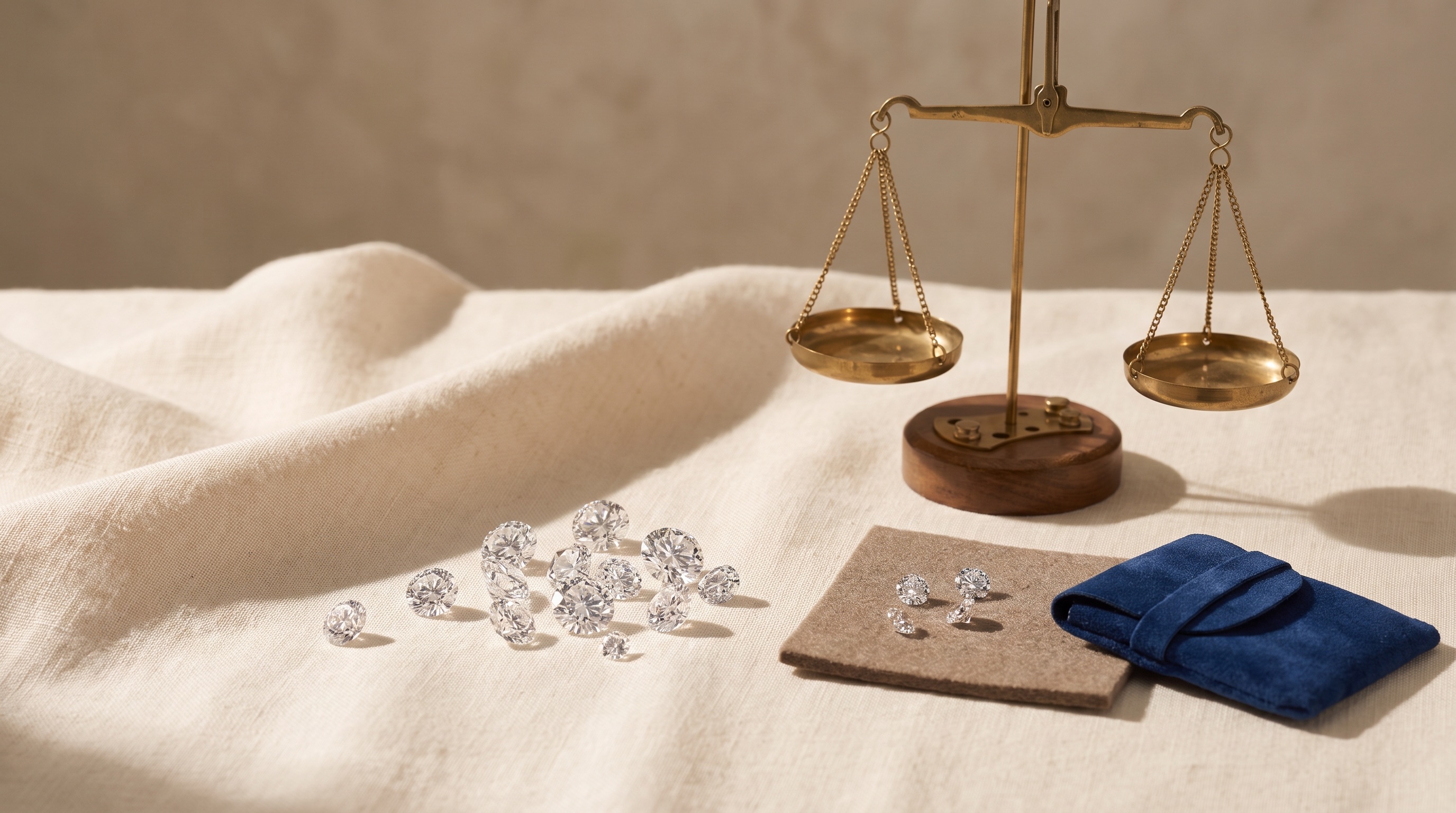
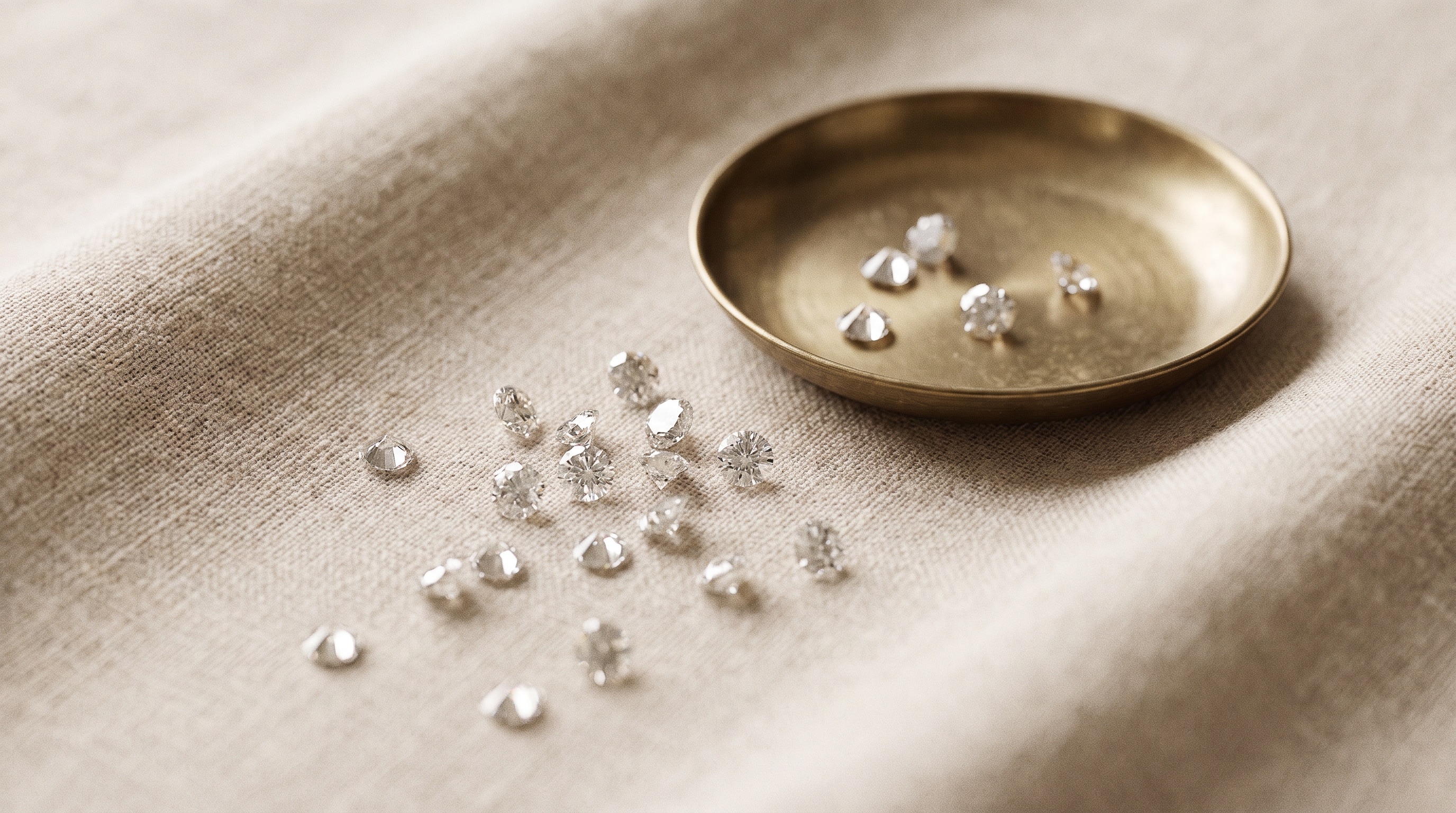
A 0.5 carat (half-carat) lab-grown diamond typically prices in the low hundreds of dollars for value-tier grading up to roughly a thousand dollars or more for top color and clarity combinations, with the exact figure set by the same 4Cs that price any diamond. Half-carat sits below the common bridal center-stone range, which makes it the go-to weight for stud earrings, side stones, and entry-level solitaires rather than a statement center stone.
This guide breaks down what actually drives 0.5 carat lab-grown diamond pricing, how it compares to 1 carat and to natural diamonds at the same weight, illustrative price ranges across grading tiers, how the half-carat market differs from whole-carat bridal buying, and practical guidance for sourcing this size at wholesale.
What Drives 0.5 Carat Lab-Grown Diamond Pricing
Price at any carat weight comes from the 4Cs interacting with each other rather than adding up independently, and 0.5 carats is no exception — the factors are the same ones that price a 1-carat or 3-carat stone, just applied to a smaller, lower-dollar base:
| Factor | Effect on Price at 0.5 Carats |
|---|---|
| Cut | Still the largest driver of visible brilliance; an Excellent or Ideal cut commands a real premium, though the dollar gap between cut grades is smaller in absolute terms than at 1 carat and up |
| Color | D-F (colorless) commands more than G-H (near-colorless), which commands more than I-J; at half-carat, color differences are harder to spot with the naked eye than at larger sizes, making mid-range color a common value choice |
| Clarity | SI1-SI2 is frequently eye-clean at this size and is a common trade choice; VS grades add a modest premium for buyers who want a documented clarity cushion |
| Shape | Round brilliant commands the highest per-carat price of common shapes; fancy shapes typically run 15-30% less per carat at comparable grading, the same relative pattern seen at larger weights |
See our 4Cs of diamonds guide and diamond pricing guide for how these factors interact across carat weights more broadly.
Why 0.5 Carat Is a Different Market Than 1ct+ Bridal Centerpieces
Most carat-tier pricing guides are written around the bridal center-stone market, where a buyer is choosing a single stone to headline an engagement ring. Half-carat buying looks meaningfully different. At 0.5 carats, the dominant use cases are stud earrings (almost always sold and priced as a matched pair rather than a single stone), side stones flanking a larger center stone, accent stones in three-stone and halo builds, and entry-level or budget-conscious solitaire rings — often a first engagement ring purchase, a promise ring, or an anniversary upgrade rather than the primary bridal purchase.
That shift in use case changes buying behavior in a few concrete ways. A stud-earring buyer is shopping for a matched pair and needs both stones to read as visually identical in color and size, which puts a premium on matching rather than on maximizing any single stone's grade. A side-stone buyer is usually working within a total-look budget set by the center stone, so half-carat pricing needs to stay proportionate rather than eating into the center-stone budget. And a solitaire buyer at 0.5 carats is frequently more price-sensitive than a 1-carat-plus buyer, making value-tier grading combinations a much larger share of actual sales volume at this weight than they are at 1 carat and above.
Round Brilliant vs. Fancy Shapes at 0.5 Carats
| Shape | Relative Per-Carat Price vs. Round | Approx. Dimensions at 0.5ct |
|---|---|---|
| Round brilliant | Baseline (highest) | ~5.0mm diameter |
| Oval | 15-20% less | ~6.5mm × 4.6mm |
| Cushion | 15-20% less | ~4.9mm × 4.9mm |
| Emerald | 20-25% less | ~5.4mm × 4.0mm |
| Pear | 20-25% less | ~6.8mm × 4.5mm |
| Marquise | 20-30% less | ~8.2mm × 4.1mm |
Round brilliant's premium reflects both higher rough wastage during cutting and consistently higher demand, the same dynamic seen at every carat weight. At half-carat specifically, elongated shapes like oval, pear, and marquise deliver visibly more face-up surface area than round at the same weight — a meaningful consideration for a stud-earring or solitaire buyer trying to maximize apparent size on a modest budget. Our marquise diamond guide covers this elongation effect in more depth.
What Certification Adds at 0.5 Carats
Half-carat sits comfortably above the 0.30ct threshold where certified loose diamonds become standard practice in the trade — a 0.5 carat stone should carry independent grading from IGI, GIA, or GCAL, letting a buyer (and their eventual retail customer) verify the 4Cs rather than taking a seller's word for it. This is a different tier from melee: melee stones below roughly 0.30ct typically ship as quality-controlled parcel goods against a DEF+/VS+ baseline rather than individually certified, while 0.5 carat loose stones intended for a center or accent role should always come with their own report.
- IGI is the most common certifying lab for lab-grown diamonds specifically, with strong international trade recognition.
- GIA carries the strongest overall trade and consumer name recognition across both natural and lab-grown, often commanding a modest premium reflecting that recognition.
- GCAL is known for particularly rigorous light-performance and cut-grade analysis, a differentiator some buyers specifically seek out.
Lab-Grown vs. Natural: 0.5 Carat Price Comparison
The price gap between lab-grown and natural diamonds holds at 0.5 carats just as it does at larger weights, though the absolute dollar gap is naturally smaller since the base price itself is lower. A natural 0.5 carat diamond of a given color and clarity grade will typically price at a meaningful multiple of a lab-grown stone at the identical grade — the exact multiple has narrowed somewhat as CVD production has scaled, but the gap remains substantial. For a buyer shopping this size specifically, the lab-grown price advantage often means the difference between a value-tier grading combination and a genuinely strong one at the same total budget.
This is a structural cost difference, not a quality difference: natural diamond pricing reflects geological rarity and mining cost, while lab-grown pricing reflects CVD production time, equipment, and energy cost — a process that scales with manufacturing investment rather than being constrained by what a given mine happens to yield. Our lab-grown diamond guide covers the CVD growth process in more depth.
0.5 Carat vs. 1 Carat: How the Pricing Actually Compares
A common assumption is that a 0.5 carat stone should cost roughly half of an equivalent 1 carat stone. In practice, per-carat pricing rises with carat weight, so a 0.5 carat stone at the same color, clarity, and cut grade typically costs meaningfully less than half of the equivalent 1 carat price on a per-stone basis, even though its per-carat rate is lower than 1 carat's.
| Weight | Typical Use Case | Per-Carat Rate vs. 1ct Baseline | Certification Norm |
|---|---|---|---|
| 0.5 carat | Studs (as a pair), side stones, entry-level solitaires | Lower per-carat rate than 1ct | Certified (IGI/GIA/GCAL) standard above 0.30ct |
| 1.0 carat | Bridal center stone (most common size) | Baseline | Certified, near-universal in trade-quality goods |
This pattern is the mirror image of what happens at the top of the carat range, where rough-yield scarcity pushes per-carat prices up sharply above 2 carats. At 0.5 carats, rough yield is far less of a constraint — smaller rough pieces are more abundant and easier to cut cleanly — so the per-carat rate sits below 1 carat's rather than above it. A buyer choosing between two 0.5 carat stud earrings and a single 1 carat solitaire, at the same total carat weight, should expect the pair of half-carat stones to cost less in total than the single 1 carat stone of comparable grading, purely from this per-carat effect.
Illustrative Price Ranges by Color and Clarity at 0.5 Carats
Exact pricing depends on a specific supplier, a specific stone's certificate, and current market conditions — the ranges below illustrate roughly how the market prices different grading combinations relative to each other at this weight, not a live GuruDiam price list or a quote for any individual stone:
| Quality Tier | Color / Clarity Combination | Typical Cut Grade | Illustrative Wholesale Range (0.5ct, per stone) |
|---|---|---|---|
| Value tier | I-J color, SI1-SI2 clarity | Good-Very Good | Roughly $220-$320 |
| Trade sweet spot | G-H color, SI1-VS2 clarity | Very Good-Excellent | Roughly $320-$450 |
| Upper-mid tier | G-H color, VVS1-VVS2 clarity | Excellent | Roughly $420-$580 |
| Premium tier | D-F color, VS1-VS2 clarity | Excellent-Ideal | Roughly $520-$700 |
| Top tier | D-F color, VVS1-VVS2 clarity | Ideal | Roughly $680-$950 |
Read this table as a general shape of the market rather than a fixed number: a typical 0.5 carat CVD lab-grown diamond in the G-H color, SI1-VS2 clarity range might be quoted in roughly the $320-$450 range by a given wholesale supplier at a given moment, with premium pricing for D-F color paired with VVS clarity, and lower pricing for I-J color and SI2 clarity. Actual quotes vary supplier to supplier and move with broader market conditions, so treat any specific figure here as illustrative rather than a number to hold a supplier to.
Unlike at 1 carat and above, where the trade sweet spot dominates volume fairly cleanly, half-carat demand splits more evenly between the value tier and the trade sweet spot — a reflection of how much of this weight's demand comes from budget-conscious solitaire buyers and stud-earring shoppers pricing a matched pair, both of which are more cost-sensitive purchase categories than a single bridal center stone.
Buying 0.5 Carat Diamonds for Stud Earrings and Matching Pairs
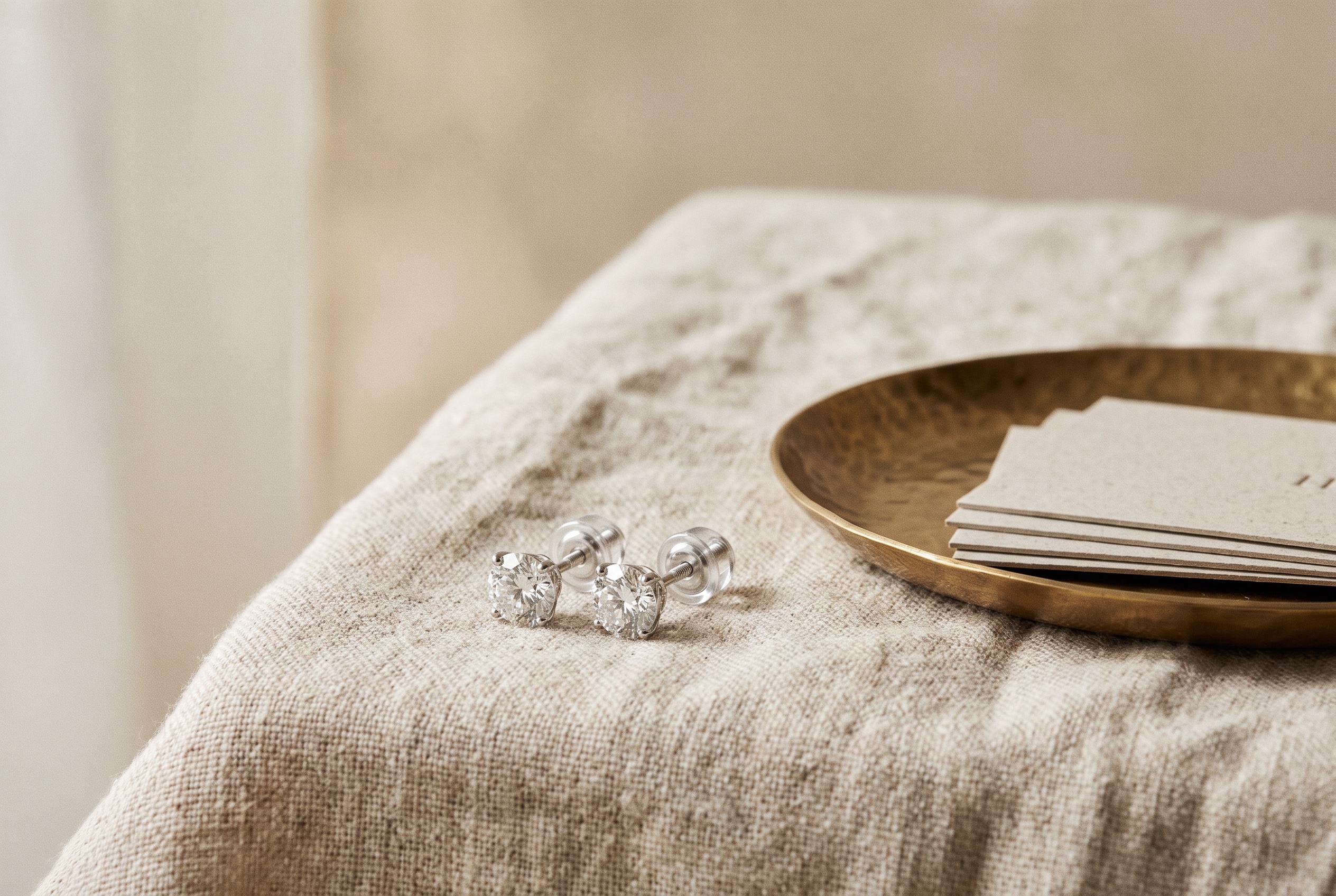
Half-carat is one of the most popular single-stone weights for diamond studs, typically sold and priced as a matched pair (roughly 1 total carat weight across both ears) rather than quoted per individual stone. Matching matters more here than at almost any other buying scenario: two stones of visibly different color, size, or brilliance sitting side by side on the same person are far more noticeable than a size or color difference would be comparing two rings bought separately. A well-matched pair should have color grades within one grade of each other, clarity grades close enough that neither stone reads visibly different, and cut proportions similar enough that both stones face up at the same apparent size despite natural variation in how any two individually cut stones measure.
Buying pre-matched pairs from a supplier that specifically curates for this — rather than picking two individually certified stones at random and hoping they match — removes a meaningful amount of buyer risk and rework. This is exactly the sourcing problem a dedicated matching-pairs category is built to solve, letting a jeweler pull a pair that's already been checked for visual consistency rather than assembling one from single-stone inventory.
0.5 Carat as Side Stones vs. as a Standalone Center Stone
Half-carat stones serve two genuinely different roles depending on the build, and the grading priorities shift between them:
- As side stones flanking a larger center stone, 0.5 carat stones are usually chosen to complement rather than compete with the center — color and clarity are typically matched closely to the center stone's grade so the whole piece reads as a cohesive unit, and cut quality matters more than absolute size since side stones are viewed at an angle and in smaller doses.
- As a standalone center stone in a solitaire or simple halo setting, a 0.5 carat stone is on full display with nothing to share attention with, which puts more weight on cut quality and color specifically — the two factors most responsible for a stone's visible sparkle and warmth when it's the sole focal point.
A halo setting is a particularly common choice for a 0.5 carat center stone specifically, since surrounding melee can make a half-carat stone read visibly larger — a genuinely useful lever for a buyer who wants more apparent size than 0.5 carats delivers alone without moving up to a pricier center-stone weight.
What Actually Sits Behind a 0.5 Carat Wholesale Quote
A wholesale quote for a 0.5 carat lab-grown stone reflects several stacked cost components: the rough crystal, CVD growth time and equipment, cutting and polishing labor, independent lab certification, and the supplier's own margin. Much of the trade's CVD cutting and polishing work — including Guru Diam's — is carried out in India before the finished stone is graded and shipped from a US location, a standard and normal part of how the diamond supply chain is structured today. At smaller weights like 0.5 carats, cutting labor is a proportionally larger share of the finished cost than it is at 2 or 3 carats, since a skilled cutter spends real time and attention on a half-carat stone even though the finished piece carries less rough material and a lower headline price.
Understanding this stack helps a buyer evaluate whether a quote makes sense: a price that looks unusually low relative to the ranges above is worth a closer look at what's actually being represented — cut grade, certifying lab, and independent verification — rather than assumed automatically to be a better deal.
Common Buyer Mistakes When Shopping by Price Alone
- Assuming 0.5 carat costs exactly half of 1 carat. Per-carat pricing is lower at 0.5 carats than at 1 carat, so a like-for-like grading comparison typically costs less than half the equivalent 1-carat price, not exactly half.
- Buying stud-earring stones without confirming they're matched. Two individually well-graded stones can still look mismatched side by side if color, size, or cut proportions aren't checked against each other specifically.
- Comparing quotes without confirming identical grading. A lower price often simply reflects a lower color, clarity, or cut grade rather than a genuinely better deal.
- Skipping certification to save a small amount at this size. The documentation premium at 0.5 carats is modest in absolute dollars, and skipping it removes any independent way to verify what's actually being sold.
- Ignoring cut grade in favor of color and clarity. A poorly cut 0.5 carat stone can look visibly duller than a better-cut stone with a lower color or clarity grade — cut should never be the line item cut to save cost.
How to Read a 0.5 Carat Diamond Quote
| Line Item | What to Check |
|---|---|
| Certification | Which lab, and whether the report number is verifiable through the lab's own lookup tool |
| Growth method | CVD should be clearly stated; HPHT origin should never be ambiguous or undisclosed |
| Cut grade | Listed separately from color and clarity — strong color and clarity grades don't guarantee a well-cut, bright-facing stone |
| Measurements | Actual millimeter dimensions confirm the stone matches its stated carat weight proportionally rather than being cut unusually deep or shallow to hit a target weight |
| Pair matching (studs) | For a two-stone quote, confirm color, clarity, and cut are specified for both stones and that the supplier represents them as a matched pair, not two unrelated stones |
Comparing Quotes Across Multiple Suppliers
When evaluating quotes from more than one wholesaler for a 0.5 carat stone, the most reliable comparison holds every variable constant except price: same shape, same color grade, same clarity grade, same cut grade, and the same certifying lab. Even small differences in any one of these — a G versus an H color, a VS2 versus an SI1 clarity, an Excellent versus a Very Good cut — can account for a meaningful percentage price gap at this size, even though the absolute dollar difference is smaller than it would be at 1 carat or above. Requesting quotes on a specific, fully-specified stone, down to the certificate number where a supplier has one in hand, removes ambiguity and makes any remaining price difference genuinely meaningful. It's also worth confirming shipping timeline and cutoff terms alongside price, since a modestly higher price from a supplier with reliable same-day shipping can be the better overall deal for a jeweler working against a customer's timeline.
Inventory Considerations for Jewelers Stocking Half-Carat
Because 0.5 carat spans such a wide range of use cases — studs, side stones, and entry-level solitaires — it's genuinely one of the deepest and most liquid weights to stock, with strong turnover across multiple product categories rather than a single narrow use. A jeweler building a case around this weight benefits from stocking a reasonable spread across the value and trade-sweet-spot tiers specifically, since that's where the bulk of half-carat demand concentrates, while keeping a smaller premium-tier selection on hand for buyers who want top grading in a smaller stone. For matched-pair stud inventory specifically, stocking pairs together rather than relying on assembling them from single-stone inventory on demand shortens the path from browsing to sale.
Sourcing 0.5 Carat Lab-Grown Diamonds at Wholesale
Guru Diam supplies certified CVD lab-grown diamonds — no HPHT anywhere in the catalog — with IGI, GIA, and GCAL certification all available, across round brilliant and the full range of fancy shapes. Half-carat is a core stocking weight, in stock now and ready to ship, with same-day shipping available on in-stock stones from New York (before 6pm EST) and Los Angeles (before 4pm PST).
Buyers can browse current 0.5 carat inventory, including certified loose stones suited to solitaires and side-stone builds, through the certified diamonds category, and buyers sourcing matched pairs for stud earrings or three-stone side settings can go directly to the matching pairs category rather than assembling a pair from single-stone listings. For a fancy-color half-carat accent or center stone, the fancy color loose diamonds category covers that inventory separately. Buyers building a full piece around a 0.5 carat stone can work through custom jewelry for a setting finished in 4-6 days — the loose stone itself ships same-day, with the 4-6 day timeline applying to the finished ring build, not the stone. Trade accounts can review terms at the wholesale hub or apply through trade partner.
Frequently Asked Questions
How much does a 0.5 carat lab-grown diamond cost?
Price varies by cut, color, clarity, shape, and certifying lab, but as a general market range, wholesale quotes for a 0.5 carat CVD lab-grown diamond commonly run from roughly $220 at the value end (I-J color, SI clarity) up to $950 or more at the top end (D-F color, VVS clarity). Getting an accurate figure requires pricing a specific 4Cs combination with a supplier directly.
Is a 0.5 carat lab-grown diamond half the price of a 1 carat one?
No — per-carat pricing is lower at 0.5 carats than at 1 carat, so a 0.5 carat stone at the same color, clarity, and cut grade typically costs less than half of the equivalent 1 carat price, not exactly half.
Is 0.5 carat a good size for diamond stud earrings?
Yes, half-carat is one of the most commonly chosen single-stone weights for studs, usually sold as a matched pair totaling roughly 1 carat combined. Matching color, clarity, and cut proportions between the two stones matters more for studs than for a single ring stone, since both are viewed side by side.
Why is a 0.5 carat lab-grown diamond cheaper than natural?
Lab-grown pricing reflects CVD production cost — equipment, energy, and growth time — which scales with manufacturing investment, while natural diamond pricing reflects geological rarity and mining cost. That price gap holds at 0.5 carats just as it does at larger weights, even though the absolute dollar difference is smaller.
What color and clarity should I choose for a 0.5 carat lab-grown diamond?
G-H color with SI1-VS2 clarity is a common trade sweet spot at this size — a balance of near-colorless appearance and eye-clean clarity at a meaningfully lower price than top D-F/VVS combinations, which are difficult to distinguish without magnification at half-carat.
Does a 0.5 carat diamond need certification?
Yes — 0.5 carats sits well above the roughly 0.30ct threshold where independent certification (IGI, GIA, or GCAL) becomes standard practice for loose diamonds, distinct from smaller uncertified melee. Certification lets a buyer verify the 4Cs independently rather than relying on a seller's representation.