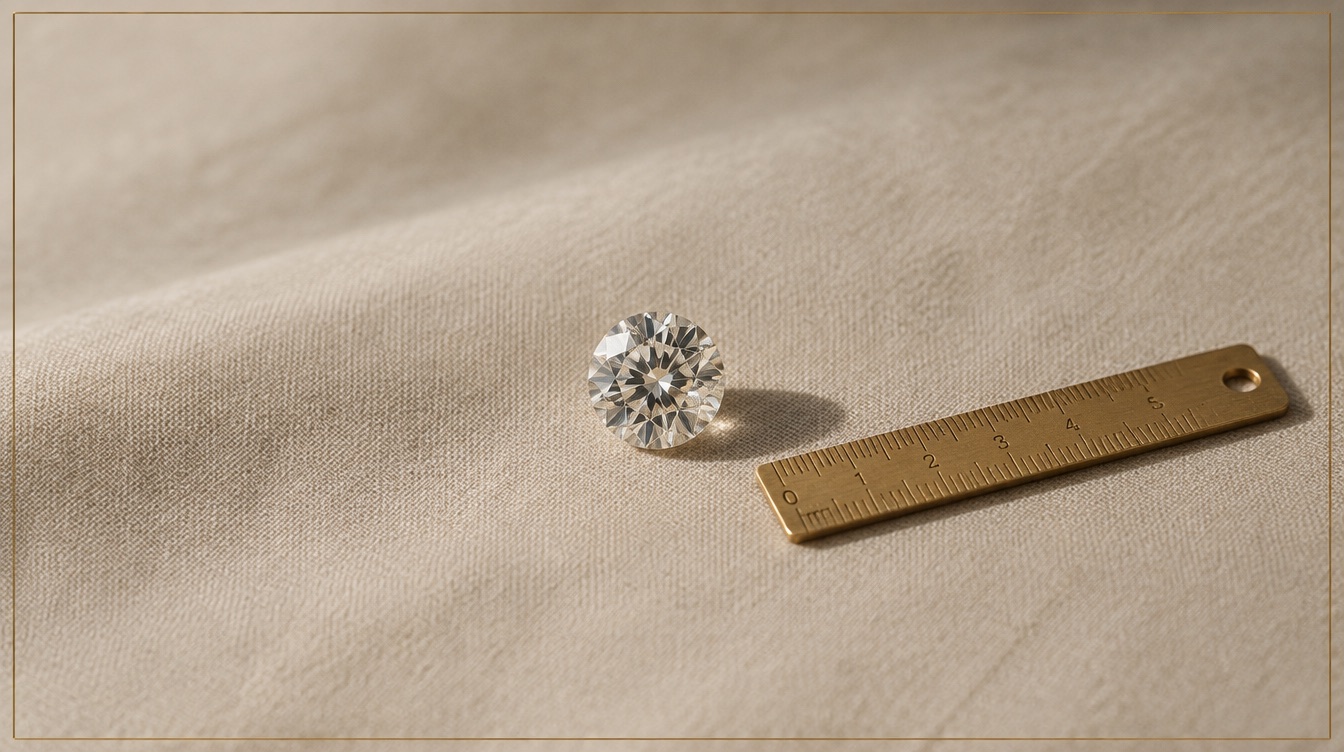
Lab-grown diamonds are cheap compared to natural diamonds because they aren't scarce the way mined diamonds are. As CVD reactor technology matured and multiplied worldwide — especially across India and China — production capacity expanded, more growers entered the market, and per-carat production costs fell steadily. It's a manufacturing cost curve, not a quality compromise.
That last point is the one buyers and retail customers most often get wrong. A falling price is not a signal of a falling standard. This guide walks through the actual mechanics behind the lab-grown price decline since roughly 2018–2020 — the supply-side story, the technology story, and the competitive story — and separates all of that clearly from the one thing that hasn't changed: what a well-cut, well-graded CVD diamond actually is.
The Short Answer: Why Lab-Grown Diamonds Are Cheap
Lab-grown diamond pricing is a function of production economics, not scarcity, and production economics improve over time the way they do in any maturing manufacturing category — think flat-panel displays, solar panels, or LED lighting, all of which followed a similar cost curve as the underlying technology scaled. When an industry figures out how to grow more, faster, and more reliably, and when more producers enter that industry and compete for the same buyers, prices fall. That is essentially the whole story for lab-grown diamonds, compressed into two sentences.
Unpacked, several concrete forces are doing the work: CVD (chemical vapor deposition) reactor technology has matured substantially since the category's early wholesale years, growing chambers have become more efficient and higher-yield, the number of growers operating at meaningful commercial scale has multiplied — heavily concentrated in India and China but no longer limited to those regions — and that expanded competitive field has pushed wholesale margins down across the board. None of those forces touch the physical, chemical, or optical properties of the stone itself. That distinction — economics versus quality — is the thread running through everything below.
No Natural Scarcity: The Structural Difference That Explains Everything Else
A natural diamond's price ultimately traces back to geology: a finite quantity of rough diamond exists in the earth's crust, a small number of major producers control most of the accessible supply, and extracting more of it requires enormous capital, exploration risk, and time that can't be compressed no matter how much demand exists. Supply cannot simply expand to meet a demand spike — mines don't scale the way factories do.
Lab-grown diamond has no equivalent constraint. A CVD reactor is a piece of industrial equipment, not a geological deposit. If demand for lab-grown diamonds increases, a producer can build another reactor, train another technician, and add capacity within a production cycle measured in months, not decades. That single structural difference — supply that can expand to meet demand, versus supply that fundamentally cannot — is the root cause of essentially every other dynamic described in this guide. Scarcity supports a price premium. The absence of scarcity does not support one, no matter how desirable the end product is.
How CVD Reactor Technology Matured and Multiplied Worldwide
In lab-grown diamond's early wholesale years, CVD growing was a comparatively specialized, capital-intensive, and slower process. Reactor yields were lower, growth cycles took longer relative to the carat weight produced, and the number of facilities capable of consistent, gem-quality output at commercial volume was genuinely limited. That scarcity of production capability — not the diamonds themselves being rare, but the ability to grow them efficiently being rare — supported meaningfully higher wholesale pricing in that earlier period.
That changed as the underlying reactor technology matured. Growing chambers improved in yield and consistency, growth-cycle times shortened relative to output, and the equipment and process knowledge needed to run a reliable CVD operation became far more widely available and far less exotic than it was at the category's outset. This is the standard trajectory of any manufacturing technology moving from an early, specialized phase into a mature, broadly accessible one — the same pattern seen in solar panel manufacturing or semiconductor fabrication a generation earlier, just compressed into a shorter timeframe for lab-grown diamond specifically.
It's worth noting that CVD is one of two dominant lab-grown growing methods — the other being HPHT (high pressure, high temperature) — and both methods saw their underlying reactor technology and production capacity mature and expand over the same general period industry-wide. Guru Diam's own catalog is CVD-only; this guide describes the broader industry-wide capacity story, which includes both methods, to explain the full picture of why lab-grown supply overall has grown so substantially.
India and China: Where Global Growing Capacity Concentrated
A large share of the worldwide increase in lab-grown diamond growing capacity concentrated in India and China, building on those countries' existing, deeply established infrastructure for diamond cutting, polishing, and gemstone manufacturing more broadly. India in particular already had decades of accumulated skilled labor, cutting-house infrastructure, and trade-finance relationships built around the natural diamond industry — infrastructure that transferred directly into scaling CVD growing and finishing operations once the technology matured enough to make that investment attractive.
This concentration matters for the price story in two ways. First, it meant new growing capacity could come online faster than it would have in a region building the entire supporting ecosystem — skilled cutters, polishers, graders, export logistics — from scratch. Second, it meant that as more facilities in these established hubs reached production maturity around the same period, a genuinely large volume of new supply entered the global wholesale market within a relatively compressed window, rather than trickling in gradually over decades the way new mining supply typically does. That compressed timing is part of why the lab-grown price decline has felt sharp and sustained rather than slow and gradual.
Commoditization: More Growers, More Competition, Thinner Margins
As reactor technology became more accessible and more producers reached commercial scale, lab-grown diamond moved from a market with a handful of specialized growers commanding premium pricing into a genuinely commoditized category with many producers competing directly for the same wholesale buyers. That shift from scarcity-driven pricing to competition-driven pricing is a distinct force from the technology-cost story above, and it compounds with it rather than simply overlapping.
In a commoditized market, a buyer comparing quotes from multiple growers or wholesalers for a stone of equivalent specification — same shape, same color and clarity grade, same certification — will naturally gravitate toward the best price, since the underlying product is functionally interchangeable between suppliers at a given grade. That competitive dynamic compresses margins at every level of the supply chain: growers compete with growers, cutting houses compete with cutting houses, and wholesalers compete with wholesalers, all working from a shrinking cost base and a widening field of comparably capable competitors. The category that has felt this most acutely is standard round brilliant in mainstream color, clarity, and carat-weight combinations — the highest-volume, most directly comparable segment of the whole market, and the one where price competition shows up fastest and most visibly.
Falling Per-Carat Production Costs: A Manufacturing Curve, Not a Market Crash
It's worth being precise about the difference between a "price crash" and a "cost curve," because they're often described interchangeably and they aren't the same thing. A price crash implies a sudden, possibly temporary market dislocation — a supply glut, a demand shock, a bubble bursting. What has actually happened with lab-grown diamond pricing is closer to a manufacturing learning curve: as an industry gains cumulative production experience, refines its processes, and scales its equipment base, the cost of producing each additional unit tends to decline steadily and predictably, and that declining cost gets passed through to wholesale pricing as competition prevents any single producer from holding pricing artificially high.
This is a well-documented pattern across manufactured goods generally, and there's no structural reason to expect lab-grown diamond to behave differently. Growers have gotten better at running reactors efficiently, yields per growing cycle have improved, energy and input costs per carat produced have come down as processes were refined, and none of that required a demand collapse or a speculative bubble popping — it required only the ordinary, cumulative effect of an industry maturing. That framing matters practically: a buyer should expect this trend to continue as an extension of ordinary manufacturing improvement, not treat the price decline as an anomaly that's about to snap back.
A Qualitative Timeline: How Lab-Grown Production Capacity Scaled
No verified, universally agreed-upon dollar figures or percentage-drop statistics exist that would hold up to scrutiny across sources — pricing data in this category comes from a range of trade sources using different methodologies and time windows, and figures vary. What follows instead is a qualitative, directional timeline of how the underlying production landscape shifted, useful for understanding sequence and cause rather than as a precise pricing chart.
| Phase | State of Production Capacity | Effect on Wholesale Pricing |
|---|---|---|
| Early wholesale era | Small number of specialized growers, lower reactor yields, longer growth cycles, limited commercial-scale capability | Meaningful premium pricing relative to production cost, reflecting scarce production capability rather than scarce material |
| Technology maturation period | Reactor efficiency and yield improve; process knowledge becomes more widely documented and transferable | Cost per carat begins a sustained decline as producers extract more usable rough per growing cycle |
| Capacity expansion period | Existing growers scale up; new entrants, concentrated in India and China, build meaningful commercial capacity | Total global supply increases substantially within a relatively short window, intensifying competition |
| Commoditization period | Standard round brilliant in mainstream grades becomes a widely available, comparably graded commodity across many suppliers | Margin compression accelerates fastest in this highest-volume, most directly comparable segment |
| Current maturity phase | Broad global capacity, continued incremental efficiency gains, ongoing new entrants at a slower pace than the expansion period | Continued, more gradual softening rather than sharp single-year drops, with larger and fancy-shape stones softening less steeply than commodity rounds |
Cheap Does Not Mean Lower Quality
This is the single most important clarification in any honest explanation of why lab-grown diamonds are inexpensive, and it deserves to be stated plainly: a CVD lab-grown diamond is chemically, physically, and optically identical to a natural diamond of the same cut, color, clarity, and carat grade. Both are crystallized carbon with the same hardness, the same refractive index, the same fire and brilliance under light, graded on the exact same 4Cs scale by the same major certification laboratories. A jeweler's loupe, a standard grading process, and even most specialized diamond-testing equipment used by consumers cannot distinguish a well-graded CVD stone from a natural one by appearance or performance alone — the distinction only shows up through the specific lab equipment designed to detect growth-method markers.
The price gap exists entirely because of what each stone costs to bring to market, not because of any difference in what the stone is. A natural diamond's price embeds geological rarity, mining capital costs, exploration risk, and a supply chain that cannot expand on demand. A lab-grown diamond's price embeds equipment, energy, growing time, and skilled cutting and finishing labor — all of which get cheaper as an industry matures, none of which reflects a lesser stone. Conflating "cheaper to produce" with "lower quality" is a common and understandable assumption, but it doesn't hold up against the actual physical and gemological facts, and it's worth correcting directly with any retail-facing account or end customer who raises the question.
Natural vs. Lab-Grown: Comparing the Underlying Cost Drivers
Putting the two cost structures side by side makes clear why one has stayed comparatively stable while the other has fallen substantially and consistently.
| Cost Driver | Natural Diamond | Lab-Grown (CVD) Diamond |
|---|---|---|
| Underlying supply constraint | Fixed by geology; cannot expand on demand | Set by installed reactor capacity; can expand with investment |
| Primary cost inputs | Exploration, mining capital, land rights, extraction risk | Reactor equipment, energy, growing time, process inputs |
| Effect of rising demand | Can push prices up faster than supply can respond | Tends to draw in more growing capacity, which pulls prices back down |
| Effect of more competitors entering | Limited — few new entrants possible at meaningful scale | Significant — new growers compete directly on price for comparable grades |
| Trajectory over time | Relatively stable, tied to producer sales policy and mine output | Consistent downward pressure as production technology and scale improve |
| Cutting and finishing cost (once rough exists) | Comparable skilled labor cost to lab-grown for equivalent cut complexity | Comparable skilled labor cost to natural for equivalent cut complexity |
That last row is worth sitting with. Cutting, polishing, and grading a stone well costs roughly the same regardless of whether the rough came from the ground or a reactor — those are skilled-labor and precision-equipment costs tied to the finished cut, not the growing method. The entire price gap, and the entire reason lab-grown pricing keeps moving while natural pricing mostly doesn't, lives upstream of finishing, in how the rough material itself gets produced.
Why the Decline Has Hit Some Categories Harder Than Others
The price decline hasn't landed evenly across the lab-grown catalog, and understanding why reinforces the whole mechanism described above. Standard round brilliant stones in common bridal color, clarity, and carat combinations have absorbed the steepest, most consistent softening, because that's precisely the highest-volume category where the largest number of growers and wholesalers compete head-to-head for the same buyers on functionally interchangeable specifications. When ten suppliers can offer essentially the same graded stone, price becomes the primary lever they compete on.
Larger carat weights, fancy shapes, and higher clarity grades within lab-grown have softened too, but generally less steeply and less uniformly, because they represent a smaller, less directly comparable slice of total production — fewer growers produce them at meaningful volume, and buyers shopping that segment are comparing across a narrower field of genuinely equivalent alternatives. A buyer or retail account whose lab-grown mix leans toward rounds in standard bridal sizes should expect to feel this pricing trend more sharply and more continuously than one whose mix skews toward fancy shapes or larger stones.
What This Means for Wholesale Buyers and Retail Pricing
The practical takeaway for a working buyer is that lab-grown inventory carries real, ongoing markdown exposure the longer it sits unsold, because the underlying production-cost curve keeps moving in one direction. Stock purchased today at today's pricing risks being worth less by the time it turns over if it sits for an extended period — not because the market crashed, but because the broader manufacturing curve kept advancing underneath it. That argues for leaner, faster-turning lab-grown positions and more frequent price check-ins rather than large speculative holds, particularly in the commoditized round-brilliant bridal categories described above.
It also has a customer-conversation dimension that's easy to underestimate. A retail account or end buyer who hasn't had this explained clearly can misread a falling price as a falling standard, which is exactly backwards and can cost a sale or damage trust if left uncorrected. The more useful framing to pass along is the one at the center of this guide: lab-grown diamonds are cheaper because they can be produced more efficiently and more abundantly than nature allows for natural stones, not because a jeweler is selling a lesser product. That framing tends to land well because it's simply accurate, and it holds up under any follow-up question a skeptical customer asks.
Sourcing Lab-Grown Diamonds at Guru Diam
Guru Diam is a trade-only wholesale supplier carrying CVD lab-grown diamonds alongside natural diamonds, certified loose stones, calibrated melee, and finished jewelry, across standard, antique, and exotic shapes — not a narrow lab-grown-only operation. That breadth matters directly in the context of this guide: a supplier who understands both sides of the market can speak accurately to why lab-grown and natural pricing behave so differently, rather than flattening the two into one generic "diamond price" answer.
Guru Diam's own diamonds are cut and polished in India before final grading and shipment from our New York and Los Angeles locations — a production footprint that reflects the same broader industry pattern described above, where established cutting and finishing infrastructure supports efficient, well-controlled production at scale. Every stone ships with the buyer's choice of IGI, GIA, or GCAL certification, and in-stock inventory ships same-day when ordered before 6pm EST from New York or 4pm PST from Los Angeles. Because lab-grown pricing specifically continues to move, Guru Diam provides current, dated quotes rather than a static price list that can go stale within a single quarter.
Buyers can review current certified inventory in the certified diamonds category, source coordinated stones through matching pairs, and browse the rarer end of the market in fancy color loose diamonds. The full catalog is accessible through the wholesale hub, retail and design partners building finished pieces can work through custom jewelry — with custom engagement rings finished in 4–6 days — and any account wanting a standing relationship with regularly refreshed pricing can apply through trade partner.
Will Lab-Grown Diamond Prices Keep Falling?
The reasonable expectation, absent some currently unforeseen shift in the underlying technology or industry structure, is that this trend continues rather than reverses. The forces driving the decline — maturing reactor technology, an expanding and increasingly global grower base, and a genuinely commoditized wholesale market for standard specifications — are structural, not temporary. There's no equivalent force on the horizon that would suddenly reintroduce artificial scarcity to a manufactured product once the manufacturing knowledge and equipment to produce it are this widely distributed.
That said, the pace of decline is unlikely to stay as steep indefinitely as an industry moves from a rapid capacity-expansion phase into a more mature, incrementally-improving phase — a pattern common to most manufacturing categories once early efficiency gains have largely been captured. Buyers and retail accounts are better served planning around continued, more gradual softening than assuming current pricing has already found its floor, and better served still by treating any lab-grown price point as something to reconfirm regularly rather than something to assume is stable from one season to the next.
Frequently Asked Questions
Why are lab-grown diamonds so cheap compared to natural diamonds?
Lab-grown diamonds are cheap because they're a manufactured product without the geological scarcity that underpins natural diamond pricing. As CVD reactor technology matured and more growers reached commercial scale — heavily concentrated in India and China — production capacity expanded to meet demand and competition pushed wholesale prices down, unlike natural diamond supply, which cannot expand the same way.
Does a cheaper price mean lab-grown diamonds are lower quality?
No. A well-cut, well-graded CVD lab-grown diamond is chemically, physically, and optically identical to a natural diamond of the same 4Cs grade, and both are graded on the same scale by the same major certification labs. The price difference reflects production economics and scarcity, not any difference in the stone's hardness, brilliance, or durability.
When did lab-grown diamond prices start dropping so much?
The steepest, most sustained decline has occurred over roughly the past several years, as CVD reactor technology matured and production capacity scaled substantially, particularly in India and China. This wasn't a single event but an ongoing trend tied to cumulative manufacturing improvement and a growing number of producers competing for the same buyers.
Will lab-grown diamond prices keep falling in the future?
The reasonable expectation is continued, though likely more gradual, softening, since the underlying drivers — maturing technology, an expanding global grower base, and a commoditized wholesale market for standard specifications — are structural rather than temporary. Buyers are better served assuming the trend continues than assuming current pricing has already stabilized.
Are all lab-grown diamonds getting cheaper at the same rate?
No. Standard round brilliant stones in mainstream color, clarity, and bridal carat sizes have seen the steepest, most consistent price declines because that's the highest-volume, most directly competed segment. Larger, rarer, or fancy-shape lab-grown stones have softened too, but generally less steeply, since fewer growers produce them at comparable scale.
Is Guru Diam's lab-grown diamond pricing based on current market conditions?
Yes. Because lab-grown pricing continues to move as production economics evolve, Guru Diam provides current, dated wholesale quotes rather than a static price list, so trade partners are working from accurate, up-to-date figures rather than a number that may already be stale.