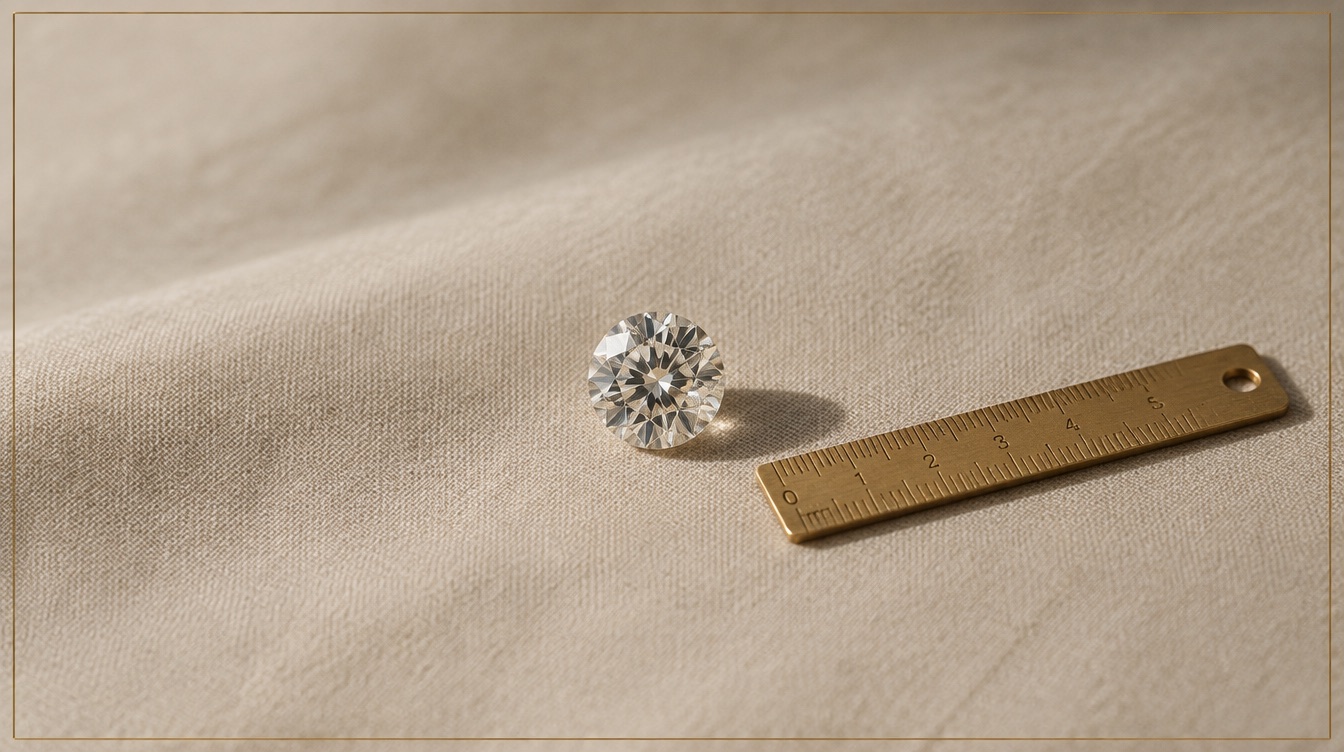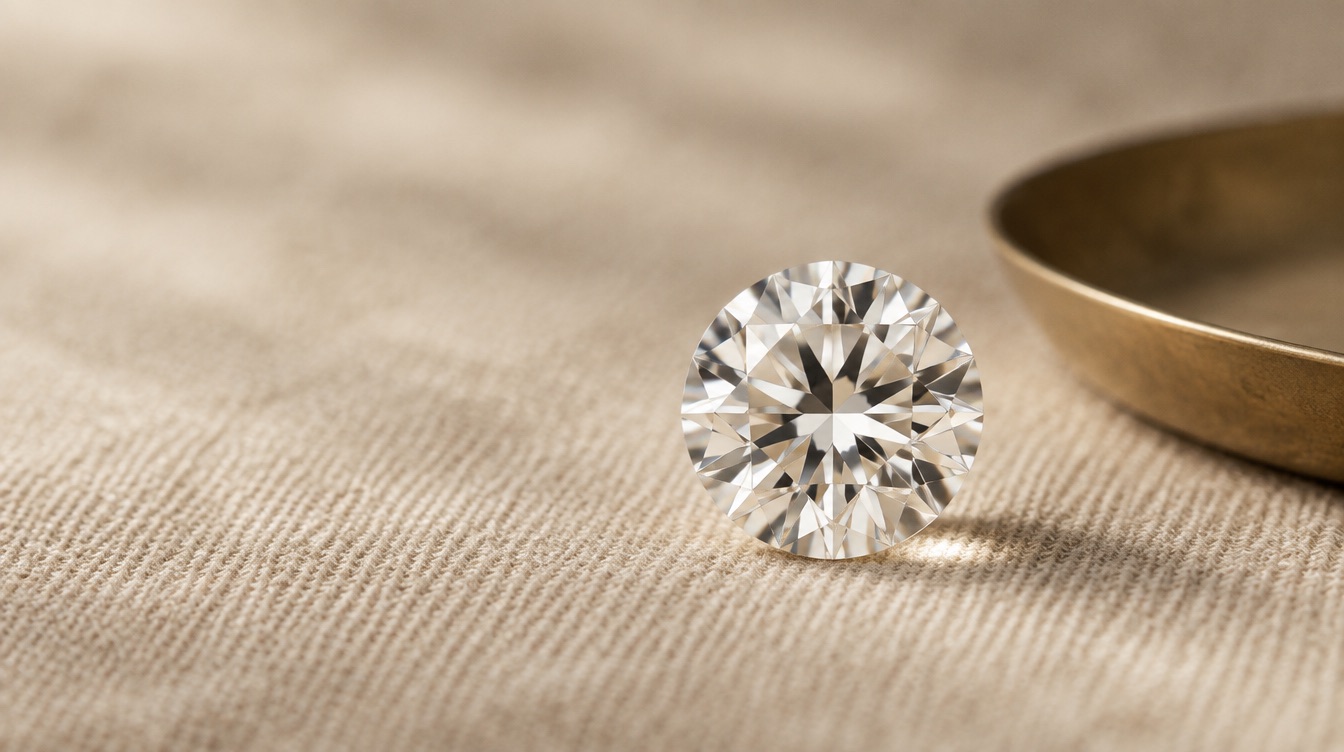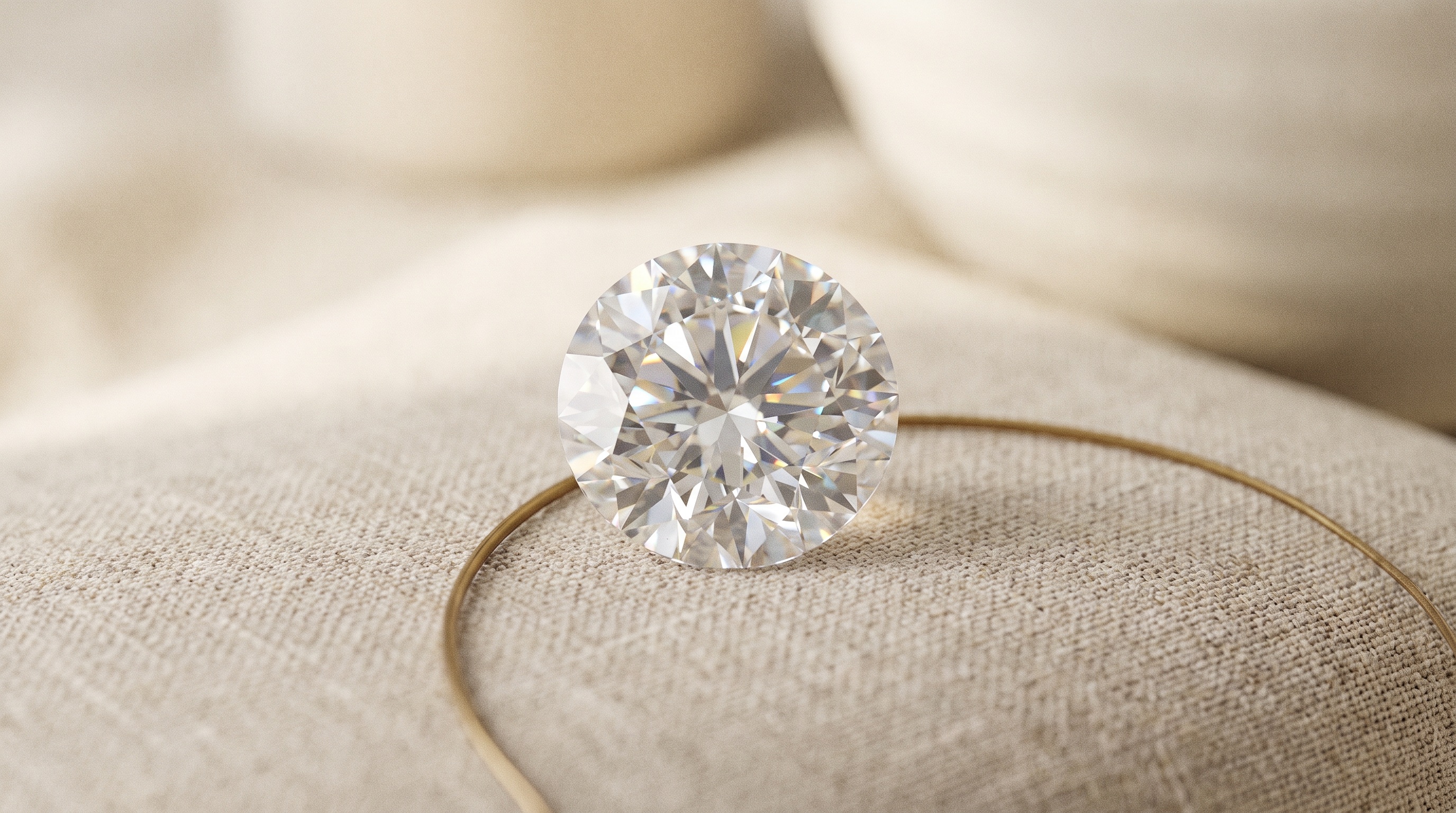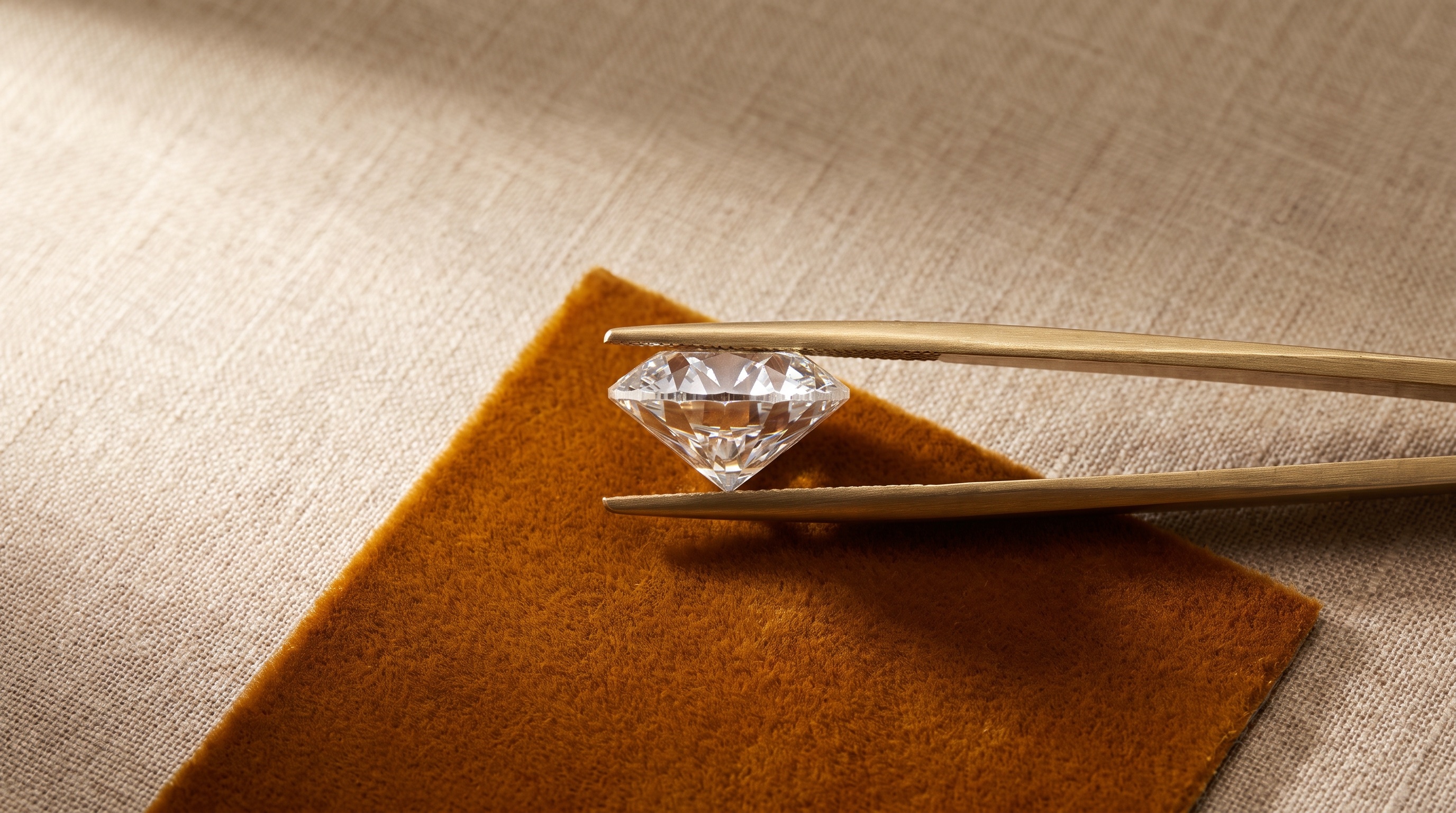
A diamond girdle is the narrow, ribbon-like band that runs around the widest point of a diamond, forming the boundary between the crown (the upper, visible part of the stone) and the pavilion (the lower, cone-shaped part). It's the thinnest and most structurally exposed part of the stone, which makes its thickness — graded from extremely thin to extremely thick — one of the most practically important proportions on a diamond report, affecting durability, how much visible weight the stone carries, and how it should be set.
Where the Girdle Sits on a Diamond
Every faceted diamond has three main structural zones: the crown above the girdle, the girdle itself, and the pavilion below it. The girdle is the diamond's outer edge at its widest diameter — the part a jeweler grips when handling a loose stone, and the part that sits inside the metal collet or prong tips once the stone is set. Because it's the thinnest cross-section of the entire diamond, it's also the part most exposed to chipping during setting, wear, and resizing. For a full breakdown of how the girdle relates to the table, crown, pavilion, and culet, see GD's diamond anatomy guide.
Girdle Thickness Grades
Grading labs describe girdle thickness on a standardized scale, typically reported as a range (since thickness can vary slightly around the stone's circumference) rather than a single fixed value:
- Extremely Thin — a fragile edge with meaningful chip risk, generally avoided for center stones
- Very Thin — still a durability concern, particularly at facet junctions
- Thin — acceptable for most stones, minor risk during setting or knocks
- Medium — the target range for most well-cut diamonds; durable without adding unnecessary bulk
- Slightly Thick to Thick — durable, but starts adding weight without adding visible size
- Very Thick to Extremely Thick — noticeably heavier for the same visible diameter, and can look clunky in a low-profile setting
Most graded diamond reports (GIA, IGI, GCAL) list girdle thickness as both a descriptive range and, on many reports, a percentage of the average girdle diameter — buyers comparing two stones of the same carat weight should check this figure specifically if visible size matters more than raw weight.
Why Girdle Thickness Affects Durability
A girdle that is too thin is the single most common point of chipping on a finished diamond, particularly at the facet junctions where two girdle facets meet at a sharp edge. This risk is highest during the setting process itself, when a jeweler applies direct pressure to the girdle to secure prongs or a bezel rim, and again during any later resizing or repair work that requires removing and resetting the stone. A girdle graded thin or thinner is worth flagging to a setter in advance so extra care is taken; a girdle graded medium or slightly thick generally poses no meaningful risk under normal setting and wear conditions.
Why Girdle Thickness Affects Carat Weight
Girdle thickness has an outsized effect on how much of a diamond's total weight sits in a part of the stone that contributes little to its visible face-up size or brilliance. Two diamonds of identical visible diameter can differ meaningfully in carat weight if one has a thick girdle and the other a medium girdle — the extra material in the thick-girdled stone adds cost (since diamonds are priced substantially by carat weight) without adding anything a buyer can actually see. This is one of the most common ways a diamond can be cut to maximize reported carat weight at the expense of face-up performance, and it's a key reason cut quality and proportions matter as much as, or more than, carat weight alone when comparing stones. See GD's round brilliant diamond cut guide for how proportions interact more broadly with a stone's visible performance.
Faceted, Polished, and Bruted Girdles
Girdles are finished in one of three ways, and the finish is typically noted on a diamond's grading report:
Bruted Girdle
A bruted girdle has a frosted, matte appearance, produced by the traditional method of shaping one diamond against another. It's the least refined finish and is now uncommon on well-cut modern stones, though it still appears on some older or lower-cost goods.
Polished Girdle
A polished girdle is smoothed to a glassy finish rather than left frosted, reducing the risk of small internal feathers or graining that can sometimes be associated with a bruted edge, and giving a cleaner overall appearance when the stone is viewed from the side.
Faceted Girdle
A faceted girdle has small individual facets cut around its circumference rather than a single smooth or frosted band. This is now the standard finish on most well-cut diamonds, since faceting reduces the visual "fisheye" or reflective ring effect that a smooth girdle can sometimes create, and it also allows a laser inscription (such as a report number) to sit cleanly on one of the facets.
Girdle Thickness and Diamond Shape
Girdle thickness recommendations vary somewhat by shape. Pointed and cornered shapes — marquise, pear, kite, heart, and other antique or fancy cuts with vulnerable tips or sharp corners — generally need a slightly thicker girdle specifically at those points to prevent chipping, even if the girdle elsewhere on the same stone is thinner. This is a normal and often deliberate feature of a well-cut fancy shape rather than a flaw; see GD's marquise diamond buying guide for how this plays out on a shape with two vulnerable points. Round brilliants, by contrast, have no single vulnerable point around their circumference, so a consistent medium girdle around the full diameter is the more typical target.
Girdle Thickness and Setting Style
The setting style a stone will go into also affects the ideal girdle thickness. A prong setting exposes more of the girdle to view and to physical risk at the points where prongs make contact, making girdle thickness at those specific points especially relevant. A bezel setting (see GD's bezel setting guide) or channel setting encloses the girdle more fully in metal, offering more physical protection regardless of the underlying girdle grade, though a very thin girdle can still be more difficult to seat securely even inside a protective setting.
Girdle Thickness at a Glance
| Grade | Durability | Weight Impact | Recommendation |
|---|---|---|---|
| Extremely Thin | High chip risk | Minimal | Generally avoid for center stones |
| Thin | Some risk, manageable with care | Low | Acceptable, flag for careful setting |
| Medium | Durable | Efficient | Ideal target range |
| Slightly Thick | Very durable | Slight added weight | Fine, minor tradeoff |
| Very Thick / Extremely Thick | Very durable | Meaningful added weight | Check visible size vs. carat weight before buying |
How to Check Girdle Thickness Before Buying
Girdle thickness is listed on every reputable diamond grading report alongside the other proportions (table percentage, depth percentage, crown angle, pavilion angle). Buyers comparing stones should look at girdle grade alongside overall cut grade rather than in isolation — a stone graded "Excellent" or "Ideal" cut overall will rarely have a problematic girdle, since girdle thickness is one of the proportions cut grade already accounts for. It becomes most relevant as an independent check when comparing stones that carry a lower overall cut grade, or when comparing two stones of similar carat weight and price to understand why one looks larger face-up than the other. See GD's GIA diamond report guide for a full walkthrough of where each proportion appears on a standard report.
Girdle Thickness Recommendations by Common Shape
While every stone should be evaluated individually, general guidance by shape helps frame what to expect:
Round Brilliant
A medium girdle around the full circumference is the standard target. Round brilliants have no single vulnerable point, so consistency matters more than any one measurement, and a well-cut round graded Excellent or Ideal overall will almost always carry an appropriate girdle by default.
Marquise, Pear, and Kite
These shapes carry one or two sharp points that concentrate stress, so a slightly thicker girdle specifically at the point (sometimes called a "bearded" or reinforced point in trade terms) is a deliberate and desirable feature, not a defect. See GD's marquise diamond buying guide for how this is evaluated in practice.
Emerald and Asscher (Step Cuts)
Step-cut corners are similarly vulnerable to chipping, and many cutters leave a touch more girdle thickness at each corner for the same protective reason, even when the girdle along the straight edges runs thinner.
Cushion and Oval
These shapes generally follow round-brilliant-style guidance fairly closely, since their curved outlines don't concentrate stress at a single sharp point the way marquise or pear shapes do, though girdle consistency around the full curve still matters for an even setting fit.
Girdle Thickness in Custom Jewelry Design
When a stone is being set into a custom piece rather than a standard stock mounting, girdle thickness is one of the measurements a bench jeweler or CAD designer factors into the setting's exact dimensions — prong height, bezel wall height, and channel width all need to accommodate the specific stone's girdle diameter and thickness precisely, rather than a generic assumption. This is particularly relevant for antique-cut stones or reset heirloom diamonds, where girdle proportions often fall outside standard modern ranges and a stock setting sized for a typical round brilliant may not fit correctly without adjustment. Getting accurate girdle measurements from the stone's grading report — or having the physical stone measured directly when no report exists — before finalizing a custom design avoids a costly refit after the setting has already been fabricated.
Common Girdle Issues to Watch For
Beyond simple thickness grading, a few specific girdle conditions are worth knowing:
- Girdle naturals — small, unpolished remnants of the original rough diamond's surface, left on the girdle. Minor naturals are common and generally don't affect durability or grade meaningfully; larger ones can be flagged as a clarity characteristic.
- Girdle chips — small nicks along the girdle edge, usually from handling or setting. These are noted on clarity plots and, depending on size and location, can affect clarity grade.
- Wavy girdle — an unevenly cut girdle that varies noticeably in thickness around the stone's circumference, sometimes affecting how symmetrically the stone sits in a setting.
Girdle Thickness Percentage vs. Descriptive Grade
Most modern grading reports express girdle thickness two ways at once: a descriptive term (thin, medium, thick, and so on) and, on many reports, a numeric percentage relative to the diamond's average diameter. The descriptive term is a quick-reference category, while the percentage gives a more precise comparison point between two stones that might both fall in the same descriptive bucket. A stone described as "medium" might sit anywhere within a percentage band that spans a small but measurable range, so a buyer comparing two "medium" girdle stones of the same shape and similar proportions elsewhere can still use the percentage figure to see which one is running slightly thinner or thicker within that band. This distinction matters most on larger stones, where even a small percentage difference in girdle thickness translates to a more noticeable difference in actual weight.
How Girdle Thickness Is Measured
Graders typically measure girdle thickness at multiple points around the stone's circumference using a specialized micrometer or an optical measuring device, rather than relying on a single spot check. Because girdle thickness can vary meaningfully around a stone — thinner in some places, thicker in others, sometimes deliberately by design on fancy shapes — the reported range on a grading document usually reflects the thinnest and thickest points found during measurement, not a single average number. This is part of why two stones with the same reported descriptive grade can still look and perform slightly differently once set, and why a jeweler inspecting a stone in person before setting will often do their own quick visual check of the girdle's evenness even when a grading report is already in hand.
Girdle Thickness in Antique and Vintage-Style Cuts
Antique cuts — Old Mine, Old European, rose cuts, and other historical styles — were generally cut by hand using techniques that predate modern precision-cutting equipment, and their girdles often reflect that: thicker, less uniform, and sometimes bruted rather than faceted or polished. This isn't a flaw so much as a genuine period characteristic, and it's part of why an authentic antique-cut stone can look and handle differently from a modern round brilliant cut to imitate an antique look. Jewelers working with genuine antique-cut inventory, or with modern antique-style reproductions intended to closely match historical proportions, should expect girdle characteristics that fall outside the "ideal" range used to judge a modern round brilliant, and should evaluate them against period-appropriate expectations rather than modern cut-grade standards. Guru Diam's antique-cut catalog — Old Mine, Old European, Hexagonal, Moval, Lozenge, Kite, Trillion, Criss-Cut, and other true antique-style cuts — reflects this distinction directly in how each stone is represented and graded.
Girdle Considerations for Melee and Small Accent Stones
Girdle thickness matters for melee and small accent stones too, though the practical stakes differ from a center stone. Melee is typically set in pavé, channel, or bead-set configurations where many small stones sit close together, and a girdle that's inconsistent from stone to stone across a batch can make it harder to achieve a uniform, level finished surface — a visible unevenness that shows up more on a pavé band or halo than it would on a single larger stone in an isolated setting. Melee buyers sourcing in volume for a consistent finished look should expect a QC baseline that accounts for this kind of consistency across a parcel, not just individual stone quality, since a single outlier stone with an unusually thick or thin girdle can create a visible dip or bump once a full row is set.
Girdle Inscriptions and Report Verification
A faceted girdle is also where laser inscriptions live on most certified diamonds — typically the grading report number, sometimes accompanied by a brand or logo microscopically etched into one of the girdle facets. This inscription is one of the fastest ways to verify that a specific stone matches its accompanying report: a jeweler or buyer can check the inscribed number under 10x magnification or a jeweler's loupe against the number printed on the physical or digital report. See GD's GIA report check verification guide for a fuller walkthrough of report-to-stone verification, much of which applies equally to IGI- and GCAL-graded stones.
Girdle Thickness and Resale or Appraisal Value
When a diamond is appraised or evaluated for resale, girdle thickness is one of several proportion factors an appraiser will weigh alongside cut grade, since it directly affects how much of the stone's reported carat weight is doing visible work. Two otherwise similar stones with the same carat weight, color, and clarity can be valued somewhat differently if one carries a notably thicker girdle than the other, because the thinner-girdled stone is generally understood to deliver more visible size and brilliance per carat. This is a secondary factor compared to the four primary value drivers (carat, cut, color, clarity), but it's one of the details a knowledgeable appraiser or buyer checks specifically when two stones look deceptively similar on paper.
Sourcing Diamonds With Verified Girdle Proportions Through Guru Diam
Guru Diam supplies certified loose diamonds — lab-grown CVD and natural — across round, fancy, and antique shapes, with full proportion data including girdle thickness available on every graded stone. IGI, GIA, and GCAL certification are all available depending on the stone. Because Guru Diam carries antique and fancy shapes as a core specialty, not just round brilliants, jewelers sourcing shapes with shape-specific girdle considerations (marquise, pear, kite, and other pointed cuts) can get proportion guidance alongside the stone itself rather than working from report data alone.
Browse certified stones with full proportion reporting through certified diamonds, or set up a trade account through trade partner to review inventory directly. Stones intended for a specific custom setting can be sourced and built together through custom jewelry, and matched pairs for earrings can be browsed under matching pairs. For general wholesale sourcing, start at the wholesale hub.
Frequently Asked Questions
What is a diamond girdle?
A diamond girdle is the narrow band running around the widest point of a diamond, separating the crown above from the pavilion below. It's the thinnest structural part of the stone and is graded from extremely thin to extremely thick on diamond reports.
Does girdle thickness affect a diamond's price?
Yes, indirectly. A thicker girdle adds carat weight without adding visible face-up size, meaning a thick-girdled stone can cost more per visible millimeter than a comparable stone with a medium girdle, since diamonds are priced substantially by carat weight.
Is a thin girdle a problem?
A girdle graded "thin" is generally acceptable and common on well-cut stones, though it warrants some care during setting. Girdles graded "extremely thin" carry meaningfully higher chip risk and are generally best avoided for center stones intended for daily wear.
What's the difference between a faceted and a bruted girdle?
A bruted girdle has a frosted, matte finish from traditional shaping methods, while a faceted girdle has small individual facets cut around its edge — the standard finish on most modern well-cut diamonds, since it reduces reflective distortion and allows for a clean laser inscription.
Why do some diamond shapes need a thicker girdle at certain points?
Pointed shapes like marquise, pear, and kite are more vulnerable to chipping at their tips or corners than round stones are anywhere around their circumference, so a well-cut fancy shape often has a deliberately thicker girdle specifically at those vulnerable points.
Where can I find a diamond's girdle grade?
Girdle thickness is listed on every reputable grading report — GIA, IGI, and GCAL all include it alongside the diamond's other proportions, such as table percentage, depth percentage, and crown and pavilion angles.
Can a diamond's girdle be reground or fixed after it's cut?
To a limited extent — a jeweler can sometimes lightly repolish or re-facet a chipped or damaged girdle area, but this typically removes a small amount of additional weight and can't meaningfully change an overall thickness grade without reshaping the stone more broadly. Significant girdle problems are usually easier to plan around at the sourcing stage than to correct afterward.