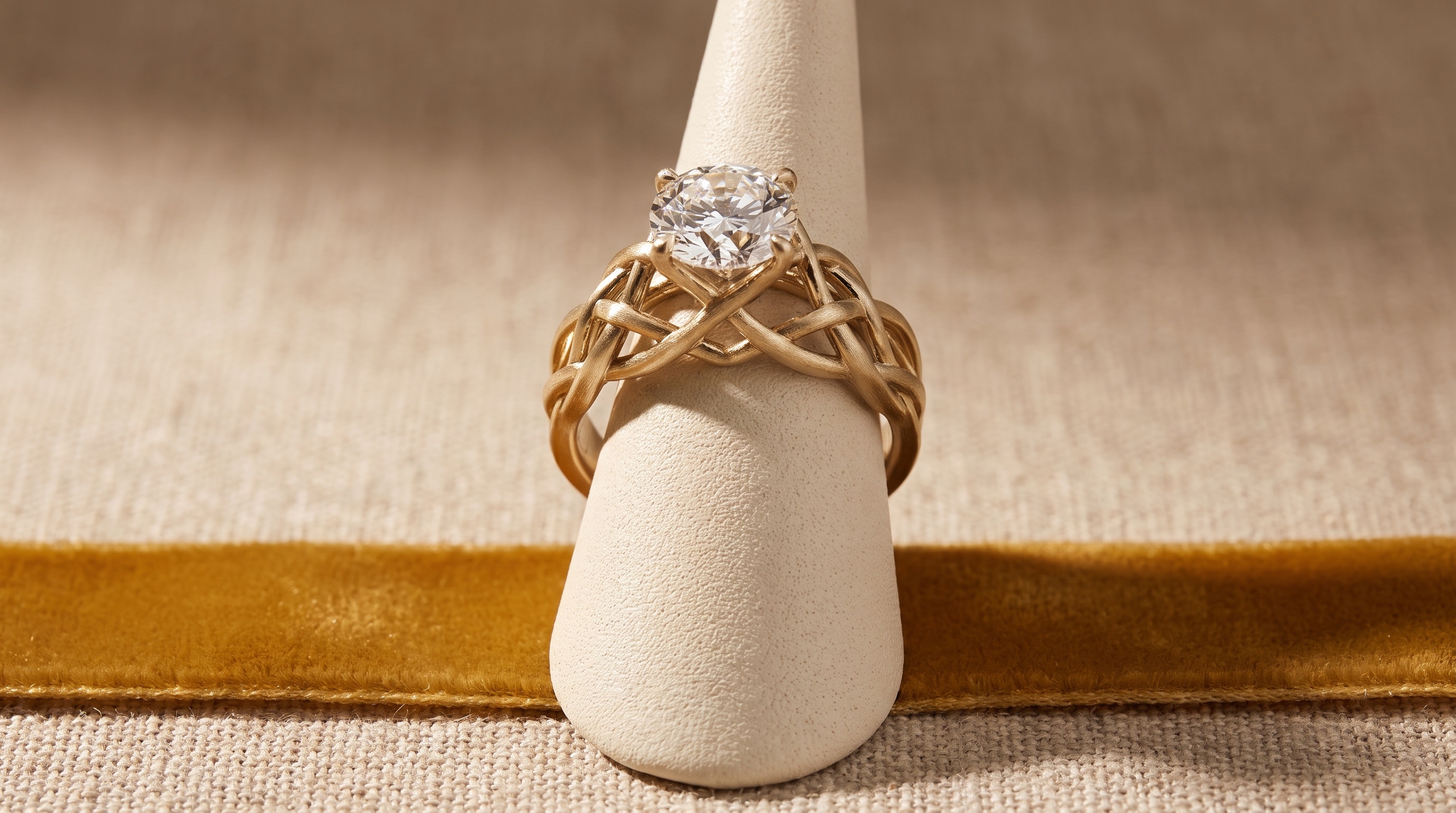
A trellis setting is a ring style where the metal shank splits and crosses in a woven, basket-weave pattern as it rises toward the head that holds the center stone — the crossing bands of metal form an open, lattice-like structure beneath the stone, similar in spirit to a garden trellis, which is where the style gets its name. The open, crossed structure adds visual texture and lets in light from multiple angles beneath the stone, giving the setting a more ornate and dimensional look than a plain, single-band rise.
Trellis settings are frequently confused with cathedral settings, since both raise the center stone above the band, but the two are structurally distinct once examined closely. This guide covers what actually defines a trellis setting, how it compares to cathedral, prong, and other raised-profile styles, the genuine pros and cons of wearing one, which center stones and shapes suit it best, metal and durability considerations, wedding band pairing, and what to check before committing to one.
What Defines a Trellis Setting
The defining feature of a trellis setting is the crossing, woven structure of the metal itself: rather than a single solid arch or a flat shank rising directly into prongs, a trellis setting splits the metal into two or more strands that cross over one another in an X or basket-weave pattern as they climb from the band toward the head. This crossing pattern is the structural and visual signature of the style — it's not a decorative overlay added to a different base structure, but the actual load-bearing form the shank takes as it approaches the stone.
This distinguishes a trellis setting from styles it's frequently confused with:
- Cathedral setting: Also raises the stone via arching shoulders, but a cathedral's arches are typically solid, single continuous curves rather than crossing woven strands — cleaner and more architectural, versus the trellis's more textured, basket-weave look. See our cathedral setting guide for a full breakdown of that style specifically.
- Standard prong setting (non-raised): The shank stays flat and low, with prongs rising directly from the band — no crossing structure and no significant elevation of the stone.
- Split-shank setting: The band itself splits into two separate strands running along the finger, which may or may not continue into a crossing pattern near the head — a trellis specifically refers to the crossing, woven portion near the stone, while "split shank" more broadly describes any band that divides into multiple strands anywhere along its length.
Anatomy of a Trellis Setting
| Component | Role |
|---|---|
| Crossing strands | The two or more bands of metal that weave over and under one another as they rise, giving the setting its lattice texture and its name |
| Head / basket | Sits atop the crossing strands and actually holds the center stone, typically with 4 or 6 prongs |
| Gallery | The open space beneath the stone and between the crossing strands, letting light reach the stone from multiple angles and contributing to the setting's dimensional look |
| Shank | The lower, single-band portion of the ring that wraps the finger before splitting into the crossing trellis structure |
| Crossover points | The specific junctions where the strands cross, often reinforced or slightly thickened during manufacturing since they carry concentrated structural stress |
Trellis vs. Other Popular Setting Styles
| Setting Style | Stone Height | Visual Texture | Snag Risk | Best For |
|---|---|---|---|---|
| Trellis | High — stone sits elevated above the finger | High — crossing, woven strands create visible texture and dimension | Moderate-to-higher — crossing strands and elevated head catch on fabric | Buyers who want an ornate, dimensional look with genuine vintage character |
| Cathedral | High | Low-to-moderate — clean, smooth arches | Moderate-to-higher | Buyers who want a cleaner, more architectural raised silhouette |
| Standard prong (low-profile) | Low-to-moderate | Minimal | Lower | Buyers who want a traditional look with less day-to-day snag risk |
| Halo | Low-to-moderate, visually larger | Moderate — perimeter stones add texture | Lower | Buyers maximizing perceived size on a given carat budget |
| Bezel | Low | Minimal — smooth metal rim | Very low | Buyers with active hands who still want a center stone |
Advantages of a Trellis Setting
- Distinctive, dimensional visual texture. The crossing strands create genuine depth and shadow play that a flat band or single-arch cathedral doesn't offer, giving the ring a more intricate, handcrafted appearance from the side and underneath.
- Strong light performance. The open gallery between crossing strands lets ambient light reach the stone from multiple angles beneath it, a genuine optical benefit similar to what a cathedral setting offers, achieved through a different structural mechanism.
- Natural fit for vintage and Edwardian-inspired designs. The woven, basket-like structure has genuine roots in early-20th-century ring construction, making it a popular base for period-appropriate antique-style engagement rings.
- Makes the stone appear larger. Like other raised settings, elevating the stone and separating it visually from the band tends to make a given carat weight read as slightly larger than the same stone in a flush setting.
- More surface for secondary detailing. The crossing strands offer more metal surface area than a clean cathedral arch for adding milgrain, engraving, or small pavé accents along the weave itself.
Drawbacks and Practical Considerations
- Higher snag risk. The crossing strands and elevated head catch on clothing, hair, and gloves more than a low-profile setting, and the textured surface of the weave itself can catch slightly more than a cathedral's smooth arches.
- More exposed to impact. The elevated structure exposes the stone and prongs to more direct knocks than a flush setting, a consideration for buyers who don't remove rings for manual work.
- More complex to manufacture and repair. The crossing strands require more precise fabrication than a single solid arch, and repairs — particularly at the crossover points, which carry concentrated stress — require a setter experienced with the style specifically.
- More complex to resize. Because the crossing structure carries structural weight across multiple strands rather than one continuous arch, resizing a trellis setting by more than a size or two sometimes requires more involved work to preserve the weave's proportions than a cathedral or plain-band resize.
Which Center Stone Shapes Work Best in a Trellis Setting
- Round brilliant. The most common pairing — the round's symmetry works naturally with the crossing strands' own symmetrical weave.
- Cushion and oval. Both pair well with the style's vintage character, particularly cushion cuts, which share strong historical ties to the same early-20th-century design era as the trellis structure itself.
- Antique cuts (Old Mine, Old European). An especially strong pairing — the trellis setting's own period-appropriate structure reinforces a genuinely vintage-styled piece built around an antique-cut center stone.
- Emerald and other step cuts. Less common; a step cut's clean linear facet pattern can visually compete with the trellis's own woven texture rather than complementing it, though it's a legitimate choice for a buyer who wants that contrast deliberately.
Metal Choice and Durability
| Metal | Durability for Trellis Strands | Notes |
|---|---|---|
| Platinum | Excellent | Dense and durable; holds the fine detail of crossing strands well and resists metal fatigue at crossover points better than softer metals over years of wear |
| 18k white/yellow/rose gold | Very good | Strong and widely used for trellis designs; crossover points benefit from slightly heavier gauge than a simpler setting would need |
| 14k gold | Good | Harder and more scratch-resistant than 18k due to higher alloy content, a practical choice for buyers prioritizing daily durability |
Because a trellis setting's crossover points concentrate structural stress more than a single continuous arch does, confirming adequate metal gauge specifically at those junctions — not just overall shank thickness — is worth doing explicitly with a jeweler or setter before finishing a custom trellis piece.
Pairing a Trellis Engagement Ring with a Wedding Band
Like a cathedral setting, a trellis setting's raised, crossing shoulders often can't sit flush against a straight wedding band, leaving a visible gap where the two rings meet. The same general approaches apply:
- Curved or contoured wedding bands designed to nest against the specific trellis profile, following its rise rather than running straight across.
- An intentional gap, which some wearers treat as an acceptable part of the look rather than a flaw needing correction.
- Custom-fitted bands made to match the exact trellis geometry — the most precise solution, though it typically requires designing both rings together rather than sourcing the band separately later.
Because a trellis's crossing structure is more irregular in profile than a cathedral's clean single arch, a custom-fitted band is somewhat more likely to be necessary for a fully flush pairing than it would be with a simpler cathedral design.
What to Check Before Ordering a Trellis Setting
- Metal gauge at the crossover points specifically, not just overall shank thickness, given the concentrated stress those junctions carry.
- Prong count and thickness on the head — a raised setting puts more leverage on prongs during impact than a flush setting, so confirming adequate prong security for the center stone's size and value is worth doing explicitly.
- Setter experience with trellis-specific repair, since the crossing structure requires more specialized fabrication and repair technique than a simpler single-arch or flush setting.
- Wedding band pairing plan, ideally decided before the engagement ring's exact weave profile is finalized, given the style's typically greater need for a custom-fitted band.
- Resizing expectations, since the multi-strand crossing structure makes resizing marginally more involved than a cathedral or plain-band resize.
A Brief History of the Trellis Setting
The trellis setting's woven, basket-like structure traces to the same broad early-20th-century period that produced the cathedral setting — Edwardian and early Art Deco jewelers were actively experimenting with structural, architectural, and textile-inspired metalwork motifs, and the crossing-strand "basket" became a recognizable structural signature distinct from the cleaner cathedral arch. The name itself borrows directly from garden trellis structures, reflecting the era's broader tendency to draw jewelry design language from architecture, nature, and decorative arts rather than treating a ring's structure as purely functional. The style has remained a consistent, if slightly less common than cathedral, choice for buyers specifically seeking genuine vintage texture rather than a cleaner, more minimal raised profile.
Trellis Setting Variations Worth Knowing
- Classic trellis. Two crossing strands in a simple X pattern beneath the head — the most common and structurally simplest version of the style.
- Multi-strand trellis. Three or more crossing strands, creating a denser, more elaborate basket-weave texture — more ornate but also more complex to manufacture and repair than the classic two-strand version.
- Pavé trellis. Small diamonds set along the crossing strands themselves, adding sparkle to the woven structure in addition to the center stone — a popular upgrade for buyers wanting maximum overall brilliance.
- Vintage/milgrain trellis. Incorporates milgrain beading along the edges of the crossing strands, reinforcing the style's Edwardian-era roots for a period-accurate look.
Common Mistakes Buyers Make When Choosing a Trellis Setting
- Underestimating repair complexity. Buyers sometimes assume any raised setting is roughly equivalent to maintain, but a trellis's crossing structure genuinely requires a setter familiar with the style specifically — not every general jeweler has handled trellis-specific repair work regularly.
- Not planning the wedding band pairing early. Given the style's typically greater need for a custom-fitted band compared to a cathedral, buyers who don't think through pairing until after the engagement ring is finished are more likely to end up compromising on fit.
- Confusing trellis with cathedral when researching or communicating with a jeweler. Because the two terms are frequently used loosely or interchangeably online, buyers should confirm with images or a physical sample which specific structure they're actually asking for before an order goes into production.
- Skipping a crossover-point durability conversation for a larger center stone. A larger or more valuable center stone benefits from an explicit conversation about crossover reinforcement, since these are the setting's structurally weakest points under repeated impact.
Maintenance and Long-Term Care for a Trellis Setting
Because the crossing strands create more surface area and more structural junctions than a simpler setting, routine maintenance matters slightly more for a trellis ring:
- Regular crossover-point checks. A jeweler inspection roughly every six to twelve months should specifically include the crossing junctions, since these points carry concentrated stress and are more prone to gradual metal fatigue than a single continuous arch.
- Careful cleaning around the weave. The textured, multi-strand structure collects more residue in its crevices than a smooth arch, and a soft brush with mild solution reaches these areas more effectively than a cloth alone.
- Deliberate removal during manual activity. Given the elevated, textured profile's higher snag and impact exposure, removing a trellis ring before heavy manual work or sports is a meaningful habit for this style.
Trellis Setting vs. Basket Setting: A Related Distinction
Buyers researching trellis settings frequently encounter the term "basket setting" used alongside or interchangeably with it, and the relationship between the two is worth clarifying. "Basket setting" is a broader term describing any head structure where the metal cradling the stone forms an open, basket-like framework beneath it — a trellis setting is technically one specific style within the broader basket-setting family, distinguished specifically by its crossing, woven strand construction rather than a solid or simpler openwork basket structure. Not every basket setting is a trellis, but every trellis setting is a type of basket setting — a distinction worth understanding so a buyer can communicate precisely with a jeweler rather than assuming the two terms always mean the same specific construction.
Trellis Settings on Wedding and Anniversary Bands
While most commonly associated with engagement ring center-stone settings, the trellis structure also appears on eternity and anniversary bands, where a row of stones runs along a repeating crossing-strand structure rather than a single continuous line. This produces a more textured, dimensional look across the full band than a standard channel or shared-prong eternity design, though it comes with the same added manufacturing complexity discussed above, multiplied across every stone position along the band rather than concentrated at a single head. A manufacturer sourcing a trellis-style eternity band should expect meaningfully higher per-unit setting labor than a standard channel-set band of the same stone count, and should confirm with a setting partner that they have specific experience with repeating trellis-style construction before committing to a full production run.
Insurance and Appraisal Notes Specific to Trellis Settings
Because a trellis setting's crossing strands and crossover points are a genuine structural feature rather than a purely cosmetic one, an insurance appraisal for a trellis piece should note the setting style specifically, since replacement or repair cost estimates can differ from a simpler cathedral or prong setting of similar overall metal weight — the more intricate fabrication work involved in a trellis rebuild, should one ever be needed after damage, generally costs more in labor than replicating a simpler single-arch or flush setting. Retailers should make sure any appraisal documentation provided to a customer reflects the setting's specific style and complexity, not just a generic "raised setting" description, so a future claim is assessed against an accurate replacement-cost baseline.
Sourcing Trellis Setting Rings and Center Stones at Wholesale
A trellis setting's open, light-catching structure rewards a well-cut center stone in much the same way a cathedral setting does, since more of the stone's light performance is genuinely visible from the side and beneath rather than shadowed by surrounding metal — making cut quality on the center stone a meaningfully higher-stakes decision for this style than for a flush or bezel build. Guru Diam supplies certified loose diamonds — natural and CVD lab-grown, with IGI, GIA, and GCAL certification all available — across round brilliants and the fancy and antique shapes that pair especially well with a trellis's vintage-leaning profile.
For jewelers and designers building trellis pieces to order, the custom jewelry program handles the full build in-house — cutting, setting, and polishing all managed internally, with finished pieces delivered in 4-6 days — including matched wedding band pairings designed alongside the engagement ring. Center stones can be sourced through the certified diamonds category, with matched melee and side-stone sets for pavé-trellis designs available through matching pairs. Buyers building a fancy-color trellis piece can browse fancy color loose diamonds. Trade accounts can review terms at the wholesale hub or apply through trade partner.
Frequently Asked Questions
What makes a ring a "trellis setting" specifically?
A trellis setting is defined by its shank splitting into two or more strands that cross over one another in a woven, basket-like pattern as they rise toward the head holding the center stone. This crossing structure is what distinguishes it from a cathedral setting, which uses a single continuous arch rather than crossing strands.
What's the difference between a trellis setting and a cathedral setting?
Both raise the center stone above the band, but a cathedral setting uses a single, clean, continuous arch on each side of the stone, while a trellis setting uses two or more strands of metal that cross and weave together, creating a more textured, dimensional look than the cathedral's smoother profile.
Is a trellis setting harder to repair than other styles?
Generally yes — the crossing strands require more precise fabrication than a single arch, and the crossover points carry concentrated structural stress, so repairs benefit from a setter with specific experience in trellis-style construction rather than general prong-setting repair alone.
Can a trellis setting be paired with a straight wedding band?
Not always cleanly — the crossing, elevated strands often leave a visible gap against a straight band, similar to a cathedral setting but sometimes more pronounced given the trellis's more irregular profile. Curved, contoured, or custom-fitted bands are the more common solutions.
What diamond shapes look best in a trellis setting?
Round brilliant is the most common pairing, and cushion and oval cuts work especially well given their shared historical ties to the same design era. Antique cuts like Old Mine and Old European are an especially strong match for a trellis's vintage-leaning structure.
Does a trellis setting make a diamond look bigger?
Yes, generally — like other raised settings, elevating the stone and separating it visually from the band tends to make a given carat weight read as slightly larger than the same stone in a flush, low-profile setting.