Rough diamond prices are set through a combination of major mining companies' sales systems (allocation-based sales, tenders, and auctions), overall supply from a relatively small number of large producers, and demand from cutting centers and manufacturers, then tracked industry-wide through benchmarks like the Zimnisky Global Rough Diamond Price Index — with prices across the mid-2020s facing sustained downward pressure from softer global demand and the continued expansion of lab-grown CVD diamond supply as a distinct, competing category.
This guide covers how rough diamond prices are actually set, the major factors that move them, how rough pricing connects to the finished, polished stone a jeweler eventually buys, how the rise of lab-grown diamonds has affected natural rough pricing specifically, and what a wholesale buyer should understand about rough pricing even when buying only certified polished inventory.
This is deliberately a pricing and market-economics guide, distinct from a rough-grading or classification explainer — it focuses on what actually moves rough diamond prices up or down, not on how individual rough stones are sorted and classified before sale, a related but separate part of the rough diamond trade. Understanding rough pricing dynamics is useful even for a buyer who never transacts in rough diamonds directly, since every certified polished stone a jeweler eventually sources began as a rough crystal priced under exactly these market forces.
How Rough Diamond Sales Actually Work
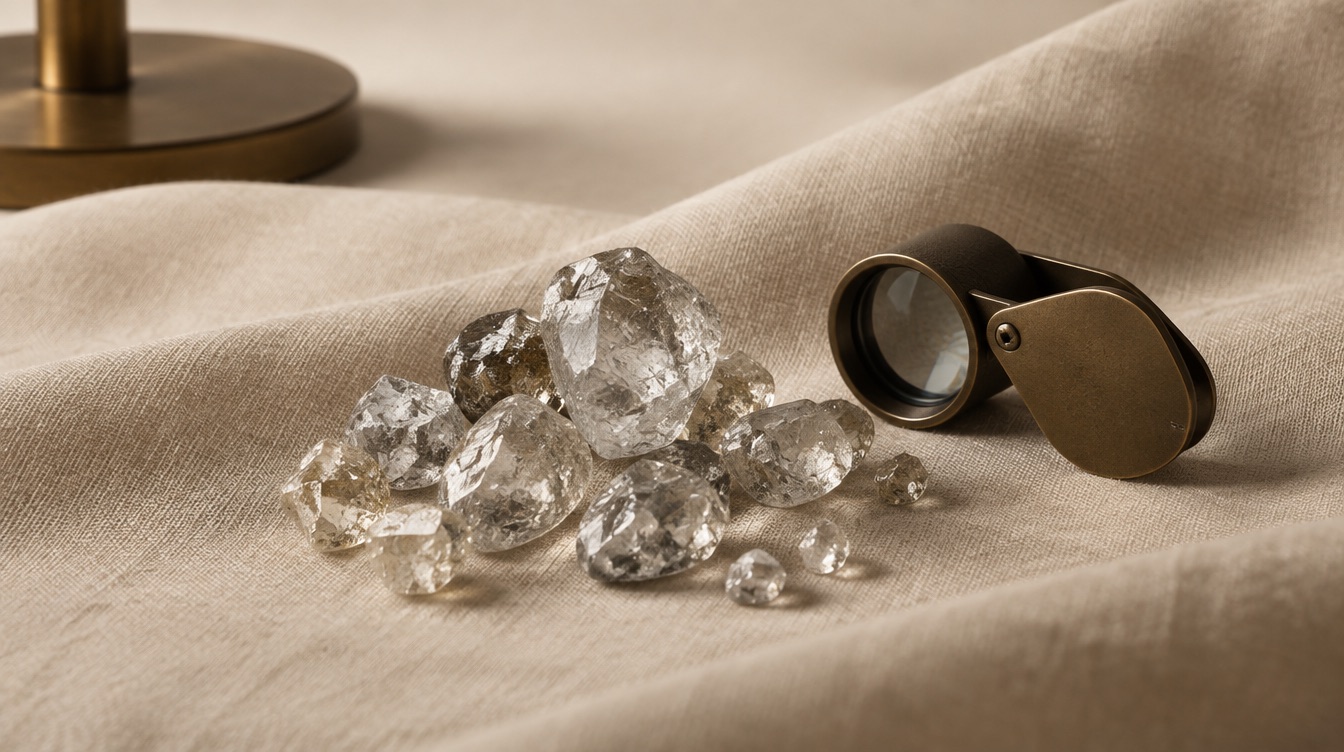
Rough diamonds reach the market through several distinct sales mechanisms depending on which mining company produced them: De Beers has historically sold the large majority of its rough production through an allocation-based system to a defined group of approved buyers, selling fixed parcels at set prices during scheduled "sights" rather than through open-market price discovery; Alrosa and other major producers use a mix of direct contract sales and their own allocation systems; and many smaller and mid-tier producers sell a larger share of their rough through open tenders and auctions, where competitive bidding sets the price directly. This mix of sales mechanisms means rough diamond pricing isn't a single unified market price the way a heavily traded commodity like gold or oil is — it reflects a blend of negotiated allocation pricing from major producers and competitive open-market pricing from tenders and auctions, tracked and estimated industry-wide through independent price indices.
Major Factors That Drive Rough Diamond Prices
| Factor | Effect on Rough Prices |
|---|---|
| Overall mining supply | Constrained by a relatively small number of major producers and aging mines with fewer large new discoveries in recent years |
| Demand from cutting centers | Manufacturers in centers like Surat, India buy rough to cut and polish; their demand directly reflects downstream polished-diamond sales expectations |
| Lab-grown diamond competition | Growing lab-grown supply has pressured natural diamond demand and pricing at the polished level, which flows back to rough pricing |
| Major producer sales policy | De Beers's and Alrosa's allocation pricing and sales-volume decisions carry outsized market influence given their scale |
| Macroeconomic conditions | Consumer discretionary spending on jewelry, a meaningful driver of polished demand, tracks broader economic conditions in major consuming markets like the US, China, and India |
| Currency and inflation effects | Rough diamonds are typically priced in US dollars industry-wide, so exchange-rate shifts affect relative costs for buyers transacting in other currencies |
The Zimnisky Global Rough Diamond Price Index
The diamond trade lacks a centralized public exchange comparable to those for gold or oil, so industry participants rely on independently compiled price indices to track rough and polished diamond pricing trends over time. The Zimnisky Global Rough Diamond Price Index, compiled by independent diamond industry analyst Paul Zimnisky, is one of the most widely referenced benchmarks in trade and financial press for tracking aggregate rough diamond price movement, aggregating pricing data across a range of rough diamond categories into a single trackable index. Indices like this matter to a wholesale buyer or analyst trying to understand broad market direction, even though any individual rough parcel's actual price still depends heavily on its specific size, color, clarity, and shape characteristics rather than the index figure alone.
Rough Diamond Pricing Across the Mid-2020s
Rough diamond prices have faced sustained downward pressure across much of the mid-2020s, a period marked by softer consumer demand for natural diamond jewelry in several major markets and the continued rapid expansion of lab-grown CVD diamond production as a lower-cost, increasingly mainstream alternative. This pressure has flowed through the entire natural diamond supply chain, from mining company revenues and profitability down to rough diamond tender and allocation pricing, prompting several major mining companies to reassess production levels, sales strategy, and in some cases mine-life economics rather than continuing to produce at prior volumes into a weaker pricing environment. This is a structural, industry-wide pattern rather than a short-term fluctuation specific to any single producer or region, and it's a useful piece of context for a jeweler trying to understand why natural diamond mining companies have featured so prominently in recent trade and financial press.
How Rough Pricing Connects to Polished Diamond Prices
Rough diamond prices set the cost baseline that cutting centers and manufacturers work from, but the price of a finished, polished, certified diamond reflects considerably more than rough cost alone — cutting and polishing labor, yield loss during the cutting process (a rough stone typically loses roughly half its original weight when cut into a well-proportioned polished stone), certification costs, and the margins of each intermediary between the cutting center and the final retail or wholesale sale. This means rough price movements don't translate one-to-one into polished price movements on any predictable short-term timeline — a rough price decline takes time to work through existing polished inventory already in the pipeline, and polished pricing also responds independently to its own demand-side factors at the retail and wholesale level.
Rough Pricing by Size and Quality Category
| Rough Category | General Pricing Pattern |
|---|---|
| Small, lower-clarity rough | Lowest per-carat pricing, often used for smaller melee-scale polished output or industrial applications |
| Mid-size, good-clarity rough | Meaningful per-carat pricing step-up, the bulk of standard commercial rough trading volume |
| Large, high-clarity rough | Pricing accelerates sharply with size and quality, reflecting natural diamond rarity at larger, cleaner sizes |
| Exceptional large rough (10+ carats, high clarity) | Often sold through special tenders or auctions rather than standard allocation channels, given the individual significance of each stone |
This size- and quality-driven pricing curve is considerably steeper for natural rough than the equivalent curve for lab-grown rough, since natural diamond rarity increases sharply at larger sizes and higher clarities in a way that lab-grown production, which can be engineered toward a target size and clarity more predictably, doesn't replicate to the same degree.
How Lab-Grown Diamond Growth Has Reshaped Natural Rough Pricing
The rapid expansion of lab-grown CVD diamond production capacity over roughly the past decade has become one of the most significant structural factors affecting natural rough diamond pricing, since lab-grown diamonds compete directly with natural stones at the polished, consumer-facing level across most standard shapes and quality tiers. As lab-grown polished pricing has fallen substantially with expanding production capacity, it has pulled some natural diamond demand toward the lab-grown alternative, particularly in more price-sensitive segments of the market, which in turn has pressured natural diamond demand and, ultimately, rough diamond pricing at the mining-company level. This dynamic is genuinely new relative to most of the natural diamond industry's history — for most of the 20th century, rough diamond pricing responded primarily to natural-diamond-specific supply and demand factors, without a fast-scaling manufactured alternative competing directly for the same polished-diamond customer.
Rough Diamond Tenders and Auctions
Beyond the major producers' allocation-based sales systems, a substantial volume of rough diamonds, particularly from smaller producers and for exceptional individual stones, moves through open tenders and auctions where qualified buyers submit competitive bids. These sales mechanisms provide some of the clearest direct price-discovery data available in the rough diamond trade, since a tender or auction result reflects real competitive bidding rather than a negotiated allocation price, making tender results a closely watched data point for industry analysts and price-index compilers trying to gauge current market conditions for specific rough categories. Exceptional individual rough stones — large, high-clarity crystals that could yield a significant finished polished stone — are particularly likely to move through a dedicated tender or special sale rather than a standard allocation channel, since a stone of genuine individual significance is better served by competitive bidding among buyers specifically interested in that category than by a standardized allocation price designed for routine commercial-volume rough.
Regional Rough Diamond Trading Centers
Rough diamonds move through a small number of major international trading centers before reaching cutting facilities — historically including Antwerp, Belgium, one of the diamond trade's oldest and most established trading hubs, alongside Dubai, which has grown substantially as a rough and polished diamond trading center in recent decades, and direct sales channels connecting producing countries to major cutting centers like Surat, India. Each of these centers plays a somewhat different role in the rough trade, from Antwerp's historic diamond bourse and established trading infrastructure to Dubai's newer but rapidly grown role as a logistics and re-export hub connecting African and other producing regions to Indian cutting centers.
What Rough Pricing Means for a Certified Polished Diamond Buyer
A jeweler or wholesale buyer purchasing certified, polished natural diamonds doesn't transact directly in the rough diamond market, but understanding rough pricing trends still matters practically: sustained rough price weakness, as seen across much of the mid-2020s, eventually works through the supply chain into polished pricing as well, affecting inventory costs, margin planning, and how a jeweler positions natural diamonds against lab-grown alternatives for price-sensitive customers. A buyer who understands why natural diamond pricing has moved the way it has — rough supply constraints, major producer sales policy, and lab-grown competition all playing a role — is better equipped to explain pricing trends to their own customers than one relying on a vague sense that "diamond prices are just what they are."
Surat's Role in Driving Rough Diamond Demand
Surat, India handles the majority of global diamond cutting volume today, making cutting-center demand from Surat's manufacturing base one of the single largest direct drivers of rough diamond purchasing worldwide. When Surat's cutting and manufacturing sector scales back purchasing — whether due to softer downstream polished demand, financing constraints, or excess existing polished inventory still working through the pipeline — that pullback shows up quickly in rough diamond tender results and allocation sales, since cutting centers are the primary buyers converting rough into the polished, certified stones that eventually reach jewelers. This makes Surat's manufacturing sector health a closely watched leading indicator within the trade for where rough diamond demand, and by extension pricing, is likely headed in the near term — a dynamic that gives cutting-center conditions in a single city outsized influence over a genuinely global commodity market.
Kimberley Process Certification and Rough Pricing
Kimberley Process certification, required for legitimate rough diamond exports from participating countries, doesn't directly set or significantly move rough diamond prices on its own — its function is conflict-diamond prevention through export documentation, not price-setting — but it does affect market access and buyer confidence, since major legitimate buyers generally won't purchase rough diamonds lacking proper Kimberley Process documentation. This makes Kimberley Process compliance a practical precondition for accessing the mainstream rough diamond market at competitive pricing, rather than a direct price input itself; rough diamonds lacking proper certification face a meaningfully smaller pool of buyers willing to purchase, which itself often results in a real, though hard-to-quantify, pricing discount reflecting that access constraint.
How Sanctions and Geopolitical Disruption Affect Rough Pricing
International sanctions imposed on Russia in connection with its invasion of Ukraine have significantly disrupted Alrosa's traditional trading relationships in several major markets, given Alrosa's position as one of the two largest rough diamond producers globally. This kind of geopolitical disruption illustrates a real structural risk in rough diamond pricing beyond the usual supply-and-demand factors: because rough diamond production is concentrated among a relatively small number of major companies, a significant disruption affecting even one major producer's ability to sell into its traditional markets can meaningfully affect global rough diamond availability and pricing dynamics, with effects that ripple through cutting centers and, eventually, polished diamond availability for jewelers sourcing certified inventory downstream. This kind of disruption is a reminder that rough diamond pricing, despite its highly specialized and fragmented trading structure, remains exposed to broader geopolitical risk in much the same way other globally traded commodities are.
Sourcing Certified Natural and Lab-Grown Diamonds From One Supplier
Guru Diam is a trade-only wholesale supplier carrying both certified natural diamonds and CVD lab-grown diamonds, along with certified loose stones and finished and custom jewelry — antique cuts, standard fancy shapes, and round brilliant all included, with IGI, GIA, and GCAL certification available for either origin. In-stock inventory ships same-day from New York (before 6pm EST) and Los Angeles (before 4pm PST), giving jewelers a single sourcing relationship across both categories regardless of how rough market pricing shifts affect one category relative to the other.
Buyers can browse certified loose diamond inventory through the certified diamonds category, source matched pairs through matching pairs, and review fancy color stones through fancy color loose diamonds. Trade accounts can review terms at the wholesale hub or apply through trade partner, and jewelers building a full piece can work through custom jewelry for a setting finished in 4-6 days.
How Currency and Macroeconomic Conditions Affect Rough Pricing
Because rough diamonds are priced in US dollars industry-wide, exchange-rate movements between the dollar and the currencies of major producing and consuming nations affect the relative cost and demand dynamics of rough diamond trading even when the underlying dollar-denominated price hasn't moved. A weaker local currency in a major consuming market like India, for instance, can dampen polished-diamond demand even at stable dollar-denominated rough prices, since the effective local-currency cost to the end consumer still rises. Broader macroeconomic conditions in major consuming markets — the United States, China, and India chief among them — also matter directly, since diamond jewelry is a discretionary consumer purchase that tends to soften during periods of economic uncertainty or reduced consumer confidence, a demand-side effect that eventually works its way back through polished pricing to rough diamond demand and pricing as well. China's role deserves particular attention in this context: as one of the largest consumer markets for diamond jewelry globally, shifts in Chinese consumer confidence and discretionary spending have historically produced outsized effects on global polished diamond demand, and by extension rough diamond pricing, relative to China's share of overall global GDP — a pattern common to several luxury and discretionary goods categories where Chinese consumer sentiment carries disproportionate market-moving weight.
How Mining Companies Respond to Weak Rough Pricing
When rough diamond prices soften for a sustained period, as seen across much of the mid-2020s, mining companies typically respond with some combination of reduced production volumes (sometimes called supply discipline, intended to avoid flooding an already-soft market), deferred investment in new mine development or expansion, and in more severe cases, placing higher-cost operations under care and maintenance rather than continuing to mine at a loss. These responses can, over time, tighten future supply if sustained long enough, one of the natural cyclical mechanisms that has historically helped rough diamond pricing eventually stabilize after a period of weakness — though the added structural pressure from lab-grown diamond competition makes the current cycle less directly comparable to prior natural-diamond-only pricing cycles in the industry's history.
Why Rough Diamond Prices Are Hard to Forecast Precisely
Forecasting rough diamond prices with real precision is genuinely difficult, since prices depend on the intersection of several factors that don't move in lockstep or on predictable timelines — mining supply decisions, cutting-center demand, consumer sentiment in multiple major markets, lab-grown production expansion, and periodic disruptions like the sanctions affecting Alrosa's international trading relationships in recent years. Industry analysts and price-index compilers like Zimnisky track current conditions and short-term trends closely, but longer-range rough diamond price forecasting carries meaningfully more uncertainty than forecasting for more heavily traded, transparently priced commodities, a limitation worth keeping in mind when evaluating any specific rough price prediction found in trade or financial press. A jeweler reading a confident-sounding rough diamond price forecast in an industry publication is generally better served treating it as one analyst's reasoned estimate based on currently observable conditions than as a reliable prediction of where prices will actually land months or years out — the same caution that applies to price forecasting in most commodity and luxury-goods markets with this level of structural complexity.
Frequently Asked Questions
What determines rough diamond prices?
A combination of overall mining supply, major producers' sales systems (allocation sales, tenders, and auctions), demand from cutting centers, macroeconomic conditions in major consuming markets, and, increasingly, competition from lab-grown CVD diamond supply.
Is there a public price index for rough diamonds?
Yes, the most widely referenced is the Zimnisky Global Rough Diamond Price Index, an independently compiled benchmark tracking aggregate rough diamond pricing trends over time.
Have rough diamond prices gone up or down recently?
Rough diamond prices faced sustained downward pressure across much of the mid-2020s, driven by softer global demand and the continued expansion of lab-grown diamond supply as a competing category.
How does lab-grown diamond production affect natural rough diamond prices?
Growing lab-grown supply competes directly with natural diamonds at the polished level, pulling some demand away from natural stones, particularly in price-sensitive segments — pressure that flows back through the supply chain to natural rough diamond pricing.
Does a lower rough diamond price mean lower prices for certified polished diamonds too?
Eventually, but not immediately or one-to-one — polished pricing reflects cutting, certification, and distribution costs on top of rough cost, and existing polished inventory already in the pipeline doesn't reprice instantly when rough prices move.
How does De Beers's sales system affect rough diamond pricing?
De Beers has historically sold most of its rough production through an allocation-based system at set prices to approved buyers rather than open-market bidding, giving its sales-volume and pricing decisions outsized influence on the broader rough market given the company's scale.