

The reason a one-off custom request feels like a bad deal isn’t the design — it’s the fixed cost of standing up a job for a single piece. An in-house bench has to absorb tooling or die cost, source an unusual stone shape from scratch, and interrupt a running production queue, all for one sale. Route that same request through an outsourced manufacturing partner that works from CAD files instead of physical tooling and already stocks depth across antique and fancy-shape cuts, and most of that fixed cost goes away. At that point, saying yes to an odd one-off isn’t a special case that needs a business justification — it’s just another order on the same intake form as everything else.
This isn’t a pitch to take every strange request that walks in. Some are genuinely bad fits regardless of who’s building them. But the number of requests getting declined purely because “it’s not worth it for one piece” is a lot larger than the number that are actually bad business — and that gap is worth closing. Closing it takes three things working together: a workflow that removes the fixed-cost barrier, a pricing structure built for a single piece instead of a production run, and a revision process that doesn’t quietly eat the margin the pricing was supposed to protect.

Why “Not Worth It For One Piece” Is Usually a Cost Problem, Not a Design Problem
Ask most retailers why they pass on an odd custom request and the answer sounds like a design objection — “we don’t really do that shape” or “that’s not something we usually make.” Underneath, it’s almost always a cost-structure objection. The design itself isn’t the issue. The economics of building it once are.
The Tooling and Setup Cost Trap
A bench built around production runs — even small ones — prices in the assumption that setup cost gets spread across multiple units. A custom die, a specialized prong jig, a one-off mold: all of that has a fixed cost that doesn’t shrink just because the order is for one ring. Divided across a run of ten, it’s a rounding error. Divided across a run of one, it can eat the entire margin on the piece, sometimes more.
This is the actual math that kills most one-off requests before anyone even prices the stone. It’s not that the piece is hard to make — it’s that the setup cost was calculated for volume that isn’t there.
The Odd-Stone Sourcing Problem
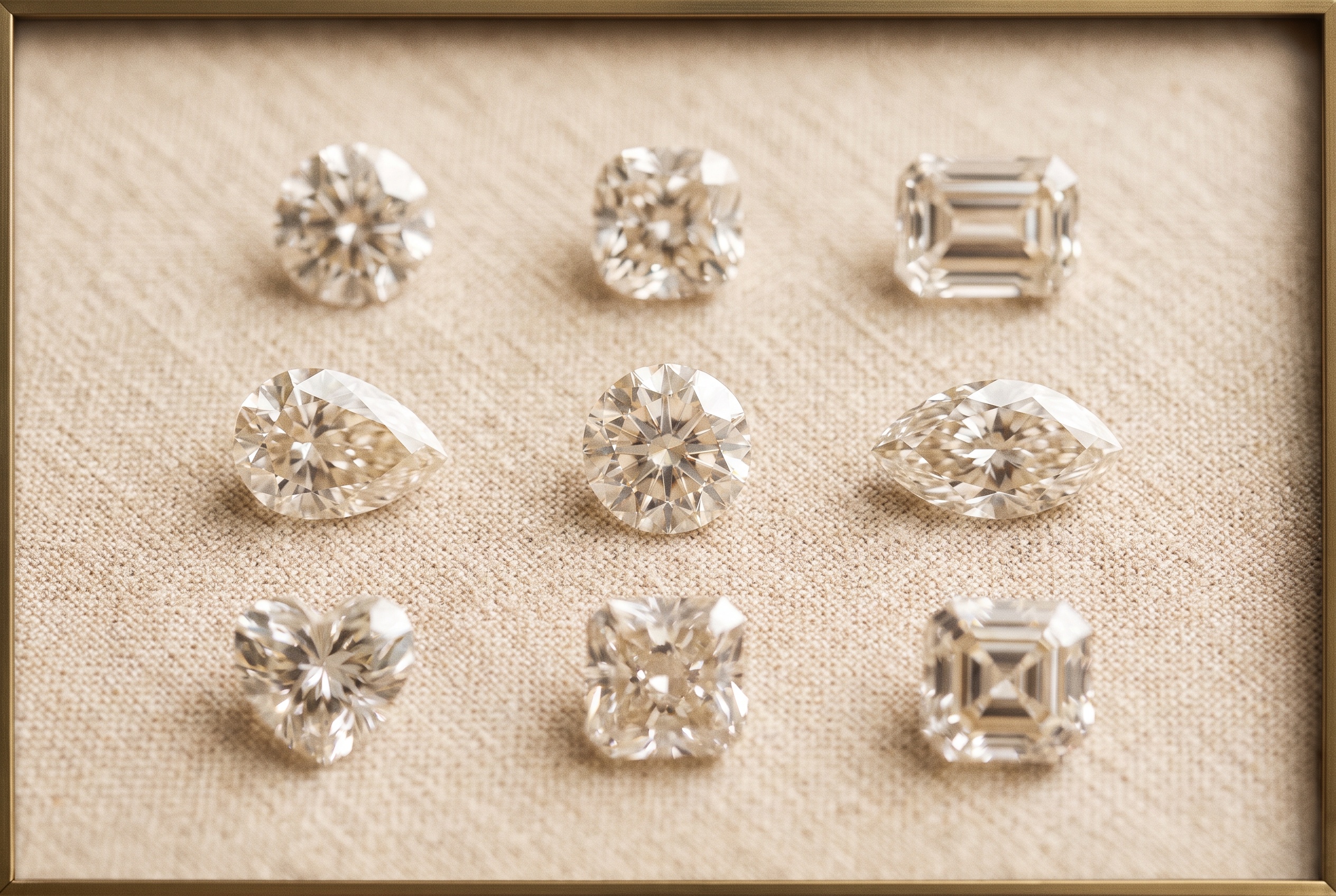
The second cost driver shows up whenever the request involves a shape outside round brilliant. Round brilliant is the commodity tier — proportions are standardized and stock is deep almost everywhere, so sourcing one is rarely the bottleneck. Everything else is a different problem. The antique and premium tier — Old Mine, Old European, Hexagonal, Moval, Lozenge, Kite, Trillion, Criss-Cut, Padparadscha — and the regular fancy tier — Emerald, Asscher, Cushion, Oval, Pear, Marquise, Radiant, Princess, Heart — don’t move through a generalist bench’s normal stock, and a retailer without an existing relationship for that shape ends up cold-calling vendors to find one stone in one size for one customer. That search alone can burn more hours than the piece is worth, before a single tool touches metal.
The Opportunity Cost of Bench Time
Even when tooling and sourcing aren’t the blocker, there’s a third cost that rarely gets named directly: pulling a bench off a running job to build a single unfamiliar piece has a real opportunity cost. It’s not that the work can’t be done — it’s that doing it means something else gets delayed, and the return on that trade-off looks bad when it’s measured against one sale instead of a batch.
Put together, these three costs are why “we don’t do that” is usually shorthand for “the math doesn’t work for one,” not an actual judgment about whether the design is good or the customer is worth keeping.
What Changes When the Build Moves Off Your Bench
None of those three cost drivers are inherent to the request — they’re inherent to building it on a bench sized for production runs. An outsourced manufacturing partner that works from CAD-to-cast rather than physical tooling, and that already carries depth across antique cuts, fancy shapes, and fancy color stones, removes each one differently:
| Cost Driver | In-House Bench (Sized for Runs) | Outsourced CAD-to-Cast Partner |
|---|---|---|
| Tooling / setup cost | Fixed cost per die or mold, doesn’t scale down for a single unit | CAD file replaces physical tooling; setup cost per piece stays flat whether it’s one or several |
| Sourcing an odd stone shape | Retailer sources cold from an unfamiliar vendor, one stone at a time | Pulled from an existing trade account already stocked across antique and fancy-shape tiers |
| Bench time / opportunity cost | Pulled off a running job to build one unfamiliar piece | Handled as one order among many at the manufacturing partner, no impact on the retailer’s own floor |
| Certification (stones 0.30ct+) | Retailer sorts IGI vs. GIA availability per vendor | Both IGI and GIA available through the same account |
| Client relationship on delivery | N/A — retailer built it | Delivered unbranded by default, so the retailer resells it as their own |
The net effect is that the request stops being a special project that needs its own business case. It becomes a normal order that happens to have an unusual stone shape on the spec sheet.

Building a Pricing Structure That Holds Up for a Single Piece
The workflow changes above solve the setup-cost problem, but they don’t automatically solve the pricing problem. A retailer who prices a one-off the same way they price a repeat product — a single markup percentage stacked on top of the total build — usually gets the number wrong in one direction or the other. Stone cost, build cost, and retailer margin behave differently on a single custom piece than they do on a production run, and treating them as one blended number is where a lot of the profit gets lost even after the tooling cost has already been removed from the equation.
Separate Stone Cost, Build Cost, and Margin Into Three Lines
A one-off quote holds together better as three separate line items than as one bundled number. The stone cost is the most stable of the three — for a certified center stone 0.30ct and up, it’s priced against cert grade and lab (IGI, GIA, or GCAL) at the time of sourcing, and that number doesn’t move once the stone is locked to the order. The build cost is the flat CAD-to-cast setup fee — the same fee whether the finished piece is the only one built to that spec or the fifth. That flatness is exactly what makes single-piece pricing predictable instead of a guess. The retailer’s margin sits on top of both, and it’s the only one of the three numbers that’s actually theirs to set.
Collecting a deposit against the stone and build cost at intake — before CAD starts, not after it’s approved — protects both sides of a one-off in a way it doesn’t need to on a repeat product. A production run absorbs a canceled unit into the batch; a single custom piece has no batch to absorb it into. A deposit sized to cover the stone hold and the CAD-to-cast setup fee means a canceled order costs the retailer time, not margin, and it’s a normal enough practice in the trade that customers rarely push back on it once it’s explained as standard for a made-to-order piece rather than a stock item.
Decide Where the Markup Sits Before the Quote Goes Out
Where the markup gets applied matters as much as how big it is. Stone cost is comparison-shoppable — a customer who wants to can get a second cert stone quote elsewhere, so a heavy markup on that line is the fastest way to lose a one-off to a competitor’s quote. Build cost isn’t comparison-shoppable in the same way; there’s no public price list for a one-off CAD-to-cast build, so it’s the line where a retailer’s actual margin can sit without inviting a shopping trip. Splitting the markup this way — thin on the stone, real on the build and the retailer’s own labor of managing the project — usually lands closer to what the market will actually bear than a single blended percentage does.
Quoting from a CAD render instead of a physical sample changes this math too, and not just because it removes tooling cost. A render can be priced accurately before a single hour of bench time is spent, which means the quote a customer sees is the real number, not a placeholder that gets revised upward once production reveals a complication a sketch couldn’t show. That predictability is worth naming on its own: a one-off that gets requoted mid-build damages the customer relationship it was probably taken on to protect in the first place, and a CAD-based quote is what keeps the number from moving.
Minimizing Revision Cycles Before They Start
Pricing a one-off correctly at intake doesn’t protect the margin if the design cycle that follows runs long. Most of the value that gets lost on a custom piece isn’t lost in production — it’s lost in the weeks before production, in revision rounds that weren’t scoped into the original quote. A production run spreads that kind of rework across many units and barely notices it. A single piece has nowhere to spread it; every unplanned revision round comes straight out of the margin the pricing structure above was built to protect. The fix isn’t refusing to revise — it’s controlling how many rounds happen and when.
Front-Load the Spec at Intake, Not After CAD
A repeat product has a reference SKU behind it, so a customer already knows roughly what they’re getting before they ask a single question. A one-off has no reference — every detail that isn’t pinned down at intake becomes an assumption CAD gets built around, and every wrong assumption becomes a revision round once the customer sees it. Metal karat and color, stone shape and size, setting and prong style, ring size, and any engraving all need to be captured before a CAD file gets started, not discovered one round at a time as the customer reacts to what’s put in front of them.
A short standardized intake checklist does more here than a longer freeform conversation. An open-ended “tell me what you’re picturing” call feels thorough but usually surfaces preferences reactively — the customer states a preference only once they see something they don’t like. A checklist that asks for each spec directly, in order, before CAD starts, catches most of that reactive feedback up front instead of one CAD round at a time, which is the difference between one revision cycle and three on the same order.
Make the CAD Render the Approval Gate, Not the Sketch
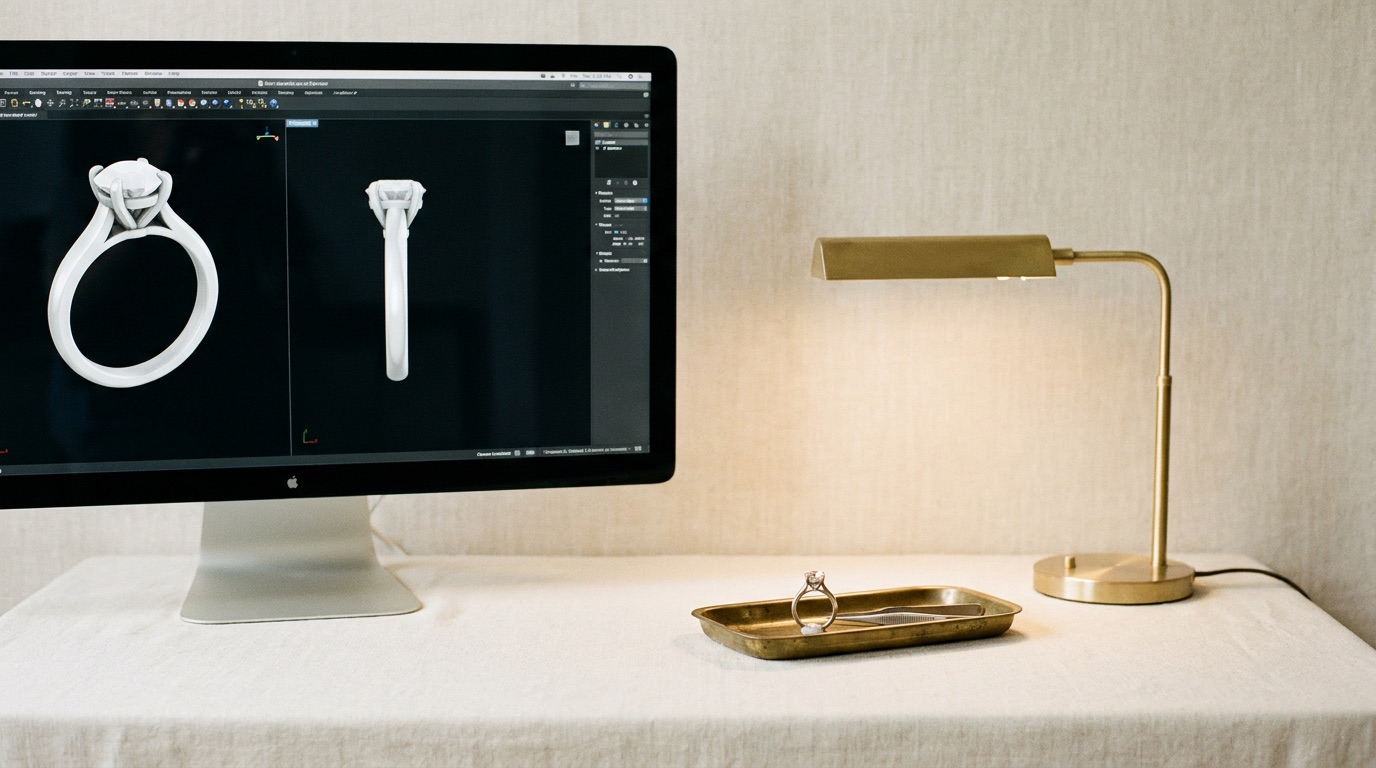
Approving a hand sketch feels like the faster step, but it usually adds a round rather than removing one — a sketch is abstract enough that a customer can approve it and still be surprised by the photorealistic render that follows, which reopens decisions that looked settled. A rendered CAD file built against the locked stone and metal spec is a better approval gate precisely because there’s less left to reinterpret; what the customer signs off on is close to what gets cast.
For a request that’s genuinely undefined at intake — no reference photo, no clear direction — a single paid concept pass before CAD is a cheaper way to lock direction than letting that ambiguity play out across CAD revisions, which cost more per round to redo. Once CAD starts, capping revisions in the quote itself — two rounds included, additional rounds billed at a set rate — gives a one-off a natural stopping point instead of an open-ended back-and-forth that has no reason to end on its own. Most customers use one round or don’t need the cap at all; it exists for the minority of cases that would otherwise run past what the piece was ever quoted to cover.
Turning “Maybe, If It’s Worth It” Into a Standard Yes
Once the fixed-cost barrier is out of the picture, the decision to take a one-off request can move from a judgment call to a checklist. That’s the real shift — not that oddball requests become effortless, but that they stop requiring a case-by-case decision about whether they’re worth chasing.
A few things make that repeatable rather than a one-time exception:
- Route unusual shapes through an account that already stocks them. If a request calls for an Old Mine cut, a Moval, or a fancy-color stone, that’s a lookup against existing inventory access, not a new sourcing project. Browsing exotic and antique cut shapes ahead of time — before a request comes in — means the retailer already knows what’s realistic to promise.
- Quote from CAD, not from a physical sample. A render can be priced and approved without a die ever being cut, which is exactly what keeps the tooling cost out of a single-piece job.
- Treat the certification decision as a line item, not a delay. For any center stone 0.30ct and up, deciding IGI or GIA at intake — rather than after the design is already approved — keeps the one-off moving at the same pace as a standard order.
- Don’t discount the unbranded handoff. Because the finished piece arrives without a manufacturer’s mark, the retailer’s relationship with their customer looks exactly the way it would if the piece had been built on their own bench. That matters more for a one-off than for a repeat product line, since a one-off is usually tied to a specific, memorable customer relationship the retailer doesn’t want any third party visible in.
- Set the price at intake, not after the fact. A one-off still needs a margin calculation — it’s just a calculation against a flat CAD-to-cast setup cost instead of an amortized-tooling cost, which is a much easier number to hit.
- Keep one point of contact on the manufacturing side. A request that gets routed through a different contact each time multiplies the clarifying questions that have to get answered from scratch — a single rep who already knows the retailer’s usual metal preference and stone quality baseline skips a full round of back-and-forth that a cold handoff would otherwise require.
- Batch questions into one message per stage instead of sending them as they come up. Five one-line emails spread across a week stretch a single order across a week of calendar time even though the actual working time is under an hour — consolidating open questions into one message per stage keeps a one-off moving at the same pace as a standard order instead of drifting on email response times.
Getting comfortable with this workflow once — reviewing it against how the CAD-to-production process actually runs — means it doesn’t need to be re-learned every time an odd request shows up. It becomes the default answer to “can you make this,” not a debate.
What This Doesn’t Fix
Removing the fixed-cost barrier makes a wider range of one-off requests profitable, but it doesn’t make every request instantly available. A genuinely unusual stone size or shape combination that isn’t sitting in standard stock can still take real lead time to source properly — that’s a variable cost, not a fixed one, but it’s still a cost that needs to be quoted honestly to the customer rather than promised away. CAD approval still has to happen before anything gets built, and a request still needs a price the retailer is comfortable quoting. What changes isn’t that one-offs become instant or free — it’s that they stop being disqualified by default just because the volume is one.
For a retailer weighing whether a specific request is worth taking on, running it past a trade-partner account with existing access to antique cuts, fancy shapes, and fancy color melee is usually faster than trying to price it from scratch. That’s a shorter conversation than most retailers assume, and it’s the difference between turning a request away reflexively and actually knowing whether it pencils out.

Frequently Asked Questions
Why do retailers usually turn down one-off custom requests?
Almost always because of fixed setup cost, not because the design itself is difficult. A bench sized for production runs prices in tooling and die cost that gets spread across multiple units — for a single piece, that same fixed cost has nowhere to spread, so the margin on the one-off looks worse than it actually needs to be. The design objection retailers usually cite is typically standing in for this cost problem.
Does outsourcing production actually make one-off requests profitable, or just less risky?
Both, but the cost change is the bigger factor. A CAD-to-cast workflow replaces physical tooling with a digital file, so the setup cost per piece stays flat whether the order is for one unit or several. That directly changes the margin math on a single custom piece, rather than just spreading risk around.
How does sourcing an unusual stone shape work for a single custom order?
It depends on whether the retailer already has account access to a supplier stocking that shape. Antique and premium-tier cuts — Old Mine, Old European, Hexagonal, Moval, Lozenge, Kite, Trillion, Criss-Cut, Padparadscha — and regular fancy-tier shapes like Cushion, Oval, Pear, and Radiant don’t move through the same generalist stock as round brilliant. Sourcing one through an existing trade account is a lookup; sourcing one cold from an unfamiliar vendor is a multi-day search that often costs more than the piece is worth.
Does the fast turnaround claimed for custom jewelry apply to one-off orders too?
Yes, with the same scope it applies to any custom piece: once CAD is approved and stone and metal specs are locked, in-house production of the finished piece typically runs 4-6 business days. That window covers CAD-approval-to-finished-piece only — it doesn’t include the time to source an unusual stone if one isn’t already in standard stock, and it isn’t a loose-diamond delivery timeline.
Will a one-off custom piece show up with the manufacturer’s branding on it?
No. Custom pieces are delivered unbranded by default specifically so the retailer can present and resell them as their own work. That matters more for one-off requests than for repeat product lines, since a one-off is usually tied to a specific customer relationship the retailer wants to own end to end.
Is there a minimum order size to get access to antique or fancy-shape stones for a single piece?
Access to a given shape depends on the supplier’s stocking depth, not on committing to a production run. A trade account that already carries antique cuts, fancy shapes, and fancy color melee can supply a single stone for a single order the same way it would for a larger one — the sourcing step doesn’t require building volume first.