
Private-label jewelry manufacturing means a retailer supplies the design direction and specs, a manufacturer produces the piece in-house, and the finished jewelry ships with no maker's mark, no hangtag branding, and no packaging — so the retailer can present it as their own house collection. That's the whole mechanism. The retailer never owns a production floor; they own the relationship with the customer and the brand the customer sees. This is different from buying a manufacturer's already-branded stock line and reselling it, where the maker's identity travels with the piece whether the retailer wants it to or not.
For independent jewelers and multi-store retailers trying to build a recognizable collection without opening a bench, that distinction is the entire decision. But the mechanism is only half the story. The harder questions sit one layer up: why take this on instead of simply reselling a supplier's line, what a manufacturing partner actually needs to deliver to make it work, how the margin math changes once the brand is yours, and where a retailer's own brand protection starts and the manufacturer's job ends. This guide covers all of it — the business decision, not just the production mechanic.
What Private Label Actually Means as a Business Model
In apparel or private-label food, "white-label" usually means picking from an existing catalog and slapping on a label. Jewelry manufacturing works differently, and conflating the two causes real confusion in first conversations with a manufacturing partner.
In custom jewelry, white-label (or private-label — the terms are used interchangeably in this trade) means:
- The piece is built to the retailer's design, not pulled from the manufacturer's own branded line.
- Nothing on the piece, the box, or the paperwork identifies who made it.
- The retailer decides the metal, the diamond quality, the sizing, and the finish — the manufacturer executes it.
- The retailer's brand is the only brand associated with the piece once it leaves the manufacturer.
The manufacturer's job ends at "finished, polished, quality-checked jewelry, unbranded." Everything a customer associates with the piece — the name on the box, the certificate cover, the in-store presentation — is the retailer's to build separately. That last sentence is where most retailers underestimate the scope of what they've taken on. Private label isn't a sourcing decision you make once; it's an ongoing brand-management responsibility that starts the moment the first piece ships and never really ends. The manufacturer supplies consistency in production. The retailer supplies consistency in everything the customer actually experiences: the name, the story, the price integrity, the after-sale service. Skipping that second half is the single biggest reason a private-label program stalls out after a promising first collection.
Why Retailers Pursue Private Label Instead of Reselling a Branded Line
Retailers often start this conversation thinking they're choosing between "custom" and "off-the-shelf." The more useful comparison is actually about who the customer sees as the source, and what that ownership is worth over time.
Reselling a manufacturer's branded stock line is the lower-effort path, and for some retailers it's the right one — there's nothing wrong with carrying a recognized line if foot traffic and brand recognition matter more than margin control. But it comes with a structural ceiling. The maker's identity travels with the piece. A customer can search the name on the certificate cover or the inside of the band and find the same design carried by a competitor three blocks away, often at a different price. That's not a hypothetical — it's the single most common way price-shopping happens in independent retail jewelry today, and a branded stock line hands the customer the tool to do it.
Private label removes that comparison point entirely, and the value compounds over three areas:
- Pricing power. Without a visible source to compare against, pricing reflects the retailer's own positioning, service, and relationship with the customer — not a race to match whatever the branded line sells for two doors down.
- Repeat-customer equity. A customer who loves a piece from a branded line associates that love with the brand, not the store that happened to carry it. A customer who loves a private-label piece associates it with the retailer, full stop — which is what turns a single sale into a referral, a repeat visit, and eventually a customer who asks for "whatever's new" without needing to be sold.
- Defensibility. A signature setting style, a consistent metal-and-quality standard, a house look — none of that can be undercut by a competitor stocking the same branded line, because there isn't one. The retailer becomes the only place to get that specific piece.
The trade-off is real and worth naming honestly: private label asks more of the retailer upfront. There's no existing brand recognition to lean on, no marketing the manufacturer has already done, no customer walking in already wanting that name. The retailer is building brand equity from a lower starting point than reselling a name people already trust. For a retailer with an existing customer base and a service reputation to lean on, that trade generally favors private label. For a retailer trying to build foot traffic from zero in a new market, a mix of both — a recognized line to draw people in, a private-label collection to keep the margin and the loyalty — is usually the more realistic starting point than an all-or-nothing switch.
What to Require From a Manufacturing Partner
The manufacturer you route a private-label program through matters more than any single design decision, because a weak partner caps what the program can become no matter how good the collection concept is. Before committing a customer relationship and a brand identity to one manufacturing partner, get specific, verifiable answers on four things.
Design Flexibility
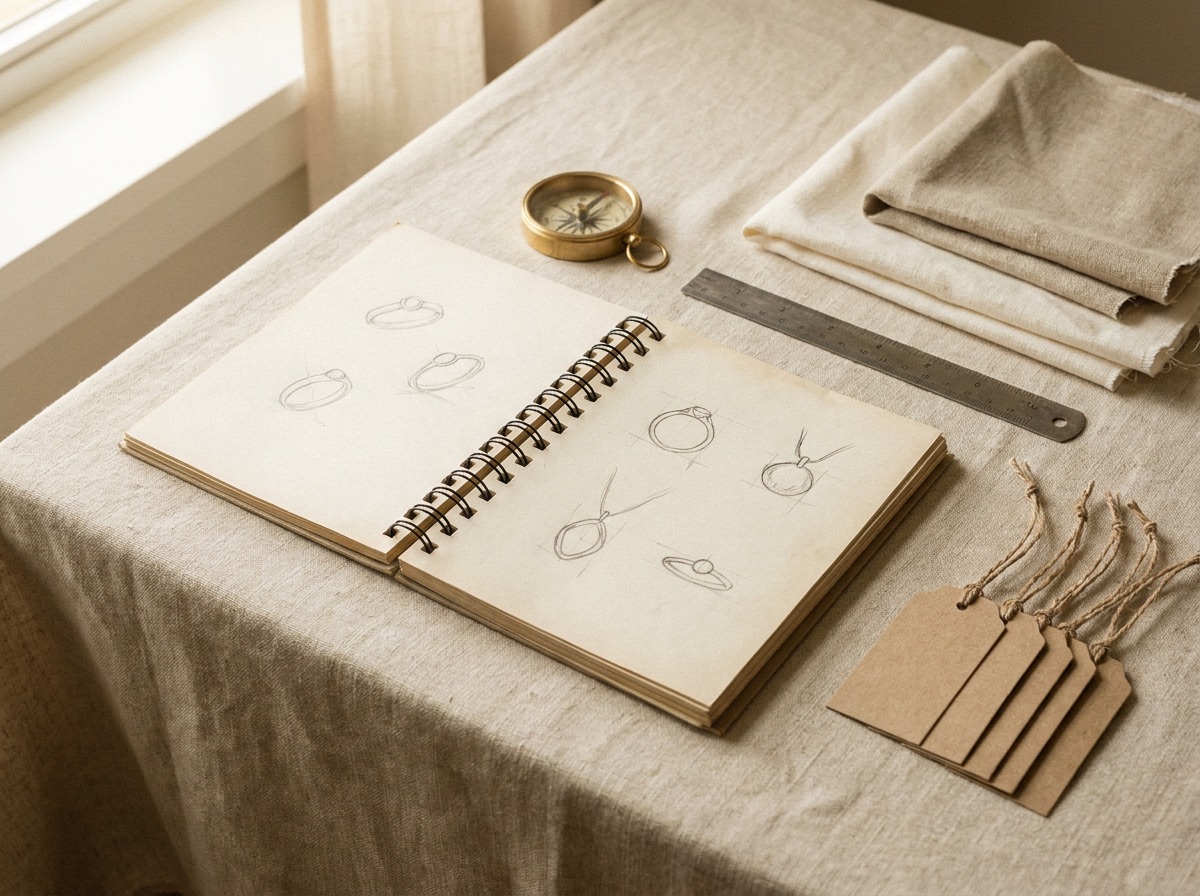
Confirm the partner can actually build from your direction rather than steering you back toward their existing catalog. A manufacturer with genuine in-house CAD capability should be able to take a hand sketch, a rough reference image with annotations, or a CAD file you already have and turn it into a production-ready render — without pushing you toward "something similar" from their own line because it's easier for them to produce. Ask to see CAD samples built from retailer-supplied references specifically, not just the manufacturer's portfolio of their own designs.
Packaging and Branding Capability
Confirm exactly how far "unbranded" goes. Every manufacturer that does private-label work can strip their own name off a finished piece; fewer can go a step further and support the retailer's own packaging, inserts, or hang tags if that's ever part of the plan. Even if branded packaging isn't a day-one priority, knowing whether the manufacturer can support it later — and what that would require — avoids a rebuild of the relationship once the collection has proven itself. This is a packaging-capability question at the sourcing stage; the operational mechanics of how a blind or branded shipment actually moves once an order is placed are a separate topic, covered in how blind and white-label shipping actually work.
MOQs and Order Flexibility
Minimum order quantities are where a lot of private-label conversations quietly die before they start. A manufacturer that requires a large minimum run to open a private-label program forces a retailer to bet capital on a collection before knowing whether it sells. Ask directly what the minimum is to start, whether it applies per style or per collection, and whether reorders can come in small batches once a design proves itself. A partner willing to build a single approved piece, then let the retailer reorder in small runs based on what's actually moving, removes most of the capital risk that keeps retailers from trying private label at all.
Certification and Quality Consistency
Confirm certification options up front — IGI and GIA availability, and whether the partner can hold a consistent quality baseline across every reorder rather than letting it drift depending on what's in stock that week. A collection is only as coherent as its weakest reorder.
Building a Private-Label Product Line Strategically
The real reason retailers pursue private label isn't a single piece — it's a repeatable collection with a consistent look, sold under one name, that a customer can only get at that store. Getting there without overcommitting capital or diluting the look takes a deliberate sequence, not a wish list of twenty designs launched at once.
- Start with one signature piece, not a full line. Pick a single recognizable design element — a specific halo shape, a signature band profile, a consistent prong count — and build the first piece around it before committing to a collection. This is the piece that tells you whether the design direction, the price point, and the manufacturing partner all actually work together before more capital is on the line.
- Expand in small, related runs. Once the signature piece is selling, extend the same design element across a matching band, a pendant version, an earring pair. Consistency across four to six related pieces reads as a collection far faster than twenty unrelated designs launched simultaneously — and it's much easier to reorder confidently when each new piece shares DNA with one that's already proven.
- Lock a metal and quality standard before varying the design. If every piece in the collection runs the same karat and the same diamond quality floor, customers start to associate that baseline with the store's name even if they can't articulate why. Varying the quality floor style to style is one of the fastest ways to make a "collection" feel like a pile of unrelated pieces.
- Reorder in small batches, adjusted by what's actually selling. Since there's no branded stock line to fall back on, a retailer can adjust sizing, finish, or a design detail between batches based on real sales data, without wasting inventory on a version that isn't moving. This is the advantage a branded stock line can't offer — the reseller takes whatever the brand produces; the private-label retailer can tune the next run.
- Treat certification as a collection-wide standard, not a per-order decision. Deciding upfront whether the house line runs IGI, GIA, or offers both keeps the certificate presentation consistent across the collection, which matters more to a repeat customer than most retailers expect walking in.
This is the practical version of "owning a brand without owning a factory": the retailer controls the five decisions above, and the manufacturing side executes them consistently, order after order.
Pricing and Margin: Owning Your Brand vs. Reselling
The margin conversation is usually the one that actually decides whether a retailer commits to private label, and it's worth separating from the branding conversation because the two get conflated constantly.
Reselling a branded stock line comes with a manufacturer's suggested price, or at minimum a price a customer can find elsewhere for comparison. A retailer's margin on that line is real, but it's bounded — sell too far above what a customer can find the same name for elsewhere, and the sale walks. The retailer is pricing against a visible reference point set by someone else.
Private label removes that reference point, which changes the pricing conversation in three concrete ways:
- Price reflects total value, not just materials. Without a comparable branded price to anchor against, a retailer can price based on design, service, the buying experience, and the relationship — not just metal weight and stone quality matched against a competitor's sticker price for the same name.
- Margin isn't diluted by markdown pressure. A branded piece that isn't moving often gets discounted to compete with the same piece elsewhere. A private-label piece has no external price to be undercut by, which removes one of the most common margin killers in independent retail: markdown chasing a competitor's price on an identical item.
- The cost structure shifts to design and relationship investment, not markup alone. Private label requires upfront investment — CAD approval rounds, a signature-piece test run, eventual packaging — that a resold branded line doesn't. That investment is real, and it should be underwritten into the pricing of the first run rather than absorbed as pure cost, or the collection's true margin gets misjudged from day one.
The honest comparison isn't "private label is always higher margin." It's that private label converts a bounded, comparison-driven margin into an uncapped one that depends entirely on how well the retailer executes the brand side — the design, the consistency, the presentation, the relationship. A retailer that treats private label as "the same margin math as reselling, minus a logo" is leaving the actual financial upside of the model on the table.
Protecting Your Brand Identity in the Relationship
Owning the brand also means owning the responsibility to protect it, and that protection starts in the manufacturing relationship itself, not after the first piece ships.
- Confirm design ownership in writing. If a retailer supplies a distinctive design element — a signature halo shape, a specific band profile — get clear, even if informal, agreement that the manufacturer won't reproduce that same design detail for another account. This matters most for a genuinely original design element, not a standard setting style every manufacturer already builds.
- Keep the design history documented. Sketches, CAD files, and approval emails aren't just production records — they're the paper trail that shows the design originated with the retailer if that history ever needs to be pointed to.
- Verify the manufacturer is trade-only, not open to end consumers. A manufacturing partner that also sells finished pieces directly to the public is one referral away from a retailer's own customer sourcing the identical piece direct next time, at a different price, with none of the retailer's markup or service attached. Confirm this before building a collection on top of any manufacturing relationship.
- Control the certificate and paperwork presentation. The certificate cover, the way it's presented at the point of sale, and any appraisal documentation are part of the brand experience just as much as the piece itself — and they're squarely the retailer's to manage, not the manufacturer's.
- Don't let packaging lag behind the collection. A well-designed private-label piece presented in generic or inconsistent packaging undercuts the exact brand impression the whole model is built to create. Packaging doesn't need to launch on day one, but it shouldn't be an afterthought once the collection is selling.
None of this requires a legal team or a large budget to start. It requires treating the brand as an asset from the first piece, not something to formalize later once the collection has proven itself — by which point inconsistent early habits are harder to unwind.
Private Label vs. Reselling vs. Fully Custom One-Offs
These three models solve different problems, and most active retailers use more than one depending on the customer and the occasion.
| Private Label | Reselling a Branded Line | Fully Custom One-Offs | |
|---|---|---|---|
| Who the customer sees as the source | The retailer, exclusively | The original brand, even through a reseller | The retailer, for that one piece specifically |
| Design origin | Retailer's own direction, built repeatably | Manufacturer's existing catalog | A single customer's own brief, built once |
| Repeatability | Designed to be reordered as a standing collection | Reorder from an existing line, not retailer-controlled | Typically never built again in the same form |
| Packaging and branding | Manufacturer ships unbranded; retailer builds its own | Often pre-branded by the manufacturer | Unbranded by default, same as private label |
| Margin control | Full pricing control, no visible source to compare against | Bounded by a comparable price elsewhere | Highest per-piece margin, but not repeatable at scale |
| Capital commitment | Moderate — a signature piece, then small reorders | Tied to whatever minimum the branded line requires | Committed only once a specific order and deposit are in hand |
| Best for | Building a recognizable house collection over time | Foot traffic and brand recognition, lower effort | A specific customer request that won't recur in the same form |
Private label sits deliberately between the other two: more brand ownership and repeatability than reselling, more scalability and margin consistency than building one-offs to order every time. A retailer building a business rather than filling individual requests generally lands here first, adding one-off custom work and select branded lines around the edges rather than the other way around.
Common Private-Label Launch Mistakes
Most private-label programs that stall out fail for a small, repeatable set of reasons — not because the concept doesn't work, but because a specific step got skipped or rushed.
- Launching a full line before testing a single piece. Committing to twenty SKUs before knowing whether the design direction, the price point, and the manufacturing partner all work together is the single most expensive version of this mistake. A signature piece tested first catches problems while they're still cheap to fix.
- Chasing every trend instead of building a consistent look. A collection where each piece follows a different current trend reads as scattered, not curated. The retailers who build recognizable house collections pick a design language and stay with it longer than feels comfortable, rather than restarting with every seasonal shift.
- Pricing without underwriting the real cost of ownership. Treating private-label pricing as "reseller markup minus a logo" ignores the design rounds, the test run, and the eventual packaging investment that a resold branded line never required. Collections priced this way often look profitable on paper and aren't once the full cost is counted.
- Letting certification vary order to order. Mixing IGI and GIA inconsistently across what's presented as one collection is one of the fastest ways to undercut the sense that it's a coherent line rather than individually sourced pieces assembled after the fact.
- Treating packaging as a launch-day afterthought. Waiting until pieces are already selling to think about boxes, inserts, and certificate presentation means the first wave of customers experiences a brand that isn't finished yet — and first impressions on a new collection are hard to walk back.
- Skipping the reorder discipline. Reordering in one large batch instead of small, sales-informed runs recreates the exact dead-stock risk private label is supposed to avoid. The advantage of no branded line to fall back on only pays off if reorders stay small and responsive to what's actually selling.
- Not confirming the manufacturing partner is trade-only. Building a collection's worth of trust in a manufacturer that also sells the same capability to end consumers directly is a risk that only becomes visible after a customer finds their way around the retailer entirely.
How Guru Diam Supports Private-Label Retailers
Guru Diam's private-label and custom jewelry program is built around the same in-house model as its loose-diamond business: cutting, setting, and polishing all happen in-house, so quality control isn't handed off between subcontractors on a private-label build any more than it is on a single custom ring.
- No bench, no minimums. A retailer doesn't need in-house CAD talent or a production floor to start — a sketch, a CAD file, or annotated reference images are enough to begin, and there's no large minimum order required to open a private-label conversation.
- Design flexibility from day one. CAD is built to the retailer's direction, not pulled from an existing branded catalog, with revision rounds before anything is cast.
- IGI and GIA certification, both available. A retailer can standardize a private-label collection on one lab or offer both, consistently, order after order.
- Finished pieces ship unbranded by default. No maker's mark, no branded hangtag, no branded packaging — the retailer's name is the only one associated with the piece once it arrives.
- 4–6 business day turnaround once CAD is approved. That window applies to finished custom jewelry specifically, starting at CAD sign-off rather than first sketch, which keeps a private-label reorder cycle fast enough to respond to what's actually selling rather than locking capital into a long production queue.
- One vendor, one shipment, one relationship. Sourcing certified stones and routing a private-label build through the same account removes the coordination gap between a separate stone vendor and a separate jewelry bench — there's one point of accountability if something needs correcting before it ships.
- Trade-only access. Private-label and custom jewelry capability is structured for verified trade accounts, not open to end consumers, which is exactly the confirmation retailers should be getting from any manufacturing partner before committing a collection to them.
For the operational side of getting a private-label or made-to-order finished-jewelry product line running without holding stock, how wholesalers add finished jewelry SKUs without holding inventory covers the handoff mechanics in detail — spec sheets, CAD sign-off gates, and where that process tends to break. And if the priority is the packaging and shipping side specifically — what's printed on the box, what the packing slip says, how a blind or branded shipment actually moves — lab-grown diamond drop-shipping and blind shipping explained is the dedicated guide to that mechanic on its own.

Private-Label Launch Checklist
Before committing a customer relationship and a brand identity to a private-label program, confirm each of these directly with a manufacturing partner — not as a general assurance, but as specific answers to point back to if something goes wrong later:
- A manufacturing partner with genuine in-house CAD capability, verified with samples built from retailer-supplied references, not just their own catalog
- A clear MOQ policy — what's required to start, and whether small reorders are possible once a design proves itself
- IGI and GIA certification both available, with a plan for which lab applies to which part of the collection
- Written confirmation that finished pieces ship unbranded by default, with no maker's mark, hangtag, or packaging identifying the manufacturer
- Confirmation the manufacturing partner is trade-only, not selling the same capability directly to end consumers
- A signature piece tested and selling before committing capital to a full collection
- A locked metal and quality-floor standard applied consistently across every piece in the collection
- A reorder plan built around small, sales-informed batches rather than one large upfront run
- A packaging and presentation plan, even a simple one, timed to launch with the first pieces rather than added later
- Design ownership discussed and documented, even informally, for any genuinely original design element
Most of this is a one-time setup conversation with a manufacturing partner, not something renegotiated on every order. Getting it settled before the first CAD is approved is what determines whether a private-label program becomes a real house collection or stalls out after one promising run.
Frequently Asked Questions
Does private-label jewelry come with any manufacturer branding at all?
No. Private-label (white-label) pieces ship with no maker's mark, no branded hangtag, and no branded packaging. Anything the customer sees with a brand name on it is added by the retailer after the piece arrives, using their own packaging and materials.
Do I need my own CAD designer to start a private-label collection?
No. A sketch, annotated reference images, or a rough description of what to keep and change from an existing design is enough to start. In-house CAD capability on the manufacturing side turns that direction into a production-ready file; the retailer doesn't need CAD skills or software of their own.
How is private label different from buying a manufacturer's branded stock line and reselling it?
With a branded stock line, the maker's identity travels with the piece, and a customer can often find the same design carried by other retailers at a comparable price. With private label, the design comes from the retailer's own direction and ships unbranded, so the retailer is the only name associated with it, pricing isn't bounded by a comparison point, and the piece isn't something a customer can price-check against a known source.
How much capital does a private-label launch actually require?
Less than most retailers assume, if it's sequenced correctly. Starting with a single signature piece rather than a full line keeps the initial commitment to one CAD approval and one production run. The bigger capital risk comes from launching a full collection of untested designs at once, which is exactly the sequencing this guide recommends against.
Can I mix IGI and GIA certified stones within one private-label collection?
You can, but it's better decided as a deliberate collection-wide standard than left to vary order by order — for example, one certification for an engagement line and another for fashion pieces. Inconsistent certification across what's presented as a single collection is one of the more common things that undercuts the sense that it's a coherent house line.
What's the fastest way to know if a private-label collection is working before committing more capital?
Build and sell a single signature piece first, then watch actual reorder demand rather than projected interest. A design that earns a genuine reorder before a second SKU is added is a far more reliable signal than a full line launched on a hunch, and it keeps capital exposure limited to one piece until that signal shows up.