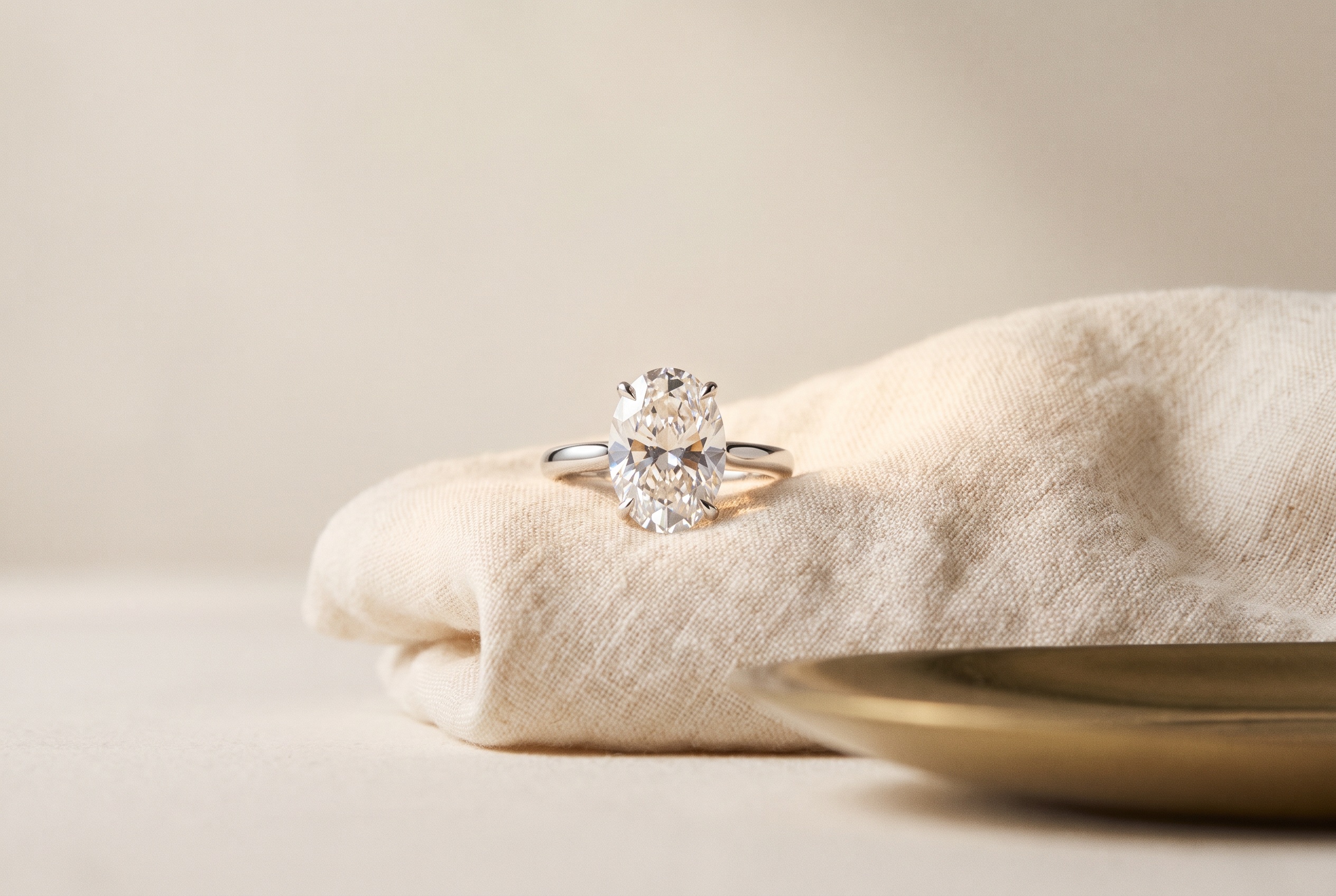

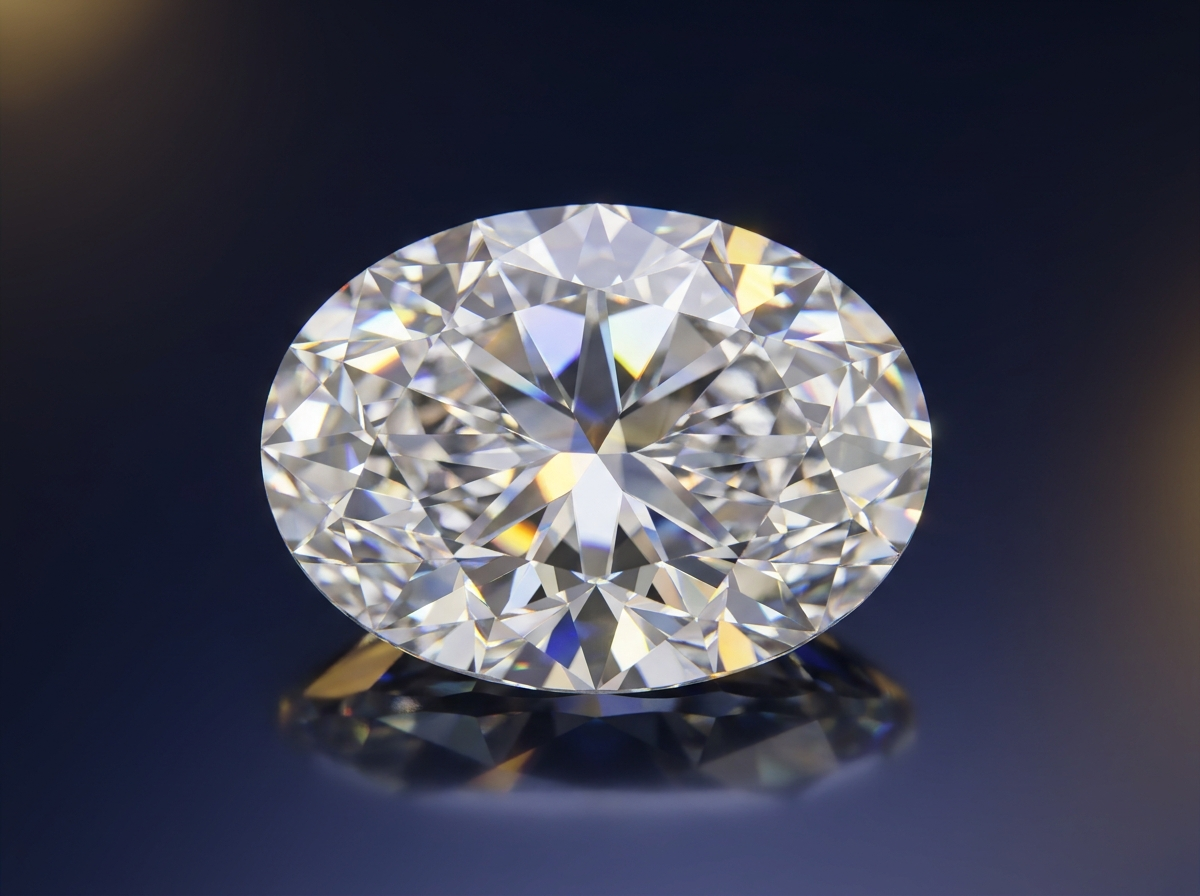
An Oval Brilliant diamond is an elongated brilliant-cut diamond — essentially a round brilliant stretched along one axis, carrying the same fire and scintillation as a round in a silhouette with no points or hard corners. Guru Diam maintains 495 IGI-certified, CVD-grown oval diamonds on hand in colorless grades (D–J) — GIA and GCAL certification available on request.
What Is an Oval Brilliant Diamond?
An Oval Brilliant takes the round brilliant's faceting logic — small triangular and kite-shaped facets arranged to bounce light back toward the viewer from every angle — and applies it to an elongated, rounded outline instead of a circular one. Standard proportions land at roughly 56 facets, close to a round brilliant's 57–58, with the difference coming from how facets compress and stretch to follow the oval's two axes of symmetry instead of a round's infinite radial symmetry. There are no points, no corners, and no exposed tips to chip — which is a real practical advantage in day-to-day wear and one reason ovals move easily into prong, bezel, and halo settings without the corner-protection conversation an emerald or princess cut requires.
In modern form, the oval brilliant is a relatively recent addition to the trade compared to the round brilliant's centuries of refinement. Most trade accounts credit cutter Lazare Kaplan with popularizing the modern oval brilliant in the late 1950s, working out the faceting math needed to keep an elongated stone bright and lively rather than looking like a stretched, flattened round. That problem — keeping brilliance consistent across a stone that isn't radially symmetrical — is still the central technical challenge in cutting a good oval, and it's why oval quality varies more from cutter to cutter than round quality does.
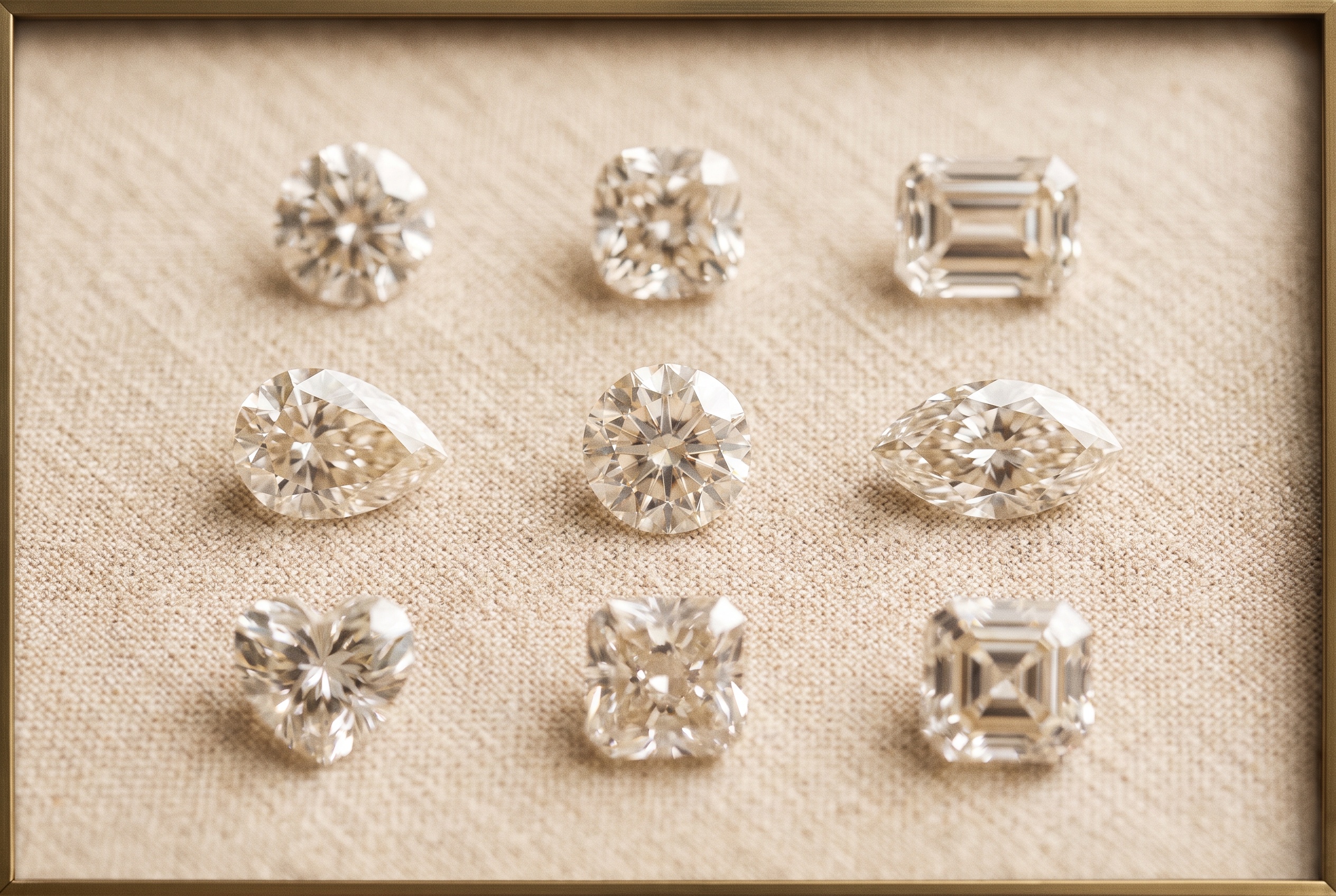
At Guru Diam, Oval sits in the Regular Fancy tier — the mid-market category that also includes Emerald, Asscher, Cushion, Pear, Marquise, Radiant, Princess, and Heart. These are modern cuts, not antique ones, even though clients sometimes assume any shape other than round must be "vintage." The antique tier (Old Mine, Old European, Hexagonal, Moval, Lozenge, Kite, Trillion, Criss-Cut, Padparadscha, and similar true antique-style cuts) is a separate category with its own sourcing story and price ceiling. It's worth being precise about that distinction with a client: an oval reads as a distinctive, non-round choice without the sourcing complexity or premium of a genuine antique cut.
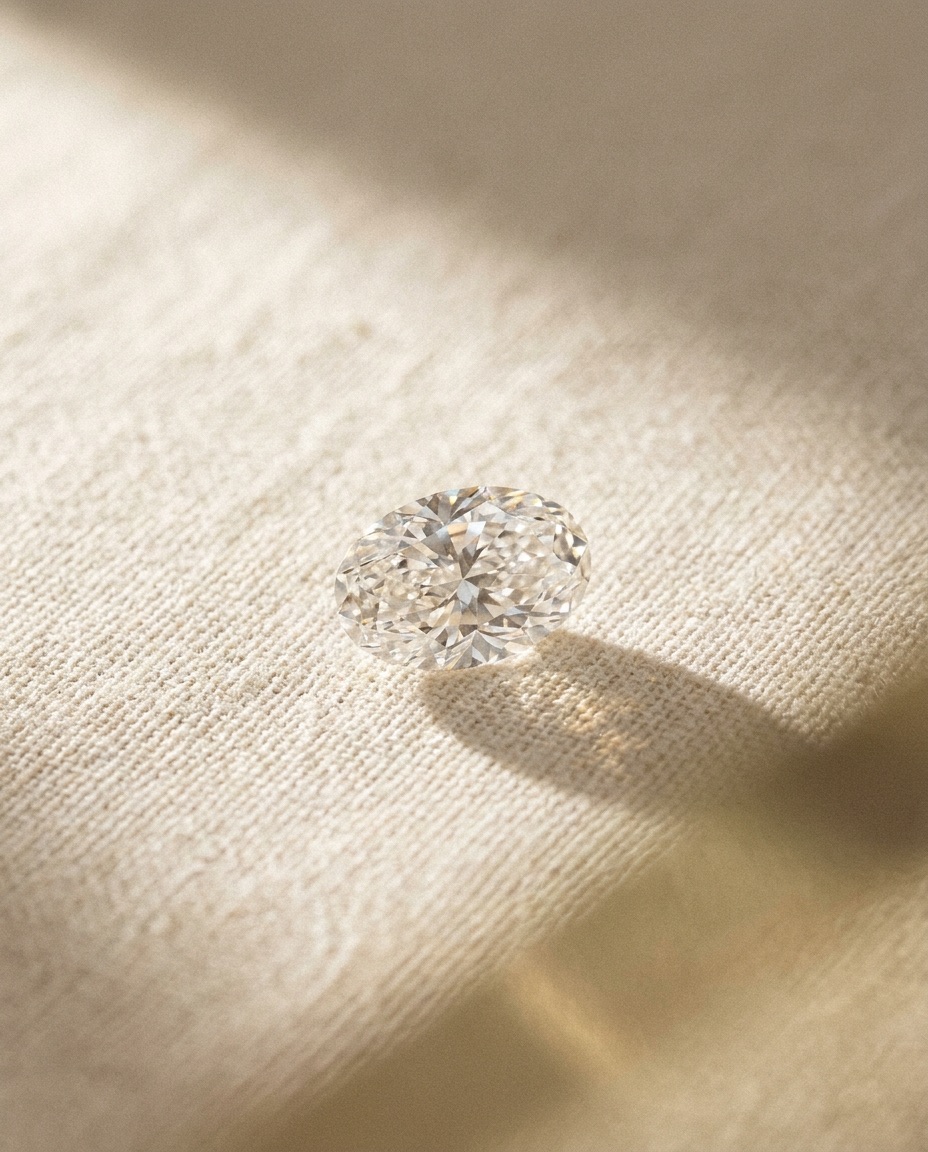
Facet Anatomy: How the Oval Brilliant's Facets Work
A standard oval brilliant's 56-facet arrangement breaks down into a crown (the top, above the girdle) and a pavilion (the bottom, below the girdle), each built from families of facets repeated in mirrored pairs across the stone's long axis. The crown typically carries a table facet, 8 star facets, 8 bezel (kite) facets, and 8 upper-girdle facets; the pavilion carries 8 lower-girdle facets and 8 pavilion mains, sometimes meeting at a culet point or polished flat depending on the cutter's finishing preference. That's the same facet family a round brilliant uses — the difference is entirely in how those facets are stretched and angled to wrap an elongated outline instead of a circle.
That stretching is where the real cutting difficulty lives. A round brilliant has infinite rotational symmetry — a slightly off facet angle gets absorbed into the overall sparkle pattern because the eye has no fixed reference point to compare against. An oval only has two axes of symmetry (lengthwise and widthwise), which means every facet on one side of the stone has to mirror its counterpart on the other side almost exactly, or the imbalance shows up as uneven brightness, a visible "off-center" table, or the dark shadow band trade buyers call bow-tie. Cutting a clean oval is measurably harder than cutting a clean round of the same rough — there's less symmetry to hide behind and a specific failure mode (bow-tie) that only shows up on elongated shapes.
Facet count itself varies more on ovals than on rounds. Some cutters add extra facets around the girdle — landing anywhere from around 56 up to the mid-60s — chasing better light performance at the elongated ends, where a standard 56-facet arrangement can leave the tips looking comparatively flat next to the brighter center. Guru Diam cuts to the 56-facet trade standard by default; buyers with a specific facet-count preference should flag it before ordering.
Oval Brilliant vs. Oval Step Cut — Not the Same Stone
It's worth drawing a hard line here, because "oval cut" gets used loosely and the two shapes get confused constantly on the sales floor. An Oval Brilliant and an Oval Step Cut share the exact same outline — elongated, no corners, continuous curve — but they are faceted completely differently, and that difference changes almost everything else about how the stone should be sold, set, and graded.
| Spec | Oval Brilliant (this guide) | Oval Step Cut | |
|---|---|---|---|
| Faceting | Brilliant (many small facets) | Step-cut (broad, parallel facets) | |
| Light behavior | Fire and scintillation | Broad flashes, hall-of-mirrors | |
| Clarity visibility | Brilliant faceting hides inclusions better | Inclusions more visible | |
| Aesthetic | Classic sparkle | Minimalist, vintage-influenced | |
| Typical client ask | "Maximum sparkle" | "Something quieter, more architectural" | |
A brilliant oval is the shape most buyers mean by default when a client asks for "an oval" — it's the sparkle-forward version, built on the same faceting family as a round brilliant. An Oval Step Cut swaps that faceting for broad, parallel step facets borrowed from the emerald-cut family, trading fire for a quieter, more graphic light pattern — and because that open faceting shows inclusions more readily, clarity grading works differently on that shape. If a client's brief is "something unusual and architectural" rather than "sparkly but not round," the step-cut version is the better fit; see our Oval Step Cut wholesale guide for that shape's specific grading and pricing considerations. Everything in this guide assumes standard brilliant faceting.
Why Oval Has Become the Default Alternative to Round
Two mechanics drive oval's popularity, and both are worth having ready for a client conversation. First, elongation increases visible surface area without increasing carat weight — a well-cut oval can face up noticeably larger than a round of the same weight, because the weight is distributed across a longer, wider outline instead of concentrated in a tight circle. That's a genuine value argument for a client working to a carat-weight budget who wants maximum apparent size for the money. Second, an oval set north-south has a visual elongating effect on the finger that a round simply doesn't produce — a real, consistently cited reason clients choose it over round even when budget isn't a factor at all.
Those two mechanics together have made oval one of the most frequently requested shapes in the trade, trailing only round brilliant itself and running ahead of every other fancy shape. That demand shows up on the wholesale side as depth-of-stock pressure — buyers who lock in a reliable oval source ahead of a busy season fill last-minute custom requests more easily than buyers sourcing stone-by-stone after a client has already committed to the shape in a showroom.
One expectation to set up front: oval's two-axes-only symmetry makes it more cutting-sensitive than round, which is the direct cause of the bow-tie risk covered below. A client comparing a mediocre oval against a well-cut round may come away thinking "round sparkles more" — when what they're seeing is cutting-quality variance within the oval category, not a limitation of the shape itself. Worth making that point before the comparison happens, not after.
Guru Diam's Sourcing and In-House Cutting
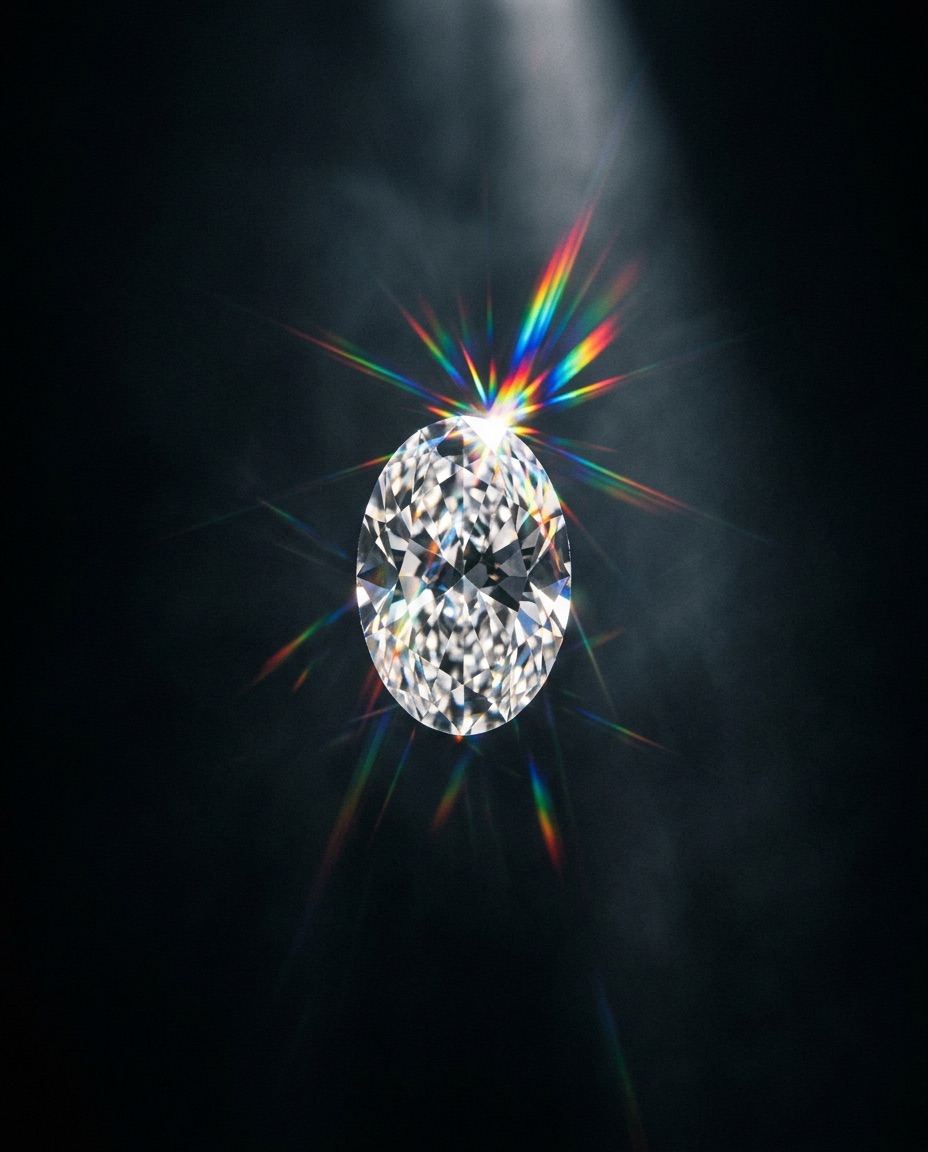
Guru Diam's Oval Brilliant inventory is CVD lab-grown and cut, set, and polished entirely in-house — one production chain end to end, not a network of subcontracted cutters passing rough and partially-finished goods between shops. That matters specifically for a shape like oval, where consistency in bilateral facet symmetry has to be held across an entire run of stones, not just achieved on a one-off basis. A single production chain is what lets a buyer reorder the same proportions and expect the same light performance months later.
Rough selection for ovals is more deliberate than for round. Round brilliants are cut to maximize yield from roughly octahedral rough — the shape rough naturally wants to become. An oval's elongated outline doesn't map onto that geometry as efficiently, so more rough weight gets sacrificed to achieve a clean, symmetrical silhouette at a good length-to-width ratio — one of the underlying reasons oval pricing works differently from round carat-for-carat, covered in more detail below.
Loose Oval Brilliant stones ship from on-hand inventory — 495 pieces currently in colorless grades, IN STOCK NOW, ready to ship same-day from New York before 6pm EST or Los Angeles before 4pm PST. If a client wants that stone set into a finished piece, made-to-order CAD-to-jewelry production — cutting, setting, and polishing all in-house — runs 4–6 days from approved design to completed jewelry, well inside the two-to-six-week range most wholesalers quote for custom work. That turnaround applies to finished jewelry only; loose stones ship on the same-day schedule above, not on a multi-day production timeline.
Grading and Quality: Bow-Tie Effect and Length-to-Width Ratio
Two proportion checks matter more on an oval than on almost any other shape, and both come down to the same root cause: an oval's limited symmetry gives cutting errors nowhere to hide.
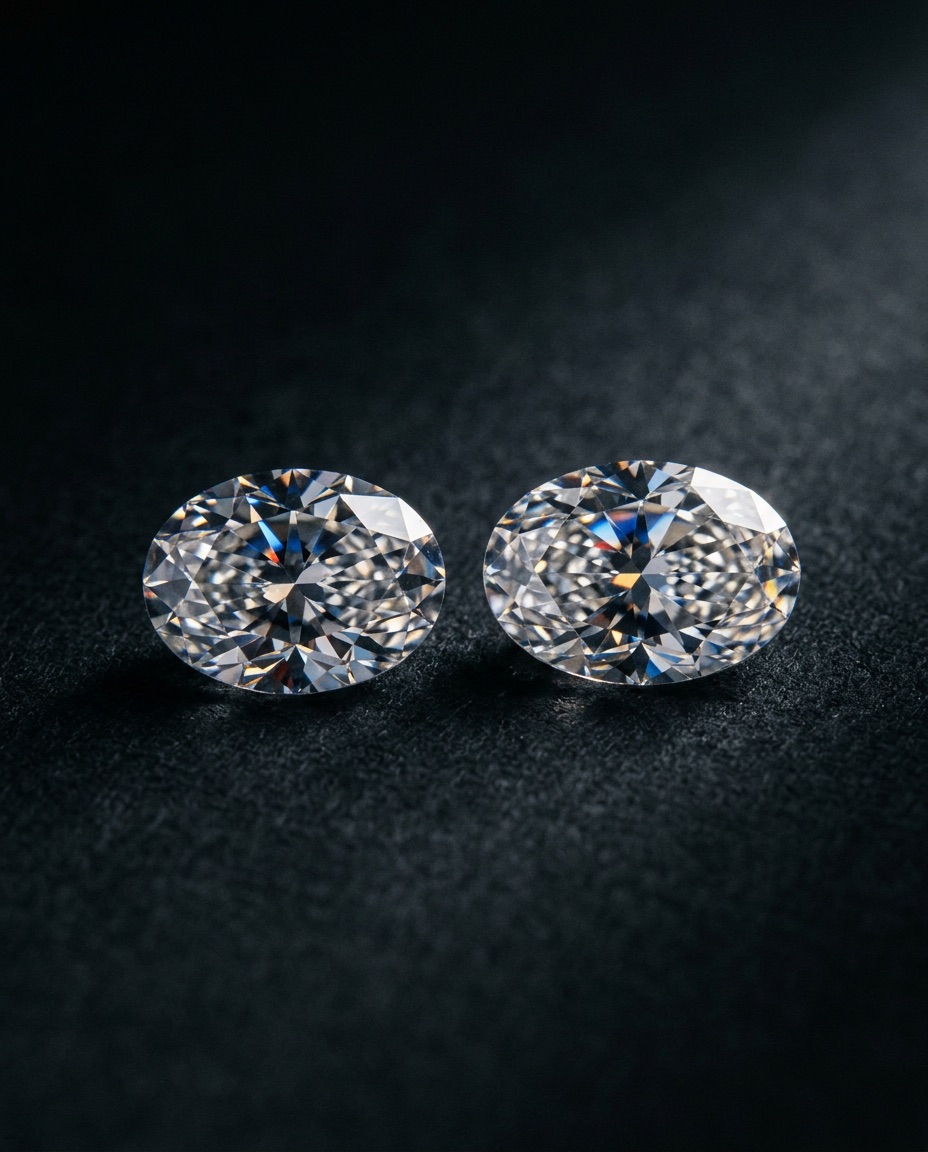
Bow-tie effect. This is a dark, shadow-like band that can appear across the center of an oval (and other elongated brilliant shapes — pear and marquise show the same phenomenon) when the crown and pavilion facets don't return light evenly along the stone's long axis. It happens because light entering through certain facets near the stone's waist leaks out through the pavilion instead of bouncing back to the viewer, leaving a visible dark patch instead of the sparkle the rest of the stone shows. A mild bow-tie is common and, on a well-proportioned stone, can read as subtle depth rather than a flaw; a strong, obvious bow-tie reads as a cutting problem and should factor directly into how a stone is priced and pitched. Check bow-tie stone by stone — request current face-up photography or video before committing a client's deposit, since it doesn't show up reliably on a certificate or spec sheet alone.
Length-to-width ratio. Trade convention targets roughly 1.35–1.50 for a classically elongated oval — enough elongation to read as clearly non-round and deliver the finger-lengthening effect, without tipping into an overly narrow, "stretched" look. Some clients prefer a fuller, closer-to-round ratio around 1.30; others — particularly on east-west or editorial-style settings — are asking for a more dramatically elongated 1.55+ look. Neither is objectively correct; confirm the client's preference and match the ratio precisely rather than assuming the classic range applies by default, and always confirm exact ratio from the certificate or spec sheet, not from a product photo, since photo cropping can make ratio hard to judge accurately.
Beyond those two proportion checks, oval grading follows the same fundamentals as any brilliant-cut white diamond: color runs the standard D-to-Z scale, with on-hand inventory concentrated in the colorless D–H range and available through J for buyers working a lower price point; clarity runs FL-to-I, with most trade demand clustering around VS-and-better for an eye-clean result. Brilliant faceting scatters light more than step-cut faceting does, so ovals hide small inclusions more effectively than a step-cut stone at the same clarity grade — a real advantage on tighter clarity budgets. On certification: Guru Diam issues Oval Brilliant inventory as IGI-certified by default, with GIA and GCAL certification available on request — IGI, GIA, and GCAL are the only three labs Guru Diam certifies against.
Pricing Factors for Wholesale Buyers
Five variables move the price on a wholesale Oval Brilliant quote:
Carat weight and length-to-width ratio together. A more elongated oval at a given carat weight has to be cut from larger rough than a closer-to-round oval at the same weight, so two stones of identical carat weight can price differently depending on ratio. Ask for the ratio alongside carat weight rather than quoting off weight alone.
Cutting yield and rejection rate. Ovals lose more rough weight in cutting than rounds do, and rough gets rejected at a higher rate for symmetry issues specific to elongated shapes. That higher cost-of-goods on the cutting side is reflected in wholesale pricing relative to round of comparable carat weight and quality.
Bow-tie and symmetry grade. A well-proportioned oval with minimal to no visible bow-tie commands a real premium over an average-cut stone at the same carat, color, and clarity — proportion quality does as much pricing work here as the standard 4Cs. Don't quote off the certificate's headline grades without checking symmetry and requesting current photography.
Clarity. Standard VS-and-better pricing tiers apply, with brilliant faceting's scattering effect giving buyers more room to go a grade or two lower than on a step-cut shape and still land eye-clean.
Color. Standard D–H colorless-range pricing applies, same as any white diamond in Guru Diam's Regular Fancy tier.
Supply depth varies more by ratio and cut quality on ovals than on round, so don't expect identical stock depth across every combination. If a client's spec is narrow — a specific ratio, near-zero bow-tie, and a tight clarity band all at once — check current inventory before quoting a delivery date, or flag it as a cutting-queue request rather than promising same-day availability.
Oval Brilliant vs. Round Brilliant: The Trade Comparison
| Spec | Oval Brilliant | Round Brilliant | |
|---|---|---|---|
| Cut tier at Guru Diam | Regular Fancy (mid-market) | Round (commodity) | |
| Facets | ~56 | 57–58 | |
| Symmetry | Two axes (length and width) | Infinite radial symmetry | |
| Bow-tie risk | Yes — proportion-dependent | None | |
| Visual size per carat | Larger face-up area | More weight held in depth | |
| Finger effect | Elongating (set north-south) | Neutral | |
| Cutting rough yield | Lower — more rough sacrificed for outline | Higher — matches natural octahedral rough | |
| Setting demands | No corners; watch bow-tie placement | Universally forgiving | |
Round remains the commodity benchmark — deepest supply, most forgiving cutting geometry, effectively zero proportion risk to manage. Oval's appeal is precisely what round doesn't offer: a larger apparent face-up size at the same weight, a finger-elongating silhouette, and a shape that reads as a deliberate choice rather than a default. The trade-off is real cutting-quality variance — sourcing oval means checking proportions and bow-tie in a way that simply isn't necessary on round. For a client torn between the two, frame it as size-and-shape preference against zero-fuss consistency, not one shape being objectively "better cut."
Oval Brilliant vs. Pear: The Trade Comparison
| Spec | Oval Brilliant | Pear | |
|---|---|---|---|
| Cut tier at Guru Diam | Regular Fancy (mid-market) | Regular Fancy (mid-market) | |
| Outline | Fully rounded, no point | One point, one rounded end | |
| Symmetry | Two axes (length and width) | One axis only (length) | |
| Bow-tie risk | Yes — proportion-dependent | Yes — often more pronounced near the point | |
| Tip vulnerability | None — no exposed point | Point needs V-prong or protective setting | |
| Orientation | North-south or east-west, either reads well | Point-down is standard; point-up is a deliberate statement look | |
Oval and pear share a category (Regular Fancy) and a common problem — both are elongated brilliant-faceted shapes prone to bow-tie, and both trade on a finger-elongating silhouette. The difference that decides most client conversations is the point: a pear's tip needs a V-prong or protective setting detail and dictates orientation (point toward the hand is the near-universal default). An oval sidesteps that entirely — no point, no setting constraint, no orientation debate — which is why oval tends to win with clients who want elongation without thinking about tip protection. Pear wins with clients chasing a more dramatic, editorial silhouette who'll accept that trade-off.
Styling and Use-Case Guidance
Setting choice on an oval is mostly about controlling two things: minimizing visible bow-tie and choosing an orientation that suits the client's hand and taste.
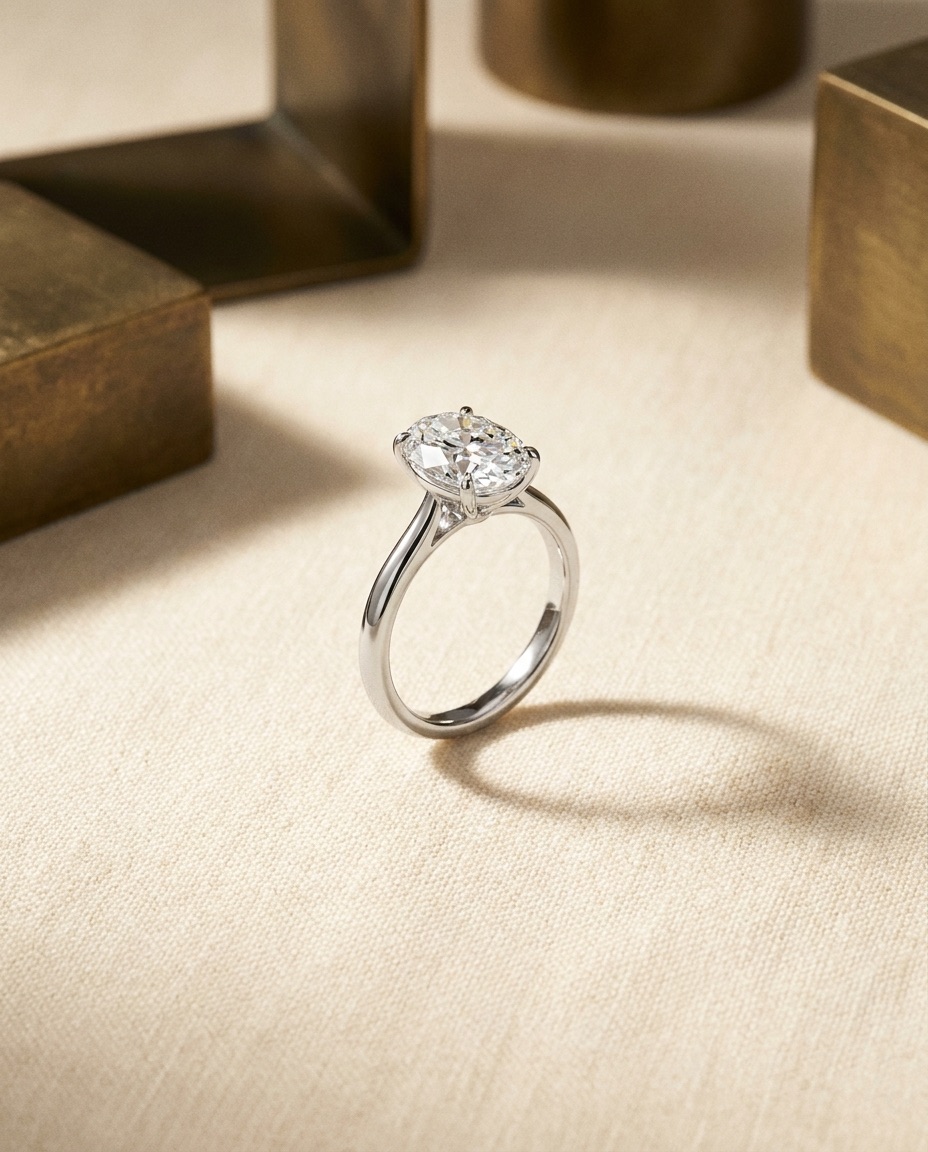
Classic north-south solitaire. The default choice, and still the strongest seller — a simple four- or six-prong solitaire lets the stone's elongation do the finger-lengthening work without any competing design elements. Works with every ratio in the standard range.
Hidden halo and pavé shoulders. A halo set slightly below the girdle line, invisible from the top view, adds perceived size and can help visually soften a mild bow-tie by interrupting the light path around the stone's perimeter — a useful pairing for a stone with a subtle but present bow-tie that a client doesn't want emphasized.
East-west settings. Setting the oval sideways across the finger rather than pointing up it is a strong current trend, giving a more editorial, non-traditional look. It also changes how bow-tie reads visually — worth showing the client both orientations in hand before they commit, since the effect can look meaningfully different rotated 90 degrees.
Three-stone settings. A very common oval pairing — trapezoid, half-moon, or pear side stones flanking an oval center reinforce the elongation and give the whole hand a cohesive silhouette. Popular for both engagement and anniversary/right-hand pieces.
Melee and accent stones. For pavé bands, hidden halos, or three-stone side stones, Guru Diam's calibrated melee program runs Round Brilliant plus fancy calibrated shapes (Emerald, Radiant, Pear, Marquise, and other calibrated shapes on request) in DEF+/VS+ CVD material from 0.8mm to 9.0mm, so center stone and matching accents can typically come from a single order.
One coaching note for sales staff: check bow-tie under the same lighting the client will actually wear the ring in, not only under jewelry-counter spotlighting. A stone that looks perfectly even under a single hard light source can show more bow-tie under diffuse daylight — worth a quick check under a couple of light sources before a client signs off.
How to Order Oval Brilliant Diamonds Wholesale
Guru Diam carries Oval Brilliant as IGI-certified lab-grown loose inventory from our New York and Los Angeles desks, with real-time online inventory and API/CSV feed access for trade accounts — so you can check current stock, certificates, and pricing without waiting on an email back-and-forth. In-stock pieces ship same-day from New York before 6pm EST or Los Angeles before 4pm PST; a made-to-order finished piece built around an oval center runs 4–6 days from approved design to completed jewelry.
If you're a new account, the process is straightforward: open a verified wholesale account, browse or request current Oval Brilliant inventory against your ratio/clarity spec, and — for anything outside standard proportions or with a bow-tie sensitivity — book time with a gemologist to review specific stones (photo, video, or in person) before committing a client's order. Guru Diam works with independent jewelers, designers, and manufacturers placing recurring wholesale orders out of the New York Diamond District and beyond, not individual consumers, so pricing and inventory access are trade-only.
Ready to buy? Open a verified wholesale account at /signup and book time with a gemologist at /book-appointment.
Frequently Asked Questions
What is an oval cut (oval brilliant) diamond? An oval brilliant is an elongated brilliant-cut diamond — a round brilliant's facet pattern stretched along one axis, with roughly 56 facets and no points or corners. It carries the same fire and scintillation as a round brilliant in a longer, size-maximizing silhouette.
How is an oval brilliant different from an oval step cut? Both share the same elongated outline, but faceting differs completely. An oval brilliant uses many small facets for maximum fire and sparkle; an oval step cut uses broad, flat, parallel facets borrowed from the emerald-cut family for a quieter, more architectural light effect. They're different stones for different client briefs, not two versions of the same product — see our oval step cut guide for that shape specifically.
What causes the bow-tie effect and how do I check for it? Bow-tie is a dark, shadow-like band across an oval's center, caused by light leaking through the pavilion instead of returning to the viewer along the stone's long axis. It's proportion-dependent and shows up stone by stone rather than by shape category — request current face-up photo or video before committing a client's deposit, since it isn't reliably visible on a certificate.
What length-to-width ratio should I look for? Classic trade ratio runs about 1.35 to 1.50 for a well-elongated look. Some clients prefer a fuller 1.30 or a more dramatic 1.55+, particularly for east-west settings — confirm the client's preference and the stone's exact ratio from the certificate rather than assuming the classic range or judging from a photo.
How does oval compare to round brilliant on price and size? Oval sits in Guru Diam's Regular Fancy (mid-market) tier versus round's commodity tier, and typically shows a larger face-up size than a round of the same carat weight due to how weight distributes across the elongated outline. Oval also costs more to cut per carat of finished weight, since rough yield is lower than round's near-perfect match to natural octahedral rough.
How do I order oval brilliant diamonds wholesale, and are they certified? Guru Diam's Oval Brilliant inventory is CVD-grown and IGI-certified by default, with GIA and GCAL certification available on request. Wholesale ordering is trade-only — open a verified account, check real-time inventory via the online catalog or API/CSV feed, and book a gemologist review for any stone with a bow-tie or ratio concern before finalizing a client's order.