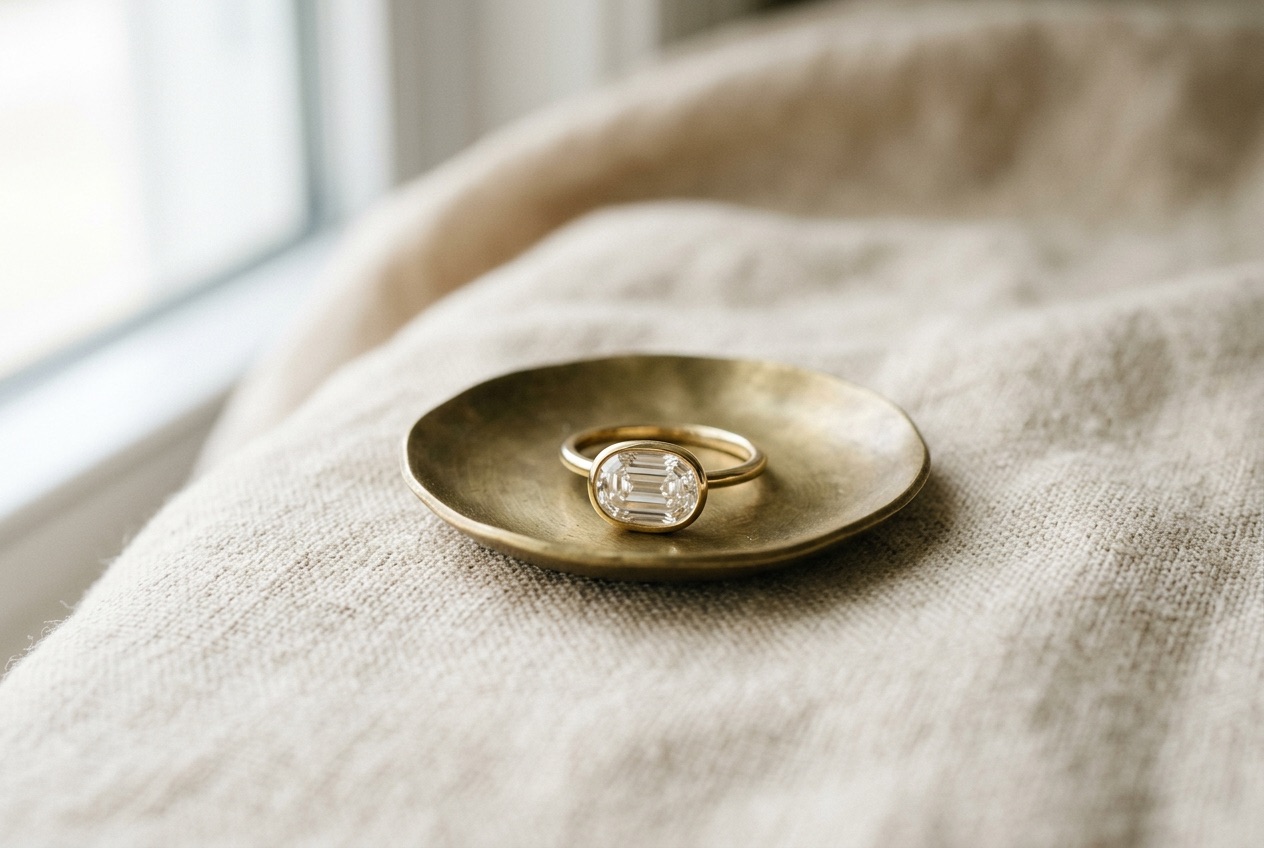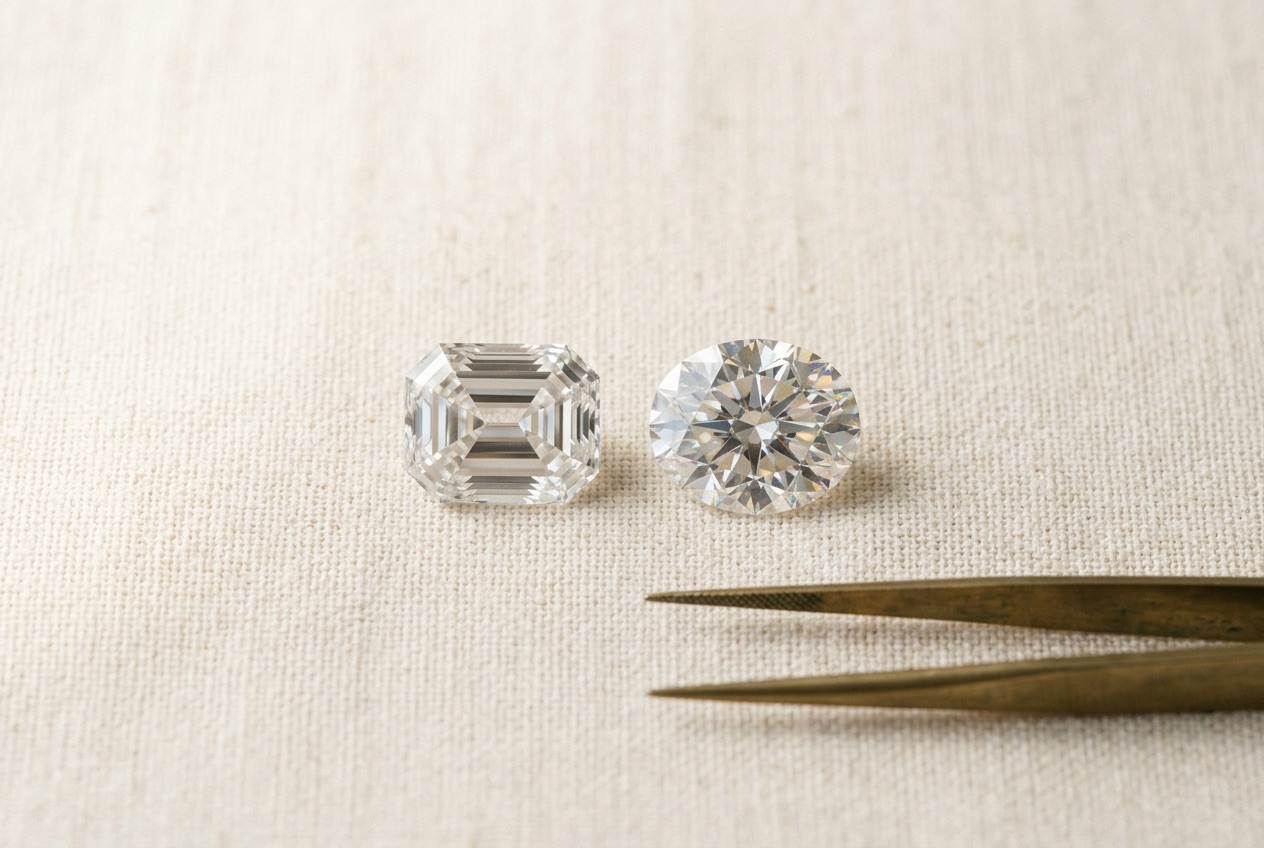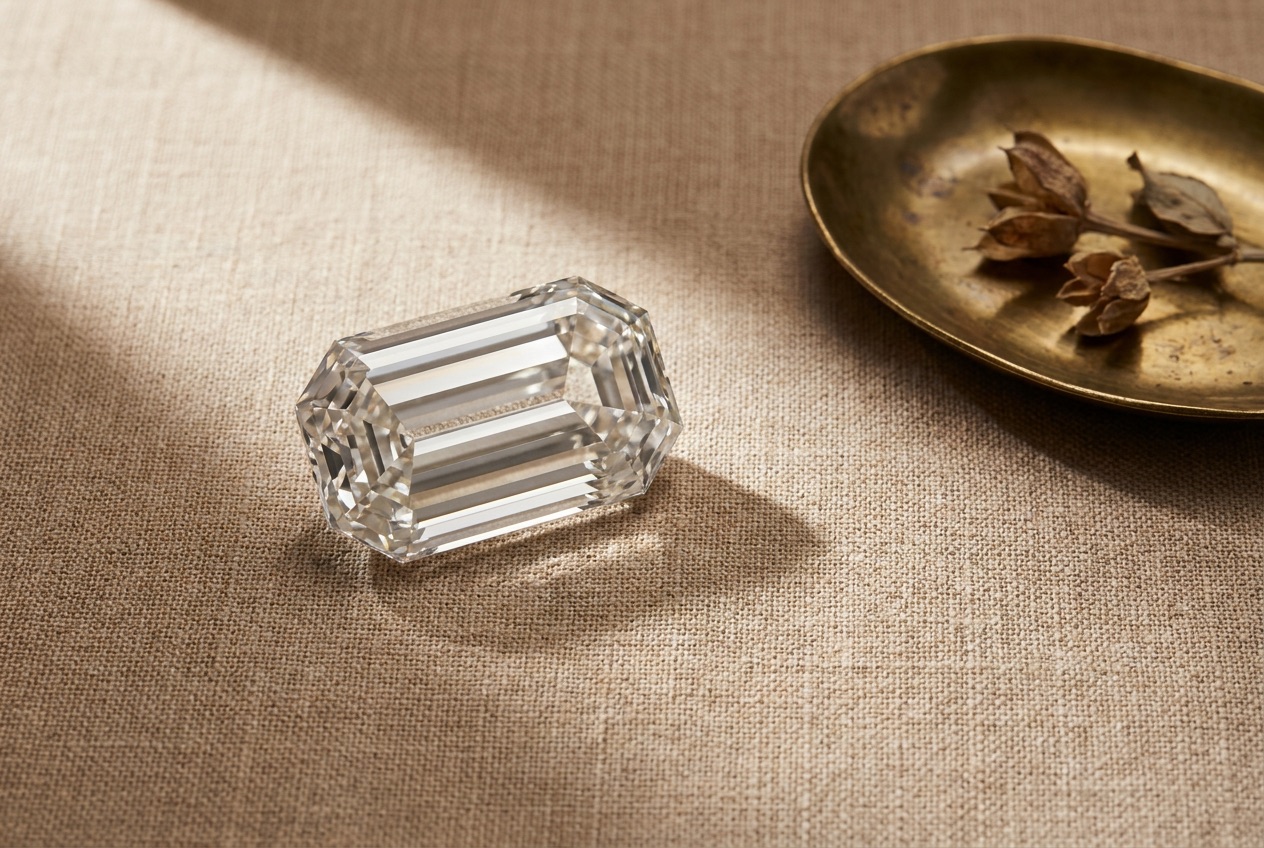

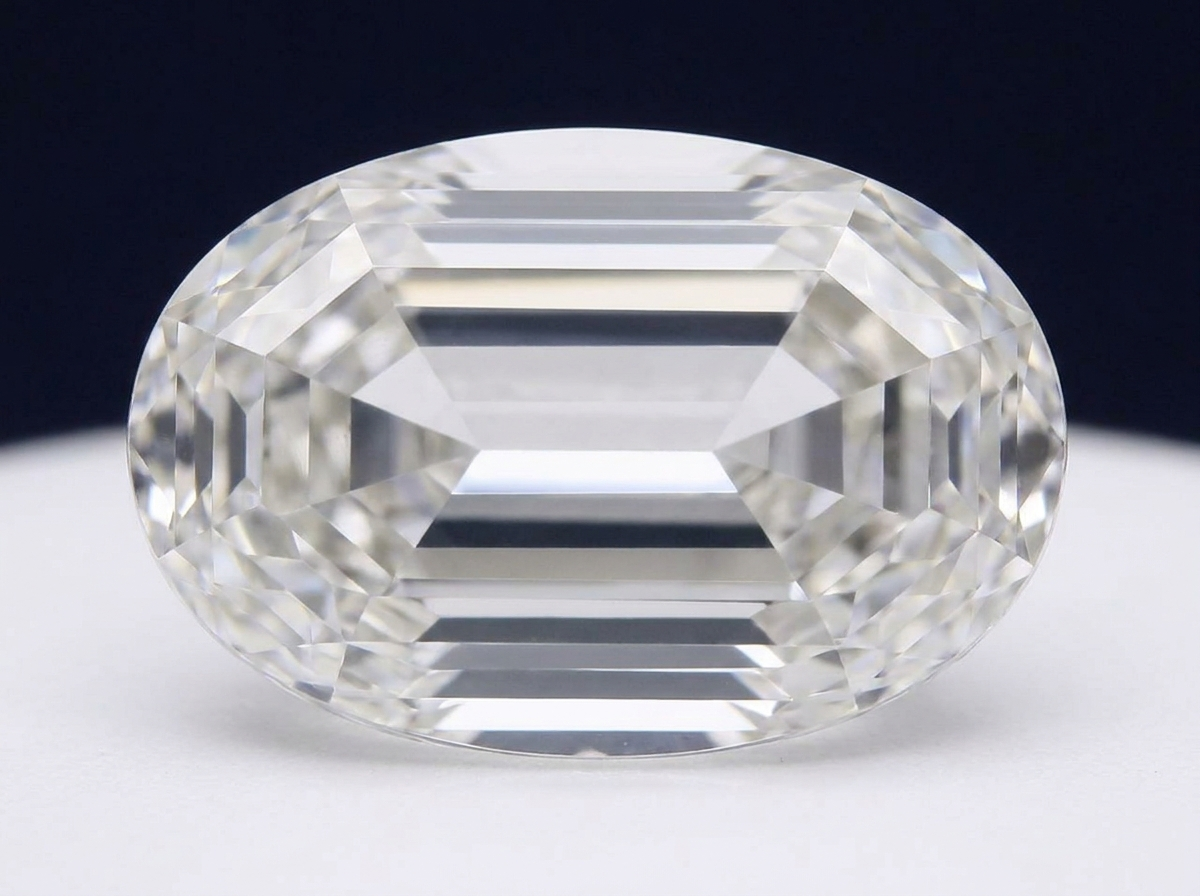
An Oval Step Cut diamond pairs the elongated oval outline with step (emerald-style) faceting instead of brilliant faceting — broad, flat parallel facets that produce a quiet hall-of-mirrors light effect rather than the fire and sparkle of a standard brilliant oval. Guru Diam stocks Oval Step Cut as IGI-certified lab-grown loose diamonds, with 29 pieces currently on hand — GIA and GCAL certification available on request.
What Is an Oval Step Cut Diamond?
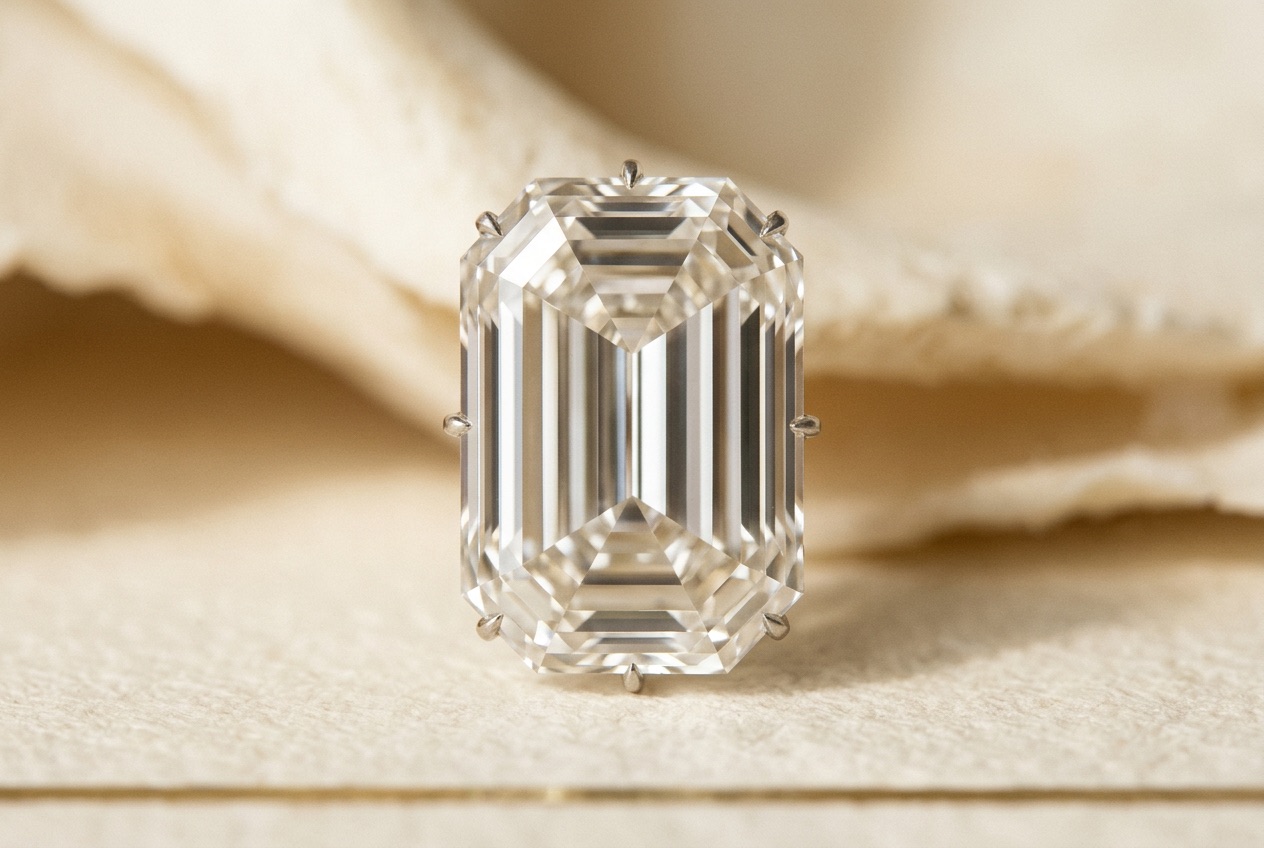
An Oval Step Cut keeps the same elongated silhouette as a standard oval but replaces the many small triangular and kite-shaped facets of a brilliant cut with fewer, larger, rectangular facets arranged in parallel rows around the outline — the same faceting logic as an emerald cut, applied to an oval outline instead of a rectangular one. The result reads noticeably different in hand: broad, sheet-like flashes of light instead of scattered fire and sparkle, and a flatter, more architectural table that draws the eye along the length of the stone rather than into a point of maximum brilliance.
It's a distinct alternative to a standard oval brilliant, not a replacement for it — buyers choose it specifically for the quieter, minimalist light behavior, not because it's a "better" oval. In practice, most buyers requesting an "oval step cut" mean exactly this: an oval outline, step (also called "trap" or "emerald-style") faceting, and open, unbroken table lines rather than a faceted crown. Some cutters use "oval step cut" and "elongated step cut" interchangeably with the shape rounded off less aggressively at the ends — worth confirming length-to-width ratio with the supplier before you assume a specific look.
Buyers sometimes conflate the step-cut oval with the "crushed ice" appearance that shows up in some brilliant-cut lab-grown ovals — the shattered, fractured-glass sparkle pattern that some clients love and others actively avoid. That's a separate phenomenon entirely: crushed ice is a faceting/light-return characteristic within the brilliant-cut category, caused by irregular or overly small facets on the crown. A true step-cut oval doesn't have a crushed-ice look at all — it has the opposite problem to manage, which is that broad open facets show clarity characteristics more readily rather than masking them in scattered sparkle.
Facet Anatomy: How Step-Cut Faceting Actually Works
On a brilliant-cut stone, the crown is built from small triangular and kite facets angled to bounce light back out toward the viewer in every direction — that's what produces fire and scintillation. A step cut abandons that structure. The crown and pavilion are built from long, rectangular facets running parallel to the girdle outline, stepping down in size toward the culet like the risers of a staircase — which is where the name comes from.
On an oval step cut specifically, those parallel facets curve to follow the oval's rounded outline rather than running in straight lines the way they do on an emerald cut's rectangular outline. That curvature is part of what makes an oval step cut harder to cut cleanly than a rectangular step cut: every facet has to maintain consistent width and angle around a continuously changing curve, and any inconsistency shows up immediately as an uneven, patchy light pattern instead of the intended broad, even flashes.
The open table and shallow facet count mean there's nowhere for a cutter to hide a symmetry problem. On a round brilliant with 57–58 facets, a slightly off angle on one facet gets absorbed into the overall sparkle pattern. On a step-cut oval with a fraction of that facet count, each facet reads as a distinct plane — buyers and their clients will see it. That's the main reason step-cut faceting commands a cutting premium over brilliant faceting on the same rough: there's less room for error and no scintillation to mask it.
Where the Oval Step Cut Sits in the Trade
It's worth being precise about category here, because "step cut" gets used loosely in the trade. At Guru Diam, Oval sits in the regular fancy tier alongside Emerald, Asscher, Cushion, Pear, Marquise, Radiant, Princess, and Heart — modern shapes, not antique cuts, even though several of them (Emerald and Asscher included) are also step-cut by faceting style. The antique tier is a separate category entirely: Old Mine, Old European, Hexagonal, Moval, Lozenge, Kite, Trillion, Criss-Cut, Padparadscha, and similar true antique-style cuts, each with its own facet arrangement and sourcing story.
So an Oval Step Cut is not an antique cut — it's a modern shape (oval) wearing a step-cut faceting style borrowed from the emerald/Asscher family. That distinction matters when you're quoting a client who's asking for "something vintage": a step-cut oval delivers vintage-influenced light behavior — that quiet, architectural flash instead of scatter sparkle — without the sourcing complexity or premium of a true antique-cut stone. It's the shape to reach for when a client wants the aesthetic conversation an antique cut starts, at a mid-market price point and with better supply depth.
Oval Step Cut vs. Oval Brilliant
| Spec | Oval Step Cut | Oval Brilliant | |
|---|---|---|---|
| Faceting | Step-cut (broad, parallel facets) | Brilliant (many small facets) | |
| Light behavior | Broad flashes, hall-of-mirrors | Fire and scintillation | |
| Clarity visibility | Inclusions more visible | Brilliant faceting hides inclusions better | |
| Aesthetic | Minimalist, vintage-influenced | Classic sparkle | |
| Bowtie effect | Can still appear depending on proportions | Common in most ovals | |
| Typical client ask | "Something quieter, more architectural" | "Maximum sparkle" | |
The practical takeaway for a sales floor: don't position these as better-or-worse versions of the same stone. They're answers to different questions. A client who tries on a brilliant oval and says it feels "busy" or "too much going on" is describing exactly what a step-cut oval solves. A client chasing maximum fire under jewelry-counter lighting will be disappointed by a step cut regardless of how well it's made — that's simply not the effect step faceting produces, no matter the quality of the cutting.
Oval Step Cut vs. Emerald Cut
Since the two share a faceting family, buyers often ask which one to recommend. The honest answer is that it's an outline decision, not a quality decision — both use the same step-cut logic, so the light behavior is close to identical stone-for-stone at comparable proportions.
| Spec | Oval Step Cut | Emerald Cut | |
|---|---|---|---|
| Outline | Elongated, curved, no corners | Rectangular with cut (beveled) corners | |
| Corner vulnerability | None — no exposed corners to chip | Corners need protective prong or bezel coverage | |
| Finger coverage | Elongates the finger, softer visual line | Elongates the finger, more graphic/geometric line | |
| Setting flexibility | Works in bezel, prong, halo, east-west | Works best in bezel or protected-corner prong settings | |
| Cutting difficulty | Higher — curved facets must stay consistent | Lower — straight facet lines are easier to hold true | |
The corner question is the one that comes up most on the floor: an emerald cut's cut corners are elegant but genuinely more exposed to chipping in everyday wear, which is why emerald-cut engagement rings usually need a setting style that shields the corners. An oval step cut sidesteps that conversation entirely — no corners means no corner-protection design constraint, which gives your client (and their setter) more freedom on setting style. If a client likes the step-cut light behavior but is nervous about durability language around "delicate corners," the oval version is the easier sell.
Why Buyers Are Asking for Oval Step Cut
The appeal is specifically the trade-off: less sparkle, more clarity of line. It pairs well with simple bezel and east-west settings where the goal is a clean, elongated silhouette rather than maximum brilliance, and it gives clients who already like the oval outline a genuinely different option instead of shopping between near-identical oval brilliants from different cutters. It's also become a differentiator play for jewelers themselves — a step-cut oval is a shape a client's friends and family are unlikely to recognize on sight, which matters to buyers who specifically don't want their ring to read as a catalog piece.
There's a second driver worth naming to trade buyers: step-cut faceting is genuinely harder to source well in an oval outline than in a rectangular one, so supply is thinner across the category. Buyers who lock in a reliable step-cut oval source ahead of demand tend to have an easier time filling custom orders than buyers scrambling to find one after a client has already committed to the look in a showroom.
Guru Diam's Sourcing and In-House Cutting
Guru Diam's Oval Step Cut inventory is CVD lab-grown and cut, set, and polished entirely in-house — one production chain, not a network of subcontracted cutters, which is how consistency in facet angle and proportion gets held across a run of stones rather than piece to piece. Rough selection for step-cut ovals is more conservative than for brilliant ovals: because the open table shows inclusions and internal graining more readily, rough that would clear for a brilliant cut sometimes doesn't clear for a step cut at the same target clarity, which is one reason step-cut oval supply runs thinner than brilliant oval supply industry-wide.
Loose Oval Step Cut stones ship from on-hand inventory — IN STOCK NOW, ready to ship same-day from New York before 6pm EST or from Los Angeles before 4pm PST. If a client wants that stone set into a finished piece, made-to-order CAD-to-jewelry production — cutting, setting, and polishing all in-house — runs 4–6 days once the design is approved, well inside the two-to-six-week range most wholesalers quote for custom work.
Grading and Quality Considerations
Because step faceting shows inclusions more readily than brilliant faceting does at the same carat weight, clarity grade matters more here than on an oval brilliant of the same size — factor that into what you quote a client, not carat weight alone. A VS2 that would read eye-clean under an oval brilliant's scattered light can show a visible inclusion under a step cut's open table, particularly anything near the center of the stone where the largest facets sit. When in doubt, ask for the certificate's plotting diagram rather than relying on clarity grade alone — inclusion location matters as much as inclusion grade on this shape.
Length-to-width ratio is the second thing to check every time. Step-cut ovals are less forgiving of a squat or overly narrow ratio than brilliant ovals are, because the parallel facet lines make proportion irregularities more visually obvious — a slightly stubby step-cut oval reads as "off" in a way a brilliant oval at the same ratio might not. Most trade buyers target a 1.35–1.50 length-to-width ratio for a classically elongated look; confirm the exact ratio on the certificate or spec sheet rather than eyeballing it from a product photo.
Third, check for a bowtie effect — a dark, shadow-like band across the center of the stone caused by light leakage through the pavilion. It can appear in step-cut ovals just as it can in brilliant ones, and it's worth reviewing stone by stone rather than assuming a supplier's general cut quality rules it out. A mild bowtie reads as intentional and architectural on a step cut (some buyers actually like the added contrast); a strong bowtie reads as a cutting flaw. That's a judgment call best made against the actual stone or a current photo/video, not a spec sheet.
On certification: Guru Diam issues Oval Step Cut inventory as IGI-certified lab-grown diamonds by default, with GIA and GCAL certification available on request — IGI, GIA, and GCAL are the only three labs Guru Diam certifies against, so any stone you're quoted against a different lab's paperwork isn't coming through this program. For a shape where clarity and proportion carry more of the value story than carat weight, we'd recommend requesting the plotting diagram alongside the grading report before you commit a client's deposit to a specific stone.
Pricing Factors for Wholesale Buyers
Four variables move the price on a wholesale Oval Step Cut quote, roughly in order of impact:
Carat weight and length-to-width ratio together. Two stones at the same carat weight can price differently if their ratios differ, because a more elongated stone (higher L/W) at a given weight has to be cut from larger, higher-cost rough than a stubbier stone at the same weight. Don't quote purely off carat weight for this shape — ask for the ratio.
Clarity, weighted more heavily than on a brilliant oval. Because clarity is more visually load-bearing on a step cut, the price gap between adjacent clarity grades tends to run wider than it does on a brilliant-cut stone of the same shape and size. Budget accordingly if a client is set on an eye-clean look rather than a specific grade number.
Cutting yield and rejection rate. Step-cut ovals lose more rough weight in cutting than brilliant ovals do, and more rough gets rejected outright at the polishing stage for symmetry or clarity reasons specific to the open-table faceting. That higher cost-of-goods on the cutting side is reflected in the wholesale price relative to an equivalent brilliant oval.
Color, same as any white diamond. Standard D–H color range pricing applies; step-cut faceting doesn't change color sensitivity the way it changes clarity sensitivity, so color grading here works the same way it does across the rest of Guru Diam's regular fancy tier.
Because supply is thinner in this shape, don't expect the same depth of stock across every clarity/carat combination that you'd see on a brilliant oval or a round. If a client's spec is narrow — a specific carat weight, ratio, and clarity all at once — check current inventory before quoting a delivery date, or flag it as a special-order request against Guru Diam's cutting queue rather than promising same-day availability.
Styling and Use-Case Guidance
Setting choice does more work on a step-cut oval than on most other shapes, because the setting either supports the architectural line the cut is built around or fights it.
Bezel settings are the strongest natural pairing — a full or partial bezel echoes the stone's own straight facet lines and gives the strong linear silhouette the shape is chosen for in the first place. It also solves any durability concern a client raises, since a bezel protects the girdle edge along the stone's full length.
East-west settings — the stone set sideways across the finger rather than pointing up the finger — are having a real moment with step-cut ovals specifically, because the horizontal orientation emphasizes the parallel facet lines running across the hand rather than along it. It's a distinctly modern, editorial look that reads very differently from a traditional north-south oval solitaire, and it's worth having in your pitch for clients who've said they don't want a "typical" ring.
Three-stone and side-stone settings work well when the side stones pick up the same step-cut faceting — trapezoid or tapered baguette side stones alongside a step-cut oval center keep the whole hand consistent in light behavior instead of pairing a quiet center stone against sparkly brilliant-cut sides, which can make the center look comparatively dull by contrast.
Melee and accent stones: if a client wants calibrated accent stones to match, ask early — Guru Diam's calibrated melee program runs Round Brilliant plus fancy calibrated shapes (Emerald, Radiant, Pear, Marquise, and other calibrated shapes on request) in DEF+/VS+ CVD material from 0.8mm to 9.0mm, so center stone and matching accents can typically come from a single order rather than two separate vendor relationships.
One coaching note for the sales floor: set client expectations on light behavior before the fitting, not during it. A step-cut oval photographs and videos differently than it performs under mixed indoor lighting — clients who've only seen it on Instagram sometimes expect brilliant-level sparkle and are surprised by the quieter effect in person. Show it in hand, under a few different light sources, before the client commits.
How to Order Oval Step Cut Diamonds Wholesale
Guru Diam carries Oval Step Cut as IGI-certified lab-grown loose inventory from our New York and Los Angeles desks, with real-time online inventory and API/CSV feed access for trade accounts — so you can check current stock, certificates, and pricing without waiting on an email back-and-forth. In-stock pieces ship same-day from New York before 6pm EST or Los Angeles before 4pm PST; a made-to-order finished piece built around a step-cut oval center runs 4–6 days from approved design to completed jewelry.
If you're a new account, the process is straightforward: open a verified wholesale account, browse or request current Oval Step Cut inventory against your clarity/ratio spec, and — for anything outside standard proportions — book time with a gemologist to review specific stones (plotting diagrams, video, or in person) before committing a client's order. Guru Diam works with independent jewelers, designers, and manufacturers placing recurring wholesale orders, not individual consumers, so pricing and inventory access are trade-only.
Ready to buy? Open a verified wholesale account at /signup and book time with a gemologist at /book-appointment.
Frequently Asked Questions
What is an Oval Step Cut diamond? An Oval Step Cut diamond has the elongated outline of a standard oval but is faceted with broad, flat, parallel step-cut facets instead of the many small facets of a brilliant cut. It produces a quieter, hall-of-mirrors light effect rather than the fire and sparkle of a brilliant oval.
How is an Oval Step Cut different from a standard Oval Brilliant? Both share the same oval outline. The difference is faceting: an Oval Brilliant uses many small facets for maximum fire and scintillation, while an Oval Step Cut uses fewer, larger, parallel facets for a quieter, more architectural flash — closer to how an emerald cut behaves than a round brilliant.
How does an Oval Step Cut compare to an Emerald Cut? They share the same step-faceting family and light behavior, but the outline differs — an emerald cut is rectangular with cut corners that need protective setting design, while an oval step cut has a continuous curved outline with no exposed corners. It's an outline and setting-flexibility choice, not a quality difference.
Does clarity matter more for an Oval Step Cut than a brilliant oval? Yes. Step-cut facets are broad and flat, which makes inclusions more visible than they'd be under a brilliant cut's many small facets at the same carat weight. It's worth quoting clarity grade and inclusion location alongside carat weight for this shape.
What length-to-width ratio should I look for? Most trade buyers target roughly 1.35–1.50 for a classically elongated look. Because step-cut faceting makes proportion irregularities more visually obvious than brilliant faceting does, confirm the exact ratio on the certificate rather than judging from a product photo alone.
Are Oval Step Cut diamonds certified, and can I order wholesale? Yes. Guru Diam's Oval Step Cut inventory is CVD-grown and IGI-certified by default, with GIA and GCAL certification available on request. Wholesale ordering is trade-only — open a verified account, check real-time inventory via the online catalog or API/CSV feed, and book a gemologist review for any stone outside standard proportions.