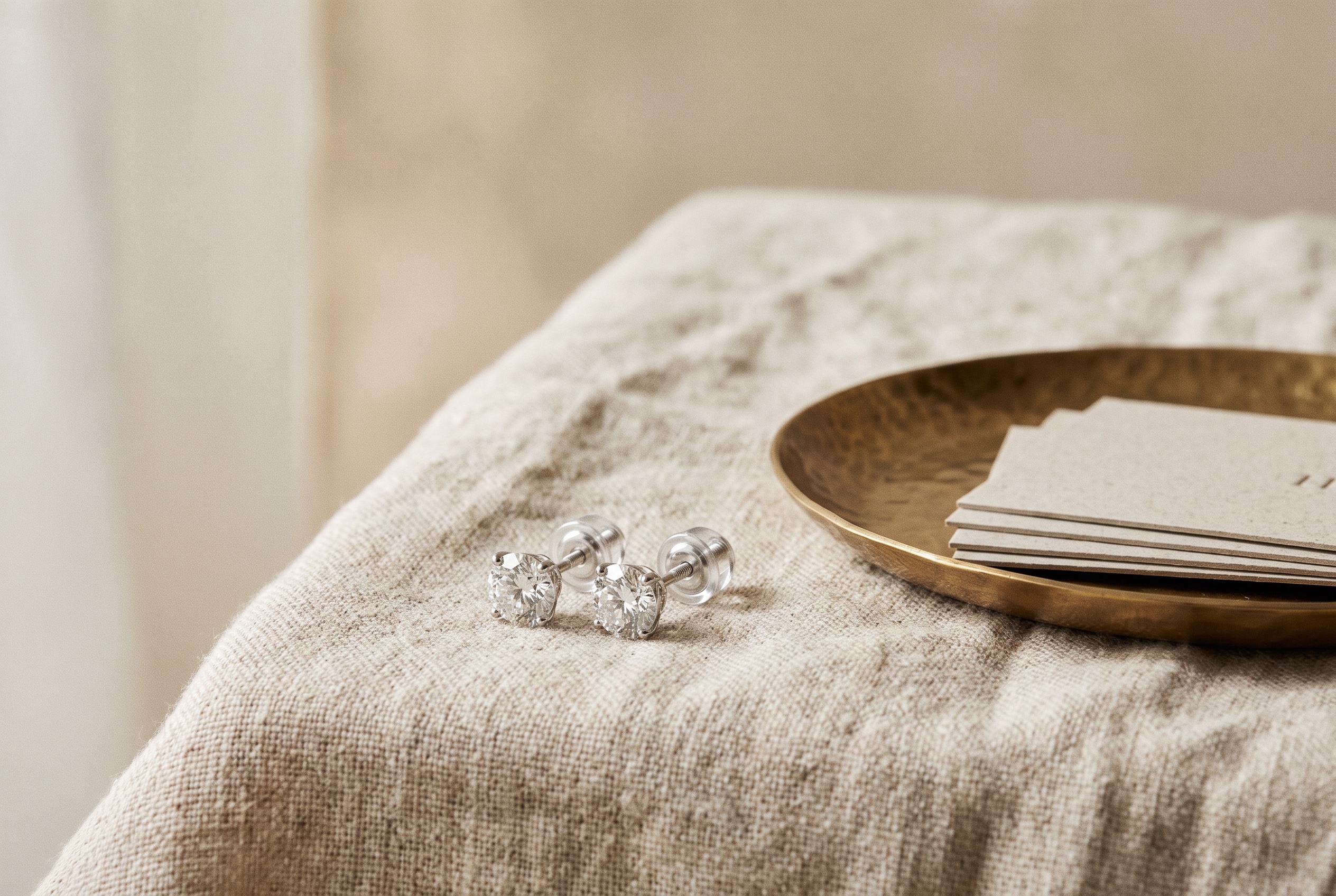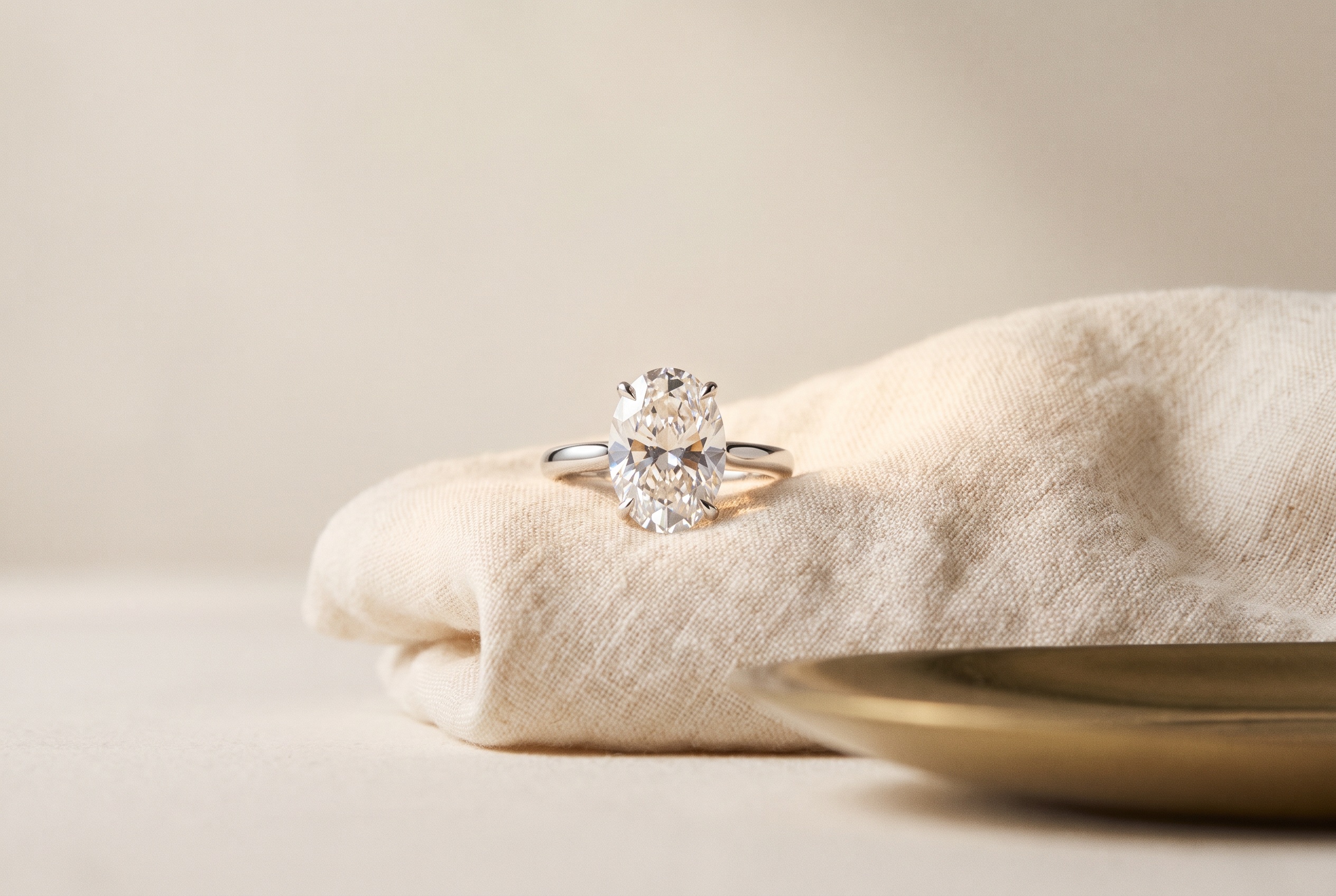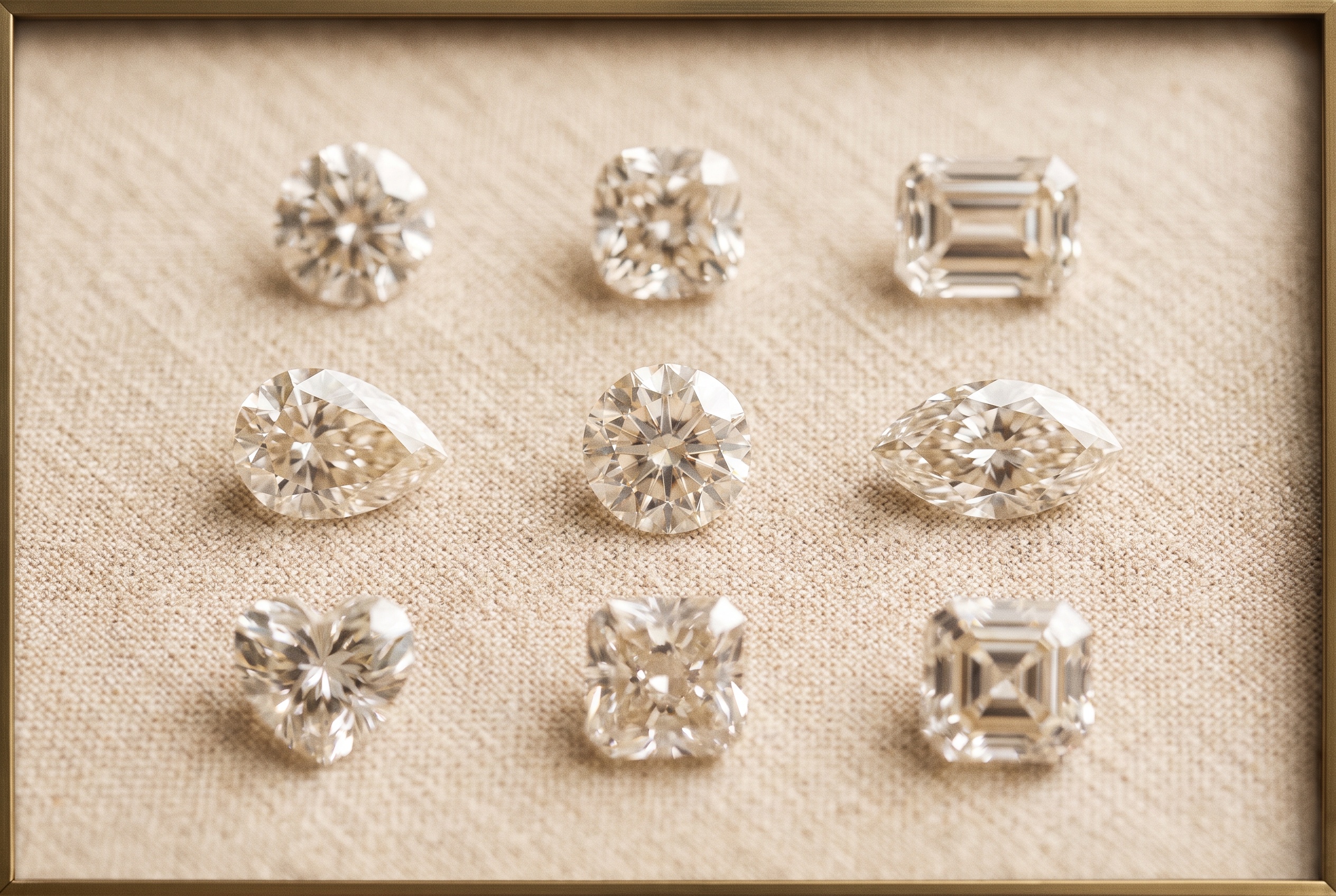

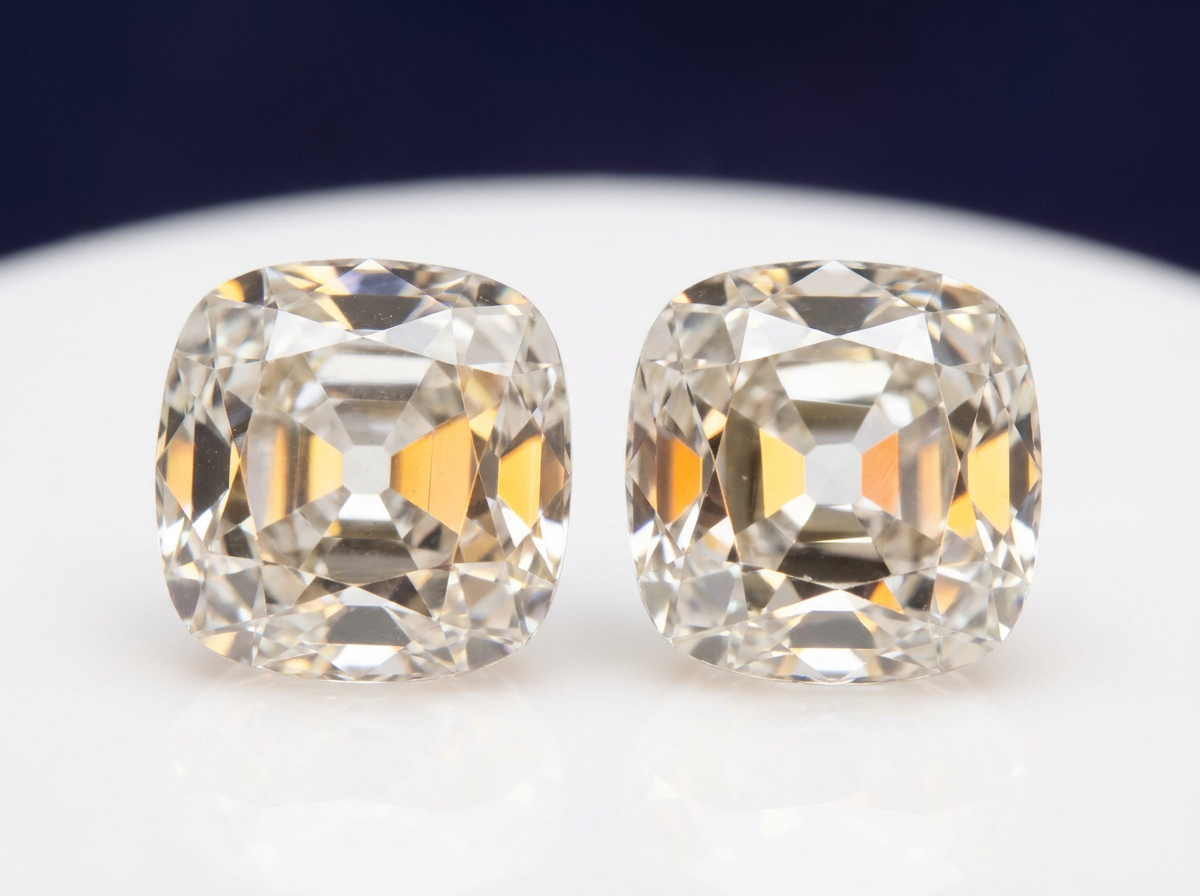
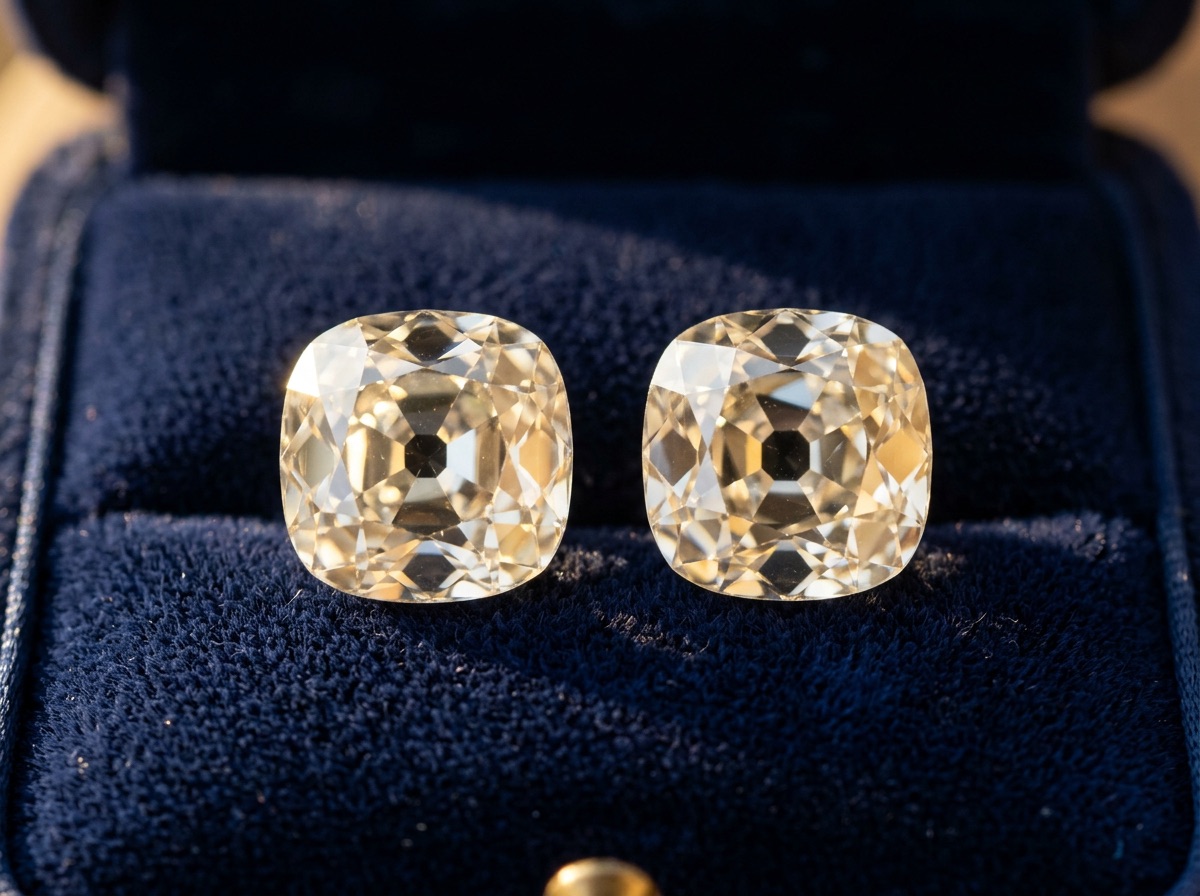
An Old Mine Cut matched pair is two Old Mine diamonds selected and cut to mirror each other — matched in size, outline, crown height, and culet character — for use in stud earrings or as symmetrical side stones. Guru Diam holds 22 Old Mine Cut pairs on hand, CVD lab-grown, IGI-gradable on request.
What is an Old Mine Cut diamond
Old Mine Cut is the antique predecessor to the modern round brilliant: a squarish-cushion outline with rounded corners, a high crown, a small table, and a deep pavilion that ends in a large, often visibly flat culet. It carries the same nominal facet count as a round brilliant — 58 facets, split between crown and pavilion — but the arrangement is chunkier and less uniform, because the cut was faceted by eye and by hand rather than to a fixed mathematical formula. No modern bruting machine or laser-guided faceting rig was involved in the original cutting tradition, and that hand-shaped irregularity is the entire point of the look.
Guru Diam's Old Mine Cut inventory is CVD lab-grown rough, faceted in-house to reproduce that historic proportion set — not reclaimed antique material. That distinction matters for buyers: you're getting the visual signature of the cut (the open culet, the high crown, the soft, broad flashes of light) on new stock, at wholesale terms, without sourcing century-old goods.
The squarish-cushion outline wasn't purely aesthetic — it also retained more weight from the original octahedral rough than a round shape would. Before rough-mapping software existed to plan a cut around maximum brilliance, cutters shaped the stone to follow the crystal's natural form and keep carat weight up, then faceted for broad light return rather than the tight, mathematically tuned scintillation a modern round brilliant is cut to produce. That weight-retention logic is part of why the outline reads squarer and less refined than a round brilliant — it's a byproduct of the priorities the cut was built around, not an error later cuts corrected.
The trade history behind the cut
The name "Old Mine" is a trade distinction, not a marketing term. Before large-scale South African production reached the market in the 1870s, diamond rough came almost entirely from the older mining regions of India and Brazil — the "old mines." Cutters faceted that rough by hand, working candlelight and gaslight performance rather than the electric, track-lit display cases jewelers use today. A cut optimized for flickering, low-intensity light throws big, soft flashes rather than the tight fire-and-scintillation pattern a modern ideal-cut round is engineered to produce. That's a deliberate optical trade-off, not a cutting limitation buyers should read as a flaw.
As bruting technology improved through the late 1800s, the cut evolved into the rounder, higher-crowned Old European Cut, and eventually — once Marcel Tolkowsky published the mathematically optimized proportions for maximum brilliance in 1919 — into the modern round brilliant that now dominates the market. Old Mine Cut sits at the origin point of that lineage, which is why it reads as the most distinctly "antique" of the three to a trained eye: squarer outline, larger culet, and none of the mechanical uniformity that came later.
Wholesale demand for the cut has picked back up in recent years as vintage-inspired bridal work has moved from a niche request to a mainstream one. Independent jewelers are building new engagement rings and stud earrings around antique-style stones rather than only resetting a client's inherited diamond, which is what's pulling Old Mine Cut and Old European Cut back into active wholesale rotation instead of leaving them as a specialty request handled occasionally.
What makes an Old Mine pair different from two Old Mine stones
Buying two Old Mine Cut diamonds and buying an Old Mine Cut pair are not the same order. Because the cut is hand-shaped rather than machine-bruted — see our Old Mine Cut vs Old European Cut guide for the full breakdown of what defines the cut — no two stones come out identical by default. A pair means the two stones have been matched deliberately: same squarish-cushion outline, same crown height, comparable culet size, and consistent color and tone. Put two unmatched Old Mine stones side by side in a stud setting and the asymmetry is obvious the moment they catch light differently.
Why matching matters more on this cut than most
Round brilliants tolerate minor mismatches because the outline and faceting are standardized — a 0.1mm difference barely reads. Old Mine Cut has the opposite problem: its whole appeal is the irregular, hand-cut character, which means the natural variation between any two stones is wider to start with. Matching an Old Mine pair means narrowing that variation back down — pulling from enough on-hand stock to find two stones whose irregularities happen to line up, not just their carat weight.
This is also why Old Mine pairs don't scale the way parcel goods do. A melee parcel is matched to a color/clarity baseline across hundreds of calibrated stones cut to the same spec; an Old Mine pair is two specific stones matched against each other, one at a time, out of whatever happens to be sitting in current inventory. There's no production run to draw a third or fourth matching stone from once a pair is sold — the next pair comes from a different pull of rough entirely.
How Guru Diam sources, cuts, and matches Old Mine pairs in-house
Old Mine Cut is cut and faceted in-house, then matched from current on-hand stock rather than cut to order as a pair from scratch. That sequencing matters: cutting two stones from separate rough with the specific intent of matching them is a low-probability bet, because hand-faceted proportions drift stone to stone even under the same cutter's hand. Pulling a match from a deeper pool of already-cut inventory gives buyers a real, physical pair to evaluate rather than a promise that two independently commissioned stones will land close enough.
The matching process itself is manual: candidate stones are set face-up under consistent lighting and compared directly against each other for outline symmetry, crown height, culet openness, and color/tone — the same way a buyer would evaluate them once mounted. Carat weight is checked last, because two stones can weigh the same and still read as mismatched if the outline or culet character is off, and conversely a slightly graduated pair can read as a cleaner match than two "identical" weights that were never compared side by side.
Depth of on-hand inventory is what makes this workable. A single stone can be pulled and shipped the moment it's ordered; a pair needs enough candidates in the same rough carat-and-color range to actually find a match, which is why Old Mine pair availability tracks total on-hand stock more closely than single-stone availability does. When a specific match can't be pulled from current inventory, the honest answer is that it isn't available yet rather than approximating a pair from whatever happens to be in stock.
Grading and quality considerations for matched pairs
IGI, GIA, and GCAL all grade individual diamonds — none of the three labs issues a certificate for a "pair" as a combined unit. When a matched pair ships certified, each stone carries its own individual report; the match itself is Guru Diam's curation across two separately gradable stones whose parameters line up closely enough to read as a pair once set. Buyers who want both stones on paper should request certification on both at the time of order, not assume a pair automatically comes with matched paperwork.
One trade detail worth knowing: labs generally don't assign an overall Excellent-to-Poor cut grade to Old Mine Cut or other antique fancy cuts the way they do for round brilliants — the cut style is noted, along with measurements and proportions, but there's no single numeric cut score to filter by. That's exactly why hands-on matching matters more than spec-sheet matching for this shape. What actually needs to line up between the two stones: outline shape and corner rounding, crown height, culet size and openness, color grade and face-up warmth, clarity tier, and total depth. Symmetry gets evaluated as a pair — how the two stones sit relative to each other — rather than each stone hitting a perfect symmetry grade on its own, which isn't a standard the cut was ever built around.
Culet character deserves its own callout, because it's usually the single hardest attribute to match and the one buyers are least likely to specify up front. An open, flat culet reads as a visible small facet or window at the base of the stone when viewed face-up; a tighter, near-pointed culet reads almost invisible. Both are correct for the cut — it varies stone to stone — but a pair with mismatched culet openness will show a visible difference in how light exits the bottom of each stone, even when outline and color are matched well. Specify culet character as its own criterion when requesting a pair, not just as a byproduct of matching carat and color.
Pricing factors for Old Mine Cut matched pairs
A handful of variables move price on a matched pair independent of the two stones' individual per-carat value:
| Factor | How it moves price |
|---|---|
| Carat parity | An exact-weight matched pair costs more than a graduated pair — fewer true matches exist at identical weight |
| Color & tone target | Icy-white pairs (for high-contrast blackened-gold or platinum settings) are scarcer in antique-cut stock than warmer tones and price accordingly |
| Clarity tier | Standard VS+ range vs. a buyer-specified higher clarity floor |
| Culet match | Tighter culet-openness tolerance between the two stones narrows the usable pool further |
| Certification | Individually IGI/GIA/GCAL-graded stones cost more than on-hand gradable-on-request stock, since certification adds lab time on both stones |
| Curation itself | The labor of identifying a genuine match from deep inventory is priced into the pair, separate from the stones' raw value |
That last line is the one buyers new to antique cuts tend to miss. On a standardized shape, matching is close to free — any two stones meeting the same 4Cs spec will look alike. On Old Mine Cut, matching is a discrete step that takes time and inventory depth, and it's reflected in the price of the pair, not just the price of the stones.
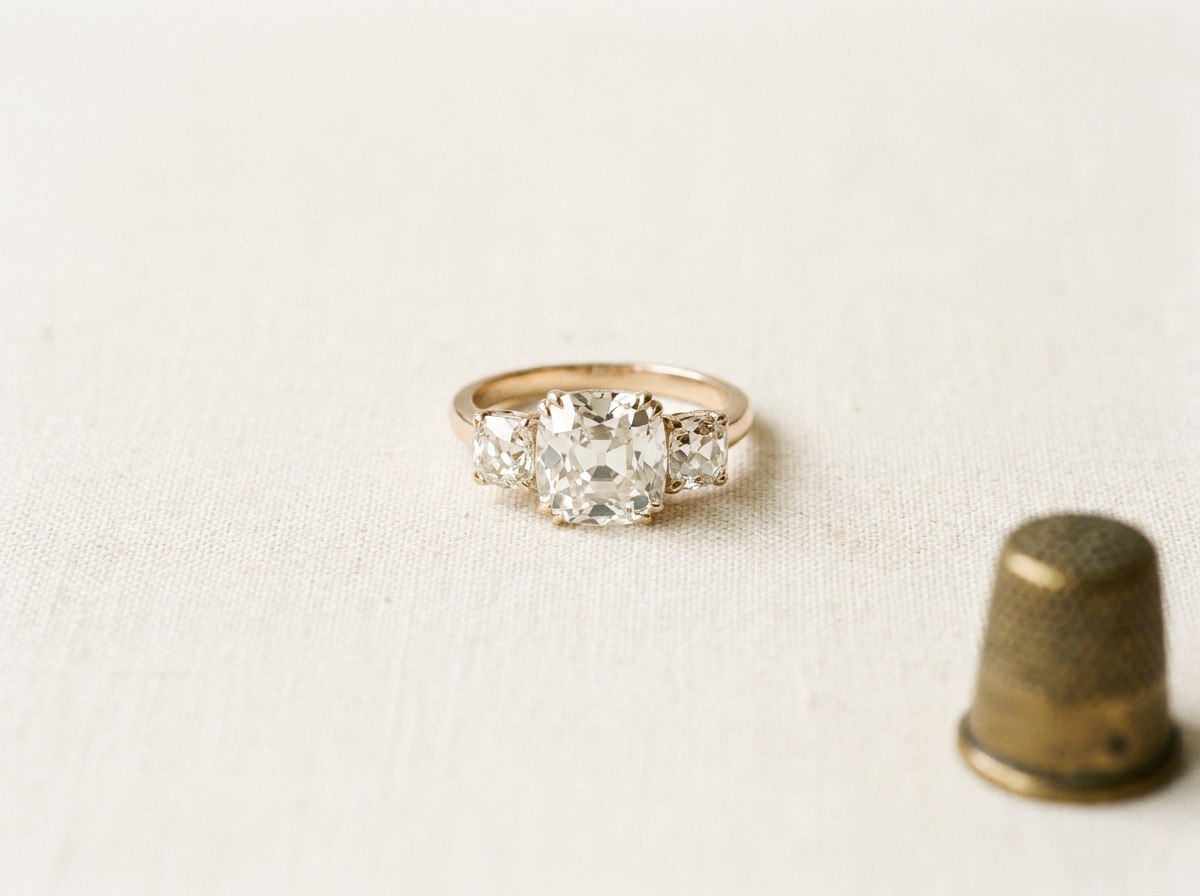
A practical example: a three-stone ring with a 1.50ct certified center stone doesn't need 1.50ct side stones to look balanced — 0.35–0.45ct graduated Old Mine side stones matched to each other in outline and color will typically read cleaner and cost less than forcing an exact-carat match that doesn't serve the design anyway. Specifying the actual end use up front, not just a target carat weight, is usually the fastest way to get a workable price on the pair.
What Old Mine pairs are used for
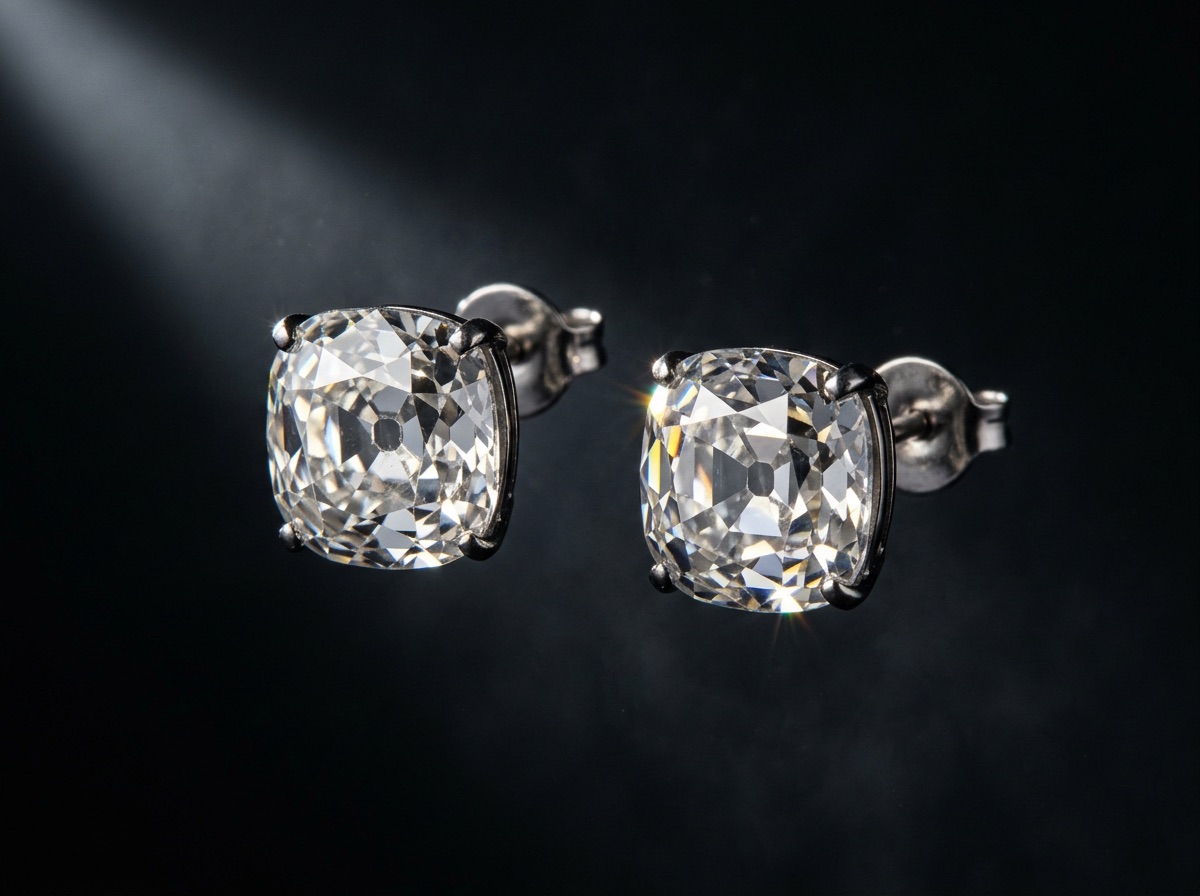
The two standard uses are stud earrings and symmetrical side stones flanking a center stone in a three-stone ring. Both applications put the two stones in direct visual comparison, worn or set close together, which is why matching quality — not just individual stone quality — is what buyers are actually paying for. Beyond those two core uses, jewelers reselling Old Mine pairs are also placing them in:
| Setting | Notes |
|---|---|
| Stud earrings | The most common placement — matched pair worn at identical viewing distance and angle, so any mismatch is immediately visible |
| Three-stone rings | Matched or deliberately graduated side stones flanking a certified center stone |
| Cluster / toi-et-moi settings | Two Old Mine stones set close together as the visual focal point rather than flanking a separate center |
| Blackened-gold mountings | Icy-white Old Mine pairs set high-contrast against matte black-rhodium gold — a current trend in antique-cut resale, favoring maximum contrast over the warmer tones purists sometimes prefer |
| Drop pendants | Matched pair set as a symmetrical double-stone drop rather than a single solitaire |
A less obvious but common use case: heirloom rebuilds, where a jeweler's retail client wants to reset a family stone into a new mounting and needs a matched Old Mine pair to flank it, without sourcing an actual antique stone for the sides. Buying a lab-grown matched pair cut to the same historic proportions solves that without the cost, sourcing risk, or inconsistent quality of hunting down genuine antique material on the secondary market.
What's matched within the pair, specifically:
| Attribute | What's matched |
|---|---|
| Outline | Squarish-cushion shape and corner rounding |
| Crown height | Matched within the pair |
| Culet | Comparable size/openness |
| Color & tone | Matched for consistent warmth under light |
| Carat weight | Matched or graduated, per order spec |
Old Mine Cut vs Old European Cut: what changes when you're buying a pair
The two cuts sit next to each other on the same evolutionary line, and buyers frequently use the names interchangeably — which causes real problems when placing a pair order. Old Mine Cut has a squarer, more visibly "cushioned" outline with rounded corners, a higher crown, and a larger, often flatter culet. Old European Cut came later, as bruting equipment improved: rounder outline closer to a true circle, marginally smaller table, and more consistent facet junctions, since it was cut with better tooling than Old Mine Cut ever had access to. It's the visual midpoint between Old Mine Cut and the modern round brilliant.
For pair-buying specifically, that difference cuts both ways. Old European Cut's rounder, more standardized outline makes matching marginally more forgiving than Old Mine Cut's squarer profile — there's less outline variance to reconcile between two candidate stones. But Old Mine Cut pairs read as more distinctly antique once set, precisely because of the squared corners and the visibly open culet that Old European Cut mostly cut away. Buyers choosing between the two shapes for a pair should decide on the look they want first — soft and rounded versus squared-corner and overtly antique — rather than defaulting to whichever is easier to source. Full cut-by-cut comparison, including facet counts and proportions for both, is in our Old Mine Cut vs Old European Cut guide.
Mislabeling is the practical risk when the two get treated as interchangeable on a wholesale order. A buyer who orders an "antique cut pair" without naming the specific cut can end up with whichever the supplier interprets that to mean, and the two shapes are different enough once set that a client expecting Old Mine Cut's squared, open-culet look won't be satisfied by an Old European Cut substitution, even though both are correctly graded and well matched. Name the cut specifically on every order.
How to order Old Mine Cut matched pairs wholesale
Open a wholesale trade account for live pricing and access to current on-hand matched-pair inventory, browsable under Matching Pair Diamonds. For a specific project, submit a match spec — carat range, color/tone target, culet character, and certification preference — and Guru Diam pulls candidates from current stock rather than approximating from single loose stones. Certification is chosen upfront: IGI, GIA, or GCAL, with each stone in the pair individually reported, or gradable-on-request if a buyer wants to hold cost down on inventory that hasn't been submitted to a lab yet.
Shipping runs out of two offices — New York and Los Angeles — with same-day cutoffs on in-stock orders (NYC before 6pm EST, LA before 4pm PST). Loose matched-pair inventory is on-hand and ready to ship, not made to order. If a buyer wants the pair mounted into finished stud earrings or a three-stone ring rather than shipped loose, that custom build is a separate line item and turns around in 4–6 days.
Buyers placing recurring orders for antique-cut pairs, rather than one-off project requests, can also connect directly to Guru Diam's live inventory feed instead of submitting a spec each time — see Connect Your Inventory for API access to current on-hand stock across matched pairs and the rest of the catalog.
Common mistakes buyers make sourcing Old Mine pairs
A few patterns show up repeatedly with buyers new to antique-cut pairs:
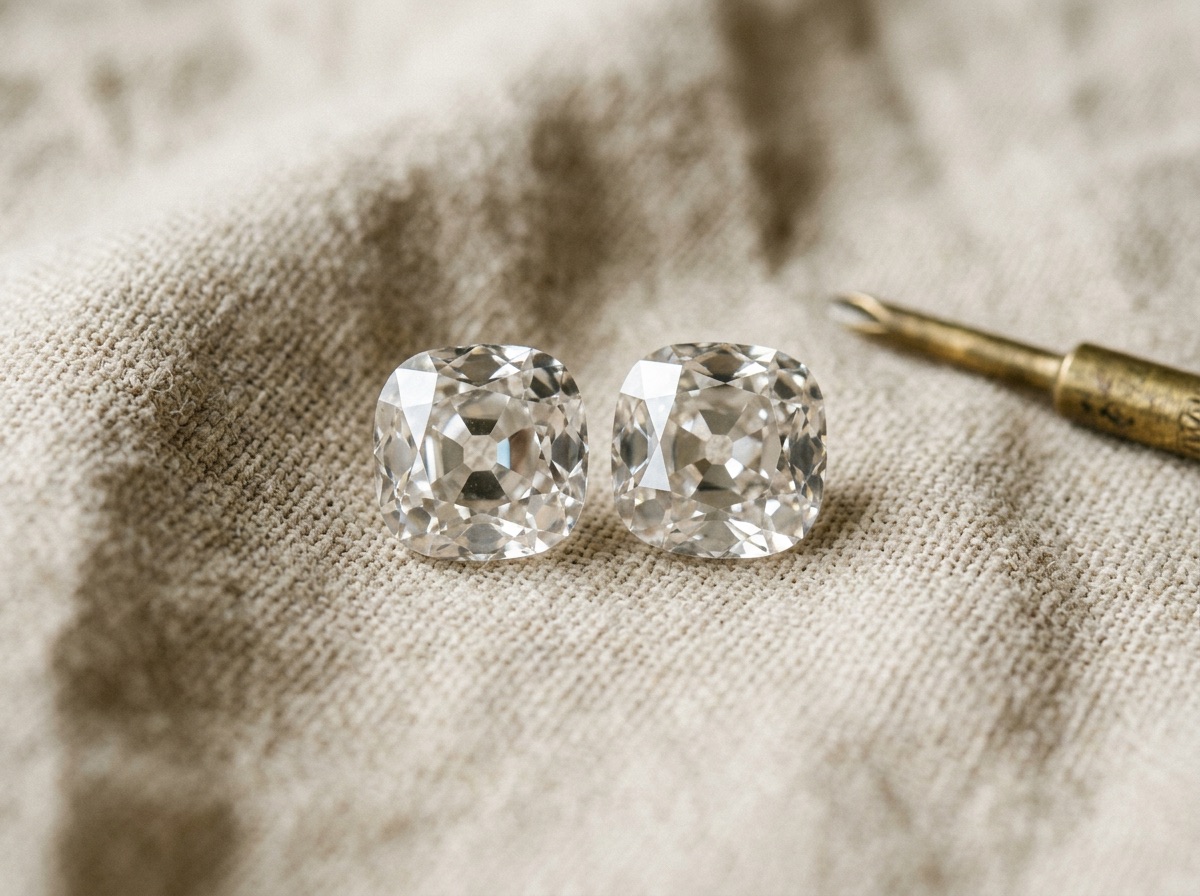
Buying two individually listed stones and assuming they'll match. Two Old Mine Cut diamonds pulled from separate listings, even at the same carat weight and color, were never compared against each other. Matching is a distinct curation step, not a byproduct of both stones sharing a grade.
Specifying carat weight only. Weight parity says nothing about outline, crown height, or culet character — the attributes that actually determine whether a pair reads as matched once set side by side.
Confusing Old Mine Cut with Old European Cut when placing an order. The two are related but visually distinct, and ordering one while expecting the look of the other produces a pair that technically meets the spec but misses the intended aesthetic. Confirm which cut by name and outline before ordering, not by carat and color alone.
Assuming a numeric cut grade exists on the certificate. Labs don't issue an overall Excellent-to-Poor cut grade for antique fancy cuts. Evaluating a pair off the report alone, without a side-by-side physical comparison, misses the thing that actually determines match quality.
Ordering identical sizing when the design calls for graduated stones. Three-stone rings with a substantially larger center stone often look better with side stones sized down proportionally rather than matched to identical carat weight — specify graduated sizing explicitly if that's the intended design, since default matching assumes parity unless told otherwise.
Not specifying culet character as its own requirement. Buyers who list carat, color, and clarity but leave culet openness unspecified often end up with a pair that satisfies every line on the spec sheet and still looks mismatched once set, because culet is the attribute most likely to vary even between two otherwise well-matched stones.
Sourcing a matched pair
Guru Diam pulls Old Mine pairs from current on-hand stock and matches them to spec rather than approximating from single loose stones — CVD lab-grown, IGI-gradable on request, GIA available on request. Open a wholesale account for live pricing and to request a matched pair for a specific project.
Frequently Asked Questions
What is an Old Mine Cut matched pair? Two Old Mine Cut diamonds selected and matched for outline, crown height, culet character, and color/tone — used for stud earrings or symmetrical side stones, where the two stones sit in direct visual comparison.
Why is matching harder for Old Mine Cut than for round brilliants? Old Mine Cut is hand-shaped, not machine-bruted, so individual stones vary more to begin with. A true pair means finding two stones whose irregularities align, which requires deeper on-hand stock than matching a standardized cut.
What is an Old Mine Cut, exactly? See our full Old Mine Cut vs Old European Cut guide for the detailed definition — in short, a squarish-cushion antique cut with a high crown, large open culet, and chunky hand-cut facets.
Are Old Mine Cut pairs certified? They're sold as matched-pair goods, IGI-gradable on request, following the same convention as our other matched-pair inventory. Center stones sold alongside a pair are certified separately.
Can I choose which lab certifies my matched pair? Yes — IGI, GIA, and GCAL are all available on request. Each stone in the pair is submitted and reported individually; labs don't issue a combined certificate for a pair as a set.
What's the difference between a matched pair and a graduated pair? A matched pair is two stones at identical (or near-identical) carat weight. A graduated pair is deliberately sized differently — smaller side stones flanking a larger center stone, for example — while still matched to each other in outline, color, and culet character. Specify which one your design needs when ordering; default matching assumes parity.