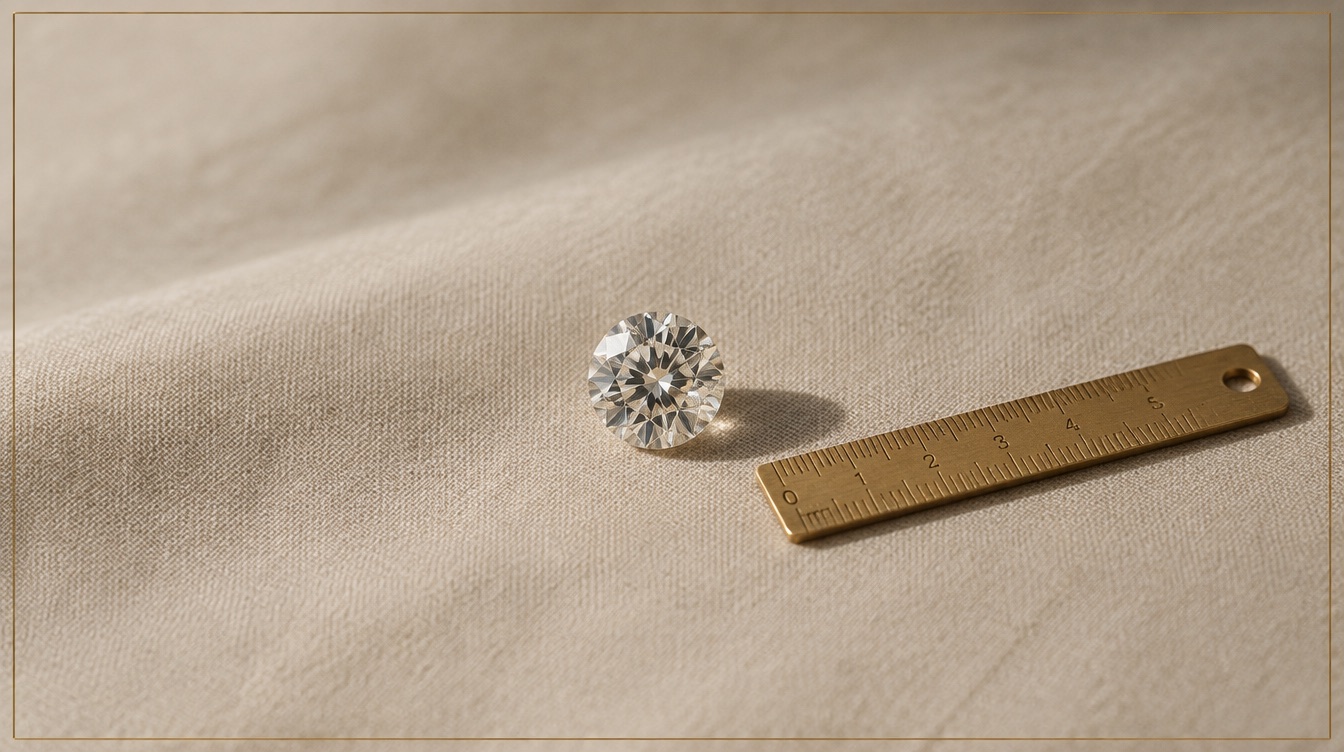
Melee is the fine print of a piece of jewelry — the smallest diamonds in a ring, band, or pendant, and the ones a bench jeweler and a wholesale buyer spend the most time getting right. This guide covers what melee actually means, how it's sized and graded differently from a center stone, how parcel pricing works, and what to check before a parcel goes into production.
What "Melee" Means, and the Size Range It Covers
Melee refers to small accent diamonds — typically under roughly 0.18 ct — used in volume rather than as a single focal stone. They fill pavé fields, ring halos, line side settings, and run the length of eternity bands. A center stone is judged on its own merits: cut, color, clarity, and carat weight all matter individually. Melee is judged differently, because it's set side by side in quantity. A parcel of melee behaves as a single visual field once it's on a finger, so consistency across the whole parcel matters more than any one stone's grade.
Calibrated melee is cut and sorted to a target millimeter diameter within a tight tolerance, and buyers order it by that millimeter measurement rather than by individual carat weight. For round brilliants, weight tracks diameter closely and predictably — a small change in diameter produces a proportionally larger change in weight, since weight scales with volume rather than a single linear dimension. That's part of why the trade orders round melee by mm rather than carat: a setting's seat is cut to a millimeter depth, not a carat number, so the mm figure is what actually determines fit. Fancy shapes are specified differently again — by length × width, because their footprint (not a single diameter) is what determines whether the stone drops cleanly into its seat.
| Diameter (mm) | Approx. Weight (ct) | Typical Use |
|---|---|---|
| 0.80 | 0.0025 | Micro-pavé, fine fill |
| 1.00 | 0.005 | Pavé, accent lines |
| 1.30 | 0.010 | Pavé, halo |
| 1.50 | 0.015 | Halo, side accents |
| 1.80 | 0.025 | Halo, eternity band |
| 2.00 | 0.030 | Eternity band, side stones |
| 2.50 | 0.060 | Larger calibrated goods, side stones |
| 3.00 | 0.100 | Three-stone sides, channel set |
Weights are approximate and vary slightly with cut proportions; specify by mm for setting fit, and confirm the parcel against your seats before it goes to the bench.
The mm-first convention exists because a CAD file or a wax model is built to a millimeter seat, not a carat target — a bench jeweler cutting a bezel or a prong seat is working from a physical measurement, so ordering by the same unit removes a conversion step and the rounding error that comes with it. It also matters more at the small end of the range than the large end: the jump from a 1.00 mm stone to a 1.30 mm stone looks small on paper but roughly doubles the weight, so a size group that's slightly off can throw a graduated halo or a tapered band out of proportion even when every individual stone in the parcel is well within spec. Fancy calibrated shapes carry the same logic one step further — a marquise or a baguette doesn't have a single diameter to anchor to, so length and width are both specified, and both are held to tolerance, so the stone's footprint matches the cut seat in two dimensions instead of one.
In practice, "melee" isn't one product but a spread of size and shape combinations that share a common trait: they're bought and evaluated as a group. A buyer sourcing for a single custom ring and a buyer sourcing for a recurring production run are both working in the same size and shape vocabulary — mm group, shape, color range — even though the volumes and the matching requirements differ sharply between the two.

How Melee Is Graded and Sold Differently From Larger Stones
A loose diamond at 0.30 ct or above is individually graded, and that grading is tied to one physical stone through a lab report. Melee doesn't work that way, and the reason is practical rather than a shortcut: at sub-0.18 ct sizes, grading every stone one at a time simply isn't workable at the volume the trade needs. So melee ships as a sorted parcel evaluated against a quality baseline rather than as a set of individually documented stones — typically a DEF+ color and VS+ clarity floor for white CVD melee, held consistently across the whole parcel rather than certified stone by stone.
That baseline is what a buyer is actually purchasing: a guarantee that every stone in the parcel sits at or above a stated color and clarity floor, sorted and matched for tone, rather than a stack of individual certificates. Melee parcels are gradable through IGI on request, with GIA also available on request, for the cases where a sale needs supporting documentation — a retail counter claim, an insurance appraisal, a client who wants paperwork. Outside of those cases, most melee moves as sorted parcel goods without per-stone certificates, because the stones are too small and too numerous for individual grading to be the norm.
The DEF+/VS+ baseline is a floor, not a fixed ceiling — a buyer who needs a tighter band than the standard baseline, whether that's a narrower color range for a demanding match or a stricter clarity cut for a piece that will be worn under close inspection, can request custom sorting to that spec. The trade-off is the same one that runs through every part of melee sourcing: a tighter, more specific spec takes more of the parcel to sort out, which is exactly why it's specified up front rather than adjusted after the fact.
Melee Grading Tiers and Typical Use Cases
Even without per-stone certificates, melee is organized into working tiers so a buyer can order predictably and a supplier can quote consistently. The tiers below map size range to a quality baseline and the applications each one typically serves.
| Tier | Size Range | Quality Baseline | Typical Use |
|---|---|---|---|
| Micro-pavé | 0.8 – 1.2 mm | DEF+ / VS+ | Fine fill, delicate pavé lines |
| Pavé & Halo Standard | 1.3 – 2.0 mm | DEF+ / VS+, tone-matched | Halos, pavé fields, eternity bands |
| Larger Calibrated Goods | 2.0 – 3.0 mm+ | DEF+ / VS+, tone-matched | Three-stone sides, channel-set shoulders, statement halos |
| Fancy Color Melee | Round & fancy shapes | Yellow, pink, blue, green — tone-held | Color accent work, fancy color halos and pavé |
The tier a piece calls for is set by the design, not the other way around — a fine micro-pavé line and a channel-set shoulder are both "melee," but they draw from different ends of the size range and carry different tolerance expectations. Production runs that repeat a style benefit from staying inside one tier consistently, so a reorder six months later matches the original run rather than drifting into an adjacent size group.
"Tight tolerance" at the calibrated-melee level generally means the parcel is held within a fraction of a millimeter of its stated size, which sounds negligible until it's multiplied across a full pavé field or a graduated halo — a handful of stones running slightly large or small at the edge of the parcel is enough to create a visible step where none should exist. That's the practical reason tier and tolerance are treated as a single spec rather than two separate ones: ordering "1.3 mm, standard tolerance" is really ordering a size and a consistency guarantee at the same time.
How Melee Pricing Works: Parcel Pricing vs. Per-Stone
Center stones and larger loose diamonds are priced individually — cut, color, clarity, and carat weight combine into a specific number tied to one certificate. Melee pricing works on a different axis entirely. Shape, mm size group, and color/quality baseline set a per-carat rate for the parcel, and the total cost is that rate multiplied by the total carat weight ordered — not a count of stones.
This isn't an arbitrary convention. At melee sizes, the cost driver is the total weight cut and sorted to a spec, not any single stone's individual characteristics. A jeweler filling a pavé band cares about covering the seat with enough total carat weight, plus a margin for setting loss, far more than they care about an exact piece count — and a piece count without a size and shape reference doesn't actually tell a supplier what to price anyway. That's also why melee quotes are requested and quoted in carats rather than "pieces": a request specified as round, 1.3 mm, near-colorless, roughly 1.2 ct tells a supplier exactly what to source and price, while a bare stone count leaves the size and shape ambiguous.
For recurring production, pricing a locked mm and color/quality spec at a stable per-carat rate keeps successive reorders predictable — the buyer isn't re-negotiating a new rate every time a parcel is pulled, and the tone band stays consistent run to run.
Per-carat rates also aren't flat across the melee range — shape and size group both move the number. Round melee is the baseline case, since calibrated round production is the most standardized cut in the trade. Fancy calibrated shapes generally carry a premium over round at an equivalent size, because holding a consistent length-to-width ratio and matching cut proportions across a fancy shape parcel takes more sorting than a round parcel does. Smaller size groups can also run higher per carat than larger ones within the same tier, since more individual stones are needed to reach a given carat target, and each one still has to clear the same color, clarity, and cut bar. None of that changes the underlying model — it's still a per-carat rate against a spec — but it's why two melee quotes at the same carat weight can land at different numbers once shape and size are factored in.
Quality Consistency Issues Specific to Melee Sourcing
Set side by side, melee reads as a single field rather than as individual stones — which means the standard that matters most is consistency across the parcel, not the ceiling of any one stone in it. One warmer stone in an otherwise near-colorless row is the flaw a client notices, even if that single stone would grade acceptably on its own. Color sorting has to hold a tight band across the whole parcel, not just an average.
Cut consistency matters just as much as color. Uniform table and crown proportions across the parcel are what make it face up with even brightness once it's set — a few stones cut to slightly different proportions inside an otherwise matched parcel will read as dead spots or hot spots once the piece is finished, and that's much harder to fix after setting than before. Clarity plays a smaller but real role too: inclusions are less visible at melee scale, but a parcel still needs to hold its clarity floor so haze or graininess doesn't show up under bench lighting once stones are massed together.
Fancy color melee carries the same matching discipline with an added dimension: tone has to hold across the run, not just hue. Fancy color melee is cut in-house and sorted specifically to hold tone across a parcel, available in yellow, pink, blue, and green, in both round and fancy shapes — the same "field, not individual stone" logic applies, just with a color band to match instead of a colorless one.
Clarity sorting for melee also has a bench-side dimension that's separate from face-up appearance: certain inclusion types sit closer to the surface than others, and a stone with a surface-reaching inclusion is more likely to chip during setting, regardless of how it grades on paper. A parcel sorted purely to a clarity number without screening for inclusion type and position can still cause setting losses that a tighter grade wouldn't have prevented — which is part of why sorting for melee is treated as its own discipline rather than a smaller version of grading a center stone.
Common Melee Applications: Pavé, Halo, Channel, and Accent Work
Pavé is a continuous field of small stones set close together across a surface — a band, a shank, a cluster top. Because the eye reads pavé as one unbroken sparkle rather than individual points of light, it's the application most sensitive to tone matching; a single inconsistent stone breaks the field.
Halo settings ring a center stone with melee, usually stepping down in size as the ring moves away from the center. Halos typically draw from graduated mm groups rather than a single size, so the accents scale naturally around the center stone rather than reading as one flat band.
Channel-set melee sits in a row between two metal walls with no visible prongs, most often along a band's shoulder. Because the stones drop into a fixed channel width, mm tolerance matters more here than almost anywhere else — a parcel that runs even slightly oversize won't seat cleanly, and undersize stones will rattle.
Accent and side-stone work covers everything else: three-stone shoulders, single trim lines, small cluster accents, and eternity bands running melee the full circumference of a ring. Each of these draws from a different point on the size and tier table above, but all of them share the same underlying requirement — the parcel has to behave as a matched set, not a bag of individually acceptable stones.
Setting style also drives which size group and shape combination gets ordered. Micro-pavé calls for the smallest end of the range because the goal is a dense, low-relief field with minimal metal showing between stones. A statement halo around a larger center stone often steps up to the larger calibrated tier, since bigger accent stones are needed to hold visual weight against a sizeable center. Channel-set shoulders tend to sit in the middle of the range, sized to the width of the shank they're set into. Matching the application to the right tier before ordering avoids the more expensive fix of resorting or re-cutting a parcel that was sized for the wrong setting style.
How to Evaluate a Melee Parcel Before Buying
Start by pulling a representative sample from across the parcel rather than trusting the top layer alone. View the sample loose on white paper under consistent lighting, then again under 10x magnification, checking whether the color spread and clarity floor actually hold across the sample rather than relying on a stated average.
Check cut consistency stone to stone — table and crown proportions and girdle thickness should be uniform, since even small variation causes visible brightness inconsistency once the parcel is set. Verify mm size against a gauge or the actual seat dimension rather than the size label alone; a parcel labeled at one size group can still drift toward the edges of its stated tolerance.
For anything tone-matched, matched-to-a-center-stone, or destined for a larger reorder, request photos or video of the specific parcel before committing rather than a generic stock reference. If a sale needs supporting documentation, confirm IGI or GIA grading availability up front — it's easier to arrange before the parcel is pulled than after.
Order more carat weight than the seat calculation alone suggests. Setting loss is normal — a stone can chip on the bench, a size can run slightly off the moment it's tested against the actual piece, and a small percentage of any parcel typically doesn't make the final cut for a specific run. Building that margin into the order avoids a mid-production scramble for a top-up parcel that has to match a run already underway, which is a harder match to make than sourcing the full quantity at once.

How Guru Diam Sources and Sells Melee
Guru Diam cuts and sorts melee in-house, which is what makes a parcel behave predictably under the bench rather than requiring a buyer to re-check tone and cut consistency on arrival. In-house CVD production keeps standard size groups as on-hand inventory ready to sort, with non-standard calibrations cut to request. Calibrated melee is stocked across 22 shapes — round, princess, marquise, baguette, emerald, oval, and more — sorted to target mm sizes within tight tolerances.
Matched pairs and tone-matched accent runs are sorted to a color range and matched for visual tone so they set as a uniform field, whether that's melee matched to a specific center stone or a tone band held consistently across a multi-piece collection. A typical quote specifies shape, mm size group, color range, and a carat target — for example, round, 1.3 mm, near-colorless, tone-matched, roughly 1.2 ct for a pavé band run. For recurring production, holding the same mm and tone band on hand across reorders keeps successive runs of the same style matching each other.
Guru Diam is a trade-only wholesale lab-grown diamond manufacturer, serving jewelers, designers, and manufacturers from offices in New York's Diamond District and Los Angeles, with certified center stones, calibrated melee, matched pairs, antique cuts including old mine and old European, and fancy colors available under one relationship.
Because sorting happens in-house rather than through a chain of outside suppliers, a buyer working on a matched-pair request or a tone-matched collection run deals with one point of contact for both the center stones and the accent melee around them — useful for designers building a full piece where the center and the accents need to read as one cohesive stone family rather than two separately sourced components.

Buying Checklist for Melee Wholesale
- Shape and mm size group (or length × width for fancy shapes), set by the seat dimension
- Color range and tone band required for the piece or collection
- Quality baseline needed (for example, DEF+/VS+) or a custom spec
- Total carat weight target, with margin added for setting loss and breakage
- Matching requirement — matched to a specific center stone, or held to a consistent tone band across a multi-piece run
- Certification needs: sorted parcel by default, IGI or GIA gradable on request when documentation is required
- For recurring styles, a locked mm and tone spec so future reorders match the original run
- A pulled sample reviewed before committing to the full parcel, especially for tone-matched or larger carat orders
Frequently Asked Questions
What size range counts as melee?
Melee generally refers to accent diamonds under about 0.18 ct, spanning fine micro-pavé sizes near 0.8 mm up through larger calibrated goods around 2.5–3.0 mm.
How do I order melee by size?
Order by shape and millimeter size group rather than by individual carat weight, since the mm diameter (or length × width for fancy shapes) determines the seat the stone drops into. A request specified as round, 1.3 mm, near-colorless, tone-matched, roughly 1.2 ct for a pavé band run gives a supplier everything needed to price and pull the parcel.
Is lab-grown melee available calibrated across many shapes?
Yes. Calibrated melee is stocked across 22 shapes, including round, princess, marquise, baguette, emerald, oval, and more, sorted to target mm sizes with tight tolerances.
Can I get matched pairs and tone-matched accents?
Yes. Matched pairs and tone-matched accent runs are available, sorted to a color range and matched for visual tone so they set as a uniform field, whether matched to a center stone or held consistently across a collection.
Can melee be certified?
Melee ships as sorted parcel goods against a color and clarity baseline rather than as individually or parcel-certified stones, because the stones are too small and too numerous to grade one at a time. Melee is IGI-gradable on request, with GIA available on request, when a sale needs supporting documentation.
Does Guru Diam sell melee to the trade only?
Yes. Guru Diam is a trade-only wholesale lab-grown diamond manufacturer serving jewelers, designers, and retailers, with offices in New York's Diamond District and Los Angeles.
Related Articles
- Lozenge Diamonds Wholesale Guide
- Fancy Color Heart Diamonds Wholesale
- Matched Pair Step Cut Diamonds Wholesale