
An in-house bench only pencils out once you have enough steady custom and repair volume to keep a jeweler and their equipment productive most weeks — because the cost of a bench is fixed whether or not work comes through the door. Outsourcing is the opposite: the cost is variable, tied to what you actually order, with no equipment to buy and no payroll to carry through a slow month. Most independent jewelers and smaller retailers are better served by outsourcing custom fabrication and limiting any in-house capability to repairs and sizing — the hybrid model most shops land on once they've run the numbers. Below is the real cost structure behind both, where the breakeven tends to sit, and how to think about the hybrid setup.
Why This Is a Cost-Structure Question, Not a Quality Question
Retailers often frame this decision as "can an outside manufacturer do the work as well as my own bench," which isn't really the right question once a manufacturing partner is doing cutting, setting, and polishing in-house under one roof. The question that actually determines your margin is more basic: is your cost fixed or variable, and does your order volume justify carrying a fixed cost every month regardless of whether it's a busy one?
A bench jeweler's paycheck doesn't shrink because a slow month came through with fewer custom orders. A casting machine still depreciates sitting idle. An outsourced manufacturing fee, by contrast, only shows up when you place an order — there's no cost sitting on your books between jobs. That difference in cost behavior, not craftsmanship, is what should drive the decision.
The confusion usually starts because retailers compare a single order's price tag against what they imagine a bench jeweler "should" cost per piece, without accounting for every week that jeweler is paid to sit between orders. The same fixed cost divided across a small, unpredictable number of pieces produces a very different per-piece number than divided across a steady, high volume — and most independent retailers are closer to the first case.
The Real Fixed Costs of an In-House Bench
An in-house bench carries costs that exist whether you produce one custom piece a month or twenty.
Equipment
A functioning bench setup for casting, setting, and finishing typically includes a casting unit, a laser welder, polishing and finishing equipment, an ultrasonic or steam cleaner, engraving capability, and the ventilation and safety infrastructure that goes with it. A basic vacuum or centrifugal casting unit alone commonly runs $3,000–$10,000, a laser welder capable of fine repair and setting work typically starts around $8,000 and climbs past $20,000 for higher-output machines, and polishing motors, dust collection, an ultrasonic/steam combo, and an engraver add several thousand more. A complete new-equipment build-out for a single bench station commonly lands between $20,000 and $50,000 before a single order has been produced — plus the room, ventilation, and electrical a casting station requires. That's capital outlay up front, plus an ongoing maintenance and replacement cycle that doesn't care how many orders run through it in a given quarter.
Bench Jeweler Labor
A skilled bench jeweler capable of custom fabrication and stone setting commands a salary or wage plus benefits and payroll tax, and that cost is identical in a month with steady custom orders and a month with almost none. Base wages for real custom-fabrication and setting skill — not just repair-level competence — typically run $45,000–$85,000 depending on market and experience. Add payroll tax, health benefits, and any bonus structure, and the fully loaded cost usually runs 20–30% above base — a $60,000 salary is closer to $75,000 in true carrying cost. This is the single biggest fixed-cost line item in the in-house model, and the one retailers most consistently underestimate: they price the jeweler's time against expected orders rather than the orders that actually land.
Skill Risk
Custom fabrication and stone setting — especially less common shapes or hand-finished work — sit on a real skill ceiling. If your one bench jeweler leaves, gets sick for an extended stretch, or can't keep pace with a busy season, you don't have a bench anymore; you have idle equipment and a hiring-and-training cycle ahead of you. A single-person bench is a single point of failure, and vetting a replacement capable of handling less common cuts or fancy color stones can take months, all while rent, tools, and support staff keep running.
Idle Capacity
This is the cost that never shows up on a spreadsheet until you go looking for it. Custom order volume for most independent retailers is lumpy — a strong week can be followed by two quiet ones — but the bench and the jeweler's salary don't flex down during the quiet weeks. A bench producing eight pieces in a strong month and two in a slow one isn't earning a blended average; the annual total is what actually determines whether the bench was worth running.
What a Full Bench Buildout Actually Costs, Line by Line
Consumables and Maintenance Retailers Forget to Budget
Beyond the equipment purchase, a running bench consumes casting investment powder, flasks, polishing compounds, replacement burs, torch gas, and periodic servicing. None of this is dramatic alone, but it typically adds $3,000–$6,000 a year for a single-station bench — a cost that doesn't scale down in a slow quarter.
Insurance, Compliance, and Floor Space
A working bench also changes what your insurance needs to cover — jewelers block policies and workers' compensation price differently once you're doing in-house fabrication, and open-flame, casting, and metal-finishing work often calls for updated coverage and, in many jurisdictions, permitting. A bench also needs dedicated, ventilated, securable square footage — space that could otherwise be selling floor or inventory storage.
Putting a Number on Total Annual Fixed Cost
Add a fully loaded bench jeweler (roughly $65,000–$80,000), equipment amortized over five years (roughly $4,000–$10,000 a year), and consumables, insurance, and facility overhead (another $5,000–$8,000), and a single-bench operation commonly carries $75,000–$100,000 a year in fixed cost before a single piece's metal or stones are paid for. That number doesn't change whether the bench produces 30 pieces that year or 300 — the math the worked example below walks through.
The Variable Cost Structure of Outsourcing
Outsourcing custom fabrication to a manufacturing partner flips this cost structure entirely.
- No equipment purchase or maintenance cycle — casting, setting, and finishing equipment belong to the manufacturing partner, not your balance sheet.
- No fixed payroll for bench skill — you pay per order, not per pay period, so a slow month costs you close to nothing on the manufacturing side.
- No single point of failure — a manufacturing partner isn't one person; losing an individual jeweler on their end doesn't stall your pipeline.
- Scales cleanly with demand — ten custom orders cost roughly ten times what one order costs; there's no fixed cost to spread thinner or thicker depending on volume.
- Trade-off: less direct control over the queue — you're working within your manufacturing partner's production schedule rather than checking on a piece yourself, so a reliable partner relationship matters more here than it does with a bench you supervise directly.
That trade-off is the same one you already accept for every other input you don't produce in-house — the diamonds, the raw metal, the packaging. Outsourcing doesn't mean losing quality control; it means quality control happens through a defined process rather than by standing at the bench.
What's Actually Bundled Into a Manufacturing Fee
A per-piece manufacturing fee isn't just casting labor — it typically bundles CAD design, casting, stone setting, polishing, and quality control into one line item, plus access to a manufacturing partner's own stone inventory (including certified stones across IGI, GIA, and GCAL) for shapes the retailer would otherwise have to source themselves. Many partners also deliver pieces unbranded, so the retailer sells under their own name — capturing the customer relationship and the margin while the manufacturing partner stays invisible in the transaction.
Where the Volume Threshold Sits
The honest answer is that the threshold isn't a specific number of pieces — it's the point where your bench is busy often enough that idle capacity stops being the dominant cost. Once a bench runs near full utilization, fixed costs spread across enough finished pieces that the effective cost per piece can undercut a manufacturing partner's charge on the same job. Below that point, every idle week inflates your true per-piece cost even though it never appears as its own line item.
Run the arithmetic and the threshold usually lands higher than retailers expect. If a single-bench operation carries roughly $85,000 a year in fixed cost and a manufacturing partner's typical per-piece fee runs in the low hundreds of dollars, the bench doesn't break even until it's producing somewhere in the 150–250 piece-a-year range — three to five custom pieces every single week, all year, without a slow season. Very few independent retailers hit that volume consistently; most see custom demand cluster around engagement season and slow through the rest of the year.
| Factor | In-house bench favored | Outsourcing favored |
|---|---|---|
| Custom order volume | Steady and high enough to keep the bench near capacity most weeks | Sporadic, seasonal, or growing but not yet predictable |
| Cash available for capital equipment | Comfortable making the equipment investment upfront | Prefer to keep cash working in inventory or marketing instead |
| Staffing situation | Already have (or can reliably retain) a skilled bench jeweler | Don't want single-person key-person risk |
| Stone/shape complexity | Mostly standard commodity-tier builds your bench already handles well | Frequent requests for less common cuts, fancy color stones, or CAD-heavy builds |
| Rush and specialty work | Comfortable managing your own queue and timelines | Prefer a manufacturing partner with a defined turnaround already built into the process |
If your honest answer to "how many weeks this year was the bench idle" is "more than I'd like," that's the tell your current volume doesn't yet support the fixed-cost model — a reason to keep outsourcing until volume catches up, not a reason to buy more equipment.
A Worked Example: Two Shops, One Year
Two hypothetical, similarly sized retailers illustrate how this plays out over a full year. The figures below are illustrative round numbers, not a quote for any specific shop — actual wages, equipment, and fees vary by market.
Shop A Runs Its Own Bench
Shop A hires a bench jeweler at a fully loaded cost of roughly $75,000 a year, has a $30,000 equipment build-out amortized over five years (about $6,000 a year), and carries another $6,000 a year in consumables, insurance, and facility overhead — call it $87,000 in annual fixed cost. Over the year, Shop A produces 80 custom pieces, a healthy but not maxed-out pace of roughly 1.5 pieces a week. Dividing fixed cost across those pieces puts the manufacturing-labor portion of each piece at just under $1,090, before metal or stones.
Shop B Outsources the Same Volume
Shop B produces the same 80 pieces through a manufacturing partner at an illustrative average fabrication fee of $350 a piece, covering CAD, casting, setting, and finishing — $28,000 for the year, again before metal and stone cost. At this volume, Shop B's manufacturing-labor cost per piece runs roughly a third of Shop A's, and never carried the risk of an idle bench, a jeweler leaving mid-season, or capital tied up in equipment.
Where the Numbers Cross
Using these figures, Shop A's fixed cost only starts beating Shop B's variable cost once annual volume climbs into the 240–250-piece range — roughly five pieces a week, every week, no slow season. Below that, every idle week widens the gap in the outsourced model's favor. It's worth re-running this math with your own actual wage, equipment, and fee numbers before committing to a buildout.
Opportunity Cost: What Else That Capital and Time Could Do
The comparison above still understates the in-house model's full cost, because it only counts what a bench spends — not what else that money and time could earn instead.
Capital Tied Up in Equipment vs. Working Capital
A $20,000–$50,000 equipment build-out is capital that isn't buying inventory, funding marketing, or covering a bulk-purchase discount on stones or mountings. Inventory turns and earns margin each turn; a casting machine doesn't turn at all — it just depreciates, used or not.
Owner and Staff Time Spent Managing a Bench
Running a bench in-house also means managing it — scheduling the queue, sourcing consumables, handling repairs, covering the gap when the one skilled hire is out sick. That's owner or manager time that doesn't go toward sales floor coverage or growing the business, and it never shows up on an income statement even though it's real.
The Trade Skill Shortage Makes This Worse, Not Better
Finding and retaining a bench jeweler skilled enough for complex work — antique-style settings, fancy color stones, less common cuts — has only gotten harder as fewer people enter the trade through traditional apprenticeship routes. Every month spent recruiting a replacement is a month of fixed cost with reduced output.
The Hybrid Model Most Shops Actually Run
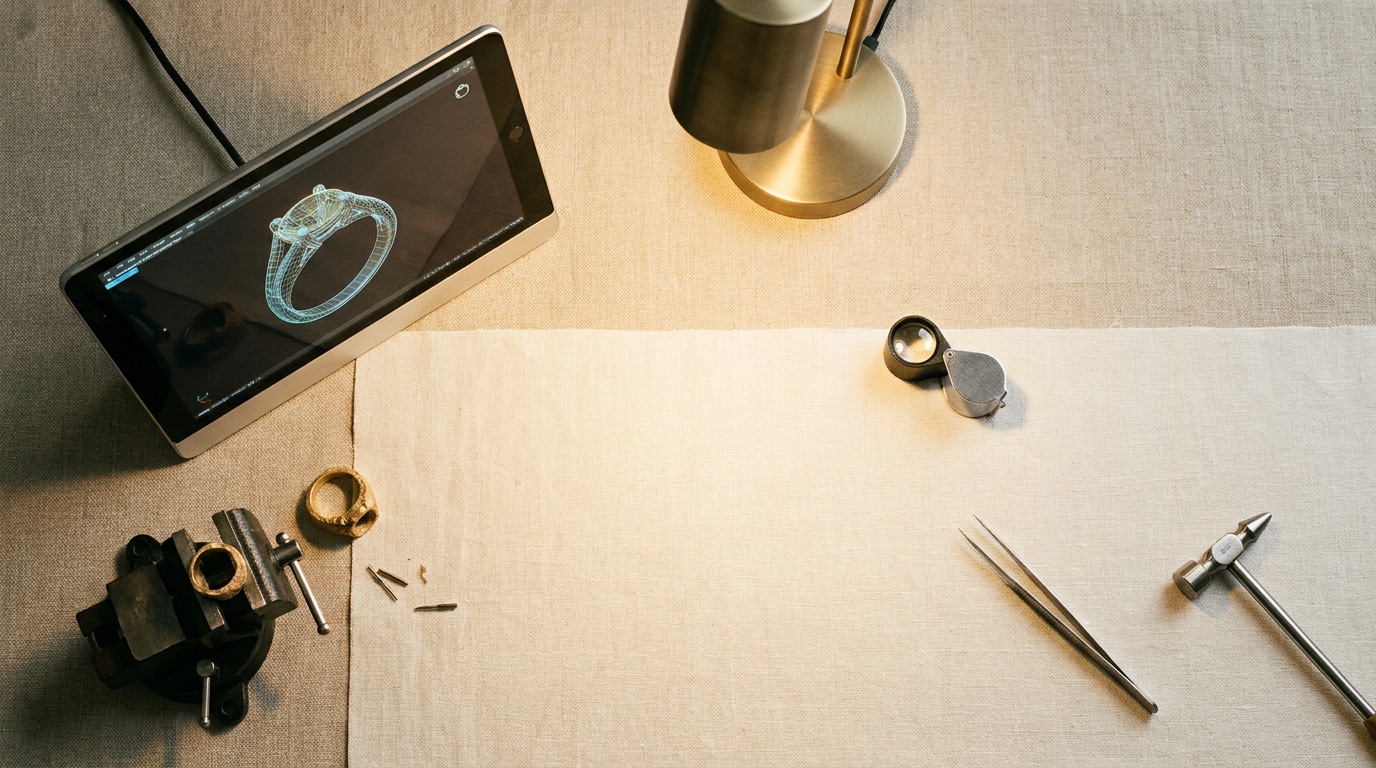
In practice, very few retailers run a pure version of either model. The setup that shows up most often, and tends to hold up best financially, splits the work by type:
Repairs, sizing, and prong retipping stay in-house. This is walk-in, immediate, customer-facing work that keeps a bench busy on the weeks custom orders are slow, and customers generally expect same-visit or same-week turnaround on it — which an outsourced partner isn't built for.
Custom fabrication gets outsourced, particularly anything that involves CAD design, less commonly stocked stone shapes, or fancy color diamonds, since a manufacturing partner that already runs CAD infrastructure and carries broader stone inventory doesn't require you to build that capability in-house just to fill occasional requests.
This split lets the in-house bench earn its keep on what it's genuinely suited for — fast, in-person repair work — while routing higher-complexity, lower-frequency custom builds to a partner already set up to absorb that variability. It also means a run of complex custom requests doesn't force a sudden capital decision — the outsourced side simply flexes to absorb the overflow.
The turnaround gap between the two models makes the split easier to defend to customers, too. A fully custom piece built through a traditional bench-and-vendor chain commonly takes two to six weeks, while a manufacturing partner running a defined, dedicated process can compress that to a matter of days from CAD approval to finished piece — a difference customers notice regardless of which side of the counter did the work.
Illustrative Cost Comparison
The table below is a simplified, illustrative comparison of cost behavior, not a quote for your shop — actual equipment, wage, and manufacturing costs vary by market.
| Cost category | In-house bench (fixed) | Outsourced (variable) |
|---|---|---|
| Equipment | One-time capital cost, plus ongoing maintenance/replacement | None |
| Labor | Full salary/wage + benefits, incurred every pay period | None — paid per order only |
| Cost during a slow month | Same as a busy month | Near zero |
| Cost during a high-volume month | Same as a slow month (bench is already at its cost ceiling) | Scales up directly with orders placed |
| Key risk | Idle capacity and single-jeweler skill risk | Dependence on partner's queue and lead times |
The takeaway isn't that one column is universally "cheaper" — the in-house column is a flat line regardless of volume, and the outsourced column tracks your actual orders. Below a certain steady volume, that flat line sitting above the variable one is money spent on unused capacity; above it, the flat line eventually wins because the fixed cost is spread across enough pieces to beat the per-piece outsourcing fee.
Signs You've Outgrown Outsourcing
The math above favors outsourcing for most independent retailers, but it isn't permanent — growth can shift which side of the breakeven line a shop sits on. A few signals suggest it's worth re-running the numbers.
Custom Volume Has Become the Predictable Baseline, Not the Exception
If custom orders have moved from an occasional add-on to a steady, weekly baseline — held for a year or more, not just one strong season — the fixed-cost math starts working in the bench's favor.
You're Opening a Second Location or Centralizing Production
A retailer scaling to multiple storefronts changes the equation: one in-house bench can potentially serve more than one location's custom volume, spreading the same fixed cost across a larger combined order base.
Margin Capture Matters More Than Flexibility Right Now
Outsourcing trades some margin for flexibility and reduced risk. A retailer with strong, consistent volume and cash reserves to weather a slow stretch may find owning fabrication captures more margin than the flexibility is worth.
None of these signals mean the hybrid model stops making sense — even high-volume shops typically keep some fabrication outsourced for antique cuts or CAD-heavy builds outside a bench's core competency. They just mean it's worth re-running the worked-example math with your current volume, not the volume that justified outsourcing a year or two ago.

Decision Checklist
Before committing capital to a bench buildout, or before deciding you're ready to bring custom fabrication in-house, work through this list honestly:
- Do you have steady custom order volume most weeks, or is it a handful of busy stretches surrounded by quiet ones?
- Could your current bench jeweler leave tomorrow, and would that stall your business — or do you have real backup?
- Are you regularly turning down or outsourcing requests for antique-tier cuts, fancy color stones, or CAD-heavy builds that your current bench isn't set up to handle?
- Would the cash tied up in equipment be better used growing inventory, marketing, or working capital right now?
- Is your walk-in repair and sizing business consistent enough on its own to justify keeping a bench busy, independent of custom order flow?
- Have you actually run your own numbers — fully loaded labor, amortized equipment, and consumables — against your real annual piece count, rather than relying on a rule of thumb?
If most of your answers point toward "inconsistent" or "not yet," outsourcing — or the hybrid split above — is the lower-risk starting point. The wholesale hub is a reasonable place to see what a manufacturing partner's standard process and catalog actually look like before you commit either way.
Frequently Asked Questions
At what order volume does an in-house bench actually make financial sense?
There's no fixed number that applies to every shop, because it depends on your local wage costs, equipment prices, and how steady your custom order flow is. The real marker is utilization: once your bench is busy near capacity most weeks rather than sitting idle between orders, the fixed costs of equipment and labor get spread across enough pieces that the effective cost per piece can beat what an outside manufacturing partner charges. Below that utilization point, idle capacity is quietly inflating your true cost even though it never appears as its own line item.
Isn't it cheaper long-term to build my own bench instead of paying a manufacturer every time?
Only if your volume is high and steady enough to keep that bench near capacity. If custom order volume is sporadic, you're paying full fixed costs — equipment, salary, benefits — during every quiet stretch, which is exactly the cost outsourcing avoids. "Cheaper long-term" only holds once utilization is high enough that the fixed cost gets spread thin across enough finished pieces.
What's the biggest hidden cost retailers miss when they compare the two models?
Idle capacity. A bench jeweler's salary and the equipment's depreciation don't pause during a slow month, but that cost rarely gets tracked against the pieces that didn't get produced that month. Retailers running their own bench often benchmark their per-piece cost against a busy month rather than an average month, which understates the true fixed cost they're carrying.
Does outsourcing mean giving up quality control?
No — it means quality control happens through your manufacturing partner's defined process rather than by supervising a bench yourself. A partner handling cutting, setting, and polishing in-house under one process gives you a single point of accountability for quality, the same way your own bench would, without you carrying the equipment and staffing cost.
Should repairs and custom fabrication be handled the same way?
Not usually. Repairs, sizing, and prong retipping are immediate, walk-in, customer-facing work that benefits from being handled on-site, and that steady flow is often what justifies keeping any bench capability in-house at all. Custom fabrication — especially CAD-driven builds, less common stone shapes, or fancy color diamonds — is lower-frequency and higher-complexity, which is exactly the kind of work that outsources well without requiring you to staff and equip for it year-round.
How does turnaround time compare between an in-house bench and an outsourced partner?
An in-house bench's turnaround depends entirely on your own jeweler's queue and availability, which can slip during a busy stretch or a staffing gap. An outsourced manufacturing partner running a defined process can offer a predictable turnaround for finished custom work — for example, a 4-6 day window from CAD approval to finished piece — because that timeline is built into a repeatable production process rather than dependent on one person's calendar.