IGI and GIA both certify lab-grown diamonds, grading the same 4Cs of color, clarity, cut, and carat and disclosing that each stone is laboratory-grown. IGI issues the majority of lab-grown reports and functions as the trade standard for loose inventory, while GIA reports are available on request. For wholesale buyers, the report confirms the grading and documents the stone as lab-grown for resale paperwork, insurance, and downstream consumer disclosure.
What are IGI and GIA, and how do they differ as institutions?
IGI and GIA are separate organizations with different histories, structures, and starting points — differences that show up in how each one built its lab-grown grading operation, even though the grading fundamentals now overlap closely.
GIA, the Gemological Institute of America, is a nonprofit research and education institute founded in 1931. It is credited with developing the 4Cs framework and the D-to-Z color scale that the wider trade — natural and lab-grown alike — still grades against today. For decades GIA's core business was natural-diamond grading, and it extended that same grading infrastructure to lab-grown stones as the category grew, applying largely the same scales and report format with a lab-grown disclosure layered on top.
IGI, the International Gemological Institute, is a for-profit commercial grading lab founded in 1975 and headquartered in Antwerp, with grading locations operating worldwide. IGI moved into lab-grown diamond grading earlier and more aggressively than GIA did, building dedicated capacity for the category as it scaled. That head start is the structural reason IGI now issues the majority of lab-grown loose-stone reports in the wholesale trade.
Neither institution's business model changes what gets measured on a lab-grown report — both apply the same 4Cs and disclosure standard. What differs is scale of operation, how quickly each lab could expand lab-grown-specific capacity, and which one the loose-goods trade standardized around as a result. For a wholesale buyer, that institutional history mostly matters as context for why IGI dominates the loose-inventory side of the market, covered in more detail below.

What does each lab actually grade on a lab-grown diamond?
Both IGI and GIA grade the same fundamentals: color, clarity, cut, carat weight, polish, symmetry, fluorescence, measurements, and a plotted or described inclusion picture. Both also state clearly that the stone is laboratory-grown and identify the growth method where applicable. The grading vocabulary is shared across the trade, so a D-color VVS1 means the same thing on either report.
The practical differences are in scale presentation and report format rather than in what gets measured. Both labs assess cut on round brilliants and assign the familiar D-to-Z color and Flawless-to-Included clarity ranges. Every Guru Diam stone ships with an IGI report covering exactly these data points, with GIA available on request for buyers whose end clients prefer it. Melee is IGI-gradable as well, so smaller calibrated goods carry documentation rather than going out unpapered.
Where the two labs diverge more noticeably is report format and shape-specific terminology, not the underlying 4Cs. GIA issues a formal Cut grade (Excellent through Poor) only for round brilliants; on fancy shapes like cushion, oval, or emerald cut, GIA's report omits a Cut grade and lists proportions and finish instead. IGI assigns a cut assessment more broadly across fancy shapes, which matters for a buyer stocking mixed-shape inventory rather than round-only goods. Fluorescence, polish, and symmetry use the same descriptive tiers on both reports — None through Very Strong for fluorescence, Excellent through Poor for polish and symmetry — so those terms translate directly between labs. Report naming differs slightly too: IGI's lab-grown paperwork is titled a Laboratory Grown Diamond Report, while GIA's is a Laboratory-Grown Diamond Grading Report; both function the same way on a resale desk.
IGI vs GIA for lab-grown diamonds: how do they compare?
Here is the side-by-side most trade buyers want. The short version: the grading content overlaps heavily, but IGI carries the larger share of lab-grown loose-inventory reports, which is why it has become the working standard for sourcing.
| Factor | IGI | GIA |
|---|---|---|
| What it grades | Color, clarity, cut, carat, polish, symmetry, fluorescence, measurements; identifies stone as lab-grown | Color, clarity, cut, carat, polish, symmetry, fluorescence, measurements; identifies stone as lab-grown |
| Lab-grown report style | Full lab-grown report with the standard 4Cs and grading scales; widely used for loose inventory | Lab-grown diamond report covering the same 4Cs and grading scales; consistent with its established format |
| Trade prevalence (lab-grown loose) | Majority of lab-grown loose-stone reports; the working standard for sourcing | Available and recognized; requested for specific end-client preferences |
| Melee documentation | Grades melee; small calibrated goods can carry IGI documentation | Focused on larger individually graded stones; melee less commonly reported |
| Cut grade on fancy shapes | Assigns a cut assessment across round and fancy shapes | Formal Cut grade limited to round brilliants; fancy shapes list proportions only |
| Report includes growth method | States lab-grown and typically notes growth process where applicable | States lab-grown and notes growth process where applicable |
| Laser inscription | Report number commonly inscribed on the girdle with a lab-grown notation | Report number commonly inscribed on the girdle with a lab-grown notation |
| Online report verification | Verifiable via IGI's online report-check tool using the report number | Verifiable via GIA's Report Check tool using the report number |
| Best fit for | Stocking loose inventory, calibrated goods, melee, fast resale documentation | End clients or programs that specifically request a GIA report |
Neither lab is the "wrong" answer. The choice usually comes down to what your end client asks for and how your inventory is structured. Most wholesale buyers stock IGI-certified loose goods because that is what the market trades on, then order GIA on request when a specific job calls for it. Guru Diam's IGI-certified inventory is built around that exact pattern.

Why does IGI dominate lab-grown diamond grading?
IGI dominates lab-grown grading because it issues the majority of lab-grown reports, which made it the practical default as the category scaled. When most of the loose stones moving through the trade carry IGI reports, sourcing, comparison, and resale all standardize around that paperwork.
The momentum is partly structural. IGI built dedicated lab-grown grading capacity early and grades a wide range of goods, including the calibrated melee and small loose stones that designers and manufacturers buy in volume. That breadth matters: a buyer stocking parcels of small certified rounds needs a lab that papers those goods consistently, not only larger individually graded centers. The result is that "IGI-certified lab-grown" has become the way most loose inventory is described, quoted, and traded. With 10,000+ loose stones on hand, Guru Diam keeps that inventory IGI-certified so buyers can match goods and compare grading on a like-for-like basis.
Scale compounds over time in a certification market: once most loose lab-grown stones already in circulation carry IGI reports, new inventory tends to get IGI-certified too, since that is what buyers expect to see when comparing parcels side by side. A GIA-certified lab-grown stone isn't harder to sell, but it is the exception rather than the default in loose trading, which is why most wholesalers reach for IGI first and treat GIA as a specific-request add-on rather than a parallel default.
Which lab should you choose for which retail context?
Request GIA when your end client specifically asks for it, or when a particular program, retailer, or jeweler standardizes on GIA reports for their lab-grown line. In those cases the GIA report is the deliverable the client expects, so ordering it up front avoids a re-grade later.
It is worth confirming the requirement before you stock. Some retail programs and individual clients prefer GIA paperwork on their lab-grown centers even though the grading content overlaps with IGI; others are indifferent as long as a recognized report is present. Because Guru Diam offers GIA on request alongside its standard IGI certification, a buyer can keep the bulk of inventory IGI-certified for trading efficiency and selectively order GIA for the specific stones or jobs that call for it. That keeps documentation aligned with each client without over-papering general stock.
The right lab often tracks the sales channel more than the stone itself. Online bridal programs and e-commerce listings lean toward GIA on center stones because shoppers researching a purchase recognize the name, which reduces friction on higher-ticket pieces. Independent jewelers and custom engagement ring counters are typically comfortable with IGI, since the client is relying on the jeweler's guidance rather than looking up the lab themselves — and IGI's broader coverage of fancy shapes and melee fits a typical custom order mix better.
Estate, trade-in, and resale-focused channels sometimes default to GIA out of habit, since GIA has long been the reference lab for natural-diamond resale infrastructure — appraisers and auction desks built decades of pricing convention around it. That habit carries over even though the lab-grown grading data itself is equivalent across both labs. Insurance replacement appraisals accept either report; the appraiser prices against the grading data on the page, not the lab's name.
How do you read a lab-grown diamond report?
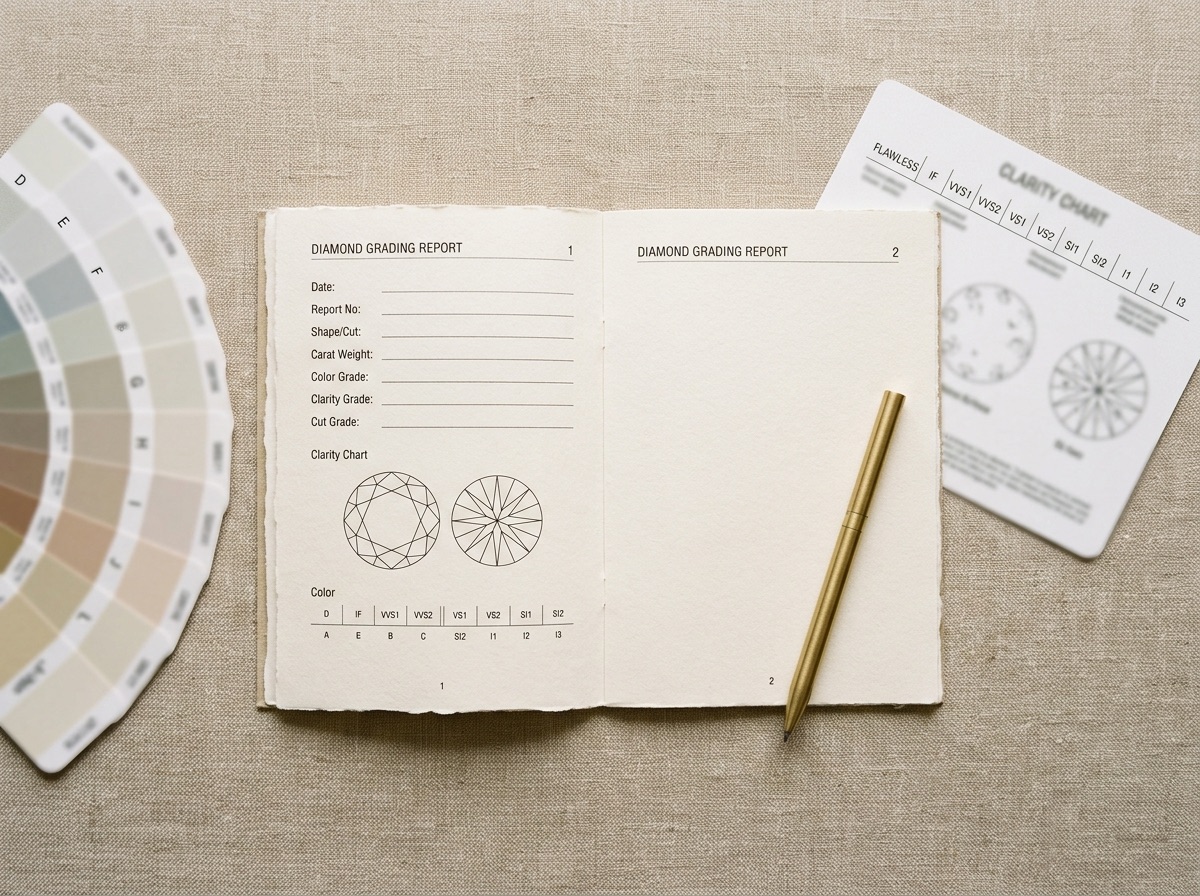
Read a lab-grown report top to bottom: confirm the report number and that it matches any girdle inscription, verify the stone is identified as laboratory-grown, then check the 4Cs (color, clarity, cut, carat) plus polish, symmetry, fluorescence, and measurements against the parcel you are buying.
A few checks matter most for wholesale. First, match the laser-inscribed report number on the girdle to the certificate so the paper belongs to the stone in hand. Second, read the lab-grown disclosure language; both IGI and GIA state plainly that the stone is laboratory-grown, and that statement is what carries through to consumer disclosure at point of sale. Third, treat the grading data as your resale basis: the report is the document your client and their insurer will rely on, so the numbers on the page should drive how you describe and price the goods. For melee and calibrated parcels, IGI documentation lets you carry the same disclosure discipline down to the small goods.
The clarity plot deserves its own look, not just the grade written above it. Both labs map each inclusion's type, size, and position on a diagram of the stone, so two diamonds with the same clarity grade can still look different in how their inclusions are distributed — one might carry a single feather near the girdle where a setting will hide it, another might have several pinpoints scattered under the table. For a buyer selecting stones for a specific mounting, the plot is often more useful than the grade alone. Proportions and measurements matter the same way: two rounds at the same carat weight can face up differently depending on depth and table percentage, and both reports list those figures for exactly that comparison.
How do you verify an IGI or GIA report is genuine?
Both labs let you cross-check a physical report against their own database before you accept a parcel, which is the fastest way to catch a report that has been altered or attached to the wrong stone. Verification takes a minute and should be routine on any stone entering wholesale inventory, not just on parcels that look questionable.
For an IGI report, use IGI's online report-check tool and enter the report number printed on the certificate. The lookup returns the grading summary on file — shape, carat weight, color, clarity, and cut — so you can confirm it matches the stone in hand before you commit to the purchase. For a GIA report, GIA's Report Check tool works the same way: enter the report number, and for extra confidence the shape and carat weight, to pull the original grading data from GIA's database.
A mismatch between the online record and the physical stone — wrong shape, wrong weight, or a report number that doesn't return a result at all — is the clearest sign something is wrong with the parcel, and it is worth catching before the stone moves further down your supply chain. Pairing the online lookup with a laser-inscription check on the girdle covers both ends of the paper trail: the report matches the lab's record, and the physical stone matches the report.
Newer reports from both labs also carry physical security features worth checking alongside the online lookup — security holograms, QR codes that link straight to the online record, and micro-print borders that are difficult to reproduce on a photocopied or altered certificate. None of these replace the database check, but a report missing the expected security features on a recent-dated certificate is worth a second look before you accept the parcel.
Does the certifying lab affect resale and consumer disclosure?
The certifying lab does not change the legal obligation to disclose that a diamond is lab-grown; both IGI and GIA state that clearly on the report. What the lab affects is buyer expectation and how easily the documentation moves through the trade, since most loose lab-grown inventory is quoted and compared on IGI reports.
For disclosure, the key is that a recognized report identifies the stone as laboratory-grown and that the identification carries to the consumer. Both labs satisfy that. For resale flow, IGI's prevalence means an IGI-certified parcel is easy to benchmark against the rest of the market, while a GIA-on-request stone fits the specific clients who want it. Carrying IGI as the default with GIA available covers both, which is how Guru Diam structures its trade-only inventory for jewelers, designers, and retailers.
Name recognition at the retail counter isn't quite the same as recognition in the wholesale trade. Decades of natural-diamond marketing means many end consumers recognize "GIA" by name even if they've never seen a report, while IGI's recognition is strongest among the buyers and jewelers who actually source inventory. That gap can shape how a jeweler chooses to present a specific stone at retail, even when the underlying lab-grown grading is identical.
Resale and trade-in markets for lab-grown diamonds are still maturing industry-wide, and lab-grown values trade differently from natural regardless of which lab issued the report — production scalability, not the certifying lab, is the main driver of that gap. What matters for resale readiness is simpler: a recognized report exists, states the stone is lab-grown, and satisfies whatever disclosure a buy-back program or appraiser requires. Both IGI and GIA clear that bar.
IGI vs GIA: Which Certification Costs Less?
For a comparable stone, IGI certification typically costs less than GIA certification — part of why IGI dominates lab-grown diamond grading in the first place. The gap shows up as a fixed line item on the finished piece rather than a percentage that scales with the order, so it matters more on smaller center stones and less as carat weight and price climb.
Certification lab choice doesn’t change turnaround. Once a stone is selected and a design is approved, a custom build still runs on the standard 4-6 business day timeline regardless of which lab issued the report.
GIA is worth the added cost specifically when resale or trade-in is part of the customer’s plan — GIA reports carry broader secondary-market recognition. For a keepsake piece with no resale intent, IGI is usually the more efficient choice.
The size of that gap tracks carat weight more than it tracks a fixed percentage. Both labs step their report fees up as stones get larger, so the dollar difference between an IGI and a GIA report on a small accent stone or a sub-half-carat center is minor, while the same lab choice on a two-carat-plus center stone carries a more noticeable difference. That's a useful rule of thumb when deciding where to spend the certification budget on a given build.
Buying checklist: what to confirm before you stock a certified lab-grown diamond
Use this checklist alongside the report-reading and verification steps above whenever a new parcel comes in the door:
- The report number on the certificate matches the laser inscription on the girdle.
- The report states the stone is laboratory-grown and names the growth method where the lab discloses it.
- The 4Cs — color, clarity, cut, carat — plus polish, symmetry, fluorescence, and measurements are all present and match the stone in hand.
- The report number returns a matching result on the issuing lab's online lookup tool.
- The certifying lab matches what your end client or retail program actually wants — IGI for general stock, GIA when a client or channel specifically requires it.
- For melee and calibrated parcels, confirm whether the goods carry individual or parcel-level documentation, since not every small stone ships with its own report.
- Any security features printed on the report — hologram, QR code, micro-print border — are present and consistent with a report of that age and lab.
Running this list on intake catches the two most common wholesale mistakes: a report that doesn't belong to the stone in the parcel, and a certifying lab that doesn't match what the end client downstream is going to ask for.

How does Guru Diam handle IGI and GIA certification?
As covered above, Guru Diam stocks IGI as the default certification across its loose lab-grown inventory — including melee — with GIA available whenever a buyer's end client specifically requires it. That coverage runs across the full range of shapes Guru Diam carries, from round brilliants to fancy shapes and antique cuts, so a mixed-shape order doesn't mean mixed documentation standards.
Guru Diam is a trade-only wholesale lab-grown diamond manufacturer in NYC's Diamond District with an LA office, producing in-house CVD goods. For IGI-certified inventory or GIA on request, call (212) 652-7108.
Frequently asked questions
Are IGI lab-grown diamonds as good as GIA?
Yes. IGI and GIA grade the same properties, color, clarity, cut, and carat, and both disclose the stone as lab-grown. A given grade means the same thing on either report. IGI simply issues the majority of lab-grown reports, which is why it is the working standard for loose wholesale inventory.
Why are most lab-grown diamonds IGI-certified?
IGI built dedicated lab-grown grading capacity early and papers a wide range of goods, including melee and small calibrated stones bought in volume. Because most loose lab-grown inventory carries IGI reports, sourcing and resale standardized around them, making "IGI-certified" the default way the trade quotes lab-grown goods.
Can I get GIA reports on Guru Diam diamonds?
Yes. Guru Diam stones are IGI-certified as standard, with GIA available on request. Most buyers stock IGI-certified loose goods for trading efficiency and order GIA selectively when a specific end client, retailer, or program requires a GIA report on their lab-grown center stone.
Is melee gradable by IGI?
Yes. Melee is IGI-gradable, so small calibrated goods can carry documentation rather than going out unpapered. That lets manufacturers and designers buying parcels of small certified rounds maintain consistent grading and lab-grown disclosure down to the smallest stones in a piece.
Does the certifying lab change how I disclose a lab-grown diamond?
No. Both IGI and GIA state on the report that the stone is laboratory-grown, and that identification carries through to consumer disclosure regardless of lab. The certifying lab affects buyer expectation and how easily the paperwork trades, not the underlying obligation to disclose the stone as lab-grown.
How do I verify an IGI or GIA lab-grown report online?
Enter the report number into the issuing lab's online lookup — IGI's report-check tool or GIA's Report Check — to pull the grading summary on file and confirm it matches the stone in hand. A mismatch, or a report number that returns no result at all, is the clearest sign to stop and investigate before the stone moves further into inventory.