
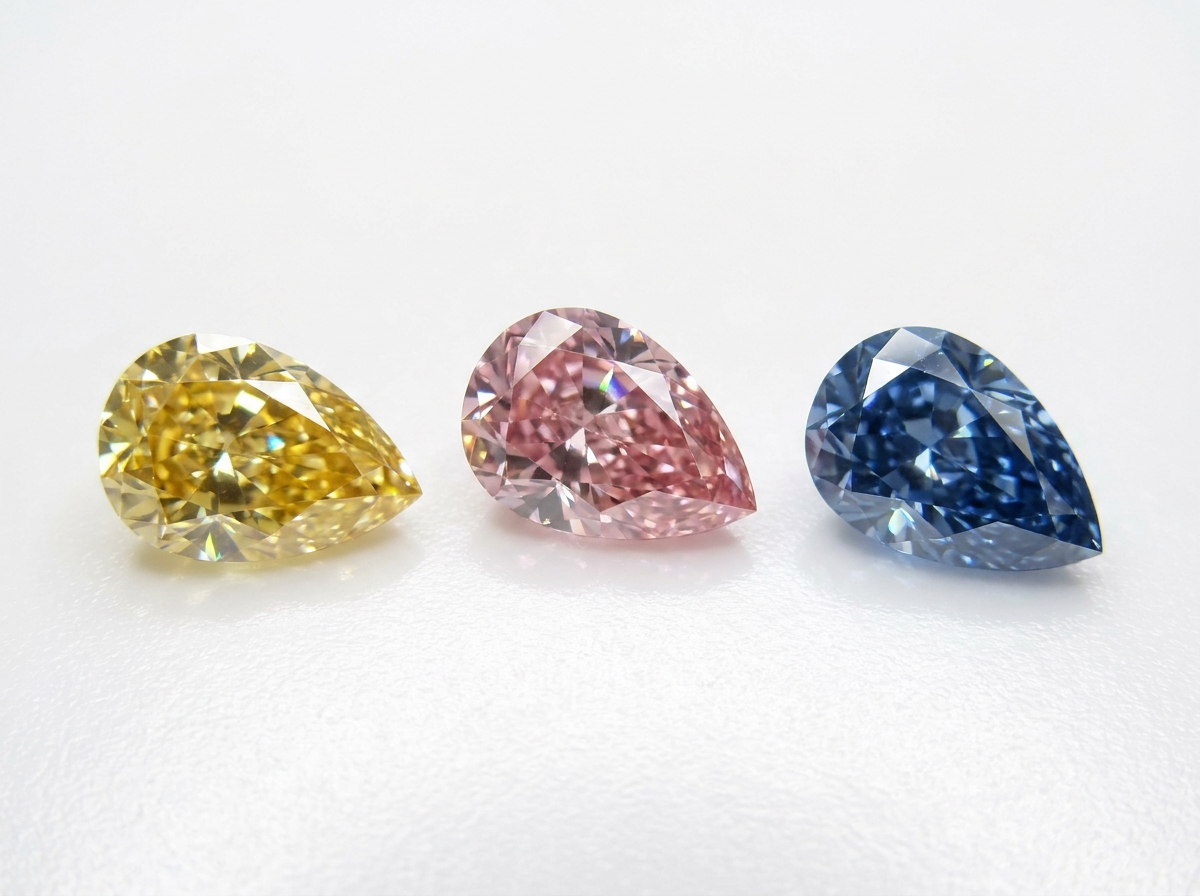
A fancy color pear shape diamond combines a rounded end with a single point in a full brilliant-faceted outline, and its elongation visibly concentrates color toward that point. Guru Diam stocks 163 IGI-certified, CVD-grown fancy color pear shapes across yellow, pink, blue, and green, popular for pendants, drop earrings, and statement rings.
Pear is the shape buyers reach for when a client wants a fancy color stone that reads as a focal point rather than a center-set gem — the tapering silhouette does visual work a symmetrical shape can't. Below: facet structure, bow-tie tradeoffs specific to fancy color, how grading and sourcing actually work, and how pear stacks up against oval and heart for a buyer deciding which shape to stock next.
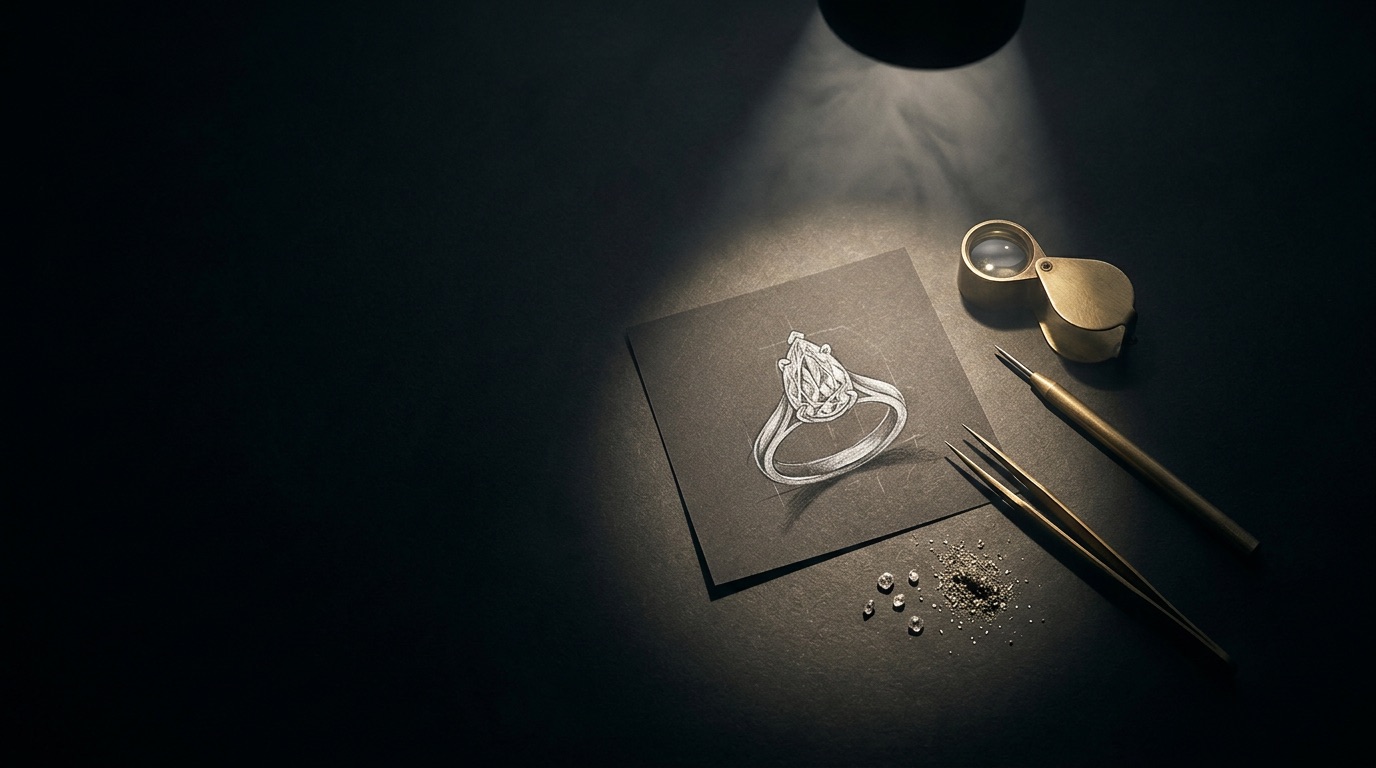
What Is a Fancy Color Pear Shape Diamond?
A pear cut is a hybrid outline: one rounded end like a round brilliant, tapering to a single point like a marquise, faceted in a brilliant pattern across the full stone rather than the parallel step facets of an emerald or asscher cut. That asymmetry is the whole point of the shape — literally and visually. Unlike a round or cushion, which reads the same from any rotation, a pear has a top and a bottom, an orientation that a jeweler has to design around rather than simply drop into a setting.
That built-in directionality is exactly what makes pear so useful for fancy color work. It's a natural fit for drop pendants and dangle earrings worn point-down, and for statement rings set on an angle to visually elongate the finger. Guru Diam's fancy color pear inventory spans the full locked palette — yellow, pink, blue, and green — cut CVD-grown and certified IGI as standard, with GIA available on request.
The brilliant faceting matters as much as the outline. A pear cut carries the same kite- and triangle-shaped facet arrangement used on a round brilliant, wrapped around an elongated, asymmetric body — the mechanism that lets a pear handle fancy color at all. Brilliant faceting breaks light into many small flashes rather than the broad, mirror-like planes of a step cut, and each flash carries the stone's body color with it. Cut colorless, a pear is judged on how little color shows. Cut fancy, that same faceting spreads color across the face-up surface and pools it, deliberately, toward the point.
How Fancy Color Forms in CVD Lab-Grown Pear Diamonds
Color in a CVD lab-grown diamond starts inside the growth chamber, not after the fact. Chemical vapor deposition builds a diamond crystal layer by layer from a carbon-rich gas; introduce controlled trace elements into that gas alongside the carbon, and they lock into the crystal lattice as the stone grows. Nitrogen incorporation is associated with yellow tones, boron with blue, and specific lattice-level structural features with pink and green hues. The color is a property of the crystal itself, grown in, not a coating or surface effect — which is why it holds up under polishing, repolishing, and normal wear the same way any diamond's body color does.
There's no separate growth process for a colored pear versus a colorless one — just a different, deliberately controlled set of growth conditions upstream of cutting. Guru Diam makes its fancy color pear stones in-house, from rough selection through faceting, and every finished stone gets independently graded rather than sold against a blanket color claim for the batch. That grading — covered in full below — is what turns "this looks yellow" into a verifiable, certificate-backed color grade a wholesale buyer can actually transact on.
That distinction matters at the point of sale. Because the color is a growth-stage property rather than something applied afterward, it doesn't fade, shift, or need special handling during setting, sizing, or repair the way a surface treatment would — a much easier claim to stand behind than a promise about a coating holding up over time.
Pear Shape Facet Structure and Bow-Tie Considerations in Fancy Color
A pear's facet structure isn't symmetrical the way a round's or an oval's is, and that asymmetry drives everything downstream. The rounded end carries broader, more evenly spaced kite and triangle facets — similar proportions to half of a round brilliant. Moving toward the point, those same facets narrow and compress, funneling toward a single apex rather than fanning out evenly. That change has a real optical consequence for color: as the material narrows, light has less lateral room to scatter and exits through a smaller, more concentrated area, so color reads visibly deeper and more saturated near the tip than across the broader end.
Cutters lean into this deliberately on fancy color pears. The point becomes the visual anchor of the stone, which is exactly why the shape works so well set point-down in a pendant, where the eye is drawn straight to where the color is most concentrated. The tradeoff is the "belly" — the widest part of the stone, between the shoulders and the rounded end — which needs enough width to avoid looking pinched without throwing off the overall proportion. A classic, saleable pear generally sits in a length-to-width ratio around 1.50–1.75; stones noticeably outside that window can look stubby or overly narrow regardless of how strong the color grade is.
Bow-tie is the other structural consideration specific to elongated brilliants, and pear is not immune to it just because it only has one point instead of two. It shows up as a dark or shadowed band across the stone's horizontal midsection, where light exits through the pavilion instead of reflecting back up. A moderate bow-tie is normal on a pear and isn't automatically a defect — but a severe one can interrupt the gradient from the broad end to the point, breaking the color continuity that makes fancy color pear desirable in the first place. Worth assessing in hand or on video before buying, since severity isn't always its own graded line item.
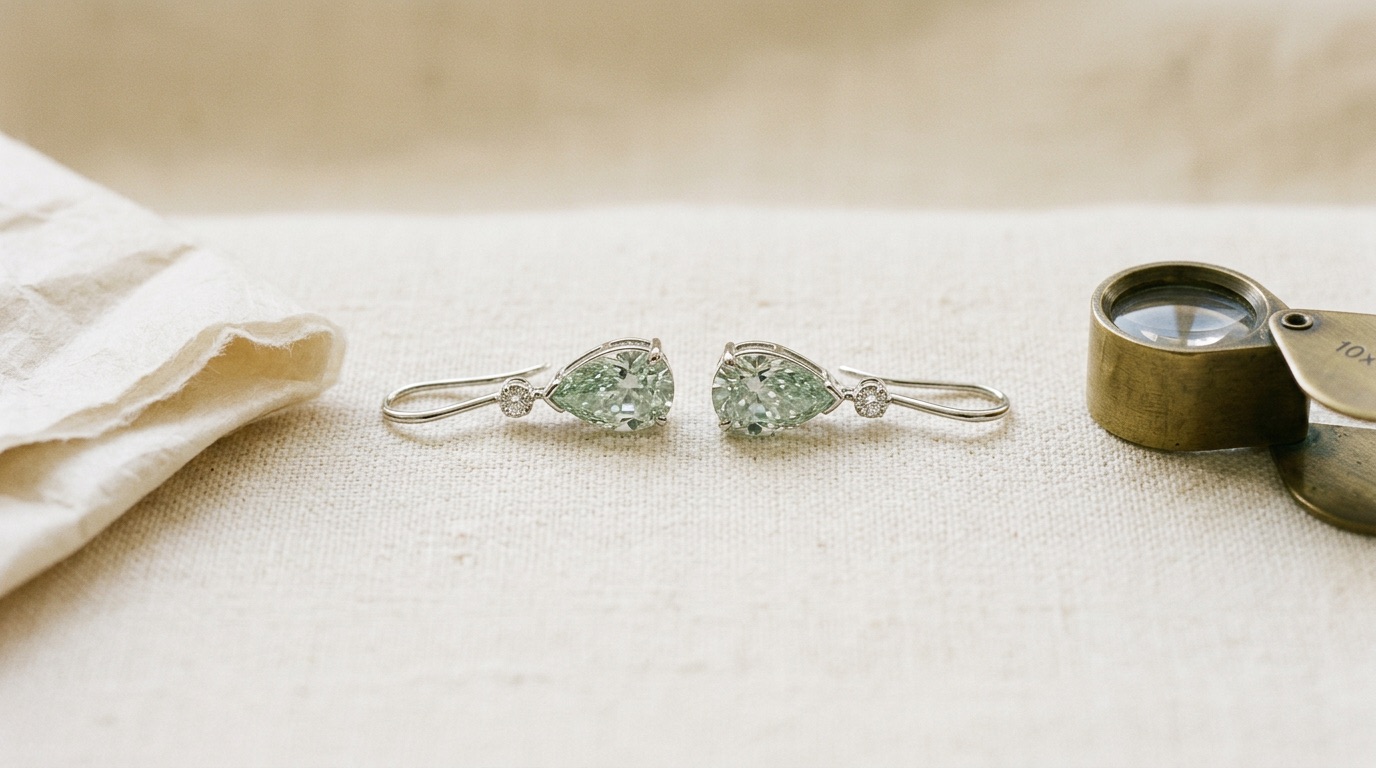
Grading Fancy Color: Hue, Tone, and Saturation Explained
Fancy color diamonds are graded on three separate axes, and understanding each one matters more for a wholesale buyer than memorizing the colorless D-to-Z scale ever did. Hue is the color name itself — yellow, pink, blue, green, or a modifier combination. Tone is how light or dark that color reads, independent of intensity. Saturation is the strength or purity of the color — how much of the visual field the hue actually occupies versus how washed-out or muted it looks.
GIA and IGI both use a scale of intensity terms combining tone and saturation into one graded label: Faint, Very Light, Light, Fancy Light, Fancy, Fancy Intense, Fancy Dark, Fancy Deep, and Fancy Vivid, roughly ascending in strength (Fancy Dark and Fancy Deep sit at the darker-toned end rather than the most saturated end). "Fancy Vivid" is the strongest grade a lab issues. A stone's full color grade reads as all three pieces together — "Fancy Intense Yellow," "Fancy Vivid Pink" — and that combination determines how the stone looks in hand, not the hue name alone.
| Intensity term | General strength |
|---|---|
| Faint / Very Light / Light | Color present but muted, closer to the colorless range |
| Fancy Light / Fancy | Clearly colored, moderate strength |
| Fancy Intense / Fancy Vivid | Strongest, most saturated, most sought-after |
| Fancy Dark / Fancy Deep | Darker-toned rather than more saturated |
For a pear specifically, the shape's point-concentration effect means a stone graded Fancy or Fancy Intense can visually punch above its certificate — the color reads stronger at the tip than the average saturation across the whole stone would suggest on paper. That's a genuinely useful thing to know when comparing a pear against a round or cushion carrying the same lab-stated grade, and it's part of why pear sells well one grade "down" from where a buyer might otherwise be shopping.
How Guru Diam Sources and Matches Fancy Color Quality
Sourcing fancy color pear inventory starts well before a finished stone reaches a tray. Rough selected for color work is chosen for its expected hue potential, then cut in-house with the point-concentration effect in mind — orienting the cut so the strongest color in the rough lands where it reads best, which for a pear generally means protecting saturation toward the tip. Every finished stone is graded independently once faceting is complete; nothing goes into on-hand inventory against a blanket claim for a batch.
Matching is where sourcing turns into a service rather than just a catalog listing. For a drop earring order — the single most common fancy color pear use case — two stones have to agree on hue, intensity, and proportion closely enough that they read as a deliberate pair rather than two similar diamonds sitting next to each other. Guru Diam's gemologists check color continuity across each stone before it's listed (confirming there's no zoning — an uneven band of color rather than a smooth gradient toward the point), then separately cross-check intensity and length-to-width ratio between candidate stones before recommending them as a match — a step most buyers can't reliably do themselves from a spec sheet.
Because pear is one of the deeper fancy color categories in current stock, most standard hue and saturation requests can be filled from on-hand inventory without a made-to-order wait — matched pairs included. Anything outside what's on hand routes to in-house cutting instead.
Quality Considerations for Wholesale Fancy Color Pear Buyers
A fancy color report carries more line items than a standard colorless certificate, and a wholesale buyer should read past the headline color name to those details. The report should state hue, tone, and saturation as a combined intensity grade — not just "yellow," but "Fancy Intense Yellow" — plus color distribution comments noting whether the hue reads even or concentrates unevenly, which matters more on an elongated shape like pear than on a round. Clarity, measurements, and a length-to-width ratio should all be listed too, since ratio directly affects how the stone will sit in a setting.
Symmetry gets checked differently on a pear than on a round brilliant. The point should sit centered on the stone's long axis rather than skewed to one side, the rounded end should be a true, even curve, and the two shoulders — where the curve transitions into the point — should mirror each other. A pear with an off-center point or uneven shoulders is far more visually obvious than a symmetry flaw on a round stone, because the eye tracks straight to the tip.
It's also worth confirming the report is genuine and current before finalizing an order. Both GIA and IGI maintain online report lookup by certificate number, and a quick cross-check against the issuing lab's own database confirms the grade matches what's on file. Guru Diam issues IGI reports as standard on its fancy color pear inventory, with GIA available on request.
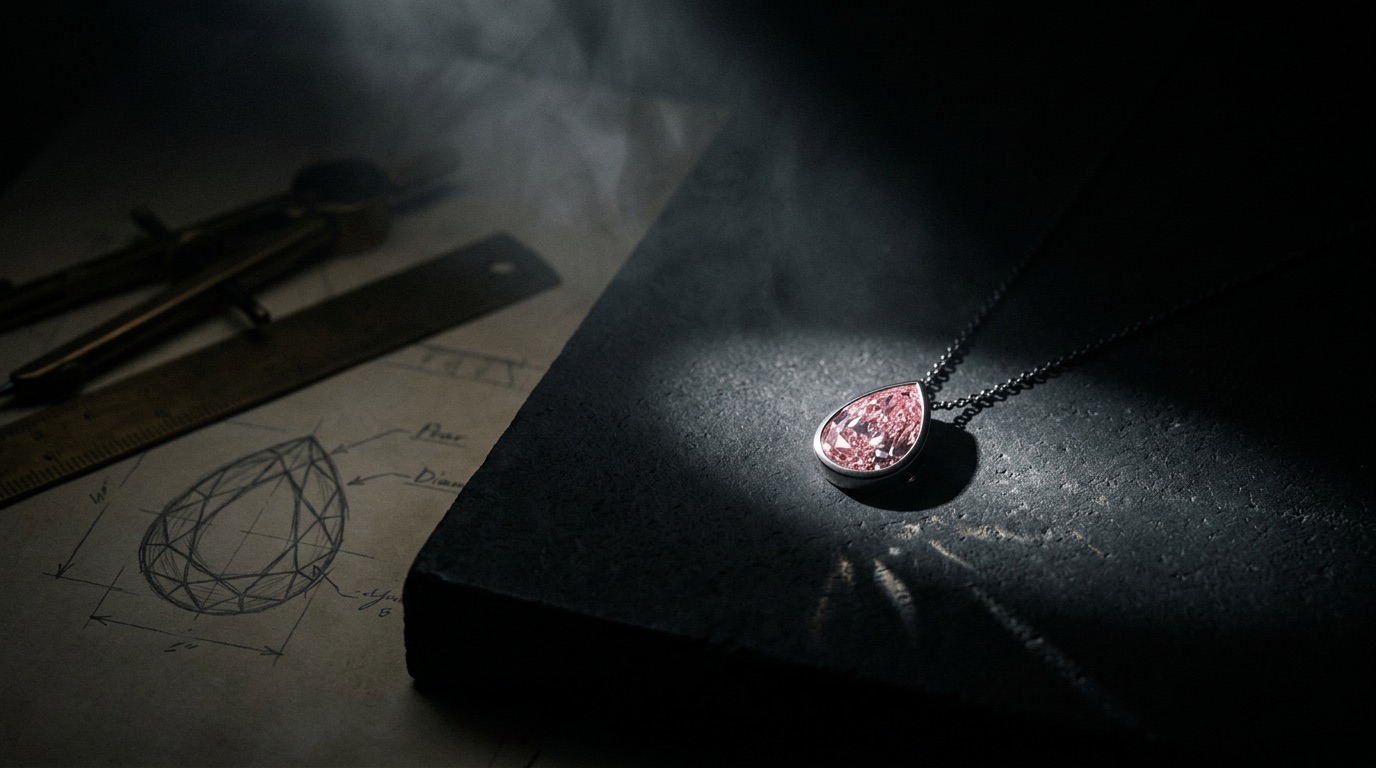
Pricing Factors for Fancy Color Pear Diamonds
Color intensity is the single biggest price driver in any fancy color diamond, pear included — a jump from Fancy to Fancy Intense to Fancy Vivid in the same hue moves the stone into a different pricing tier before carat weight or clarity enter the conversation. Hue matters too: pink and blue routinely command the steepest premiums even in lab-grown form, while yellow sits in a more moderate middle tier. The broader fancy color market also includes warmer tones like champagne and cognac at the more accessible end of that hierarchy — useful context on how hue pricing works category-wide, though Guru Diam's certified loose-stone program for pear is built around yellow, pink, blue, and green.
Length-to-width ratio functions as a pricing factor too. Pear stones in the 1.50–1.75 range are generally the most saleable and versatile for setting; stones running noticeably stubbier or narrower can be harder to place and often price differently even at an identical color grade. Carat weight scales price the way it does on any diamond, but because a pear reads larger face-up than a round or cushion of equal weight, buyers frequently get more visual size and colored surface area per carat than the raw weight implies.
Clarity plays a smaller role in fancy color pricing than on a colorless stone — a saturated body color can mask minor inclusions, so color grade and cut symmetry tend to carry more weight in a buyer's evaluation. Point symmetry and bow-tie severity, both covered above, function as practical pricing factors even when they aren't a separate line item on the certificate.
Styling and Use-Case Guidance: Pendants, Drop Earrings, Statement Rings
Pendants are the single most natural application for a fancy color pear, and it's a directional fit rather than a stylistic preference: set point-down, the tip — where color is most concentrated — sits at the visual center of the piece, facing directly toward the viewer. A bezel or three-prong setting that protects the point without covering it is standard here, since the tip is both the most fragile part of the stone and the feature the piece is built to show off.
Drop earrings are the second major use case, and this is where matched-pair sourcing becomes essential rather than optional — two pear stones that don't agree closely on hue and proportion will visibly mismatch swinging side by side. Dangle settings that let the stone move slightly catch more light across the facet structure and tend to make the color read livelier than a fixed setting does.
Statement rings take a different approach: rather than set with the point running along the finger, many buyers request a pear set on an angle, or full east-west, which shortens the visual length while widening the apparent face — a strong option for presence at the table rather than length down the finger. Halo settings pair well with lighter intensity grades, since smaller accent stones add perceived size and brightness around the color.
Fancy Color Pear vs. Oval vs. Heart: A Shape Comparison
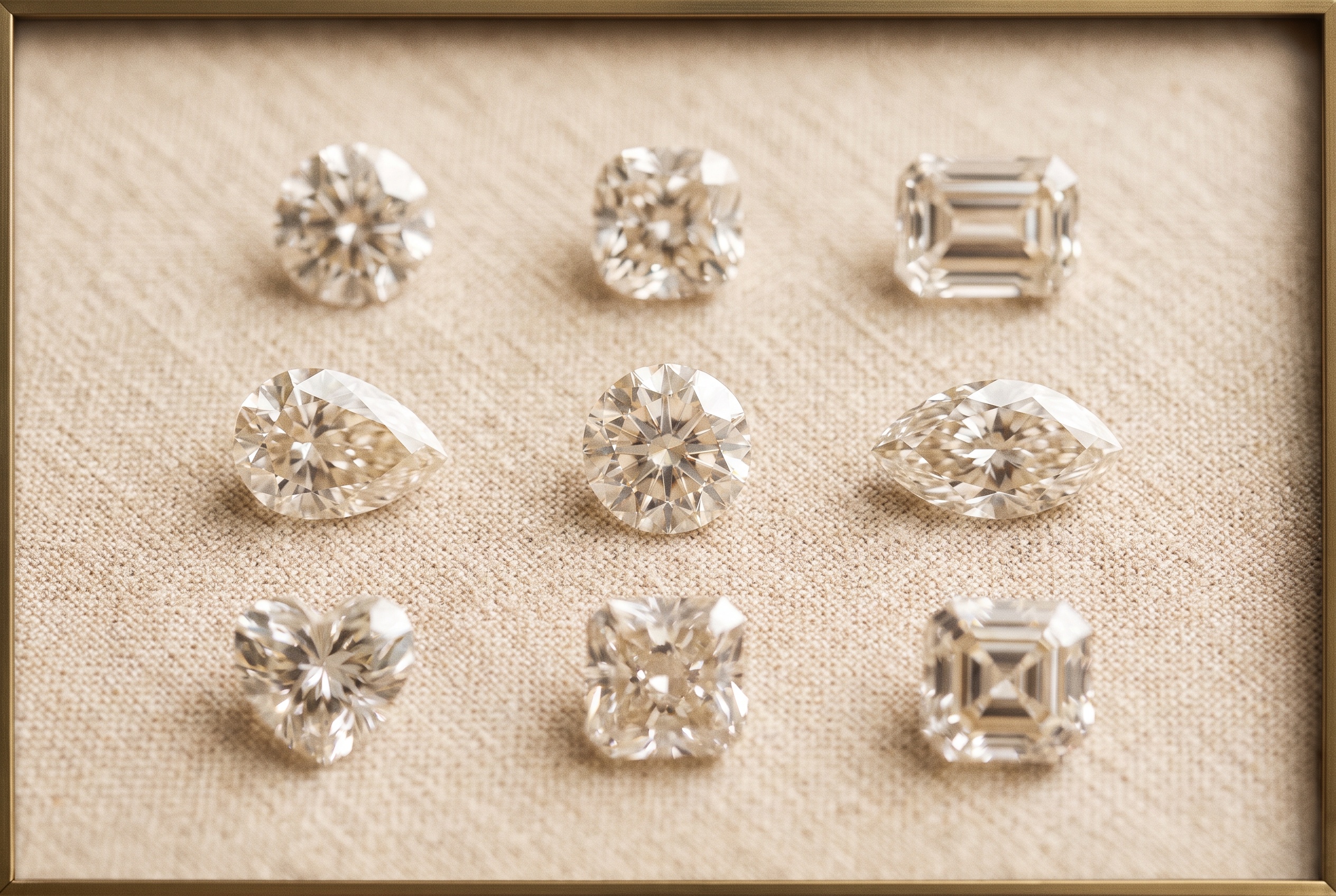
Pear sits in a specific middle position among elongated fancy color shapes, and the comparison to oval and heart is one of the more common questions from buyers deciding which shape to stock next. Oval has no point at all — a fully rounded, symmetrical elongated brilliant, so color spreads evenly across the face rather than concentrating toward one spot. That evenness is oval's strength for a buyer who wants a consistent wash with no orientation to manage, but it also means oval skips the single-point saturation boost that makes a pear or heart look more intensely colored than its certificate alone suggests. Oval carries its own bow-tie risk too, generally most pronounced on longer, narrower ratios.
Heart pushes the point-concentration effect further than pear does — it has both a single point at the bottom and a cleft at the top, so two areas of the outline need to read as symmetrical instead of just one. That makes heart the most demanding of the three to grade and match for symmetry, and the hardest to source as a true pair. In exchange, a well-cut fancy color heart delivers the strongest single-point color concentration, since light funnels to one tip the same way it does on a pear, but from a more compact, less elongated body.
| Shape | Points | Color behavior | Bow-tie risk | Pair-matching difficulty |
|---|---|---|---|---|
| Pear | One (plus a rounded end) | Concentrates toward the point, gradient from broad end | Moderate | Moderate |
| Oval | None | Even wash across the face | Moderate, ratio-dependent | Lower |
| Heart | One point, plus a cleft | Strongest single-point concentration | Lower (compact body) | Highest |
None of this makes one shape objectively better than another. A buyer chasing maximum apparent saturation with the least symmetry risk reaches for pear; a buyer prioritizing even, simple-to-source color reaches for oval; a buyer chasing the strongest focal-point effect, and willing to accept tighter matching requirements, reaches for heart.
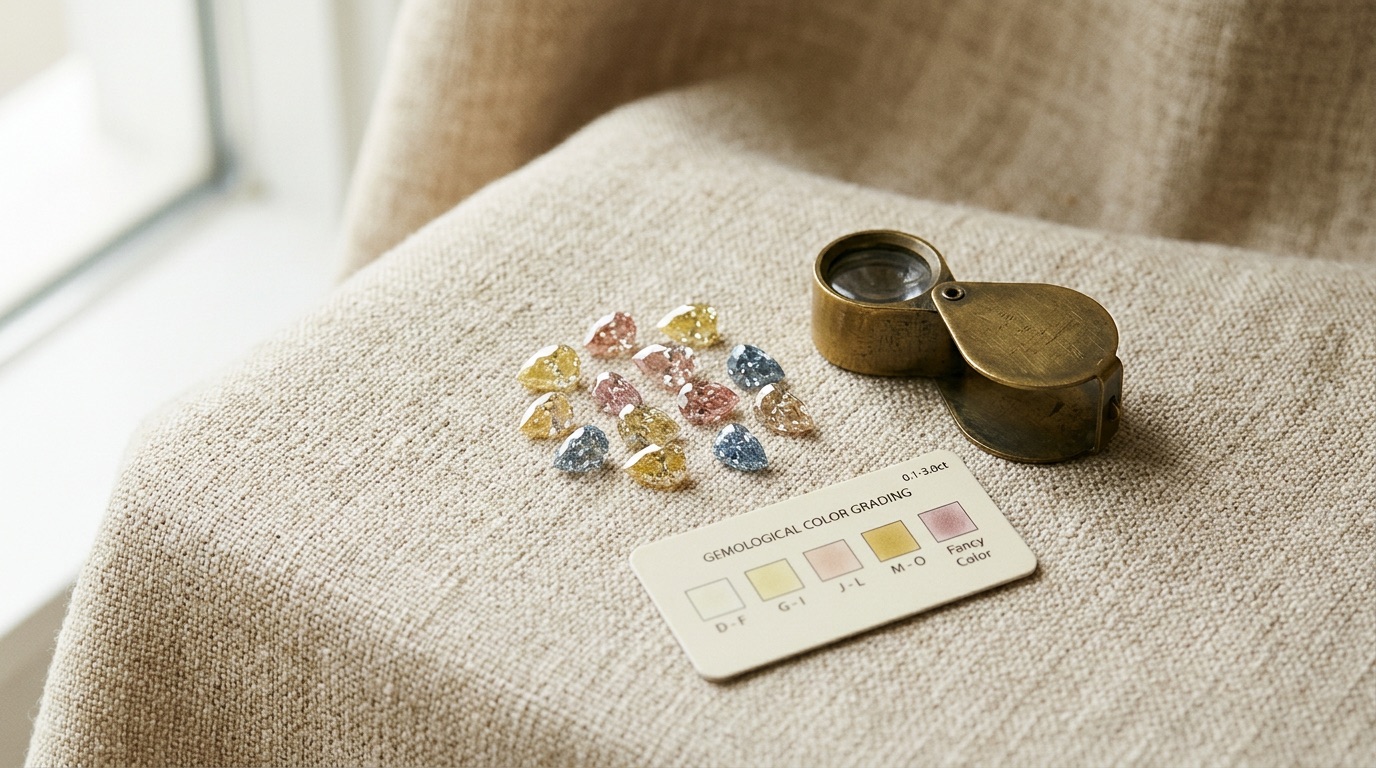
Fancy Color Pear: Spec and Availability
| Spec | Detail |
|---|---|
| Outline | Elongated, one rounded end, one point |
| Facet style | Full brilliant |
| Typical L:W ratio | 1.50–1.75 |
| Color palette (Guru Diam) | Yellow, Pink, Blue, Green |
| Growth method | CVD-grown |
| Certification | IGI standard; GIA available on request |
| Stone type | Certified single stones (not melee) |
| On-hand count | 163 pieces |
| Typical uses | Drop pendants, dangle earrings, statement rings |
With 163 pieces on hand across yellow, pink, blue, and green, pear is one of Guru Diam's deepest fancy color categories — enough range in size, hue, and saturation to cover most pendant, earring, and ring requests without a made-to-order wait. Checking point symmetry and confirming there's no visible color zoning is worth doing before committing to a piece, whether buying from stock or reviewing a made-to-order candidate.
How to Order Fancy Color Pear Diamonds Wholesale
Guru Diam sells fancy color pear diamonds as wholesale, trade-only inventory — no retail markup — from its New York Diamond District desk (36 West 47th Street, Suite 601A) and its Los Angeles office (607 South Hill Street). An order moves fastest when the buyer comes with more than "fancy color pear" as the spec: target hue, an intensity grade range (Fancy versus Fancy Intense versus Fancy Vivid), a preferred length-to-width ratio, and whether the piece needs to match an existing stone all narrow the search to something fillable from stock or routed to in-house cutting.
To start, open a verified wholesale account at /signup and book time with a gemologist at /book-appointment — the appointment is where matching requests and setting work get scoped properly rather than guessed at from a spec sheet. In-stock loose pear pieces ship same-day from New York; for a custom setting, CAD-to-finished-piece turnaround runs 4–6 days. For the full fancy color category across every shape, see our fancy color lab-grown diamonds overview.
Buying Checklist: Red Flags for Wholesale Fancy Color Pear Buyers
Before committing to a fancy color pear purchase, it's worth running through a short list of the places a stone can quietly underperform its certificate:
- Off-center point or uneven shoulders: the tip should sit on the stone's true long axis, and the two shoulders leading into it should mirror each other.
- Severe bow-tie: a shadow band strong enough to interrupt the color gradient running from the broad end to the point.
- Color zoning: patches of noticeably stronger or weaker color within the same stone rather than a smooth gradient, which a certificate's headline grade won't always flag on its own.
- L:W ratio outside the usable range: a stone well outside 1.50–1.75 can be harder to set and resell than the color grade alone would suggest.
- Vague or missing intensity grading: a report or listing that names a hue ("yellow") without a tone/saturation intensity term ("Fancy Intense Yellow") is withholding the information that actually drives price and appearance.
- Growth method and certification not disclosed up front: any wholesale fancy color stone should come with a clear growth method statement and a named certifying lab before price is even discussed.
None of these are reasons to avoid fancy color pear as a category — they're the checkable details that separate a stone performing the way its certificate promises from one that technically matches the grade but disappoints in hand.
Frequently Asked Questions
What is a fancy color pear shape diamond?
A fancy color pear shape diamond is a colored diamond cut with one rounded end and one point in a full brilliant-faceted outline. The tapering shape visually concentrates color toward the point, which is why pear is a popular choice for pendants, drop earrings, and statement rings.
Why does color look more concentrated at the point of a pear cut?
As a pear shape narrows toward its point, light has less room to scatter laterally and exits through a smaller area, so color reads deeper and more saturated near the tip than across the broader rounded end. Cutters lean into this effect deliberately for fancy color stones.
What is bow-tie effect, and does it affect fancy color pear diamonds?
Bow-tie is a dark or shadowed band that can appear across the horizontal midsection of elongated brilliant shapes, including pear, where light exits through the pavilion instead of reflecting back up. A moderate bow-tie is normal and not a defect on its own, but a severe one can interrupt the color gradient running from the broad end to the point — worth checking in hand or on video before buying, not just from the certificate.
Are fancy color pear diamonds lab-grown, and are they certified? What colors are available?
Yes. Guru Diam's fancy color pear inventory is CVD-grown and IGI-certified as standard, with GIA certification available on request. All pieces are certified single stones, not melee, and the palette covers yellow, pink, blue, and green.
How does pear compare to oval and heart for fancy color?
Oval has no point, so color spreads evenly across the face with no directional orientation to manage. Heart has a point plus a cleft, giving the strongest single-point color concentration but the most demanding symmetry and pair-matching. Pear sits between the two — a single-point color concentration effect similar to heart, with simpler symmetry and easier pair-matching than heart requires.
How fast can I get a fancy color pear stone or a finished custom piece?
In-stock pieces ship same-day from New York. For a custom setting, CAD-to-finished-piece turnaround runs 4–6 days from our New York and Los Angeles desks.