
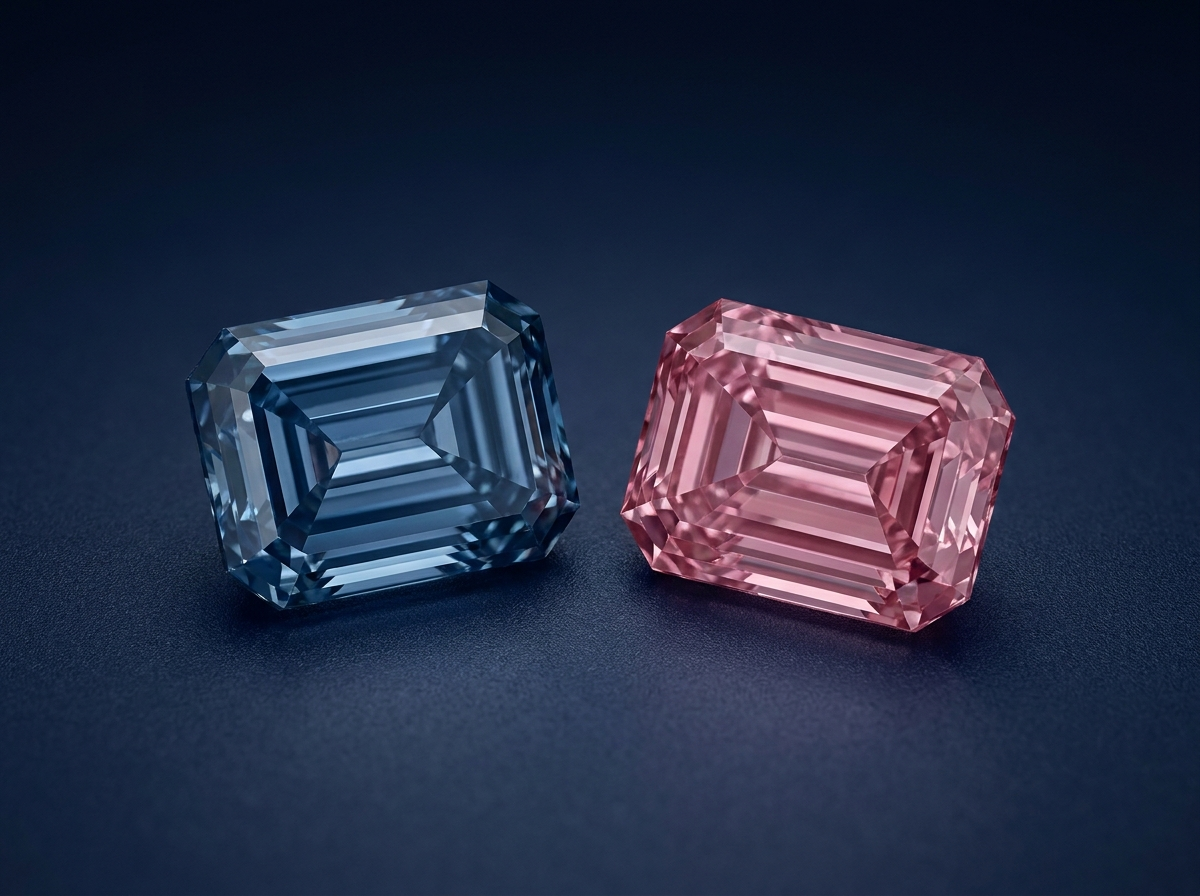
A fancy color emerald cut diamond is a rectangular, trimmed-corner step cut, faceted with long parallel planes instead of scattered brilliant facets, which shows fancy color as a broad, even wash rather than flashes of light. Guru Diam stocks 60+ IGI-certified, CVD-grown fancy color emerald cuts, across yellow, pink, blue, and green.
Emerald is the shape for buyers who want a fancy color stone that reads as a deep, uniform pool of color rather than a sparkle-first stone — a genuinely different look from every brilliant-cut shape in the fancy color range, and worth understanding in full before you steer a client toward or away from it. This guide covers how fancy color grading actually works, why step-cut geometry changes the way color performs face-up, how Guru Diam sources and matches color quality across its four-hue palette, what drives price on a fancy color emerald cut stone, how to style it, and how it compares to its closest relatives, fancy color asscher and radiant.
What Is a Fancy Color Emerald Cut Diamond?
An emerald cut is a rectangular outline with trimmed corners, faceted in a step-cut pattern — long, flat, parallel facets arranged like stair steps, rather than the small triangular and kite-shaped facets of a brilliant cut. The open table and large facet planes are the defining visual trait: instead of many small flashes of light, an emerald cut shows a smaller number of broad, mirror-like reflections, sometimes called a "hall of mirrors" effect. A standard emerald cut runs 50–58 facets depending on step count (single-cut, double-cut, or triple-cut crown and pavilion rows), with a length-to-width ratio typically between 1.30:1 and 1.50:1 for a classic rectangular proportion, though cutters working fancy color rough will sometimes deviate from that ideal to preserve carat weight or concentrate color in a stone with uneven zoning.
A fancy color emerald cut is the same outline and facet arrangement applied to a diamond that carries body color strong enough to be graded on the fancy color scale rather than the standard white D-to-Z scale. Guru Diam's fancy color emerald inventory spans the locked palette — yellow, pink, blue, and green — cut CVD-grown and certified IGI as standard, with GIA and GCAL available on request for buyers whose retail channel requires a specific lab.
Fancy Color Grading 101: Hue, Tone, and Saturation
Fancy color diamonds are graded on three variables, and understanding them is the single most useful thing a wholesale buyer can take away from this page before pricing or presenting a stone to a client.
Hue is the base color family — yellow, pink, blue, green — plus any modifying or secondary hue that attaches to it. A stone rarely reads as a pure, single-note color; certification reports frequently list a modifier, such as "purplish pink" or "greenish blue," where the first word is the weaker secondary tone and the second is the dominant hue. Buyers should expect to see these compound descriptions on cert paperwork and should not treat them as a defect — a well-balanced secondary hue can add depth rather than muddy the color.
Tone describes how light or dark the color reads, independent of how saturated it is. Two stones can share the same hue and saturation but differ in tone, with one reading brighter and one reading deeper.
Saturation is the strength or concentration of the color — how far it sits from a neutral gray toward a pure, vivid version of the hue — and it is the variable that moves price the most within a fancy color category. The grading scale used across the major certification labs runs from the faintest detectable tint through Faint, Very Light, Light, Fancy Light, Fancy, Fancy Intense, Fancy Vivid, and into the deepest Fancy Dark and Fancy Deep grades. A Fancy Vivid stone at a given hue and carat weight will command a meaningfully higher price than a Fancy Light stone of the same hue and size, because saturation — not size — is what a fancy color buyer is actually paying for.
This matters more in an emerald cut than in almost any other shape, because step-cut faceting doesn't hide a weak grading result the way a brilliant cut can. What the lab report says about saturation is close to what the naked eye will see face-up.
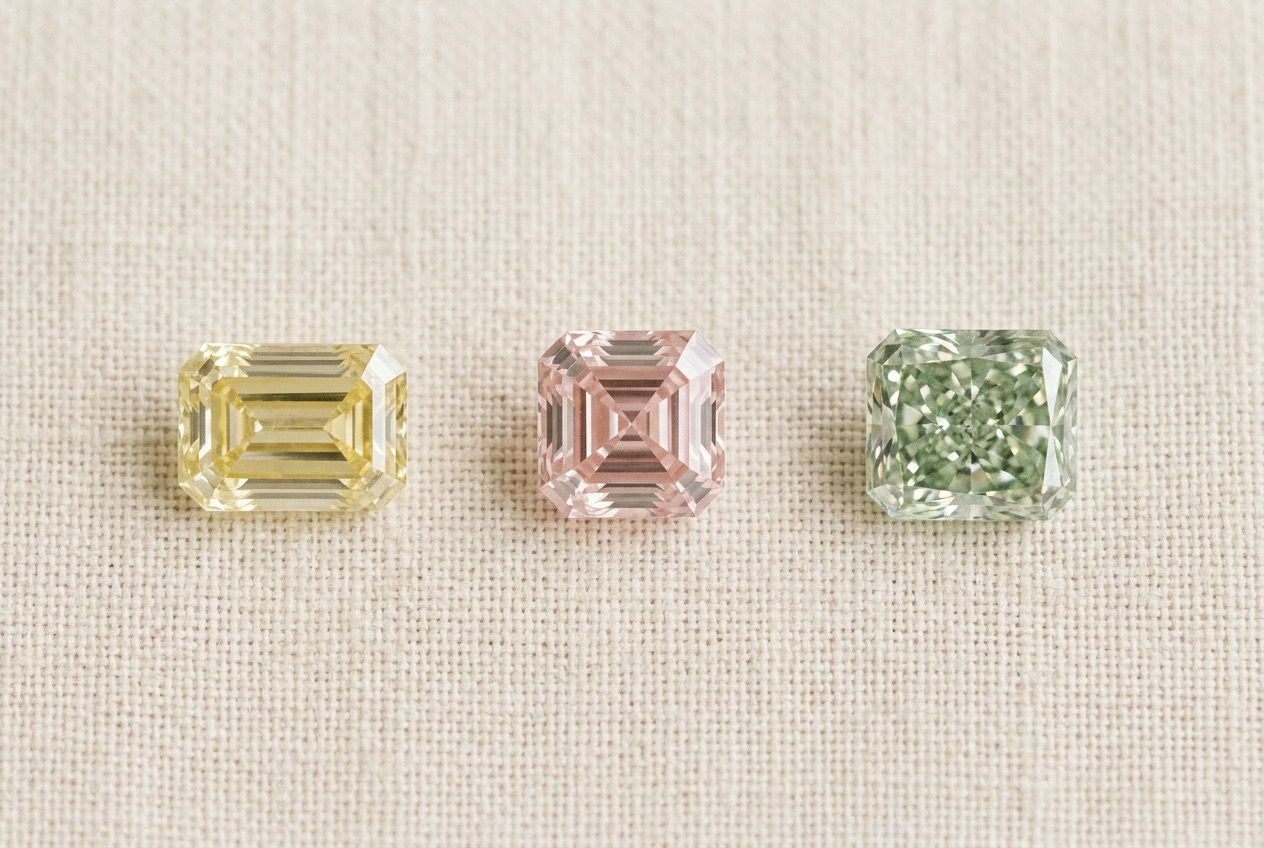
Why Step-Cut Faceting Shows Fancy Color Differently Than a Brilliant Cut
Step-cut facets are large and few compared to a brilliant cut's many small ones, and light travels a longer, more direct path across each one before reflecting. That geometry changes how color reads face-up: instead of being broken into a mosaic of light and dark flashes the way a brilliant cut scatters it, color in an emerald cut pools across each broad facet plane, producing a deep, even, "pooled" look rather than a sparkling one. For a fancy color stone with genuinely strong, even saturation, that's a striking effect — the color reads as a continuous field rather than scattered points of intensity.
The trade-off is that step cuts are less forgiving than brilliant cuts on lower or uneven saturation. A brilliant cut's scattered facets can visually mask weaker or slightly zoned color by breaking it up into smaller pieces the eye blends together; an emerald cut's open planes do the opposite — they show exactly what color is there, evenly and without disguise. An emerald cut is also more prone to "windowing," where light passes straight through the open table and pavilion instead of reflecting back to the eye, producing a pale or washed-out zone at the center of an otherwise well-colored stone. Windowing is primarily a proportion issue (table and depth percentages, pavilion angle) rather than a rough-quality issue, which is why cutting precision matters as much as starting material for how a finished fancy color emerald cut actually performs.
That's why emerald-cut fancy color stones tend to command attention from buyers who specifically want strong, well-saturated color and are comfortable with an open table showing it plainly, rather than buyers looking for a shape that's forgiving of a middling color grade.
The Locked Fancy Color Palette in Emerald Cut
Guru Diam's certified fancy color program is a fixed four-hue lineup — the same palette runs across every shape we cut, emerald included. We don't carry champagne or cognac as certified fancy color inventory; those are a separate brown-hue trade category some suppliers stock, but they sit outside Guru Diam's fancy color line. Here's how each of the four hues typically performs once it's cut into an emerald shape.
Yellow is the most commonly available fancy color hue in CVD material and the easiest to grow to strong, even saturation, which makes it the deepest-stocked color in the emerald cut category. In a step cut, yellow reads as a warm, glowing field across the table — the pooling effect described above tends to flatter yellow specifically, since even Fancy or Fancy Intense saturations look rich and continuous rather than patchy.
Pink emerald cuts are prized for a soft, romantic color field that still reads clearly at a distance, which makes them a strong engagement-ring center stone. Because pink saturation can be more uneven across a rough crystal than yellow, cutters pay close attention to table placement to avoid a visibly lighter zone at one end of the stone.
Blue is the rarer of the four hues to grow at strong saturation, and an emerald cut is an unforgiving shape for it — the open table shows exactly how deep and even the blue color is, with no brilliant-cut sparkle to distract from a thin or grayish result. A well-saturated blue emerald cut is correspondingly one of the more sought-after combinations in the category.
Green fancy color diamonds often carry a secondary modifier (yellowish-green or bluish-green are both common), and the step-cut's broad facets are a good match for showing that layered hue clearly rather than blending it into a single note the way a brilliant cut might.
How Guru Diam Sources and Matches Fancy Color Quality
Color quality control starts before a stone is ever cut. Rough CVD material is pre-screened for hue and saturation potential, and the cutting plan is built around the specific color zoning in that piece of rough — the table and culet axis are oriented to concentrate the strongest color in the finished stone's face-up view rather than cutting to a generic template and hoping the color lands well. Because emerald cut is the least forgiving shape for uneven saturation, only rough that grades well and evenly across the crystal gets routed to an emerald cutting plan; material with better color in a smaller zone is more often cut to a shape that can mask unevenness, which is part of why emerald cut is the tightest-stocked shape in the fancy color range.
All cutting, polishing, and setting happens in-house, which lets us hold a consistent internal color and clarity standard across a run of stones rather than relying on outside vendors with inconsistent grading judgment. For buyers who need matched pairs — earrings, or a symmetrical three-stone setting — that in-house control is what makes it possible to pull two emerald cuts with genuinely matched hue and saturation rather than two stones that only match on paper.
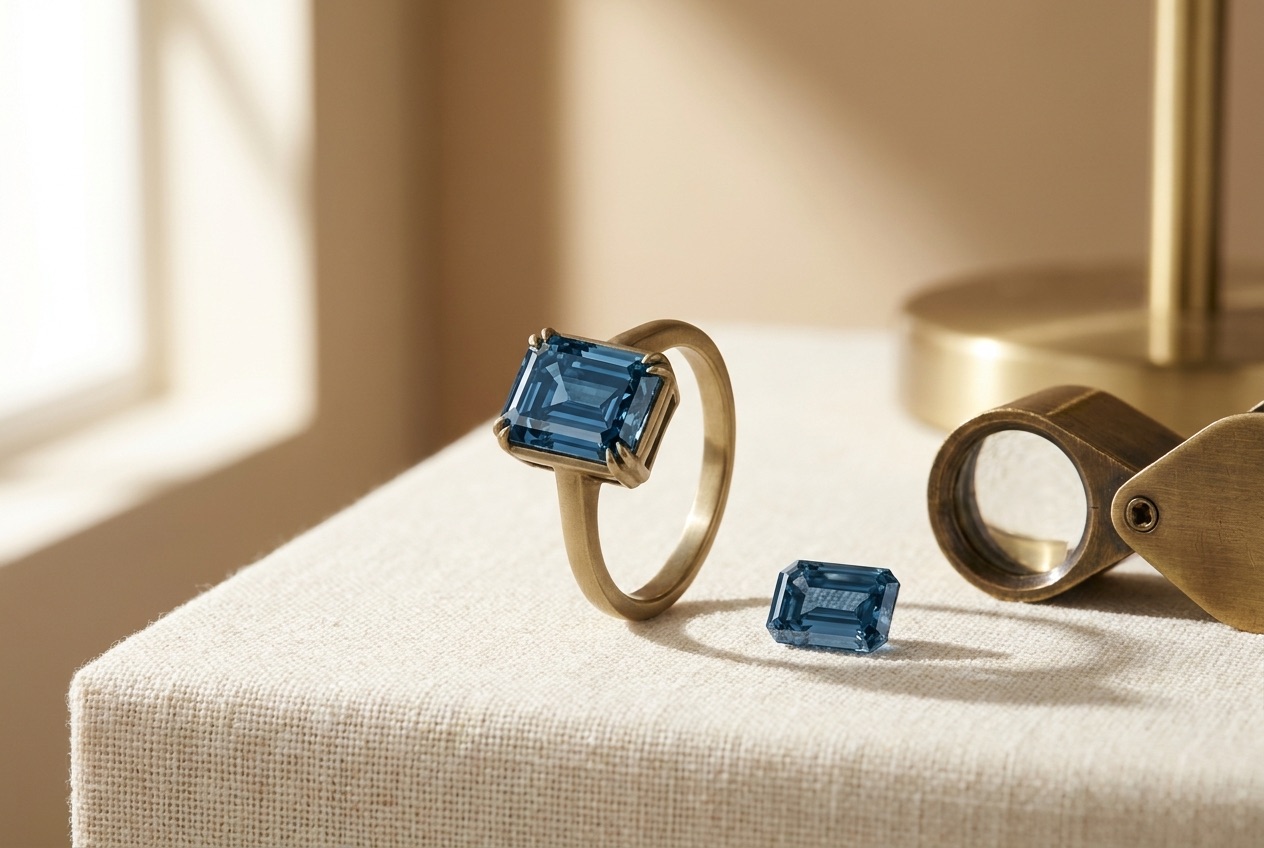
Quality Considerations Beyond Color
Color saturation is the primary price driver on any fancy color diamond, but three other factors determine how a fancy color emerald cut actually performs once it's set.
Clarity matters more here than it does on fancy color brilliant cuts. Because fancy color grading generally treats clarity as secondary to color intensity, buyers sometimes assume clarity barely matters — that's true for a cushion or radiant, where facet scatter can hide small inclusions, but an emerald cut's open table exposes inclusions the way a glass tabletop exposes scratches. We steer fancy color emerald buyers toward eye-clean material even when the certified clarity grade includes minor inclusions, because what shows through the open table is what the client will actually see.
Proportions — table percentage, depth percentage, and pavilion angle — determine whether a stone windows (reads pale at the center) or holds color evenly across the face. This is a cutting decision as much as a rough-quality one, which is why in-house cutting control matters for fancy color specifically.
Facet symmetry across the step rows affects how clean the "hall of mirrors" reflections look. Uneven step spacing or misaligned corner facets break up the broad, mirror-like reflections that are the whole visual appeal of the cut, turning a clean pooled-color look into a busier, less premium-reading one.
Fancy Color Emerald Cut: Spec and Availability
| Spec | Detail |
|---|---|
| Outline | Rectangular, trimmed corners |
| Facet style | Step-cut (open table, parallel facets) |
| Color palette (Guru Diam) | Yellow, Pink, Blue, Green |
| Growth method | CVD-grown |
| Certification | IGI standard; GIA and GCAL available on request |
| Stone type | Certified single stones (not melee) |
| On-hand inventory | 60+ pieces, ready to ship |
| Typical uses | Engagement ring center stones, three-stone settings, statement pieces |
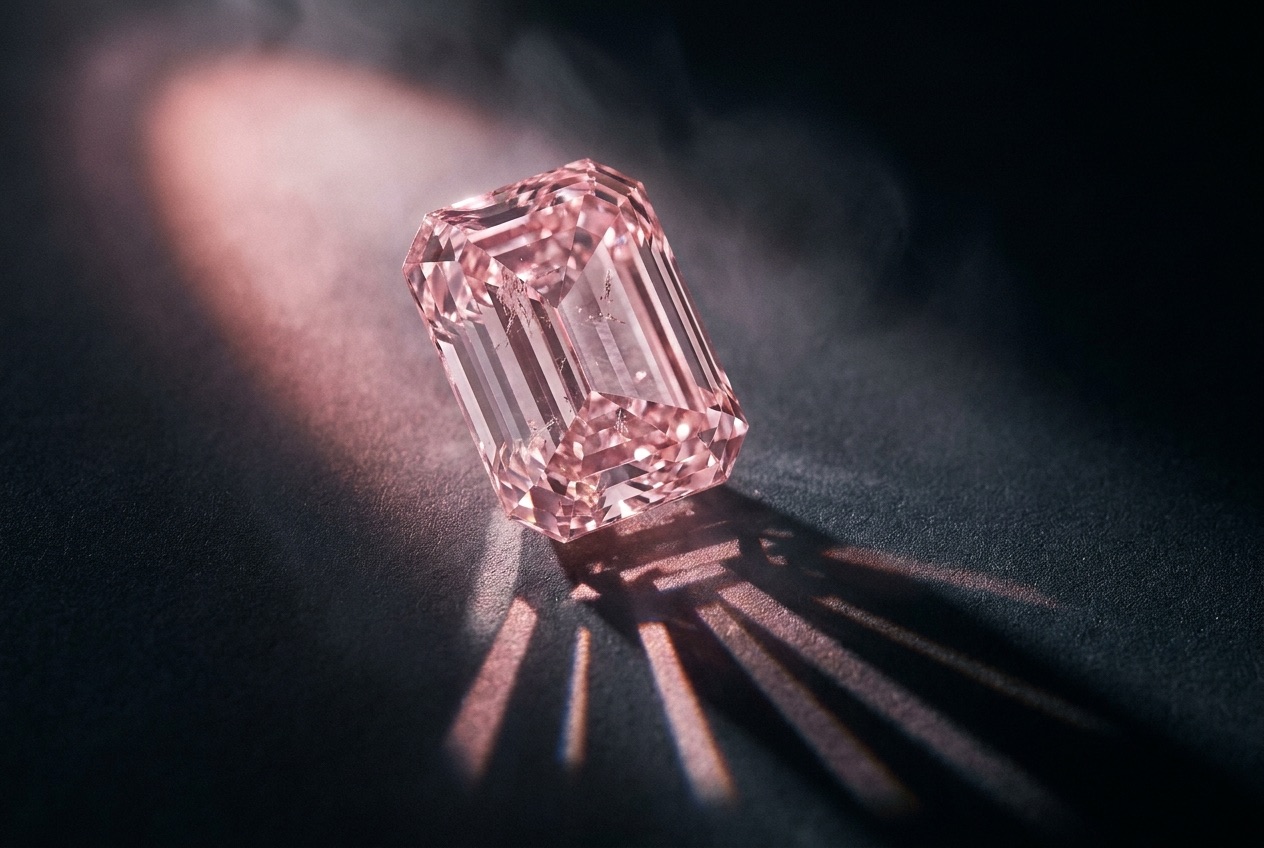
What Drives Pricing on Fancy Color Emerald Cut Diamonds
Several variables stack to set price on a fancy color emerald cut, and they don't move independently — a change in one can swing the others.
Saturation is the dominant factor. As covered above, a Fancy Vivid or Fancy Intense stone carries a substantial premium over a Fancy Light stone of the same hue and carat weight, because saturation is what defines a fancy color stone's desirability more than any other single variable.
Hue rarity plays a secondary role, even in lab-grown material. Blue tends to price above pink and green at comparable saturation, and yellow — the easiest hue to grow well — generally prices lowest of the four, simply because it's the most available.
Carat weight scales non-linearly, the same way it does on white diamonds: price per carat jumps at common breakpoints (0.50ct, 1.00ct, 1.50ct, 2.00ct) rather than climbing in a straight line.
Clarity has more pricing weight on an emerald cut than on other fancy color shapes, for the visibility reasons covered above — an eye-clean emerald cut at a given color and carat weight will command more than an included one, even when both carry the same certified clarity grade on paper.
Cut precision — how well the proportions avoid windowing and how clean the step symmetry reads — is harder to quantify than the other factors but shows up directly in how the stone looks in hand, which is why buyers should always request current photos or video before committing to a fancy color emerald cut sight-unseen.
Certification lab can add a modest cost differential; IGI is our standard and keeps pricing tightest, while GIA and GCAL reports are available on request for buyers whose retail channel requires a specific lab.
Styling and Use-Case Guidance
An emerald cut's open table and geometric outline shape how it should be set, more than most cuts. A few patterns that work well in practice:
Solitaire and hidden-halo engagement rings. A simple four- or six-prong solitaire lets the color field read cleanly with nothing competing for attention; a hidden halo underneath the crown adds perceived size and a subtle color boost without breaking the clean rectangular silhouette. Corner protection matters here — emerald cut corners are the most vulnerable point on the stone, so a setting with sturdy corner prongs or a half-bezel is worth recommending over exposed-corner styles for daily-wear pieces.
Three-stone settings pair a fancy color emerald cut center with white side stones — trapezoids, half-moons, or tapered baguettes — for a contrast frame that makes the color read even stronger against a neutral border.
Matched earrings and pendant pairs lean on the in-house color-matching described above; two emerald cuts with genuinely aligned hue and saturation read as a deliberate, premium pairing rather than two stones that happen to share a certificate description.
Metal choice should work with, not against, the hue. Warm yellow gold flatters yellow and can warm up a lighter pink; platinum or white gold gives blue and green a cooler, higher-contrast frame; rose gold intensifies pink specifically. This is a simple lever that meaningfully changes how saturated a stone appears to a client, worth raising in any sales conversation before a client locks in a metal choice.
Fancy Color Emerald Cut vs. Fancy Color Asscher and Radiant
Buyers comparing shapes within the fancy color category are usually deciding between three related cuts, and the differences matter more than they might expect.
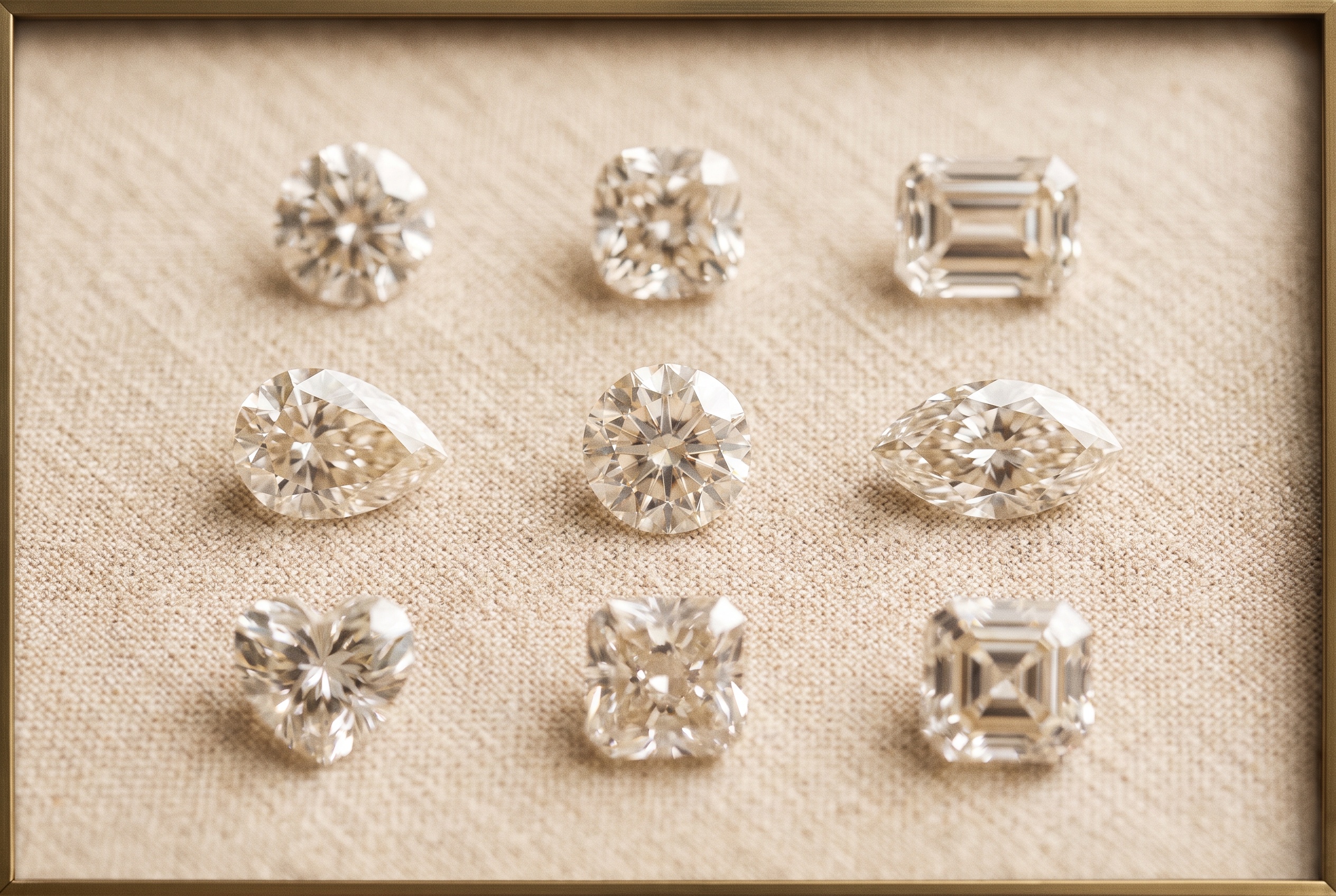
Asscher is a square step cut with more heavily cropped corners and a higher crown than emerald, producing a more concentrated, almost windmill-like pattern of reflections rather than emerald's long, parallel "hall of mirrors" planes. Because it's square rather than elongated, an asscher of the same carat weight often reads as visually smaller face-up than an emerald cut, but the deeper crown can concentrate color even more intensely in a well-saturated stone.
Radiant is a hybrid — a rectangular or square cropped-corner outline like emerald or asscher, but faceted with a brilliant-style arrangement rather than step-cut planes. That gives radiant cuts real sparkle in addition to color, and it makes them meaningfully more forgiving of lower or uneven saturation than emerald cut, the same way any brilliant-style faceting masks color and clarity issues that a step cut would expose. Buyers choosing between an emerald cut and a radiant cut in the same hue and saturation grade are really choosing between a "pooled color, minimal sparkle" look and a "sparkle plus color" look — both are legitimate, and the right answer depends entirely on what the client wants the stone to do on the hand.
Emerald cut sits at the strict end of that spectrum: it is the purest expression of step-cut color, the least forgiving of weak or uneven saturation, and correspondingly the shape that puts the most pressure on rough selection before cutting even starts — which is exactly why it's Guru Diam's tightest-stocked fancy color category by piece count.
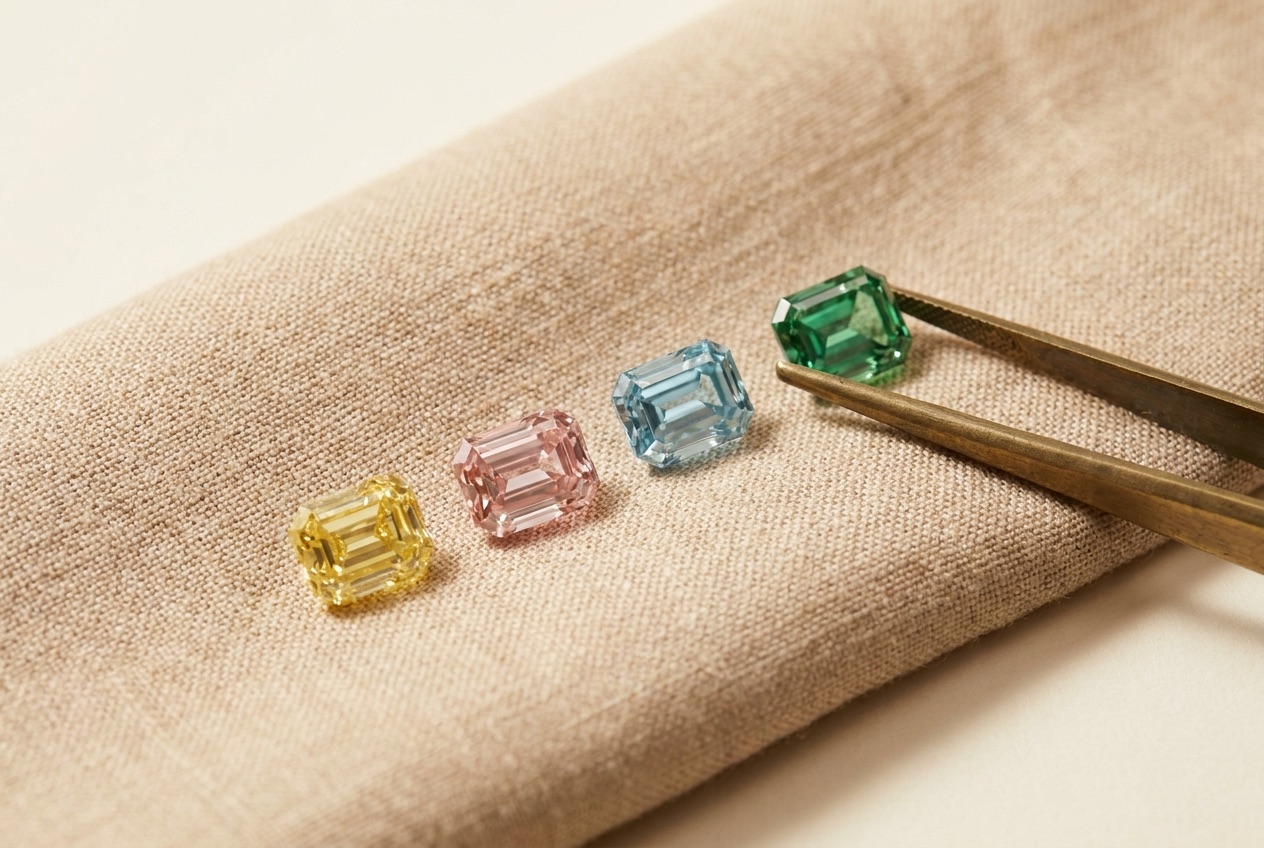
Sourcing Fancy Color Emerald Diamonds Wholesale
Fancy color emerald is Guru Diam's smallest fancy color category by count — a direct result of the cut's stricter demands on rough color quality, since only well-saturated, evenly colored material performs well in an open step-cut table. That makes availability tighter than cushion, radiant, pear, or oval, and it's worth checking current stock early if a client has settled on this shape.
Guru Diam sources fancy color emerald diamonds as wholesale, trade-only inventory — no retail markup — from our New York Diamond District desk (36 West 47th Street, Suite 601A) and our Los Angeles office (607 South Hill Street, Suite 241). In-stock pieces ship same-day from New York before 6pm EST, and same-day from Los Angeles before 4pm PST. For a size or color not currently on hand, our team can source and cut to order — ask your account rep for current lead time on made-to-order pieces. For the full fancy color category across every shape, see our fancy color lab-grown diamonds overview.
How to Order Fancy Color Emerald Cut Diamonds Wholesale
Ordering fancy color emerald cut inventory follows the same process as the rest of Guru Diam's wholesale catalog:
1. Open a verified wholesale account. Trade accounts get access to live inventory, certificates, and trade pricing — sign up at /signup. Verification confirms you're a jeweler, designer, or manufacturer buying for resale, not a retail customer.
2. Review current stock. Once verified, request current photos, video, and the certificate for any stone you're considering — especially important for an open-table shape like emerald cut, where proportions and clarity placement are visible in a way they aren't on other cuts.
3. Book time with a gemologist if you want a walkthrough of available stock, help matching a pair, or guidance on which hue and saturation combination fits a specific client brief — schedule at /book-appointment.
4. Consolidate your order. Fancy color emerald cuts can ship alongside antique cuts, other fancy shapes, melee, and finished jewelry in one shipment — a useful option for buyers who don't want a separate freight event for every category. Custom rings built around a fancy color emerald cut center finish in 4–6 days from our New York and Los Angeles desks once a setting is selected.
Frequently Asked Questions
What is a fancy color emerald cut diamond? A fancy color emerald cut diamond is a colored diamond cut with a rectangular, trimmed-corner outline and step-cut faceting — long, flat, parallel facets rather than a brilliant cut's small triangular ones. This produces a broad, mirror-like look often described as a "hall of mirrors" effect.
How is a fancy color emerald cut diamond graded? Fancy color diamonds are graded on hue (the base color family plus any modifying tone), tone (how light or dark it reads), and saturation (how concentrated the color is). Saturation is the biggest driver of both visual impact and price, running from Faint up through Fancy, Fancy Intense, and Fancy Vivid.
Why does an emerald cut show fancy color differently than a brilliant cut? Step-cut facets are larger and fewer, so light reflects across broad, flat planes instead of scattering into many small flashes. That means color pools evenly across the stone's face rather than breaking into a mosaic — a deeper, more uniform look, but one that shows exactly what saturation is present rather than visually blending a weaker color the way brilliant faceting can.
Are fancy color emerald cut diamonds lab-grown, and are they certified? Yes. Guru Diam's fancy color emerald inventory is CVD-grown and IGI-certified as standard, with GIA and GCAL certification available on request. All pieces are certified single stones, not melee.
What colors are available in fancy color emerald cut at Guru Diam? Yellow, pink, blue, and green. That's the full certified fancy color palette we stock across every shape, including emerald cut — we don't carry champagne or cognac as certified fancy color inventory.
How fast can I get a fancy color emerald stone or a finished custom piece? In-stock loose stones ship same-day from New York or Los Angeles. Custom rings built around a fancy color emerald cut center finish in 4–6 days from our New York and Los Angeles desks once a setting is chosen.