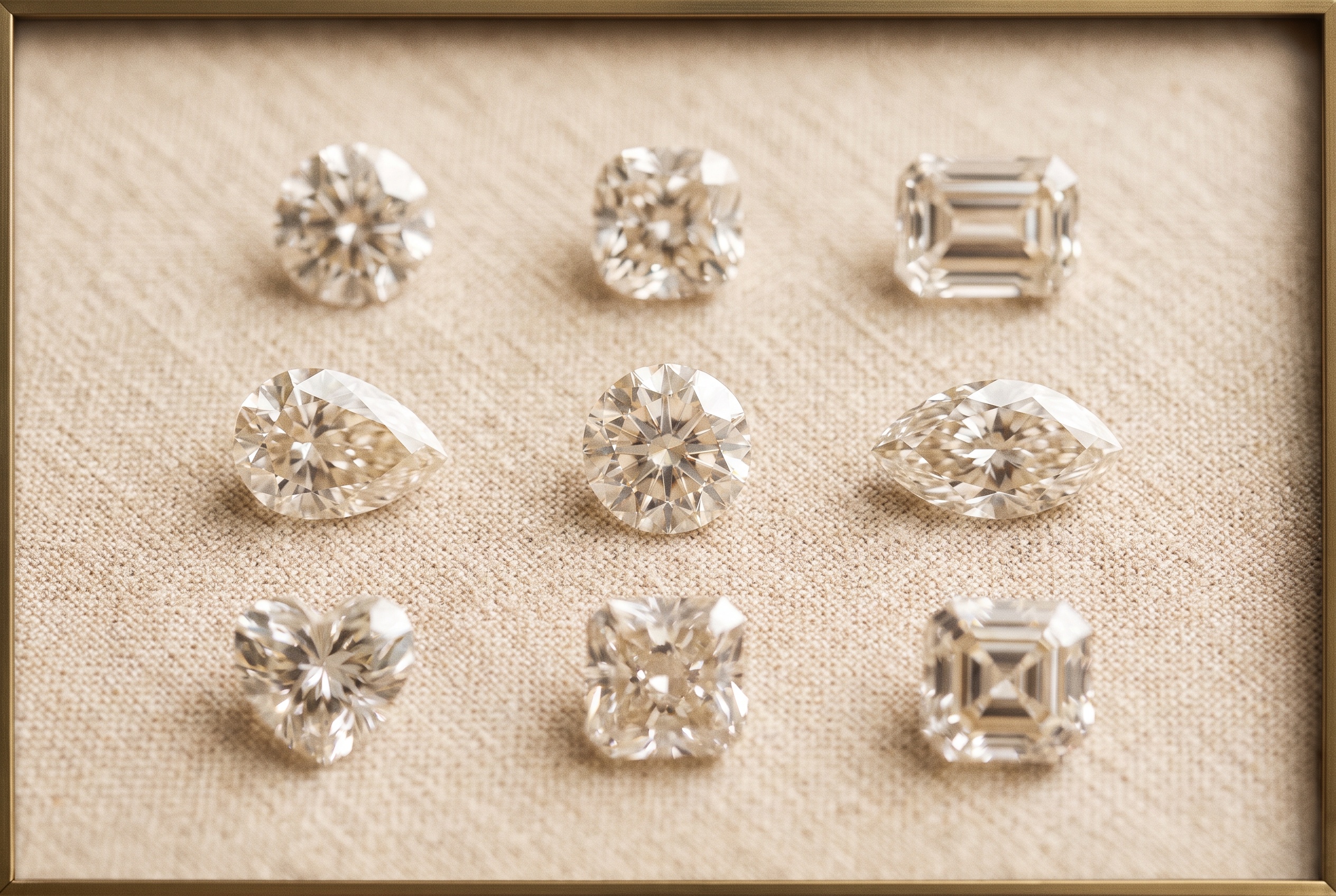

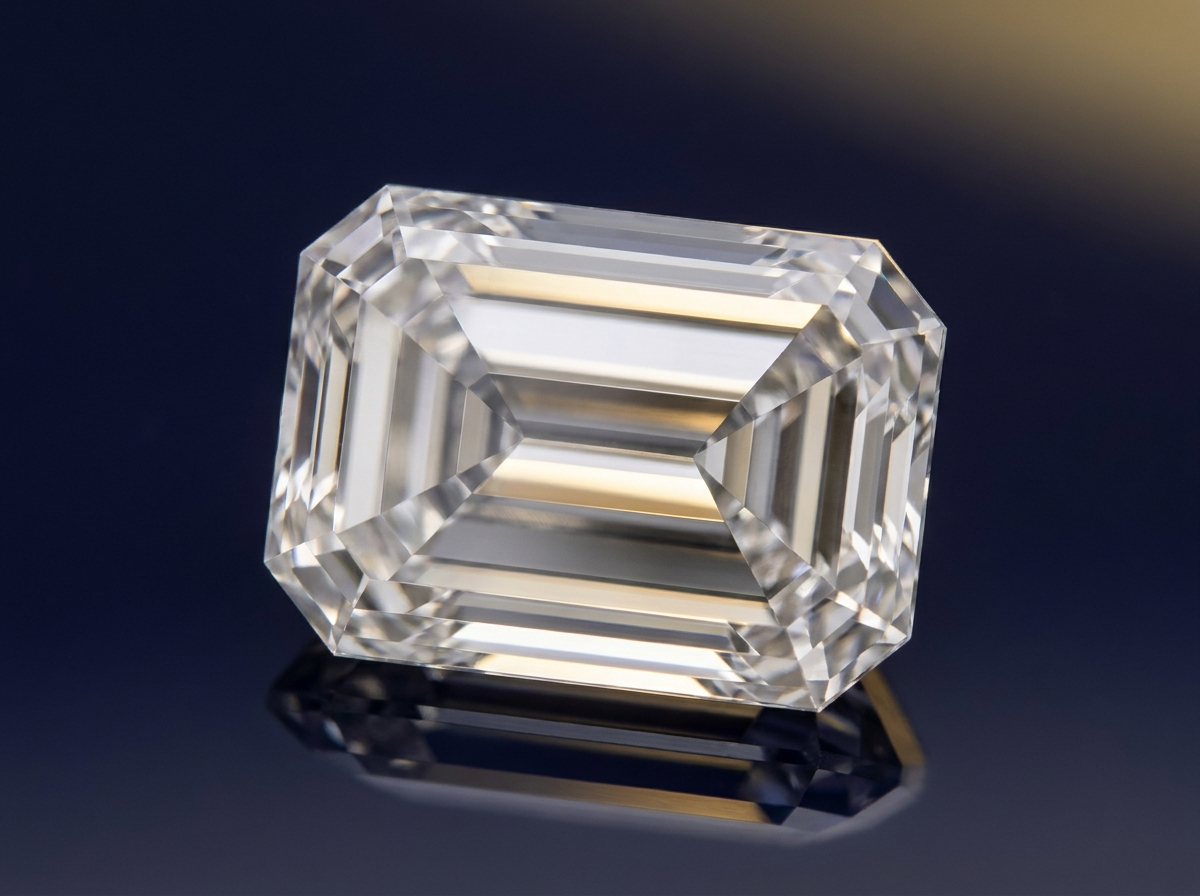
An emerald cut is a rectangular step-cut diamond with cropped corners, a large open table, and long parallel facets instead of brilliant-cut wedges — producing broad, mirror-like flashes of light rather than scattered fire. Guru Diam stocks emerald cut as IGI-certified, CVD-grown lab-grown loose diamonds, with 596 pieces currently on hand from our New York Diamond District desk. This guide covers the cut's facet structure and history, how we grade and price it for trade buyers, where it fits in a jewelry line, and how to order it wholesale.
What is an emerald cut diamond?
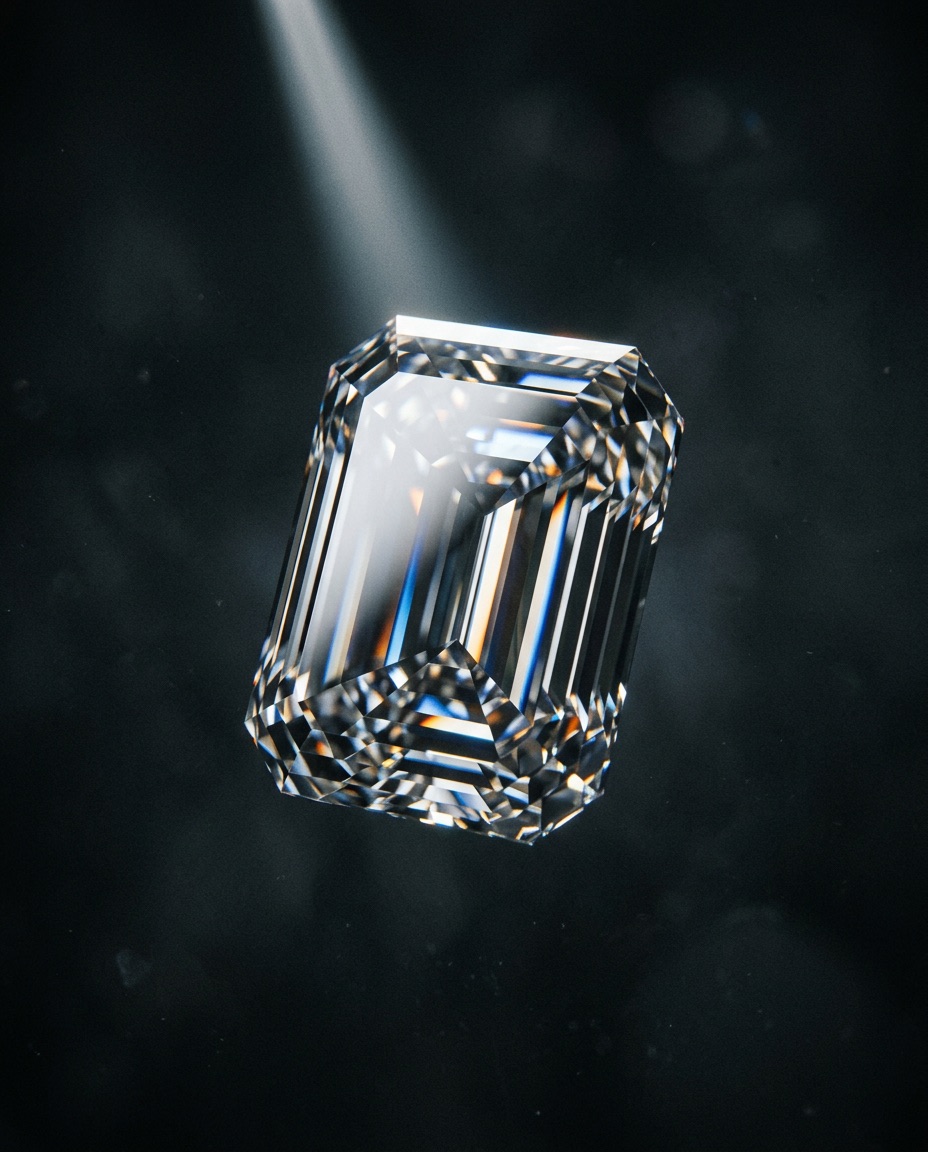
An emerald cut is a rectangular (occasionally square) step cut: cropped corners, a wide open table, and rows of long, parallel, concentric facets running down the crown and pavilion instead of the small triangular and kite-shaped facets of a brilliant cut. That step faceting produces a different kind of sparkle than a round or princess — fewer, broader flashes instead of scattered fire, an effect often described as "hall of mirrors." Because the table is so open, clarity and color are more visible face-up than in a brilliant cut of the same grade, which is why the shape is generally paired with higher clarity grades in trade sourcing.
The name describes a cutting style, not a gemstone — "emerald cut" refers to the facet arrangement, and the same step-cut geometry is applied to diamond, sapphire, aquamarine, and other stones. In Guru Diam's own catalog taxonomy, emerald cut sits in the Regular Fancy tier alongside asscher, cushion, oval, and radiant — a modern shape, not an antique one, even though the step-facet pattern reads as vintage. Buyers sometimes assume any step-cut stone is an antique cut; it isn't. Antique-style cuts (old mine, old European, kite, lozenge) have their own distinct facet geometry and sourcing path.
A brief history: from table cuts to Art Deco icon
Step faceting predates the brilliant cut by centuries. Early diamond and colored-stone cutters used simple table cuts and step cuts because the technology to calculate and polish the compound triangular facets of a modern brilliant didn't exist yet — a step cut is mechanically simpler to plan and polish, even if it's less forgiving of inclusions. The style takes its name from its long use on emerald gemstones, where step facets protect the relatively brittle emerald from chipping during cutting and wear better than they protect diamond, which doesn't need that same structural accommodation but keeps the look.
The cut had its defining moment in the 1920s and 1930s, when Art Deco jewelry houses embraced its clean geometric lines, symmetry, and architectural presence — a natural fit for a design movement built on straight edges, repetition, and contrast rather than curves and clusters. That period cemented the emerald cut's identity as the "quiet luxury" shape: less sparkle-forward than a round brilliant, more about proportion, symmetry, and the size and clarity of the stone itself.
The current bridal cycle has circled back to that same sensibility. Vintage-modern and minimalist engagement ring styles are back in heavy rotation, and the emerald cut's understated, architectural presence fits that mood better than a maximalist halo or cluster setting. Independent designers sourcing for editorial and custom work have driven a steady lift in emerald cut requests over the past several seasons.
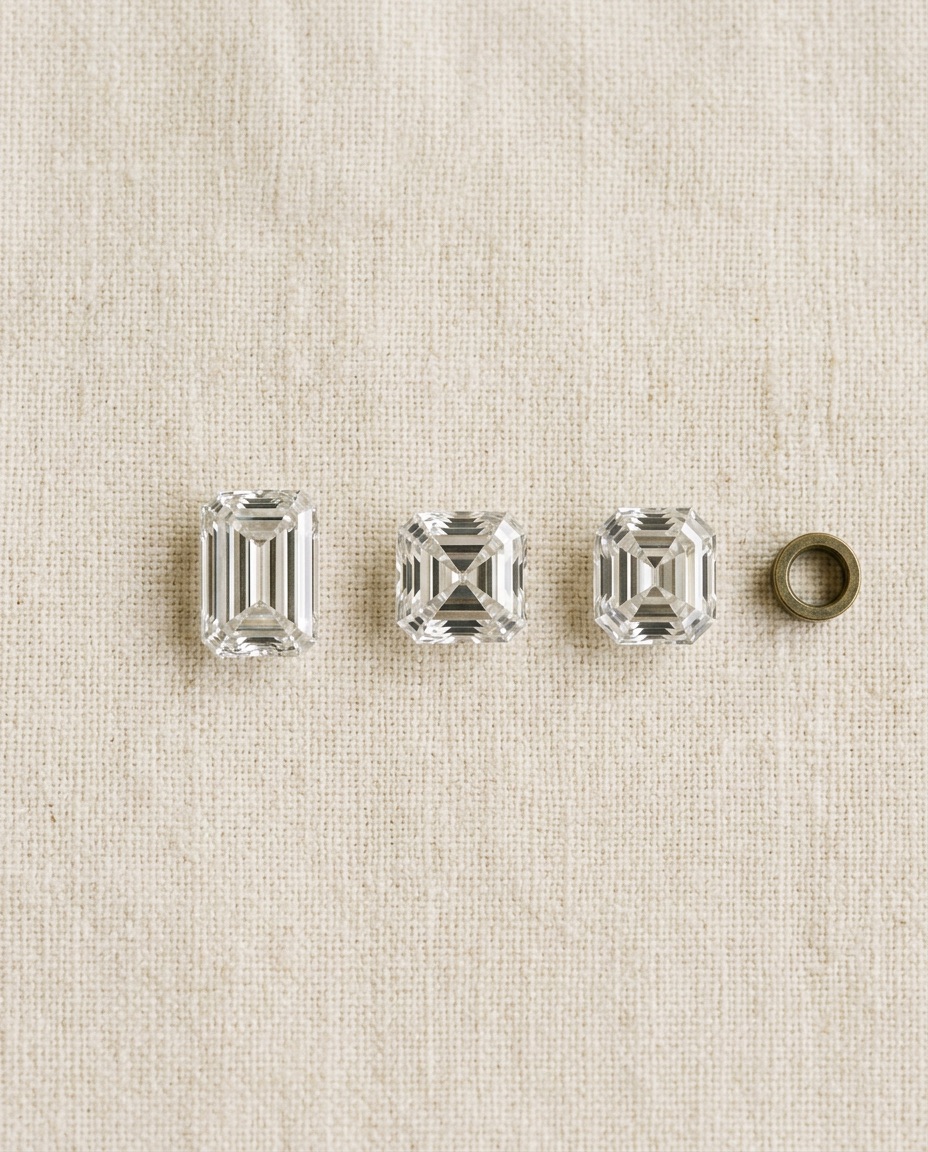
Step-cut facet structure explained
Understanding the facet structure matters for trade buyers because it directly explains why emerald cut grades, sources, and sets differently than a brilliant cut of the same carat weight.
Table, crown steps, and pavilion steps
A round brilliant has 57 or 58 facets arranged as small triangles and kites radiating from the culet, engineered to bounce light back and forth for maximum scintillation. An emerald cut instead has a large, flat table surrounded by a small number of long, rectangular, stair-step facets — usually two or three concentric rows on the crown and a matching set on the pavilion. Light entering through the table and crown steps reflects off the pavilion in broad, flat planes rather than being broken into hundreds of small flashes, which is why the cut reads as a series of long, mirrored flashes as the stone moves instead of an all-over sparkle.
Cropped corners, culet, and symmetry
The cropped (bevelled) corners are both a design signature and a durability feature — a true 90-degree corner on a rectangular stone is the most vulnerable point on the diamond, so the corner facet spreads that stress across a wider edge. Because the open table gives an almost unobstructed view straight down into the stone, any misalignment between the crown steps and pavilion steps, or an off-center culet, is far more visible face-up than it would be on a brilliant cut, where the complex facet pattern hides small asymmetries. Symmetry grading carries more practical weight on an emerald cut than on most other shapes for exactly this reason.
Why emerald cut is trending in modern engagement rings
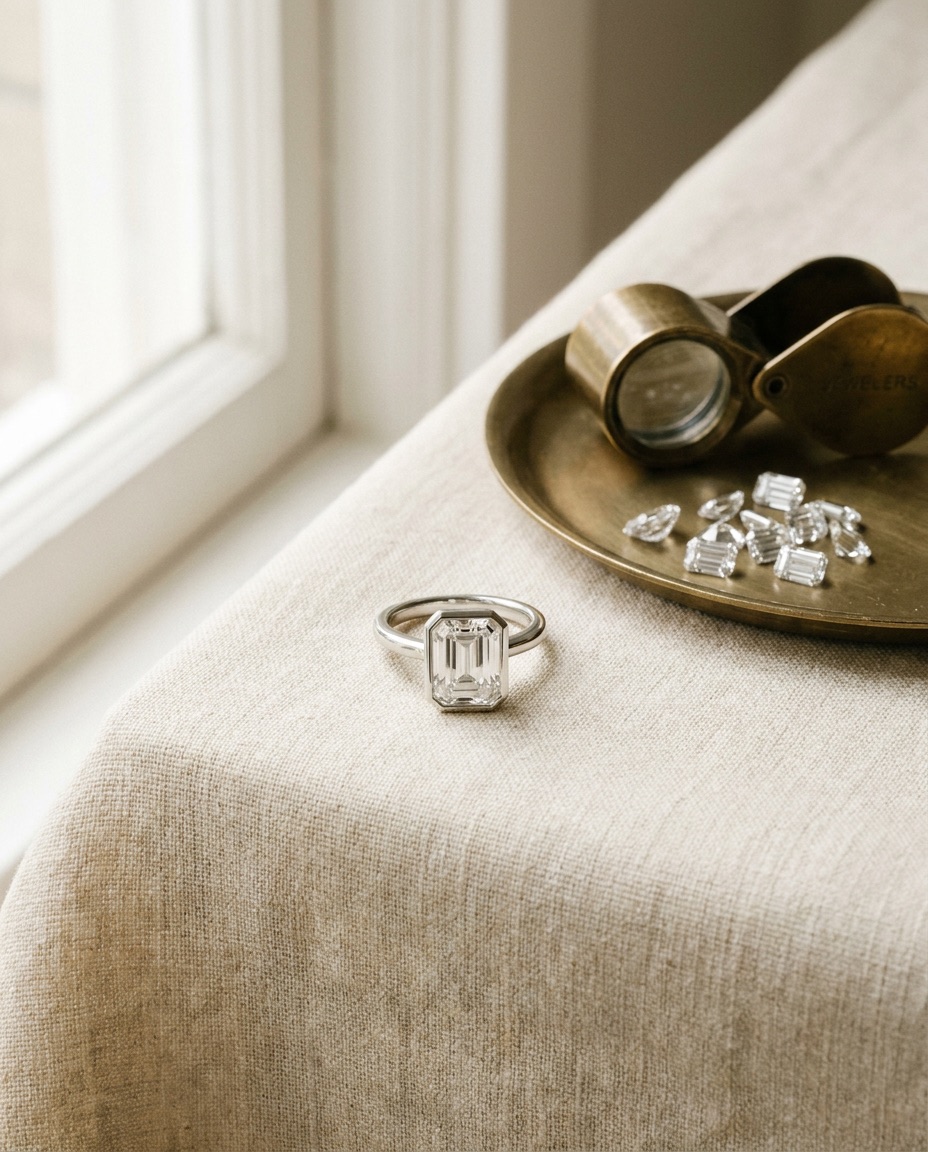
Emerald cut has moved from a secondary option to a lead request, and the reason is visual, not just trend-driven: the large open table and rectangular outline give it a bigger face-up appearance per carat than most brilliant cuts, and the step faceting reads as understated and architectural rather than maximalist — a look that fits the current shift toward vintage-modern and minimalist engagement ring styles. It also sets cleanly in bezel, halo, and three-stone configurations without the corner-protection concerns of princess or radiant, which makes it an easy shape to move across a range of settings and price points.
The shape also photographs well for the editorial, minimal-set style that dominates current engagement ring marketing — a single elongated stone on a thin band reads as intentional and modern in a way a cluster of small brilliants doesn't. Designers building capsule or signature collections frequently anchor them on an emerald cut center stone precisely because the silhouette does more visual work with less metal.
Grading and quality considerations for wholesale buyers
Because the facet structure is fundamentally different from a brilliant cut, the standard 4Cs need to be read differently when sourcing emerald cut for resale. Three factors matter more here than on most other shapes: proportions, clarity visibility, and table-to-depth ratio.
Length-to-width ratio and outline
Classic emerald cut runs 1.30–1.50 L:W; outside that range it reads as either too square (closer to an asscher) or too narrow and "letterbox" in profile, so confirm exact measurements against the shape name rather than relying on the label alone. A ratio in the middle of that range (roughly 1.35–1.45) is the safest default for a general trade assortment — it reads as a clean, classic emerald cut to the widest range of retail customers. Buyers sourcing for a specific aesthetic (a longer, more dramatic silhouette for statement pieces, for example) can request a higher ratio, but should expect a smaller available pool at that spec.
Clarity visibility and the open-table effect
Because the open table hides inclusions less than a brilliant facet pattern, buyers sourcing emerald cut should generally spec one clarity grade higher than they would for a round of the same size — a VS2 emerald cut will typically show more than a VS2 round of comparable carat weight, because there's no facet pattern breaking up the sight line into the stone. For resale inventory intended to move quickly at retail, VS1 and above is the safer working floor; SI clarity can still work but needs individual eye-clean confirmation rather than a blanket clarity-grade assumption, since inclusion location relative to the table matters as much as the grade itself on this shape. Color reads the same way — face-up color is more visible on an open-table shape, so buyers working toward a specific color ceiling for a line should hold that line more strictly on emerald cut than on brilliant shapes.
Table and depth ratio
Depth typically runs 60–68% on a well-cut emerald cut, and table percentage is usually large by design — that's the source of the cut's signature look. Too shallow a pavilion and the stone can show a "fish-eye" dead zone in the center of the table where light leaks through instead of reflecting back; too deep and the stone can look small and dark for its carat weight, with light escaping out the sides of the pavilion instead of returning through the table. Step count adds to this: more concentric steps on the crown and pavilion generally produce a cleaner, more graduated "hall of mirrors" effect, while fewer, coarser steps can look flat. None of this shows up directly on a certificate as a single "cut grade" the way it does for round brilliants — most labs don't issue an overall cut grade for fancy shapes — so proportions, symmetry, and polish notes on the certificate need to be read together rather than relying on one summary grade.
Guru Diam's in-house sourcing and cutting
Guru Diam's emerald cut inventory is CVD-grown and cut in-house, with the rough selected specifically for step-cut yield rather than repurposed from brilliant-cut leftovers. Because step-cut proportions and symmetry matter more to the finished look than they do on a brilliant, cutting decisions — where to place the table, how many steps to cut, where the corners fall — are made stone by stone rather than run through a single automated recipe. Every finished stone is checked for facet alignment and step symmetry before it's certified and added to inventory, which is also why our on-hand assortment skews toward the clarity and color ranges that hold up well face-up on this shape rather than carrying the full spread a brilliant-cut category would.
Certification is IGI standard, with GIA and GCAL both available on request — useful for buyers whose retail customers ask for a specific lab, or who are matching a certificate type already used elsewhere in a bridal set. All three labs grade the same physical stone the same way; the choice is about buyer or end-customer preference, not stone quality.
Pricing factors for emerald cut wholesale
Emerald cut pricing follows the same core inputs as any diamond — carat, color, clarity, certification — but a few shape-specific factors move the number more than buyers used to sourcing brilliant cuts might expect.
- Rough utilization. Step cuts retain a smaller percentage of the starting rough than a round brilliant does, because the rectangular outline and flat step facets are less efficient at working around a rough stone's natural shape. That yield difference is baked into cutting cost and shows up more at larger carat sizes, where rough scarcity compounds the effect.
- Length-to-width ratio. Stones at the classic 1.30–1.50 ratio price in line with standard market expectations; ratios well outside that range — either very square or very elongated — move price in either direction depending on how deep the demand pool is for that specific look at the time of sourcing.
- Clarity premium. Because buyers generally need to spec one grade higher than they would on a round for the same face-up clean look, the effective clarity cost per stone runs higher than a straight grade-for-grade comparison against brilliant cuts would suggest.
- Symmetry and step alignment. Two stones with identical certificate numbers for carat, color, and clarity can look meaningfully different face-up if step alignment or table centering differs — well-aligned stones command a premium buyers should expect and budget for, since it's a real quality difference the certificate doesn't always fully capture in one line.
- Certification lab. IGI, GIA, and GCAL price slightly differently against each other in the secondary market; Guru Diam prices each stone on its own merits rather than a flat lab surcharge, but buyers matching a specific lab for a retail program should confirm current pricing by lab at order time.
- Fancy color emerald cut. Guru Diam's fancy color emerald cut assortment — available in yellow, pink, blue, and green — carries the same premium structure as fancy color in other shapes, with the open table showing hue as a deep, even wash rather than scattered color flashes, which is part of why fancy color buyers specifically request step cuts.
With 596 pieces on hand, emerald cut is one of Guru Diam's deepest standard categories, which matters for pricing consistency on multi-stone orders — matching a bridal set or a small production run to consistent color and clarity is easier from a deep, single-source pool than by combining partial lots from multiple suppliers.
Setting and styling guidance
Emerald cut's cropped corners are less chip-prone than princess or radiant, but the long, exposed step facets along the girdle mean the setting still needs to distribute pressure evenly rather than concentrate it. Four-prong and bezel settings are both standard; a bezel adds extra edge protection and is common for buyers who want the shape's clean lines uninterrupted by metal. Because the open table shows the culet and any facet misalignment clearly, symmetry grading matters more here than on a brilliant cut of comparable size — worth checking alongside the standard color and clarity grades before committing to a stone.
For center-stone work, double-claw prongs at each corner are the most common commercial setting, balancing security with minimal metal coverage over the step facets. Hidden-halo settings — a halo tucked under the crown rather than surrounding it — have picked up demand from buyers wanting extra sparkle without disrupting the clean rectangular outline that's the whole appeal of the shape. Three-stone settings pairing an emerald cut center with trapezoid or half-moon side stones remain a strong seller for buyers targeting the vintage-modern bridal customer, and an emerald cut set East-West (long axis running across the finger rather than up it) has become a recognizable statement look for fashion-forward pieces distinct from traditional bridal.
Outside bridal, emerald cut performs well in stud and drop earrings, tennis-style lines using calibrated smaller sizes, and as a center stone in cocktail rings where the large face-up presence per carat is a direct selling point to end customers comparing carat weight against sticker price.
Emerald cut vs. asscher cut vs. octagon cut
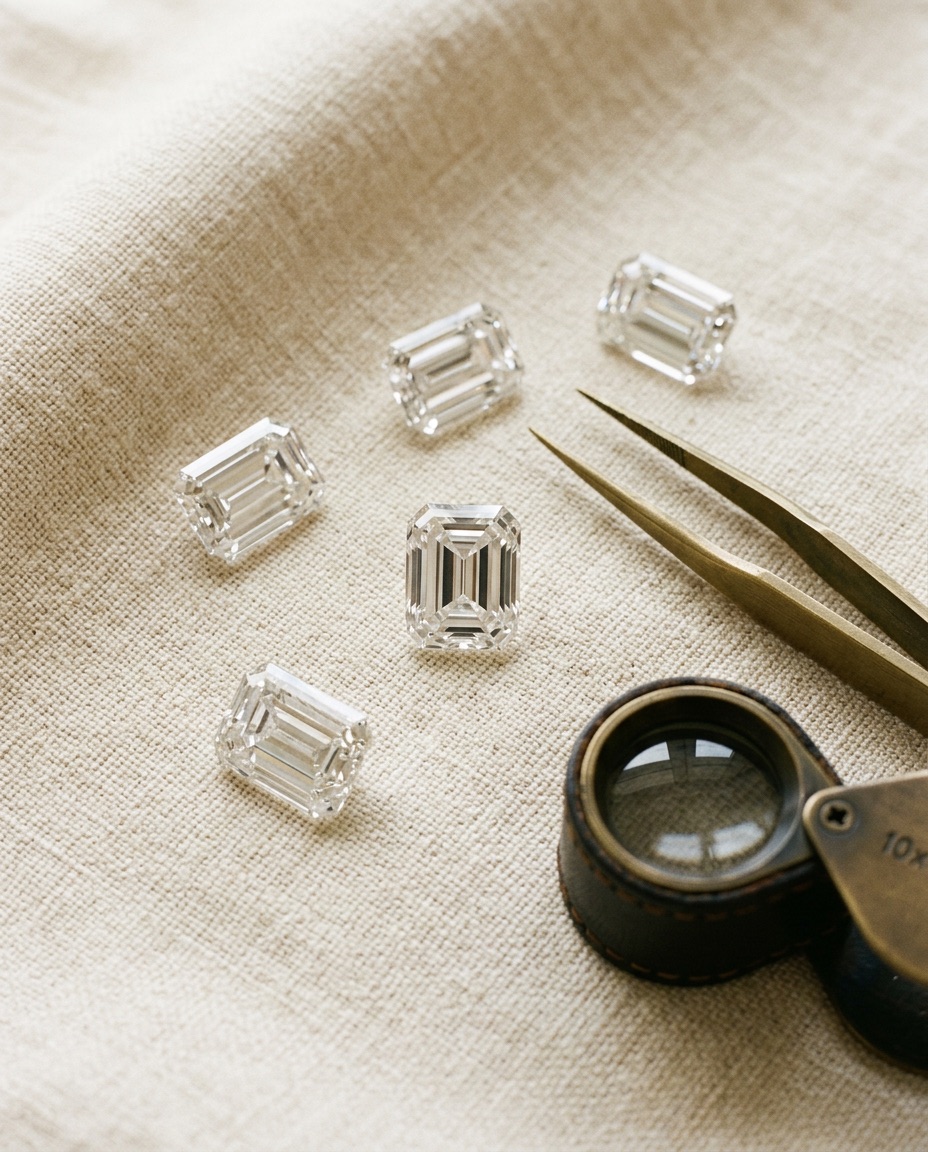
All three are step-cut shapes and get confused for each other regularly in trade conversations, but they read and source differently enough that buyers should treat them as distinct categories rather than substitutes.
| Shape | Outline | Typical L:W | Facet character | Best fit |
|---|---|---|---|---|
| Emerald | Elongated rectangle, cropped corners | 1.30–1.50 | Broad, elongated step flashes; largest face-up spread per carat of the three | Bridal center stones, statement rings, editorial-style pieces |
| Asscher | Nearly square, deeply cropped corners (near-octagonal outline) | 1.00–1.05 | Tighter, more concentrated "windmill" pattern from steeper, higher crown steps | Vintage-forward buyers wanting a more contained, symmetrical look |
| Octagon | True eight-sided outline, less standardized proportions | Varies by cutter | Broader step facets than asscher, flatter crown than emerald | Calibrated melee and accent stones, geometric Art Deco-style settings |
Asscher is essentially a square-format step cut — the near-equal length and width mean the concentric steps sit closer together and the crown is typically cut a little steeper, producing that tighter "windmill" light pattern collectors associate with the shape. It shows inclusions and color at least as readily as emerald cut, sometimes more, since the shorter facets give light even fewer places to hide. Octagon, in trade usage, usually refers to a true eight-sided step-cut outline — distinct from an elongated emerald cut, though the terms occasionally get used loosely for calibrated shapes in melee work. All three fall into the same Regular Fancy pricing and production tier in Guru Diam's catalog — none of them are antique cuts, despite the step-facet pattern reading as vintage to most buyers. Emerald cut carries Guru Diam's deepest standard inventory of the three; asscher and octagon are both sourced primarily to order and as calibrated shapes for accent work.
How to order emerald cut wholesale from Guru Diam
Guru Diam carries emerald cut as trade-only, wholesale inventory — no retail markup — from our New York Diamond District desk (36 West 47th Street, Suite 601A, New York, NY 10036) and our Los Angeles office (607 South Hill Street, Suite 241, Los Angeles, CA 90014). At 596 pieces on hand, emerald cut is one of our deepest standard categories, with size, color, and clarity range to match. In-stock pieces ship same-day from New York before 6pm EST, or same-day from Los Angeles before 4pm PST; a custom-built ring — from CAD approval to finished piece — is ready in 4–6 days.
To start sourcing, open a verified wholesale account at /signup and book time with a gemologist at /book-appointment to walk through current inventory against your spec — carat range, L:W ratio, clarity floor, and certification lab. For a quick trade question outside a scheduled call, our WhatsApp line is the fastest way to reach a gemologist directly. Multi-stone and matched-set orders (bridal sets, small production runs) are sourced from the same on-hand pool where possible to keep color and clarity consistent across the order, and ship as one consolidated shipment rather than split lots.
Emerald cut is also available in fancy color — yellow, pink, blue, and green — showing hue as a deep, even wash rather than scattered sparkle. See our fancy color emerald cut guide for that side of the category.
FAQ
What is an emerald cut lab-grown diamond? An emerald cut is a rectangular step-cut diamond with cropped corners, a large open table, and long parallel facets that produce broad, mirror-like flashes of light instead of scattered fire — often described as a "hall of mirrors" effect.
Why do emerald cut diamonds show inclusions more than round diamonds? The open table and step faceting reflect light in long, flat planes rather than breaking it into small brilliant flashes, which makes inclusions and color more visible face-up. Buyers typically spec one clarity grade higher for emerald cut than they would for a round of the same size.
What's the difference between emerald cut and asscher cut? Emerald cut is an elongated rectangle (1.30–1.50 length-to-width); asscher is nearly square (1.00–1.05) with more deeply cropped corners and a steeper crown, producing a tighter "windmill" light pattern instead of emerald cut's broader, longer flashes. Both are step cuts and both fall in the same Regular Fancy pricing tier — neither is an antique cut.
Is IGI, GIA, or GCAL certification available for emerald cut lab-grown diamonds? IGI is standard across Guru Diam's emerald cut inventory, with GIA and GCAL both available on request.
How many emerald cut diamonds does Guru Diam have in stock? 596 pieces as of this writing, one of our deepest standard shape categories, from our New York Diamond District desk. Inventory is on-hand stock that rotates as orders ship and new cut stones are added.
How fast can I get an emerald cut stone or a finished custom piece? In-stock loose stones ship same-day from New York or Los Angeles. A custom-built piece — from CAD approval to a finished, ready-to-ship ring — takes 4–6 days.