E and F color diamonds sit second and third on the GIA color scale, directly below D (the top, completely colorless grade), and both are classified within the "Colorless" category — meaning the practical visual difference between an E and an F color diamond is extremely subtle, detectable reliably only by a trained grader under controlled lighting against master comparison stones, not by eye in normal wear. For most buyers, the real question isn't which grade looks better, since face-up they look essentially identical, but whether the price gap between the two grades is worth paying for a distinction that's functionally invisible outside a gemological lab.
This guide compares E and F color diamonds on what actually causes the grade difference, how visible that difference really is, pricing, and when — if ever — a wholesale buyer should prioritize E over F color for a specific customer or inventory need.
The GIA Color Scale: Where E and F Sit
The GIA color scale runs from D (completely colorless) through Z (light yellow or brown), graded by comparing a stone against a set of master stones under controlled, standardized lighting conditions — a diamond's exact color grade is determined by how much (if any) yellow or brown body tint a trained grader detects relative to those masters, viewed table-down against a white background. D, E, and F together make up the "Colorless" category, the top tier of the scale, before G through J make up "Near Colorless," where body tint starts becoming faintly detectable to a trained eye without comparison stones, particularly in larger stones or specific settings.
| Grade | Category | Practical description |
|---|---|---|
| D | Colorless | Completely colorless, the top of the scale, no detectable tint even to a trained grader |
| E | Colorless | Essentially colorless, an extremely minor trace detectable only by a trained grader under comparison |
| F | Colorless | Still within the colorless category, an extremely minor trace detectable only by a trained grader under comparison |
| G-H | Near Colorless | Near colorless to the eye, warmth becomes faintly detectable without comparison stones starting around here for some trained observers |
What Actually Distinguishes E From F Color
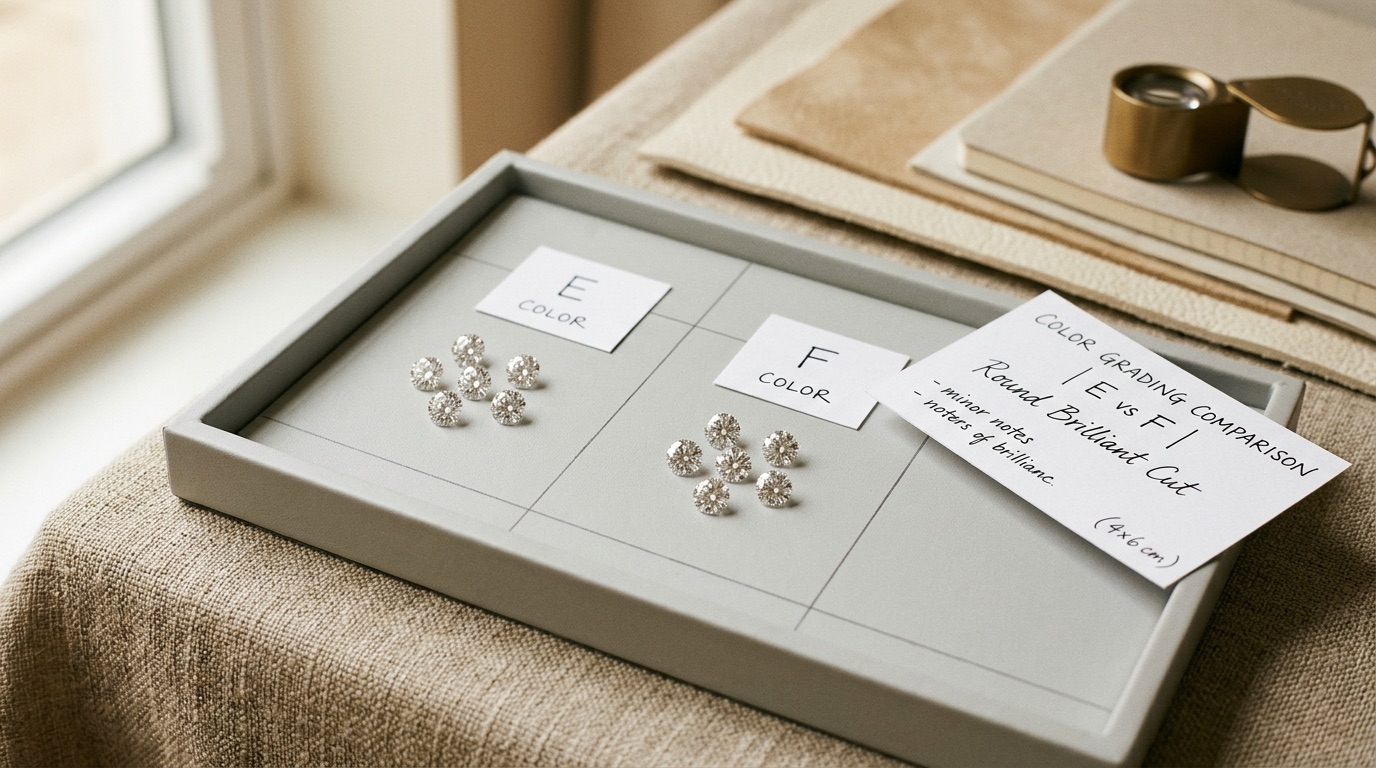
The difference between E and F color comes down to an extremely small amount of additional yellow or brown body tint present in an F color stone compared to an E, caused by trace nitrogen impurities in the crystal lattice (for natural diamonds) or specific growth-process variables (for CVD lab-grown diamonds) — a difference so minor that GIA graders themselves rely on side-by-side comparison against calibrated master stones rather than judging a stone in isolation, since the human eye alone can't reliably distinguish adjacent color grades this close to the top of the scale without that direct comparison reference. In practical terms, both E and F color diamonds read as fully colorless to virtually any observer in any real-world viewing condition, including jewelers experienced in color grading who lack access to master comparison stones in the moment.
Is There a Visible Difference Between E and F Color?
No — not to the naked eye, and not reliably even to an experienced jeweler without master stones for direct comparison. The difference between adjacent color grades this high on the scale (D-E, E-F, F-G) is consistently described across the trade as face-up invisible without comparison-stone grading equipment, and this is precisely why GIA's own methodology relies on physical master stone comparison rather than independent visual assessment — if the difference were reliably visible without that aid, the grading process wouldn't need it. A buyer or end customer looking at a mounted E color stone next to a mounted F color stone of the same cut and clarity, with no reference stones or grading equipment on hand, will not be able to reliably tell which is which.
E vs. F Color: Side-by-Side Comparison
| Factor | E Color | F Color |
|---|---|---|
| GIA category | Colorless | Colorless |
| Visible difference face-up | None detectable without master-stone comparison | None detectable without master-stone comparison |
| Typical price vs. D color | Modest discount to D | Slightly larger discount to D than E carries |
| Best paired with | Any clarity/cut tier where a buyer specifically wants to market a near-top color grade | Any clarity/cut tier — the more cost-efficient colorless-category choice for most buyers |
| Common use case | Larger center stones, halo settings that amplify color visibility around the stone's edge | Most colorless-tier sourcing where value efficiency matters more than the marginal grade difference |
Pricing: Is E Color Worth the Premium Over F?
E color typically commands a real, though moderate, price premium over F color at matched clarity, cut, and carat weight, reflecting its position one step closer to D on the scale rather than any actual visible quality advantage. For most wholesale buyers and most end customers, F color delivers essentially the same face-up appearance as E at a lower price point, making F the more cost-efficient choice within the colorless category for the large majority of use cases — the premium for E is paid primarily for the grade label itself and its marginal proximity to D, not for a perceptible visual improvement. Buyers should weigh this premium against their specific customer base: a customer who cares primarily about a "colorless" or "D-F" label for its own sake, or who's purchasing at a price point where every grade increment is part of the sales narrative, may still value E specifically, while a customer focused purely on visual result per dollar is generally better served recommending F.
When the E-F Distinction Actually Matters
There are a small number of situations where color grade this high on the scale can matter more than usual, even though E and F remain visually indistinguishable from each other in every case:
- Larger stones — body color, to the extent any is present, becomes marginally easier to detect in larger stones simply because there's more material for light to travel through, which is part of why buyers sourcing larger center stones sometimes prioritize the top of the colorless range generally (D-F) rather than dropping into G-H, even though E vs. F specifically remains indistinguishable at any size.
- Certain settings — a halo setting surrounding the center stone with smaller diamonds, or a yellow gold setting, can each interact with perceived color in ways that make overall colorless-category sourcing (D-F broadly) a more deliberate choice, again without meaningfully distinguishing E from F specifically within that range.
- Certificate-driven sales narratives — some buyers and end customers specifically want the highest defensible grade on paper for resale or investment-framed purchases, where E's proximity to D carries marketing value independent of any visual difference.
Color Grading: Natural vs. CVD Lab-Grown
GIA, IGI, and GCAL all grade color the same way regardless of whether a diamond is natural or CVD lab-grown — using the same master-stone comparison methodology under the same standardized viewing conditions — so an E or F color grade means the same thing on a lab-grown certificate as it does on a natural one. The trace elements or growth conditions that produce a small amount of body tint differ in origin between natural formation and controlled CVD growth, but the resulting grade and its practical visual meaning to a buyer are identical across both origins.
How Color Interacts With Cut and Clarity
Color grade doesn't operate independently of a stone's other quality factors when it comes to actual face-up appearance. A well-cut stone returns more light and brilliance, which can make minor color less noticeable by drawing the eye to sparkle rather than body tint — meaning a well-cut F color stone can look every bit as bright and colorless as a poorly cut E color stone in practical terms. This is part of why experienced buyers weigh cut quality alongside color grade rather than optimizing color in isolation, since an excellent cut can do more for a stone's actual visual impression than climbing one color grade typically does.
Fluorescence Considerations for D-F Color Stones
Fluorescence — how a diamond reacts under ultraviolet light — is a separate certificate data point from color grade, but it's worth factoring into color-tier sourcing decisions specifically at the top of the scale. Strong blue fluorescence can, in some stones, cause a very slight hazy or oily appearance under certain lighting, a consideration buyers sourcing D-F color stones sometimes weigh alongside the color grade itself, since a strongly fluorescent stone at the top of the color scale can occasionally underperform its grade visually in a way a non-fluorescent stone of the same grade wouldn't. This is a stone-specific characteristic worth checking on the certificate rather than a universal rule against fluorescence at any particular color grade.
Sourcing Strategy for Colorless-Category Inventory
Buyers building a colorless-category (D-F) inventory tier generally get the most value weighting F color more heavily than E within that tier, given F's essentially identical visual performance at a lower cost, while reserving E and D sourcing specifically for customer requests or sales contexts where the grade label itself — not the visual result — is part of what's being sold. This approach maximizes visual quality delivered per dollar across a broad inventory mix, while still keeping D and E available for the specific customers and use cases where the top grades carry real value beyond their appearance.
Metal Setting and Perceived Color
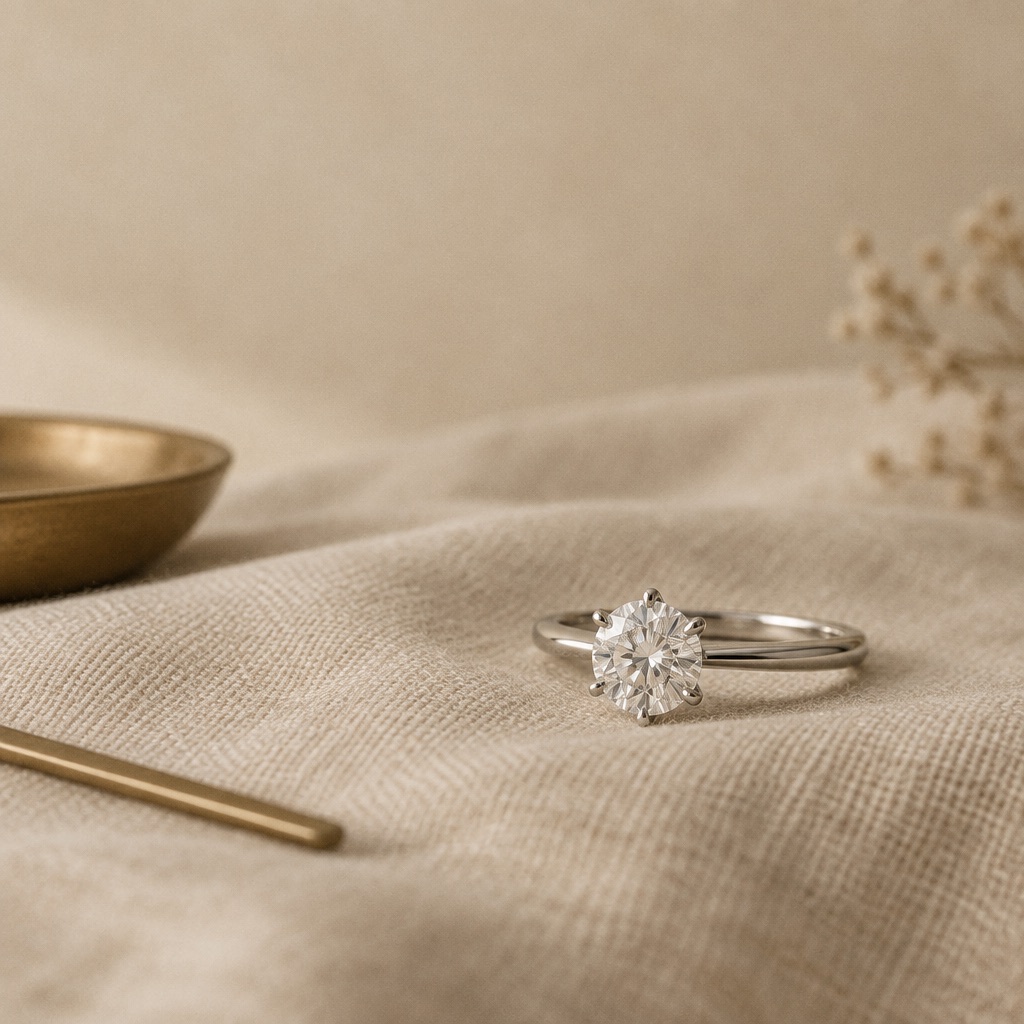
The metal a stone is set in can subtly affect how its color reads face-up, which is worth factoring into color-tier recommendations alongside the certificate grade itself. White metals (platinum, white gold, white rhodium-plated gold) provide a neutral backdrop that lets a stone's true color grade show through most directly, while yellow or rose gold settings reflect warm tones back into the stone, which can make a near-colorless or faint-color stone read whiter than its certificate grade alone would suggest — a detail some buyers use deliberately to stretch value further down the color scale for a given desired appearance, and one that applies equally within the colorless category, though the effect matters far less there since D, E, and F are already visually indistinguishable from each other regardless of setting.
Cut and Clarity Requirements Interacting With Color Choice
Color, cut, and clarity are frequently discussed as independent factors, but sourcing decisions benefit from weighing them together rather than optimizing any one in isolation. A buyer with a fixed budget per stone generally gets a better-performing, better-looking finished stone allocating more of that budget toward excellent cut grade and adequate clarity, and less toward chasing the top of the color scale specifically — since cut quality affects visible brilliance and whiteness far more directly than an imperceptible one-grade color shift does. This tradeoff is a common point of buyer education: many customers arrive assuming color grade is the primary lever for a stone looking "whiter" or brighter, when cut quality is usually the stronger, more visible driver of that same impression.
Certification and Verifying Color Grade
Because the E-F distinction is so fine, buyers should rely on certificate data from a reputable lab (GIA, IGI, or GCAL) rather than attempting to distinguish the two grades by eye when evaluating loose stone inventory, and should confirm any loose certified stone's laser inscription or measurements match its certificate before purchase — a mismatch is both a compliance issue and, given how visually similar E and F color stones are, an easy substitution error to make without careful certificate verification.
Sourcing E and F Color Diamonds Wholesale
Guru Diam stocks both E and F color diamonds across CVD lab-grown and natural catalogs, in standard, antique, and exotic shapes, cut and polished in-house before shipment from Guru Diam's New York and Los Angeles locations, with IGI, GIA, and GCAL certification available. In-stock inventory ships same-day (before 6pm EST from New York, before 4pm PST from Los Angeles), and Guru Diam can source specific color-clarity combinations for buyers sourcing against a defined quality tier. Trade buyers can browse certified inventory through certified diamonds, source matched color-graded side stones through matching pairs, review sourcing terms at the wholesale hub, or apply for a trade account through trade partner.
How Master Stones Work in Color Grading
The precision required to separate E from F color relies on a specific tool: a calibrated set of master stones, each pre-verified at a known, fixed position on the color scale, that a grader compares an unknown stone against directly, side by side, under standardized daylight-equivalent lighting in a controlled viewing environment. The stone being graded is viewed table-down (to remove the confounding effect of cut and light return on perceived color) against a neutral white background, positioned immediately next to a master stone at the grade boundary in question, so the grader is making a direct, immediate comparison rather than relying on memory or an isolated visual impression. This methodology exists specifically because color differences this fine — a trace of yellow or brown so faint it sits well below what most people would register as "off-white" in any normal context — aren't reliably assessable without that direct comparison reference, which is exactly why GIA, IGI, and GCAL all use master-stone comparison as the backbone of their color-grading process rather than an unaided visual scale.
Why the Colorless Category Commands a Premium at All
Given that E and F (and D) are visually indistinguishable to virtually anyone without master-stone comparison equipment, it's a fair question why the colorless category commands any price premium over near-colorless grades at all. Part of the answer is genuinely visual — the practical, detectable difference between D-F (colorless) and G-J (near colorless) does exist and grows more apparent as stones get larger, even though the specific gap within D-F itself doesn't. The rest of the premium reflects certificate-driven market dynamics: buyers and end customers who specifically want the highest defensible grade on paper, whether for resale considerations, investment-adjacent purchases, or simply wanting the reassurance of a top grade regardless of visual impact, sustain real demand — and therefore real pricing — at the very top of the scale independent of whether that top grade is perceptible.
Common Buyer Misconceptions About Top Color Grades
- Assuming a visible gap exists between every adjacent grade. The gap between D and J, taken as a whole, is real and eventually visible; the gap between any two adjacent grades within that range, including D-E, E-F, and F-G, is not reliably visible on its own.
- Assuming higher color grade always means a better-performing stone. Cut quality has a larger practical effect on a stone's face-up brilliance and apparent whiteness than moving one color grade typically does — an excellently cut F color stone will generally out-perform a poorly cut E color stone in actual visual impression.
- Assuming color grading differs meaningfully between labs at this tier. GIA, IGI, and GCAL all use comparable master-stone methodology at the top of the scale; buyers should confirm which lab graded a specific stone for their own recordkeeping and customer-facing certificate presentation, but shouldn't assume one lab is systematically more lenient at D-F specifically without stone-by-stone evidence.
- Overpaying for E across an entire inventory tier rather than sourcing it selectively. Given F's near-identical visual performance, defaulting an entire colorless-tier program to E color rather than reserving it for specific customer requests is a common, avoidable source of unnecessary sourcing cost.
Building a Color-Tiered Sourcing Program
Wholesale buyers serving a range of customer price points benefit from structuring loose-stone inventory across clearly defined color tiers rather than sourcing a single blended color grade across the board — a colorless tier (D-F, weighted toward F and G for value efficiency, with D and E available specifically for grade-driven requests), a near-colorless tier (G-H, the highest-volume sweet spot for most bridal buyers balancing appearance and cost), and a faint-color tier (I-J and below, priced for buyers specifically optimizing budget over grade). Structuring inventory this way lets sales staff match a customer's actual priorities — visual result, budget, or certificate grade — to the right tier quickly, rather than treating color grade as a single linear scale where higher is always better regardless of what the customer is actually optimizing for.
Guidance for Recommending E vs. F to Customers
Jewelers and sales staff fielding a customer's color-grade question generally get the best result explaining that E and F are visually indistinguishable and that F delivers essentially the same appearance at better value, reserving a specific E or D recommendation for customers who've explicitly prioritized top-of-scale grading for reasons beyond visual appearance (certificate-driven purchases, resale considerations, or simply wanting the marketing reassurance of the highest defensible grade). This transparent, value-focused approach tends to build more customer trust than defaulting to the higher-margin higher grade without explaining that the visual difference is effectively zero.
Frequently Asked Questions
Can you tell the difference between E and F color diamonds by looking at them?
No — the difference is so minor that even trained graders rely on side-by-side comparison against master stones under controlled lighting to distinguish them. To any observer without that equipment, E and F color diamonds look identical.
Is E color diamond better than F color?
E sits one step closer to D (completely colorless) on the GIA scale, but both are within the same "Colorless" category and are visually indistinguishable face-up. E typically costs more without delivering a visible quality improvement over F for most buyers.
Is F color a good choice for an engagement ring center stone?
Yes — F color delivers essentially the same colorless appearance as E or D at a more efficient price point, making it a strong value choice for a center stone at any size for the large majority of buyers.
Does diamond size affect how visible E vs. F color is?
The E-F distinction itself stays invisible regardless of size, but larger stones generally make any body tint present marginally easier to detect overall, which is part of why some buyers sourcing larger center stones prioritize the broader D-F colorless range rather than dropping into G-H.
Does color grading work the same way for lab-grown and natural diamonds?
Yes — GIA, IGI, and GCAL grade color using the same master-stone comparison methodology regardless of whether a diamond is CVD lab-grown or natural, so an E or F grade means the same thing on either type of certificate.
Should fluorescence affect a decision between D, E, and F color diamonds?
It can be worth checking — strong blue fluorescence occasionally causes a very slight hazy appearance in some stones at the top of the color scale, so it's worth reviewing the certificate's fluorescence field alongside color grade rather than treating color grade in isolation.