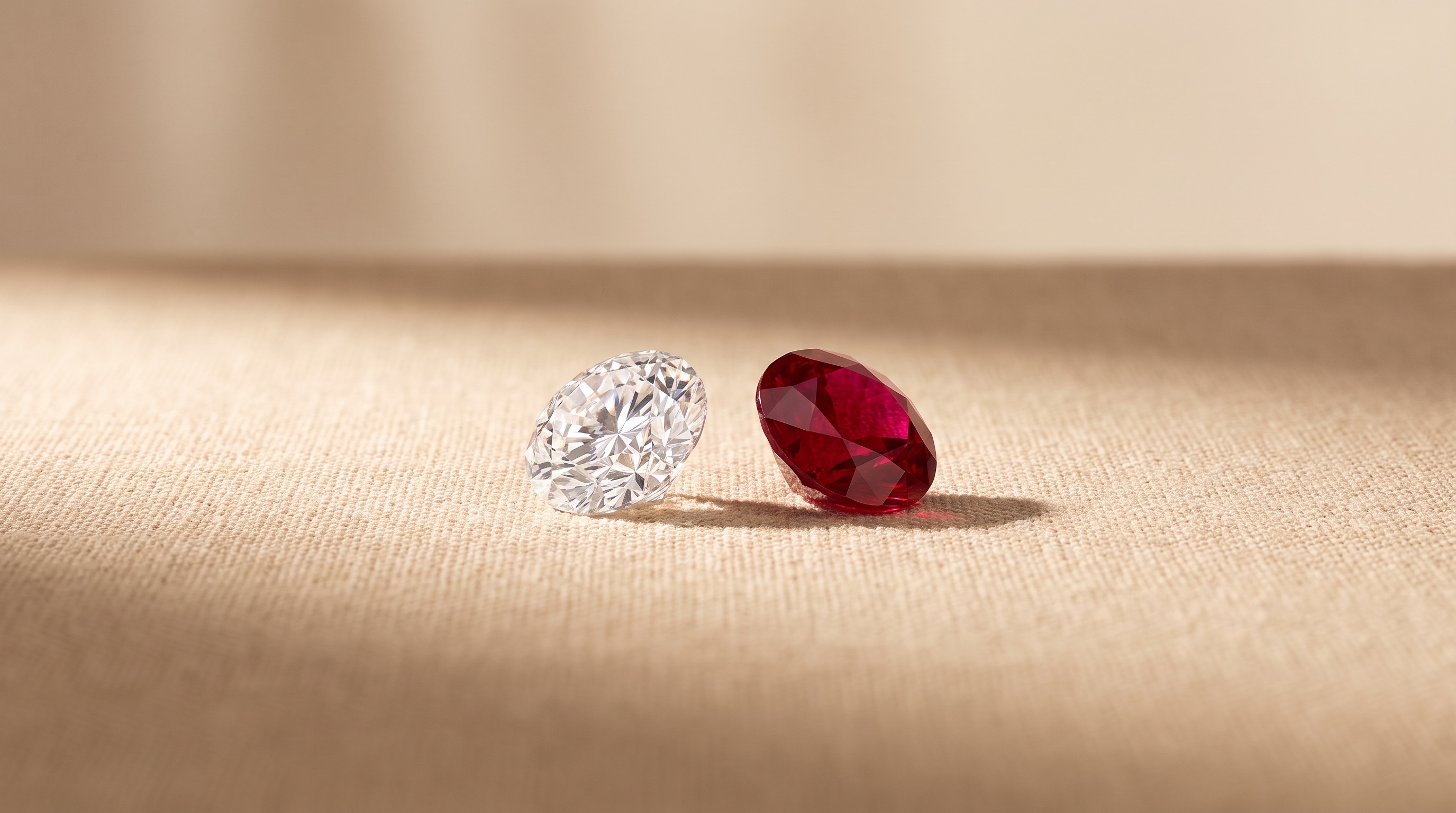
Diamond and ruby are both hard, durable gemstones suited to daily-wear fine jewelry, but they differ fundamentally in composition, color, and value drivers: diamond is crystallized carbon, valued in its classic form for colorlessness and light performance, while ruby is a red variety of the mineral corundum, valued almost entirely for the depth and purity of its red color. They aren't interchangeable, and the choice between them typically comes down to whether a buyer wants a colorless, maximum-brilliance center stone or a saturated color statement in one of the most historically prized gemstone colors.
This is a comparison retail jewelers field regularly from customers weighing a colored center stone against a traditional diamond, and it's one wholesale buyers need a confident, accurate answer to when advising accounts on center-stone alternatives. This guide covers what each material actually is, how they compare on hardness, color, treatment, certification, and price, and what to know before recommending either for a piece meant to be worn every day.
What a Diamond Actually Is
Diamond is a single-element mineral — pure crystallized carbon arranged in a cubic lattice, formed under extreme heat and pressure either deep within the earth's mantle over geological time (natural diamond) or in a controlled reactor via Chemical Vapor Deposition, or CVD (lab-grown diamond). Diamond's classic form is colorless to near-colorless, graded on the D-to-Z scale, though diamond also occurs in fancy colors — yellow, pink, blue, and green among them — driven by trace elements or structural anomalies in the crystal lattice. Diamond is graded on the 4Cs: cut, color, clarity, and carat weight, applied identically by GIA, IGI, and GCAL across both natural and lab-grown material.
What a Ruby Actually Is
Ruby is a gem-quality variety of corundum, a crystalline form of aluminum oxide, colored red by trace amounts of chromium present during formation. Corundum in any other color — blue, pink, yellow, green, purple — is classified as sapphire; ruby and sapphire are chemically identical minerals, distinguished from each other purely by the presence of red color intense enough to qualify as ruby rather than a pink or purplish-red sapphire, a distinction that itself is a genuine, sometimes debated line in the trade. Ruby forms naturally across a handful of significant geological sources and is also produced synthetically at gem quality using processes distinct from diamond's CVD growth method. Ruby is graded primarily on color — hue, tone, and saturation, with the finest examples showing a pure, vivid red often described in the trade as "pigeon's blood" — alongside clarity and cut, using a system that differs meaningfully from diamond's 4Cs framework.
Diamond vs. Ruby: Side-by-Side
| Attribute | Diamond | Ruby |
|---|---|---|
| Composition | Pure carbon | Aluminum oxide (corundum) colored by chromium |
| Mohs hardness | 10 | 9 |
| Refractive index | ~2.42 | ~1.76-1.78 |
| Dispersion (fire) | ~0.044 | ~0.018 |
| Primary value driver | Colorlessness and cut brilliance (classic form); saturation for fancy colors | Red color purity and saturation |
| Grading system | 4Cs — cut, color, clarity, carat (GIA/IGI/GCAL) | Color-led grading (hue, tone, saturation), plus clarity, cut, and often origin |
| Relative price tier | Higher for comparable-quality colorless stones; fancy color diamond commands its own premium | Wide range; fine natural ruby with strong "pigeon's blood" color can price at or above diamond of comparable carat weight |
Hardness and Durability for Daily Wear
Diamond sits at 10 on the Mohs hardness scale, the hardest known natural material, whether natural or lab-grown. Ruby sits at 9 — a single step below diamond, but still exceptionally hard, sharing its exact hardness rating with sapphire since both are corundum. In practical terms, both materials resist scratching extremely well under normal daily wear; the narrow gap between 9 and 10 is one reason ruby, like sapphire, is widely considered a genuinely worry-free choice for a daily-wear engagement ring or eternity band, unlike softer colored stones that require more careful handling.
Toughness — resistance to chipping or fracturing under impact, distinct from scratch-hardness — also favors both stones for daily wear. Diamond has a well-documented cleavage plane that can, in rare cases, cause a chip from a direct, precisely angled blow; ruby lacks diamond's cleavage plane and is, if anything, slightly more resistant to chipping from an off-angle impact despite its marginally lower Mohs hardness. Neither difference should meaningfully steer a typical buyer's decision on its own.
Color: The Central Difference
This is where the two stones diverge most fundamentally. Diamond's classic form is valued for the absence of color — the closer to perfectly colorless, the higher the D-to-Z grade — with brilliance and light performance, not hue, as the visual centerpiece. Ruby is valued almost entirely for the presence of a specific, intensely saturated red; unlike diamond, where fancy colors are a separate category alongside a colorless mainstream, ruby's entire commercial identity is built around one color family, and grading exists specifically to rank how close a given stone comes to the purest, most saturated red the trade recognizes.
This means the two stones answer different aesthetic goals entirely. A diamond center stone reads as bright, colorless, and maximally light-scattering — the classic engagement-ring look most buyers picture by default. A ruby center stone reads as a bold, historically significant color statement, long associated with passion, power, and royal jewelry across many cultures, and increasingly chosen by buyers specifically seeking a distinctive, non-traditional alternative to a colorless diamond solitaire.
Fire and Brilliance: Why a Diamond Sparkles Differently
Diamond's dispersion — the property responsible for "fire," the flashes of spectral color a stone throws under bright light — is approximately 0.044, more than double ruby's roughly 0.018. Combined with diamond's higher refractive index (about 2.42 versus ruby's roughly 1.76-1.78), diamond bends and splits light more dramatically, which is the physical basis for diamond's reputation as the more overtly "sparkly" of the two stones. Ruby's lower dispersion means it shows less rainbow-flash fire and instead reads as a rich, saturated block of red with a warmer, more velvety brilliance — a genuinely different visual character, not a lesser one. Buyers wanting maximum light-performance sparkle are typically better served by diamond; buyers wanting a bold, saturated color statement are typically better served by ruby.
Certification: What Documentation Comes With Each Stone
Diamonds receive standard 4Cs grading reports from GIA, IGI, or GCAL, each with a verifiable report number tied to cut, color, clarity, and carat weight. Ruby certification works differently: major labs including GIA and GCAL issue colored-stone identification and origin reports for ruby, confirming the stone is genuinely corundum with chromium-driven red color, documenting any detected treatment, and often geographic origin, since origin carries a substantial premium for ruby specifically. A ruby report is a genuinely different document from a diamond grading report, answering origin- and treatment-focused questions central to ruby's value rather than the standardized 4Cs a diamond certificate documents.
Treatment Disclosure: A Much Bigger Factor for Ruby
Heat treatment to improve ruby's color and clarity is standard, disclosed, and broadly accepted throughout the trade — the substantial majority of commercially available ruby has been heat-treated, and this doesn't meaningfully reduce value when properly disclosed. More invasive treatments are far more common and more consequential in ruby than in almost any other major gemstone: lead-glass filling, used to dramatically improve the apparent clarity of heavily fractured, low-grade ruby, is widespread at the lower end of the market and carries a very large value discount relative to untreated or heat-only material, since it fills structural fractures with glass rather than merely improving color. This makes treatment disclosure an even bigger factor in ruby buying than in sapphire or diamond buying — a buyer or retailer sourcing ruby should always confirm treatment status is clearly and specifically stated on any accompanying report, since undisclosed or vaguely disclosed treatment is one of the most common sources of dispute and buyer complaint in the ruby trade.
Price: Rarity at the Top of the Ruby Market
Pricing between diamond and ruby depends heavily on quality tier, and ruby's price curve is unusually steep. At the commercial and mid-market tier, treated ruby is generally more affordable than a diamond of comparable visual size and quality, making it a genuine value alternative for budget-conscious buyers wanting a hard, durable, colored center stone. At the top of the market, the comparison inverts dramatically: a fine natural ruby with pure, vivid "pigeon's blood" red color and no treatment beyond standard heat is exceptionally rare — rarer, by most trade accounts, than a comparably fine sapphire or emerald — and top examples can command prices per carat that meet or exceed the finest diamonds, a well-documented dynamic at major auction houses rather than a marketing exaggeration. Lab-grown (synthetic) ruby, like lab-grown diamond, is dramatically less expensive than its natural counterpart at any given color and clarity, since it doesn't carry the same geological scarcity or the extreme rarity premium natural fine ruby commands.
Lab-Grown Diamond vs. Lab-Grown Ruby
Both diamond and ruby have long-established lab-grown production methods, though the two processes and their market history differ. CVD lab-grown diamond is a relatively recent commercial development, chemically and optically identical to natural diamond and graded on the same 4Cs scale. Synthetic ruby has an even longer manufacturing history than lab-grown diamond — flame-fusion synthetic corundum has been produced at commercial scale since the early 20th century — and synthetic ruby is, like lab-grown diamond, chemically identical to its natural counterpart, requiring specialized lab testing to distinguish origin. For a buyer weighing lab-grown options in either stone, the same basic value proposition applies: a lab-grown stone is the real mineral, at a dramatically lower price than natural material of comparable visual quality, with origin affecting price and market positioning rather than the stone's fundamental identity.
Choosing Between Diamond and Ruby for an Engagement Ring
- Buyers wanting the classic, colorless, maximum-brilliance look: diamond remains the standard choice, and no other gemstone matches its combination of hardness, fire, and cultural familiarity as a center stone.
- Buyers wanting a bold, historically significant color statement with strong daily-wear durability: ruby is one of the very few colored gemstones hard enough for genuinely worry-free daily wear, making it one of the most sought-after non-diamond center-stone choices among buyers wanting a colored alternative.
- Budget-conscious buyers wanting a large, durable center stone: commercial-tier heat-treated ruby frequently offers more visible size and color impact per dollar than a diamond of comparable price, though buyers should understand they're choosing a genuinely different aesthetic, not simply a cheaper diamond.
- Buyers wanting the strongest, most liquid resale position: diamond, particularly certified diamond graded on the standardized 4Cs scale, generally holds a clearer, more liquid resale position than ruby, where value depends heavily on origin, treatment history, and the specific stone's color, which are harder for a non-specialist buyer to assess independently.
Common Misconceptions Worth Correcting
- "Ruby is just a cheaper diamond alternative." Ruby is a genuinely different mineral valued for a specific saturated red color, not a budget substitute for diamond's colorless brilliance — the two solve entirely different aesthetic goals.
- "All ruby is treated and that makes it lower quality." Standard heat treatment is broadly accepted and disclosed industry-wide and doesn't meaningfully reduce a well-graded stone's value; it's glass-filling and other more invasive treatments that carry a very large discount and require clear, specific disclosure.
- "Ruby isn't durable enough for an engagement ring." At 9 on the Mohs scale, ruby is one of the hardest and most daily-wear-appropriate gemstones available outside diamond itself.
- "A diamond is always the more expensive stone." At the top of the market, a fine natural ruby with rare, pure red color can price at or above a diamond of comparable carat weight — ruby's rarity premium at the very top of the market is exceptionally steep.
- "Ruby and sapphire are different minerals." They're chemically identical corundum, distinguished from each other only by color — red corundum is ruby, every other color is sapphire.
Geographic Origin and Why It Matters Enormously for Ruby
Geographic origin plays an even larger role in ruby pricing than it does for sapphire, and a much larger role than for diamond. Burmese ruby — historically from the Mogok region of Myanmar — carries the single strongest origin reputation in the colored-stone trade, commanding a substantial premium for stones with lab-documented Burmese origin and the associated pure "pigeon's blood" color character. Mozambique has emerged as a major modern source producing fine material at meaningful volume, alongside Thailand, Sri Lanka, and Madagascar as other significant sources with their own trade reputations. Diamond, by contrast, is priced almost entirely on the 4Cs regardless of mine of origin, setting aside the separate question of conflict-free sourcing and chain-of-custody documentation, which applies to ethical sourcing rather than value. This is well-documented, widely taught colored-gemstone trade knowledge, distinct from and unrelated to any question about where a particular supplier's own diamonds are cut or manufactured.
Using Diamond and Ruby Together in One Piece
Diamond and ruby are frequently combined rather than treated as an either-or choice — a ruby center stone surrounded by a diamond halo is one of the most classic colored-center-stone configurations, pairing ruby's bold color statement with diamond's brilliance and light-scattering fire around the perimeter. This combination also has a practical sourcing benefit: diamond melee for a halo or accent setting is sourced the same way regardless of what center stone it surrounds, so a retailer already stocking diamond melee for standard diamond-center pieces can apply that same melee inventory to a ruby-center design without a separate sourcing process. Ruby and diamond eternity bands, alternating the two stones, are another well-established combination that reads as a bold, high-contrast alternative to an all-diamond band.
Cut Quality: A Different Priority for Each Stone
Cut grading works differently between the two materials in a way that reflects their different value priorities. Diamond cut grading (Excellent through Poor on GIA's scale) is a precise, angle-and-proportion-driven system built to maximize light return and brilliance from a colorless stone — cut is one of diamond's 4Cs and carries independent grading weight. Ruby cutting is judged less by a standardized proportion scale and more by how well the cutter has oriented the rough to maximize color evenness and depth of red across the finished stone — a skilled ruby cutter may sacrifice some theoretical brilliance-optimized proportions specifically to preserve or improve color saturation, a tradeoff that has no real equivalent in diamond cutting, where color and cut are graded as fully independent factors.
Sourcing Certified Diamonds at Wholesale
Guru Diam is a trade-only wholesale supplier carrying CVD lab-grown diamonds alongside natural loose stones, fancy color diamonds, and finished jewelry — one source for buyers who need real, certified diamond inventory across the full range of standard, antique, and exotic shapes. Every stone in the catalog is graded by GIA, IGI, or GCAL on the standard 4Cs scale, giving retail-facing jewelers a documented, verifiable answer for any customer weighing a diamond center stone. Guru Diam does not carry ruby or other colored gemstones; the focus is diamond — natural and CVD lab-grown, colorless and fancy color.
Certified loose stones ship same-day on in-stock inventory from both the New York and Los Angeles locations — before 6pm EST in NYC, before 4pm PST in LA — and custom engagement rings built around a certified center stone finish in 4-6 days, with cutting, setting, and polishing all handled in-house. Buyers can browse current inventory in the certified diamonds category or the fancy color loose diamonds category for buyers drawn to diamond's own colored varieties as an alternative to a separate colored gemstone, review trade terms at the wholesale hub, or apply for an account through trade partner. Buyers weighing a colorful diamond alternative rather than a separate gemstone entirely can start with our pink diamond buying guide or yellow diamond buying guide — the closest warm-toned diamond categories Guru Diam actually carries — and buyers comparing diamond against other colored gemstones can also see our diamond vs. sapphire guide. Jewelers designing a full piece around a center stone can work through custom jewelry.
Frequently Asked Questions
Is a diamond or a ruby harder?
Diamond is harder — it measures 10 on the Mohs hardness scale, the hardest known material, while ruby measures 9. Both are exceptionally durable for daily wear; ruby is one of the very few gemstones hard enough to be considered a genuinely worry-free everyday-wear alternative to diamond.
Is ruby cheaper than diamond?
Generally, yes, at the commercial and mid-market tier — treated ruby typically costs less than a diamond of comparable visual size and quality. At the very top of the market, a fine natural ruby with rare "pigeon's blood" color can meet or exceed diamond pricing at a comparable carat weight, and can even surpass it.
Does ruby sparkle like a diamond?
No, not in the same way. Diamond's dispersion (fire) is more than double ruby's, giving diamond a brighter, more colorful flash pattern. Ruby shows a more subdued, velvety brilliance, with its visual impact coming primarily from its saturated red color rather than light-splitting fire.
Is ruby a good stone for an engagement ring?
Yes — at 9 on the Mohs hardness scale, ruby is one of the few colored gemstones hard and durable enough for genuinely worry-free daily wear, which is a major reason it's one of the most popular non-diamond center-stone choices for buyers wanting a colored alternative to a traditional diamond.
Is all ruby treated?
The substantial majority of commercially available ruby is heat-treated to improve color and clarity, a standard, broadly disclosed, and widely accepted practice that doesn't meaningfully reduce value. Lead-glass filling, used on lower-grade material, is far more consequential and carries a very large value discount, requiring clear disclosure.
What is the difference between ruby and sapphire?
They're chemically identical minerals — both are corundum. Red corundum is classified as ruby; every other color, including blue, pink, yellow, and green, is classified as sapphire. The distinction is purely about color, not composition.
Can a ruby be lab-grown like a diamond?
Yes — synthetic ruby has an even longer commercial manufacturing history than lab-grown diamond, and is chemically identical to natural ruby. Like lab-grown diamond, it's dramatically less expensive than natural material of comparable color and quality, since it isn't limited by geological scarcity or ruby's steep natural-rarity premium.