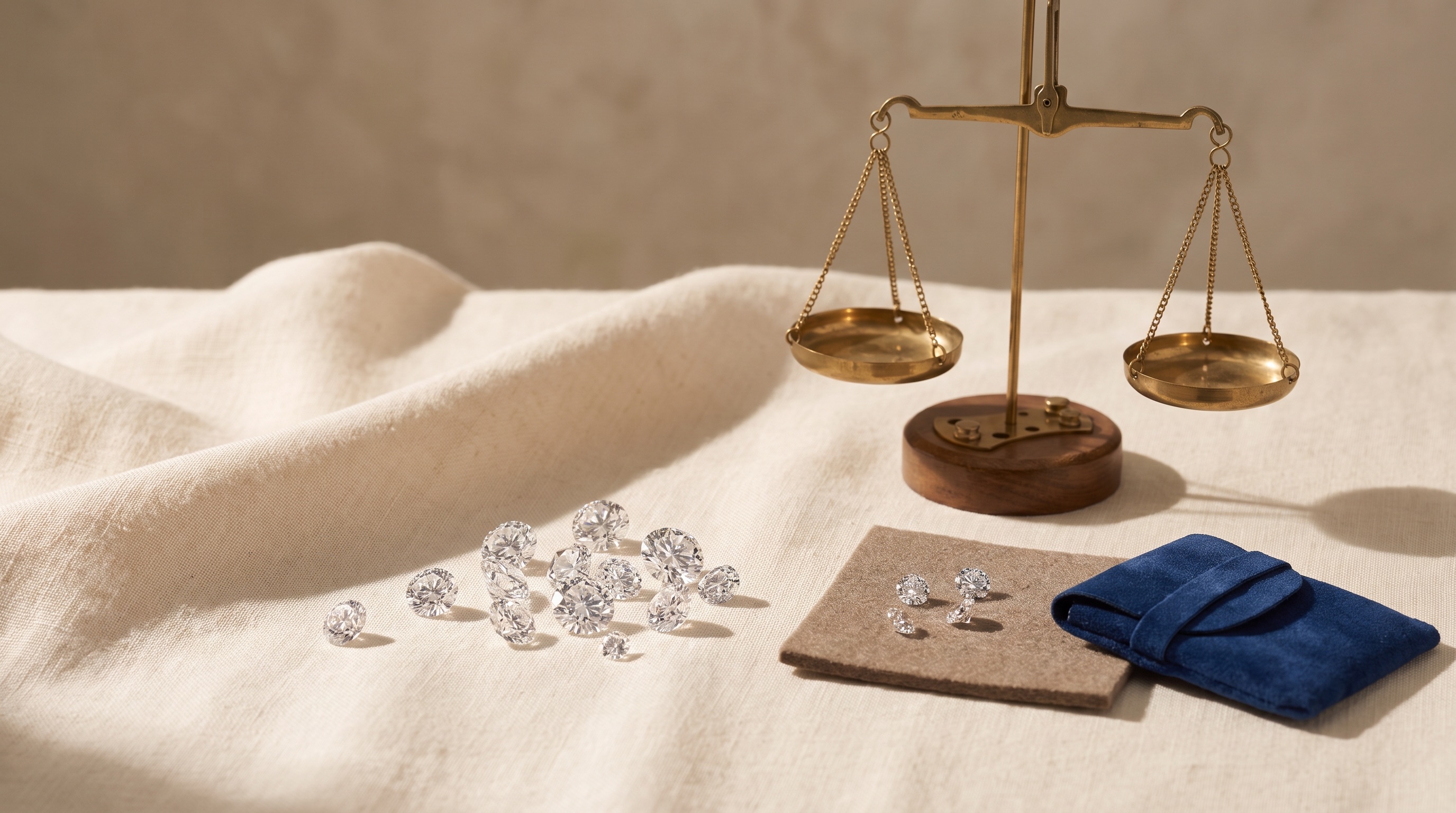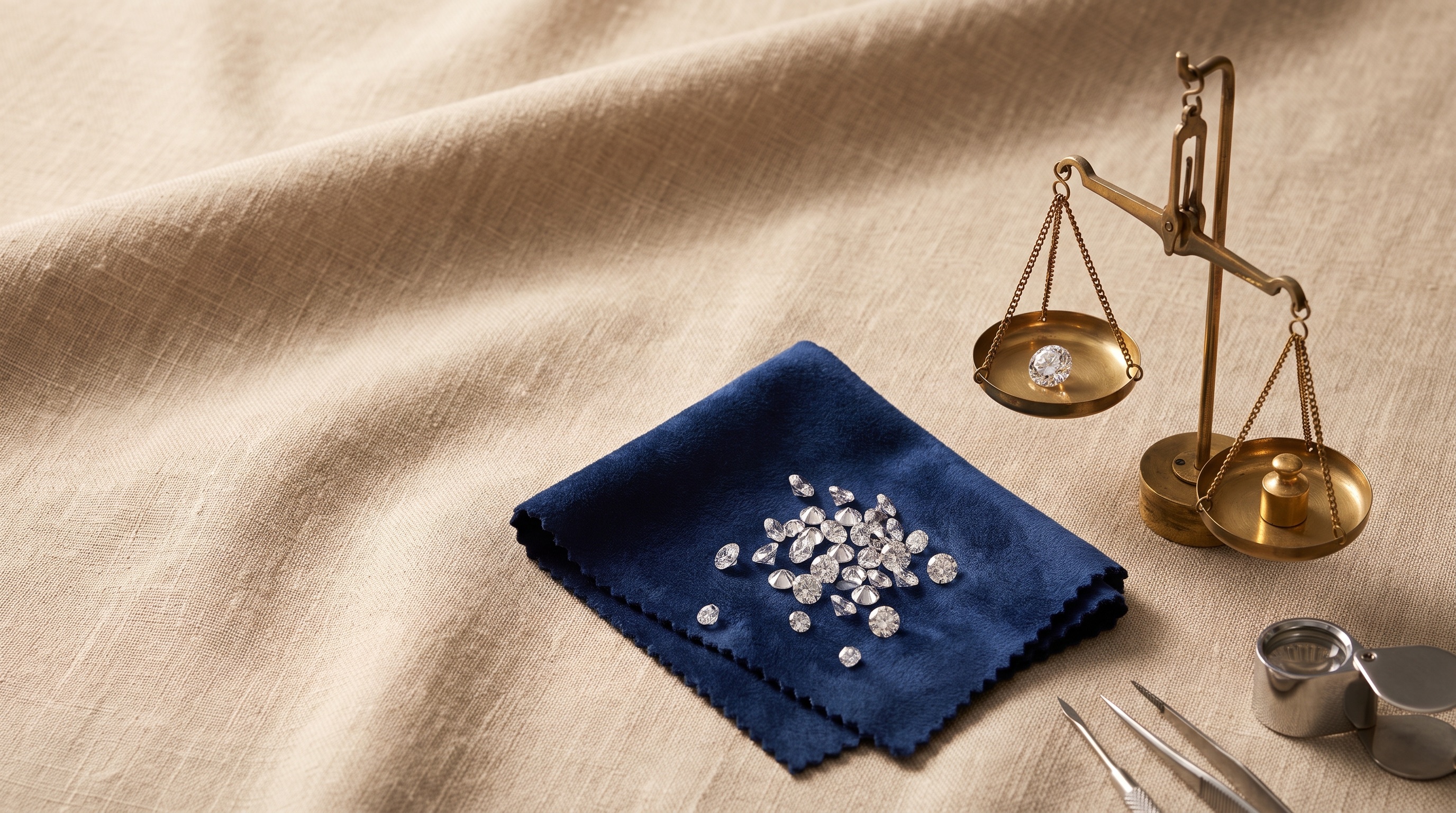
Diamonds are not priced per gram in the trade — they're priced per carat, a unit of weight equal to 0.2 grams, and that distinction is the source of most of the confusion behind this search. A 1-carat diamond weighs exactly 0.2 grams, so a price quoted "per gram" would need to be five times the per-carat price to describe the same stone, but no wholesale or retail diamond pricing actually works that way, because carat weight is only one of several factors — cut, color, clarity, and shape all move price independently of raw weight. This guide explains why diamonds use carat rather than gram pricing, how to convert between the two units if needed, and what genuinely drives a diamond's price instead.
This confusion usually comes from comparing diamond shopping to gold or silver shopping, where price genuinely is quoted per gram (or per troy ounce) as a fairly direct function of weight and daily market rate. Diamonds don't work that way, and understanding why clarifies both how diamond pricing actually functions and why a per-gram diamond price isn't a meaningful number to look for in the first place.
Why Diamonds Are Priced Per Carat, Not Per Gram
A carat is a unit of mass, standardized internationally at exactly 200 milligrams (0.2 grams), and it became the diamond trade's standard weight unit in 1907 when it was formally adopted to replace a patchwork of inconsistent local weight measures used across different diamond trading centers. The carat isn't arbitrary or diamond-specific in origin — it comes from the carob seed, historically used as a small, relatively consistent counterweight in ancient gem trading — but by the time it was standardized for the modern trade, it had become specifically associated with gemstones, and diamonds in particular, rather than precious metals. Gold and silver, by contrast, are priced by mass alone because a given quantity of pure gold is fungible — one gram of 24k gold is functionally identical to another gram of 24k gold, and price tracks a public daily market rate for the raw commodity. A diamond is never priced that way because no two diamonds of equal weight are otherwise identical: cut quality, color, clarity, and shape all vary independently and each affects price substantially, sometimes vastly more than weight itself.
Converting Between Carat and Gram Weight
| Carat Weight | Gram Equivalent |
|---|---|
| 0.25ct | 0.05 grams |
| 0.50ct | 0.10 grams |
| 1.00ct | 0.20 grams |
| 2.00ct | 0.40 grams |
| 3.00ct | 0.60 grams |
| 5.00ct | 1.00 gram |
The conversion is simple math (1 carat = 0.2 grams, so gram weight = carat weight × 0.2), but the resulting gram figures are small enough that they're rarely useful in practice — a 5-carat diamond, a genuinely large and valuable stone, weighs only 1 full gram, which illustrates just how little raw mass actually matters to diamond value compared to a metal like gold, where 1 gram is a meaningful, price-relevant quantity on its own.
What Actually Drives Diamond Price: The 4Cs
Instead of weight alone, diamond price is driven by the combination of four factors industry-wide known as the 4Cs, and understanding how they interact explains why a "price per gram" figure would be nearly meaningless even if the trade quoted diamonds that way.
Carat (Weight)
Price per carat generally increases at specific weight thresholds — a stone just over 1.00ct commands a meaningfully higher per-carat rate than a stone at 0.99ct, even though the actual weight difference is negligible, because of how demand clusters around round-number carat weights. This threshold effect alone means a simple linear price-per-gram calculation would misrepresent how diamond pricing actually scales with size.
Cut
Cut quality — how precisely a diamond's facets are proportioned and angled — determines how effectively the stone returns light as brilliance, fire, and scintillation, and is widely considered the most important of the 4Cs for a stone's visual appeal. Two diamonds of identical carat weight, color, and clarity can differ substantially in both appearance and price based on cut quality alone.
Color
For colorless diamonds, color is graded on a scale from D (colorless) to Z (light yellow or brown), with higher grades commanding higher prices at equivalent carat weight, cut, and clarity. Fancy color diamonds — genuine yellow, pink, blue, or green stones, distinct from the near-colorless D-Z scale — are priced on an entirely different basis tied to hue, tone, and saturation rather than the colorless grading scale.
Clarity
Clarity measures the presence and visibility of internal inclusions and external blemishes, graded from Flawless down through Included. Two stones of identical weight, cut, and color can differ meaningfully in price based on clarity grade alone, particularly at the boundary between eye-clean grades and grades where inclusions become visible without magnification.
Why Shape Also Affects Price Independent of Weight
Diamond shape adds another variable that a simple per-gram or per-carat number doesn't capture on its own: a round brilliant cut, the most popular and most standardized shape, typically commands a price premium over a fancy shape of equal carat weight, color, and clarity, largely because more rough diamond is lost cutting a round brilliant to its ideal proportions than cutting many fancy shapes, and because round brilliant demand is consistently higher. This means two diamonds with identical carat weight — and therefore identical gram weight — can have meaningfully different prices purely based on shape, reinforcing why weight-based pricing (per gram or otherwise, in isolation) doesn't capture what actually determines a diamond's value.
A Price-Per-Gram Comparison Across the 4Cs
| Stone | Carat / Gram Weight | Cut / Color / Clarity | Relative Price |
|---|---|---|---|
| Stone A | 1.00ct / 0.20g | Excellent / D / VVS1 | Highest |
| Stone B | 1.00ct / 0.20g | Good / J / SI2 | Meaningfully lower |
| Stone C | 1.00ct / 0.20g | Excellent / G / VS1 | Mid-range |
All three stones in this comparison weigh exactly the same — 1 carat, or 0.20 grams — yet carry substantially different prices, which is the clearest illustration of why a per-gram (or per-carat) figure alone can't describe diamond value the way it can for a fungible commodity like gold.
Lab-Grown vs. Natural: Does Weight-Based Pricing Differ?
Both CVD lab-grown and natural diamonds are priced per carat using the same 4Cs framework, not per gram, and the same weight-conversion math applies identically to both. The meaningful price difference between lab-grown and natural stones of equivalent specifications comes from supply economics rather than any difference in how weight factors into pricing — natural diamond supply is fixed by geology and mining output, while lab-grown production scales with reactor capacity, which is the actual driver behind lab-grown diamonds' typically lower price at a given carat weight, cut, color, and clarity combination.
Why Gold and Diamond Pricing Get Confused
The comparison to gold pricing is a natural one, since both are precious materials commonly sold in the same jewelry stores and often discussed together in the context of an engagement ring or other fine jewelry purchase. But the underlying pricing logic is fundamentally different: gold's value comes almost entirely from its mass and purity (karat, which measures gold purity, not weight, adding a further point of possible confusion since "carat" and "karat" sound identical but measure different things), tracked against a publicly quoted daily commodity price. A diamond's value comes from a combination of weight and several independent quality factors that can't be reduced to a single market-rate number the way gold's can, which is why no equivalent "diamond spot price per gram" exists or would be meaningful even if it did.
How to Actually Estimate a Diamond's Value
Rather than looking for a price-per-gram figure, a buyer or jeweler estimating a diamond's value should start from its certified 4Cs specifications — carat weight, cut grade, color grade, and clarity grade, all documented on a GIA, IGI, or GCAL grading report — and compare against current per-carat pricing for stones of similar specifications. Wholesale and retail pricing both use per-carat quotes as the standard unit, scaled by the specific quality combination the stone carries, rather than a flat rate applied to raw carat weight. For a buyer new to diamond shopping, understanding this per-carat, quality-adjusted pricing model is meaningfully more useful than any gram-based conversion, since it reflects how the trade actually prices and transacts diamonds at every level, and it's the same framework used whether the transaction is a single retail purchase or a recurring wholesale order at production volume.
Wholesale Pricing Structure for Loose Diamonds
At the wholesale level, per-carat pricing is quoted against specific certified 4Cs combinations, and buyers ordering at volume can expect per-carat pricing to vary not just with quality but with order size and consistency requirements — a buyer sourcing a large, closely matched parcel for line-set jewelry (melee for a tennis necklace, for example) pays a different pricing structure than a buyer sourcing a single certified center stone. This is a separate pricing dynamic from anything captured by weight alone, and it's one more reason a simple per-gram figure would obscure more than it clarifies about how diamonds are actually bought and sold in the trade.
Why the "Per Gram" Search Usually Means Something Else
Buyers searching for a diamond's price per gram are typically trying to solve one of a few underlying questions rather than genuinely wanting a gram-based figure, and it's worth naming these directly since the actual answer to each is different from a weight conversion. Some are trying to estimate the value of a piece of jewelry that combines diamonds with gold, and want a single unit to compare the two materials — but because gold and diamond value work on entirely different bases (commodity weight versus quality-adjusted per-carat pricing), there's no meaningful way to combine them into one blended per-gram figure; the two components need to be valued separately and added together. Others are trying to convert an old or unfamiliar appraisal document that lists a stone's weight in points or grains (older units still occasionally seen on vintage paperwork) into a more familiar unit, in which case the correct conversion target is carats, not grams. And some are simply unaware that carat, not gram, is the standard diamond weight unit and are using "per gram" as a generic stand-in for "per unit of weight" without meaning anything gram-specific. Recognizing which of these is the actual underlying question is more useful than any direct per-gram number, since the real answer in every case routes back through carat weight and the 4Cs rather than a mass-based commodity calculation.
Points and Grains: Other Diamond Weight Units Worth Knowing
Beyond carats and grams, two smaller or older units occasionally appear in diamond paperwork and trade conversation. A "point" is one-hundredth of a carat — a 0.25-carat diamond is commonly called a "25-pointer" in trade shorthand — and is simply a more granular way of expressing carat weight for smaller stones, particularly melee, rather than a separate unit with its own conversion logic. A "grain," an older unit predating the standardized modern carat, equals one-quarter of a carat and shows up occasionally on older appraisal documents or in some international markets, though it's rarely used in current US trade practice. Neither unit changes the underlying pricing logic described above — both still route back to the same per-carat, 4C-based pricing model, they're simply alternate ways of expressing the same weight measurement at different levels of granularity.
How Melee Pricing Differs From Single Center-Stone Pricing
The per-carat pricing model described above applies most directly to individually certified stones, typically 0.30ct and above. Melee — the small diamonds, generally under a carat, used as accents or in continuous lines like a pavé band or tennis necklace — is priced somewhat differently in practice: rather than certifying and pricing each tiny stone individually, melee is sold as a graded parcel against a consistent commercial quality baseline (commonly DEF+/VS+), priced per total carat weight across the whole parcel rather than stone by stone. This is still fundamentally carat-based pricing, not gram-based, but it illustrates another way the trade's per-carat pricing convention adapts to different transaction types — a large certified center stone and a parcel of small melee are priced under the same basic per-carat logic, just applied at different scales and with different documentation practices appropriate to each.
Common Misconceptions About Diamond Weight and Price
- "A bigger diamond always costs proportionally more." Not linearly — price per carat generally rises at each higher weight threshold rather than scaling in a flat straight line, largely because larger rough is rarer and demand clusters around specific carat milestones (0.50ct, 1.00ct, 2.00ct especially).
- "Two diamonds of the same carat weight should cost about the same." Only if cut, color, and clarity also match closely. Weight alone is a poor predictor of price without the rest of the 4Cs, as the side-by-side comparison table above illustrates directly.
- "Gold and diamond value can be added using the same per-gram unit." They can't be combined into one blended number, since gold's value tracks weight and purity against a commodity market rate, while diamond value tracks weight against independently varying quality factors. Each material needs to be valued on its own terms and then summed.
- "A heavier diamond is automatically a better diamond." Carat weight measures size, not quality. A well-cut, high-clarity 0.75ct diamond can outperform a poorly cut, heavily included 1.25ct diamond on every visible measure that actually matters to how a stone looks when worn.
- "Lab-grown diamonds are priced by a totally different weight system than natural diamonds." They're not — both use the identical per-carat, 4C-based pricing framework. The price gap between them comes from production economics, not a different measurement or pricing method.
Why Understanding Per-Carat Pricing Matters for a First-Time Buyer
For a buyer new to purchasing a diamond — whether a consumer researching an engagement ring or a jeweler new to sourcing loose stones — understanding that price scales with a combination of weight and quality, rather than weight alone, changes how a comparison shopping process should actually work. Comparing two stones purely by "price per carat" without also matching cut, color, and clarity grades produces a misleading comparison, since a lower price-per-carat figure on one stone might simply reflect a lower color or clarity grade rather than a genuinely better deal. A more useful comparison holds the 4Cs roughly constant across the stones being compared and looks at how price varies within that controlled set, which is the same logic a wholesale buyer applies when evaluating supplier quotes: request pricing against a specific, defined quality standard, not a generic "price per carat" figure detached from what quality tier that price actually represents.
Sourcing Diamonds at Wholesale Per-Carat Pricing
Guru Diam is a trade-only wholesale diamond supplier carrying certified loose diamonds — natural and CVD lab-grown — across standard, antique, and exotic shapes, all priced per carat against documented 4Cs specifications rather than by raw weight alone. Every certified stone at 0.30ct and above ships with IGI, GIA, or GCAL documentation, and in-stock inventory ships same-day from Guru Diam's New York and Los Angeles locations. Buyers can browse certified loose stones by carat weight and quality specification in the certified diamonds category, review fancy color pricing in fancy color loose diamonds, or apply for a trade account through trade partner, with current terms available at the wholesale hub, and full trade account details reviewable before a first order. Buyers wanting a deeper look at how carat weight interacts with cut, color, and clarity in practice may also find our diamond carat chart guide useful background, and trade buyers pricing melee specifically for line-set or pavé work can see our diamond tennis necklace sourcing guide for how parcel-based per-carat pricing works in practice at that scale.
Frequently Asked Questions
Are diamonds priced per gram?
No. Diamonds are priced per carat, a unit of weight equal to 0.2 grams. Weight is only one of several factors driving price — cut, color, clarity, and shape all affect price independently, which is why a per-gram figure isn't used or particularly meaningful in the diamond trade.
How many grams is a 1 carat diamond?
A 1-carat diamond weighs exactly 0.2 grams. The carat-to-gram conversion is simple (carat weight × 0.2 = gram weight), but the resulting figures are small enough that they're rarely a useful way to think about diamond value.
Why are diamonds priced per carat instead of per gram like gold?
Gold is a fungible commodity — a gram of pure gold is functionally identical to another gram of pure gold, so price tracks weight and a daily market rate. A diamond's value depends on cut, color, and clarity in addition to weight, and no two diamonds of equal weight are otherwise identical, which is why per-carat pricing incorporates quality grading rather than weight alone.
What determines a diamond's price if not just its weight?
The 4Cs: carat weight, cut quality, color grade, and clarity grade, evaluated together. Two diamonds of identical carat weight can have substantially different prices based on differences in cut, color, and clarity alone.
Do lab-grown diamonds use different weight-based pricing than natural diamonds?
No — both are priced per carat using the same 4Cs framework. The price difference between lab-grown and natural diamonds of equivalent specifications comes from supply economics (fixed natural supply versus scalable lab production), not from a different weight-pricing method.
Is carat the same as karat?
No, despite sounding identical. Carat measures a diamond's weight (0.2 grams per carat). Karat measures gold purity (24 karat being pure gold), an entirely different measurement applied to a different material.
How can I estimate what my diamond is worth?
Start with its certified 4Cs specifications — carat weight, cut, color, and clarity grade from a GIA, IGI, or GCAL report — and compare against current per-carat pricing for diamonds of similar specifications, rather than looking for a weight-based or per-gram estimate.
Guru Diam is a trade-only wholesale diamond supplier with locations in New York and Los Angeles, carrying certified loose diamonds — natural and CVD lab-grown — across standard, antique, and exotic shapes, priced per carat against documented 4Cs specifications. Browse certified inventory in the certified diamonds category or apply for a trade account through trade partner.