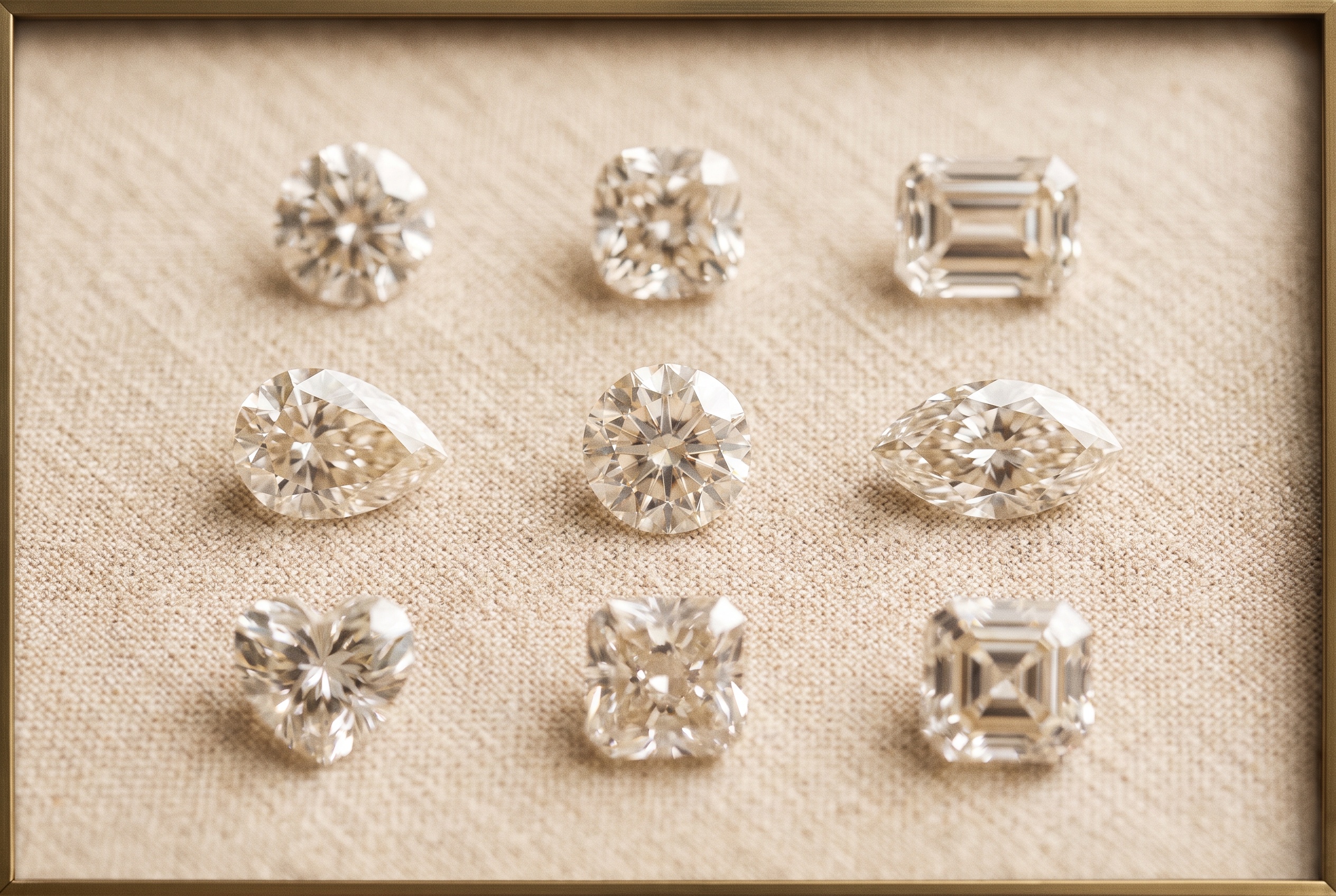


A diamond inventory API for jewelry websites is a real-time data connection that lets a retailer display a wholesaler's live certified stock — thousands of stones with prices, specs, and certificates — on their own site without owning any of it. You sell the stone, then source it on demand, carrying zero inventory risk.
How to Use a Diamond Inventory API for Jewelry Websites: Wholesaler API and CSV Feed Guide

Most independent jewelers cannot afford to put 40,000 diamonds in a case. So their websites show a thin, dated, hand-built selection — a dozen stones, stale prices, no certs — while the customer who wanted a 2.1-carat oval in a specific color and clarity quietly closes the browser tab and buys somewhere with a deeper catalog. The fix is not buying more inventory. It is connecting your storefront to a wholesaler's live feed so the depth on your site matches the depth of the market, while the carrying cost stays on the supplier's balance sheet. This is how a diamond inventory API for jewelry websites turns a small shop into a deep online catalog overnight. This guide explains the two ways to do it — API and CSV — what each one is good for, how the data flows, and how to launch without inventory risk.
What Is a Diamond Inventory API and How Does It Work?
An API (application programming interface) is a live, machine-to-machine connection between your website and the wholesaler's inventory system. Instead of you manually re-uploading a spreadsheet, your site asks the supplier's server a question in real time — "show me every round lab-grown between 1.5 and 2.5 carats, G or better, VS or better, IGI certified" — and gets back a structured answer instantly: stock numbers, dimensions, prices, certificate links, and media for every matching stone.
The flow is straightforward once you see it:
- Your customer searches on your site using filters (shape, carat, color, clarity, certificate lab, price).
- Your site queries the API in the background, passing those filters as parameters.
- The supplier's server responds with live matching inventory — only stones that are actually available right now, at current prices.
- Your site renders the results under your branding, your markup, and your checkout.
- When a stone sells, you source it from the wholesaler on demand, often on memo, and never touched it until the sale was already made.
The customer never knows the stone lives on a wholesaler's shelf in the New York Diamond District or Los Angeles. They see your store, your prices, your name. The API is invisible plumbing. This is the core mechanic of a real-time diamond inventory sourcing tool: you are renting access to the catalog, not the carrying cost.
Why "Real-Time" Is the Part That Matters
A static product page lies a little more every day. Diamonds sell, prices move, certs get re-cut into the inventory. A real-time API means your listing reflects the supplier's actual availability at the moment of the query, so you are not selling a stone that sold yesterday or quoting a price three updates out of date. That live accuracy is what separates a true diamond inventory API for jewelry websites from a quarterly spreadsheet someone forgot to refresh.
API vs. CSV Feed: Which Do You Need?
There are two ways to power your site from a wholesaler's stock, and the right answer depends on your platform, your developer access, and how fresh the data has to be. A lab grown diamond CSV feed for retailers and a live API solve the same business problem with different mechanics.
| Factor | Live API | CSV / Data Feed |
|---|---|---|
| Freshness | Real-time, per query | As fresh as your last import (hourly/daily) |
| Setup effort | Developer integration required | Often no-code; scheduled file import |
| Best for | Custom sites, high traffic, instant accuracy | Shopify/WordPress catalogs, simpler stacks |
| Data direction | Two-way (query + filter on demand) | One-way (bulk download, you host a copy) |
| Price accuracy | Live at moment of sale | Accurate to last sync window |
| Typical refresh | Instant | Scheduled (e.g., every 1–24 hours) |
| Stale-stock risk | Lowest | Managed by import frequency |
A CSV or data feed is a structured file — every available stone in rows and columns — that you download on a schedule and load into your own catalog. It is the path of least resistance: most e-commerce platforms can ingest a CSV with little or no custom code, and the file format is universally readable. The trade-off is freshness. Your site is only as current as your last import, so you set the refresh cadence tight enough that a sold stone falls off your site quickly.
A live API is the higher-end option. It queries the source on every customer search, so accuracy is near-perfect, but it requires a developer or a platform connector to wire up. For a high-traffic site or a custom build where selling an already-sold stone would be embarrassing, the API earns its setup cost.
Many jewelers run both: a CSV feed to bulk-populate the catalog and keep the SEO surface area large, plus an API check at the point of sale to confirm the specific stone is still live before taking payment. That hybrid is the safest pattern for a serious online catalog.
How Do You Sell Diamonds Online Without Holding Inventory?
This is the question underneath the whole topic, and the answer is virtual inventory — sometimes called drop-ship or memo-backed listing. You list the wholesaler's stones as if they were yours. You do not pay for any stone until a customer commits to buying it. The model works because of how the trade already operates:
- You list the feed. Thousands of certified stones populate your site, each with full specs and a certificate reference. Your acquisition cost so far is zero.
- A customer buys a specific stone. You take their payment (or deposit) at your retail price.
- You source that one stone from the wholesaler at your wholesale cost, frequently on memo terms so you do not even front the cash.
- You keep the spread. The difference between your retail price and the wholesale cost is your margin, and you never carried the stone.
The risk you eliminate is the one that quietly kills small jewelers: capital tied up in slow-moving inventory and exposure to price swings on stones sitting in your case. With virtual inventory for jewelers, the wholesaler holds the stock, the financing, and the price risk. You hold the customer relationship and the margin. That is a far better division of labor for an independent shop than trying to out-stock a national chain.
It also changes what you can credibly offer. A shop that physically stocks 30 stones can suddenly present a customer with hundreds of matches across shapes, sizes, and budgets — including categories that are hard to stock speculatively, like matched pairs for studs, fancy color, and exotic fancy shapes. You are selling from the whole market, not from your safe.
What Should Be in the Feed? The Fields That Matter
A feed is only useful if it carries the data your site and your customers need to make a decision. Whether you take API or CSV, confirm the supplier exposes at minimum:
- Stock number — the unique key you map every listing to.
- Origin — natural vs. lab-grown, and growth method (CVD or HPHT) where relevant. Lab-grown is the same physical, chemical, and optical material as mined; disclosure is non-negotiable.
- Shape and the full 4Cs — carat, color, clarity, cut. For fancy color, the intensity grade matters most (the GIA scale runs Faint, Very Light, Light, Fancy Light, Fancy, Fancy Intense, Fancy Vivid, Fancy Dark, Fancy Deep, with Fancy Vivid commanding the top premium).
- Measurements and proportions — diameter, depth %, table %, ratio. Essential if you serve customers matching side stones or pairs.
- Certificate lab and number — IGI or GIA, with a link to the report. IGI grades the large majority of lab-grown (roughly 95%+) and is the practical trade default for lab-grown; as of late 2025, GIA shifted lab-grown reports toward a two-tier "Premium/Standard" descriptive system rather than the full letter 4Cs, so present the lab clearly and compare reports from the same lab when matching.
- Price — per-carat and total, live.
- Media — still image, 360° video, and the cert URL so the customer can verify.
Two practical notes for clean listings. First, a stone can grade up to about one color grade differently between labs, so do not silently mix IGI and GIA grades in a comparison view — surface the lab on every card. Second, if you are also feeding accent stones, melee travels by parcel rather than per-stone cert (a 1.0 mm round is roughly 0.005 ct, about 200 stones to the carat), so handle melee sizing as ranges, not individual SKUs.

How Do You Actually Integrate the Feed Into Your Site?
The API integration for your jewelry website follows a predictable arc regardless of platform:
- Open a verified wholesale account. Trade feeds are gated. You authenticate as a real, vetted trade buyer before you get credentials or a feed URL.
- Get your access credentials. For an API, that is typically a key or token. For a CSV, a secure feed URL or scheduled file drop.
- Map the fields. Match the supplier's column names to your site's product schema once. This is the step that prevents garbage listings.
- Set the markup logic. Apply your margin rule — a percentage, a tiered markup by price band, or fixed dollar adds — so retail prices generate automatically from wholesale cost.
- Choose refresh cadence. API is live; for CSV, schedule imports frequently enough that sold stones disappear fast.
- Add a point-of-sale availability check. Before you charge a customer, confirm the specific stone is still live so you never sell a ghost.
- Launch behind your brand. The catalog is yours visually; the inventory engine is the supplier's.
On Shopify, WordPress/WooCommerce, or most hosted jewelry platforms, a CSV import plus a scheduled sync gets you live without a developer. On a custom or headless build, the live API is usually worth the integration work for the accuracy alone. If you are vetting suppliers before committing, run them through the same diligence you would any first relationship — see our 12 questions to ask a wholesale supplier before you wire your storefront to anyone's data.
A Note on Disclosure and Compliance
When you list a wholesaler's stones as your own, the disclosure obligation rides with the sale to you, the seller of record. Your listings must clearly disclose lab-grown origin per Federal Trade Commission guidance, carry the correct certificate lab, and not blur natural and lab-grown. A good feed makes this easy by carrying clean origin and cert fields; your job is to render them honestly. Industry trade press such as National Jeweler regularly covers how disclosure standards are tightening, and a transparent listing is also a better-converting one.
Why Guru Diam's Feed Is Built for This
Guru Diam runs 11,000+ IGI and GIA certified stones live, with real-time online inventory and API/CSV feed tools made specifically for trade partners — natural and lab-grown on a dual track, plus antique and rare cuts, matched pairs, fancy color, calibrated melee, and exotic fancy shapes. The inventory is US-held across New York and Los Angeles, a real advantage for a website: domestic stock means shorter lead times to fulfill an online order and a cleaner landed-cost picture. With a proposed, still-evolving 2026 US–India trade framework reportedly treating loose natural, finished goods, and lab-grown differently (an ~18% figure has circulated for some categories, though nothing is settled law), US-held inventory hedges both cost and delivery time on the stones you list online. "All Under One Roof" means one feed gives your site the entire category range, not a thin slice.
Open Your Trade Account and Connect Your Site
To power your jewelry website with live certified inventory and zero stock risk, open a verified wholesale account at /signup and book an appointment at /book-appointment to walk through API or CSV integration with our New York and Los Angeles desks. We will help you map fields, set markup logic, and launch a deep online catalog under your own brand. All Under One Roof — one connection, the full range.
Frequently Asked Questions
What is a diamond inventory API for a jewelry website?
It is a live, machine-to-machine connection that lets your website display a wholesaler's real-time certified inventory — stock numbers, specs, prices, and certificates — without you owning the stones. When a customer searches, your site queries the supplier's system and shows only stones actually available right now, under your branding and markup. You source each stone on demand only after it sells.
How do I sell diamonds online without holding inventory?
You list the wholesaler's stones as virtual inventory using their API or CSV feed. The stones appear on your site, but you pay nothing until a customer commits to a specific stone at your retail price. You then source that one stone from the wholesaler at wholesale cost — often on memo terms — and keep the spread. The supplier carries the stock, the financing, and the price risk; you carry the customer and the margin.
What is the difference between an API and a CSV feed?
A CSV feed is a structured file of all available stones that you import into your catalog on a schedule, so your data is as fresh as your last import — easy to set up, often no-code. A live API queries the supplier in real time on every customer search, so accuracy is near-perfect but it needs developer or connector setup. Many jewelers use a CSV to populate the catalog and an API check at checkout to confirm the stone is still live.
How often does the feed update?
A live API is instant — it reflects availability at the moment of each query. A CSV or data feed is only as current as your import cadence, which you should schedule frequently (often hourly to daily) so sold stones drop off your site quickly. Guru Diam's inventory is real-time, so an API connection mirrors current availability and pricing without a sync lag.
Do I need a developer to integrate a diamond feed?
Not necessarily. On platforms like Shopify or WooCommerce, a scheduled CSV import gets you live without custom code. A live API on a custom or headless site usually does need a developer or a platform connector, but the accuracy is worth it for high-traffic stores. Our New York and Los Angeles desks help map fields and set markup logic either way.
Who is responsible for disclosure when I list a wholesaler's stones?
You are, as the seller of record. Even though the stone lives on the wholesaler's shelf until it sells, your listing must clearly disclose lab-grown origin per FTC guidance, show the correct certificate lab (IGI or GIA), and not blur natural and lab-grown. A clean feed carries accurate origin and cert fields so you can render disclosure honestly — which is both compliant and better-converting.