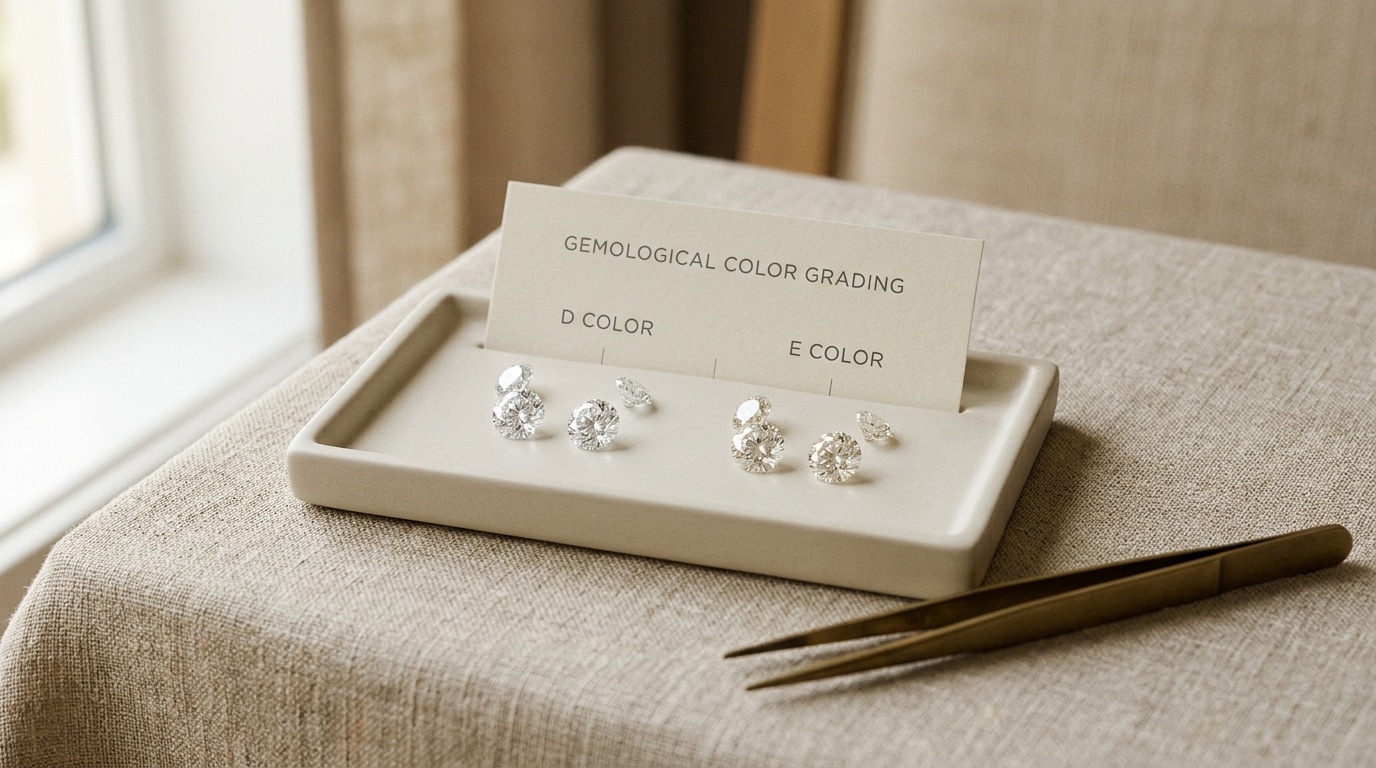
D color sits at the absolute top of the GIA color scale — completely colorless, with no detectable trace of yellow or brown tint even under a trained grader's direct master-stone comparison — while E color sits one step below, within the same "Colorless" category, carrying an extremely faint trace detectable only through that same controlled comparison process. Face-up, in any real-world viewing situation, D and E color diamonds are indistinguishable to virtually every observer, including most jewelers without master stones on hand, which makes the price premium D commands over E a question of what that top-of-scale label is actually worth to a specific buyer.
This guide compares D and E color diamonds on what technically separates them, how visible that difference really is, pricing, and when a wholesale buyer should actually prioritize D over the more cost-efficient E color grade — covering the grading methodology behind the distinction, how it interacts with cut, clarity, fluorescence, and setting metal, and how to build a color-tiered sourcing strategy around it.
The GIA Color Scale: D Through F
The GIA color scale runs D through Z, graded by comparing a stone table-down against a white background to a set of master stones under standardized lighting — a methodology used by GIA, IGI, and GCAL alike. D is the highest possible grade: completely colorless, with absolutely no detectable body tint. E and F sit directly below D, both still within the "Colorless" category, each representing a vanishingly small step of additional trace tint invisible without direct comparison equipment. G through J make up "Near Colorless," where faint warmth starts becoming detectable to a trained eye without comparison stones in some cases, particularly in larger stones.
| Grade | Category | Practical description |
|---|---|---|
| D | Colorless | Completely colorless, the absolute top of the scale, no detectable tint under any grading condition |
| E | Colorless | Essentially colorless, an extremely minor trace detectable only through master-stone comparison |
| F | Colorless | Still colorless-category, a marginally larger trace than E, still invisible without comparison |
| G-H | Near Colorless | Near colorless to the eye, faint warmth can become detectable without comparison stones starting around here for some observers |
What Actually Separates D From E Color
D color diamonds have no detectable trace of yellow or brown body tint whatsoever under GIA's grading methodology, making D the theoretical ceiling of the color scale rather than simply the top of a gradual range. E color diamonds carry an extremely faint trace of tint, caused by minute nitrogen-related impurities in the crystal lattice for natural diamonds or specific growth-process variables for CVD lab-grown material, so faint that GIA graders themselves need side-by-side comparison against calibrated master stones to distinguish it from D reliably. In practice, this means D and E color diamonds look completely identical to essentially any observer — including experienced jewelers — without laboratory-grade comparison equipment in hand.
Is There a Visible Difference Between D and E Color?
No — this is consistently the case across the trade at the top of the color scale. The distinction between D and E exists because GIA's grading system is built to capture even the most minute measurable difference for certification and market-pricing purposes, not because that difference is something a buyer, jeweler, or end customer could ever reliably perceive without the exact master-stone comparison tools a grading lab uses. A D color stone and an E color stone of matched cut and clarity, mounted side by side with no reference material present, cannot be reliably told apart by eye.
D vs. E Color: Side-by-Side Comparison
| Factor | D Color | E Color |
|---|---|---|
| GIA category | Colorless (the absolute top grade) | Colorless |
| Detectable body tint | None, under any grading condition | Extremely faint trace, detectable only via master-stone comparison |
| Visible difference face-up | None, versus E, F, or G in practice for most observers | None, versus D or F in practice for most observers |
| Typical price premium | Highest premium on the color scale, for the top-grade label itself | Meaningful discount to D, still a premium versus F and below |
| Best paired with | Grade-driven sales narratives, investment-framed purchases, top-tier certificate presentation | Most colorless-tier sourcing where near-top grade with better value is the priority |
Pricing: Is D Color Worth the Premium?
D color commands the largest single price premium anywhere on the color scale, disproportionate to the visual difference it delivers over E, simply because it's the single highest attainable grade and demand for that specific "top of the scale" label — independent of visual result — is real and persistent in the trade. For the overwhelming majority of buyers and end customers, E color delivers a visually identical result to D at a meaningfully lower cost, making E (or F) the more cost-efficient choice within the colorless category for nearly every practical use case. The D premium is paid specifically for the grade itself: for buyers or customers who want the certificate to say "D" for resale, investment, or prestige reasons, not for buyers optimizing purely for visual brilliance and whiteness per dollar spent.
When D Color Actually Matters
- Investment-framed and resale-conscious purchases. D color's status as the singular top grade gives it a distinct market position for buyers thinking about long-term resale or perceived value retention, independent of any visual advantage over E.
- Certificate-driven sales narratives. Some end customers specifically want the highest defensible grade on paper as part of the purchase story, and D's position as the literal ceiling of the scale carries marketing weight E can't quite match, even though the two are visually identical.
- Extremely large center stones. Body tint, to the extent any is present at all, becomes marginally easier to detect as stone size increases, which is part of why some buyers sourcing exceptionally large center stones prioritize the very top of the scale broadly — though D specifically versus E remains indistinguishable at any size.
- Matched sets where absolute uniformity matters most. For high-value matched pairs or sets where a buyer wants zero risk of any perceptible variation, sourcing at the top of the scale (D or E together) reduces variability risk versus mixing grades, though D itself offers no visible advantage over E even here.
Color Grading: Natural vs. CVD Lab-Grown
GIA, IGI, and GCAL grade color identically regardless of a diamond's origin, using the same master-stone comparison methodology under the same standardized conditions, so a D or E grade carries the same meaning on a CVD lab-grown certificate as it does on a natural one. CVD lab-grown production can achieve D color reliably under well-controlled growth conditions, and D color lab-grown stones are a normal, available part of the market rather than a rare outcome — a useful point for buyers who may assume top color grades are somehow harder to source in lab-grown material specifically.
How Cut Quality Affects Perceived Color at the Top of the Scale
An excellently cut diamond returns more light and brilliance than a poorly cut one, and that added brilliance can make minor color differences even less noticeable by drawing attention to sparkle rather than body tint — meaning a well-cut E color stone can, in practical visual terms, out-perform a poorly cut D color stone despite sitting one grade lower on paper. This is a key piece of buyer education: cut quality generally has a larger practical effect on how bright and colorless a stone actually looks than moving from E up to D does, since that specific grade jump delivers no perceptible visual change at all.
How Master Stones Work in Color Grading
Separating D from E requires a specific, precise tool: a calibrated set of master stones, each independently verified at a known, fixed position on the color scale, placed directly beside the stone being graded under standardized daylight-equivalent lighting in a controlled viewing booth. The stone is viewed table-down against a neutral white background — removing the confounding effect cut and light return have on perceived color — and compared immediately, side by side, against the relevant master stone rather than judged from memory or in isolation. This is why GIA, IGI, and GCAL all build their grading process around physical master-stone comparison rather than an unaided visual scale: the difference between D and E is far too fine to assess reliably any other way, even for graders with years of daily experience.
Metal Setting and Perceived Color
The metal a stone is mounted in can subtly influence how its color reads face-up, a detail worth factoring into color-tier guidance alongside the certificate grade itself. White metals — platinum, white gold, rhodium-plated white gold — provide a neutral visual backdrop that shows a stone's true grade most directly, while yellow or rose gold settings reflect warm tones back into the stone, which can make a lower grade look whiter than its certificate alone suggests. This effect is a useful lever for buyers stretching value further down the color scale for a given target appearance, though it barely applies within the D-E-F range itself, since those three grades are already visually indistinguishable from one another in any metal setting.
Regional and Market Variation in D Color Demand
Demand for D color specifically — as distinct from the broader colorless category — varies meaningfully by market and customer segment rather than following a single uniform pattern. Some markets and customer bases, particularly those where diamonds are purchased with resale value or investment framing in mind, show a disproportionate preference for the top-grade label regardless of price premium, while other markets prioritize visual value per dollar and gravitate naturally toward E and F once educated on the lack of visible difference. Wholesale buyers serving multiple markets benefit from tracking D-specific sell-through separately from broader colorless-tier sales, since a blended figure across dissimilar customer segments can obscure a real, actionable difference in how much D-specific demand a given market actually supports.
Fluorescence at the Top of the Color Scale
Fluorescence — how a diamond reacts under ultraviolet light — is a separate certificate field worth checking alongside color grade specifically at the D-F tier. Strong blue fluorescence can occasionally cause a subtle hazy or oily face-up appearance in some stones, which is worth factoring into a purchase decision at the top of the color scale, where buyers are often paying the largest premiums specifically for visual perfection. This is a stone-specific characteristic to verify on the certificate rather than a blanket rule against fluorescence at any particular grade, and it applies equally whether the stone graded is D, E, or F color.
Building a Color-Tiered Sourcing Program Around D and E
Wholesale buyers serving a broad customer base generally get the most value weighting E (and F) more heavily than D within a colorless-category inventory tier, given their visually identical performance at meaningfully better cost, while reserving D specifically for customers or sales contexts where the top-grade label itself carries value beyond appearance — resale-conscious buyers, investment-framed purchases, and customers who've specifically asked for the highest available grade. This structure maximizes visual quality and customer satisfaction per dollar of inventory cost, while still keeping D available for the specific segment that values it for its own sake.
Common Buyer Misconceptions About D Color
Several assumptions about D color recur often enough among buyers and end customers alike that they're worth addressing directly rather than leaving unstated in a sourcing or sales conversation:
- Assuming D looks noticeably whiter than E or F. It doesn't — D, E, and F are visually indistinguishable from each other without master-stone comparison equipment, and no observer can reliably separate them by eye alone.
- Assuming D color is rare or hard to source. D color diamonds are a normal, regularly available part of both the natural and CVD lab-grown supply, not an unusually scarce grade requiring special sourcing effort.
- Assuming color grade matters more than cut for overall brilliance. Cut quality has a far larger practical effect on how bright and colorless a stone looks than the imperceptible jump from E to D does.
- Defaulting an entire colorless-tier inventory to D rather than sourcing it selectively. Given the price premium D carries for no visible benefit over E, stocking D broadly rather than reserving it for grade-driven customer requests is a common, avoidable inflation of sourcing cost.
D Color and Matched Pairs or Sets
Sourcing matched side-stone pairs or larger matched sets around a D or E color center stone requires close attention to consistent color character across every stone in the set, not just a matching grade on paper — two stones both graded D, or both graded E, can still show subtle differences in exact tint character or fluorescence behavior that become noticeable placed directly side by side, even though neither stone would show any issue evaluated on its own. Buyers building matched sets at the top of the color scale benefit from requesting stones sourced and pre-matched specifically for visual consistency, rather than assembling a set purely from certificates that happen to share the same letter grade, since two same-graded stones aren't automatically a strong visual match without that extra sourcing step.
D and E Color Across Different Diamond Shapes
Color visibility varies somewhat by shape, which is worth factoring into D-versus-E sourcing decisions across a mixed-shape inventory. Step-cut shapes like emerald and asscher show body color more readily than brilliant-faceted shapes due to their large, open flat facets, which is part of why some buyers lean slightly toward the top of the color scale for step-cut center stones specifically — though even here, the D-E distinction itself remains imperceptible, and the more meaningful color-tier decision is staying within D-F broadly rather than dropping into G-H for a step cut. Brilliant-faceted shapes (round, oval, cushion, princess) scatter light more evenly and are comparatively more forgiving of color across the entire D-J range, giving buyers more flexibility to source E or F confidently even for larger brilliant-cut center stones.
Verifying Color Grade on Certified Stones
Because the D-E distinction is this fine, buyers should rely on certificate data from a reputable lab (GIA, IGI, or GCAL) rather than attempting to distinguish the grades visually, and should confirm a loose certified stone's laser inscription or measurements match its certificate before purchase — particularly important at the top of the color scale, where the price gap between grades is largest and a substitution error is, given how visually similar D and E stones are, an easy mistake to make without careful certificate verification.
Sourcing D and E Color Diamonds Wholesale
Guru Diam stocks both D and E color diamonds across CVD lab-grown and natural catalogs, in standard, antique, and exotic shapes, cut and polished in-house before shipment from Guru Diam's New York and Los Angeles locations, with IGI, GIA, and GCAL certification available. In-stock inventory ships same-day (before 6pm EST from New York, before 4pm PST from Los Angeles), and Guru Diam can source specific top-tier color-clarity combinations for buyers whose customers specifically request D or E color. Trade buyers can browse certified inventory through certified diamonds, source matched top-color side stones through matching pairs, review sourcing terms at the wholesale hub, or apply for a trade account through trade partner.
Guidance for Recommending D vs. E to Customers
Jewelers and sales staff fielding a customer's question about D versus E color generally build more trust explaining plainly that the two are visually identical and that E delivers the same appearance at meaningfully better value, reserving an active D recommendation for customers who've specifically prioritized owning the single highest color grade for reasons beyond visual appearance. This transparent approach — leading with value and honesty about what a grade upgrade actually delivers — tends to produce more repeat, higher-trust customer relationships than defaulting to the higher-margin top grade without explaining that the visible difference is effectively zero. Framing the conversation around the customer's actual priorities — visual brilliance per dollar, versus wanting the top grade on the certificate itself — consistently produces a better-matched sale than leading with a technical scale explanation the customer didn't ask for.
Frequently Asked Questions
Can you tell the difference between D and E color diamonds by looking at them?
No — even trained graders need side-by-side comparison against calibrated master stones under controlled lighting to distinguish D from E. To any observer without that equipment, D and E color diamonds are visually identical.
Is D color diamond worth the extra cost over E color?
For most buyers, no — D commands the largest premium on the color scale for a grade that delivers no visible difference over E. D is worth prioritizing mainly for resale-conscious, investment-framed, or grade-driven customer purchases rather than for any perceptible visual advantage.
Is E color a good alternative to D color for an engagement ring?
Yes — E color delivers an essentially identical colorless appearance to D at meaningfully better value, making it a strong choice for buyers and customers prioritizing visual result and cost efficiency over the top-grade label itself.
Are D color diamonds rare?
No — D color is a normal, regularly available grade across both natural and CVD lab-grown diamond supply, not an unusually scarce or hard-to-source grade.
Does D color grading work the same way for lab-grown and natural diamonds?
Yes — GIA, IGI, and GCAL grade color using identical master-stone comparison methodology regardless of whether a diamond is CVD lab-grown or natural, so a D or E grade carries the same meaning on either type of certificate.
Does cut quality matter more than color grade for how bright a diamond looks?
In practical terms, yes for grades this close together — an excellent cut has a far larger effect on a stone's visible brilliance and apparent whiteness than moving from E up to D does, since that specific grade jump produces no perceptible visual change on its own. Diamond shape matters too: step-cut shapes like emerald and asscher show body color more readily due to their large open facets, so some buyers lean toward the top of the color scale broadly for those shapes, though D specifically still remains indistinguishable from E even there.