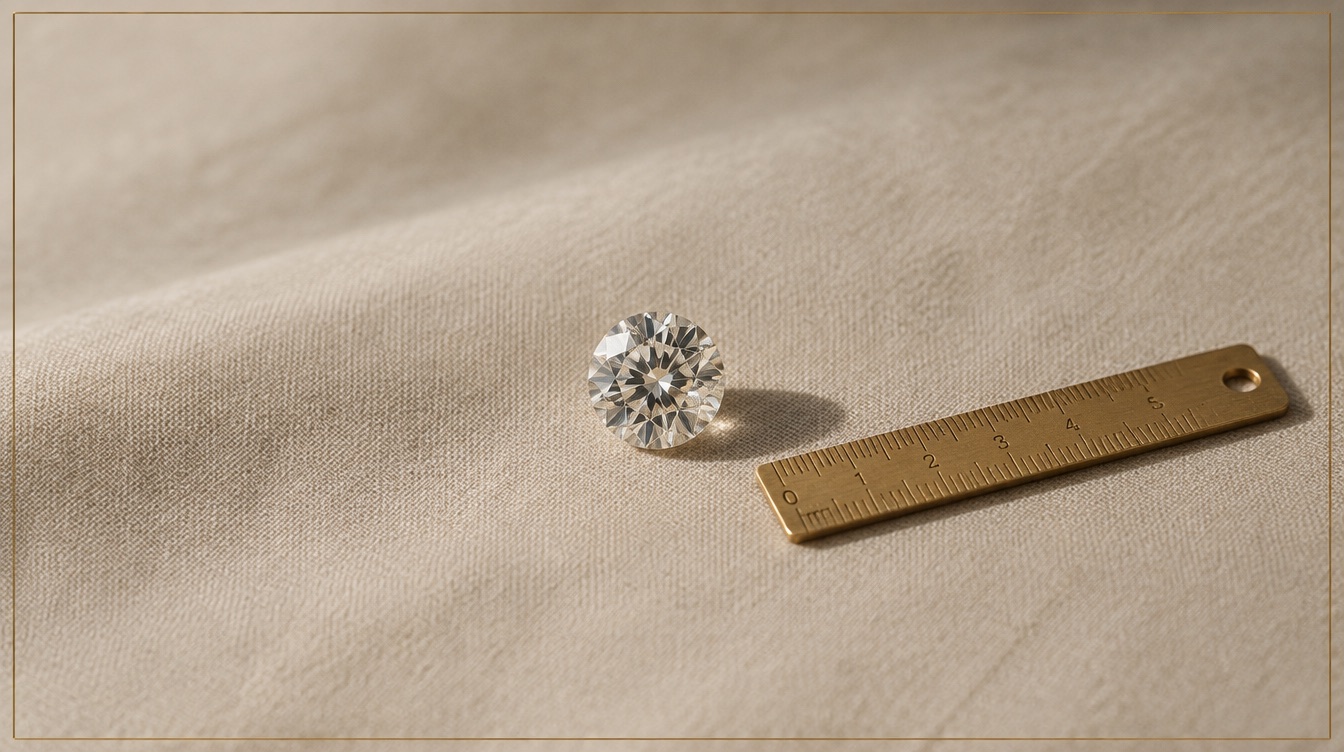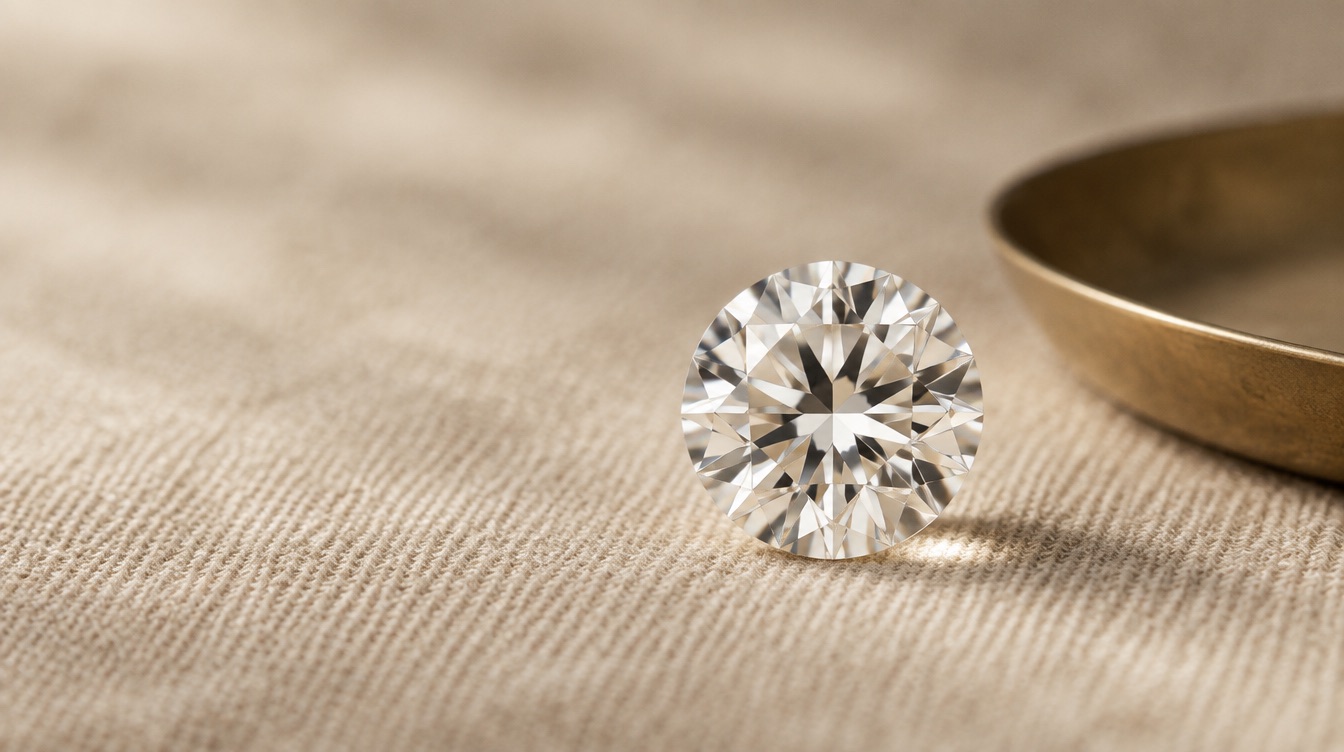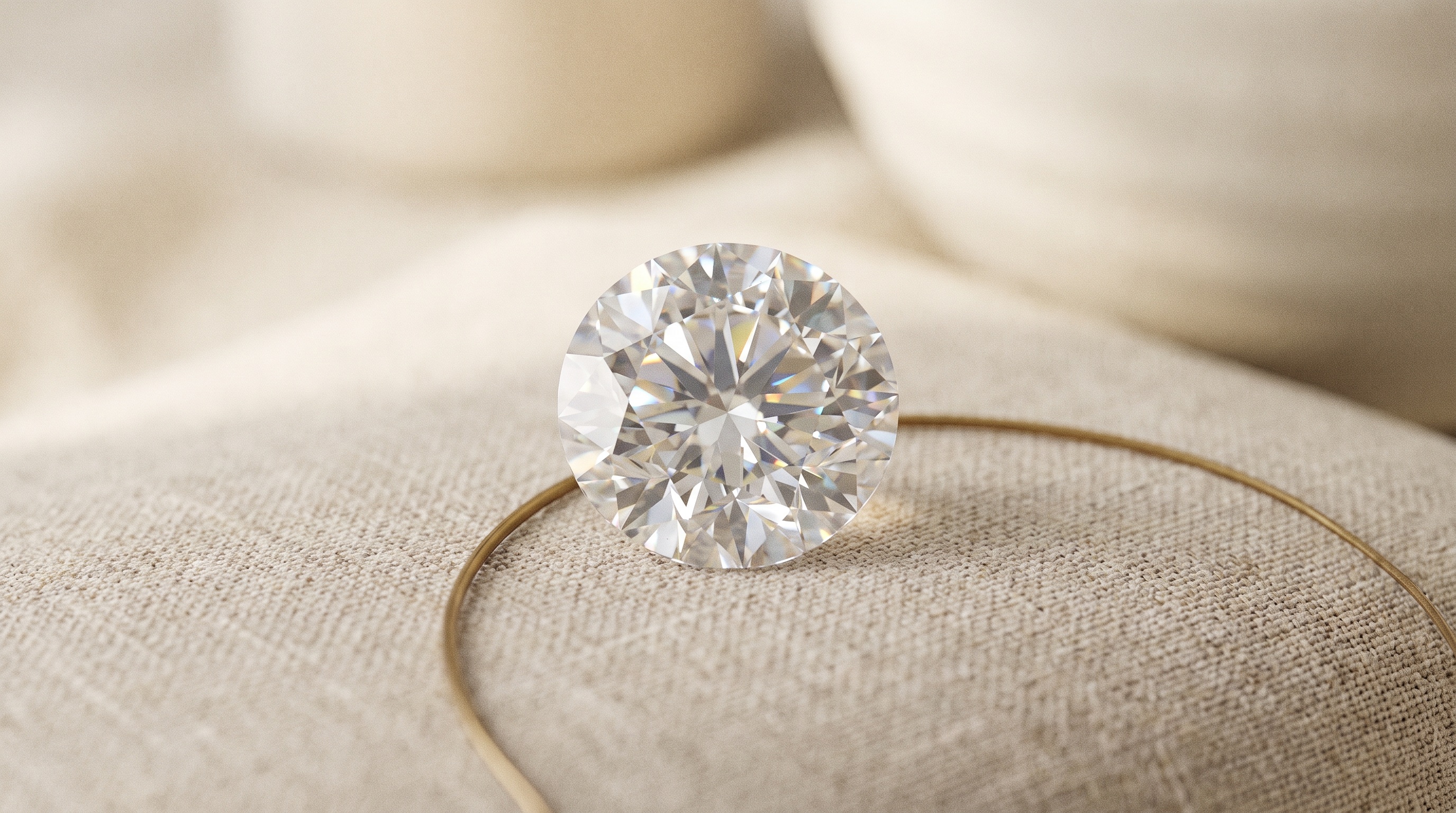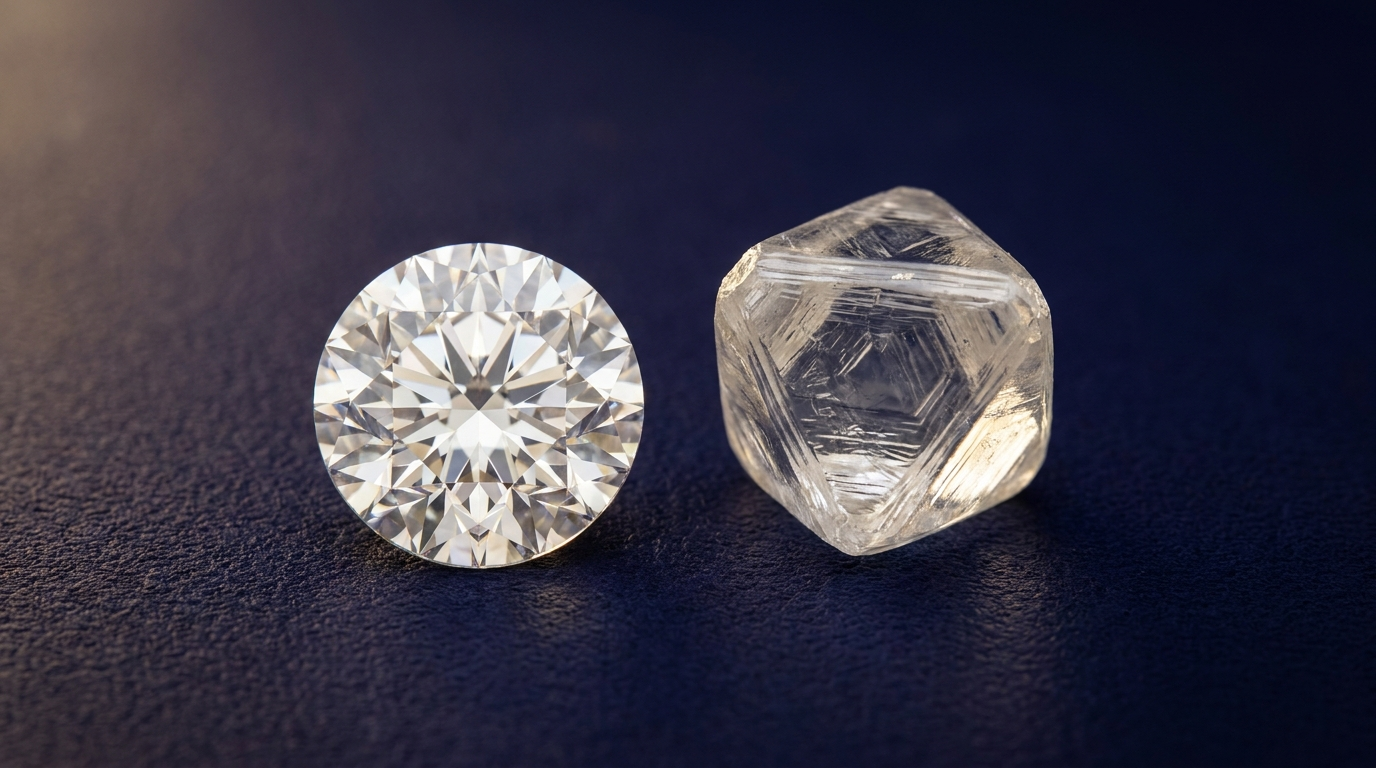
CVD and HPHT are the two methods of growing lab diamonds. CVD (chemical vapor deposition) builds the crystal layer by layer from carbon-rich gas, while HPHT (high pressure, high temperature) recreates the heat and pressure of natural diamond formation. Both produce real, certifiable diamonds — identical in hardness, refractive index, and chemistry to mined diamond. What most buyer-facing explainers stop short of is the part that actually matters for a purchasing decision: the specific defects each process leaves in the crystal lattice, what a gemological lab's instruments do with those defects, and how that chain of cause and effect ends up printed on the certificate in front of you. This piece goes under the hood — the physics and chemistry of each growth method, how a lab actually detects which one produced a given stone, and what that detection work means for grading, pricing, and what you should ask a supplier before you buy.
What actually happens inside a CVD reactor
Chemical vapor deposition starts with a thin diamond seed plate loaded into a sealed chamber held at a pressure far below atmospheric. The chamber is filled with a carbon-rich gas — typically methane mixed with hydrogen — and energized with microwaves until it turns into plasma: a glowing, superheated cloud of ionized gas. Inside that plasma, carbon atoms break free from the methane molecules and drift down onto the seed, bonding one atomic layer at a time. Hydrogen plays an active chemical role here, not just a supporting one — it etches away weaker, non-diamond carbon bonds faster than it etches proper diamond bonds, which is part of what keeps the growing crystal locked into a true diamond lattice instead of drifting into graphite or amorphous carbon.
Because the process runs at low, stable pressure, a producer can hold tight conditions for the length of a growth run, which is what makes CVD well suited to larger, cleaner rough. But that same layer-by-layer mechanism has a side effect: growth interruptions, gas-flow variation, or plasma instability during a run tend to get frozen into the lattice as dislocations and vacancy clusters — missing or misplaced atoms in the carbon framework. A fresh CVD plate coming out of the chamber very often carries a brown or grayish bodycolor because of exactly this — not because the process failed, but because that's what unannealed CVD growth typically looks like before it goes through a secondary step. Reputable labs disclose that secondary step on the report, which is a subject worth its own section further down.

What actually happens inside an HPHT press
HPHT growth takes the opposite route: instead of assembling a crystal gently from gas, it recreates the brute-force conditions under which diamond forms naturally. A small diamond seed and a carbon source sit inside a press generating roughly 5–6 gigapascals of pressure — on the order of what's found deep in the earth's mantle — alongside temperatures near 1,400–1,600°C. Under those conditions, the carbon source dissolves into a molten metal solvent (commonly an iron-nickel-cobalt alloy) positioned near the seed. As the molten metal carries dissolved carbon toward the cooler seed, that carbon crystallizes out and attaches, growing the diamond outward in every direction rather than in the single upward direction CVD uses.
Two chemistry details matter more than the pressure number itself. First, the metal solvent isn't just a carrier — producers add "getter" elements like titanium or aluminum to the melt specifically to scavenge stray nitrogen atoms before they can lodge in the growing crystal, because uncontrolled nitrogen uptake is what gives as-grown HPHT material a yellowish cast. Second, the molten metal itself can get trapped as the crystal grows around it, leaving tiny pinpoint metallic inclusions near the seed. Those inclusions are a real, well-documented feature of some HPHT rough — small enough that they're graded like any other clarity characteristic, but distinctive enough that they occasionally respond to a strong magnet, which is one of several clues (never used alone) that a gemologist can use during examination.

Why the crystal shape differs — and why that changes cutting yield
Growth direction is what produces the two methods' signature rough shapes. CVD, building in one direction from a flat seed plate, comes out of the chamber as a flat, tabular block. HPHT, growing outward from a point seed in every direction, comes out as a cuboctahedron — a shape with eight triangular and six square-ish faces meeting at the seed, made up of distinct geometric growth sectors that formed under slightly different conditions as the crystal expanded.
That geometric difference isn't cosmetic — it drives what a cutter can efficiently get out of a given piece of rough. A flat CVD block hands a cutter a predictable, single-orientation slab that's well suited to targeting one larger stone or a small cluster of similarly sized stones along a consistent grain direction. A cuboctahedral HPHT crystal offers more volume in more directions but with growth-sector boundaries running through it — internal zones where strain and impurity concentration change abruptly — that a cutter has to plan around to avoid landing a facet junction on a zone that will show strain patterns under polarized light. Neither shape is better; they're better suited to different cutting plans, which is a production-fit difference with real downstream effects on what sizes and shapes a given method's rough tends to yield efficiently.
The defect chemistry behind color — and why it explains post-growth treatment
Diamond is carbon, but trace elements locked into the lattice during growth are what create color, and the two methods tend to trap different trace elements in different arrangements. Nitrogen is the most common one. When it sits in the lattice as isolated, unaggregated atoms, it's classified as Type Ib and typically produces a yellowish tint — this is common in as-grown HPHT material before the flux-getter chemistry described above scavenges most of it out. When nitrogen is essentially absent, a diamond is classified Type IIa; CVD rough, grown from a nitrogen-poor gas mixture, typically lands in this category as-grown.
Type IIa doesn't automatically mean colorless, though — this is the detail most buyer-facing explanations skip. CVD's layer-by-layer growth is prone to vacancy clusters and dislocations that absorb light in a way that produces a brown or gray bodycolor, independent of nitrogen content. That's why so much CVD rough goes through a post-growth HPHT annealing step before cutting: applying HPHT-level pressure and heat to already-grown material (not to grow a new crystal, but purely to treat one that already exists) mobilizes those vacancies, lets them migrate to the surface or recombine, and lifts the brown tint. This is the point where "HPHT" shows up in a second, entirely different context on a certificate — not as a growth method, but as a treatment code applied to material grown either way. A stone can be "CVD, HPHT-treated" on a report, and that's not a contradiction; it's two separate steps in the same production chain, and it's exactly the kind of report language a buyer needs to be able to parse correctly rather than misreading as an error.
How a gemological lab actually detects growth method
None of the differences above are visible to a jeweler, a customer, or even a trained gemologist working without instruments. Labs make the call using tools a jewelry counter doesn't have. Fourier-transform infrared (FTIR) spectroscopy reads absorption features tied to nitrogen and boron content, which is how a lab assigns a type classification (Ia, Ib, IIa, or IIb) in the first place. Photoluminescence (PL) spectroscopy goes further, exciting the stone with specific laser wavelengths and reading the emission peaks that come back — different growth conditions and different defect populations produce different peak patterns, and a trained analyst reads that pattern the way a technician reads a chromatogram.
The most visually direct tool is DiamondView imaging, which exposes a stone to deep ultraviolet light and photographs the fluorescence pattern that results. CVD's layer-by-layer growth typically fluoresces in flat, planar striations stacked like sediment. HPHT's outward growth typically fluoresces in the same geometric sector pattern the crystal grew in — a faceted, pinwheel-like zoning radiating from a central point. Neither pattern is visible under a loupe or ordinary light; DiamondView is a dedicated instrument built specifically to make internal growth structure visible. Taken together, FTIR, PL, and DiamondView are what let a lab state growth method as fact on a report rather than as a guess — and it's why the certificate, not a seller's description, is the only reliable source for that information.

How CVD and HPHT compare at the process level
The table below is organized around the physics and chemistry covered above, rather than around a simple buy/don't-buy checklist — it's meant to show what mechanism produces what downstream characteristic.
| Factor | CVD (Chemical Vapor Deposition) | HPHT (High Pressure, High Temperature) |
|---|---|---|
| Growth mechanism | Carbon-rich plasma deposits atoms onto a seed, one layer at a time, at low pressure | Carbon dissolves in molten metal solvent under ~5–6 GPa and ~1,400–1,600°C, crystallizes onto a seed |
| Rough crystal shape | Flat, tabular block; single growth direction | Cuboctahedral; grows outward in multiple geometric sectors |
| Typical as-grown type | Type IIa (very low nitrogen) | Type Ib as-grown; getter chemistry can reduce nitrogen toward Type IIa |
| Common as-grown color issue | Brown/gray tint from vacancy clusters and dislocations | Yellowish tint from residual isolated nitrogen |
| Common post-growth treatment | HPHT annealing to remove brown/gray tint (disclosed on report) | Often grown closer to final color; HPHT itself also used as a standalone treatment on either method's rough |
| Distinctive inclusion type | Fine strain lines, planar graining tied to layer growth | Occasional pinpoint metallic flux inclusions near the seed |
| DiamondView fluorescence pattern | Flat, planar striations | Faceted, sector-zoned pinwheel pattern |
| Typical wholesale strength | Larger, cleaner rough for center stones; broad fancy-color range | Efficient for colorless and select fancy-color rough |
| Certification | Graded by IGI/GIA; growth method and any treatment noted on report | Graded by IGI/GIA; growth method and any treatment noted on report |
Every row describes a typical pattern, not an absolute rule — a well-run process of either type can produce excellent rough, and a poorly run one can produce weak material regardless of method.
What this looks like on an IGI or GIA report
The instruments described above feed directly into report language, and knowing that language is what lets a buyer read a certificate correctly instead of just skimming the headline grade. Every reputable lab identifies a stone as "laboratory-grown" in the report header, separate from a natural-diamond report format, and states the growth method directly. The comments section is where treatment gets disclosed — if a stone went through post-growth HPHT annealing, a reputable lab notes it there, using the same section that would disclose irradiation or fracture-filling on a mined stone. Type classification (Ia, Ib, IIa, IIb) sometimes appears as well; it's a nitrogen/boron-content classification derived from the FTIR work above, correlated with but not identical to growth method, and worth reading as its own data point rather than conflating with the CVD-versus-HPHT question. Finally, every legitimate report ties to the physical stone through a laser inscription on the girdle — matching that inscription number to the report in hand is the step that confirms the paperwork actually belongs to the parcel it arrived with.
Pricing implications of the growth physics
Growth method is not a pricing tier by itself — a given color, clarity, cut, and carat weight commands its price because of those four factors, not because of which chamber or press produced the rough. Where the physics does show up in a wholesale price list is through production economics. A CVD run aimed at larger, cleaner center-stone rough takes a controlled, multi-week growth cycle in a chamber that can be tuned run after run for a specific size and clarity target — that predictability is what lets a manufacturer keep a category like certified center stones or calibrated melee in steady, consistent supply. An HPHT press cycle runs faster per crystal but with more geometric variability across the batch, which historically made it efficient for producing colorless rough and select fancy colors at volume, with growth-sector planning absorbed into the cutting process rather than the growth process.
None of that translates into one method being categorically cheaper — it translates into which categories each method's producers can reliably stock at scale. A buyer comparing two price lists gets more useful signal from asking about a supplier's production consistency and treatment disclosure than from asking which method grew a given parcel, since normalized for the 4Cs, properly graded stones from either method should price comparably.
There's also a sourcing-structure cost that rarely shows up on a price list but shows up in a buyer's actual landed cost: a manufacturer running its own chambers controls the color and clarity target across an entire production run, while a reseller working from mixed, third-party parcels is passing along whatever variability came in the door. That difference doesn't change the growth-method label on a certificate, but it changes how much time a buyer spends re-sorting or re-certifying stones that drift from spec after the order arrives — which is a real cost even when it never appears as a line item.
Which method Guru Diam uses — and why
Guru Diam's lab-grown catalog is CVD, grown in-house, across every category we carry — certified center stones, calibrated melee, matched pairs, antique cuts, and fancy colors. There's no HPHT growth line running in parallel and no mixed parcel whose composition shifts month to month. We chose CVD specifically because its controlled, low-pressure process is the better tool for the flat, larger rough that certified center stones are cut from, and because that same process control is what makes tight calibration possible across a full parcel of matched pairs or melee — the color and clarity target a buyer sees on a spec sheet is the target our production floor is actually working toward, run after run.
Manufacturing in-house — rather than reselling parcels sourced from mixed, unverified third parties — is also what lets us stand behind IGI certification, with GIA available on request, on every stone without needing to reverse-engineer where a given parcel actually came from. Where a stone requires HPHT annealing to reach final color, that step is disclosed on the report exactly as described above; it's a documented part of finishing CVD rough, not a departure from being a CVD manufacturer.
A technical buying checklist: what to ask beyond the headline grade
The questions below go one level deeper than a standard sourcing checklist — they're aimed at getting past the headline 4Cs and into the report data that actually documents growth method and treatment.
- Ask to see the full comments section, not just the grade summary. That's where treatment, including HPHT annealing on CVD material, gets disclosed.
- Ask whether a type classification (Ia, Ib, IIa, IIb) is noted, and what it is. It's a separate data point from growth method, but it tells you something real about nitrogen content and how the stone was likely finished.
- For high-value center stones, ask whether the supplier can speak to DiamondView or spectroscopy findings behind the report, particularly if you're buying against a specific quality claim.
- Confirm the laser inscription on the girdle matches the report number — this is the step that ties the paperwork to the physical stone on arrival, not just at the point of sale.
- For melee and matched pairs, ask how tightly color and clarity are calibrated across the parcel — a producer with real process control should be able to describe its tolerance specifically rather than in general terms.
- Ask whether growth method is consistent across the supplier's catalog or mixed parcel to parcel. Mixed sourcing usually means mixed consistency in both grading and treatment disclosure.

Frequently asked questions
Why does CVD rough often need a post-growth color treatment?
CVD's layer-by-layer growth is prone to vacancy clusters and dislocations that absorb light and produce a brown or gray bodycolor, independent of nitrogen content. A post-growth HPHT annealing step mobilizes those defects and lifts the tint. This is a documented, disclosed part of finishing — not a sign of lower quality.
Can a diamond grown by one method receive HPHT treatment afterward?
Yes, and this is one of the most commonly confused points in the trade. HPHT is both a growth method and, separately, a standalone post-growth treatment applied to already-grown material — most often to CVD rough, to remove a brown or gray tint. A report reading "CVD, HPHT-processed" describes two distinct steps, not a contradiction.
What is a Type IIa classification, and why do lab-grown diamonds often carry it?
Type IIa means a diamond has essentially no detectable nitrogen, determined through FTIR spectroscopy. CVD rough, grown from a nitrogen-poor gas mixture, commonly lands in this category as-grown. Type IIa is a separate classification from growth method and from color — a Type IIa stone can still need treatment to remove a brown tint.
What does a DiamondView image actually show?
DiamondView exposes a stone to deep ultraviolet light and captures the fluorescence pattern that results, revealing internal growth structure invisible under normal light or a loupe. CVD material typically shows flat, planar striations from its layer-by-layer growth; HPHT material typically shows a faceted, sector-zoned pattern radiating from the seed. It's one of the core tools labs use to determine growth method.
Do the metallic inclusions sometimes found in HPHT diamonds affect durability?
No. Tiny pinpoint metallic inclusions from the molten growth solvent are graded like any other clarity characteristic and don't affect a diamond's hardness or durability. They're a documented, well-understood feature of some HPHT rough, not a defect in the finished stone's performance.
Where can wholesale buyers source certified CVD diamonds?
Guru Diam is an in-house CVD manufacturer based in NYC's Diamond District with an LA office, supplying trade buyers with 10,000+ loose stones — certified center stones, calibrated melee, matched pairs, antique cuts, and fancy colors. Every stone is IGI-certified, with GIA available on request. Reach the trade desk at (212) 652-7108.