Carat measures the weight of a diamond or other gemstone, while karat measures the purity of gold in a piece of jewelry — two completely different scales that happen to sound nearly identical and are routinely confused by first-time jewelry buyers. A "2 carat" diamond and "18 karat" gold describe two unrelated properties of the same ring: one is about the stone, the other about the metal it's set in.
This guide breaks down exactly what each scale measures, where the terms come from, and how to read both correctly when evaluating a piece of diamond jewelry, whether you're a first-time buyer comparing options or a retailer training staff to explain both terms clearly at the counter.
Carat: A Measurement of Weight
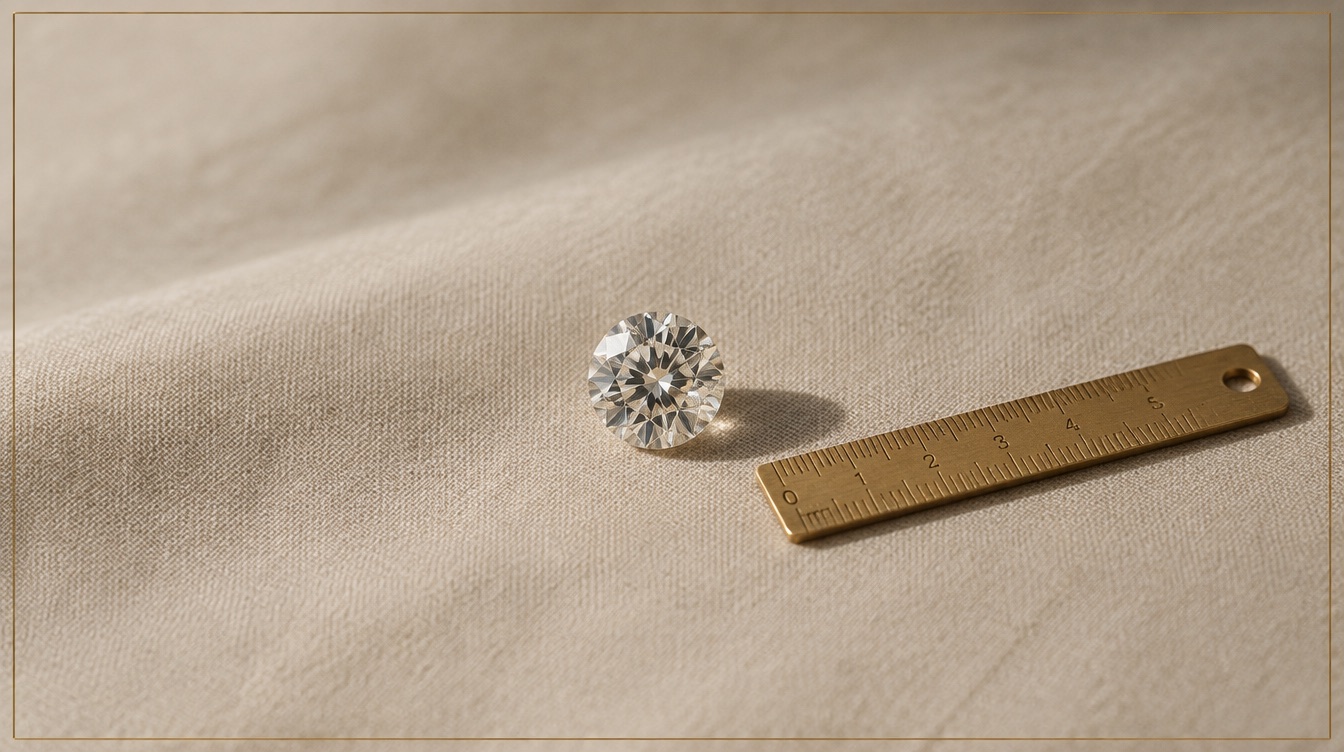
Carat (abbreviated "ct") measures the weight of a diamond or other gemstone, with one carat equal to exactly 200 milligrams (0.2 grams). Carat weight is not a measurement of physical size in the way millimeters would be — two diamonds of the same carat weight can appear different sizes depending on their cut proportions and shape, since a shallow-cut stone spreads more surface area for the same weight than a deep-cut stone of identical weight. Carat weight is one of the 4Cs (alongside color, clarity, and cut) used to evaluate and price a diamond, and it's typically the single factor that most influences price at a given quality level, since larger rough stones are exponentially rarer than smaller ones.
Karat: A Measurement of Gold Purity
Karat (abbreviated "k" or "kt") measures the purity of gold in an alloy, on a scale where 24 karat represents pure, unalloyed gold and lower karat values represent gold mixed with other metals (commonly copper, silver, zinc, or nickel) to improve durability, alter color, or reduce cost. Pure 24k gold is too soft for most everyday jewelry, which is why 14k and 18k are the most common purities used in diamond rings, necklaces, and bracelets — the added alloy metals increase hardness and scratch resistance at the cost of a slightly less intense yellow color and, in the case of white gold, requiring rhodium plating to achieve a bright white finish.
Side-by-Side Comparison
| Aspect | Carat | Karat |
|---|---|---|
| What it measures | Weight of a diamond or gemstone | Purity of gold in an alloy |
| Scale | Decimal weight units (1ct = 200mg) | Fraction out of 24 parts (24k = pure gold) |
| Applies to | Diamonds and other gemstones | Gold jewelry, settings, and findings |
| Common values seen | 0.25ct, 0.50ct, 1.00ct, 2.00ct, and up | 10k, 14k, 18k, 22k, 24k |
| Higher number means | A heavier, generally more valuable stone (all else equal) | A purer, softer, typically more expensive metal alloy |
| Word origin | From the carob seed, historically used as a small, consistent counterweight | From the same carob-seed root, adapted into a fractional-purity system for gold |
Where Both Words Actually Come From
Carat and karat share the same etymological root — the carob tree seed, historically used across ancient trade routes as a small, remarkably consistent unit of weight for weighing gemstones, since carob seeds vary in weight less than most other natural objects available at the time. As gold trading and gemstone trading developed as related but separate practices, the same root word split into two spellings and two distinct measurement systems: "carat" stayed a weight measurement for gemstones, while "karat" (the spelling more common in the US; many other English-speaking markets still use "carat" for both) became a fractional purity measurement for gold. This shared origin is exactly why the two terms are so often confused today, despite measuring entirely different things.
Common Gold Karat Values and What They Mean
| Karat | Gold Content | Typical Use |
|---|---|---|
| 24k | 99.9% pure gold | Rarely used in Western jewelry due to softness; more common in some Asian markets for investment-grade pieces |
| 22k | ~91.6% gold | Common in South Asian and Middle Eastern jewelry traditions |
| 18k | 75% gold | Common premium choice in the US and Europe, balancing purity with durability |
| 14k | 58.3% gold | The most common everyday jewelry standard in the US market, favored for durability and lower cost |
| 10k | 41.7% gold | The minimum legal karat for something to be called "gold" in the US; more durable but less valuable |
How Carat Weight Is Actually Measured
A diamond's carat weight is measured on a precision scale calibrated specifically for gemstones, typically to a hundredth of a carat (two decimal places), with the smallest routinely traded unit being a "point" — one point equals 0.01 carat, so a 0.50 carat stone is also described as "50 points." Loose stones are weighed before setting, since a mounted stone's weight can't be measured directly without removing it from its setting; a jeweler estimating the weight of a diamond already set in a ring uses published formulas based on the stone's visible diameter and depth, which is why a "certified" carat weight (measured loose, before setting) is more reliable than an estimated set-stone weight. For a broader look at how millimeter measurements translate to carat weight across shapes, see our diamond size chart guide.
How Gold Karat Is Actually Verified
Gold karat purity is verified either through a hallmark stamp applied by the manufacturer (legally required to be accurate in most markets, though not independently verified at the point of stamping) or through independent testing — acid testing, X-ray fluorescence (XRF) analysis, or fire assay for the most rigorous confirmation. A buyer purchasing a significant piece of gold jewelry, particularly secondhand or from a less established source, can request or perform independent karat verification rather than relying solely on a stamped hallmark, since counterfeit or mismarked hallmarks do occur, though they're uncommon from established, reputable jewelry suppliers.
Why the Confusion Persists
Beyond the shared word origin, the confusion is reinforced by the fact that both terms appear together constantly in the same sentence when describing a piece of jewelry — "a 1 carat diamond set in 18 karat gold" packs both scales into one phrase, and a buyer unfamiliar with either term has no obvious cue that they're switching between a weight measurement and a purity measurement mid-sentence. Retailers and sales staff who take a moment to clarify the distinction when a customer asks about either term tend to build more buyer confidence than those who assume the distinction is already understood, since the confusion is genuinely common even among buyers who've purchased fine jewelry before.
Carat Weight and Price: What Actually Drives Cost
Diamond price doesn't scale linearly with carat weight — because larger rough diamonds are dramatically rarer than smaller ones, price per carat increases at specific weight thresholds (notably at 1.00ct, 1.50ct, and 2.00ct), which is why a 0.99ct diamond can cost meaningfully less than a 1.00ct diamond of otherwise identical quality despite the negligible visible size difference. This pattern, sometimes called the "carat weight premium" or "magic size" effect, is worth understanding for buyers trying to maximize visible size within a fixed budget, since shopping just below a threshold weight can capture most of the visual size at a lower price point.
Gold Karat and Price: What Actually Drives Cost
Gold jewelry price scales more directly with karat purity, since the raw material cost of gold is a larger share of a piece's total price than labor and design at higher purities — an 18k piece contains meaningfully more actual gold by weight than a 14k piece of the same design, and that difference tracks the spot price of gold directly. Lower karat gold isn't simply "worse," though; it's a genuine design and durability tradeoff, since the added alloy metals in 14k and 10k gold make those purities more scratch- and dent-resistant for daily-wear pieces like engagement rings and wedding bands, which is part of why 14k remains the dominant everyday choice in the US market despite 18k's higher purity and prestige association.
How Metal Choice Affects Diamond Color Appearance
The karat and color of a gold setting can subtly affect how a diamond's own color grade appears to the eye — a lower-color diamond (closer to the J-K-L range) can look warmer and less noticeably tinted when set in yellow or rose gold, since the surrounding metal's warm tone masks a faint yellow tint in the stone, while the same diamond set in white gold or platinum shows any warmth more distinctly by contrast. This is a practical reason some buyers choosing a warmer metal tone can comfortably select a slightly lower, less expensive color grade without a visible tradeoff, while a buyer set on white metal should generally prioritize a higher color grade to avoid an unwanted contrast.
Platinum: A Purity Scale Without "Karat"
Platinum jewelry uses its own purity marking system, separate from gold's karat scale, typically expressed as a percentage or a fineness stamp like "Plat950" or "950 Pt," indicating 95% pure platinum alloyed with other metals (commonly ruthenium or iridium) for workability. Platinum's naturally white, non-reactive color means it doesn't require rhodium plating the way white gold does, and it's generally denser and more durable against prong wear over decades, though it commands a higher price than gold at comparable purity due to platinum's own higher raw material cost and denser weight per volume. Buyers comparing an 18k white gold setting against a platinum setting for the same diamond should understand this is a metal-choice decision distinct from either the carat or karat scale, governed by its own purity and pricing dynamics.
How Jewelers Communicate Both Scales Clearly to Customers
Experienced sales staff develop a habit of stating carat and karat figures in a way that avoids ambiguity — leading with the full unit name rather than an abbreviation when speaking ("this stone weighs one point two carats, set in eighteen karat gold") rather than a string of numbers and letters that a customer unfamiliar with the terms has to parse in real time. Written materials, receipts, and appraisal documents benefit from the same clarity: spelling out "carat weight" and "karat purity" as separate labeled fields rather than relying on abbreviations alone, since a customer reviewing paperwork after the purchase, sometimes months or years later for insurance purposes, needs to be able to read and understand both figures without a salesperson present to explain them.
Common Buyer Mistakes Involving Carat and Karat
The most frequent mistake is simply misusing the words interchangeably in conversation or in writing — describing gold as "24 carat" or a diamond as "2 karat" — which, while a minor error in casual speech, can cause real confusion if it appears on a receipt, appraisal document, or insurance form where the distinction actually matters. A second common mistake is assuming that "bigger carat number" and "bigger karat number" both simply mean "better," when in practice higher karat gold is softer and less durable, making it a genuine tradeoff rather than a straightforward upgrade for everyday-wear pieces. A third, more subtle mistake is comparing two rings' prices purely by carat weight without accounting for karat — a 1ct diamond in 10k gold and a 1ct diamond in 18k gold aren't priced the same, since the metal content itself is a meaningful share of total cost, and buyers focused only on the stone's carat weight can be surprised by a price gap that's actually coming from the setting's karat purity rather than the diamond itself. Confirming both figures separately, rather than treating "carat weight" as a stand-in for overall piece value, avoids this comparison error, especially when shopping across multiple retailers or price points where either the stone or the metal purity might differ without being immediately obvious.
Total Carat Weight vs. Individual Carat Weight
A piece of jewelry with multiple diamonds — a halo ring, a tennis bracelet, or a pair of stud earrings — is often described by its "total carat weight" (abbreviated TCW or ct. tw.), which sums the weight of every stone in the piece rather than describing any single stone's individual weight. This distinction matters because a 2.00ct TCW halo ring might have a 1.20ct center stone surrounded by smaller accent diamonds making up the remaining 0.80ct, which looks and prices very differently from a solitaire ring with a single 2.00ct center stone. Buyers comparing pieces should always confirm whether a quoted carat weight refers to the total across all stones or a single center stone, since the two numbers can describe visually and financially very different pieces.
Karat and Gold Color: How Alloys Create White, Yellow, and Rose Gold
Karat purity and gold color are technically independent, but in practice they interact, since the specific alloy metals used to reach a given karat also determine the resulting color. Yellow gold at a given karat uses an alloy mix (commonly copper and silver) that preserves gold's natural warm tone. Rose gold uses a higher proportion of copper specifically, which shifts the color toward pink. White gold uses alloy metals like palladium or nickel to neutralize gold's natural yellow, though the result is still a warm-toned pale gold rather than a true bright white — which is why white gold jewelry is typically finished with a thin rhodium plating layer to achieve the bright white look most buyers expect, a plating that wears over years of daily use and can be professionally reapplied.
International Terminology Differences
The word "karat" with a "k" is primarily an American spelling convention; many other English-speaking markets, including the UK, use "carat" for both gemstone weight and gold purity, distinguishing the two only by context (a jeweler in London might correctly say "a one carat diamond in nine carat gold"). This means a buyer researching jewelry terminology from international sources may encounter "carat" used for gold purity and need to rely on context — a decimal weight value versus a whole-number-out-of-24 value — rather than the spelling alone to know which measurement is being described. Guru Diam's own materials use the American "karat" spelling for gold purity specifically to avoid this ambiguity for a US and North American trade audience.
Why Both Numbers Matter for Insurance and Appraisal
An insurance appraisal or replacement-value document for a diamond ring records both figures separately and precisely — the diamond's certified carat weight (along with color, clarity, and cut) and the setting's karat gold purity (along with total metal weight) — because both directly affect the piece's total replacement cost. A customer who only remembers "it's a big diamond in nice gold" without the specific carat and karat figures on file will generally face a slower, more uncertain claims process than one who retained the original certificate and appraisal document listing both numbers precisely, since an insurer replacing a lost or stolen piece needs both figures to source a genuinely equivalent replacement rather than an approximate guess. Retailers should encourage customers to keep both records together, since replacing either the stone or the setting alone still requires knowing the other's exact specification to match the original piece.
Sourcing Diamonds and Gold Jewelry Through Guru Diam
Guru Diam is a trade-only, B2B wholesale diamond supplier with locations in New York and Los Angeles, carrying loose diamonds by carat weight across CVD lab-grown and natural stock, alongside finished jewelry available in a range of gold karats and metal types, so a retailer or manufacturer sourcing both the stone and the setting for a finished piece can confirm exact carat and karat specifications on both components from a single order. Custom engagement rings are finished in 4-6 days once a stone and setting are selected. Buyers can browse loose diamond inventory by carat weight at the certified diamonds category, explore finished pieces at custom jewelry, or apply for a trade account through trade partner. For more on how carat weight interacts with the other quality factors that drive diamond pricing, see our 4Cs of diamonds guide.
Frequently Asked Questions
What is the difference between carat and karat?
Carat measures the weight of a diamond or gemstone (1 carat = 200 milligrams). Karat measures the purity of gold in an alloy, on a scale where 24 karat is pure gold. They measure completely different properties despite sounding alike.
Why do carat and karat sound so similar?
Both words trace back to the same root — the carob seed, historically used as a small, consistent weight unit in ancient trade. The spelling and meaning diverged over time into a gemstone-weight measurement (carat) and a gold-purity measurement (karat).
Is 18 karat gold better than 14 karat gold?
It depends on the goal — 18k has higher gold purity and a richer color, but 14k is more durable and scratch-resistant for everyday wear, and typically less expensive. Neither is objectively "better"; they're a genuine tradeoff between purity and durability.
Does a higher carat weight always mean a bigger-looking diamond?
Not always — carat is a weight measurement, and a shallow-cut stone can appear larger than a deep-cut stone of the same carat weight, since cut proportions affect how much surface area a given weight spreads across.
What does 24 karat gold mean?
24 karat represents pure, unalloyed gold (99.9% purity). It's the softest and most vulnerable to scratching and denting, which is why most jewelry uses lower karats like 14k or 18k for better everyday durability.
How can I verify a piece of jewelry's actual gold karat?
A hallmark stamp indicates the manufacturer's stated karat, but independent verification through acid testing or X-ray fluorescence (XRF) analysis provides confirmation beyond the stamp alone, which is worth requesting for a significant purchase from a less established source.
What does "total carat weight" mean on a piece with multiple diamonds?
Total carat weight (TCW) sums the weight of every diamond in a piece, not any single stone. A ring listed at 2.00ct TCW could have a smaller center stone with the remaining weight spread across accent diamonds, which looks and prices differently from a single 2.00ct solitaire.
Does platinum use the karat scale?
No — platinum uses its own purity marking system, typically shown as a fineness stamp like "950 Pt" (95% pure platinum), separate from gold's karat scale. It's a different metal with its own pricing and durability characteristics.