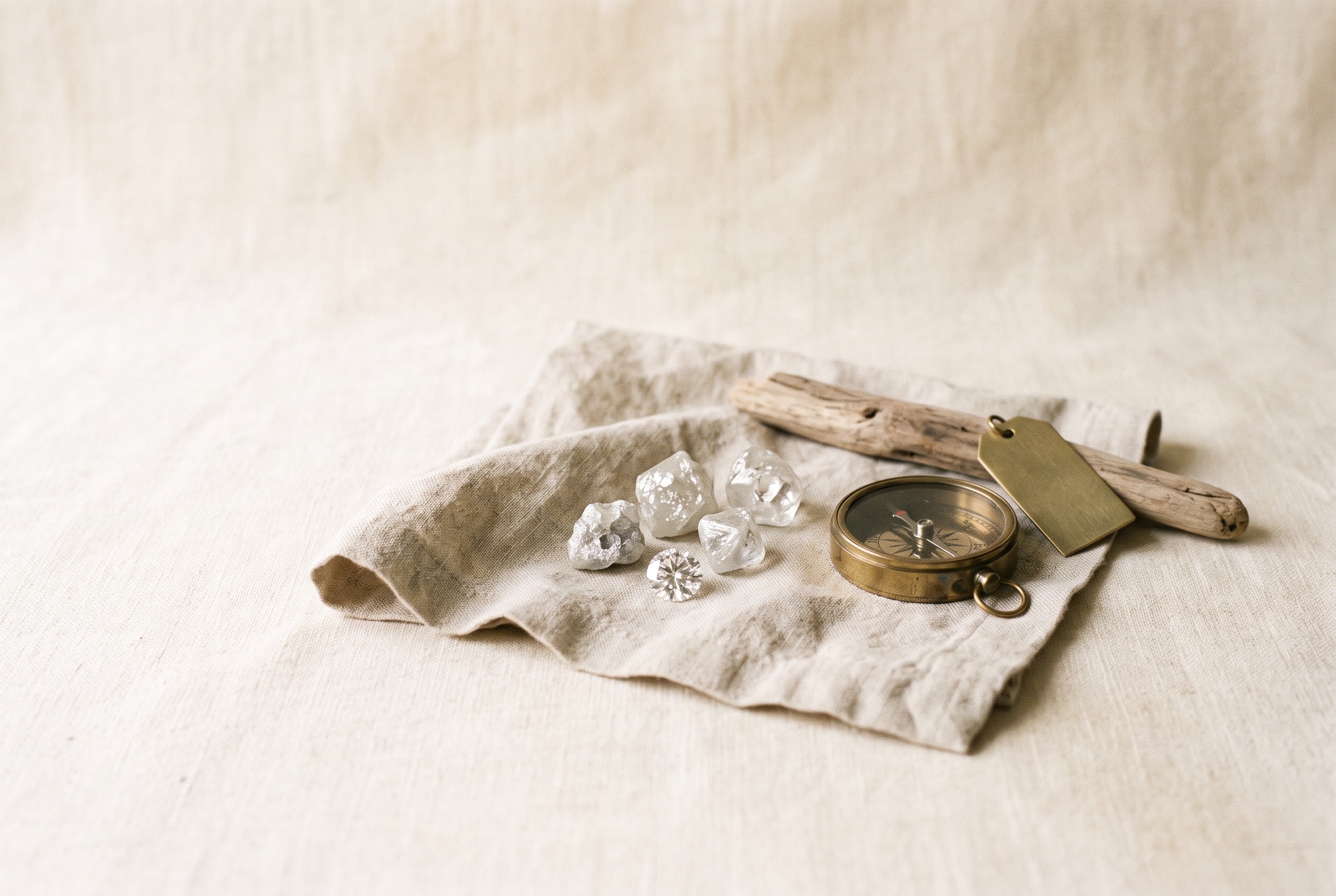
Canada is one of the world's major diamond-producing countries, with an industry built almost entirely around the Northwest Territories since kimberlite deposits were discovered there in the early 1990s. Canadian diamond mining is known in the trade less for sheer volume than for strict environmental and labor regulation, and for provenance and certification programs that let buyers trace a polished stone back to a specific Canadian mine.
This guide covers how Canada's diamond industry got started, where production is concentrated, a brief overview of the country's major mines, how Canadian-origin certification programs like Canadamark work, how Canada's regulatory standards and production compare to other major producing countries, and what all of this means for a wholesale buyer sourcing natural and lab-grown diamonds today.
How Canada's Diamond Industry Began
Canada's diamond industry is young compared to producers like South Africa or Russia — commercial diamond mining in Canada didn't begin until the late 1990s, even though geologists had suspected for decades that the Canadian Shield's ancient, stable geology could host kimberlite pipes similar to those found in other diamond-producing regions. The breakthrough came from two Canadian geologists, Chuck Fipke and Stewart Blusson, who spent years tracing kimberlite indicator minerals — distinctive garnets and other minerals carried and scattered by glacial ice sheets — back toward their source. Rather than searching for diamonds directly, their method involved sampling glacial till across a huge stretch of the Northwest Territories and following the trail of indicator minerals upstream, in a geological sense, to locate the kimberlite pipes those minerals had eroded from.
That exploration effort culminated in the discovery of diamond-bearing kimberlite at Point Lake, near Lac de Gras in the Northwest Territories, with the find becoming public in the early 1990s. The announcement triggered one of the largest staking rushes in Canadian mining history, as prospectors and mining companies scrambled to claim land across the Lac de Gras area based on the belief that more kimberlite pipes were likely nearby. That belief proved correct: the area turned out to host a cluster of kimberlite pipes that would eventually become the foundation for Canada's first diamond mines. Within less than a decade of the initial discovery, Canada went from having no commercial diamond production at all to hosting a mine recognized as a significant new source of gem-quality rough diamonds on the world stage.
The Northwest Territories: Canada's Diamond Heartland
Virtually all of Canada's major diamond production has historically come from the Northwest Territories, specifically the remote Lac de Gras region roughly 300 kilometers northeast of Yellowknife, deep in the subarctic tundra. This is genuinely difficult mining country: the region has no year-round road access to the outside highway network, so mine construction and ongoing supply depend heavily on winter ice roads built each year across frozen lakes, along with air freight for time-sensitive cargo. Mines in the region operate through long, dark winters and short summers, and every piece of major infrastructure — power generation, worker housing, processing plants — has to be built and maintained on-site rather than connected to existing regional utilities.
The Northwest Territories' geology made it a promising target for diamond exploration precisely because it sits on very old, stable continental crust — the kind of ancient craton geology known to host kimberlite pipes elsewhere in the world. That same remoteness that made the region hard to explore also meant it had gone largely unprospected for diamonds before the Fipke-Blusson era, unlike better-studied diamond regions with longer mining histories. Diamond mining transformed the Northwest Territories' economy over a relatively short period, becoming one of the territory's largest private-sector contributors to employment and government revenue, and reshaping Yellowknife specifically into a logistics and services hub supporting the mines to its north.
Canada's Major Diamond Mines
Canada's diamond production is associated with a small number of large mines rather than a broad base of many smaller operations. The table below gives a brief overview of the mines most relevant to Canada's diamond mining story.
| Mine | Region | Status |
|---|---|---|
| Ekati | Northwest Territories (Lac de Gras) | Canada's first diamond mine; operating with a history of ownership changes |
| Diavik | Northwest Territories (Lac de Gras area) | Long-running major producer, historically operated by Rio Tinto |
| Gahcho Kué | Northwest Territories | Operating; joint venture between De Beers Canada and Mountain Province Diamonds |
| Victor | Ontario (James Bay lowlands) | Closed; formerly operated by De Beers Canada |
| Renard | Quebec | Quebec's first diamond mine; production has been interrupted amid ownership restructuring |
Ekati was Canada's first operating diamond mine, opening in the late 1990s directly on the strength of the Fipke-Blusson discovery, and it remains a well-known name in the trade as the mine that put Canadian diamonds on the map — though the mine's own detailed history, discovery story, and ownership changes are a large enough topic to deserve their own dedicated coverage rather than a full retelling here. Diavik, located nearby, became another major Northwest Territories producer known in part for its distinctive water-retention dike construction, which allowed mining beneath a lake bed. Gahcho Kué, a newer entrant that began production in the mid-2010s, added meaningful additional Northwest Territories capacity at a time when some of the region's earlier mines were maturing. Outside the Northwest Territories, Ontario's Victor mine and Quebec's Renard mine demonstrated that Canadian diamond potential wasn't limited to a single territory, even though both have faced a harder operating and ownership history than the Lac de Gras cluster — Victor has since closed, and Renard has gone through significant financial and ownership turbulence.
Canadamark and Canadian Diamond Provenance Certification
One of the most distinctive features of Canada's diamond industry isn't the mining itself but what happens afterward: a well-established set of provenance and origin-certification programs built specifically around the "Canadian diamond" story. The best-known of these is Canadamark, a program developed to track diamonds from specific Canadian mines through cutting and polishing, culminating in a laser-inscribed serial number on the finished stone's girdle along with an accompanying certificate documenting Canadian origin. The idea is straightforward: rather than asking a buyer to simply trust that a diamond originated in Canada, the program creates a physical, verifiable link between the polished stone in hand and its documented country of origin, tracked at each stage of the supply chain rather than relying on paperwork alone.
This kind of origin certification matters commercially because "Canadian diamond" has become a genuine market differentiator in ways that are somewhat unusual for natural diamonds generally, where country-of-origin tracking for an individual polished stone is often lost once rough diamonds from multiple sources are pooled, sorted, and cut together in international trading and manufacturing centers. Canadian-origin programs solve that traceability gap specifically for diamonds mined in Canada by keeping chain-of-custody documentation intact from mine output through to the finished, laser-inscribed stone. For jewelers and their customers who specifically want a documented Canadian-origin diamond — often motivated by interest in the country's mining and labor standards, discussed below — that inscription and certificate are the practical mechanism that makes the claim verifiable rather than just a marketing line.
It's worth noting that not every diamond mined in Canada ends up laser-inscribed and marketed under one of these origin programs; a meaningful share of Canadian rough is still sold into the broader international rough diamond market without that additional certification and tracking. Canadian-origin certification is best understood as a distinct, opt-in premium program layered on top of Canada's underlying mining industry, rather than something that automatically applies to every diamond that comes out of a Northwest Territories mine.
Environmental and Labor Regulatory Standards
Canada's diamond mines operate under some of the more rigorous environmental and labor regulatory frameworks found anywhere in the global diamond mining industry, reflecting both Canada's general regulatory environment for extractive industries and the specific environmental sensitivity of subarctic and Arctic tundra ecosystems. Before construction, Canadian diamond mines go through formal environmental assessment and permitting processes that evaluate impacts on water systems, wildlife (including caribou migration routes, a significant consideration given the Northwest Territories' barren-ground caribou herds), and surrounding land, with ongoing monitoring requirements that continue throughout a mine's operating life and into eventual closure and reclamation.
Labor standards are similarly shaped by Canadian employment law and, in the Northwest Territories specifically, by formal agreements negotiated directly with Indigenous communities whose traditional territories overlap with mining operations. These impact benefit agreements typically address local hiring commitments, training and skills-development programs, business opportunities for Indigenous-owned suppliers and contractors, and ongoing revenue-sharing or community investment arrangements. This model gives local communities a documented, negotiated stake in how a mine operates and how its benefits are distributed, rather than leaving those questions solely to a mining company's discretion or to broad national tax policy.
None of this makes Canadian diamond mining free of environmental footprint — large-scale open-pit and underground mining in a fragile subarctic environment inherently disturbs land, uses substantial energy (much of it generated on-site given the remoteness of these operations), and requires long-term water management and eventual site reclamation once a mine closes. That tradeoff is real and worth stating plainly rather than glossing over: natural diamond mining anywhere, including in a well-regulated jurisdiction like Canada, carries a genuine environmental footprint that doesn't disappear simply because the regulatory framework overseeing it is strong. What Canada's regulatory standards do provide is a comparatively high degree of oversight, monitoring, and documented community involvement relative to some other diamond-producing regions globally — a distinction buyers weighing sourcing questions often find meaningful even though it doesn't eliminate the underlying environmental tradeoffs of mining itself.
Canada Compared to Other Major Diamond-Producing Countries
Canada is regularly counted among the world's most significant diamond-producing countries by value, though it sits in a different position than several other major producers when it comes to production scale, ownership structure, and regulatory environment. The table below offers a general comparison rather than precise production statistics, since exact output figures shift year to year with mine maturity and market conditions.
| Country | Production Character | Notable Distinction |
|---|---|---|
| Canada | Concentrated in a small number of large, privately operated mines, mostly in the Northwest Territories | Strong environmental/labor regulation; well-established origin-certification programs like Canadamark |
| Botswana | Large-scale kimberlite mining, historically dominant by value | 50-50 government/De Beers partnership (Debswana); home to some of the highest-value mines in the world |
| Russia | State-linked production across multiple large kimberlite fields | Among the largest producers globally by volume |
| Australia | Historically significant producer, notably known for colored (pink/fancy) diamond output before its flagship mine's closure | Known for having produced a large share of the world's fancy pink diamonds historically |
Compared to Botswana and Russia, Canada's overall production volume is smaller, reflecting both the country's shorter mining history and the practical difficulty of operating in such remote terrain, which limits how many deposits are economically viable to develop even when geologically promising. What sets Canada apart isn't scale but positioning: a combination of strict, well-documented environmental and labor oversight and a mature system of origin certification that few other producing countries have built out to the same degree. Australia's history is a useful point of comparison in a different way — its Argyle mine became famous specifically for fancy pink diamond production before closing, illustrating how a producing country's reputation can rest on a specific quality or rarity distinction rather than sheer output. Canada's reputation has settled into something comparable but distinct: not the single largest producer, but one of the most closely tracked and transparently regulated.
Canada and the Kimberley Process
Canada is a founding participant in the Kimberley Process Certification Scheme, the international framework established in the early 2000s to prevent conflict diamonds — rough stones sold to finance armed conflict — from entering the legitimate global diamond trade. Every shipment of rough diamonds exported from Canada is accompanied by a Kimberley Process certificate confirming its conflict-free origin, the same baseline requirement that applies to rough diamond exports from any participating country. Canada's diamond industry has generally not faced the conflict-diamond concerns historically associated with parts of West and Central Africa during the 1990s and early 2000s, given both the country's stable governance and the fact that Canadian diamond mining only began after the Kimberley Process framework and broader industry conflict-diamond awareness were already taking shape.
Because Canada's diamond mining history is relatively recent and its regulatory environment relatively strict from the outset, "ethically sourced" framing has become a natural extension of Canada's existing origin-certification programs rather than a separate initiative bolted on afterward. A buyer asking about ethical sourcing in the context of Canadian diamonds is typically pointed toward the same documentation — Kimberley Process compliance at the rough export stage, plus programs like Canadamark carrying that documented origin all the way through to the polished stone.
Natural Canadian Diamonds vs. Lab-Grown CVD Diamonds
Canadian-origin natural diamonds and lab-grown CVD diamonds are both legitimate, certifiable diamond categories, but they differ in ways worth understanding clearly rather than blending together. A natural Canadian diamond formed deep within the earth over enormous geological timescales and was extracted through large-scale mining, with its supply tied directly to the productive life of specific mines like those in the Northwest Territories — once a mine's economically viable reserves are exhausted, that specific source of supply ends. A CVD lab-grown diamond, by contrast, is produced in a controlled reactor environment using chemical vapor deposition, growing a diamond crystal from a carbon-rich gas onto a diamond seed over a period of weeks; its supply scales with manufacturing capacity rather than with geological scarcity.
Both categories are graded using the same 4Cs framework by major labs, with a lab-grown stone's report clearly disclosing its growth method as required by grading standards. Visually, a well-cut natural Canadian diamond and a well-cut CVD lab-grown diamond of equivalent grade can look effectively identical to the naked eye. The meaningful differences buyers weigh are origin story and provenance, price per carat (lab-grown typically carries a significant price advantage at equivalent grade), and supply dynamics — finite mine-based extraction on one side, scalable manufacturing on the other. Neither category is inherently "better"; they serve different priorities, and an informed buyer benefits from understanding both rather than treating one as simply an inferior substitute for the other.
This is also where Canada's environmental tradeoff conversation and the lab-grown alternative genuinely intersect. Natural diamond mining, even under Canada's comparatively strict regulatory standards, involves large-scale land disturbance, substantial energy use, and long-term reclamation obligations. Lab-grown CVD production carries its own energy footprint tied to reactor operation, but avoids the land disturbance and mine-life question entirely. Presenting this fairly means acknowledging that both categories carry real, different tradeoffs rather than presenting either one as a clean win — a customer choosing between a documented Canadian-origin natural diamond and a CVD lab-grown diamond is weighing genuinely different values, not choosing between a "real" option and a compromise.
Sourcing Canadian and Lab-Grown Diamonds From One Supplier
Guru Diam is a trade-only wholesale supplier carrying both certified natural diamonds and CVD lab-grown diamonds as two distinct, clearly labeled catalogs, alongside certified loose stones and finished and custom jewelry — antique cuts, standard fancy shapes, and round brilliant included, with IGI, GIA, and GCAL certification available. For a jeweler working with customers who specifically ask about Canadian-origin or other documented-provenance natural diamonds, as well as customers interested in a CVD lab-grown alternative, having both catalogs available through one supplier means those conversations don't require juggling separate vendor relationships — one supplier, one shipment, one relationship for both origins.
In-stock inventory ships same-day from New York (before 6pm EST) and Los Angeles (before 4pm PST), and jewelers building a full piece around a natural or lab-grown center stone can work through Guru Diam's custom engagement ring service, with finished jewelry completed in 4-6 days. Buyers can browse certified loose diamond inventory through the certified diamonds category, source matched pairs for side stones through matching pairs, and review fancy color stones through fancy color loose diamonds. Trade accounts can review wholesale terms at the wholesale hub or apply through trade partner, and jewelers ready to build a complete piece can start through custom jewelry.
What Canadian Provenance Means in a Sales Conversation
For a jeweler fielding a customer question about a Canadian diamond, the practical talking points are fairly concrete: the stone likely originated from a Northwest Territories mine (or, less commonly, from Ontario's now-closed Victor mine or Quebec's Renard mine), moved through a documented chain of custody if it carries a program like Canadamark, and was mined under Canadian environmental and labor regulation that includes formal Indigenous community agreements. A customer specifically drawn to that story is usually responding to two things at once: an interest in traceable, well-regulated origin, and often a general preference for supporting mining conducted under strong labor and environmental oversight rather than in a less-regulated jurisdiction.
It's worth being straightforward with customers that origin certification like Canadamark typically applies to specific inventory lines carrying that documentation, rather than to natural diamonds broadly — a natural diamond without that specific certification isn't necessarily of lower quality or worse provenance, it simply hasn't been tracked and inscribed under that particular program. Setting that expectation accurately avoids overselling a "Canadian diamond" claim on a stone that doesn't actually carry the documentation to back it up, which matters both for customer trust and for accurate representation in a trade transaction.
Challenges Facing Canada's Diamond Industry
Canada's diamond mining industry faces a set of challenges that are somewhat distinct from those facing larger, longer-established producers. The remoteness that makes the Northwest Territories geologically interesting also makes operating there expensive — ice-road construction, on-site power generation, and long supply chains all add real cost that a mine in a more accessible location wouldn't face. Several of Canada's mines are also relatively mature at this point relative to the original 1990s discovery era, meaning mine-life and eventual closure planning are active considerations for the industry rather than distant hypotheticals, as illustrated by Ontario's Victor mine closure and Quebec's Renard mine facing significant ownership and financial restructuring.
Layered on top of these operational realities is the same competitive pressure facing every natural diamond-producing country: the growth of lab-grown CVD diamonds as a mainstream, lower-cost alternative has changed the demand backdrop for natural stones generally, Canadian-origin included. Canada's response has leaned into the same distinguishing factors already discussed — strict regulatory standards, transparent labor practices negotiated directly with Indigenous communities, and origin-certification programs that give a documented, verifiable story to a natural stone in a market where lab-grown alternatives are increasingly common. Whether that positioning sustains long-term demand for Canadian-origin natural diamonds as lab-grown supply continues to grow is one of the more closely watched questions in the broader natural diamond trade, and it's a question Canada shares with essentially every other natural diamond-producing country right now.
The Future of Canadian Diamond Mining
Canada's diamond industry is at something of an inflection point. The original wave of Lac de Gras-era mines that defined the industry's first two and a half decades are maturing, and newer development in the Northwest Territories and elsewhere in Canada has been comparatively limited relative to the initial exploration boom that followed the Fipke-Blusson discovery. Ongoing exploration continues across the Canadian Shield's broader craton geology, on the premise that more kimberlite pipes remain undiscovered given how much of the region's remote terrain has still had only limited systematic exploration. Whether new discoveries translate into new mines depends heavily on the same factors that shaped the industry from the start: remote-location development costs, environmental permitting timelines, and negotiated agreements with Indigenous communities whose territories any new project would need to operate within.
At the same time, Canada's existing origin-certification infrastructure — the laser-inscription and documentation systems built around programs like Canadamark — represents an asset that doesn't depend on new mine development to remain valuable. That infrastructure gives Canada's diamond industry a differentiated position in the broader natural diamond trade regardless of how production volume trends over the coming years, built on traceability and regulatory transparency rather than on being the largest producer by volume.
Frequently Asked Questions
When did diamond mining start in Canada?
Commercial diamond mining in Canada began in the late 1990s, following the early-1990s discovery of diamond-bearing kimberlite near Lac de Gras in the Northwest Territories by geologists Chuck Fipke and Stewart Blusson. Canada's first operating diamond mine opened directly on the strength of that discovery, making Canadian diamond mining a relatively young industry compared to producers like South Africa or Russia.
Where are Canada's diamond mines located?
The great majority of Canada's diamond production has come from the Northwest Territories, concentrated in the remote Lac de Gras region northeast of Yellowknife. Canada has also had diamond production in Ontario (the now-closed Victor mine) and Quebec (the Renard mine), though the Northwest Territories remains the country's primary diamond-producing region.
What is Canadamark and why does it matter?
Canadamark is a Canadian diamond origin and provenance certification program that tracks a diamond from a specific Canadian mine through cutting and polishing, culminating in a laser-inscribed serial number and an accompanying certificate documenting Canadian origin. It gives buyers a verifiable, physical way to confirm a polished stone's Canadian origin rather than relying on paperwork alone.
Are all Canadian diamonds certified as Canadian origin?
No. Origin-certification programs like Canadamark apply to specific inventory lines that are tracked and laser-inscribed under that program, while a meaningful share of Canadian rough diamonds still moves through the broader international market without that additional certification and tracking layered on top.
How does Canadian diamond mining compare to other major producing countries?
Canada produces less by volume than leading producers like Russia or Botswana, largely due to its shorter mining history and the high cost of operating in remote subarctic terrain. Canada's industry is instead distinguished by strict environmental and labor regulation and well-established origin-certification programs that few other producing countries have built to the same degree.
Is a Canadian diamond better than a lab-grown CVD diamond?
Neither is inherently better — they're different categories with different tradeoffs. A Canadian natural diamond offers documented geological origin and finite mine-based supply, while a CVD lab-grown diamond offers a typically lower price at equivalent grade and supply that scales with manufacturing rather than geology; a well-cut, well-graded stone from either category can look identical to the naked eye.