To buy wholesale lab-grown diamonds in NYC's Diamond District, you open a trade account with a 47th Street supplier, book an appointment to view goods in person, and buy loose certified stones outright or on memo. Out-of-town jewelers can do the same remotely from a US-held inventory list, with stones shipped instead of viewed at the counter.
New York's Diamond District — 47th Street between Fifth and Sixth Avenues — is the densest concentration of diamond trade in the country. Dealers, cutters, setters, casting houses, and certifying labs work out of a single city block. For a jeweler, designer, or manufacturer sourcing lab-grown diamonds, it is also one of the last corners of the industry where you can still walk a tray, loupe a stone in person, and leave with goods the same afternoon — something no marketplace listing or PDF catalog can replicate. This guide explains how trade buying actually works on 47th Street in 2026: what the district is, who sells there, what separates a good supplier from a mediocre one, how to open a wholesale account, what an appointment looks like, how a New York trade desk actually processes an order, and how to buy remotely if you cannot make the trip.
We have written it for the buying desk, not the tourist. None of this is legal or tax advice — confirm resale-certificate and sales-tax specifics for your state with your accountant before you open any wholesale account.
What is the NYC Diamond District, and why does it matter for lab-grown?
The Diamond District is a one-block trade ecosystem on West 47th Street, built out of street-level storefronts and vertical exchanges — shared trade floors where dozens of independent dealer booths operate under one roof, each specializing in a narrow slice of the business: loose diamonds, colored stones, findings, casting, or finished jewelry. Inside those exchanges and the upstairs offices sit cutters, dealers, setters, casting houses, certifying labs, and wholesale suppliers, most of the supply chain within a few hundred feet of each other. That density is the point: a jeweler can source a center stone, have it set, get it certified, and ship a finished piece without the goods ever leaving the block.
The district also runs on a trade calendar that out-of-towners often miss. Many houses close early on Fridays and stay closed Saturdays in observance of the Jewish Sabbath, which shapes when appointments can realistically be booked. It is worth building that into your schedule if you are flying in for a specific stone rather than assuming standard retail hours apply.
For lab-grown diamonds specifically, the district matters because it compresses time and distance. Instead of ordering from an overseas factory and waiting on customs, a trade buyer can view US-held stones in person and take them the same day. Guru Diam sits in the heart of it at 36 West 47th Street, running its own CVD production and holding active inventory in the United States — which is what makes same-day loose goods possible rather than a 1–3 week import wait.
Who sells wholesale lab-grown diamonds on 47th Street?
The district is trade-only at the wholesale level. The sellers a jeweler will deal with fall into a few types:
- Producers — firms that grow and cut their own goods (CVD or HPHT) and sell loose stones at trade pricing closest to cost.
- Dealers and wholesalers — houses that aggregate loose certified stones and parcels from multiple producers, often with deep selection across shapes and grades.
- Manufacturers and casting houses — shops that turn loose stones into finished pieces for jewelers without an in-house bench.
- Certifying labs and graders — IGI, GIA, and GCAL all maintain a grading presence in or near the district, and most trade transactions move against one of their reports.
The distinction that saves you money is producer versus reseller. A supplier that grows and cuts its own diamonds can price closer to production cost than a house that buys finished stones from a producer and adds its own markup on top. That is not a knock on dealers — deep, aggregated selection has real value when you are chasing an unusual spec — but it does mean two houses quoting the "same" stone on paper can land at different prices depending on how many hands it passed through first. Ask a new supplier directly whether they cut their own goods; a straight answer is itself a useful signal. For a current view of who operates here, see our roundup of the 10 best lab-grown diamond wholesalers in NYC for 2026.
What should a trade buyer look for in a supplier?
Not every door on 47th Street is worth walking through, and not every remote supplier is worth opening an account with. Before committing real order volume to a new house, run through the basics that actually predict whether the relationship holds up past the first purchase:
- Certification you can verify. Ask which labs the supplier reports against. IGI, GIA, and GCAL are the labs that carry weight in the lab-grown trade — a supplier that only offers an obscure or in-house grading report is one to be cautious with, since those stones are harder to resell or reset later.
- Production control, not just price. A quoted price means little without knowing how many markups sit behind it. Ask whether the house cuts and polishes its own goods in-house or buys finished stones from a producer and marks them up — production control is usually what separates a sustainable trade price from a one-time discount.
- Real inventory depth. A supplier that only stocks round brilliants in commodity grades will not cover a full case. Look for coverage across antique cuts (Old Mine, Old European, Kite, and similar), the standard modern fancy shapes, and fancy color stones (yellow, pink, blue, green) alongside rounds — breadth is what lets you fill one order instead of splitting it across three vendors.
- Clear memo and payment terms. Get memo periods, deposit requirements, and return conditions in writing before goods leave the building. A supplier that stays vague about terms up front tends to stay vague later, when it costs you more.
- Responsiveness on verification. Sight-unseen buyers should be able to request extra photos, video, or a specific measurement on a candidate stone and get an answer the same day. If a supplier goes quiet during diligence, that pattern tends to repeat after the sale.
Before committing to any new house, it is worth running the fuller checklist in our guide to the 12 questions to ask a wholesale diamond supplier.
How do you open a wholesale account in the Diamond District?
Walking in off the street and asking for trade pricing will not work — wholesale on 47th Street is gated to verified businesses, and every legitimate supplier will ask for proof before quoting real numbers. A standard trade application asks for some combination of:
- A business license or registration
- A resale certificate (so the sale is tax-exempt for resale) or your state equivalent — in New York State this is Form ST-120, filed with the seller rather than the state
- An EIN or business tax ID
- Government photo ID for the principal
- Sometimes a trade reference or two
Most Diamond District suppliers can turn around a straightforward application within a day or two once the paperwork is complete — the resale certificate is usually what trips up first-time applicants, since it has to match the state where the business is actually registered, not where the goods will be resold. Once you are approved, you get the part that matters: access to the live loose-diamond list and the right to book appointments. At Guru Diam you can open a trade account and receive the current list the same day — whether you plan to visit 36 West 47th in person or buy entirely from a distance.
What happens at a Diamond District appointment?
Wholesale buying on 47th Street runs on appointments, not foot traffic. You email or call ahead with what the job needs — say, a 2 ct oval, F color, VS clarity — and the supplier pulls matching goods so they are waiting when you arrive. Many exchange buildings also require a security check-in with photo ID at the entrance, so confirm the exact suite number and building access rules before you show up, not after. A typical visit looks like this:
- Confirm the brief in advance — shape, carat range, color, clarity, cut, and lab report so the right stones are ready.
- View the goods in person — loupe each stone, compare side by side, and check it against its IGI, GIA, or GCAL report.
- Decide how to take it — buy outright, or take it on memo to show your client first.
- Arrange setting if needed — hand it to the supplier's bench for a finished piece, or carry the loose stone to your own.
- Walk out with goods or a shipment — local buyers often leave with the stone the same day.
Bring your own 10x loupe rather than relying on the house's — you want to be comfortable with the tool, not learning it under time pressure at the counter. It is also worth asking upfront how the supplier prices before negotiating on the first stone; established accounts typically get quoted closer to trade cost than a first-time walk-in, so knowing where you stand on that scale changes how hard it makes sense to push.
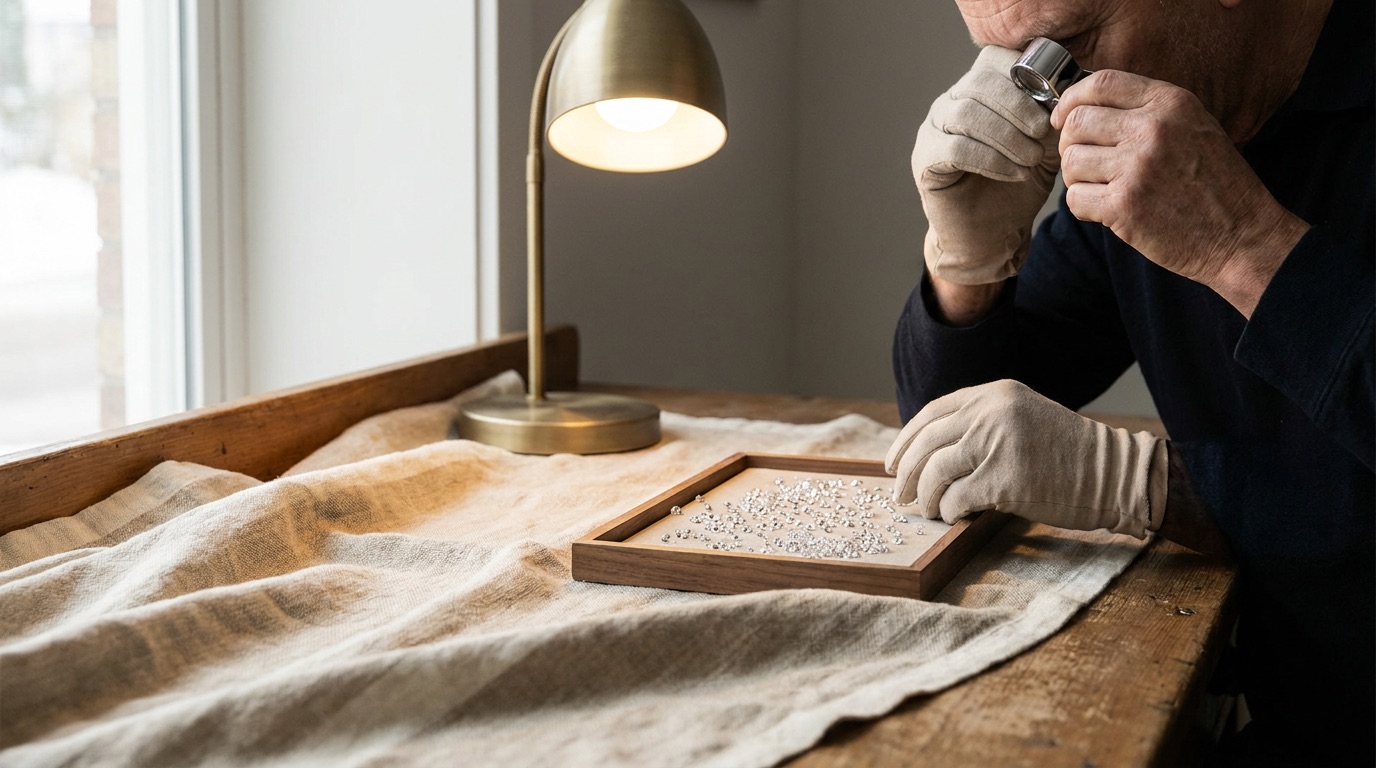
The in-person view is the district's real edge. Color and cut differences that are hard to judge from a list become obvious under a loupe across a tray — which is why many jewelers still make the trip for important center stones even in a remote-first market.

Loose, memo, or finished: which way should you buy?
Trade buyers in the district have three ways to take goods. The right one depends on whether you are quoting a custom job, stocking a case, or filling a confirmed order.
| Method | What it is | Best for |
|---|---|---|
| Loose purchase | You buy the stone outright | Confirmed sales and stock you turn quickly |
| Memo / consignment | You hold the stone to show, pay only if it sells | Showing options to a client before the deposit clears |
| Finished / custom | Supplier sets the stone into a finished piece | Jewelers without an in-house bench |
Memo is especially useful for an out-of-town jeweler: you can take options to show a client, and only the kept stone is invoiced. Get the memo period, insurance responsibility while the stone is in your possession, and the return condition in writing before you leave with goods — most memo agreements run five to ten business days, though this varies by supplier and stone value. New accounts should also expect to pay a deposit or pay outright on early orders; net terms on invoiced purchases typically open up once a payment history is established. For more on consignment terms, see our guide to just-in-time diamond supply, and before committing to any new house, run the 12 questions to ask a wholesale diamond supplier.
Why does being physically at 36 West 47th matter?
A physical address on 47th Street is more than a mailing label — it signals that the goods, the bench, and the people are real and in one place. For a buyer, that translates into three practical advantages:
- In-person viewing — you can loupe the actual stone before you commit, not a photo.
- US-held inventory — goods already cleared and held in the States ship in a day or two, versus a 1–3 week import wait plus customs.
- On-the-block finishing — setting, certification, and casting are all within walking distance, so a finished piece does not bounce between cities.
Guru Diam holds its active inventory in the US across New York and Los Angeles, so loose certified stones are clear-to-ship within 24 hours and finished custom pieces run roughly 4–6 working days. For a deadline-driven custom order, that domestic-stock advantage is the whole game — whether you walk into 36 West 47th, call the LA desk, or never leave your own bench.
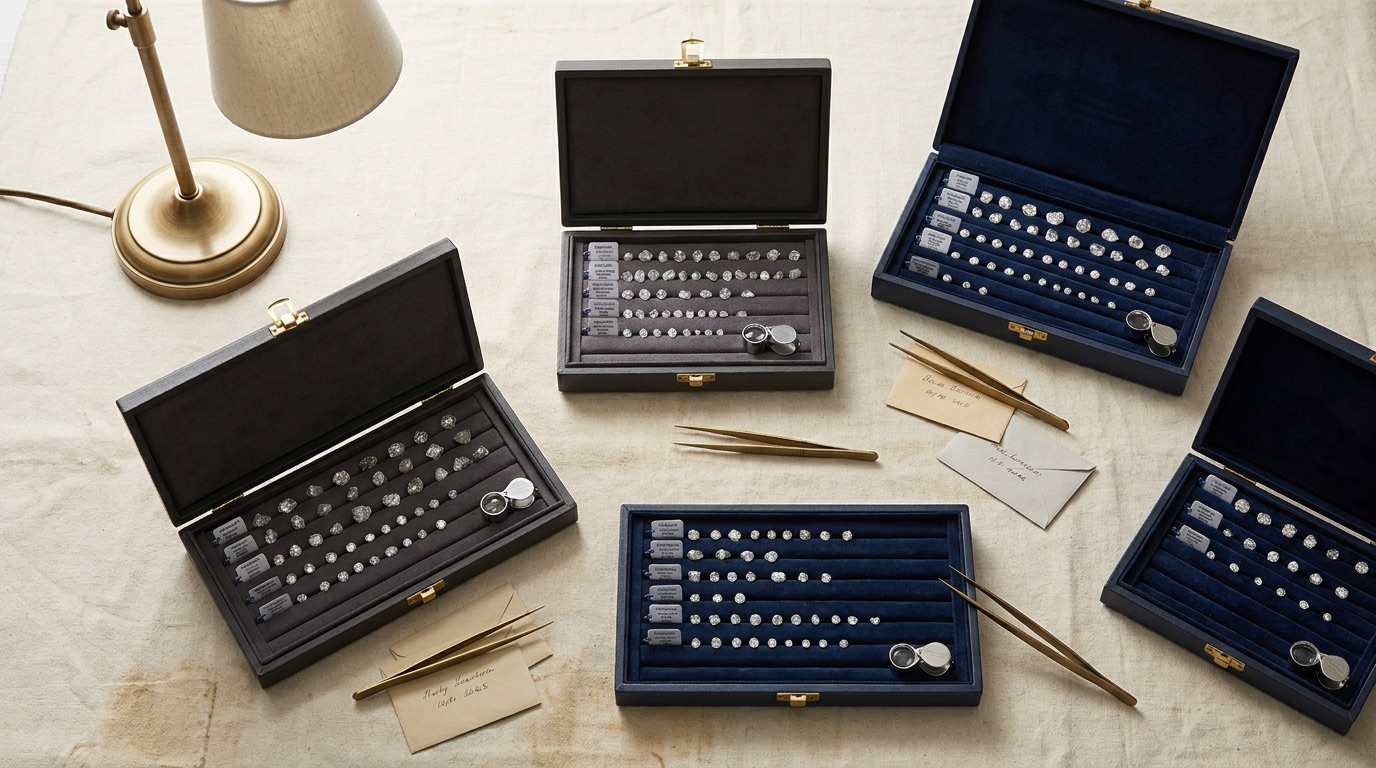
Inside a 47th Street trade desk: from account approval to appointment
What actually happens between opening an account and getting a stone in hand looks similar across most 47th Street suppliers, though the details vary. Here is how it runs on Guru Diam's desk specifically:
- Account approval. Submit a resale certificate, business ID, and EIN through the trade signup flow; most applications clear the same day.
- List access. Approved accounts get the live loose-diamond list, plus an inventory API or CSV feed for retailers who want to pull stock directly into their own site.
- Shortlisting. Whether you are booking an in-person appointment or buying remotely, the desk pulls candidate stones against your brief — shape, carat, color, clarity, and lab of choice among IGI, GIA, or GCAL.
- Decision. Buy outright, or take stones on memo to show a client before committing.
- Fulfillment. Loose certified stones already in US stock are clear-to-ship within 24 hours; custom settings go to the in-house bench, where cutting, setting, and polishing all happen under one roof, and finished pieces run roughly 4–6 working days.
- Delivery. Local buyers can pick up in person at 36 West 47th; everyone else ships from New York (cutoff 6pm EST) or Los Angeles (cutoff 4pm PST), blind or drop-shipped and unbranded by default so a retailer can resell a custom piece as its own.
The point of walking through it step by step is that none of it depends on being in the room. A buyer in Chicago or Miami goes through the identical sequence minus the in-person viewing — same account, same list, same bench, same lab reports.
How do you buy from the Diamond District remotely?
Most wholesale lab-grown buying today is remote, and a good 47th Street supplier is built for it. You do not need to be in New York to buy from New York stock. The remote flow mirrors the in-person one:
- Open a trade account online with your resale certificate and business ID.
- Request the live loose-diamond list — or pull it via an inventory API or CSV feed if you run your own site.
- Shortlist by grade and report and ask for additional photos, video, or specs on candidate stones.
- Buy outright or on memo and have goods shipped to your bench from US-held inventory.
- Verify on arrival against the IGI, GIA, or GCAL report before you set or sell.
Guru Diam supports trade accounts via the signup flow, memo and consignment, an inventory API and CSV feed for retailers listing stock on their own sites, and blind or drop-shipping so the package arrives unbranded to your customer. The net effect: an out-of-town jeweler gets the district's selection and speed without the flight. Browse certified lab-grown diamonds to see how a current list reads.
One habit worth keeping regardless of how you buy: federal rules require lab-grown diamonds to be clearly disclosed as such at every point of sale. Make sure whatever paperwork or listing follows the stone downstream — your invoice, your own product page, your customer's receipt — carries that disclosure through. It protects you as much as your customer.
In-person appointments vs. wholesale accounts: which approach fits?
The two paths are not exclusive — many jewelers use both — but it helps to know where each wins.
The case for in-person buying: nothing beats loupe time on the actual stone, especially for a center stone above a few carats or an antique cut where cut quality varies more than the certificate alone reveals. Same-day pickup also removes shipping risk entirely for a time-sensitive job.
The case for a remote wholesale account: you get the same list and the same certified stones, and — from a US-held supplier — shipping in one to two business days, without the cost or time of travel. For routine reorders, calibrated melee, or any purchase where the certificate and clear photos are enough to decide, remote buying is simply more efficient.
| Buyer | Best approach | Why |
|---|---|---|
| Local NYC jeweler | In-person appointments at 36 W 47th | Loupe goods, same-day pickup, on-block setting |
| Out-of-town jeweler | Remote list + memo + shipping | District selection and US-held speed without travel |
| Online retailer / brand | Inventory API / CSV feed + drop-ship | List live stock, fulfill blind from US stock |
For a fuller walkthrough of opening a trade account and getting the list, see our guide on how to buy lab-grown diamonds wholesale.
Common mistakes trade buyers make in the Diamond District
A handful of avoidable errors account for most of the friction jewelers run into when they start sourcing on 47th Street, whether in person or remotely:
- Not confirming the lab before viewing. IGI, GIA, and GCAL reports are graded to different house standards. Know which lab a stone is certified against before comparing it to another quote — two "VS1" stones from different labs are not automatically equivalent.
- Treating melee like certified stones. Calibrated melee ships as uncertified parcel goods against a quality baseline, not individually graded reports. Asking for "certified melee" signals to a supplier that you have not sourced melee before, and it is worth knowing the distinction going in.
- Skipping the resale certificate step. Showing up to an appointment without paperwork wastes the visit — no legitimate wholesale supplier will quote trade pricing without it on file first.
- Over-negotiating on the first order. New accounts rarely get the same pricing as established ones. Building the relationship over a few orders typically does more for your margin than pushing hard on the first one.
- Buying a center stone on photos alone. Photos and video help you shortlist, but for anything above a few carats or an antique cut, ask for a live video call or make the trip — cut quality and light performance are hard to judge from a still image.
- Losing track of memo stones. Keep memo goods separate from owned stock and log the return date. It is the single most common paperwork error new accounts make.
The bottom line for trade buyers
The Diamond District still offers something a marketplace tab cannot: real goods, real benches, and real people in one square block, with US-held inventory that moves at trade speed. Whether you walk into 36 West 47th to loupe a center stone or buy the whole list remotely from New York or Los Angeles, the unlock is the same — a verified trade account with a producer whose stones, certificates, and lead times you trust. Open a trade account and we will send the current list the same day, or browse certified lab-grown diamonds to start.
Frequently Asked Questions
Wholesale buying on 47th Street runs on appointments, not walk-in foot traffic. You open a trade account first, then book a time so the supplier can pull stones matching your brief before you arrive. This applies whether you visit in person or buy remotely from the same list.
No. Most wholesale lab-grown buying today is remote. An out-of-town jeweler opens a trade account online, works from the live loose-diamond list, buys outright or on memo, and has goods shipped from US-held inventory — getting the district's selection and speed without traveling to 47th Street.
Guru Diam is at 36 West 47th Street, in the heart of New York's Diamond District — the block of 47th Street between Fifth and Sixth Avenues. The firm runs its own CVD production and holds active inventory in the US across New York and Los Angeles.
From a US-held supplier, loose certified stones are clear-to-ship within 24 hours and arrive in one to two business days; local buyers often leave with the stone the same day. Finished custom pieces run roughly 4–6 working days. Overseas factory orders, by contrast, take one to three weeks plus customs.
Yes. In-person viewing is the district's real advantage. With an appointment, you can loupe each stone, compare goods side by side across a tray, and check every stone against its IGI, GIA, or GCAL report before you commit — something hard to judge from a list alone.
Yes. Diamond District wholesalers sell to the trade only and require proof of business — typically a business license and a resale certificate (Form ST-120 in New York State), plus a tax ID and photo ID. This keeps the sale tax-exempt for resale and confirms you are a reselling business, not a consumer.