
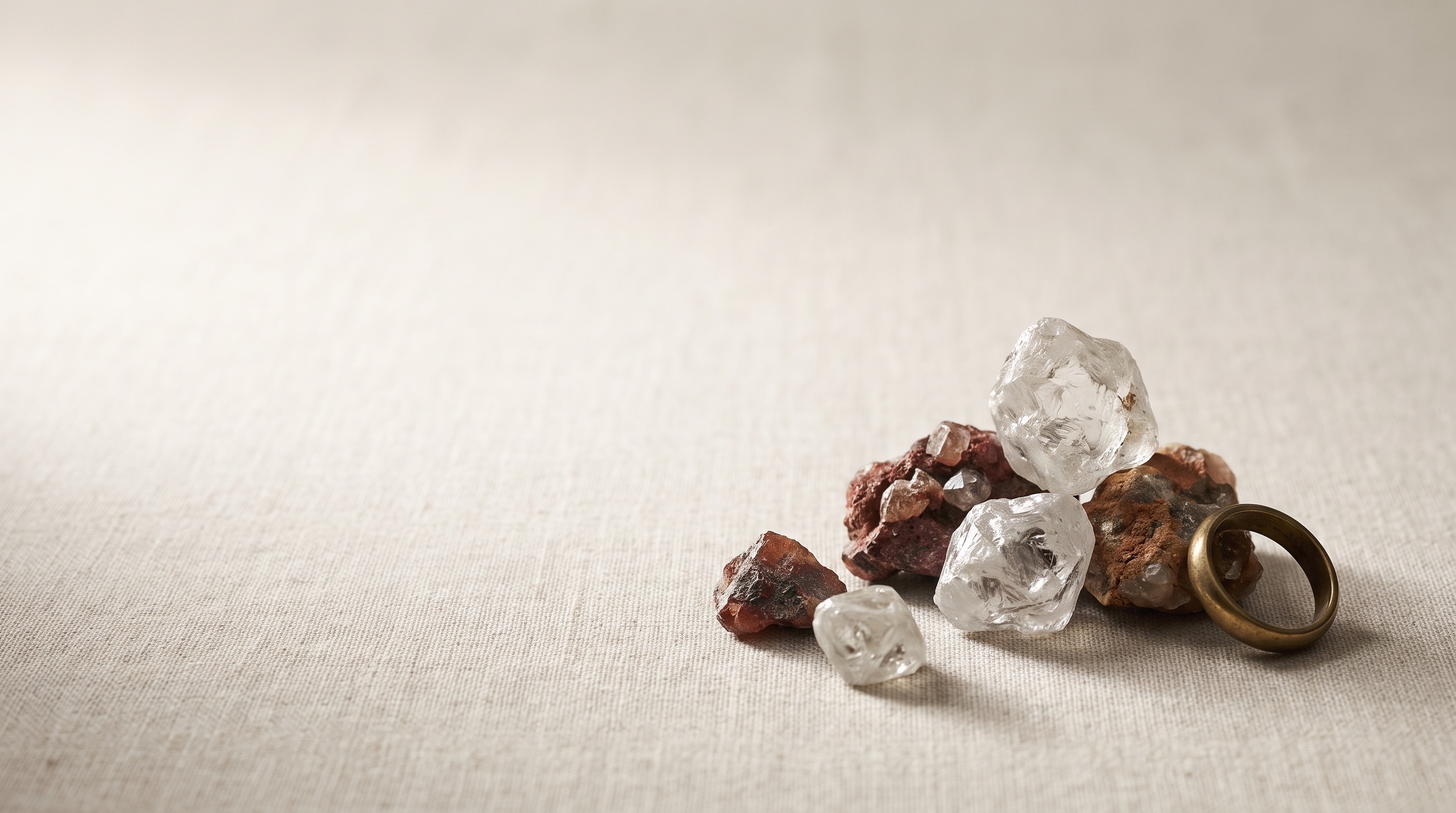
Botswana is one of the world's largest diamond producers by value, with its diamond industry built around large-scale kimberlite pipe mining operated primarily through Debswana, a 50-50 joint venture between the Botswana government and De Beers. Diamond mining has been central to Botswana's economy since major deposits were discovered shortly after the country's 1966 independence, transforming it from one of the poorest countries in the world at the time into one of Africa's strongest examples of resource-driven economic development.
This guide covers how Botswana's diamond industry developed, its major mines and production methods, the Debswana partnership structure, how Botswana's diamonds move through certification and the Kimberley Process, and what Botswana's role in global diamond supply means for a wholesale buyer sourcing natural stones today.
How Botswana's Diamond Industry Began
Diamonds were discovered in Botswana at the Orapa deposit in 1967, just a year after the country gained independence from British colonial rule. That timing mattered enormously — rather than diamond wealth flowing primarily to a colonial power or being extracted with minimal benefit to the local population, Botswana's government negotiated a direct partnership structure with De Beers from very early in the country's independence, giving the state a substantial ownership stake and revenue share in diamond production from the outset. That structural decision is widely credited by economists as a key reason Botswana avoided the "resource curse" pattern seen in some other mineral-rich developing nations, using diamond revenue to fund substantial infrastructure, healthcare, and education investment over subsequent decades.
The Debswana Partnership
Debswana Diamond Company is a 50-50 joint venture between the Government of Botswana and De Beers, formed to operate the country's major diamond mines. This structure gives Botswana's government direct ownership in mining operations rather than relying solely on taxation or royalties from a foreign-owned operator, a partnership model that has remained largely stable since its formation and is frequently cited as a template other resource-rich nations have studied when structuring their own extractive-industry partnerships. Botswana's government also holds a stake in De Beers itself, further aligning the country's interests with the broader De Beers group's global diamond marketing and sales operations.
Major Diamond Mines in Botswana
| Mine | Location | Notable Characteristics |
|---|---|---|
| Orapa | Central Botswana | Botswana's first major mine, discovered 1967; one of the largest diamond mines by area in the world |
| Jwaneng | Southern Botswana | Often cited as the richest diamond mine in the world by value, operating since 1982 |
| Letlhakane | Central Botswana, near Orapa | Long-running production mine, part of the same central mining complex as Orapa |
| Damtshaa | Central Botswana | Smaller satellite operation within the Orapa mining complex |
| Karowe | Central Botswana | Operated by Lucara Diamond (not Debswana); known for recovering several exceptionally large rough diamonds |
All of Botswana's major producing mines extract diamonds through kimberlite pipe mining, using large-scale open-pit methods given the scale and depth of the country's kimberlite deposits. Jwaneng in particular is frequently described in the trade as the world's richest diamond mine by value, reflecting both the volume and the exceptional quality of stones recovered there relative to ore processed.
How Botswana's Diamonds Move From Mine to Market
Rough diamonds recovered from Debswana's mines are sorted and valued domestically before entering the broader international trade, a deliberate policy shift Botswana pursued over the past two decades to capture more value domestically rather than exporting all rough stones for sorting and sale elsewhere. Botswana has invested significantly in building domestic diamond-sector capacity — including sorting, valuation, and a smaller but growing domestic cutting and polishing industry — as part of a broader economic strategy to move beyond simply exporting raw rough diamonds. De Beers relocated a substantial share of its global rough diamond sales and sorting operations to Gaborone, Botswana's capital, reflecting this shift toward greater in-country value capture.
Once sorted and valued, rough stones move into the broader international trade pipeline — sold to manufacturers and cutting houses (with a large share ultimately cut and polished in Surat, India, which handles the majority of global cutting volume) before being graded by labs like GIA, IGI, or GCAL and entering wholesale and retail markets worldwide.
Botswana's Economic Reliance on Diamonds
Diamond mining has historically accounted for a very large share of Botswana's GDP, government revenue, and export earnings, making the country's economic fortunes closely tied to global diamond demand and pricing cycles. This concentration has prompted Botswana's government to pursue economic diversification efforts in recent years, given the recognized long-term risk of relying so heavily on a single resource sector, particularly as natural diamond demand has faced new competitive pressure from lab-grown CVD alternatives. Botswana has responded partly by pushing further into domestic value-added activity (sorting, cutting, and jewelry manufacturing) rather than only extracting and exporting rough stones, aiming to capture a larger share of each diamond's total value chain within the country.
Kimberley Process and Ethical Sourcing Standing
Botswana is a founding and active participant in the Kimberley Process Certification Scheme, the international framework certifying that rough diamond exports are conflict-free. Botswana's diamond industry is widely regarded in the trade as one of the more transparent and well-regulated national diamond sectors globally, reflecting both its stable governance structure and its long-standing direct government partnership in mining operations, which gives the state significant visibility into production and export practices compared to a purely private, foreign-owned extraction model.
Botswana Diamonds vs. Lab-Grown CVD Diamonds
| Aspect | Botswana Natural Diamonds | Lab-Grown CVD Diamonds |
|---|---|---|
| Origin | Mined from kimberlite pipes, formed over 1+ billion years | Grown in a lab reactor over weeks using chemical vapor deposition |
| Certification | Graded by GIA, IGI, GCAL, and others under standard natural-diamond reporting | Graded by the same labs, with growth method clearly disclosed on the report |
| Traceability | Kimberley Process-certified at export; Botswana has invested in enhanced domestic traceability | Traceable to a specific grower/reactor batch |
| Supply dynamics | Finite — tied to the productive life of specific mines like Jwaneng and Orapa | Scales with manufacturing capacity, not geological scarcity |
| Economic role | Central to Botswana's national economy and government revenue | Manufacturing-based, distributed across CVD production facilities globally |
Neither origin determines a stone's visible quality — a well-cut, well-graded diamond from a Botswana mine and a well-cut, well-graded lab-grown CVD diamond can look identical to the naked eye and carry equivalent 4Cs grades. The distinction buyers weigh is origin, price per carat, supply dynamics, and, for some buyers, the significance of a stone's geological history and national provenance.
Why Botswana's Diamond Story Matters for a Wholesale Buyer
Understanding Botswana's role in the natural diamond supply chain helps a trade buyer speak accurately to customers about provenance, particularly for buyers who specifically value or ask about natural diamond origin. Botswana diamonds carry a well-documented reputation for both quality (particularly from Jwaneng) and a comparatively transparent, government-partnered production model, which some customers find meaningful when choosing a natural stone. That said, origin-specific sourcing for an individual stone typically isn't something a retail buyer can specify or guarantee at the point of purchase unless working with a supplier who tracks and discloses country-of-origin data specifically — most natural diamond inventory moves through international trading and cutting channels without stone-by-stone country tracking preserved all the way to the final certified, polished product.
Sourcing Natural and Lab-Grown Diamonds From One Supplier
Guru Diam is a trade-only wholesale supplier carrying both certified natural diamonds and CVD lab-grown diamonds, along with certified loose stones and finished and custom jewelry — antique cuts, standard fancy shapes, and round brilliant all included, with IGI, GIA, and GCAL certification available for either origin. In-stock inventory ships same-day from New York (before 6pm EST) and Los Angeles (before 4pm PST), giving jewelers serving customers interested in natural diamond provenance — Botswana or otherwise — and lab-grown alternatives a single sourcing relationship for both.
Buyers can browse certified loose diamond inventory through the certified diamonds category, source matched pairs through matching pairs, and review fancy color stones through fancy color loose diamonds. Trade accounts can review terms at the wholesale hub or apply through trade partner, and jewelers building a full piece can work through custom jewelry for a setting finished in 4-6 days.
Botswana Compared to Other Major Producing Countries
| Country | Ownership/Operating Structure | Notable Distinction |
|---|---|---|
| Botswana | 50-50 government/De Beers joint venture (Debswana) | Widely cited model for equitable resource-revenue sharing; home to Jwaneng, often called the world's richest mine by value |
| Russia | State-linked production (Alrosa) | Largest producer by volume globally; major deposits include Mir and Udachny |
| Canada | Privately operated (Rio Tinto, others) under strict environmental regulation | Known for traceable, well-regulated "Canadian diamond" origin marketing |
| South Africa | Mixed private and historically De Beers-linked operations | Historic birthplace of large-scale kimberlite mining in the 19th century |
| Democratic Republic of Congo | Mixed artisanal and industrial alluvial mining | High-volume alluvial production, historically associated with conflict-diamond concerns now addressed through the Kimberley Process |
The Future of Botswana's Diamond Industry
Botswana's government has been actively planning for the eventual decline of its current major mines' productive lives, investing in exploration for new deposits, extending mine life through deeper underground development at sites like Jwaneng, and continuing to push economic diversification beyond diamonds. Botswana has also taken an increasingly assertive negotiating position with De Beers in recent contract renewals, seeking greater control over sales and a larger share of value capture domestically — a sign of a maturing producer relationship rather than a purely dependent one. How Botswana balances its historical reliance on natural diamond mining against a global market increasingly shaped by lab-grown CVD supply is one of the more closely watched economic questions in the broader diamond trade over the coming decade.
Notable Large Diamonds Discovered in Botswana
Botswana's mines have produced several of the largest and most significant rough diamonds recovered in the modern era. Karowe mine, operated by Lucara Diamond rather than Debswana, has become particularly well known in the trade for recovering multiple exceptionally large rough stones over the past decade, including some of the largest gem-quality rough diamonds found anywhere in the world during that period. These discoveries draw significant attention in the trade press and among specialist rough-diamond buyers, since stones of that size require specialized planning, cutting decisions, and often command significant premiums at auction well beyond standard per-carat commercial pricing. Large, headline discoveries like these are a small fraction of Botswana's overall production, but they've contributed meaningfully to the country's reputation as a source of exceptional as well as high-volume commercial diamond material.
Environmental and Community Programs
Botswana's major mining operations have invested in environmental management and community development programs alongside their core extraction activity, reflecting both regulatory requirements and the government's direct ownership stake in Debswana, which gives the state a more immediate interest in long-term environmental and social outcomes than a purely private, foreign-owned operation might have. Programs have included land reclamation planning for mined areas, water management given Botswana's arid climate and the water demands of large-scale ore processing, and community investment funded through diamond revenue in areas like healthcare, education, and infrastructure surrounding mining regions. Botswana's government has also used diamond revenue to fund the Okavango Delta and other conservation areas indirectly through broader national budget allocation, an example often cited of resource revenue funding non-resource-sector priorities like tourism and conservation.
Diamond-Related Tourism in Botswana
Botswana has developed a small but notable diamond-tourism sector, including visitor programs at some mining operations and diamond-sorting and valuation facility tours in Gaborone for groups with legitimate trade or educational interest. This is distinct from a casual walk-in retail experience — most diamond-related tourism in Botswana is structured around organized group visits rather than open public access, reflecting the security and operational realities of active mining and sorting facilities. For most travelers, Botswana's diamond industry is more likely to be encountered indirectly, through the country's broader reputation and the infrastructure diamond revenue has helped fund, than through direct facility visits.
How Global Lab-Grown Competition Is Reshaping Botswana's Strategy
The growth of lab-grown CVD diamonds as a mainstream, lower-cost alternative has created real strategic pressure on natural diamond-producing economies, Botswana included, since a meaningful share of the natural diamond market's historical pricing power depended on natural stones facing limited direct substitute competition. Botswana's response has centered on emphasizing what lab-grown production can't replicate — geological rarity, a specific national provenance story, and the country's transparent, government-partnered production model — while continuing to invest in domestic value capture (sorting, valuation, and cutting) so that a larger share of each natural stone's value stays within Botswana's economy regardless of how the broader natural-versus-lab-grown market mix evolves. How successfully that positioning holds up against continued lab-grown price and volume growth remains one of the more closely watched dynamics in the natural diamond trade, and the outcome carries real stakes for Botswana's economy well beyond the diamond sector itself, given how deeply diamond revenue is woven into the country's broader fiscal and social investment over the past several decades.
Botswana's Broader Economic Diversification Efforts
Recognizing the long-term risk of relying so heavily on diamond revenue, Botswana's government has pursued diversification into sectors including tourism (notably around the Okavango Delta and Chobe National Park), financial services, and light manufacturing, using diamond-funded infrastructure and education investment as a foundation for that broader economic base. Progress on diversification has been gradual — diamonds still represent a substantial share of Botswana's export earnings and government revenue — but the strategy reflects lessons drawn directly from the country's own diamond-era experience: that resource wealth is most durable when it's used to build capacity in other sectors rather than treated as a permanent, self-sustaining revenue source. This diversification push has become more urgent as global lab-grown diamond competition has introduced new uncertainty into long-term natural diamond demand projections.
How Botswana's Model Compares to Other Diamond-Producing Nations
Botswana is frequently cited as a contrasting case study against diamond-producing nations that experienced significant conflict or governance problems tied to their diamond wealth, most notably parts of West and Central Africa during the "blood diamond" era of the 1990s and early 2000s. The comparison isn't simply about diamonds themselves — Botswana had relatively stable, accountable governance institutions already in place at the time diamonds were discovered, which shaped how the resulting wealth was managed from the outset. That contrast has made Botswana a frequently studied example in development economics literature on the so-called "resource curse," illustrating that natural resource wealth's outcomes depend heavily on the governance institutions already in place before major resource revenue begins flowing, not on the resource itself.
Botswana's Workforce and Local Employment in Mining
Debswana and Botswana's broader diamond sector have made significant investment in developing a domestically trained workforce across mining, processing, sorting, and valuation roles, reducing historical reliance on foreign technical staff for skilled positions. This workforce development has been supported by targeted education and training programs, often funded directly or indirectly through diamond revenue, that have built local technical and engineering capacity over successive generations since major mining began in the late 1960s. That local skills base is itself a form of economic diversification distinct from revenue diversification — it means Botswana's diamond-sector expertise increasingly stays within the country's own workforce rather than depending on rotating foreign specialists, and it has supported the country's push into higher-value domestic activities like sorting and valuation rather than remaining limited to raw extraction, and it gives Botswana a more durable base of institutional knowledge to draw on as the industry adapts to new pressures like lab-grown competition and eventual mine depletion at its oldest sites.
What Botswana's Experience Means for Understanding Diamond Provenance
For a trade buyer or a customer asking thoughtful questions about diamond origin, Botswana's story illustrates why "where was this diamond mined" is a more complex and more interesting question than a simple country name suggests — it touches on mine ownership structure, revenue-sharing arrangements, environmental and labor practices, and how much of a stone's value chain stays within the producing country versus flowing to cutting and trading centers elsewhere. A jeweler who understands this level of detail can have a genuinely more informed conversation with a customer who cares about origin, rather than treating "natural diamond" or "African diamond" as a single undifferentiated category.
That same nuance is worth carrying into any conversation about natural diamond sourcing generally: two natural stones can carry identical 4Cs grades while coming from mines with very different ownership structures, environmental practices, and revenue outcomes for the country of origin, and a buyer who can speak to that distinction — rather than treating "natural" as a single uniform category — offers a meaningfully more informed perspective than most retail-level sourcing conversations typically include.
Frequently Asked Questions
Why is Botswana such a major diamond producer?
Botswana has some of the world's richest kimberlite diamond deposits, discovered shortly after the country's 1966 independence, and built a stable 50-50 government/De Beers partnership (Debswana) that has operated major mines like Orapa and Jwaneng for decades.
What is Debswana?
Debswana Diamond Company is a 50-50 joint venture between the Government of Botswana and De Beers that operates Botswana's major diamond mines, giving the government direct ownership and revenue share in production.
What is the richest diamond mine in Botswana?
Jwaneng, operating since 1982, is frequently described in the trade as the richest diamond mine in the world by value, reflecting the exceptional quality and volume of stones recovered relative to ore processed.
Are Botswana diamonds ethically sourced?
Botswana is a founding participant in the Kimberley Process and is widely regarded as one of the more transparent, well-regulated national diamond industries, partly due to its direct government partnership in mining operations.
Can I specifically buy diamonds sourced from Botswana?
Country-of-origin tracking for an individual polished stone typically isn't preserved through standard international cutting and certification unless a supplier specifically tracks and discloses it — most natural diamond inventory moves through international trading channels without stone-by-stone origin data carried to the final product.
How does Botswana compare to lab-grown diamond production?
Botswana's diamonds are mined from kimberlite pipes formed over geologic time, a finite resource tied to specific mines' productive lives, while lab-grown CVD diamonds are manufactured in reactors and scale with production capacity rather than geological scarcity.