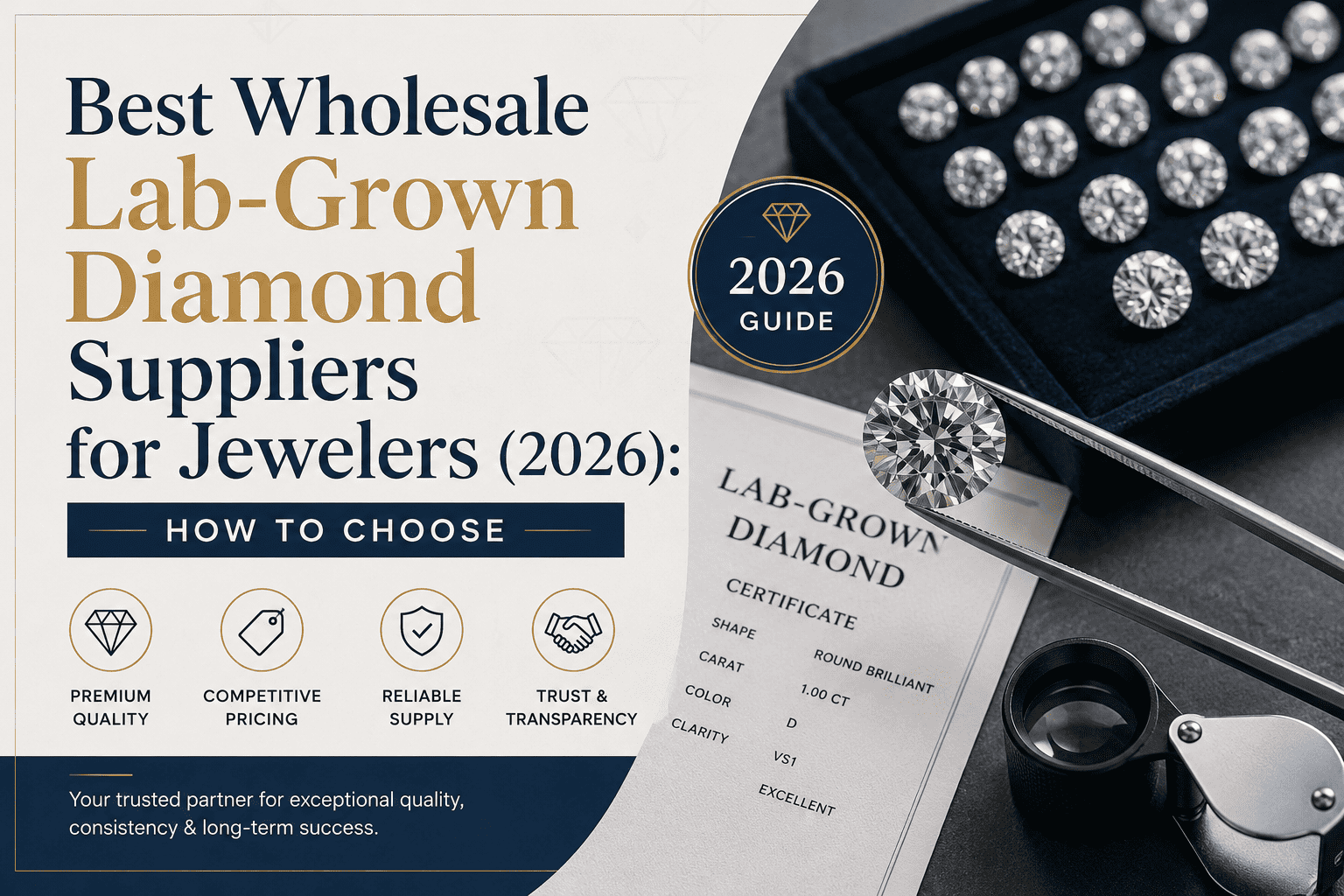
The best wholesale lab-grown diamond supplier isn't the one with the lowest per-carat quote this week — it's the one whose certification standard, inventory depth, and account terms still hold up on your fiftieth reorder.
Short answer: The best wholesale lab-grown diamond supplier for a jeweler is the one that matches how you actually sell — certification standard, inventory depth, pricing transparency, minimum order requirements, turnaround, and trade tools — not whoever posts the lowest per-carat number. Wholesale lab-grown suppliers generally fall into three categories: large multi-brand distributors that carry stones alongside mountings and findings, boutique lab-grown specialists focused narrowly on loose diamonds, and direct-from-cutter producers that control their own production and sell straight to trade accounts. This guide breaks down the criteria that separate them, the red flags that should make you slow down, and the concrete steps for testing and onboarding a new supplier before you commit real volume.
Lab-grown diamond prices have fallen sharply over the past two years, which is exactly why supplier selection now matters more than supplier price. When wholesale costs compress across the board, your margin and your customer experience come from reliability, certification accuracy, and category depth — not from shaving another few dollars per carat off an already-thin spread. A supplier relationship is also an operational dependency: if a supplier's inventory data is stale, its certs are inconsistent, or its account terms shift after you've built a customer relationship around them, the cost shows up in returns, delays, and reputation — not just on the invoice.

What "Wholesale Supplier" Actually Means (vs. a Broker or Reseller)
The term "wholesale supplier" gets used loosely in the lab-grown trade, and the distinction matters more than most jewelers realize when they're opening a new account. A true wholesale supplier holds or produces its own inventory and sells directly to trade accounts at trade pricing. It controls — or is close enough to the source to verify — certification, cutting quality, and stock availability. When you place an order, the stone either already exists in that supplier's inventory or is in active production, not sourced on the fly from a third party once your PO lands.
A broker or reseller, by contrast, doesn't typically hold meaningful inventory of its own. It arranges deals between buyers and whoever actually holds the stone — another wholesaler, a cutting house, a memo network — and marks up the price for the introduction. That's not automatically a problem; brokers can be useful for one-off or hard-to-find requests. But it changes what you should expect: a broker usually can't tell you with certainty where a stone physically sits, can't guarantee same-day availability because "same-day" depends on someone else's stock, and has less control over certification consistency because the stone passed through hands before it reached you.
The practical test is simple: ask a prospective supplier whether the specific stone or parcel you're inquiring about is in their own inventory right now, and ask them to confirm it against a certificate number you can verify independently. A genuine direct-source wholesaler answers immediately. A broker often needs to "check with someone" first — which is a reasonable answer once, but a pattern worth noting if it happens on every order.
Key Evaluation Criteria: Certification, Inventory, Pricing, and Minimum Orders
Score any wholesale lab-grown diamond supplier against these before you open an account. None of them are deal-breakers in isolation, but weakness across several is a pattern worth taking seriously.
Certification Practices
Are stones certified by IGI or GIA — the two labs US retail customers actually recognize and trust — or does the supplier mix in off-brand or in-house "certificates" that carry no resale credibility? Ask whether certification is per-stone or only per-parcel, and confirm you can independently look up a certificate number against the issuing lab's own database before you rely on it. Mixed or unverifiable certs create resale friction for your customer down the line, not just a paperwork headache for you.
Inventory Depth and Location
How many stones are actually in stock, in which categories, and are they held domestically or sourced only on request? US-held inventory ships faster and removes import uncertainty from your timeline; inventory that exists only as a supplier's production schedule can be cheaper on paper but far less certain to arrive when promised. Ask to see live stock in the specific shape, color, and size range you actually sell — not just the categories a supplier leads with in its marketing.
Pricing Transparency
A trade-only supplier should be able to explain its pricing logic — how per-carat price moves with color, clarity, cut, and certification lab — without hedging. Opaque pricing that changes noticeably between quote and invoice, or that varies for reasons the rep can't explain, is a signal to slow down. Ask for a written price list or a rate card tied to standard grading combinations, even if final quotes are negotiated per order.
Minimum Order Requirements
MOQs vary widely across the lab-grown trade — some suppliers set a per-stone minimum, some a dollar minimum per order, some a minimum only on melee parcels, and some none at all on certified loose stones. Get the actual MOQ in writing before you assume you know it, and ask specifically whether it changes for harder-to-source categories like fancy colors, antique cuts, or calibrated melee versus commodity rounds.
Turnaround Commitments
Same-day shipping on loose certified stones, and a clearly defined lead time on finished jewelry, are what let you say "yes" to a customer on the spot instead of hedging with "let me check." Ask what "same-day" actually means in practice — cutoff times, which categories qualify, and what happens when a specific stone isn't in that day's available stock.
Trade Tools and Category Coverage
Real-time inventory through a portal or API beats a once-a-day emailed spreadsheet, especially if you sell online — a feed that isn't live is the difference between showing real stock and showing stones that sold yesterday. Separately, confirm category depth beyond the commodity middle: can the supplier actually fill fancy shapes, fancy colors, antique or exotic cuts, and calibrated melee, or only round brilliants in common sizes? Depth in the harder categories is usually where the real differentiation between suppliers shows up.
Supplier Types Compared: Distributor vs. Specialist vs. Direct-From-Cutter
No single supplier type wins on every row — the right fit depends on which criteria matter most to your store. The table below reflects general tradeoffs across the market; confirm specifics directly with any supplier you're evaluating, since inventory and terms change.
| Supplier Type | Best For | Strengths | Watch For |
|---|---|---|---|
| Large multi-brand distributor | Jewelers who want mountings, findings, and stones under one account | Enormous catalog, single invoice for everything, deep stock on commodity shapes and sizes | Lab-grown depth in harder categories (fancy color, antique cuts, calibrated melee) is often thin; you're one of thousands of accounts, so pricing flexibility and rep attention can be limited |
| Boutique lab-grown specialist | Jewelers who want category depth and hands-on trade relationships in lab-grown loose specifically | Narrower focus means stronger selection in niche shapes and colors, faster answers on hard-to-source requests, more personal account handling | Commodity-size inventory can be shallower than a full-line house; confirm how much stock is genuinely on-hand versus sourced per order |
| Direct-from-cutter / vertically integrated producer | Jewelers who want pricing and certification control closer to the source, often alongside finished-jewelry capability | Fewer markups between production and your invoice, tighter consistency on certification, frequently paired with in-house custom/CAD capability | "Direct" doesn't automatically mean "fastest" — confirm actual US-held inventory and real turnaround before assuming it beats a specialist on speed |
Read it this way: if you want one account to cover mountings, findings, and stones, a large multi-brand distributor is hard to beat on convenience. If your priority is depth in a specific niche — fancy colors, antique cuts, calibrated melee — a boutique specialist that lives in that category day-to-day will usually out-select a generalist. If you want pricing and certification consistency closer to the source, plus the option to move from loose stone to finished piece without a second vendor, a direct-from-cutter producer is the category to shortlist.

Red Flags When Evaluating a New Supplier
Most bad wholesale relationships show warning signs before the first order ships, not after. Watch for these:
- Certificate numbers you can't verify. If a supplier won't let you look up a cert number against the issuing lab's own database before you buy, treat that as disqualifying, not just inconvenient.
- Pricing that looks disconnected from the rest of the market. A quote dramatically below what comparable suppliers are charging for the same grading combination usually means a substitution somewhere — lab, clarity, or cut quality — not a genuine discount.
- No written return, memo, or consignment policy. Verbal assurances about returns or memo terms that never make it into a written account agreement tend to evaporate exactly when you need them.
- Vague answers about where inventory physically sits. A supplier that can't tell you whether a stone is in domestic stock, still in transit, or still in production is asking you to price a promise, not a product.
- Pressure to commit to volume before a test order. A supplier confident in its own inventory and service doesn't need to pressure a new account into a large first order — it lets a small test order make the case.
- No trade references, or reluctance to provide them. Established wholesale suppliers expect to be checked out by new accounts; hesitation here is itself informative.
- Inconsistent certs or invoicing across repeat orders. If the certification lab, documentation format, or invoice detail shifts order to order with no explanation, that inconsistency tends to show up in other places too.
- Minimum order requirements that surface only after you've engaged. An MOQ isn't a red flag by itself — but one that wasn't disclosed until you were ready to place an order is a sign of how the rest of the relationship will go.
How to Test a New Supplier Relationship Before Committing Volume
Don't move your whole book of business to a new supplier on the strength of a good sales call. Treat the first several orders as a structured test:
- Start with a small, real order — not a sample request. Order stones you'd actually sell, in the quantities you'd actually buy, so the test reflects real conditions.
- Verify every certificate independently. Look up each cert number against the issuing lab's database yourself rather than trusting the paperwork that ships with the stone.
- Order something outside the commodity middle. A 1.5-carat round tells you almost nothing about a supplier's real depth. Test a fancy color, an antique or exotic cut, or a calibrated melee parcel — the categories where weak suppliers thin out.
- Time the actual turnaround against what was promised. If a supplier claims same-day shipping on loose stones, confirm what time the order actually left, and whether that held on a repeat order, not just the first one.
- Create a problem on purpose. Request a return, ask for an exchange, or flag a discrepancy — even a small one — and see how the supplier's team handles it. How a supplier responds to a problem tells you more than how it handles a clean transaction.
- Check invoice-to-certificate consistency across two or three orders. Consistency over time is a better signal than any single transaction.
Only after a new supplier clears a real test across a few orders — accurate certs, honest turnaround, and a competent response to a problem — does it make sense to shift meaningful volume its way.
Questions to Ask Before Opening a Wholesale Account Anywhere
Bring this list to the first real conversation with any prospective supplier, and get answers in writing wherever possible:
- Which certification labs do you use, and is certification per-stone or per-parcel?
- Is the inventory I'm quoted on physically in your possession right now, and where is it held?
- What is your minimum order — per stone, per dollar amount, or per category — and does it change for fancy colors, antique cuts, or melee?
- What is your actual turnaround on loose stones, and what's your defined lead time on custom or finished pieces?
- Do you offer memo or consignment terms, and what's the return window in writing?
- How do you share live inventory — a portal, an API/feed, or a manually updated list — and how often is it refreshed?
- Who is my dedicated point of contact, and what's the escalation path if a cert or shipment has a problem?
- Can you provide two or three trade references from accounts of a similar size to mine?
- What happens, contractually, if a certificate turns out to be inaccurate after the sale?
- Do your prices and terms differ for a new account versus an established one, and for how long?
How Certification and Documentation Practices Signal Supplier Reliability
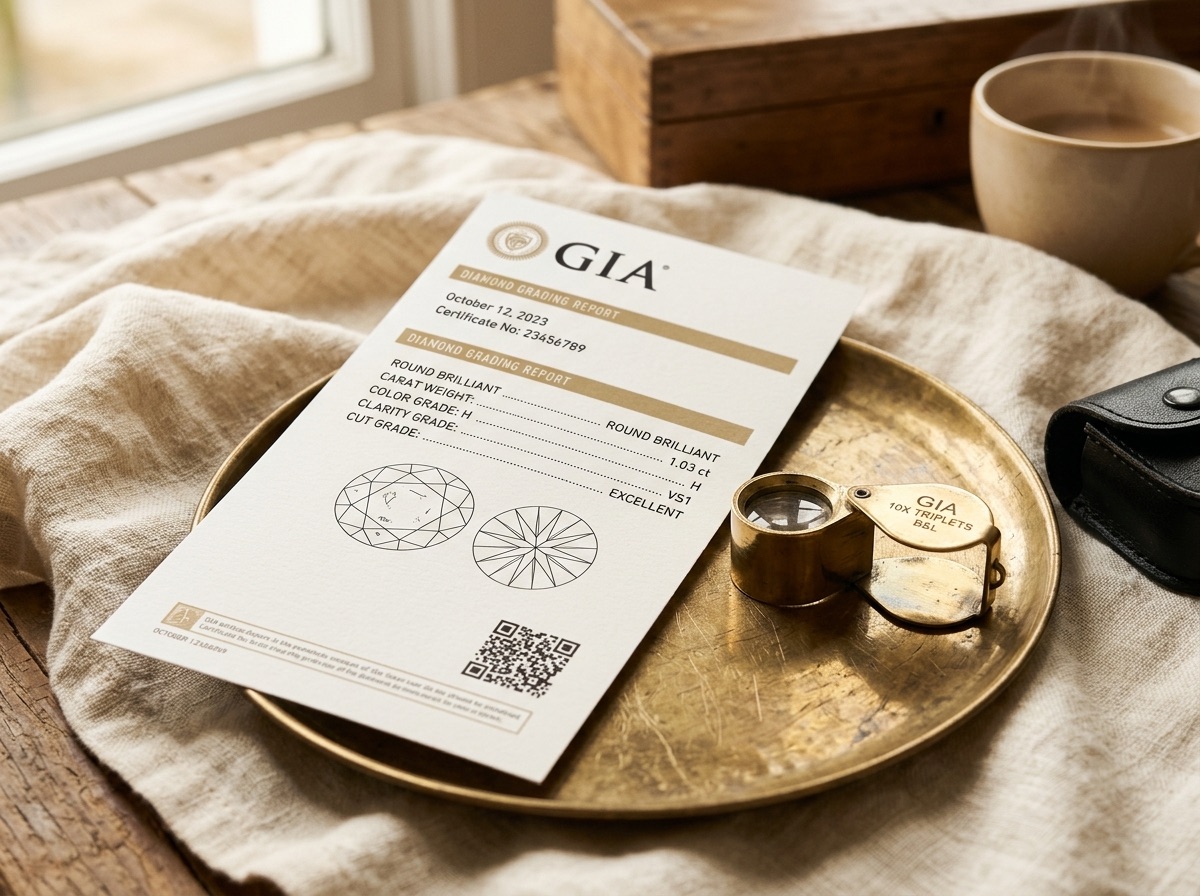
Certification discipline is one of the most reliable proxies for how a supplier runs its whole operation, not just its stones. A supplier that insists on IGI or GIA certification for every stone, keeps that standard consistent order after order, and can produce documentation that holds up for appraisal and insurance purposes is telling you something about its internal controls — inventory tracking, quality checks, and accountability — well beyond the specific transaction in front of you.
The reverse is also true. A supplier that's loose about which lab certified a given stone, that substitutes certification standards without flagging it, or that can't produce clean documentation on request is usually loose in other places too — inventory accuracy, order fulfillment, and how it handles a mistake. Certification consistency is cheap for a supplier to fake on any single order and expensive to fake across dozens of them, which is exactly why testing it across a real order history is more informative than testing it once.
For your own resale purposes, per-stone certification also does real commercial work: it's what lets your customer verify what they're buying independently, and it's what protects you if a certification question comes up after the sale. A supplier that treats that documentation as a formality rather than a discipline is passing that risk on to you.
Where Guru Diam Fits in This Framework
To be direct about it: if you need a single account that also supplies your mountings and findings, Guru Diam isn't built for that — a large multi-brand distributor serves that need better. Where Guru Diam is built to win is the direct-from-cutter category: the lab-grown stone itself, and the finished piece built around it.
Guru Diam runs its own CVD diamond production alongside a New York Diamond District trade desk, which places it in the direct-from-cutter category above rather than the distributor or specialist rows. That means it supplies certified loose lab-grown diamonds same-day from US-held inventory, and CAD-to-finished custom jewelry in 4–6 days from the same source — one vendor across a handoff that usually happens between a stone supplier and a separate jewelry manufacturer. It carries the categories that thin out fastest at larger, more generalist suppliers — fancy colors, antique and exotic cuts, and calibrated melee — and it gives trade accounts real-time inventory through a portal and API rather than a once-a-day emailed stock list. Every stone is IGI or GIA certified, which is the baseline this entire framework is built around.
That combination — direct production, US-held certified inventory, finished-jewelry capability under the same account, and live trade tools — is the specific profile to weigh against any other direct-from-cutter producer or boutique specialist you're considering. Run it through the test-order process above before shifting volume, the same as you would with any new supplier.
Onboarding Checklist: Opening a Wholesale Account
Once you've evaluated and test-ordered from a supplier, opening the account itself is mostly documentation and setup. Work through this before your first real order:
- Business documentation. Resale certificate, business license, and any trade-association or jeweler credential the supplier requires to extend trade pricing.
- Trade references. Have two or three ready if the supplier asks — and ask for the same in return.
- Category scope. Decide up front which categories you'll actually source from this supplier (loose rounds, fancy shapes, melee, finished custom) versus what stays with an existing vendor.
- Pricing and MOQ in writing. Get the rate structure and minimum order terms confirmed in writing before your first order, not verbally on a call.
- Return, memo, and consignment terms. Confirm the written policy, not just a verbal assurance, before you need to use it.
- Trade tool access. Set up portal or API access immediately if you sell online — don't launch on a manually emailed list and switch later.
- Point of contact and escalation path. Know who to call for a routine order and who to escalate to if something goes wrong.
- First test order. Place it before you route real customer orders through the new account, and evaluate it against everything above.

FAQ
How is a wholesale lab-grown diamond supplier different from a broker?
A true wholesale supplier holds or produces its own inventory and sells directly to trade accounts. A broker arranges deals with whoever actually holds the stone and marks up the introduction, which means less certainty over where a stone physically sits and less control over certification consistency. Ask any prospective supplier whether the stone you're quoted on is in their own inventory right now.
What's the most important factor in choosing a wholesale lab-grown diamond supplier?
There's no single factor that outweighs the rest — certification standard, inventory depth and location, pricing transparency, minimum order requirements, and turnaround all matter together. The right weighting depends on how you sell: a custom-and-bridal shop should weight finished-jewelry turnaround heavily, while an online-first retailer should weight real-time inventory tools most.
Should I choose a supplier based on the lowest per-carat price?
No. Because lab-grown wholesale prices have compressed industry-wide, price differences between reputable suppliers are usually small, while differences in certification accuracy, US-held inventory, ship speed, and trade tools are large. Those service factors protect your margin more than a marginally cheaper stone.
Do wholesale lab-grown diamond suppliers sell to the public?
Generally no. True wholesale suppliers sell only to verified trade buyers — retailers, jewelers, designers, and manufacturers — and restrict pricing and inventory tools to approved accounts. Consumers buy from retail jewelers who source from these suppliers.
What certification should wholesale lab-grown diamonds have?
Look for IGI or GIA certification on every stone, not a mix of recognized and off-brand labs. These are the two labs US retail customers recognize, and per-stone, independently verifiable certificates reduce resale friction and returns down the line.
How many wholesale suppliers should a jewelry store work with?
Most stores are better served by two or three suppliers whose strengths cover their actual category mix than by a single source for everything. Running a real test order through each before committing volume lets you judge them on certification accuracy, ship speed, and problem-handling — not just on the headline price.
Sourcing lab-grown diamonds for your store? Open a Guru Diam trade account for same-day certified loose stones and 4–6 day finished jewelry, or talk to the trade desk.