
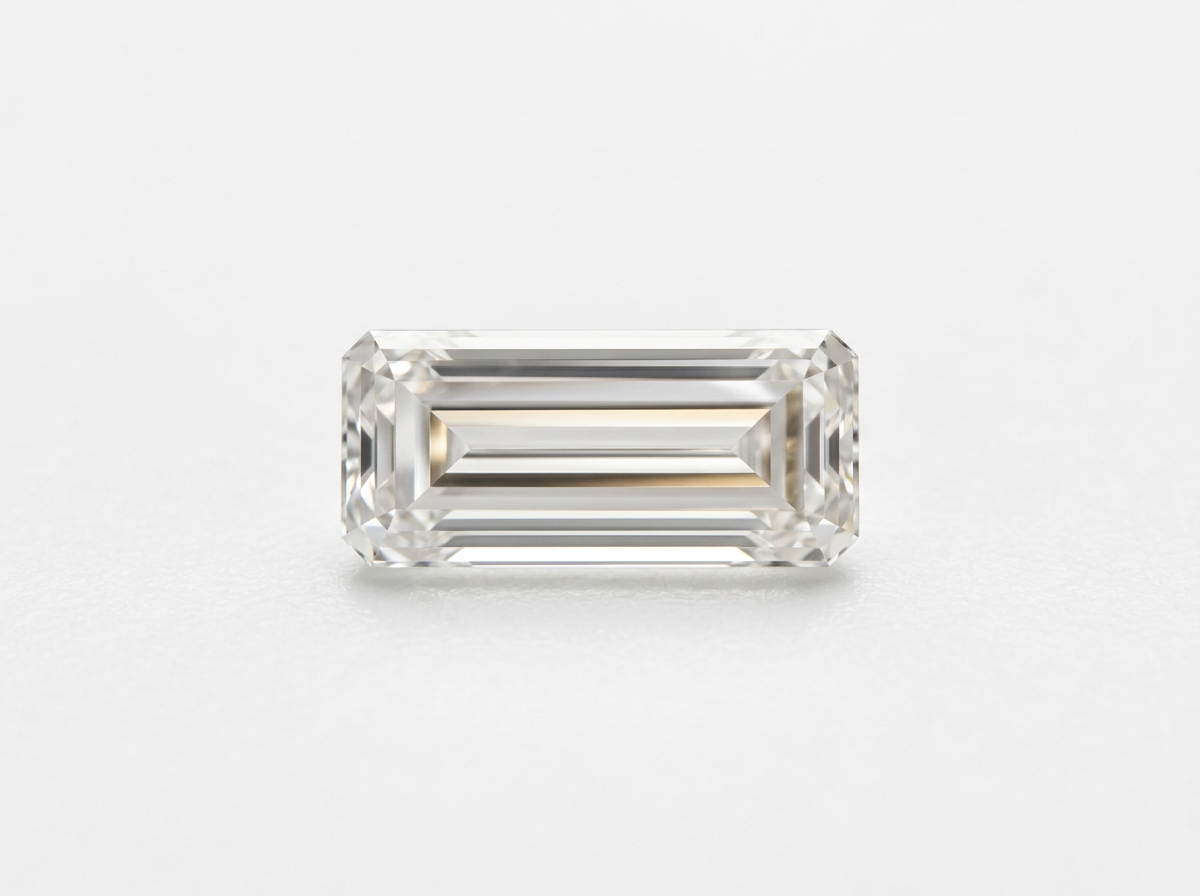
A Baguette is a narrow, rectangular step-cut diamond with parallel long edges — the classic Art Deco side stone, straight-sided rather than angled, used in eternity bands, channel settings, and as accents flanking a center stone. Guru Diam stocks 263 Baguette diamonds on hand, calibrated and matched, IGI-gradable on request from our New York Diamond District desk and Los Angeles office. This guide covers how the shape is built, graded, priced, and matched at wholesale — and where it splits from its close relative, the tapered baguette.

What is a baguette cut diamond?
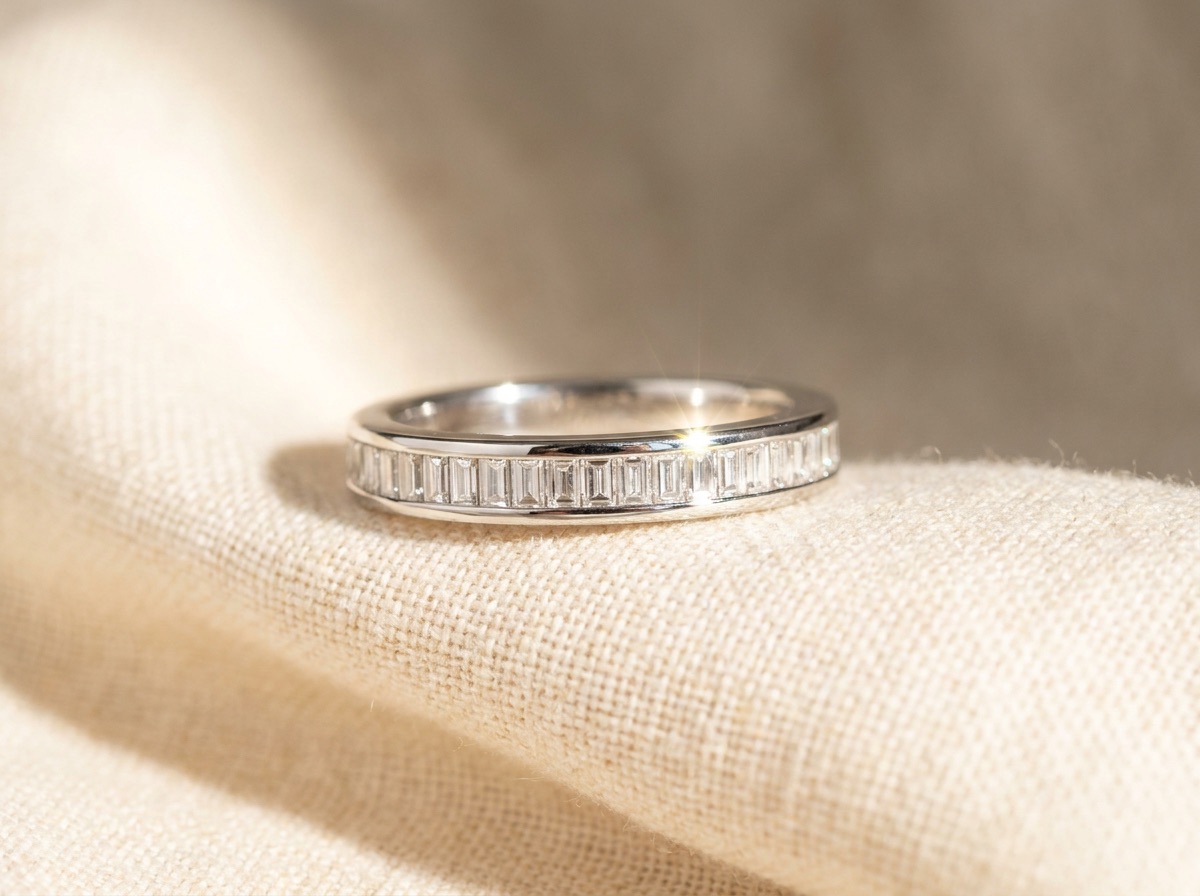
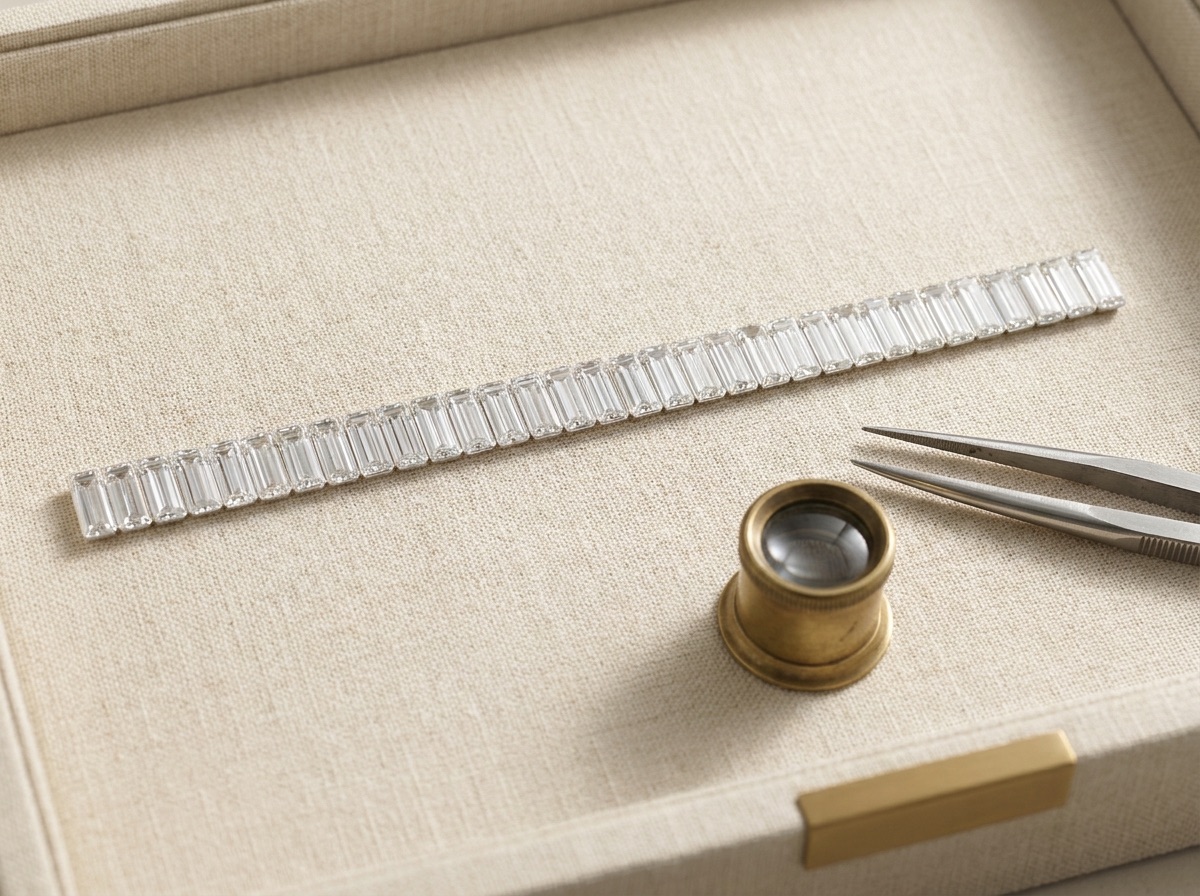
A baguette is a calibrated step-cut side stone: a narrow rectangle with two long edges running perfectly parallel to each other, faceted with broad, flat planes rather than brilliant faceting. That parallel-sided rectangle is the whole identity of the shape — it's what makes baguettes stackable in straight, uninterrupted rows, which is why the cut became the signature side stone of Art Deco jewelry and remains the default choice for eternity bands and channel settings today.
The name comes from the French word for a rod or wand — the same root as the bread — a nod to the stone's long, narrow silhouette rather than anything about its grade or origin. Structurally, a baguette carries far fewer facets than a round brilliant: where a round runs 57 or 58 facets designed to scatter light from every angle, a baguette typically works with roughly 14 — a rectangular table, a small number of long step facets banded around the crown and pavilion in parallel rows, and square, uncut corners. That last detail is what separates a baguette from an emerald cut at a glance: an emerald cut clips its corners into a faceted octagon, while a baguette holds a true 90-degree right angle at all four.
The flat step-cut faceting keeps baguettes quiet rather than sparkly, the same design logic as other calibrated step-cut side stones: they're meant to frame a center stone or build a clean linear pattern, not compete for attention. A well-cut baguette reads as a plane of light rather than a burst of fire — long, glassy flashes as the piece moves, instead of the scattered scintillation a brilliant throws.
The trade history of the baguette cut
The baguette's rise tracks directly with the Art Deco movement of the 1920s and 1930s, when jewelry design pulled sharply away from the curved, floral settings of the preceding Edwardian era and moved toward hard edges, symmetry, and repeated geometric motifs. Step-cut shapes — baguette, trapezoid, lozenge — suited that new visual language better than brilliant cuts did, because their flat planes and straight edges could be lined up edge-to-edge without interrupting a design's geometry. The baguette in particular became the workhorse of the period: cheap enough in small sizes to run in long unbroken channels, and quiet enough in its faceting to sit beside a center stone without stealing light from it.
That utility carried the shape well past the Deco period itself. Baguettes anchored the tennis bracelet boom of the 1980s and 90s, became a default choice for wedding bands through the mid-century, and never fully left channel-setting work even as brilliant-cut side stones gained ground for a stretch. Men's jewelry kept the shape alive through decades when it fell out of favor for engagement rings — baguette rows turn up constantly in vintage cufflinks, signet rings, and watch bezels from the mid-20th century, a use case that's resurfaced again as unisex and men's fine jewelry has grown as its own category.
The current cycle — vintage-inspired engagement rings, Deco-revival eternity bands, and stacked bands mixing baguette rows with round or antique-cut centers — is less a rediscovery than a return to a shape that never really left wholesale inventory. It's the highest-volume calibrated step-cut shape in the trade for exactly that reason: demand for it has never gone fully quiet the way it has for rarer antique cuts, which makes it a dependable category rather than a trend-driven one for a supplier to hold deep stock against.
Baguette vs. other calibrated step-cut shapes
Buyers sourcing a baguette are usually weighing it against a short list of related calibrated shapes, and it helps to know where each one sits before placing an order.
| Shape | Corners | Typical use |
|---|---|---|
| Baguette | Square, true right angle | Straight channels, eternity bands, uniform rows |
| Tapered Baguette | Square, angled sides | Following a shank taper toward a center stone |
| Emerald cut | Clipped (octagonal outline) | Center stones and larger step-cut accents |
| Trapezoid | Two parallel sides of different lengths, angled ends | Tapering a channel toward a shoulder or flanking an emerald/Asscher center |
The baguette's square corners are what make it stack cleanly into a row with no visual gap at the joins — an emerald cut's clipped corners would leave a small triangular void between stones if set the same way, which is why emerald-shaped accents are used individually or in pairs rather than in continuous channels.
Baguette vs. Tapered Baguette — parallel vs. angled sides
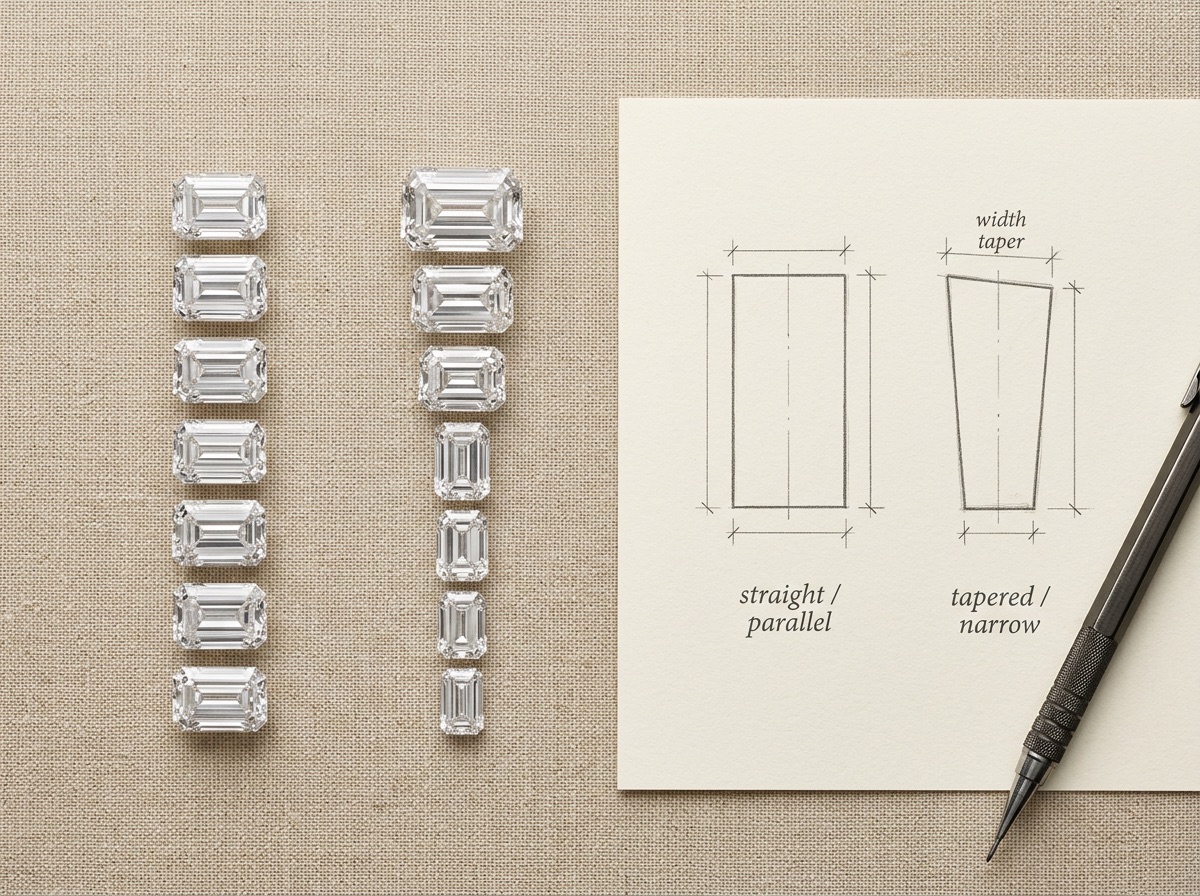
The most common sourcing mix-up with this shape is Baguette vs. Tapered Baguette. A straight baguette has parallel long edges, full stop — it's a rectangle. A tapered baguette angles inward, wider at one end than the other, specifically so it can follow the curve of a ring shank as it narrows toward a center stone.
| Spec | Baguette (straight) | Tapered Baguette |
|---|---|---|
| Long edges | Parallel | Angled, narrowing toward one end |
| Best use | Eternity bands, straight channels, Art Deco lines | Following a shank taper toward a center stone |
| Set as | Uniform rows | Matched pairs or graduated angled sets |
| On-hand at Guru Diam | 263 | 638+ — see our Tapered Baguette guide |
If the setting is a straight channel or a full eternity band, straight baguette is the correct shape. If the design needs side stones that narrow toward a center stone along a tapered shank, see our Tapered Baguette guide for that version in full — sizing, matching, and how it's sourced as a distinct calibrated shape.
Sourcing, cutting, and matching baguette parcels at wholesale
Baguette orders are a matching problem as much as a grading one. A full eternity band needs a run of baguettes that are uniform in width, length, and tone from end to end, and even a two-stone accent pair needs to match closely enough that neither stone reads as the odd one out once it's set. That depends on a supplier holding deep enough calibrated stock — across enough widths and lengths — to pull a true matched run on demand, rather than assembling one from whatever happens to be left in a general parcel.
Guru Diam calibrates and matches baguette diamonds in-house from our New York Diamond District desk and Los Angeles office — CVD lab-grown, IGI-gradable on request. Calibration and matching are treated as one production step rather than two: a batch is cut toward a shared width, length-to-width ratio, and depth target from the start, rather than cut to individual best proportions and sorted into matches afterward. That's slower than cutting single fancy shapes, but it's the only way a run of twenty or thirty baguettes ends up sitting level and consistent once it's channel-set in a finished band.
In-stock pieces ship same-day from New York (before 6pm EST) or Los Angeles (before 4pm PST). A custom size or a full matched run outside current stock moves through CAD to a finished piece in 4–6 days. Depth of matched inventory — not just raw carat count on hand — is the real constraint on how fast a wholesale baguette order can be filled, which is why a buyer sourcing a full eternity run is better off asking what's available in a specific width and length before designing around a size that isn't in stock.
Grading and quality considerations for wholesale baguette diamonds
Baguettes don't carry the kind of official cut grade IGI and GIA assign to round brilliants — there's no universal "Excellent" or "Ideal" rating for a step-cut rectangle the way there is for a round. That doesn't mean quality is unmeasurable; it means the checks shift to proportion consistency and the specific ways a step cut reveals flaws that a brilliant cut hides.
One practical check that doesn't require special equipment: lay a baguette face-up and look straight down through the table. The corners should read as crisp right angles, not softened or rounded, and the stone should show even, glassy light across its length rather than a dark or washed-out patch anywhere along it. A dark patch usually means the pavilion angle is off; a washed-out patch usually means the stone is cut too shallow. Either one is a faster tell than trying to eyeball proportions directly.
Symmetry and proportion across a matched run
For a single stone, symmetry means the long edges run genuinely parallel and the corners hold a true right angle rather than drifting toward a soft curve. For a matched run, it means every stone in the set holds the same length-to-width ratio as its neighbors — a run where one baguette reads slightly wider or shorter than the rest will visibly break the line of a channel even if each individual stone would pass inspection on its own.
Table-to-depth ratio and windowing
Because a baguette's faceting is just a handful of large, flat planes, depth matters more here than it does on a brilliant cut with dozens of small facets to compensate. Cut too shallow, a baguette washes out and shows a visible "window" — light passing straight through instead of reflecting — under the table. Cut too deep, the stone looks smaller than its actual weight once it's set, and it can sit proud of the setting rather than flush with its neighbors.
Color and tone consistency
Step cuts show body color more readily than brilliant cuts do. A round brilliant's dense faceting scatters light in a way that can mask a faint tint; a baguette's open, flat planes do the opposite — they act almost like a window onto the stone's actual body color. That's why color consistency across a run matters even more for baguettes than it does for round melee: two stones a full color grade apart will read as mismatched the moment they're set side by side, even if both would individually pass a standard trade grading baseline.
Certification — what "IGI-gradable" means for a calibrated side stone
Small calibrated baguettes built for a channel or an eternity row ship as matched-set goods, gradable by IGI on request rather than individually certified — the standard trade convention for this size and use case, and the same convention that applies to other calibrated side-stone shapes. Larger single baguette accents, generally at 0.30ct and above, can be certified individually — IGI, GIA, or GCAL, depending on what the project calls for. Either way, any center stone in the design is certified on its own, separate from the side-stone run.
What drives baguette diamond pricing at wholesale
Baguette pricing runs on a different logic than pricing a single fancy-shape stone, because the buyer is almost never pricing one baguette in isolation.
| Factor | Why it moves price |
|---|---|
| Size (length × width in mm) | Baguettes are typically bought and specified by millimeter dimension rather than carat alone, since carat weight shifts with length-to-width ratio and depth even at the same visual footprint. |
| Run length / depth of match required | A two-stone accent pair is a simpler match than a full eternity run of twenty-plus stones — longer runs cost more per stone because deeper matched inventory has to be drawn on to hold consistency end to end. |
| Color and clarity tier | Near-colorless (D–H) and eye-clean (VS+ and above) baguettes cost more than lower tiers, and the premium compounds when the whole run has to hold that tier consistently rather than just the average of the batch. |
| Certified vs. gradable parcel goods | Individually certified baguettes (0.30ct+, IGI/GIA/GCAL) carry a per-stone certification cost that calibrated parcel goods sold as IGI-gradable do not. |
| Cut precision and calibration labor | Calibrating a batch to a shared angle, ratio, and depth target is more labor-intensive than cutting single stones to their own best proportions — that labor shows up in the price of a genuinely matched run versus an assembled-after-the-fact one. |
Lab-grown CVD baguettes carry a meaningfully lower cost basis than natural stones of comparable size and match quality, which is part of why the shape has become more accessible at wholesale for buyers who previously priced full eternity runs out of a project entirely — a full band that once meant sourcing thirty natural stones close enough in size and tone to hold a line is a materially easier ask, and a materially different price point, in lab-grown. That shift is a large part of why eternity and channel work has grown as a category rather than staying a niche request. Open a wholesale account for current live pricing on specific widths and lengths.
Styling and use-case guidance for baguette side stones
Channel settings
The channel is the baguette's native setting: two parallel metal rails hold a row of stones with no visible prongs between them, so the parallel-sided baguette sits flush edge-to-edge with no gap breaking the line. This is where proportion consistency matters most — a channel is unforgiving of even a slightly off-spec stone, since there's no prong or bezel to visually break up an inconsistency the way there is in a prong-set row.
Eternity and wedding bands
Baguette is the default shape for a straight, geometric eternity band — full eternity (stones running the complete circumference), half eternity, and three-quarter eternity are all standard variants on the same underlying build. Because a full eternity band is worn daily and seen from every angle, matching quality here has the highest bar of any baguette use case: any run needs enough depth of stock behind it to hold size and tone across the entire band, not just a visible front-facing arc.
Side stones flanking a center stone
Outside a full channel or band, baguettes commonly flank a center stone as a matched accent pair — one on either side, straight-sided if the shank is flat, tapered if it needs to follow a curve toward the center (see the tapered baguette guide for that variant). This is a lighter-touch matching job than a full eternity run, but the same principle holds: two stones set symmetrically need to read as a genuine pair, not two baguettes pulled from unrelated parcels.
Pairing with fancy color center stones
Because a baguette's flat step-cut faceting stays visually quiet, it works well as a neutral white frame around a fancy color center stone rather than competing with it for attention — a common pairing in designs built around Yellow, Pink, Blue, or Green center diamonds. The white baguette does the framing; the color does the talking.
Baguette sizing — what "calibrated" actually means
"Calibrated" means a stone is cut to a standard, repeatable dimension rather than to its own best individual proportions — the wholesale equivalent of a stock size versus a bespoke one. For baguettes, that means widths held to common channel increments (roughly 1.5mm up through 4mm and beyond, in fine steps) with length varying by design, since a channel or band is built around a target total length that the stone count and individual lengths need to add up to precisely.
Carat weight follows from those dimensions rather than the other way around: a longer, narrower baguette and a shorter, wider one can carry similar face-up presence at different weights, because depth and length-to-width ratio both move the number. That's why baguette orders at wholesale are specified by millimeter size first and carat weight second — a buyer designing a channel needs a stone that fits the channel's dimensions, and the carat total is a byproduct of that fit rather than the starting spec.
How to order baguette diamonds wholesale
Open a wholesale account for live pricing and inventory access, or reach the desk directly on WhatsApp to scope a project. For a matched run — a full eternity band, a channel, or an accent pair — the fastest path is to specify the total run length or stone count needed, the target width, and the color/clarity tier, so the desk can confirm what's available from current calibrated stock before pulling or cutting a new run. In-stock pieces ship same-day from New York or Los Angeles; a custom size or a full run built to spec moves through CAD to a finished piece in 4–6 days.
FAQ
What is a baguette cut diamond? A baguette is a narrow, rectangular step-cut diamond with parallel long edges, used as a calibrated side stone in eternity bands, channel settings, and as accents flanking a center stone. The flat step-cut faceting gives a quiet, geometric look rather than heavy sparkle.
What's the difference between a baguette and a tapered baguette? A straight baguette has parallel long edges and is used in uniform rows or straight channels. A tapered baguette angles inward, wider at one end than the other, so it can follow the taper of a ring shank toward a center stone — see our Tapered Baguette guide for that comparison in full.
How are baguette diamonds matched for an eternity band? Matching is done by width, length, and color/tone across the full run needed for the band, since the stones sit in an uninterrupted row. Deep on-hand calibrated inventory lets a supplier pull a genuinely matched set rather than combining stones from separate lots.
Are baguette diamonds certified? Small calibrated baguettes are sold as matched-set goods, IGI-gradable on request — the standard convention for calibrated side-stone shapes. Larger single baguette accents (generally 0.30ct+) can be individually certified by IGI, GIA, or GCAL, while any center stone in the design is certified separately.
How is a baguette diamond sized for a project? By millimeter width and length rather than carat weight alone — a channel or band is built around a target total length, and the individual stone dimensions need to add up to that length while holding a consistent width across the run. Carat weight follows from those dimensions rather than setting them.
Can I order a single baguette instead of a full matched set? Yes — single accent baguettes or matched pairs are available outside a full eternity run, sized and graded the same way. The matching bar is simply lower for a two-stone pair than for a twenty-plus-stone band.