
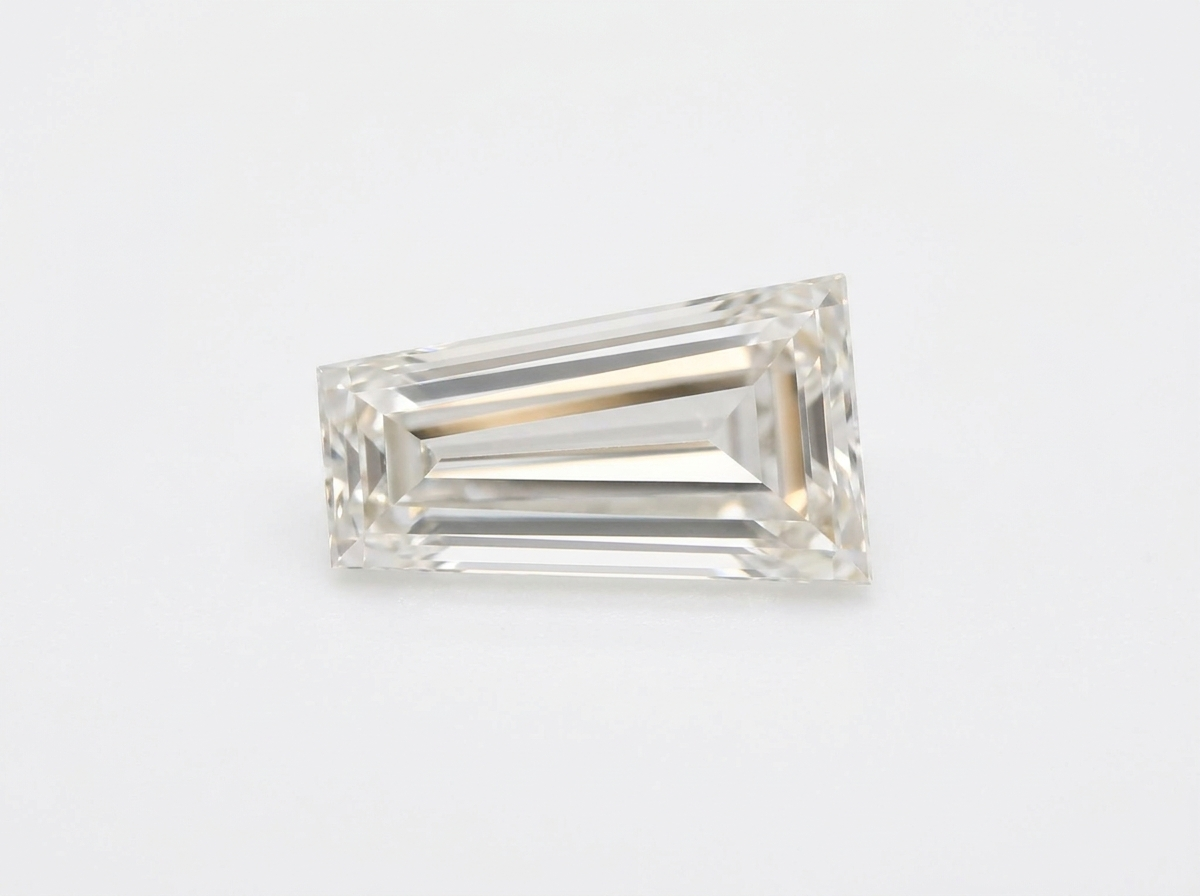
A Tapered Baguette is a narrow, elongated step-cut diamond that angles inward toward one end rather than running parallel-sided like a standard baguette — the classic side stone that flanks a center diamond in solitaire and three-stone settings, following the taper of the ring shank as it narrows. Guru Diam stocks 638+ Tapered Baguettes, calibrated and matched, cut in-house and IGI/GIA/GCAL-gradable on request — this guide covers the facet structure, trade history, grading, pricing, and ordering details jewelers need before specifying them on a build sheet.
What is a tapered baguette diamond?
A tapered baguette is a step-cut diamond — long, narrow, faceted in parallel rows rather than the kite-and-triangle pattern of a brilliant cut — with two long sides that angle inward toward one end instead of running perfectly parallel. That inward angle is the entire distinguishing feature. A standard baguette is a rectangle; a tapered baguette is closer to an elongated trapezoid, wider at one end and narrower at the other, cut specifically so the stone's outline follows a converging line rather than a straight one.
The taper isn't decorative. It exists to solve a fitting problem: a ring shank narrows as it moves from the wide mounting under a center stone down toward the back of the band, and a side stone with parallel sides leaves a visible wedge-shaped gap when it's set against that narrowing line. A tapered baguette's angled sides close that gap, which is why the shape shows up almost exclusively as an accent stone rather than a center stone — its geometry is built around sitting next to something else, not standing alone.
Like other step cuts, a tapered baguette carries far fewer facets than a brilliant-cut diamond — typically somewhere in the low-to-high teens depending on stone size, against a round brilliant's 57–58. Facets run as long, flat, rectangular-to-trapezoidal planes parallel to the girdle on both crown and pavilion, which produces a different kind of sparkle than a brilliant cut: broad, mirror-like flashes of light rather than the scattered pinpoint fire of a round or cushion. That flat, architectural look is the reason step cuts read as "quiet" and geometric next to a brighter center stone, and it's also why tapered baguettes have stayed a fixture of clean, linear ring design for a century.
Tapered baguette vs. straight baguette
A straight baguette has parallel long edges — a simple rectangle, the same width from end to end. A tapered baguette angles inward, wider at one end than the other, which lets it follow the curve of a ring shank as it narrows toward the center stone. That's the entire reason the shape exists: it's a fitting solution as much as a cut style. See our Baguette guide for the straight version and when each is the right call.
In practice, the two get chosen for different construction problems rather than different looks. A straight baguette works wherever the setting itself is straight or the stone sits inside a channel that doesn't taper — a simple channel-set band, a rectangular cluster, or a run of uniform-size accents along a flat section of shank. A tapered baguette is the only correct choice wherever the mounting narrows: the two side stones flanking a center diamond in a classic three-stone ring, or a graduated run following a curved or tapering channel toward the shoulders of the ring. Specifying the wrong one on a build sheet is a common and entirely avoidable fitting mistake — a straight baguette forced into a tapering channel either leaves a gap or has to be reset at an angle that stresses the stone and the prongs holding it.
A brief history: step cuts, Art Deco, and why the taper exists
Step-cut faceting is older than brilliant-cut faceting — the flat, table-and-facet-row approach traces back to early European cutting styles that predate the mathematically optimized brilliant cut by centuries, when cutters worked with simpler tools and prioritized preserving rough weight over maximizing fire. The baguette itself — the word is French for a slim rod or wand, the same root that names a loaf of bread — became a defined, standardized cutting style in the early 20th century, and it found its signature moment in the Art Deco period of the 1920s and 1930s.
Art Deco jewelry design leaned hard into geometry: straight lines, symmetrical repetition, and hard architectural shapes replacing the flowing, naturalistic curves of the preceding Art Nouveau era. Step-cut diamonds — baguettes, trapezoids, and later the emerald cut — were the natural faceting choice for that aesthetic, because their flat, linear facets read as clean geometric planes rather than sparkle for its own sake. Tapered baguettes specifically solved a construction need that came with that geometric style: three-stone rings, wide dinner rings, and curved bracelet links all needed side stones that followed a converging or curved line rather than sitting as awkward rectangles against an angled mounting. The taper was the engineering answer, and it's stayed the standard answer ever since — a century later, tapered baguettes are still the default side stone whenever a design needs a step-cut accent to follow a narrowing shank.
Facet structure and light performance
The optical character of a tapered baguette comes directly from having so few, so large, facets. A brilliant cut breaks light into many small return events across dozens of facets, which produces the scattered, high-contrast sparkle most people associate with "diamond." A step cut sends light back in a handful of broad, mirror-flat flashes instead — less fire, more what cutters call luster or flash, a glassy hall-of-mirrors effect down the length of the stone. Neither is objectively better; they're different tools, and a tapered baguette's job in a setting is almost never to out-sparkle the center stone. It's there to draw a clean line and frame.
That facet structure has a direct consequence for grading standards, which matters more here than on most shapes: an open table and large flat facets act like a window into the stone. Inclusions that would be camouflaged by a brilliant cut's scattered light pattern sit in plain view under a step cut's broad, calm facets, which is why the trade sometimes calls step cuts "the clarity cut." A tapered baguette that reads eye-clean at VS clarity can still show a visible inclusion that the same clarity grade would hide completely on a round brilliant.
Cutting a tapered baguette correctly is also a harder proportioning problem than it looks. The crown and pavilion facets have to converge cleanly toward the narrow end without creating a dead, light-starved point, and cut too shallow, the stone windows — light passes straight through the table to whatever's underneath instead of reflecting back, which is an obvious defect on a side stone sitting a few millimeters from a bright center diamond. Cut too deep near the narrow end and the stone looks undersized for its length. None of this is visible from a certificate; it only shows up once the stone is actually cut, which is why in-house cutting control matters for a shape this unforgiving of small proportioning errors.
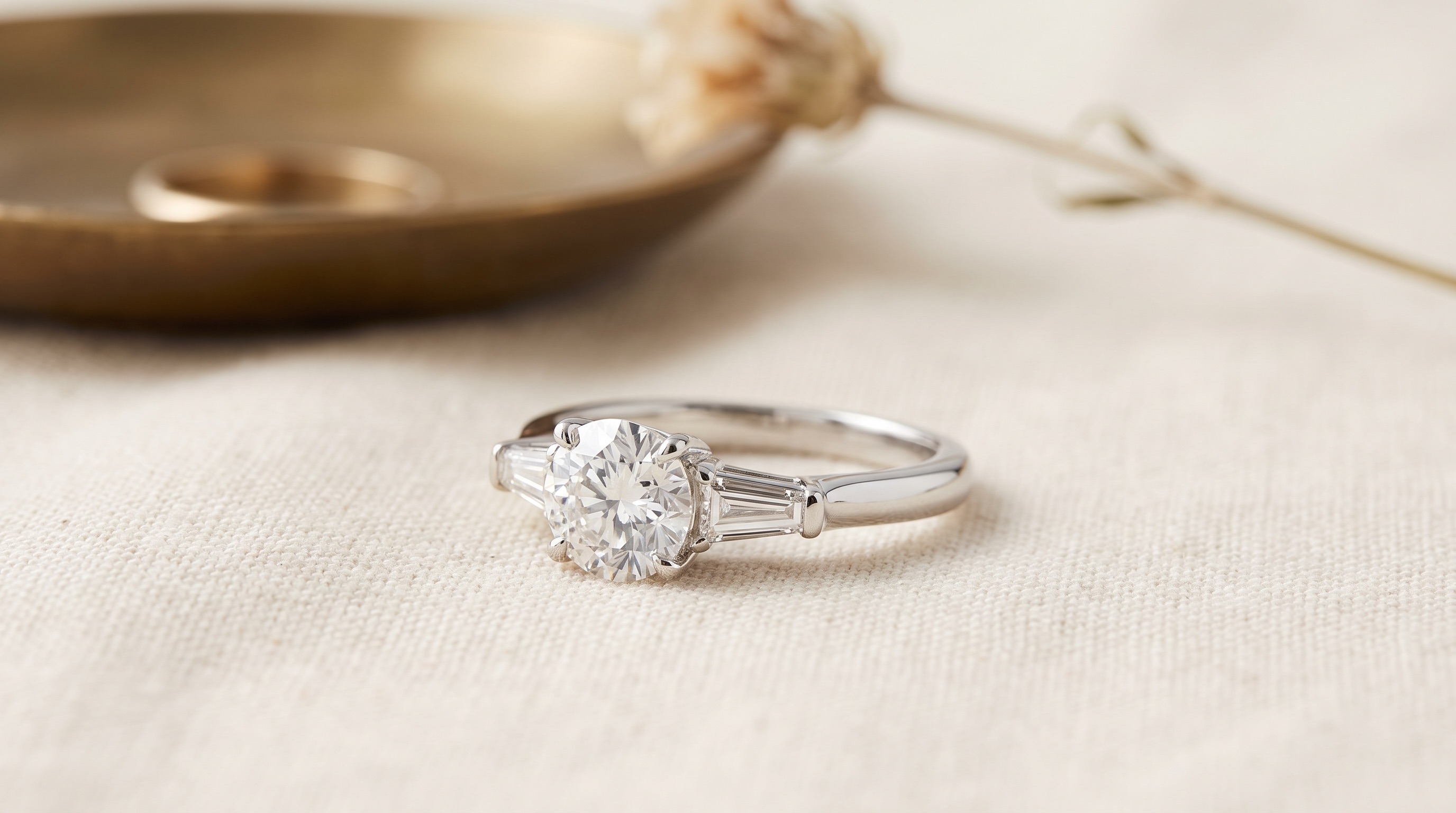
How Guru Diam cuts and matches tapered baguettes in-house
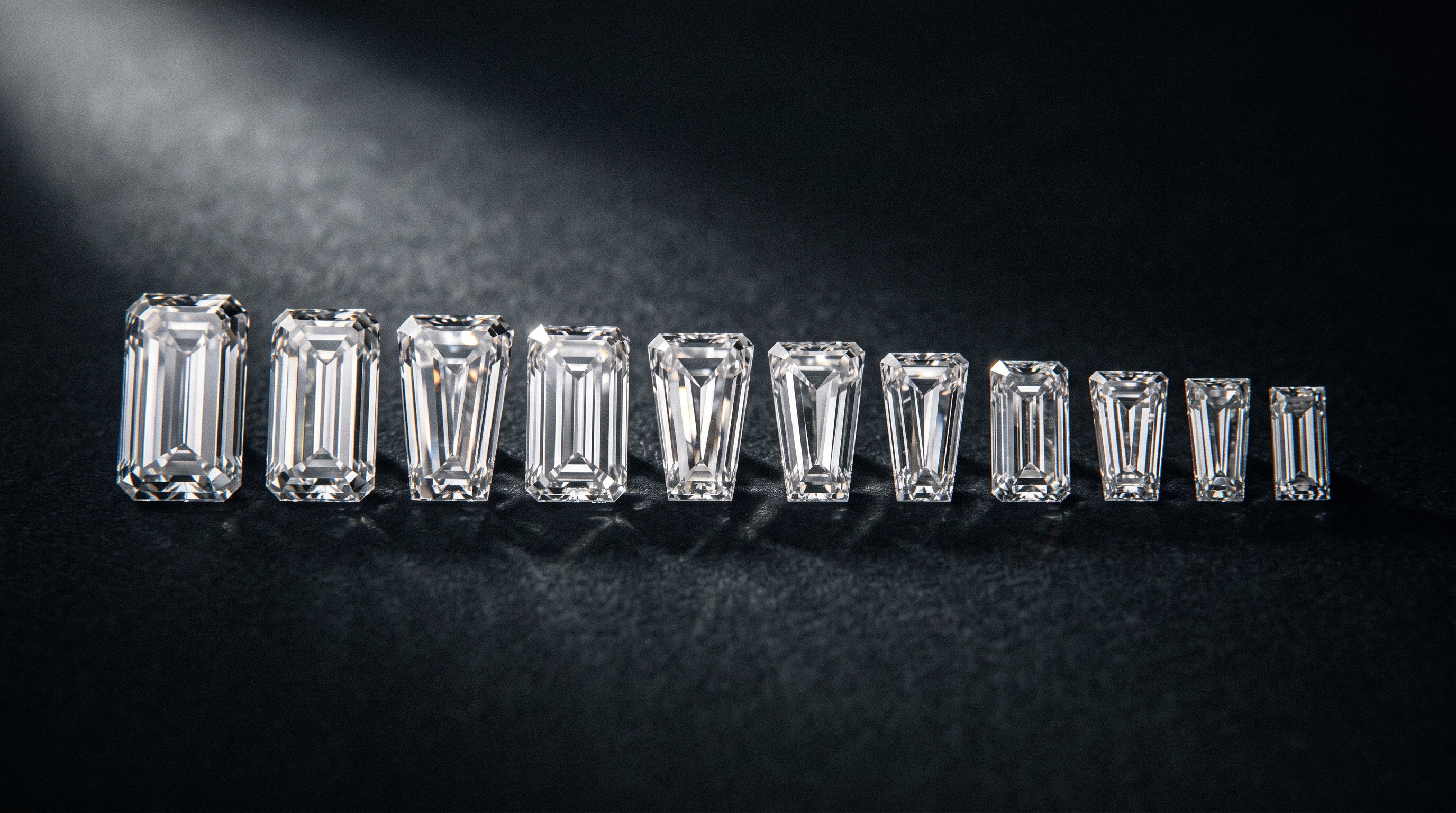
Guru Diam's tapered baguettes are CVD lab-grown and cut, faceted, and calibrated in-house from rough through final polish — one continuous process rather than rough sourced from one vendor and faceting subcontracted to another. That matters more for a shape like this than it does for round brilliants, because a matched pair or a graduated set needs identical taper angles, identical facet junctions, and identical proportions across every stone in the set, and that consistency is much harder to guarantee across pieces cut on different wheels by different hands at different times.
Because the taper angle and length of a tapered baguette are the entire functional spec — not just a stylistic choice — Guru Diam holds standing calibrated inventory across the common taper angles and length ranges used in three-stone and channel construction, so a jeweler ordering a standard pair or set is pulling from on-hand stock rather than waiting on a cutting run. When a project needs a non-standard taper angle — a shank with an unusual curve, a custom mounting, or a graduated set larger than what's held in standard stock — that request routes to a custom cutting queue instead, and turnaround runs longer than an on-hand order.
Why matching is the whole job
Tapered baguettes are sold and set in pairs or graduated sets, angled and sized to fit a specific shank taper. A mismatch in angle or length is visible immediately once set, so sourcing depends on a supplier that can calibrate to your exact taper spec rather than selling generic stock sizes. This is true of every calibrated side stone, but it's especially unforgiving on a tapered baguette because the taper angle itself is the thing being matched — two stones can both measure the correct overall length and still look mismatched if the angle of convergence differs even slightly, because that difference shows up as an asymmetric gap on one side of the mounting once the ring is set.
Grading and quality considerations for tapered baguette diamonds
Tapered baguette side stones are evaluated against a different set of priorities than a center stone, and jewelers specifying them should weight the four Cs differently than they would for the center diamond in the same ring.
Clarity needs to work harder on a step cut
Because the open, flat facets show inclusions more readily than a brilliant cut's scattered light pattern, tapered baguettes generally need to sit at a higher effective clarity than a brilliant-cut stone of comparable size to read eye-clean. On larger tapered baguettes used as a visible feature stone rather than a small accent, VS clarity or better is the common trade baseline; on very small stones used purely as line accents in a channel run, clarity requirements loosen somewhat because inclusions become harder to see at that scale regardless of cut style. Color follows a similar logic — a tapered baguette needs to visually match the center stone's color grade, not just carry a number on paper, since a warmer-toned side stone next to a colorless center reads as an obvious mismatch under a step cut's flat, revealing facets.
Certification and grading options
Tapered baguette diamonds are sold as calibrated pair or set goods, gradable on request through IGI, GIA, or GCAL, the same certification flexibility available across Guru Diam's other calibrated side-stone shapes. Individual per-stone certification isn't the standard for calibrated pairs and sets — the deliverable is a matched pair or set rather than a single graded stone, so grading is arranged against the pair or set as a unit when a jeweler needs it for a client's paperwork or resale documentation.

What drives tapered baguette pricing
A handful of variables move the price on a tapered baguette order, roughly in order of impact:
Carat weight and millimeter length. The baseline driver, same as any diamond — longer, heavier stones cost more per piece.
Taper angle: standard vs. custom. Common taper angles used across typical three-stone and channel mountings price lower and ship faster because they're pulled from on-hand calibrated stock. A non-standard angle cut to match an unusual shank curve routes to custom cutting, which costs more and takes longer to turn around.
Set size. A single pair for a three-stone ring is the simplest and least expensive order. A graduated set — four, six, or more stones stepping down in size to follow a curved channel toward the shoulders of a ring — draws more heavily on matched inventory and costs proportionally more to assemble consistently.
Color and clarity matching. Matching side stones to a specific center-stone color grade, or holding to a higher clarity tier because the step-cut facets show inclusions more readily, narrows the usable stock pool and moves price accordingly.
Matching precision itself. A visually matched pair — identical taper angle, table alignment, color, and clarity as seen face-up, not just matching numbers on a spec sheet — takes more sourcing and QC time than pulling two stones that happen to share a grade, and that labor is reflected in price.
None of these are list-priced publicly the way a catalog SKU would be, because a matched set is inherently a sourcing job, not a shelf pull — open a wholesale account for live pricing on a specific taper angle, size, and set count.
Styling and use-case guidance for jewelers reselling tapered baguettes
Three-stone and trilogy rings
The signature application, and the one that gives the shape its reason for existing. A pair of tapered baguettes flanks a center stone — round, oval, cushion, emerald, or any other shape — angled so the wider end sits against the center stone's girdle and the narrow end runs toward the shank. Because the taper follows the natural narrowing of the mounting, the finished setting reads as one continuous, deliberate line rather than a center stone with two stones bolted on either side. This is the single most requested use case for the shape across the trade, past and present.
Wedding bands and channel-set eternity work
Where a band curves around the finger, a run of stones with parallel sides leaves visible wedge gaps between each stone as the channel curves. Graduated tapered baguettes solve that the same way they solve it in a three-stone ring — the taper angle closes the gap — which makes them the standard choice for full or partial eternity bands built in a step-cut style, and for channel-set shoulders that taper down from a center stone toward the back of a ring.
Art Deco-revival and vintage-inspired design
Tapered baguettes are one of the fastest visual signals of Art Deco-era design language, and vintage-inspired engagement rings and cocktail rings lean on them heavily to read as period-accurate without actually being antique pieces. A step-cut center stone — emerald or Asscher — paired with tapered baguette sides keeps the entire ring in one consistent faceting family, which is the look most vintage-revival clients are specifically asking for when they bring in a reference photo of a 1920s or 1930s piece.
Guru Diam also builds finished jewelry featuring tapered baguettes to order — three-stone rings, channel-set bands, and full custom builds — as a separate service from loose-stone supply. Once a design is confirmed, finished custom pieces turn around in 4–6 days; that timeline applies to the finished jewelry build, not to loose-stone sourcing, which ships against on-hand inventory on its own faster schedule.
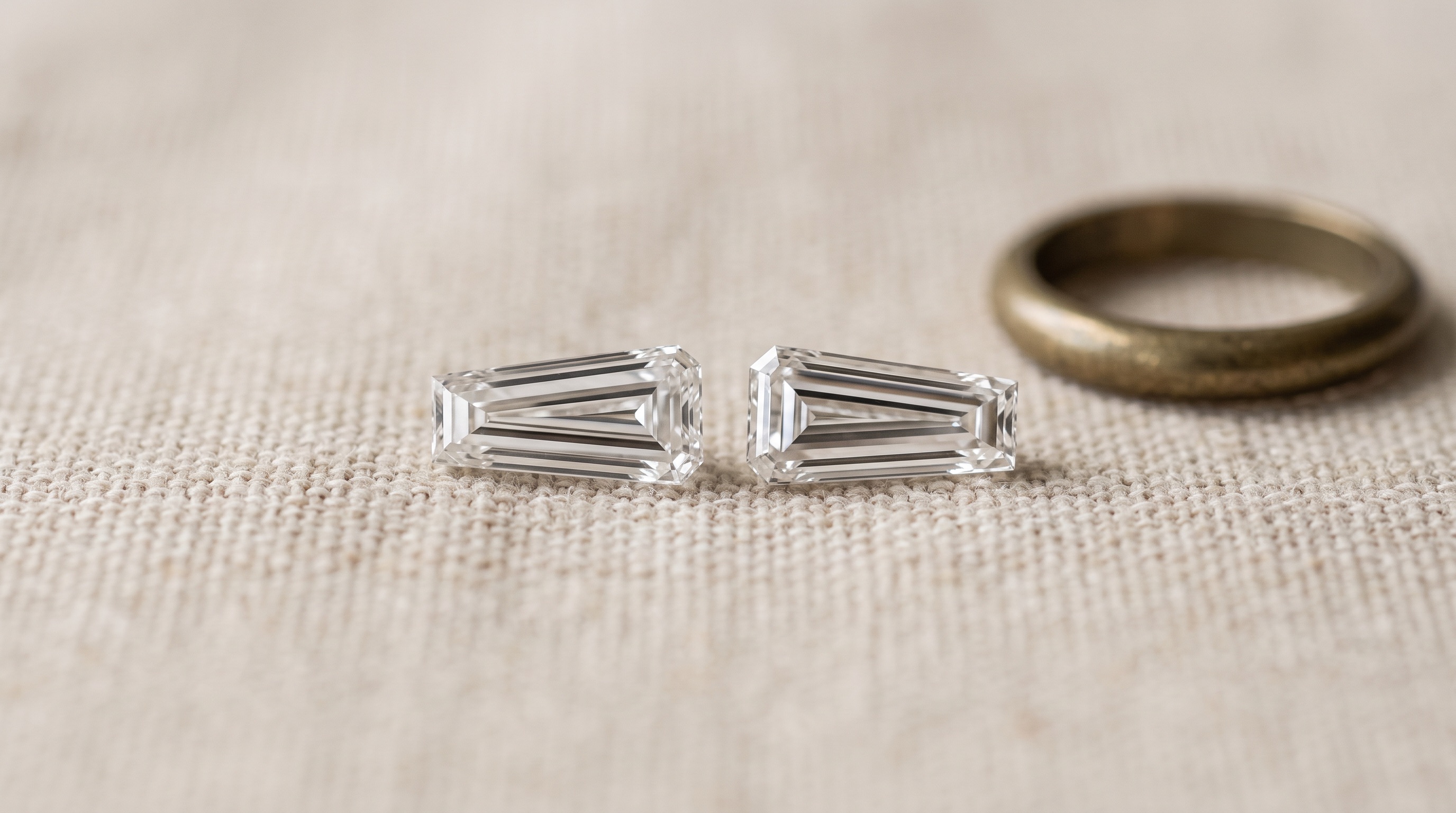
Tapered baguette compared to trapezoid and half moon side stones
Two other calibrated shapes come up constantly in the same conversation as tapered baguettes, and it's worth knowing where each one fits.
Trapezoid. A trapezoid has one short parallel edge, one long parallel edge, and two slanted sides — geometrically closer to a tapered baguette than to a straight one, but shorter and wider in proportion, and usually set with the short edge against the center stone rather than running as a long line down the shank. Trapezoids read as more compact and geometric; tapered baguettes read as more linear and elongated. Both can be cut as step cuts, and a brilliant-faceted version of the trapezoid outline also exists in the trade for clients who want side-stone fire rather than a quiet architectural line — a separate shape and a separate conversation from a step-cut tapered baguette.
Half moon (demilune). A half moon is a semicircular side stone, flat along one edge and curved along the other, almost always cut with brilliant faceting rather than step faceting. It solves a different design problem than a tapered baguette — a softer, rounded frame against a center stone rather than a hard geometric line — and gets chosen specifically when a client wants curved, organic side stones instead of the angular look a tapered baguette or trapezoid delivers. Where a tapered baguette is the default for a linear, Art Deco-style three-stone ring, a half moon is the default when the same three-stone concept needs to read as softer and more rounded.
All three shapes are calibrated goods in Guru Diam's inventory, cut and matched under the same in-house process, so switching a build sheet between them mid-project is a sourcing conversation rather than a different vendor relationship.
How to order tapered baguette diamonds wholesale from Guru Diam
Standard tapered baguette pairs and sets are on-hand inventory — in stock now, ready to ship against a wholesale order, not a made-to-order product with a production wait. Placing an order is a sourcing conversation, not a checkout flow: specify the taper angle (or the shank curve it needs to match), length and width, color and clarity target, and set count — a single pair for a three-stone ring, or a larger graduated set for channel or eternity work — and the desk pulls from current calibrated stock or routes the request to custom cutting if the taper angle falls outside standard sizing.
Wholesale accounts get live pricing rather than list pricing, since a matched set's price depends on exactly what's being matched. Guru Diam serves 2,000+ active wholesale accounts across independent jewelers, designers, and manufacturers, and tapered baguette is one of dozens of calibrated shapes carried alongside antique cuts, fancy color stones, and finished jewelry lines. Open a wholesale account for live pricing and to request a matched set cut to your shank taper.
FAQ
What is a tapered baguette diamond? A tapered baguette is a narrow step-cut side stone that angles inward toward one end, used in pairs or graduated sets to flank a center stone and follow the taper of a ring shank — distinct from a straight baguette, which has parallel sides.
How are tapered baguettes matched to a ring design? They're cut or selected to match the specific taper angle and length needed for a shank's curve, sold in pairs or graduated sets rather than as single stones — a fitting problem as much as a matching one.
Are tapered baguette diamonds certified? They're sold as calibrated pair or set goods, gradable on request through IGI, GIA, or GCAL, the same convention used across other calibrated side-stone shapes.
What's the difference between a tapered baguette and a trapezoid side stone? A trapezoid has one short and one long parallel edge with two slanted sides, usually set short-edge-in against a center stone. A tapered baguette is longer and narrower, tapering along its full length to follow a shank rather than framing a center stone at a single point.
How many tapered baguettes do I need for a three-stone ring vs. a wedding band? A three-stone ring needs a single matched pair. A channel-set or eternity-style band needs a graduated set — four, six, or more stones stepping down in size along the curve of the shank — which is priced and sourced as a distinct job from a simple pair.
Can Guru Diam cut a custom taper angle to match my shank? Yes. Standard taper angles ship from on-hand calibrated stock; a non-standard angle for an unusual mounting or curve routes to Guru Diam's in-house custom cutting queue rather than being pulled from stock, with pricing and turnaround quoted against the specific spec.