
An Asscher cut is a square step-cut diamond with cropped corners and a deep pavilion — essentially a square emerald cut, faceted in concentric layers that produce a distinctive windmill-shaped pattern of light and dark planes rather than scattered fire. Guru Diam stocks Asscher cut as IGI-certified, CVD-grown lab-grown loose diamonds, with 89 pieces currently on hand from our New York Diamond District desk. This guide covers the cut's facet structure and trade history, how we source and cut it, what to check on a grading report before you buy, what actually moves price, how it stacks up against emerald and octagon cuts, and how to place a wholesale order.
What is an Asscher cut diamond, and how does it differ from an emerald cut?
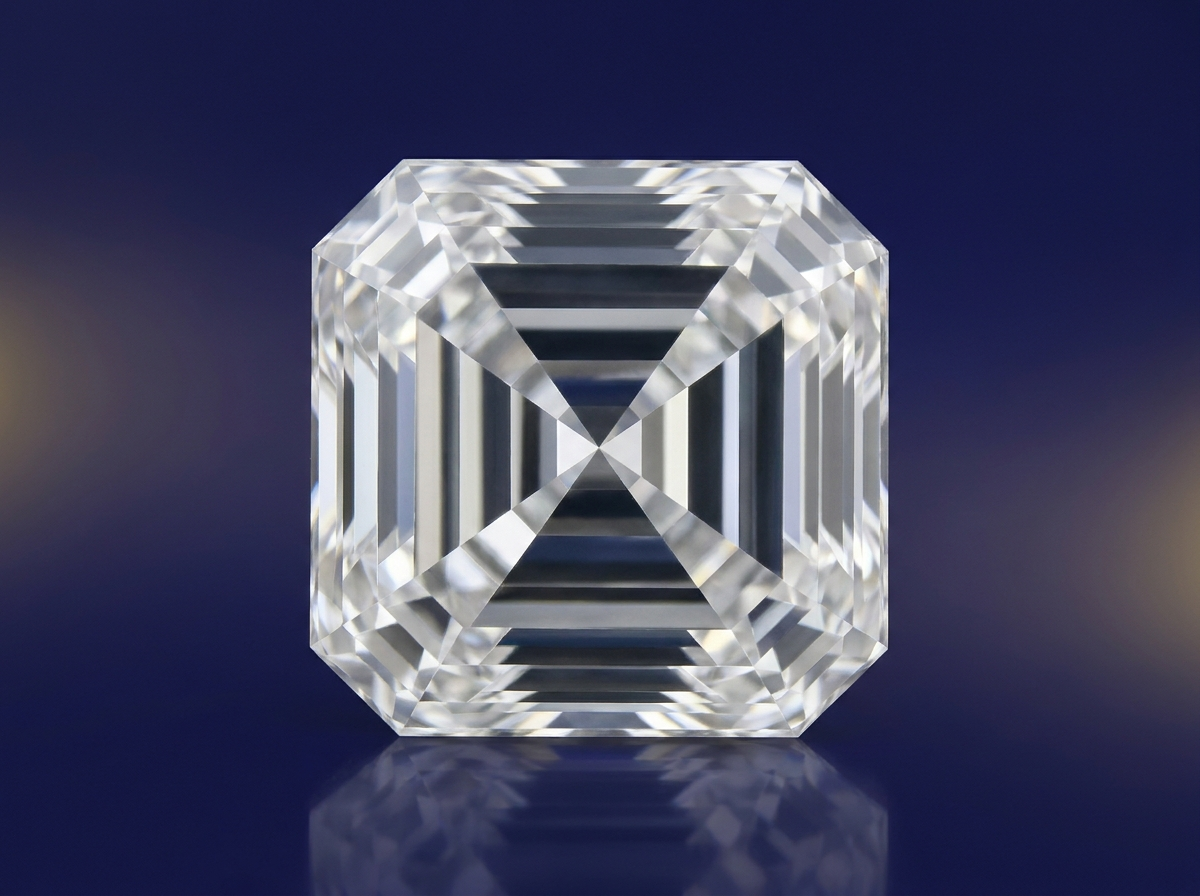
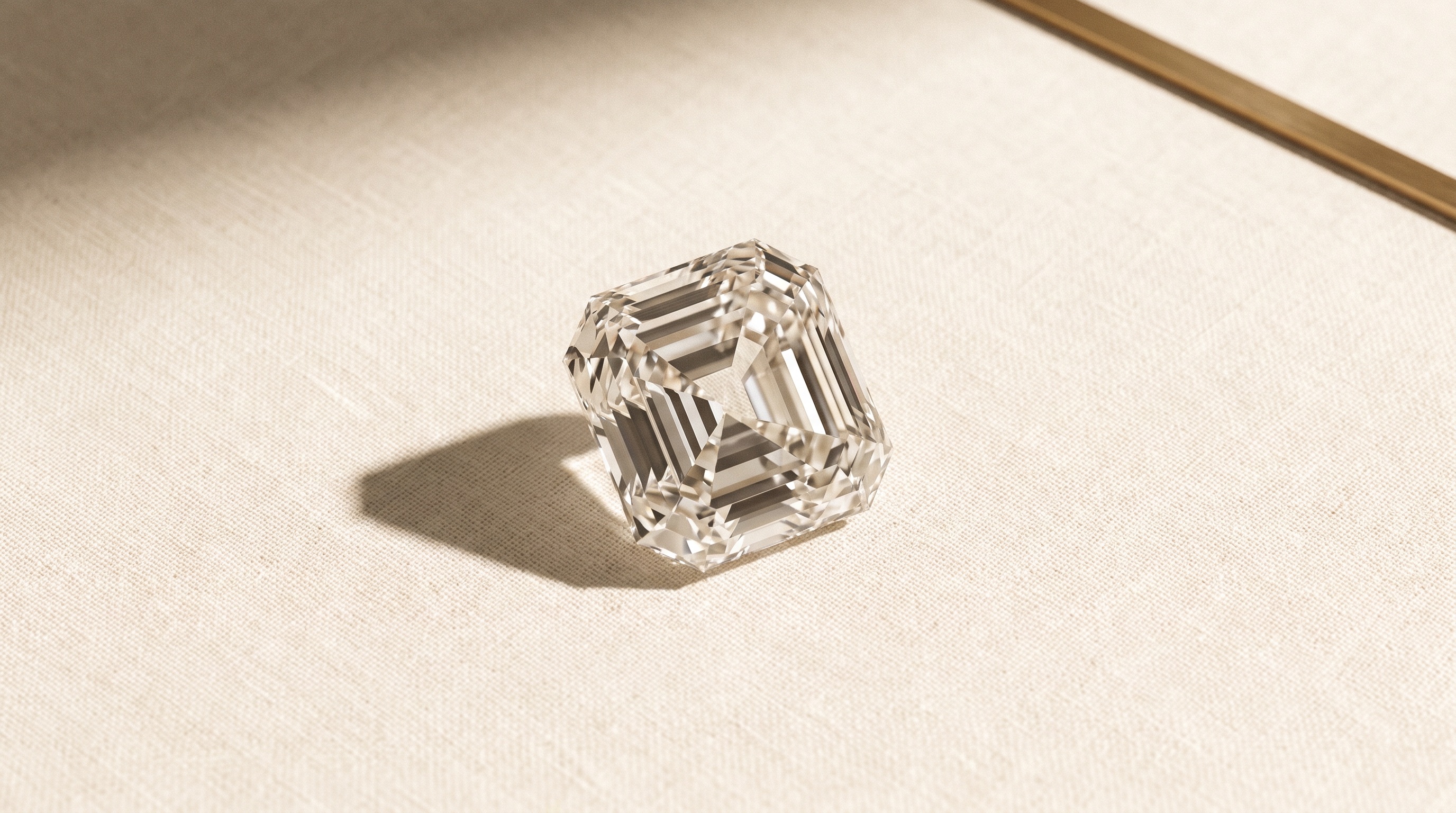
An Asscher cut is a square step cut: cropped corners, a smaller table than an emerald cut, and a notably deeper pavilion, faceted in the same long, parallel, concentric style as an emerald cut but arranged around a square rather than rectangular outline. The deeper pavilion and higher step count produce a more pronounced optical effect than a standard emerald cut — a repeating, X-shaped windmill pattern of light and dark facets visible from the top of the stone, rather than the more uniform "hall of mirrors" wash of a rectangular emerald.
Because the outline reads square with its corners clipped, buyers sometimes describe it in the trade as a "square emerald cut" — that shorthand is accurate for the facet arrangement but understates how different the two shapes actually look and wear once mounted. An Asscher sits more compact on the finger than an emerald of the same carat weight, since the weight is distributed front-to-back through the pavilion rather than spread across a longer table.
The 1902 origin: how the Asscher cut entered the trade
Asscher carries genuine cutting pedigree. The shape was patented in 1902 by the Asscher Diamond Company, a cutting house founded in Amsterdam, and it became a defining cut of the Art Deco period through the 1920s and '30s — prized for the same deep, geometric light pattern it still produces today. The firm's most famous historical association is the 1908 cutting of the Cullinan diamond, the largest rough diamond ever recovered, into the Cullinan I and Cullinan II — both cut in the step style the company had patented six years earlier. That project cemented the square step cut as a serious, technically demanding shape rather than a simplified emerald variant.
It fell out of common production for decades for the same reason most step cuts of this precision did: cutting a symmetrical square with a true deep pavilion and clean concentric steps is exacting work, and natural rough yield for it runs lower than for a rectangular emerald — a cutter loses more of the rough crystal squaring it off than shaping a rectangle. Round brilliants and simpler fancy shapes offered better yield-to-value math for most of the 20th century, and Asscher receded to a specialty request filled mostly from estate stones and vintage re-cuts.
Lab-grown production reopens that math. Rough can be grown and cut directly to the square outline and depth the shape requires, rather than salvaged from whatever an estate or rough parcel happens to allow — which is what makes Asscher sourceable as a standing wholesale category again, rather than a rare estate find a jeweler has to hunt for one piece at a time.
Anatomy of the cut: facets, table, and the windmill effect
An Asscher's step facets run in broad, parallel bands around the crown and pavilion, stepping down toward the culet in layers rather than the small triangular facets a brilliant cut uses to scatter light in every direction. The table is proportionally smaller than an emerald cut's, and the corners are cropped at roughly 45 degrees, giving the outline eight sides rather than four — a detail that matters later when comparing Asscher to true octagon-cut stones.
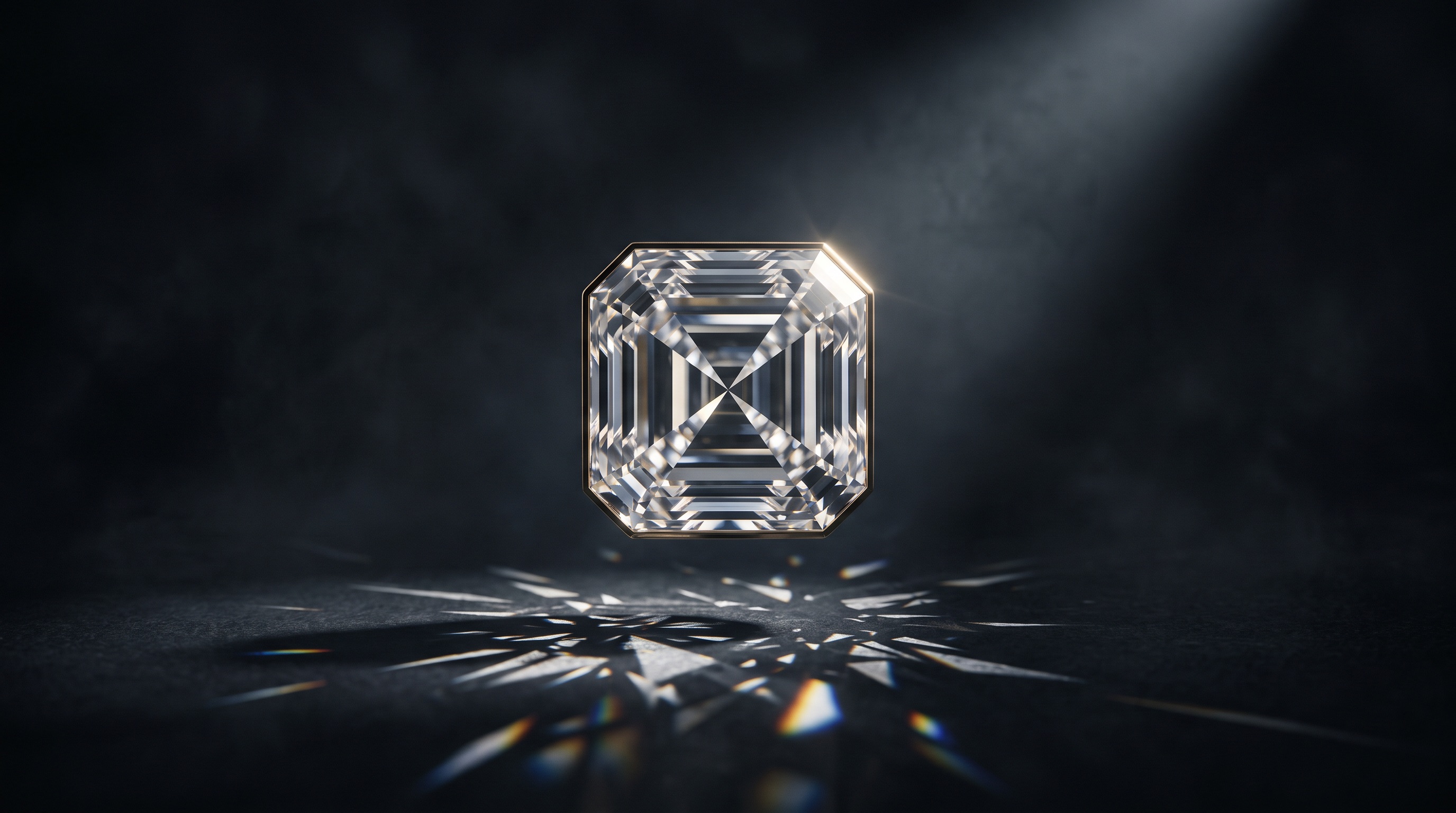
That combination of a smaller table, deeper pavilion, and higher step count is what produces the "windmill" — four (or eight, depending on facet count) triangular zones of alternating light and dark visible from the face-up view, rotating slightly as the stone or the viewer moves. It's a quieter, more architectural optical signature than brilliant-cut fire: fewer flashes, more depth, and a distinct geometric identity that reads immediately as Asscher rather than "square diamond" from across a counter.
The trade-off is that step facets are unforgiving. A brilliant cut's small facets break up and hide minor inclusions and light color tinting; an Asscher's broad, flat planes act almost like a window into the stone. That single fact drives most of what follows on grading and pricing.
How Guru Diam sources and cuts Asscher diamonds
Guru Diam cuts Asscher diamonds in-house against a standing spec — square outline, cropped corners, deep pavilion, concentric step facets — rather than buying finished-cut parcels on the open market and reselling them. That control matters specifically for a step cut: because the facets are large and unforgiving, symmetry and step alignment have to be right at the cutting stage, not corrected afterward with additional faceting the way a brilliant cut sometimes can be.
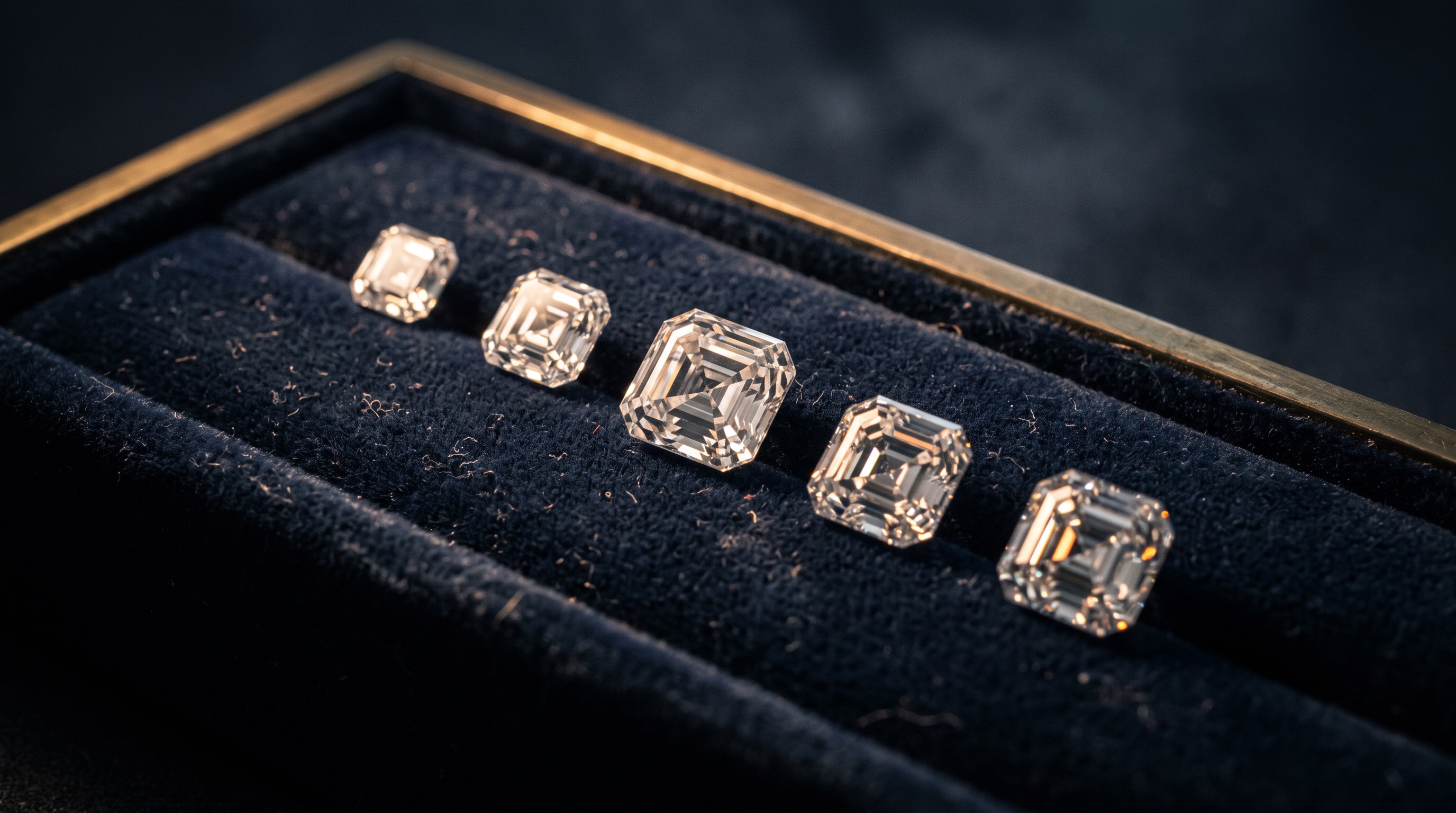
We hold 89 pieces of standard IGI-certified Asscher cut on hand at any given time, spanning a working carat and clarity range, with additional volume cut to order for buyers who need a specific size, L:W ratio, or clarity tier not currently on the shelf. Because we're growing and cutting to spec rather than sourcing finished goods, made-to-order Asscher doesn't carry the long lead times a natural-diamond cutter quoting against uncertain rough yield would need — though the cutting timeline for loose stones is separate from, and should not be confused with, our finished-jewelry turnaround (more on that below).
Every Asscher we cut goes through the same in-house quality check before it's added to on-hand inventory: outline symmetry against a square template, step-facet alignment top to bottom, and pavilion depth against the target proportions above. A stone that comes off the wheel reading rectangular rather than square, or with step facets that don't align cleanly at the corners, doesn't get sold as standard Asscher cut — it either gets re-cut against a different shape target or moved into a lower spec tier and disclosed as such. That in-house QC step is why buyers reordering from us can spec by proportion range rather than having to eyeball every stone against a loupe before committing.
| Spec | Detail |
|---|---|
| Outline | Square, cropped corners |
| Facet style | Step-cut, deep pavilion, concentric layers |
| Typical L:W ratio | 1.00–1.05 |
| Growth method | CVD-grown |
| Certification | IGI standard; GIA and GCAL available on request |
| Stone type | Certified single stones (not melee) |
| On-hand count | 89 pieces |
| Sourcing path | In-stock or made-to-order |
| Guru Diam tier | Regular Fancy (mid-market) |
Grading an Asscher cut: why clarity reads differently in a step cut
Because step facets act like a window rather than a kaleidoscope, clarity grade matters more for a buyer's actual visual result on an Asscher than it does on an equivalent round or cushion brilliant. A VS2 round can face up clean to the naked eye all day; a VS2 Asscher of the same carat weight is more likely to show a feather or pinpoint under normal store lighting, simply because there's nowhere in the facet pattern for it to hide. We'd point wholesale buyers toward VS1 and above as the practical floor for an Asscher a customer will examine closely, and toward VVS for larger stones (1.5ct+) where the open table makes even small inclusions more visible at typical viewing distance.
Color reads the same way. A step cut shows body color more directly than a brilliant, since there's less facet-junction scatter to break it up — the same optical property that makes Asscher a strong candidate for fancy color (see below) works against it slightly on the white end of the scale. G and above is the safe working range for a colorless-looking result; buyers stretching to I or J for margin should expect a warmer face-up appearance than the same grade would show in a round or princess.
Cut proportions matter more here than the standard "excellent/very good" grade a brilliant cut gets, because Asscher doesn't have a universal cut-grade scale the way round brilliants do. What to check instead: the L:W ratio (1.00–1.03 reads as a true square; anything drifting past 1.05 starts reading rectangular), step count and symmetry (uneven step widths break the windmill pattern), and pavilion depth relative to table size — a shallow pavilion on an Asscher looks glassy and lifeless rather than showing the deep geometric contrast the cut is known for.
What drives Asscher cut pricing
Carat weight is the largest lever, as with any diamond, but three Asscher-specific factors move price more than they would on a round or princess: clarity tier, cutting precision, and L:W ratio. Given the visibility issue above, a clean VS1+ Asscher commands a real premium over an equivalent-carat SI stone in a way that wouldn't show up nearly as strongly on a brilliant cut — buyers are effectively paying for facets that don't hide anything, and that transparency has a cost.
Cutting precision is the second lever. A true square Asscher with clean, evenly spaced step facets and sharp corner symmetry takes more cutting time and yields less usable weight from the rough crystal than a looser interpretation of the shape — which is reflected in price for made-to-order pieces cut tighter to spec versus standard-tolerance stock.
Certification lab is a smaller but real factor: IGI-certified stones are our standard and typically price lowest for a given 4Cs combination, GIA carries a modest premium reflecting stricter grading tolerances and stronger secondary-market recognition, and GCAL sits between the two for buyers who want an additional cut-quality and light-performance analysis layered onto the standard report. All three are available on Asscher cut stones on request.
Finally, size tiers matter more visibly on a step cut than a brilliant because the windmill pattern itself scales with stone size — a 0.75ct Asscher and a 2ct Asscher don't just differ in weight, they show a visibly different depth of optical effect, which is part of why larger Asscher stones command a size premium beyond the simple per-carat math.
Asscher cut vs. emerald cut: what actually differs
The two cuts share a facet family — both are step cuts with concentric, parallel faceting rather than brilliant faceting — which is why Asscher gets called a "square emerald" as trade shorthand. The real differences: outline (square vs. rectangular), pavilion depth (Asscher runs notably deeper), table size (Asscher's is smaller relative to the stone), and the resulting optical effect (Asscher's windmill pattern is more concentrated and geometric; emerald's is a broader, more even flash across a longer surface).
Those differences carry through to how each wears. An emerald cut elongates the finger and tends to look larger face-up per carat because of its length; an Asscher sits compact and reads as dense, architectural weight rather than elongated sparkle. Clarity sensitivity is comparable between the two — both are step cuts, both show inclusions more readily than a brilliant — but Asscher's deeper pavilion and smaller table concentrate that visibility into a tighter viewing window, which is part of why buyers sourcing Asscher tend to be more clarity-conscious than buyers sourcing emerald at the same price point.
For a wholesale buyer stocking both: emerald cut serves a broader, more universally wearable customer; Asscher serves a narrower but more design-literate buyer who specifically wants the Art Deco geometric look and is willing to pay the clarity premium that look requires.
Asscher cut vs. octagon cut: two angular shapes, different anatomy
Because an Asscher's cropped corners give its outline eight sides, buyers occasionally conflate it with a true octagon cut — but the two are distinct shapes in the trade. An Asscher is fundamentally a square with corners clipped at a steep angle, so four of its eight sides are long and four are short; the proportions still read as "square" from typical viewing distance, and the L:W ratio target (1.00–1.05) reflects that. A true octagon cut is built as an elongated eight-sided step cut from the outset, with more evenly proportioned sides and a longer overall footprint closer to an emerald cut's L:W range — it's essentially an emerald cut with its own corners cropped, rather than a square with corners cropped.
The practical distinction for a buyer: ask for an Asscher when the brief calls for a compact, square, high-contrast Art Deco look, and ask for an octagon cut specifically when the brief calls for that same step-cut faceting family stretched into a more elongated silhouette. The two get cut to different proportion targets even though both start from the same step-facet vocabulary, and quoting the wrong one against a customer's reference photo is a common sourcing mix-up worth confirming before an order is placed.
Setting and styling guidance
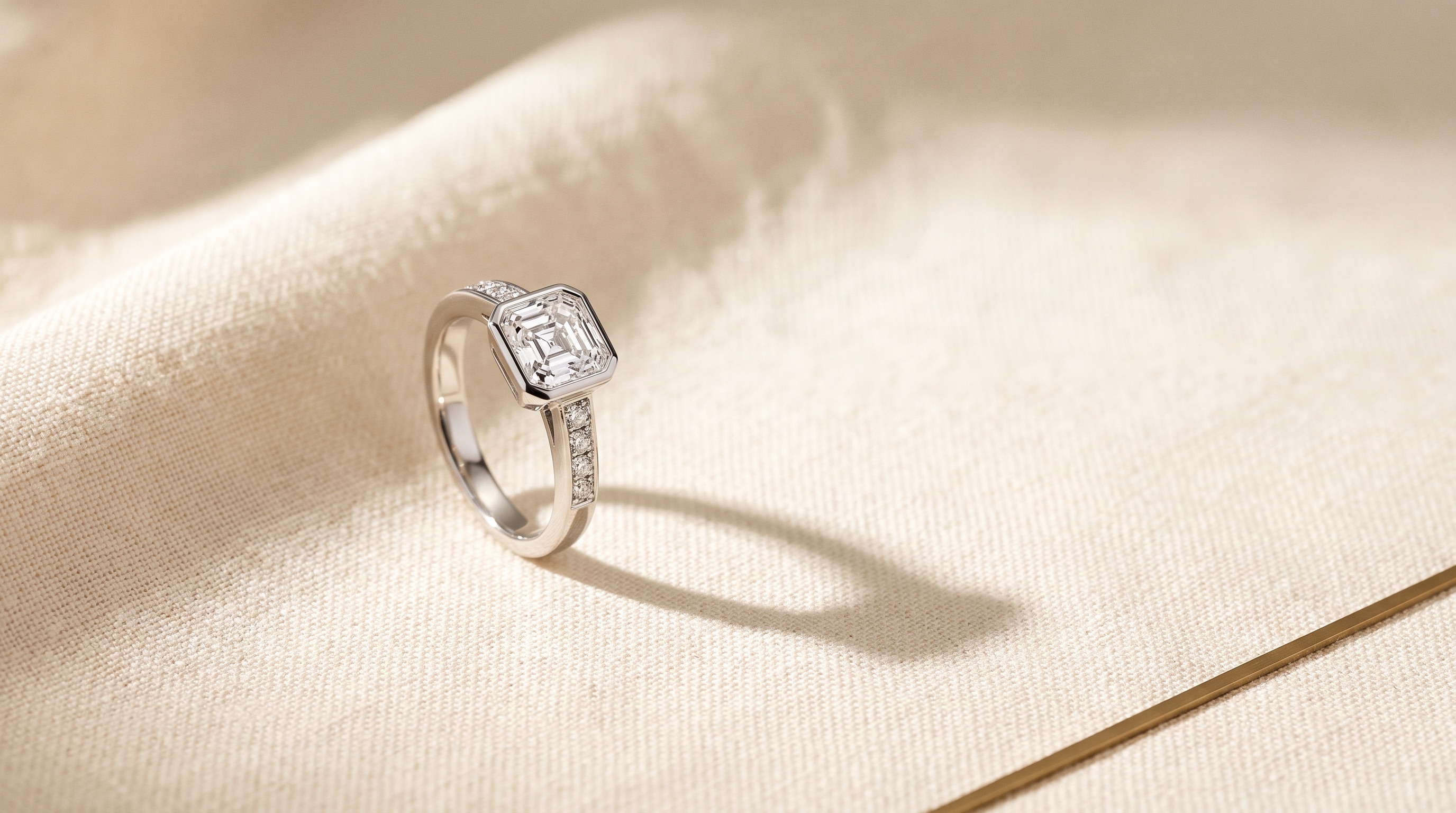
Asscher's cropped corners carry less chip risk than princess, but the deep pavilion adds weight below the girdle that a mounting needs to accommodate — confirm ring depth clearance before finalizing a custom setting, especially for lower-profile designs. Four-prong and bezel settings both work; a bezel is common for buyers who want the square outline and windmill facet pattern to read without interruption from metal, and it also protects the corners fully, which some retail customers specifically ask for.
Solitaire settings let the windmill pattern stand on its own and are the most common request. Three-stone settings with trapezoid or baguette side stones echo the step faceting and are a strong match stylistically — the straight lines of a baguette pair more naturally with Asscher's geometry than a round or pear side stone would. Halo settings work but soften the architectural look the cut is chosen for in the first place, so buyers building for a customer who specifically wants that Art Deco identity tend to skip the halo and let the corners and step facets carry the design.
On metal: yellow and rose gold read warmer against Asscher's step facets and suit buyers leaning into the vintage association; platinum and white gold sharpen the geometric contrast and suit a more contemporary presentation of the same shape. Both work — it's a styling call based on the customer's overall aesthetic rather than a technical constraint of the cut itself.
Band and shoulder design is worth flagging separately, since it's an area where an Asscher benefits from more deliberate treatment than a round center stone would. A plain, narrow band draws all the attention to the corners and step pattern, which suits the Art Deco reference most directly; milgrain edges or straight-line channel-set shoulders extend the geometric language of the stone into the mounting rather than competing with it. Curved, organic shoulder designs — pavé scallops, floral motifs — tend to fight the Asscher's hard-edged geometry rather than complement it, so buyers building a piece around this shape should steer customers toward straight-line detailing on the band if the goal is a cohesive design rather than a round-cut mounting with an Asscher dropped in.
Worth flagging for buyers building out a shape assortment: Asscher sits in Guru Diam's Regular Fancy, mid-market tier alongside Emerald, Cushion, Oval, Pear, Marquise, Radiant, Princess, and Heart — not in the antique-cut tier, despite its Art Deco design lineage and step-cut kinship with true antique shapes like Old Mine and Old European. That distinction matters for pricing and positioning: Asscher should be merchandised and quoted as a modern fancy shape with vintage styling appeal, not priced or marketed as an antique cut.
Fancy color Asscher: a specialty extension
Asscher cut is also available in fancy color — a specialty request, since the shape's depth and step faceting show hue as a saturated, even wash rather than scattered flashes, which makes it a strong performer for colored stones specifically. Guru Diam's certified fancy color loose stones are limited to yellow, pink, blue, and green; we don't carry champagne or cognac as certified loose fancy color inventory. See our fancy color Asscher cut guide for availability, sourcing lead times, and how the color-visibility advantage plays out in that category specifically.
How to order Asscher cut diamonds wholesale
Guru Diam carries Asscher cut as trade-only, wholesale inventory — no retail markup — from our New York Diamond District desk (36 West 47th Street, Suite 601A) and our Los Angeles office (607 South Hill Street). Ordering starts with a verified wholesale account; once that's set up, you can request current on-hand inventory by carat, clarity, and L:W ratio, or spec a made-to-order stone cut to your target parameters.
In-stock pieces ship same-day from New York (before 6pm EST) or Los Angeles (before 4pm PST). If the order includes a custom setting, that runs CAD-to-finished-piece in 4–6 days from either desk — that turnaround applies to finished jewelry, not to loose-stone cutting lead times, which vary by spec and are quoted per order. IGI certification is standard on Asscher cut stock; GIA and GCAL are available on request for buyers who need a specific lab for a specific end customer or market.
Ready to buy? Open a verified wholesale account at /signup and book time with a gemologist at /book-appointment.
FAQ
What is an Asscher cut lab-grown diamond? An Asscher cut is a square step-cut diamond with cropped corners and a deep pavilion, faceted in concentric layers that produce a distinctive windmill-shaped light pattern. It's essentially a square version of an emerald cut, with a deeper pavilion and higher step count.
How is an Asscher cut different from an emerald cut? Asscher is square rather than rectangular, with a smaller table and a notably deeper pavilion. That depth produces a more pronounced, geometric X-shaped light pattern than the broader, more even flashes of a standard emerald cut, and the stone wears more compact on the finger than an emerald of the same carat weight.
How is an Asscher cut different from an octagon cut? Asscher is a square with steeply cropped corners, so four sides are long and four are short — it still reads as square. A true octagon cut is built as a more evenly proportioned, elongated eight-sided step cut from the outset, closer to an emerald cut's proportions with its own corners cropped. Both use step faceting, but they're cut to different outline targets.
Is Asscher cut a vintage or Art Deco style? Yes — the cut was patented in 1902 by the Asscher Diamond Company in Amsterdam and became closely associated with Art Deco jewelry design for its deep, geometric optical pattern; the firm later cut the Cullinan diamond in the same step style in 1908. It fell out of common production for decades due to low rough yield and cutting difficulty, and lab-grown production has made it sourceable as a standing category again.
Why does clarity matter more on an Asscher than on a round or cushion? Step facets are broad and flat, acting almost like a window into the stone rather than breaking up light the way small brilliant facets do. Inclusions that would disappear in a round or cushion cut are more visible in an Asscher at the same clarity grade, which is why we point buyers toward VS1 and above as a practical floor.
Is IGI, GIA, or GCAL certification available for Asscher cut lab-grown diamonds? IGI is standard across Guru Diam's Asscher cut inventory, with GIA and GCAL both available on request.