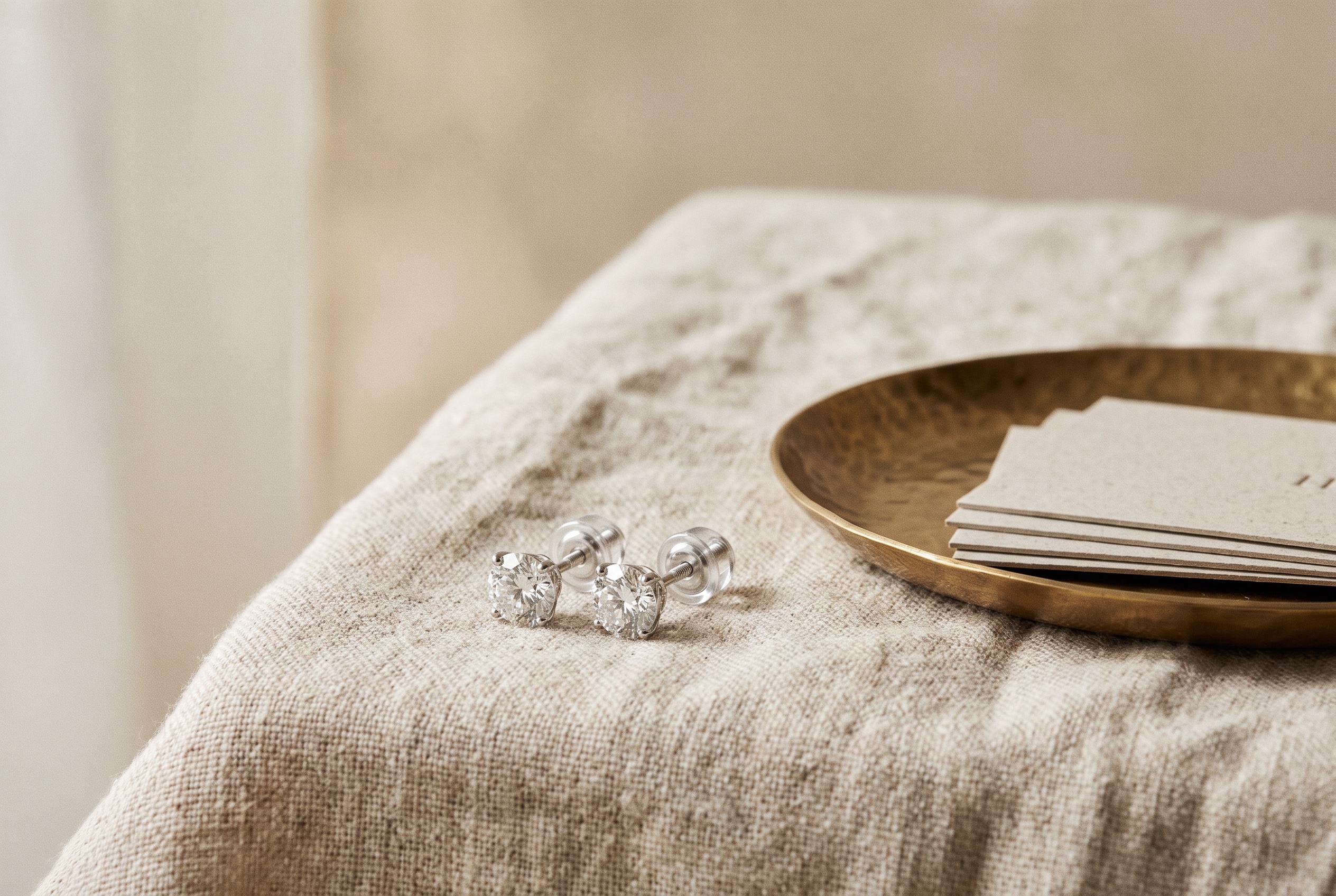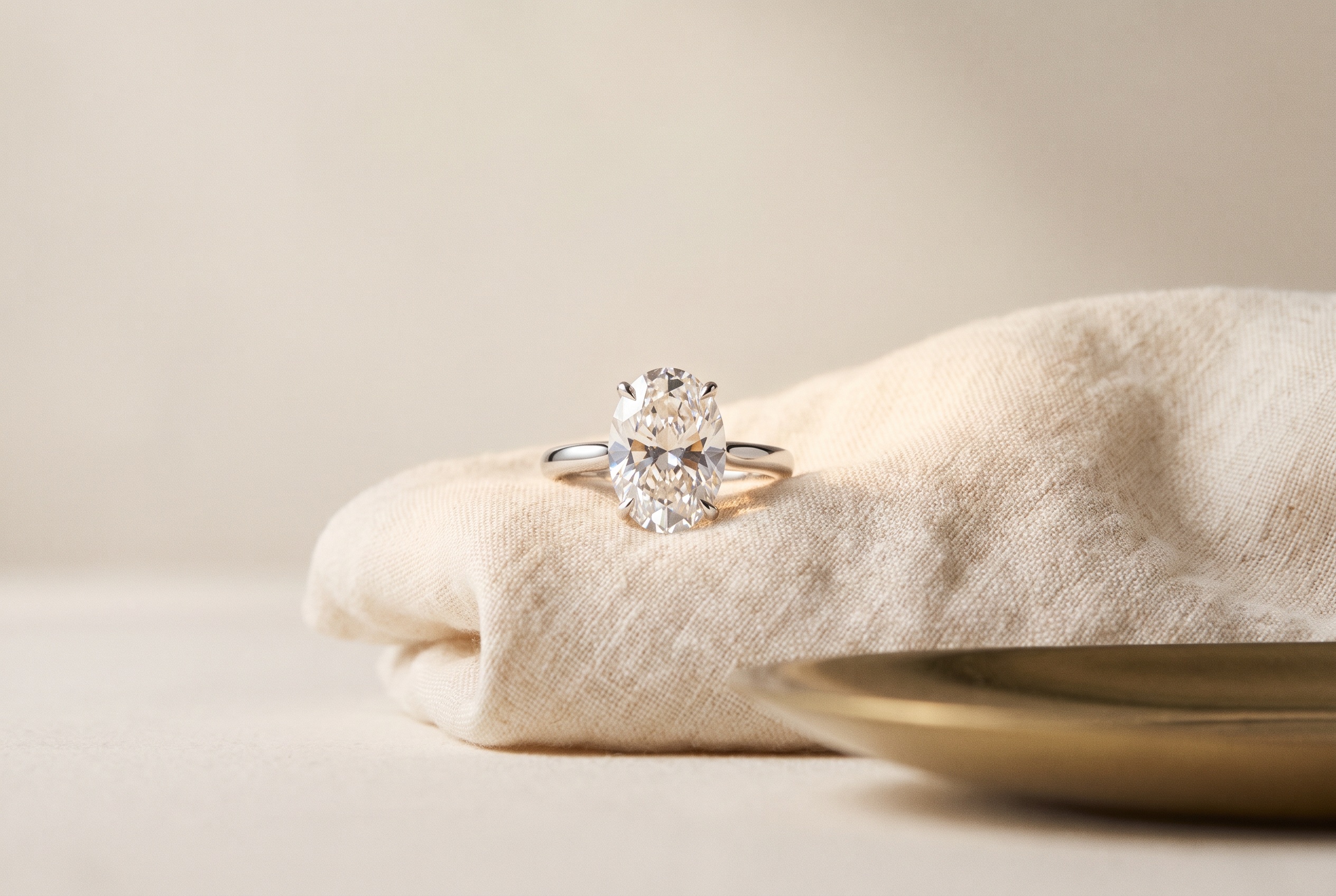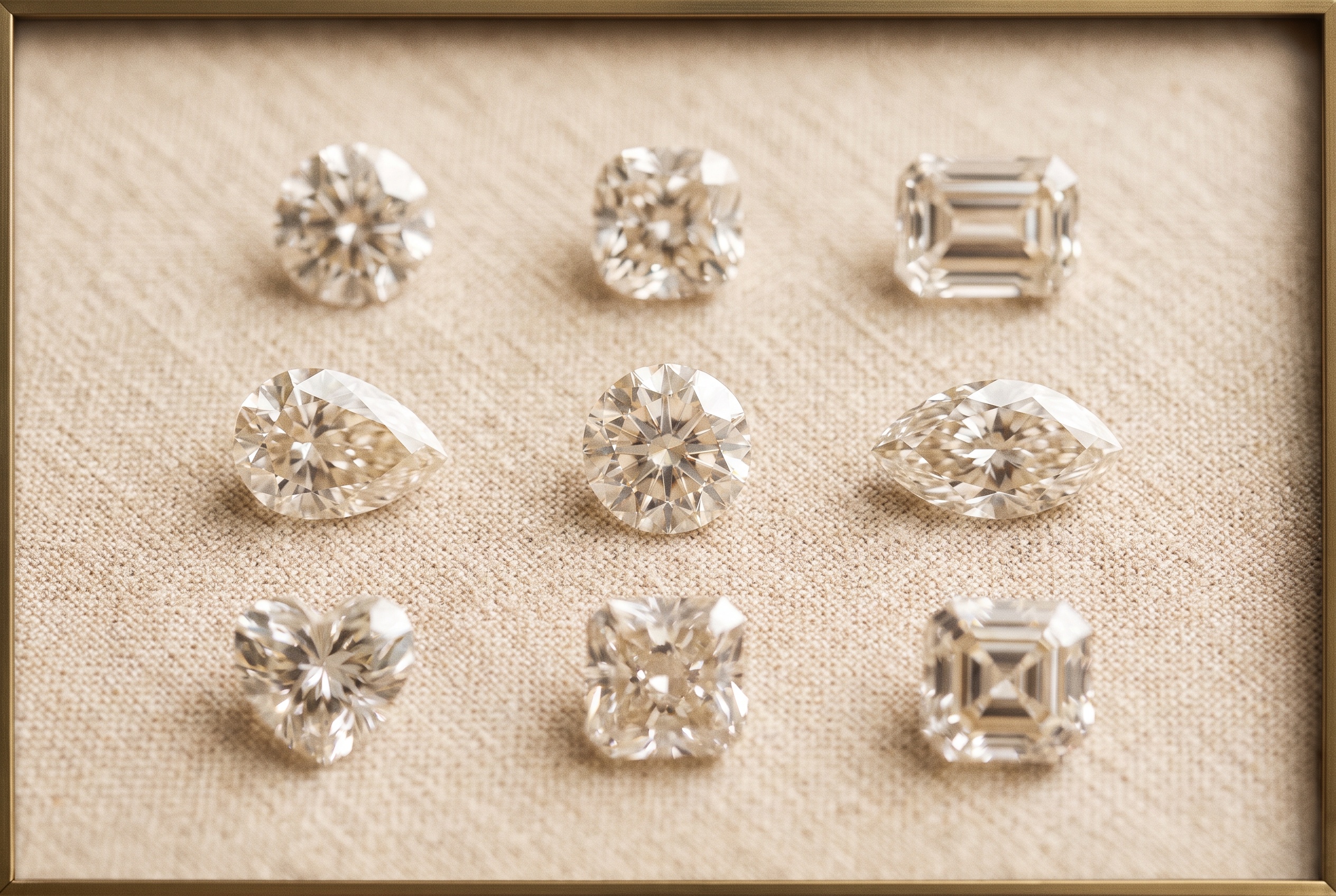

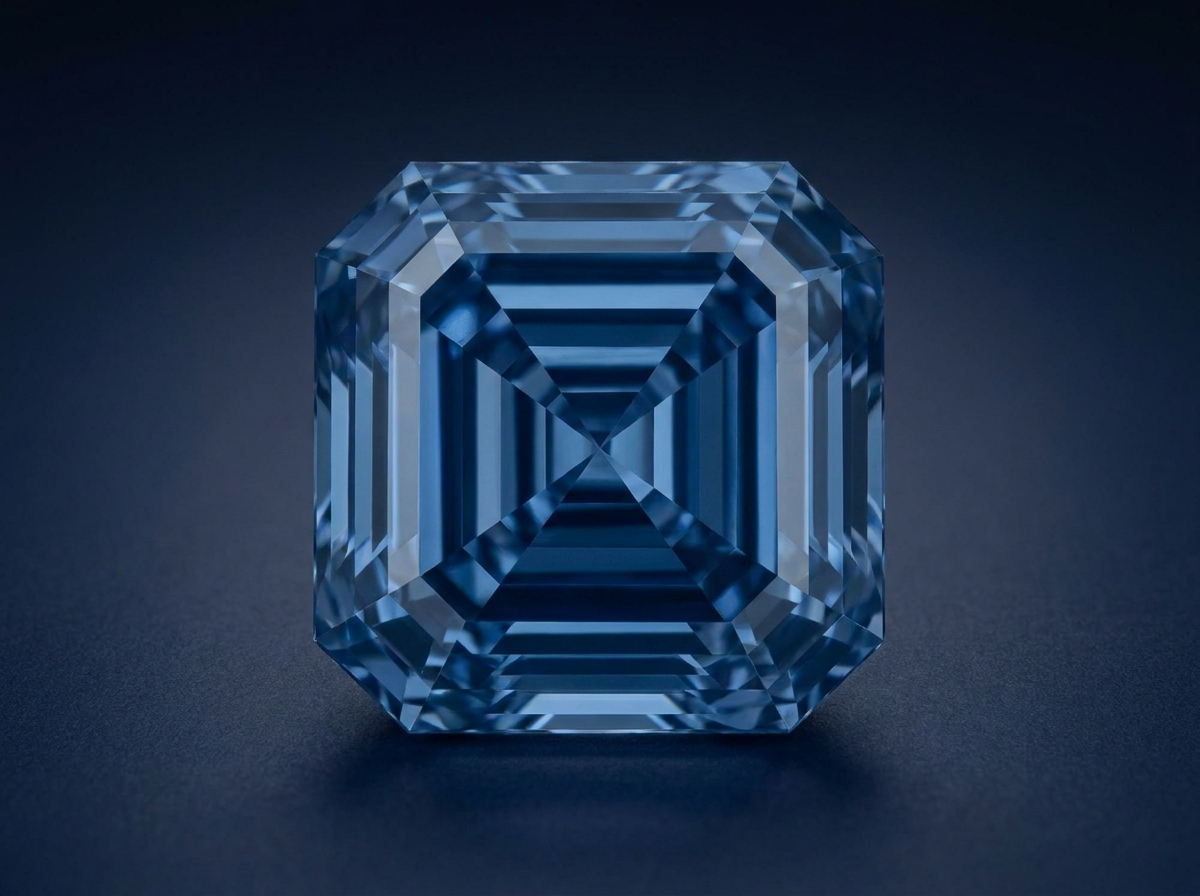
A fancy color Asscher is a square step-cut lab-grown diamond — cropped corners and broad, concentric facets, like a square emerald cut — in an intentional hue rather than graded colorless. The open step faceting shows color as a deep, even wash rather than scattered sparkle, which is exactly why the shape has a following among fancy color buyers who want depth over disco-ball flash. Guru Diam carries a small, genuinely limited run of IGI-certified, CVD-grown pieces on hand at any given time; request current inventory or spec a made-to-order cut against the hue and size a project calls for.
What is a fancy color Asscher cut diamond?
An Asscher cut is a square outline with cropped (bevelled) corners, faceted in large concentric steps rather than the small triangular facets of a brilliant cut — the same "hall of mirrors" layered look as an emerald cut, just squared off instead of rectangular. In colorless goods, that architecture reads as a series of clean, mirrored planes. In fancy color goods, the same open facets do something more useful: they let the stone's own body color pool and read as a continuous field rather than breaking it into scattered flashes the way a round or princess brilliant would.
That distinction matters more than it sounds. Two stones can carry the same GIA or IGI color grade and look noticeably different face-up depending on cut — a well-proportioned fancy color Asscher tends to look more saturated at the same grade than a brilliant-cut stone of identical color, simply because the facet geometry is doing less to dilute the hue. It's a large part of why jewelers who specialize in fancy color inventory keep at least a token Asscher presence even when it isn't their highest-turnover shape.
Origin and trade context of the Asscher cut
The cut traces to 1902, when the Asscher Brothers of Holland developed and patented a square step-cut with unusually deep pavilion angles and a small table — a deliberate departure from the brilliant-cut math that dominated the era. The original 58-facet pattern earned a reputation in the trade for a distinctive "windmill" optical effect: alternating light and dark step bands that shift as the stone moves, rather than the all-over sparkle of a brilliant. A modernized 74-facet version, sometimes marketed as the Royal Asscher cut, tightened the step geometry further and is the closer ancestor of what most cutters produce today.
In the modern lab-grown market, Asscher sits in a specific production niche: it's a mature, well-understood cut style with established proportion standards, but it consumes rough less efficiently than a round or princess cut and takes more cutting judgment to execute cleanly than most brilliant shapes — every step facet has to align or the "hall of mirrors" effect breaks down into visible mismatch. That combination — established demand, lower rough yield, more cutting skill required — is a big part of why Asscher (fancy color or colorless) never became a high-volume commodity shape the way round or princess did, and why standing fancy color Asscher inventory tends to run thin across the trade generally, not just at any one supplier.
Why does step-cut faceting show fancy color differently than a brilliant cut?
Step-cut facets are fewer and larger than brilliant-cut facets, so light travels further inside the stone before it exits, carrying more of the diamond's own hue back out through the table — a continuous field of color rather than a mosaic of light and dark flashes. Brilliant faceting is built to maximize scintillation and fire; it breaks light into small return paths that read as sparkle, which is exactly what you want in a colorless stone but works against color saturation, since each tiny facet reflects a slightly different light path and can visually "wash" a subtle hue.
Step-cut faceting does the opposite: fewer, larger, flatter mirrors mean the color reads as a unified plane rather than a scatter of small flashes. It's the same reason emerald and radiant cuts are disproportionately popular in fancy color inventory relative to their share of colorless production — the facet math simply flatters saturation better. The tradeoff is that step cuts are far less forgiving of inclusions: with fewer facets to break up the view into the stone, clarity characteristics that a brilliant cut would hide inside its facet pattern are much more visible in an Asscher, which is one of the first things a jeweler should check before buying fancy color goods in this shape.
How Guru Diam sources and cuts fancy color Asscher diamonds
Guru Diam's fancy color Asscher stones are CVD-grown and cut in-house against the color, saturation, and proportion targets each piece is intended for — the rough is selected specifically for the color and clarity characteristics an Asscher cut needs, since (as above) this shape hides less than a brilliant cut does. Cutting decisions on a colored rough crystal are different from cutting a colorless one: the cutter is orienting the piece to maximize how the finished stone's step facets will carry saturation to the table, not just maximizing carat yield, which is part of why fancy color Asscher output stays low relative to demand — it's a slower, more deliberate process per stone than round or brilliant production.
Because Asscher draws from the same limited pool of colored rough as Guru Diam's other fancy color shapes, standing inventory in this specific cut is intentionally thin. Most of what moves through fancy color Asscher is either an in-stock piece pulled directly from current inventory, or a made-to-order cut specified against a project brief — a target hue, saturation tier, and carat weight a jeweler is designing around. Both paths run through the same wholesale, trade-only pricing with no retail markup, from Guru Diam's New York Diamond District desk (36 West 47th Street, Suite 601A) and Los Angeles office (607 South Hill Street).
Grading fancy color Asscher diamonds — what to check before buying
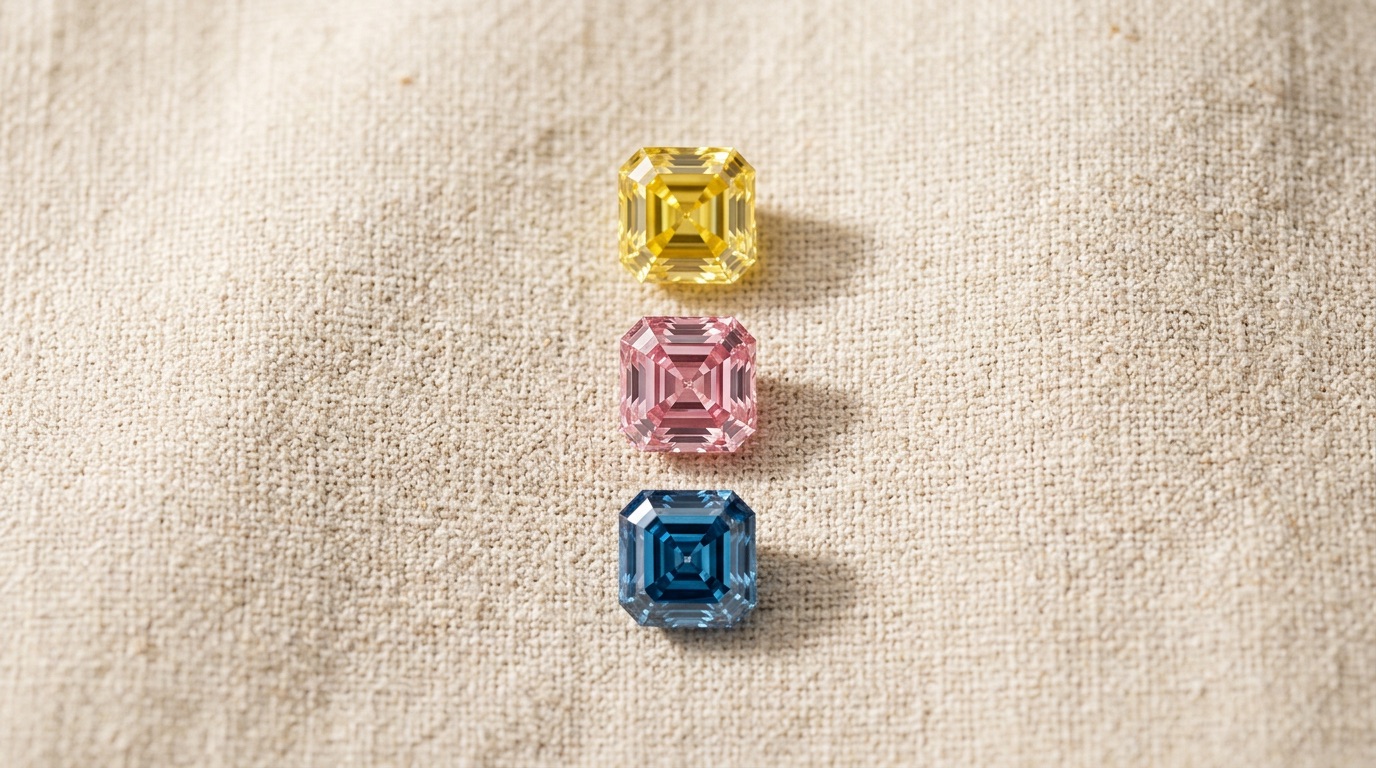
Fancy color grading runs on a different axis than colorless grading. Instead of the D-to-Z scale, IGI and GIA grade fancy color stones on hue, tone, and saturation, producing terms like Fancy Light, Fancy, Fancy Intense, Fancy Vivid, and Fancy Deep — Vivid and Deep generally command the strongest premiums because they represent the most saturated, most visually assertive color at a given hue. On an Asscher specifically, that color-grade language only tells half the story, because cut quality has an outsized effect on how a given color grade actually reads face-up.
A few things matter more on a fancy color Asscher than they would on a round brilliant of the same color grade:
- Corner and step symmetry. Because the "hall of mirrors" effect depends on the step facets lining up cleanly, even minor misalignment reads as a visible flaw across the whole face of the stone — not a subtle asymmetry the way it might on a brilliant cut.
- Depth and pavilion angle. Cut too shallow, an Asscher loses the saturation the step facets are supposed to concentrate; cut too deep, light leaks out the pavilion and the stone looks dark rather than richly colored. There's a narrower proportion window for a colored Asscher than for a colorless one.
- Clarity, read honestly. Because step facets don't hide inclusions the way brilliant facets do, a clarity grade that would be invisible face-up on a round or cushion can be plainly visible on an Asscher. Buyers should ask for clarity plot detail, not just the grade, on any fancy color step-cut purchase.
- Color evenness across the table. Zoning — uneven color distribution within the stone — is far more noticeable under open step faceting than under brilliant faceting, which tends to blend zoning into the overall sparkle pattern.
Guru Diam issues certification through IGI as standard on fancy color Asscher stones, with GIA available on request — both labs use comparable fancy color nomenclature, so a certificate from either is directly comparable on hue, tone, and saturation terms.
What drives pricing on fancy color Asscher diamonds
Fancy color pricing works differently from colorless pricing, and it's worth walking through for buyers used to pricing white goods by the standard carat-weight/color/clarity grid:
- Saturation is the primary driver, not clarity. A Fancy Vivid stone with a modest clarity grade will often price above a Fancy Light stone with excellent clarity — color intensity is what fancy color buyers are paying for, and clarity is a secondary check rather than the primary value lever it is in colorless goods.
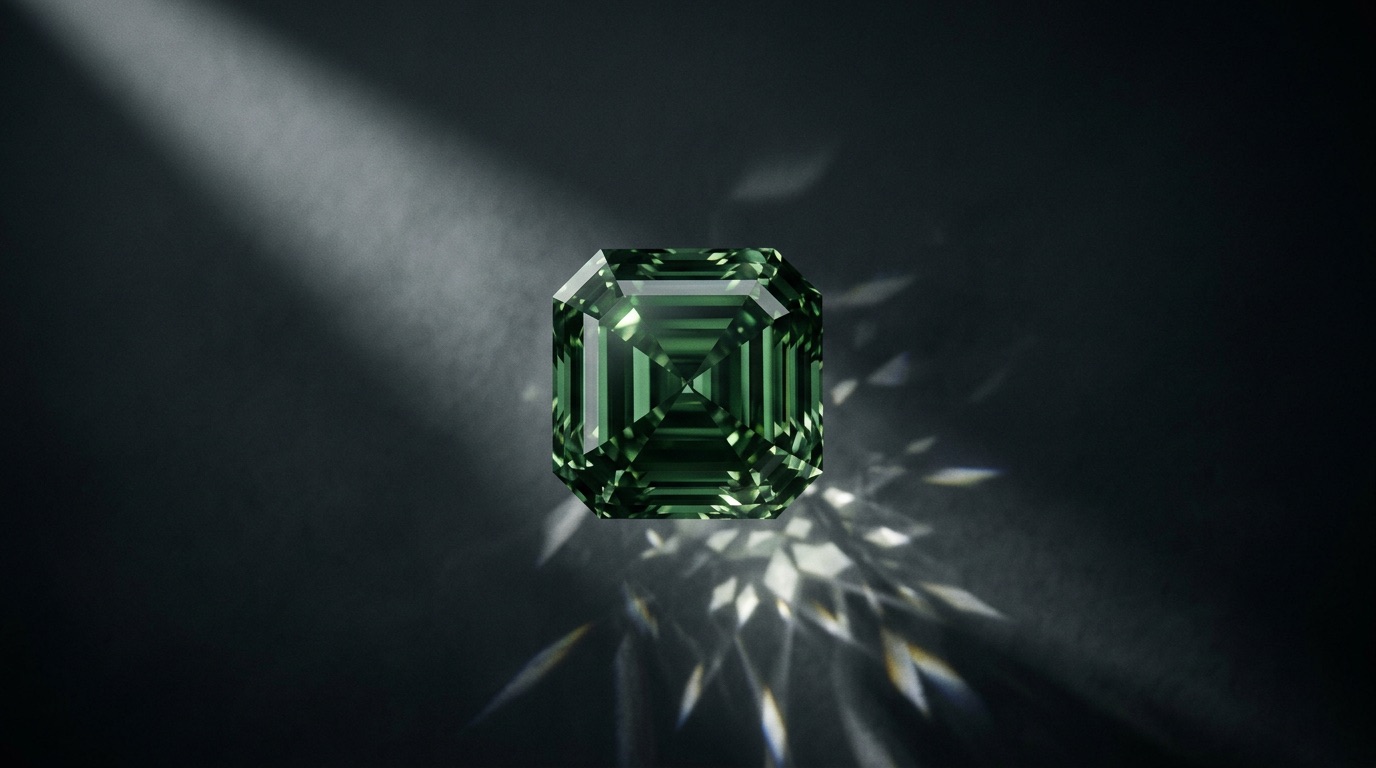
- Hue rarity varies by color. Among the palette Guru Diam certifies in loose fancy color stock — yellow, pink, blue, and green — yellow is the most production-efficient to grow and cut, which generally makes it the most accessible entry point on price. Blue and pink and, in particular, saturated green tend to be more difficult to produce consistently and price accordingly higher, even in lab-grown production where the rough is engineered rather than mined.
- Cut yield loss. An Asscher's deep pavilion and small table mean more rough gets cut away relative to a shallower cut, and a colored rough crystal is inherently more expensive per carat going in than colorless rough of the same size class — so the yield penalty compounds on fancy color Asscher specifically.
- Size premiums step up, not scale linearly. As with most fancy color diamonds, price per carat jumps at certain size breakpoints (roughly 0.50ct, 1.00ct, 2.00ct) rather than climbing smoothly — a function of how rarely larger colored rough of Asscher-appropriate proportions and clarity comes through in a growth run.
- Certification and made-to-order lead time. A made-to-order cut carries a cutting cost that in-stock inventory doesn't, since it's a bespoke job against a specific brief rather than a stone already finished and sitting in inventory.
None of this is unique to Guru Diam — it's how the fancy color trade prices generally, lab-grown or natural. What's specific to sourcing through a wholesale desk rather than a cutter or broker directly is that pricing comes without a retail markup layered on top, since the buyer is a trade account rather than an end consumer.
Fancy color Asscher: spec and current availability
| Spec | Detail |
|---|---|
| Outline | Square, cropped corners |
| Facet style | Step-cut, broad concentric facets |
| Color palette (Guru Diam certified loose stock) | Yellow, Pink, Blue, Green |
| Growth method | CVD-grown |
| Certification | IGI standard; GIA available on request |
| Stone type | Certified single stones (not melee) |
| On-hand count | Limited — request current inventory |
| Sourcing path | In-stock (limited) or made-to-order |
Guru Diam's fancy color Asscher inventory is drawn from the same locked color palette as the rest of the certified fancy color loose-stone catalog — yellow, pink, blue, and green — CVD-grown and IGI-certified as standard, with GIA available on request. Other fancy hues (brown/champagne, orange, and mixed secondary hues) exist in the broader trade and appear occasionally in natural fancy color markets, but they're not part of Guru Diam's certified loose-stone offering — if a project brief calls for a color outside yellow, pink, blue, or green, the desk can advise on realistic sourcing paths rather than listing it as stocked.
On-hand count in this specific cut runs low at any given time — a genuinely small number, reflecting how little colored rough gets routed to Asscher relative to brilliant and mixed-cut shapes across the entire fancy color trade, not a Guru Diam-specific constraint. Request current inventory directly, or spec a made-to-order cut against the hue, saturation, and size a project needs.
Styling fancy color Asscher diamonds for resale
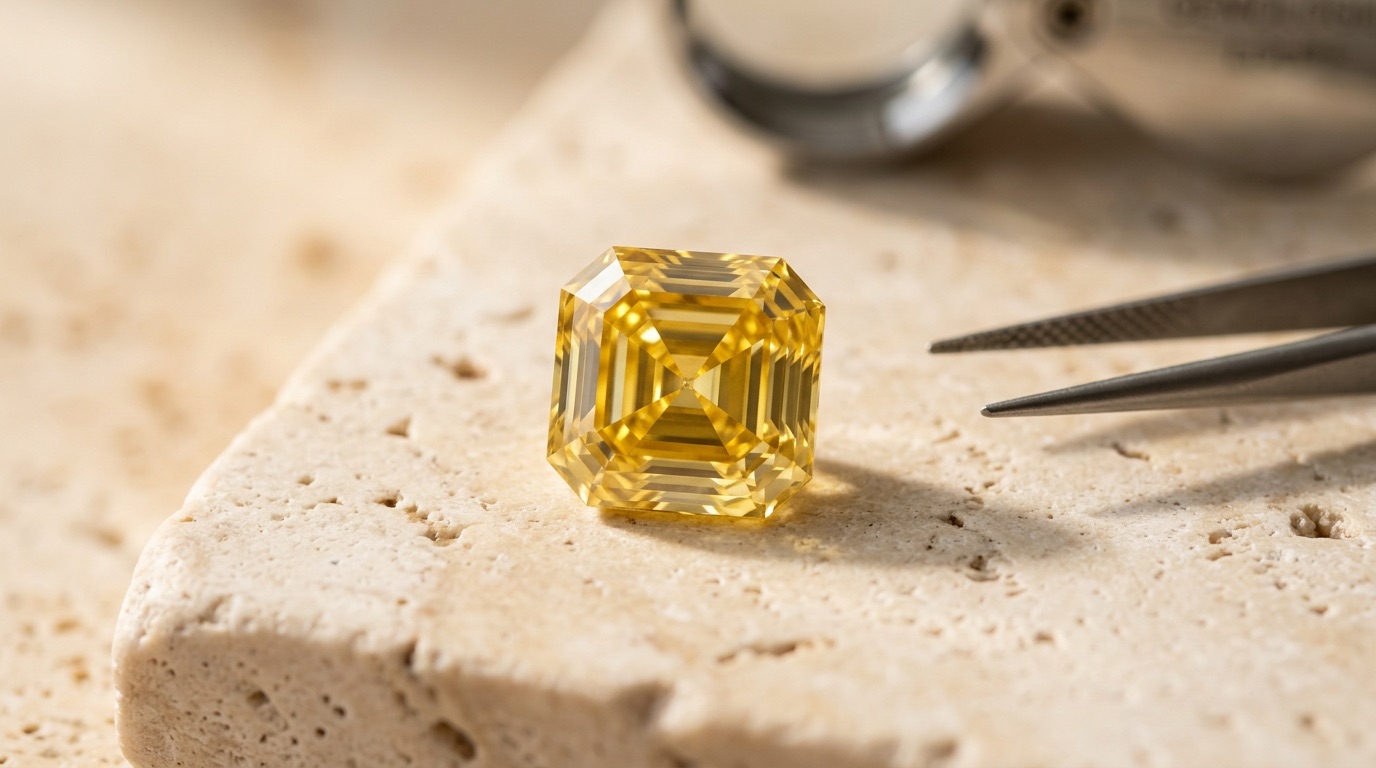
For jewelers building pieces around a fancy color Asscher center stone, the shape's architecture drives a few practical setting decisions worth knowing before a client consultation:
- Bezel settings protect the corners. Asscher's cropped corners are more vulnerable to chipping than a fully rounded shape — a full or partial bezel is the most protective option and also reinforces the stone's geometric, architectural look rather than fighting it.
- Simple prong settings let the color carry the design. Because a fancy color Asscher already reads as a bold, saturated block of color, most experienced designers keep the metalwork restrained — four-prong or double-claw settings that don't compete with the stone's own visual weight.
- Halo settings amplify perceived size and saturation. A halo of small colorless or matching-hue melee around a fancy color Asscher center is one of the most common resale-friendly builds, since it makes the center stone read larger and reinforces the color story without needing a larger, more expensive center stone.
- East-West orientation is a strong differentiator in bridal and cocktail pieces. Setting an Asscher sideways rather than the traditional north-south orientation is a design move that reads as current and gives jewelers a way to differentiate a fancy color Asscher piece from more conventional colorless Asscher inventory in the same case.
- Three-stone and toi-et-moi builds pair well with a fancy color Asscher center. Flanking a colored center stone with two smaller colorless or tonal side stones is a reliable way to use a single fancy color center in a higher-ticket finished piece rather than selling it loose.
For jewelers who want a finished piece rather than a loose stone to set in-house, Guru Diam runs CAD-to-finished-piece custom builds in 4–6 days from the New York and Los Angeles desks — a fancy color Asscher center can go from spec to a finished, ready-to-ship ring, pendant, or pair of earrings inside that window once a design is confirmed.
Asscher vs. emerald vs. cushion: choosing a fancy color shape
Buyers weighing a fancy color Asscher against the trade's other popular fancy color shapes are usually choosing between three practical options, each with a different look and a different sourcing profile:
Asscher vs. emerald cut. These are close cousins — both step-cut, both built on broad concentric facets that flatter saturation the same way. The difference is almost entirely proportional: Asscher is square with a higher crown and deeper pavilion, giving it a more compact, blocky presence and a stronger "windmill" light-and-dark pattern; emerald is rectangular and generally cut shallower, reading as more elongated and slightly more forgiving of minor color zoning because the longer facets distribute it more subtly. Jewelers building a fashion-forward, geometric piece tend to reach for Asscher; those building an elongated, classic silhouette (especially in engagement work) tend to reach for emerald. Emerald cut also has meaningfully deeper standing inventory across the trade generally, since it draws a larger share of colored rough than Asscher does.
Asscher vs. cushion cut. Cushion is a mixed cut — brilliant faceting on the pavilion married to a rounded-square outline — and it's arguably the single most popular shape in fancy color diamonds overall, natural or lab-grown, largely because that brilliant faceting is more forgiving: it hides minor inclusions and color zoning the way a pure step cut can't, while still showing strong saturation thanks to its typically higher crown and closed culet. For a jeweler choosing between the two on a marginal-quality stone, cushion is usually the safer sell; on a high-clarity, evenly saturated stone, Asscher's cleaner geometric read is the stronger differentiator, since it signals confidence in the stone rather than using facet pattern to disguise a flaw.
In practice, most jewelers who carry fancy color inventory stock cushion as the volume shape and keep Asscher (and emerald) as the specialty, design-forward option for clients who specifically want the step-cut look — which lines up with why Asscher inventory across the trade, including Guru Diam's, stays thinner than cushion or round.
How to order fancy color Asscher diamonds wholesale from Guru Diam
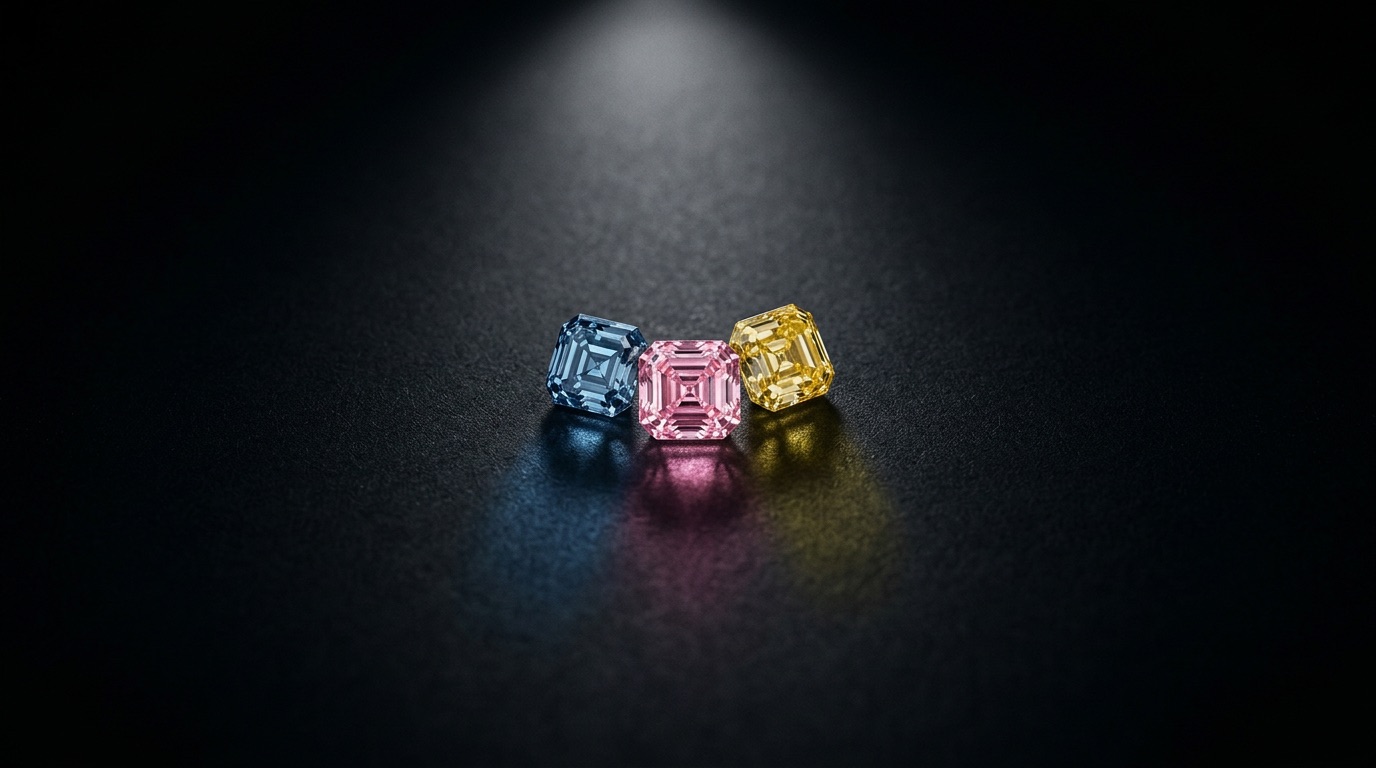
Guru Diam sells fancy color Asscher cut diamonds as wholesale, trade-only inventory — no retail markup — from the New York Diamond District desk (36 West 47th Street, Suite 601A) and the Los Angeles office (607 South Hill Street). Because standing inventory in this specific cut runs thin, most orders fall into one of two paths:
- In-stock purchase. Request current inventory to see what's on hand right now — color, carat weight, and certification detail on whatever pieces are available. In-stock pieces ship same-day.
- Made-to-order cut. Specify the hue, saturation tier, and carat weight a project needs, and the desk will confirm cutting timeline and pricing against that brief. This is the more common path for fancy color Asscher specifically, given how little colored rough gets routed to this shape at any one time.
For projects that need a finished piece rather than a loose stone, custom settings run CAD-to-finished-piece in 4–6 days. For shapes with deeper standing inventory than Asscher, see the fancy color lab-grown diamonds overview.
Ready to buy? Open a verified wholesale account at gurudiam.com/signup and book time with a gemologist at gurudiam.com/book-appointment to review current fancy color Asscher inventory or scope a made-to-order cut.
Frequently Asked Questions
Why does step-cut faceting show fancy color differently than a brilliant cut?
Step-cut facets are fewer and larger than brilliant-cut facets, so light travels further inside the stone before exiting, carrying more of the diamond's own hue back out through the table — a continuous field of color rather than a mosaic of light and dark flashes. The tradeoff is that step cuts show inclusions and color zoning more readily than brilliant cuts, since there are fewer facets to break up the view into the stone.
Does Guru Diam have fancy color Asscher diamonds in stock, and are they certified?
Yes, in limited numbers at any given time — CVD-grown and IGI-certified as standard, with GIA available on request. Request current inventory directly, or specify a made-to-order cut against the hue, saturation, and size a project needs.
What colors does Guru Diam offer in fancy color Asscher cut?
Guru Diam's certified fancy color Asscher inventory covers yellow, pink, blue, and green — the same locked palette as the rest of the certified fancy color loose-stone catalog. Other fancy hues exist in the broader diamond trade but aren't part of the current stocked or made-to-order offering.
Why is standing inventory in fancy color Asscher cut so limited compared to round or cushion?
Colored rough gets routed to whichever cut will show its particular color and clarity characteristics to best advantage, and relatively little of it suits Asscher's demanding step-facet geometry — which hides inclusions and zoning far less than a brilliant or mixed cut does. That's a trade-wide pattern, not specific to any one supplier, and it's why Asscher tends to run as a specialty, made-to-order-leaning shape in fancy color rather than a stocked shelf item.
How fast can I get a fancy color Asscher stone or a finished custom piece?
In-stock loose stones ship same-day. A finished custom piece — center stone set into a ring, pendant, or earrings — runs CAD-to-finished-piece in 4–6 days from the New York and Los Angeles desks. Made-to-order cutting on the stone itself is quoted separately based on the specific brief.
How should I choose between a fancy color Asscher and a fancy color emerald or cushion cut?
It comes down to the stone's clarity and how it'll be styled. Cushion's mixed-cut faceting is more forgiving of minor inclusions and color zoning, which makes it the safer choice on a marginal-quality stone and the most popular fancy color shape overall. Asscher and emerald both show color as a cleaner, more saturated field and read as more geometric and design-forward — Asscher square and compact, emerald elongated — but both demand higher clarity and more even color distribution to look their best, since step facets hide far less than brilliant faceting does.