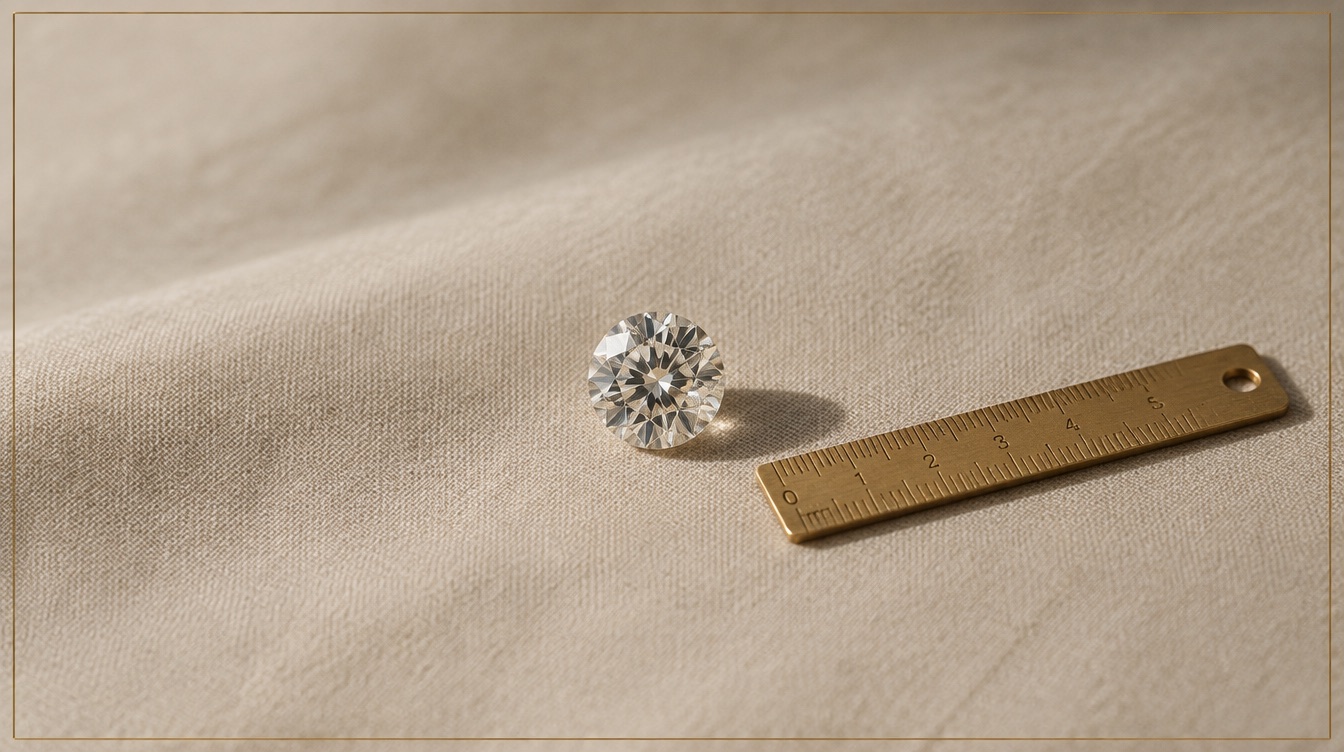
An 8.0mm round brilliant diamond weighs approximately 1.90 to 2.00 carat. That places it right at the threshold buyers care about most in this size range: an 8mm stone reads, prices, and sources as a near-two-carat center stone, which is exactly why so many searches for this measurement are really asking one specific question — does 8mm mean 2 carats, or not quite.
The honest answer is "close, but confirm it." An 8.0mm diameter sits in a narrow band just under the 2.00-carat line for a standard, well-proportioned make, and depending on how a given stone is cut, it can land anywhere from just under 1.90 carat to just over 2.00 carat. At this size and price level, that gap is not a rounding footnote — it is real money, and it is exactly the kind of detail a grading report resolves and a bare mm listing does not. This guide covers what 8mm actually measures, why the carat figure is a range rather than one number, the reference table that anchors 8mm against the sizes around it, why 8mm sits right at the edge of the melee size definition without actually behaving like melee, and what changes about sourcing once a stone this size is doing the visual work of a genuine statement centerpiece.
What 8mm Means on a Round Brilliant — Girdle Width, Not Weight
On a round brilliant, millimeter diameter describes the girdle width — the widest point of the stone, measured straight across as seen face-up. It is one linear measurement, and it is the number that determines whether a stone drops cleanly into a given prong basket, halo channel, or bezel opening. Carat weight measures something different: mass. Most of a round brilliant's mass sits in the pavilion, the cone-shaped lower portion beneath the girdle, which contributes nothing to how wide the stone looks from directly above.
At smaller diameters this distinction is mostly academic. At 8mm it is not, because this is the diameter jewelers reach for when a client wants a round solitaire, halo, or three-stone build with real, unmistakable presence on the hand — the kind of center stone a client points to and calls "the two-carat one." Specifying "an 8mm stone" and expecting it to also land at exactly 2.00 carat are two different design decisions, and the gap between them is the single most common point of confusion in briefs for center stones this large.
Why Carat Weight Isn't Fixed by Diameter Alone
If every round brilliant were cut to identical proportions, one millimeter diameter would map to one exact carat weight, with no range to explain. In practice, three variables in how a stone is cut determine how much mass sits beneath a given girdle width, which is why 8.0mm corresponds to a range of carat weights instead of a single figure:
- Depth percentage — total depth from table to culet, expressed as a percentage of diameter. A deeper-cut stone holds more volume beneath an identical girdle width than a shallower one, so it weighs more even measured at the same diameter.
- Table percentage — the width of the flat top facet relative to the stone's overall diameter. Table size interacts with crown and pavilion angle to shift where volume concentrates, which can move final carat weight up or down even between two stones with similar overall depth.
- Overall cut proportions — crown angle, pavilion angle, girdle thickness, and culet size together make up what a grading report summarizes as cut grade. A cutter working to maximize light performance from a piece of rough, and one working to maximize weight retention from that same rough, can both finish a legitimate 8.0mm stone — and land on meaningfully different final carat weights.
A "spready" 8.0mm stone, cut shallower to maximize face-up diameter for its weight, can sit closer to 1.85 carat. A deeper make at the identical 8.0mm diameter can push past 2.05 carat. Both are legitimate cutting outcomes at this size — the difference is a design tradeoff between face-up spread and total mass, not a flaw in either stone.
The 8mm Round Brilliant Carat Range: 1.90–2.00 Carat
For a well-proportioned, standard-make round brilliant, 8.0mm diameter corresponds to approximately 1.90 to 2.00 carat. That figure holds consistently across trade mm-to-carat references, grading-lab sizing charts, and CAD sizing libraries, and it is the number to plan a sourcing search or a design brief around. In practice, well-cut 8.0mm stones can fall anywhere from roughly 1.80 to 2.10 carat and still be entirely normal for the size — the range widens slightly further at the extremes for stones cut to unusually shallow or unusually deep proportions.
Treat 1.90–2.00ct as the planning estimate, and confirm the exact weight against a grading report or scale reading before it goes on an invoice, an appraisal, or a client quote. That confirmation step carries more weight at 8mm than at almost any smaller diameter in the round-brilliant range, for a simple reason: this is the size band where a stone crosses — or doesn't quite cross — the 2.00-carat line, and per-carat pricing on stones near that psychological threshold does not move in a straight line. A stone confirmed at 2.01ct can price meaningfully differently than one confirmed at 1.94ct, even though both would be casually described as "an 8mm."
Round Brilliant mm-to-Carat Reference Table
The table below lines up standard round brilliant diameters against their approximate carat weights, spanning from popular center-stone sizes through the range where a stone reads unambiguously as a large statement solitaire. As with any mm-to-carat reference, treat these as planning figures — the actual weight of an individual stone depends on its specific cut proportions and should always be confirmed against its certificate.
| Diameter (mm) | Approximate Carat Weight | Typical Role |
|---|---|---|
| 5.0mm | ~0.46–0.50 ct | Small center stone |
| 5.5mm | ~0.61–0.66 ct | Center stone |
| 6.0mm | ~0.75–0.80 ct | Popular center-stone / solitaire size |
| 6.5mm | ~1.00–1.05 ct | Classic "1-carat look" benchmark diameter |
| 7.0mm | ~1.25–1.30 ct | Statement center stone |
| 7.5mm | ~1.55–1.65 ct | Statement center stone |
| 8.0mm | ~1.90–2.00 ct | Large statement center stone |
| 8.5mm | ~2.30–2.40 ct | Large statement center stone |
| 9.0mm | ~2.70–2.80 ct | Statement / bridal focal stone |
Look at how the carat jump between each half-millimeter step widens as diameter increases. The move from 6.0mm to 6.5mm adds roughly a quarter carat; the move from 7.5mm to 8.0mm adds closer to 0.30–0.35 carat, and the next step, 8.0mm to 8.5mm, adds nearly 0.40 carat on its own. Carat weight tracks volume, and volume scales with the cube of a linear measurement like diameter, so every additional half-millimeter at this end of the table adds proportionally more weight than the same half-millimeter step did at a smaller size. That is also why 8.0mm sits so close to the 2.00-carat line in the first place — it is the diameter where the cumulative effect of that cubic scaling finally lands a round brilliant right on top of a major carat-weight threshold.
8mm and the Near-Two-Carat Benchmark
It is worth being direct about why "8mm diamond" gets searched so specifically, compared with neighboring sizes. At 6.5mm, buyers ask whether a stone "looks like a carat." At 8.0mm, the question shifts to whether a stone "is two carats," and the honest answer is that a standard-make 8.0mm round brilliant sits just under that mark, at roughly 1.90–2.00 carat rather than a clean 2.00. Reaching an exact 2.00ct round brilliant typically requires a diameter fractionally larger than 8.0mm, or a deeper cut at 8.0mm that trades some face-up spread for the extra hundredths of a carat.
That distinction matters for how a jeweler frames the size with a client. Some buyers specifically want "a full two carats" as a round number for an appraisal, an insurance schedule, or simply the marketing value of the figure itself, and for them an 8.0mm stone needs to be confirmed at or above 2.00ct on paper, not assumed to hit it because it is casually called "8mm." Other buyers are shopping for face-up size and are perfectly served by a 1.90–1.96ct stone at 8.0mm that reads every bit as large in the setting. Neither preference is wrong, but they lead to sourcing two different stones, and the only way to tell them apart in advance is the certificate, not the millimeter figure on a listing.
This also shows up clearly in how the stone performs visually. An 8.0mm round brilliant has enough face-up surface area that facet pattern, light return, and any color tint are easy to read at arm's length, on a stone that a client will often be showing off specifically because of its size — which is exactly why cut, color, and clarity all carry more weight at this size than at smaller center-stone diameters, covered next.
What Changes About Sourcing at 8mm
Sourcing an 8mm round brilliant is a different exercise from sourcing a smaller center stone, and not only because of the price point — because of what that price point is actually paying for. A few things follow directly from the size:
- Individual certification is not a question — it is the baseline. An 8mm stone at roughly 1.90–2.00 carat is well past the size where individually graded loose stones are standard trade practice. A buyer should expect a full IGI, GIA, or GCAL report as a condition of sale, confirming exact carat weight along with color, clarity, and cut — not a request that needs justifying.
- Color and clarity matter even more than at smaller center-stone sizes. An 8mm diameter gives a viewer noticeably more face-up surface area to inspect than a 7mm stone of the same shape, since area scales with the square of diameter. Any color tint, any visible inclusion, and any asymmetry in the facet pattern is correspondingly easier to spot at arm's length — the color and clarity grade a buyer is comfortable with at 6mm may look entirely different once it is spread across an 8mm stone.
- Symmetry and polish carry more weight relative to the stone's total value. A larger stone has more girdle, more facet junctions, and more surface for a grading lab to assess for symmetry and polish — small deviations that would be nearly invisible on a smaller stone become measurable, and occasionally visible, contributors to how the stone performs optically at this size.
- Whether the stone actually reaches 2.00ct is its own line item to confirm. Because 8mm sits just below that threshold on a standard make, a buyer who needs the round-number carat weight for an appraisal or a specific price bracket should confirm the exact figure on the certificate before committing — not assume it from the mm listing alone.
None of this means smaller center stones are sourced carelessly — it means the margin for error shrinks as the stone, and the price tag attached to it, gets larger. A buyer who would tolerate a marginal color grade or a slightly loose symmetry call on a half-carat accent stone typically will not extend the same tolerance to a near-two-carat statement centerpiece, and should not.
Cut Quality's Effect on Perceived Size at 8mm
Cut proportions do outsized work at this diameter for the same reason they matter at any round-brilliant size, just with higher stakes attached. A stone cut for maximum spread — a wider table, a shallower crown — presents more face-up diameter for a given carat weight, which is exactly how two stones both loosely described as "around 8mm" can carry noticeably different carat weights and noticeably different price tags. At smaller sizes, that gap might be a few hundredths of a carat. At 8mm, the same proportional difference can shift the final weight by well over a tenth of a carat, which at this price-per-carat level is a meaningful sum of money either way — and, again, it is often the difference between a stone that clears 2.00ct and one that does not.
The practical guidance for anyone evaluating 8mm stones from different sources is to never rely on the millimeter figure in isolation. Ask for the actual measured diameter, depth percentage, table percentage, and cut grade together, straight off the grading report, rather than comparing listings on a rounded "8mm" description alone. A stone cut to excellent proportions at a slightly smaller measured diameter can out-perform a shallower, wider-spread stone in brilliance and light return even at a comparable or lower carat weight — and at this size, that performance difference is visible to the naked eye, not just to a trained grader.
Why 8mm Sits at the Edge of the Melee Range — and Never Actually Ships as Melee
It is worth stating plainly where 8mm sits relative to the melee category, because the answer looks different on paper than it does in practice. Melee, as a trade category, is generally specified as running from roughly 0.8mm up to about 9.0mm in diameter — a range wide enough that 8mm falls inside it, and in fact sits close to its stated upper edge. Read only that specification, and it might seem like an 8mm stone belongs in the same conversation as a parcel of small accent goods.
In practice, it does not, and the reason has nothing to do with the mm figure and everything to do with what melee actually is as a sourcing category: small, high-volume, commercially graded accent stones sold as uncertified parcel goods against a DEF+/VS+ baseline, priced and moved in bulk rather than stone by stone. An 8mm round brilliant, at roughly 1.90–2.00 carat, is a large, individually valuable stone that gets sourced, graded, and priced one stone at a time — the opposite of how melee parcels are built and sold. The melee size range's stated upper bound is a technical specification, not a signal about how stones near the top of that range actually move through the trade; an 8mm stone essentially never appears in a melee parcel, full stop, regardless of where it technically sits on the size chart.
Fancy Shapes: Why the 8mm-to-Carat Rule Doesn't Transfer
Everything in this guide applies specifically to round brilliants, where a single diameter measurement reasonably predicts a carat range because the shape is radially symmetrical — every point on the girdle is the same distance from the center. Fancy shapes do not offer that same shortcut. An oval, cushion, emerald, marquise, pear, or radiant is measured by length and width, not one diameter, and the ratio between those two dimensions changes how much carat weight a given footprint carries just as much as depth and cut style do.
That means there is no "8mm equals roughly 1.90–2.00 carat" equivalent for a fancy shape. An 8mm-wide oval, depending on how elongated it is cut, could weigh meaningfully more or less than an 8.0mm round — an elongated oval often carries less carat weight than a round of the same width because more of its footprint is length rather than width, while a more compact cushion at a similar footprint can carry more. This is part of why fancy shapes are frequently marketed on a "looks bigger for the carat weight" basis relative to round brilliants, and it is exactly why that comparison needs actual length-times-width figures behind it rather than a single mm number borrowed from round-brilliant logic. Anyone sourcing a fancy-shape statement stone and using this guide's 8mm round figures as a reference point should ask a supplier for shape-specific length, width, and weight data rather than assuming the round-brilliant table above applies.
Sourcing 8mm Statement Diamonds Through Guru Diam
Sourcing an 8mm round brilliant as a near-two-carat center stone comes with a different checklist than sourcing a smaller center stone: confirmed carat weight and cut proportions rather than an estimate from diameter alone, an unambiguous individual grading report, and enough color and clarity headroom that the stone holds up to the closer visual scrutiny a large centerpiece inevitably gets. Guru Diam's certified diamonds category carries individually graded loose round brilliants at this size with full IGI, GIA, or GCAL documentation, so the exact carat weight, depth percentage, and cut grade behind a given 8mm stone are confirmed on paper rather than inferred from a rounded mm listing — including whether a specific stone clears the 2.00ct line or sits just under it.
Guru Diam's lab-grown catalog is CVD-only — no HPHT anywhere in the line, at any carat weight — alongside a separate natural diamond offering for buyers who want that option specifically for a statement center stone. For three-stone or halo designs built around an 8mm centerpiece, symmetrical flanking stones are available through the matching pairs category, and buyers considering a colored statement stone rather than a colorless one can browse the fancy color loose diamonds selection. Guru Diam operates as a trade-only B2B supplier from two US locations — New York (headquarters) and Los Angeles — with same-day shipping available on in-stock inventory ordered before 6pm EST from New York or 4pm PST from Los Angeles, which matters when a large, individually sourced center stone needs to land against a client deadline rather than sit in transit.
For projects pairing a sourced 8mm center stone with a finished setting, custom engagement rings are completed in 4 to 6 days once the design and stone are confirmed — a timeline specific to finished jewelry, not to loose-stone orders — through custom jewelry. Jewelers and designers evaluating Guru Diam as a wholesale source for large-format round brilliants can review account terms through the trade partner program, or browse the full catalog of loose stones, matched sets, and finished pieces through the wholesale hub. GuruDiam's earlier guides in this series cover the 2mm through 7mm round diamond carat weight ranges for buyers sourcing across the full size spectrum from melee through large statement center stones.
Frequently Asked Questions
How many carats is an 8mm round diamond?
An 8.0mm round brilliant diamond weighs approximately 1.90 to 2.00 carat. The exact figure depends on the stone's individual cut proportions — depth percentage, table percentage, and overall cut grade — so a well-cut 8.0mm stone can reasonably fall anywhere from about 1.80 to 2.10 carat.
Is an 8mm diamond considered 2 carats?
Close, but usually not quite. A standard-make 8.0mm round brilliant typically weighs just under 2.00 carat, in the 1.90–2.00ct range. Reaching a full 2.00ct or more at this diameter usually means a slightly deeper cut, or a diameter fractionally over 8.0mm — always confirm the exact weight on the certificate rather than assuming "8mm" means exactly two carats.
What is the difference between a 7mm and an 8mm diamond?
A 7.0mm round brilliant weighs approximately 1.25–1.30 carat, while an 8.0mm round brilliant weighs approximately 1.90–2.00 carat — roughly two-thirds of a carat more from a single millimeter of added diameter. That gap is larger than the same millimeter step produces at smaller sizes, because carat weight tracks volume, which scales with the cube of diameter rather than diameter itself.
Why do two 8mm diamonds sometimes weigh different amounts?
Millimeter diameter measures only the width across the top of the stone, while carat weight measures total mass, most of which sits in the pavilion below the girdle where it is not visible face-up. A deeper-cut 8.0mm stone holds more volume beneath the same diameter and weighs more, while a shallower "spready" cut at the same width weighs less — which is why the size corresponds to a 1.90–2.00ct range rather than one fixed number, and why some 8mm stones clear 2.00ct while others do not.
Is an 8mm diamond ever sold as melee?
No, essentially never in practice. Melee as a trade category technically spans roughly 0.8mm to 9.0mm, so 8mm falls within that stated range and even sits close to its upper edge, but melee sourcing and pricing logic is built around small, high-volume accent stones sold as uncertified parcel goods. An 8mm stone, at roughly 1.90–2.00 carat, is individually graded and priced stone by stone — the opposite of how melee is sourced — regardless of where it sits within the melee size definition.
Does the 8mm-to-carat rule apply to oval or cushion cut diamonds?
No. The mm-to-carat relationship described in this guide applies specifically to round brilliants, which are radially symmetrical and measured by a single diameter. Fancy shapes like oval, cushion, emerald, and marquise are measured by length and width instead, and their proportions vary too much for a single millimeter figure to reliably predict carat weight — always ask for shape-specific length, width, and weight data for those cuts.