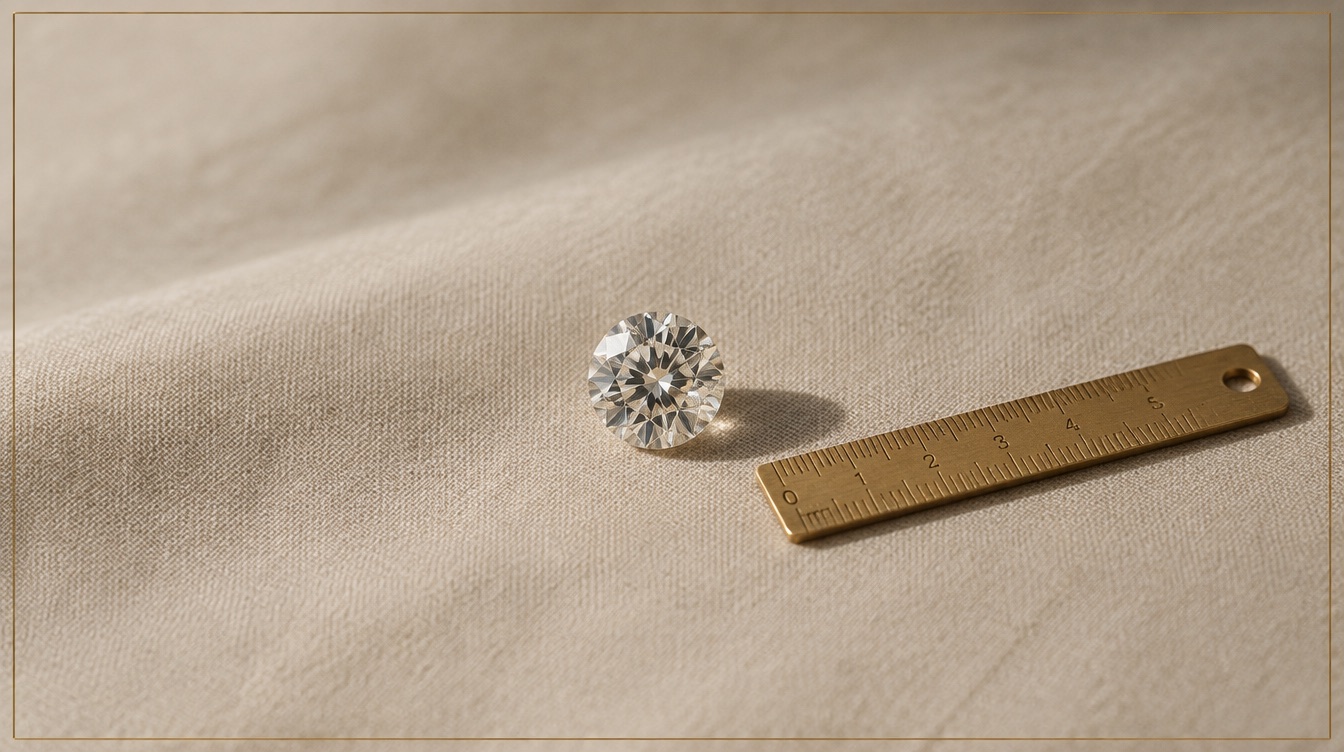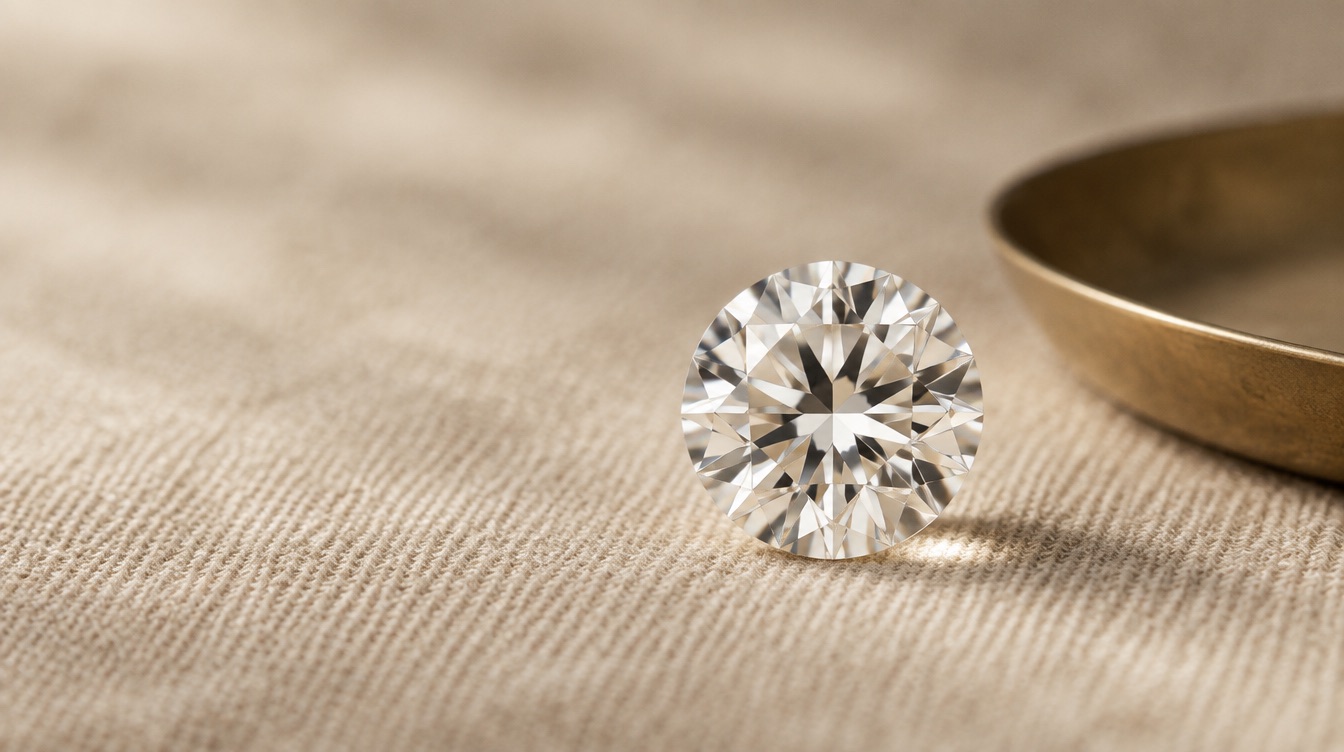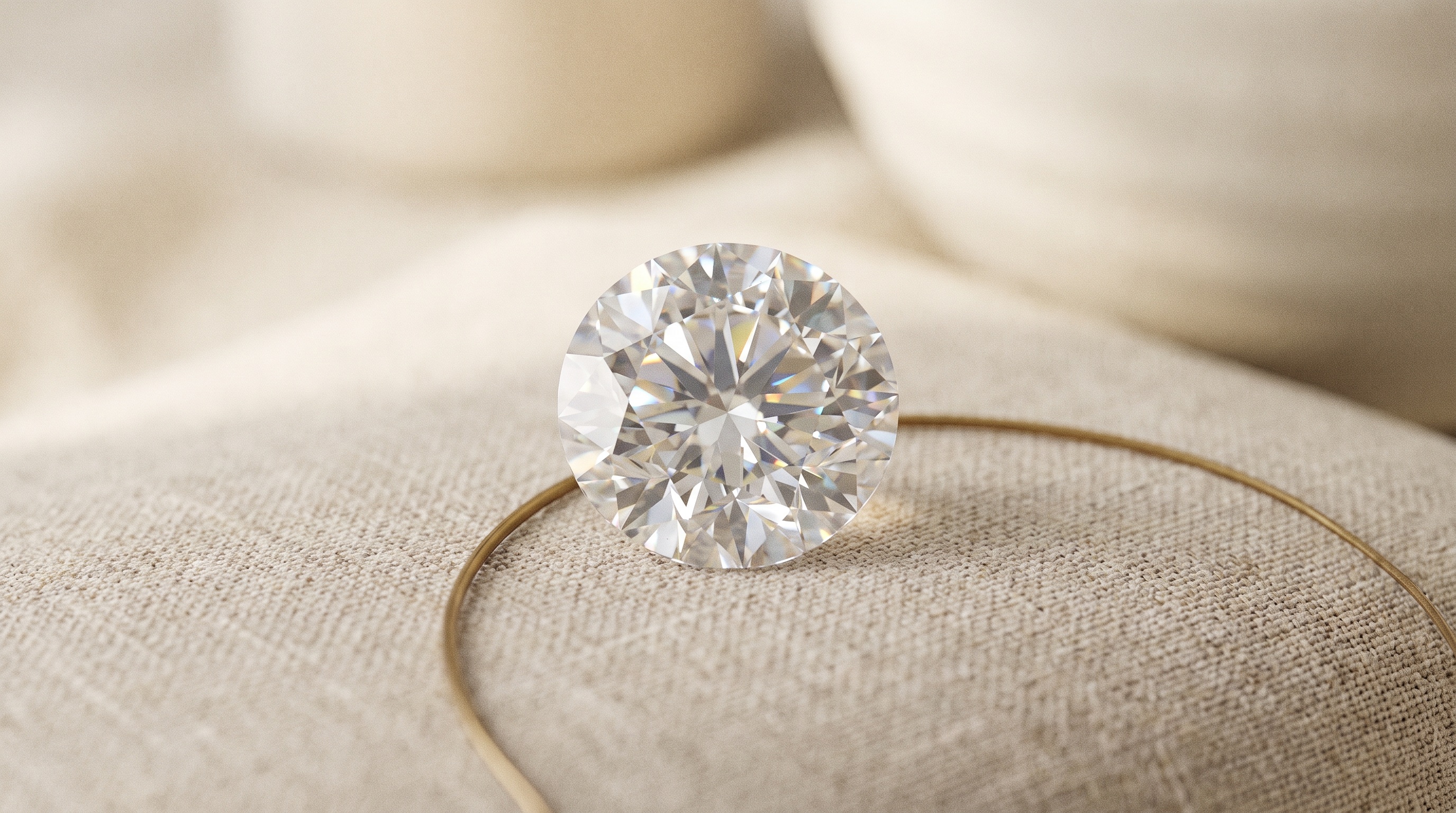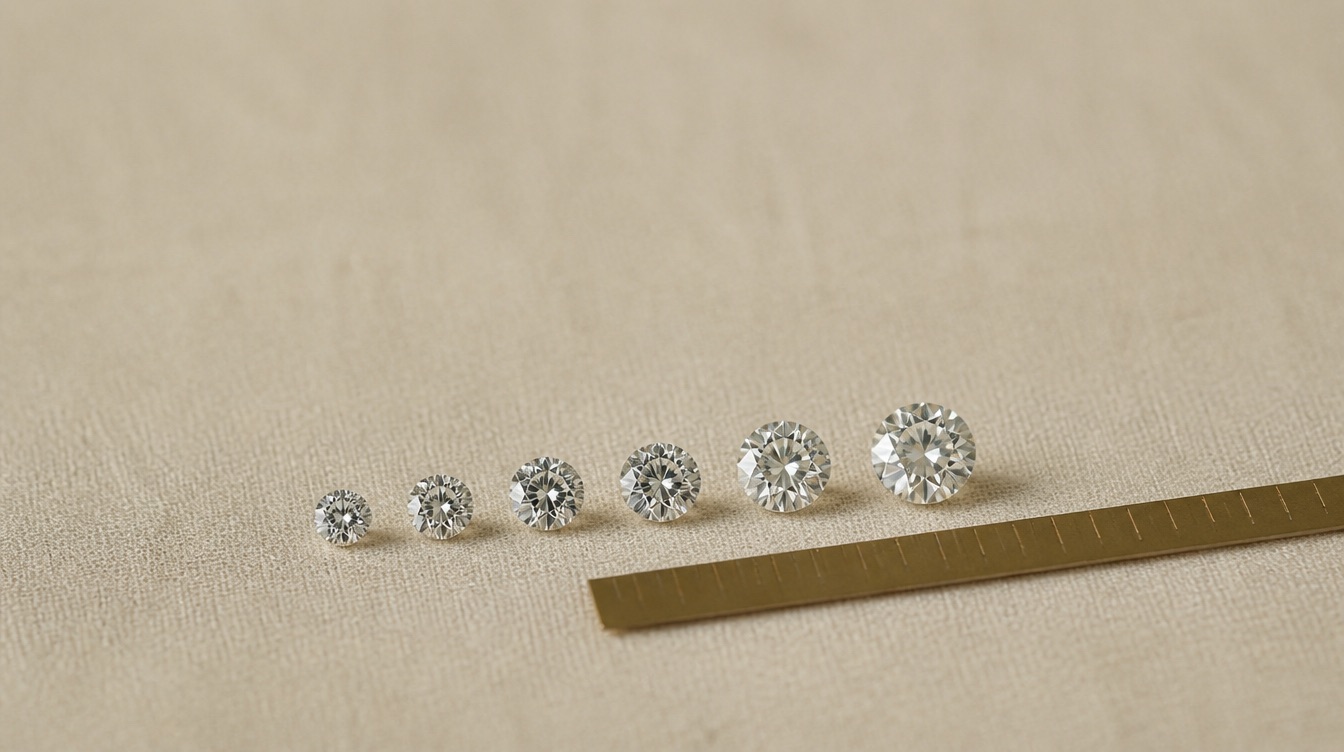
A 4mm round brilliant diamond typically weighs approximately 0.23 to 0.25 carat, though the exact figure shifts with cut proportions. Diameter alone doesn't fix carat weight — depth percentage, table percentage, and overall cut quality all change how much material sits beneath a stone of a given width, which is why sourcing and setting decisions built on mm measurements need a range, not a single number.
What "4mm" Actually Measures on a Round Brilliant
When a diamond is described as "4mm," that figure refers to the girdle diameter — the widest point of the stone, measured across the outline of the round brilliant as it sits face-up. It's a linear measurement, not a weight, and it's the number that matters most when a stone needs to fit a specific seat, prong configuration, or channel width in a piece of jewelry. Carat weight, by contrast, is a measurement of mass (one carat equals 0.2 grams), and mass depends on volume, not just the width of the widest circle.
Two diamonds can share an identical 4.0mm diameter and still differ in carat weight, because a round brilliant is a three-dimensional shape. The girdle diameter tells you how wide the stone reads from directly above; it says nothing about how deep the pavilion runs below the girdle or how much of that width is "spent" on the table facet versus the crown. That's the gap this guide is built to close — treating 4mm-to-carat conversion as a well-established approximate range used across the trade, while explaining clearly why the range exists instead of presenting a single misleading number.
Why Carat Weight Isn't Fixed by Diameter Alone
Three cut-proportion variables account for almost all of the variance between two same-diameter round brilliants: depth percentage, table percentage, and overall cut proportions (crown angle, pavilion angle, and girdle thickness working together). Understanding each one explains why a 4mm reference figure is a range rather than a constant.
Depth Percentage
Depth percentage is the total depth of the stone (table to culet) divided by the average girdle diameter, expressed as a percentage. A well-cut round brilliant typically falls somewhere in the 59% to 62.6% range. For two stones with the same 4.0mm girdle diameter, the one with a higher depth percentage has more volume packed underneath — more pavilion, more material, more weight. A shallower stone with the same diameter has less volume below the girdle and weighs less, even though it measures identically across the top.
Table Percentage
Table percentage is the width of the flat top facet relative to the girdle diameter. It interacts with depth rather than acting independently: cutters balancing light performance, yield, and rough-stone economics make small trade-offs between table size and crown/pavilion angles, and those trade-offs shift how much carat weight a given diameter carries. A larger table paired with a shallower crown, for instance, tends to correlate with a "spready" cut — more visual diameter for less weight.
Overall Cut Proportions
Depth and table percentage don't act alone — crown angle, pavilion angle, girdle thickness, and culet size all combine into what graders summarize as overall cut grade. A diamond cut to maximize light return and proportion balance (an Excellent or Ideal cut grade) will land close to the "standard" carat weight for its diameter. A diamond cut to maximize weight retention from a particular piece of rough — sometimes called a heavy or deep make — can weigh more than the standard reference at the same diameter, while a shallow, spready make weighs less. This is why any mm-to-carat table, including the one below, is best read as an approximate, well-established trade reference rather than a physical law.
4mm Round Brilliant Diamond: Typical Carat Weight Range
For a round brilliant cut to standard, well-proportioned parameters, a 4.0mm diameter corresponds to approximately 0.23 to 0.25 carat. This is the figure most commonly cited across trade mm-to-carat references, and it's a reasonable working number for early-stage sourcing and design planning. Depending on the specific stone's depth and table proportions, that range widens slightly in practice — well-cut 4.0mm stones can reasonably fall anywhere from about 0.22 to 0.26 carat and still be entirely normal, well-made diamonds.
The takeaway for anyone sourcing or designing around 4mm stones: treat 0.23–0.25 carat as the planning estimate, but confirm actual weight against a certificate or a scale reading whenever precision matters — for total-carat-weight disclosures, for insurance appraisals, or for matching a specific weight target across a set of stones. Millimeter size is the right unit for physical fit; carat weight is the right unit for value, certification thresholds, and total-weight claims. They correlate closely but are not interchangeable.
Round Brilliant mm-to-Carat Reference Table
The table below lines up several neighboring round brilliant diameters against their approximate standard carat weights. These figures reflect well-proportioned, standard-make round brilliants and are meant as a planning reference — actual weight for any individual stone should always be confirmed against its certificate or a direct measurement, since depth, table, and overall cut proportions will shift real stones within (and occasionally slightly outside) these ranges.
| Diameter (mm) | Approximate Carat Weight | Notes |
|---|---|---|
| 3.0mm | ~0.10–0.11 ct | Melee range; uncertified parcel goods |
| 3.5mm | ~0.14–0.16 ct | Melee range; uncertified parcel goods |
| 4.0mm | ~0.23–0.25 ct | Sits near the individual-certification threshold — verify actual weight |
| 4.5mm | ~0.29–0.34 ct | Typically above the certification threshold |
| 5.0mm | ~0.46–0.50 ct | Commonly certified as an individual loose stone |
| 5.5mm | ~0.61–0.66 ct | Commonly certified as an individual loose stone |
| 6.0mm | ~0.75–0.80 ct | Commonly certified as an individual loose stone |
Notice how the jump in carat weight accelerates as diameter increases — carat weight scales with volume, which grows roughly with the cube of the linear dimensions, while diameter is a single linear measurement. That's why the difference between 3.0mm and 3.5mm is a fraction of a point, but the difference between 5.5mm and 6.0mm is a much larger absolute swing. It's also why small mm errors compound faster at the upper end of any given size range than at the lower end.
The Melee-to-Certified-Stone Threshold at 4mm
4mm is a genuinely useful size to understand precisely because it sits close to a real boundary in how the trade handles small diamonds. Melee-sized stones — generally running from about 0.8mm up to roughly 9.0mm in diameter — are typically sourced and sold as uncertified parcel goods, sorted and quality-controlled against a consistent baseline (commonly DEF-and-better color, VS-and-better clarity) rather than certified stone by stone. Individually IGI- or GIA-certified loose diamonds, by contrast, generally start around 0.30 carat and up, where per-stone certification becomes standard practice and economically sensible.
A 4.0mm round brilliant, at roughly 0.23 to 0.25 carat, lands just under that 0.30-carat certification threshold in most cases — but "just under" is doing real work in that sentence. Because actual weight at 4.0mm varies with cut proportions, a particular 4.0mm stone from a deeper, heavier make could measure closer to 0.27 or even 0.28 carat, while a shallower, spready 4.0mm stone might sit closer to 0.21 or 0.22 carat. Neither of those is unusual, and neither is a defect — but it means diameter alone doesn't tell you which side of the certification threshold a specific stone falls on.
The practical implication: don't assume from millimeter size alone whether a 4mm-range stone qualifies for individual certification. Check the actual measured weight, and where one exists, the certificate. A batch of stones all described as "4mm" can include individually certifiable pieces and melee-tier pieces side by side, depending on how each one was cut. This matters for jewelers building bills of materials, quoting total carat weight to a client, or deciding whether a given stone needs its own grading report versus sourcing it as calibrated melee.
How to Verify Actual Weight: Certificate vs. Measurement
Because a diameter-based estimate is a planning tool rather than a guarantee, verifying real carat weight matters whenever the number will appear on an invoice, an appraisal, or a total-carat-weight disclosure. There are two reliable ways to do it.
For individually certified stones, the grading report (IGI, GIA, or GCAL) lists the exact measured carat weight alongside the millimeter dimensions, so there's no ambiguity — the certificate is the source of truth, and the mm figure on it is descriptive, not the basis for the weight. For melee and parcel goods, where individual certificates aren't standard, weight is typically confirmed by direct scale measurement of the parcel or lot, since a stated "4mm" or "DEF/VS+" description is a sorting specification, not a weight guarantee for any single stone within the parcel.
When mm size and carat weight both need to be precise — matching pairs for earrings, a graduated line for a tennis bracelet, or side stones that need to total a specific carat weight for a listing — request both figures rather than deriving one from the other. A supplier that can hand over matched sets with both dimensions and total weight confirmed removes the guesswork that a diameter-only spec leaves open.
Sourcing 4mm Diamonds for Accent and Side Stones
4mm round brilliants are a common accent-stone size in bridal and fine jewelry, sitting in a practical middle ground: large enough to read clearly as a distinct stone rather than pavé texture, small enough to flank a center stone without competing with it. Typical placements include side stones on a three-stone ring, accents along a cathedral or split-shank band, or the graduated stones stepping down from a halo toward the shank.
Because setting work is done against physical seat sizes — the prong or bezel opening cut or cast to hold a stone of a specific diameter — jewelers and CAD designers generally spec accent stones by millimeter first, then treat carat weight as the resulting total once the stone count and size are fixed. A ring calling for six 4mm round accents, for example, is really a spec for six stones physically sized to fit six matching seats; the total carat weight (roughly 1.4 to 1.5 carats combined, using the 0.23–0.25 range) is a downstream calculation, not the starting constraint.
This is also where the melee/certified-stone boundary discussed above becomes practically relevant. If a design calls for accent stones at 4mm specifically because a target total carat weight needs to be hit, it's worth confirming actual per-stone weight rather than assuming 0.24 carat flat across the board — small variances across six or eight stones add up, and matched sets sourced with both dimensions and weight confirmed will hit a target total far more reliably than stones pulled purely to a millimeter spec.
Halo, Three-Stone, and Cluster Designs Using 4mm Stones
4mm stones show up frequently in halo and three-stone designs, though in different roles depending on the layout. In a halo setting, a ring of smaller melee-range stones (often well under 4mm) usually surrounds the center stone, while 4mm-and-up stones are more likely to appear as the flanking side stones in a three-stone design, or as a secondary halo tier in a double-halo build where an inner ring of small melee gives way to a slightly larger outer accent size.
In three-stone rings specifically, 4mm side stones pair naturally with center stones in roughly the 0.75 to 1.25 carat range, keeping proportion between the center and its flanking stones visually balanced without overwhelming the design. In cluster designs, where several similarly sized stones are grouped to read as one larger shape, 4mm stones sit at a size where individual facets and sparkle remain distinct rather than blurring into a pavé texture — a design consideration separate from, but related to, the certification question above.
For any of these designs, matched pairs and matched sets matter more than any single stone's exact weight: side stones that are visibly mismatched in size or color break the symmetry a three-stone or cluster design depends on, even if each stone individually falls within an acceptable range. Sourcing matched pairs specifically, rather than pulling similarly-sized stones from unrelated lots, is the more reliable path to that symmetry.
Sourcing by Millimeter for Fixed Setting Seats
Custom and semi-mount jewelry frequently locks in a stone seat — a prong basket, bezel, or channel — before the exact stone is finalized, which makes millimeter diameter the operative sourcing unit rather than carat weight. A setting cast or CAD-modeled for a 4mm stone needs a stone that physically measures 4mm (within a very tight tolerance) to seat correctly; a stone that's 0.25 carat but cut slightly narrower or wider than 4.0mm in diameter may not sit flush, regardless of how close its weight is to the target.
This is a genuinely different sourcing logic than shopping by carat weight for a center stone, where weight is usually the primary spec and mm size is checked afterward for proportion. For fixed-seat accent and side-stone sourcing, the sequence reverses: the seat dictates the millimeter requirement, and carat weight becomes a secondary confirmation used mainly for total-weight disclosures, insurance documentation, or invoicing — not for deciding whether the stone fits.
Buyers working this way benefit from being able to search and filter by exact millimeter measurement rather than reverse-engineering an mm estimate from a carat-weight listing, and from working with a supplier that can hold consistent mm tolerances across repeat orders so that a semi-mount line doesn't need to be re-tooled every time a new batch of stones comes in.
Fancy Shapes: Why the Ratio Doesn't Carry Over
Everything above describes round brilliants specifically, and it's worth being explicit that the same mm-to-carat logic does not transfer cleanly to fancy shapes. A 4mm measurement on an oval, marquise, or pear diamond typically refers to just one dimension — width, for instance — while the stone's other dimension (length) varies independently and has a large effect on total carat weight for a given width. Two ovals that are both "4mm wide" can differ substantially in carat weight depending on how elongated each one is cut.
Step cuts like emerald and asscher, and cushion or radiant cuts with their own facet structures and crown/pavilion geometries, each carry their own approximate mm-to-carat relationships that don't line up with the round brilliant figures in the table above. Rather than inventing precise cross-shape conversion numbers here — which would be more misleading than useful given how much shape-specific proportion varies — the practical guidance is simpler: when sourcing fancy shapes, always confirm both length and width (and, where available, carat weight) rather than assuming a round-brilliant-style single-diameter reference applies.
Sourcing 4mm Diamonds Through a Trade Supplier
For jewelers and designers who need 4mm-range stones with weight and dimensions confirmed rather than estimated, working with a trade-only wholesale supplier that carries both melee and certified loose inventory in this size range removes much of the guesswork described above. Guru Diam is a B2B wholesale diamond supplier — trade accounts only, not a direct-to-consumer storefront — carrying lab-grown diamonds cut exclusively via CVD (no HPHT), individually IGI, GIA, or GCAL certified loose stones, matched pairs and sets, and finished custom jewelry, alongside natural diamond inventory.
Because 4mm sits close to the melee/certified-stone line, sourcing from a supplier that clearly separates the two — uncertified melee parcels sorted to a DEF+/VS+ baseline on one side, individually certified loose stones with documented weight and measurements on the other — makes it easier to specify exactly what a project needs instead of guessing from diameter alone. For matched accent sets specifically, sourcing from Guru Diam's matching pairs category gives designers pairs and sets confirmed for consistent size and color rather than assembled loose from mixed lots, and the certified diamonds category covers individually graded loose stones where a documented weight and measurement record matters.
Guru Diam operates from two US locations — New York (headquarters) and Los Angeles — with same-day shipping available on in-stock inventory ordered before 6pm EST from the New York location or 4pm PST from Los Angeles. For projects that pair sourced loose stones with a finished setting, custom engagement rings are turned around in 4 to 6 days once a design is finalized (a timeline that applies to finished jewelry builds, not to loose-stone orders). Jewelers and designers evaluating a wholesale account can review sourcing terms through the trade partner page, browse the full wholesale catalog via the wholesale hub, or start a build directly through custom jewelry for projects that need both stones and a finished setting handled together.
Frequently Asked Questions
What carat weight is a 4mm round diamond?
A 4mm round brilliant diamond typically weighs approximately 0.23 to 0.25 carat. This is an industry-standard approximate reference, not a fixed number — actual weight for any individual stone depends on its depth percentage, table percentage, and overall cut proportions, so well-cut 4mm stones can reasonably range from about 0.22 to 0.26 carat.
Why do two 4mm diamonds weigh different amounts?
Because carat weight measures mass while millimeter diameter measures only the width across the girdle. A deeper-cut stone has more volume beneath the same diameter and weighs more, while a shallower, "spready" cut has less volume and weighs less, even at an identical 4.0mm measurement. Table percentage and overall cut proportions shift the figure further in either direction.
Is a 4mm diamond considered melee or a certified stone?
It can be either, which is exactly why diameter alone isn't a reliable guide at this size. Melee typically covers roughly 0.8mm to 9.0mm and is sold as uncertified parcel goods, while individually IGI or GIA-certified loose stones generally start around 0.30 carat. A 4mm stone at roughly 0.23 to 0.25 carat usually falls just under that certification threshold, but actual measured weight should always be checked rather than assumed.
How many 4mm diamonds equal one carat?
Using the standard approximate weight of about 0.23 to 0.25 carat per stone, roughly four 4mm round brilliants combine to approximately one carat total weight. The exact count needed can shift slightly depending on the actual cut proportions of the specific stones being combined.
Do fancy-shape diamonds follow the same mm-to-carat ratio as round brilliants?
No. A round brilliant's carat weight can be estimated fairly consistently from its single diameter measurement because the shape is symmetrical, but fancy shapes like oval, marquise, pear, and emerald cut vary independently in length and width, so a matching mm-to-carat table doesn't carry over. Always confirm both dimensions, and weight where available, when sourcing fancy shapes.
Should I source accent diamonds by millimeter or by carat weight?
For accent and side stones going into a fixed prong, bezel, or channel seat, millimeter diameter is the primary spec, since the stone has to physically fit the setting. Carat weight becomes the secondary figure, useful for total-weight disclosures and invoicing once the mm-appropriate stones are selected — sourcing sets with both figures confirmed avoids mismatches either measurement alone could miss.