
 info@gurudiam.com
 Book Appointment



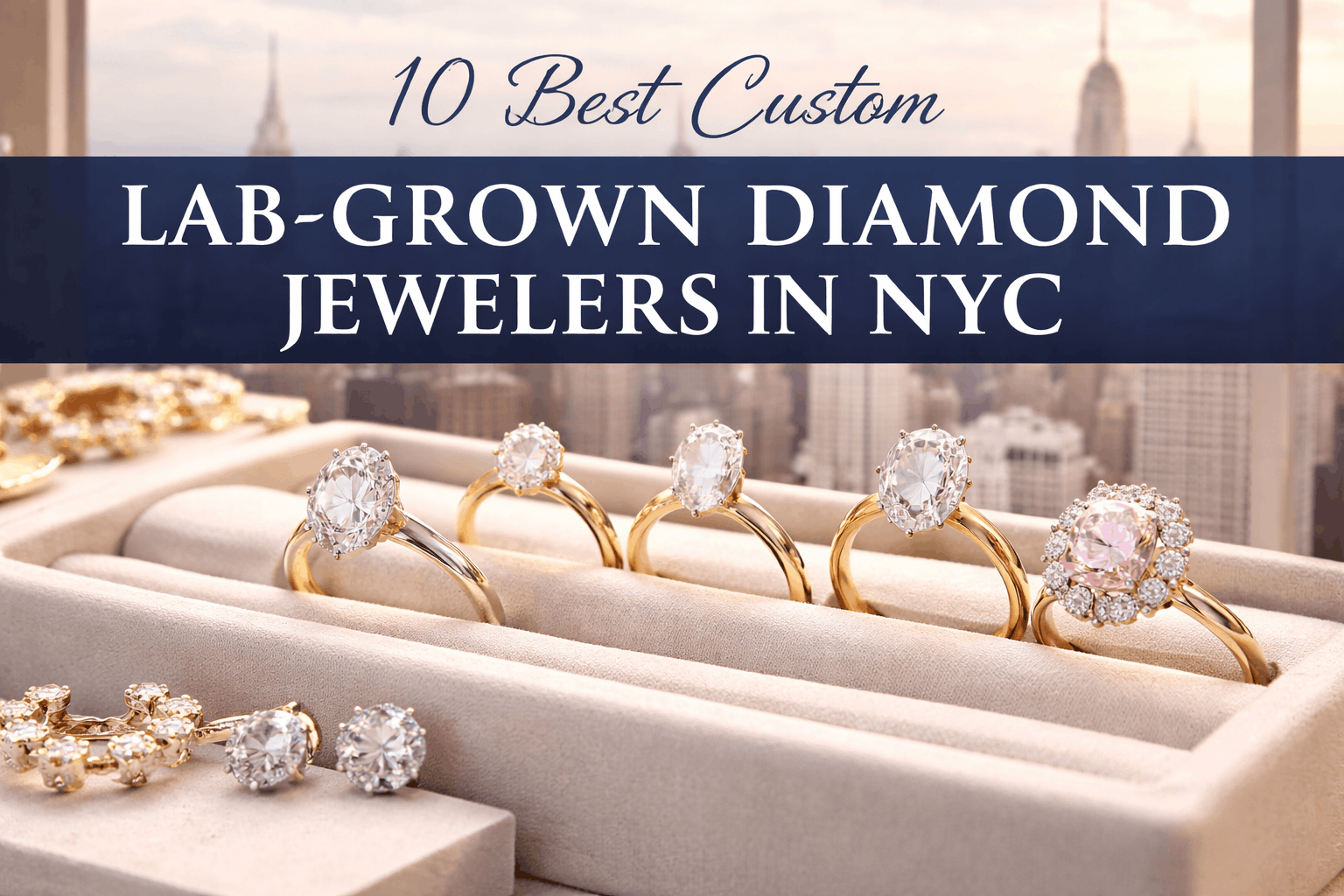
8 Types of Custom Lab-Grown Diamond Jewelers to Know in NYC (2026 Guide)
New York's custom jewelry trade is not one industry — it's a cluster of specialties that happen to share a few square blocks near 47th Street. A buyer who walks into the Diamond District looking for "a custom jeweler" without knowing which kind of custom jeweler they need usually leaves with the wrong fit: a bridal specialist who's never touched an antique cut, or an antique-recreation workshop that will make a client wait months for a simple solitaire. The district works because it's specialized, not because it's generic.
That specialization is easy to miss from the outside. Search results and directory listings tend to flatten every custom jeweler into the same category — "custom engagement rings" — regardless of whether the shop actually does bridal work, period-style recreation, minimalist fabrication, or wholesale manufacturing for other jewelers. The result is a lot of mismatched expectations: buyers comparing a four-week bridal specialist against a same-week production house on price alone, without understanding why the timelines and price points differ in the first place.
This guide breaks the NYC custom jewelry market into the specialist categories that actually exist, explains what each one is built for, and gives a framework for evaluating any custom jeweler regardless of which lane they occupy. It also covers where a wholesale lab-grown diamond supplier — the layer most buyers never see — fits into how these specialists source their stones. Whether you're commissioning a single engagement ring or you're a retail jeweler trying to identify a manufacturing partner, understanding the category first makes every downstream conversation shorter and more useful.
How NYC's Custom Jewelry Ecosystem Actually Works
The Diamond District and the broader NYC jewelry trade function less like a single marketplace and more like a supply chain with dozens of specialized nodes. At the top are design-facing studios that meet directly with clients, sketch concepts, and manage the customer relationship. Behind many of those studios sit production layers — setters, casters, polishers, and stone suppliers — who never interact with the end buyer at all. A single custom ring might pass through a designer, a CAD technician, a wax carver, a caster, a setter, and a polisher before it's finished, and any one of those steps might be outsourced to a specialist a few floors up or a few blocks over.
This structure is why category matters more than brand name when you're choosing a custom jeweler. A shop's reputation tells you about their design taste and client service, but it doesn't tell you whether they have an in-house setting bench, whether they cut their own stones or buy finished goods, or whether their real strength is bridal work versus colored-stone work versus restoration. The eight specialist types below cover the categories that actually structure this market — not an arbitrary ranking of businesses, but the functional roles a buyer or retail partner needs to recognize before they start evaluating specific shops.
1. Bridal and Engagement Ring Specialists
Bridal specialists are the largest single category in the custom jewelry trade, and for good reason: engagement rings are the highest-frequency custom commission most people will ever place. These studios build their entire process around the bridal timeline — consultation, budget-setting, stone selection, setting design, sizing, and delivery — usually with enough in-stock diamond inventory on hand that a client can walk out with a finished ring in a matter of weeks rather than months.
What separates a strong bridal specialist from a generic jeweler is depth of process, not speed alone. The best ones walk a client through setting styles (solitaire, halo, three-stone, hidden-halo) with actual samples to try on, offer CAD renderings before any metal is touched, and know how to talk through the trade-offs between carat weight, cut quality, and budget without steering the conversation toward whatever they happen to have in the case. Because bridal work is high-volume and emotionally weighted, these specialists also tend to have the most refined client-communication processes of any category — regular check-ins, clear timelines, and a defined revision process if the first design isn't quite right.
Evaluate a bridal specialist on three things: how many setting styles they can show you in person versus only in a catalog, whether they provide certified stones with a clear grading report, and how they handle the inevitable request to adjust a design mid-process. A shop that gets defensive about a design change request in week two is not a shop built for how bridal commissions actually go.
2. Antique and Period-Style Recreation Specialists
This is one of the most technically demanding specialties in the trade, and one of the easiest for a generalist jeweler to get wrong. Antique-style recreation means building a new piece that authentically replicates the look and construction of a specific historical period — Art Deco geometry, Victorian mille-grain detailing, Edwardian filigree work, Georgian-era closed-back settings — using period-appropriate techniques rather than modern shortcuts that only approximate the look.
The giveaway of a real antique specialist is their fluency with period-correct diamond cuts: old mine cuts, old European cuts, rose cuts, and other antique shapes that were faceted differently from a modern round brilliant specifically to catch candlelight rather than electric light. A shop that recommends a modern brilliant-cut stone for a "Victorian-inspired" ring either doesn't understand the period or isn't being upfront about what they can actually source. The same scrutiny applies to metalwork — hand-milgraining, hand-engraving, and closed-back or button-back collet settings all take longer and cost more than their modern equivalents, and a specialist worth commissioning will explain why rather than quietly substituting a faster technique.
Because antique-style pieces depend on stone availability as much as design skill, ask any period-recreation specialist directly about their access to antique-cut diamonds specifically — not just "fancy shapes," which is a broader and often unrelated category. Sourcing old mine and old European cuts, whether natural or lab-grown, requires a supplier relationship most generalist jewelers simply don't maintain.
3. Minimalist and Modern Designers
At the opposite end of the aesthetic spectrum from antique recreation, minimalist and modern design studios build their reputation on restraint: clean lines, low-profile settings, asymmetry used deliberately, and a general rejection of ornamentation for its own sake. This category has grown significantly as engagement ring and fine jewelry buyers increasingly want pieces that read as contemporary rather than traditional — thin pavé bands, bezel settings, sculptural negative space, and mixed-metal combinations that a classic bridal specialist wouldn't typically stock.
Modern designers tend to work more experimentally with setting geometry than other categories, which makes portfolio review especially important here. Because "minimalist" can mean anything from a plain solitaire to an architecturally unconventional asymmetric band, ask to see a broad range of the studio's actual completed work rather than a handful of hero shots — a minimalist design studio's range says more about their capability than any single piece could.
This category also tends to attract buyers who want a piece that doesn't look like anyone else's, which raises the stakes on original design work versus templated variations. A studio that primarily resizes and re-metals a handful of stock silhouettes is not the same as one that develops a genuinely custom sketch for every client — ask directly how much of the design process starts from a blank page.
4. Private-Label and White-Label Workshops
Private-label workshops occupy a different position in the supply chain entirely: their clients are other jewelers and brands, not individual consumers. A retail jeweler, an online jewelry brand, or an independent designer without in-house manufacturing will commission a white-label workshop to produce finished pieces that the client then sells under their own name, with no reference to the workshop that actually made them.
This model exists because manufacturing capability — casting, setting, polishing, quality control — is expensive to build in-house and makes little sense for a brand that's primarily focused on design and retail. White-label workshops let smaller jewelry brands offer a full custom program without owning a production floor. For buyers, the practical implication is that a beautifully branded "custom collection" from a boutique jeweler may well have been produced by a private-label workshop a few blocks away — which isn't a red flag, it's simply how a large share of the industry actually operates.
When evaluating a private-label relationship (from the retailer's side) or trying to understand who actually made a piece (from the buyer's side), the relevant questions are about production capacity and consistency rather than design credit: minimum order quantities, typical turnaround per batch, in-house quality control standards, and whether the workshop can maintain consistency across a full collection rather than a single one-off piece.
5. Gemstone-Forward Colored-Stone Specialists
Most custom jewelry conversations in New York center on diamonds, but a distinct specialist category exists for buyers whose primary interest is colored gemstones — sapphires, emeralds, rubies, and fancy-color diamonds — where the stone itself, not the setting, is the centerpiece of the commission. These specialists differ from general jewelers in a meaningful way: they typically maintain direct relationships with colored-stone cutters and dealers, understand treatment disclosure (heat treatment, clarity enhancement, and so on) at a technical level, and design settings specifically engineered to showcase a colored stone's hue and saturation rather than defaulting to diamond-first setting conventions.
A genuine colored-stone specialist will walk a client through origin, treatment history, and color grading with the same rigor a bridal specialist applies to diamond cut and clarity — and should be able to produce or point to independent lab documentation for any stone above a modest carat weight. This category also tends to overlap with fancy-color diamond work, since sourcing and setting a fancy-color stone requires many of the same skills as sourcing and setting a colored gemstone: both demand a setting design built around the stone's specific optical properties rather than a generic mounting.
Because colored stones vary enormously in durability and treatment stability, ask any colored-stone specialist directly about long-term care requirements for the specific stone you're considering — an emerald and a sapphire, for instance, have very different tolerances for everyday wear, and a specialist worth trusting will tell you this upfront rather than after the sale.
6. Men's Jewelry Specialists
Men's custom jewelry has grown from a niche request into its own specialist category, covering wedding bands, signet rings, cufflinks, bracelets, and increasingly, men's engagement rings. The design considerations here differ meaningfully from women's fine jewelry: durability under daily wear takes priority, setting styles trend toward flush and bezel settings that won't catch on tools or gloves, and metal choices skew toward harder alloys and alternative metals (tungsten, titanium, and heavier-gauge platinum) that aren't typically part of a bridal specialist's core offering.
A men's jewelry specialist earns the category label by understanding these durability trade-offs natively rather than simply scaling down a women's design. Signet ring engraving, in particular, is close to its own micro-specialty — hand-engraving a family crest or monogram at the right depth and scale requires an engraver with specific experience, not just a general setter willing to try it. The same goes for men's wedding bands with mixed-metal inlays or textured finishes, which require different fabrication techniques than a standard polished band.
When evaluating a men's jewelry specialist, ask to see examples of pieces at least a year or two old, not just new work — durability claims are only meaningful once you can see how a piece has actually held up to daily wear.
7. Heirloom-Restoration Specialists
Restoration is a fundamentally different skill from new custom design, and the two are often conflated by buyers looking for "someone to fix grandmother's ring." A true heirloom-restoration specialist can disassemble an antique or vintage piece, identify and source period-appropriate replacement materials, re-set stones without damaging fragile antique cuts, and rebuild worn prongs or shanks while preserving the piece's original character rather than modernizing it into something unrecognizable.
This category also frequently handles remounting — taking a stone from a piece that's structurally failing or stylistically dated and resetting it into a new design the family will actually wear. Remounting projects require a specific kind of judgment: knowing which original elements are worth preserving (a distinctive gallery, a family engraving, an unusual antique cut) versus which can be updated without losing what made the piece meaningful in the first place.
The clearest signal of a genuine restoration specialist is how they talk about risk. Antique diamonds — old mine and old European cuts especially — are more fragile than modern brilliants and can fracture under careless resetting. A restoration specialist worth trusting will walk through exactly how they plan to protect the stone during the process, and will be candid about pieces that are too fragile to restore safely rather than taking the job anyway.
8. Direct-from-Manufacturer Custom Houses
The final category is the one most buyers never interact with directly but that underpins much of the rest of the trade: manufacturers who control cutting, casting, setting, and finishing in-house rather than outsourcing production to third parties. These houses may sell directly to consumers, but their core business is often serving other jewelers — supplying finished custom pieces, calibrated stones, or full manufacturing capacity to retailers who don't have production floors of their own.
The advantage of working with (or through) a direct-from-manufacturer house is control: because every production step happens under one roof, there's no handoff between a design studio and an outside caster or setter, which usually means tighter tolerances, more consistent quality, and pricing that reflects genuine production economics rather than layered markups from multiple middlemen. For retail jewelers specifically, this category is the most common source of white-label custom manufacturing (see Type 4 above) — a manufacturer who both fabricates and stocks stone inventory can support a retailer's custom program without that retailer ever needing to build in-house capability.
For an individual buyer, the trade-off is usually less hand-holding on the front end — direct manufacturers are optimized for production efficiency, not necessarily boutique client experience — in exchange for pricing and turnaround that a design-first studio, which is paying for someone else's production capacity, typically can't match.
Comparison: Custom Jeweler Types at a Glance
| Specialist Type | Typical Turnaround | Typical Price Range | Best Use Case |
|---|---|---|---|
| Bridal / engagement specialists | 2–6 weeks | $$–$$$$ | Engagement rings, wedding bands, standard bridal timelines |
| Antique / period-style recreation | 6–12 weeks | $$$–$$$$$ | Historically accurate period pieces, antique-cut settings |
| Minimalist / modern designers | 3–8 weeks | $$–$$$$ | Contemporary, low-profile, or architecturally unconventional designs |
| Private-label / white-label workshops | Varies by batch size | $–$$$ (wholesale) | Retail jewelers and brands needing production capacity, not individual buyers |
| Colored-stone specialists | 4–10 weeks | $$$–$$$$$ | Sapphire, emerald, ruby, or fancy-color diamond centerpieces |
| Men's jewelry specialists | 3–6 weeks | $$–$$$$ | Signets, bands, and durable everyday-wear pieces |
| Heirloom-restoration specialists | 2–8 weeks (case-dependent) | $–$$$ | Repairing, remounting, or preserving inherited pieces |
| Direct-from-manufacturer houses | 1–6 weeks | $–$$$ | Retail sourcing partnerships, value-driven custom production |
Price ranges are directional, not quotes — actual cost depends heavily on metal, carat weight, stone type, and design complexity within any category. The table is meant to set expectations before a consultation, not replace one.
Where a Wholesale Diamond Supplier Fits In
Every specialist above depends on a layer most clients never see directly: the supplier who provides the loose diamonds a custom jeweler sets into a finished piece. Guru Diam operates in that layer, as a wholesale lab-grown diamond supplier serving custom jewelers, designers, and manufacturers across these categories rather than selling directly to end consumers.
What that means in practice for a custom jeweler evaluating sourcing options:
- Custom to any specification. Whether a jeweler needs an unusual carat weight, a specific fancy shape, or an exact color-and-clarity combination for a client commission, Guru Diam cuts to order rather than limiting jewelers to whatever happens to be in stock.
- In-house cutting, setting, and polishing. Because production runs in-house rather than through outside subcontractors, quality control applies at every stage from rough stone to finished polish.
- Multi-certification options. Both IGI and GIA certification are available on finished stones, so a jeweler can match whichever lab their own clients recognize or prefer.
- Wholesale custom manufacturing. Guru Diam's B2B division works specifically with retail jewelers and designers who need custom lab-grown diamonds for their own client commissions — including several of the specialist categories above, from bridal to direct-from-manufacturer houses.
- CAD design and visualization support. Full 3D CAD renderings are available before cutting begins, so a jeweler can confirm a stone's proportions against a client's setting design ahead of time.
- Shape and size flexibility. Round brilliant, cushion, emerald, radiant, oval, pear, marquise, and antique cuts including old mine and old European — cut to the millimeter dimensions a specific setting requires.
For antique and period-style specialists in particular, this sourcing layer matters more than it does for other categories — old mine and old European cuts aren't something a jeweler can typically pull from generic diamond inventory, which is why antique-cut sourcing relationships tend to be long-standing rather than transactional.
Guru Diam is based in New York's Diamond District. Contact: www.gurudiam.com | (212) 652-7108.
A Checklist for Choosing Any Custom Jeweler
Regardless of which specialist category fits your project, the same evaluation framework applies. Work through these before committing to a shop:
- Match the category to the commission. A bridal specialist and an antique-recreation workshop solve different problems — confirm you're talking to the right type before comparing price or timeline at all.
- Ask about certification directly. Confirm which labs a jeweler works with (IGI and GIA are the two most widely recognized) and get the grading report in hand before finalizing a stone, not after.
- Request a design process walkthrough, not just a portfolio. Ask specifically how many rounds of revision are included, whether CAD renderings come before fabrication, and how changes mid-process are handled.
- Get an itemized cost breakdown. Stone cost, setting fabrication, metal cost, certification, and any design fee should each be visible as separate line items. Bundled, opaque pricing makes it impossible to evaluate value.
- Confirm realistic turnaround for the category. Compare any quoted timeline against the ranges in the table above — a bridal specialist quoting antique-recreation timelines (or vice versa) is a signal worth asking about directly.
- Ask what happens if you're not satisfied with the first design. A clearly defined revision policy, stated upfront, is one of the most reliable indicators of a shop that has done this many times before.
Frequently Asked Questions
How do I know which type of custom jeweler I actually need?
Start with what matters most about your project: timeline, aesthetic (traditional versus modern), stone type (diamond versus colored gemstone), and whether it's a new piece or a restoration. Those four answers point directly to one of the eight categories above — a tight timeline and a classic diamond ring points to a bridal specialist, while a family ring that needs repair points to a restoration specialist, and so on.
Is lab-grown or mined the better choice for a custom piece?
Lab-grown diamonds are chemically, physically, and optically identical to mined diamonds — same hardness, same brilliance, same certification standards from labs like IGI and GIA. The main practical difference is cost: lab-grown stones typically run meaningfully less per carat than an equivalent mined stone, which lets buyers size up, upgrade clarity or color, or reallocate budget toward setting and design work instead.
How long does a custom piece typically take from start to finish?
It depends heavily on category. Bridal specialists with in-stock inventory often deliver in two to six weeks. Antique-recreation and colored-stone work, which depend on sourcing specific materials, typically run six to twelve weeks. Restoration timelines vary the most, since scope depends entirely on the condition of the original piece. Always get a specific timeline in writing before committing, rather than relying on a general industry average.
What certifications should I look for on a diamond used in a custom piece?
IGI and GIA are the two most widely recognized certification labs for both natural and lab-grown diamonds, and either is a reasonable standard to require. A grading report should confirm carat weight, cut, color, clarity, and — for lab-grown stones — explicitly state the growth method. For stones above roughly half a carat, a report is worth requiring regardless of which specialist you're working with.
Can a custom jeweler use an unusual or antique diamond cut in a new design?
Yes, but not every jeweler has access to antique cuts like old mine, old European, or rose cuts — sourcing them (whether natural or lab-grown) requires a specific supplier relationship that generalist jewelers often don't maintain. If an antique cut is central to your design, confirm sourcing capability before committing to a shop, rather than assuming any custom jeweler can accommodate the request.
Should I expect the same design process from a retail jeweler and a wholesale manufacturer?
No, and that's by design rather than a shortcoming on either side. Retail-facing studios are built around client consultation, revisions, and hand-holding through the process. Wholesale manufacturers and private-label workshops are optimized for production consistency and typically work through a retail partner rather than directly with an end client. Knowing which one you're dealing with sets the right expectations for how much direct design input you'll have.
This guide reflects general market structure in New York's custom jewelry trade as of 2026 and is intended as an educational framework for evaluating custom jewelers by specialty. Turnaround and pricing ranges are directional estimates, not quotes from any specific business — always confirm current timelines, pricing, and certification practices directly with any jeweler before commissioning a piece.