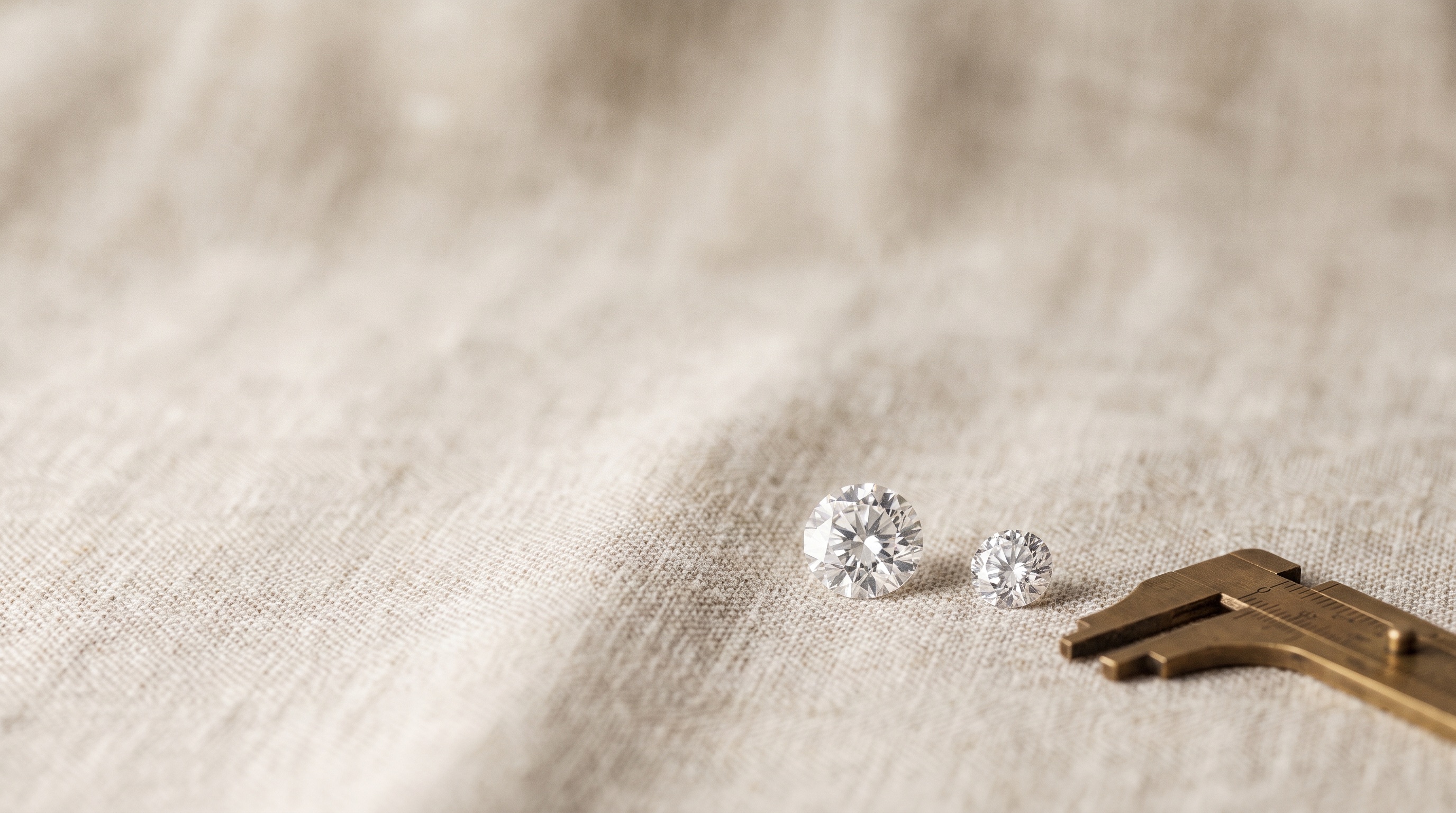
A 1 carat round brilliant diamond measures roughly 6.4-6.5mm in diameter, while a 2 carat round brilliant measures roughly 8.1-8.2mm — about a 1.7mm difference for a stone that weighs twice as much. The price gap tells a different story: a well-matched 2 carat diamond typically costs considerably more than twice the price of a comparable 1 carat stone, in both natural and CVD lab-grown material, because diamond pricing scales by rarity per carat, not by weight alone.
For wholesale buyers deciding which carat tier to stock, quote, or steer a client toward, the 1-to-2-carat jump is one of the most consequential decisions in the catalog — it sits across two separate "magic size" pricing thresholds, so the per-carat rate at 2 carats is meaningfully higher than at 1 carat even before the doubled weight is factored in. This guide covers the real size difference in millimeters, how price scales for both natural and lab-grown stones, how shape changes the visual comparison, cut quality tradeoffs at each weight, setting considerations, certification, and how to think through the decision for a given budget or client brief.
Size Comparison: 1 Carat vs. 2 Carat
| Carat Weight | Approximate Diameter (Round Brilliant) | Visual Size Impression |
|---|---|---|
| 1.00 ct | ~6.4-6.5mm | The standard, widely recognized "solitaire" size — reads as a proper center stone without being a statement piece |
| 1.50 ct | ~7.3-7.4mm | A visible step up from 1 carat, though the increase in diameter is proportionally smaller than the increase in weight |
| 2.00 ct | ~8.1-8.2mm | A noticeably larger, statement-leaning stone on the hand — the jump from 1 carat is around 1.7mm in diameter, real but far less dramatic than "twice the size" implies |
This is the fact buyers most often underestimate about carat scaling: carat weight measures mass, not linear size, and a diamond's face-up diameter is roughly proportional to the cube root of its weight. Doubling carat weight from 1 to 2 carats increases diameter by only around 25-27% — genuinely noticeable side by side, but nowhere near the "double the size" impression the carat number alone suggests. A client expecting a 2 carat stone to look literally twice as large as a 1 carat stone on the hand should be shown the two diameters next to each other before they commit to a budget around that expectation.
Price Comparison: How the Gap Scales
Diamond pricing is not linear with carat weight. Price per carat steps up meaningfully at specific weight thresholds — the trade calls these "magic sizes," and both 1.00 carat and 2.00 carat are among the most recognized of them — because rough diamonds large enough to yield a finished stone at or above each threshold get disproportionately scarcer as target weight increases. The practical result: a 2 carat diamond of comparable color, clarity, and cut to a 1 carat stone typically costs considerably more than twice as much, not simply double, because the 2 carat stone is priced against its own higher per-carat tier applied across double the weight, rather than a proportional extension of the 1 carat tier.
| Factor | 1 Carat | 2 Carat |
|---|---|---|
| Rough diamond rarity at this finished weight | Widely available relative to 2ct+, though 1.00ct is itself a recognized magic-size threshold | Meaningfully rarer — fewer rough stones yield a finished 2ct+ stone after cutting, and yield loss is proportionally costlier at this weight |
| Typical price-per-carat vs. smaller weights | Meaningfully higher per-carat price than a 0.90ct stone of the same quality | Meaningfully higher per-carat price than a 1ct stone of the same quality — one of the steeper jumps among common carat tiers |
| Natural vs. lab-grown price gap | Present and noticeable at 1 carat | More pronounced at 2 carats — the natural/lab-grown gap tends to widen as carat weight increases, since natural rarity compounds while lab-grown production cost scales more predictably |
| Illustrative total price range (same color/clarity/cut tier) | Baseline — treat as the reference point | Commonly three to four times the 1 carat baseline in natural material; a smaller, though still meaningful, multiple in CVD lab-grown material |
Those price-range figures are illustrative and relative, not a live quote — actual pricing on any given day depends on current market conditions, the specific color/clarity/cut combination, and certifying lab, so buyers and jewelers should always confirm current wholesale pricing directly rather than working from a fixed multiplier. The consistent pattern across the market, though, is that the 1-to-2-carat step prices steeper than the weight difference alone would suggest.
Natural vs. Lab-Grown at 1 vs. 2 Carats
The choice between natural and CVD lab-grown material changes how steep the 1-to-2-carat jump feels, because the two markets price carat scaling differently:
- Natural diamonds. The price increase from 1 to 2 carat is steep, reflecting genuine geological rarity that compounds as target weight increases — moving up a full carat in natural material at this range is a significant budget step that often forces real compromises elsewhere (color, clarity, or cut) to stay within range.
- CVD lab-grown diamonds. The price increase from 1 to 2 carat is also present but considerably less steep than in natural stones, since lab-grown production cost scales more predictably with size rather than being subject to the same compounding rarity premium. This makes a 2 carat lab-grown stone considerably more attainable, at a comparable quality level, than a 2 carat natural stone.
- Practical implication for buyers. A client or reseller whose priority is carat size specifically, rather than natural origin specifically, frequently finds that CVD lab-grown material reaches 2 carats at a budget that would only support 1 carat or less in natural material of comparable color, clarity, and cut — a useful reframe when a client's stated carat goal and stated budget don't match up in natural stones.
How Shape Changes the Comparison
| Shape | How 1ct vs. 2ct Reads Differently Than Round |
|---|---|
| Oval, pear, marquise (elongated shapes) | The size difference between 1 and 2 carat reads more dramatically than in round, since these shapes spread weight along a longer visible footprint rather than a compact circular one — the jump feels bigger to the eye than the mm figures alone suggest |
| Cushion, princess (squarer shapes) | Size scaling tracks closer to round's proportional pattern, though princess in particular can face up slightly smaller than round or oval at the same weight, since more weight sits retained in the pavilion |
| Emerald, Asscher (step cuts) | These shapes tend to look larger per carat than round at both weights, since step-cut proportions typically run shallower and spread more surface area — meaning a 1 carat emerald cut can read closer in visual size to a 2 carat round than the weight difference alone suggests |
This means the 1-vs-2-carat decision is not purely a weight question. A buyer or client set on a specific visual size target may be able to reach it at 1 carat in an elongated or step-cut shape rather than needing the full 2 carats in round, which has real budget implications given how steeply price increases across the 2 carat threshold.
Cut Quality Tradeoffs at Each Weight
Cut quality matters at every carat weight, but the stakes of a cut-quality compromise scale with the size and price of the stone. A poorly cut 1 carat stone that leaks light through the pavilion or looks dull face-up is a disappointing outcome at a meaningful price point; the same cut-quality problem on a 2 carat stone represents a considerably larger sum spent on a stone that doesn't perform optically the way its size and price suggest it should. Larger stones also tend to show cut, color, and clarity issues more visibly than smaller stones simply because there is more surface area for a viewer's eye to inspect — so buyers stretching budget to reach 2 carats specifically should weigh whether a 1.50 carat stone with excellent proportions might outperform, in actual appearance, a 2 carat stone with mediocre cut at a similar total price.
Setting Considerations for 1 vs. 2 Carat Center Stones
- Prong count and security. A 2 carat center stone generally warrants more robust prong coverage than a 1 carat stone in an equivalent design — six-prong heads are more common at 2 carats and above, given the higher stakes of a lost or chipped stone at that value.
- Band proportion. A 2 carat stone can visually overwhelm a very thin band or delicate setting profile that suits a 1 carat stone well; a slightly more substantial band or setting design keeps proportions balanced as center stone size increases.
- Everyday wearability. A 2 carat stone, by virtue of its larger surface area and typically higher profile in most settings, is somewhat more exposed to daily knocks than a 1 carat stone in an equivalent setting — worth factoring into setting choice (a lower-profile option like bezel, for instance) for clients planning to wear the ring during hands-on work.
- Insurance and appraisal. Given the meaningfully higher value at 2 carats compared to 1, buyers and their clients should plan for a current appraisal and appropriate insurance coverage as a standard part of the purchase, not an afterthought.
Certification at 1 and 2 Carats
Both 1 and 2 carat diamonds, natural and lab-grown alike, sit well within the range where full grading certification is standard practice and strongly recommended — IGI, GIA, and GCAL all certify stones at these weights, documenting the 4Cs plus proportions and, for round brilliants, an overall cut grade. Given the price stakes at both weights, and especially at 2 carats where the jump from 1 carat is steep, a full grading certificate should be treated as a non-negotiable part of any purchase at this level rather than something to take on a seller's description alone. The certificate also becomes the reference document for insurance appraisal down the line, so keeping it with other paperwork after purchase matters as much as checking it before buying.
Understanding "Magic Sizes" in Diamond Pricing
The trade term "magic size" refers to specific carat weight thresholds — commonly 0.50, 1.00, 1.50, 2.00, 3.00, and 5.00 carats — where price per carat jumps disproportionately compared to weights just below the threshold. The 1-to-2-carat comparison is unusual in that it spans two of these thresholds at once, which is a large part of why the price gap feels steeper than a simple doubling of weight would predict. A 1.95 carat diamond, for instance, often prices meaningfully lower per carat than a 2.00 carat diamond of otherwise identical quality, even though the size difference between the two is virtually imperceptible to the eye. This happens partly because the market broadly associates round-number carat weights with a certain status, and partly because rough-cutting decisions are influenced by these thresholds — a cutter facing a rough stone that could yield either a 1.90 or a 2.05 carat finished stone has a strong incentive to cut for the higher number, concentrating supply just above each threshold and scarcity just below it in ways that reinforce the pricing pattern over time.
The same logic applies at the 1 carat mark itself: a 0.90-0.95 carat stone frequently offers better value than a "true" 1.00 carat stone of the same quality, for the same reason. Buyers and jewelers focused on value rather than the exact number on a certificate benefit from asking a supplier about options just under each magic-size threshold before committing to the round number — this applies whether the client's target is 1 carat, 2 carat, or anywhere the two thresholds sit near a real budget line.
Common Buyer Mistakes When Choosing Between 1 and 2 Carats
- Assuming a 2 carat stone costs "about double" a 1 carat stone. Because the comparison spans two magic-size thresholds, the real price gap is typically considerably steeper than a simple doubling — a mismatch that catches buyers and their clients off guard when the actual quote comes in.
- Not considering a near-magic-size weight. As covered above, a 0.90-0.95 or 1.90-1.95 carat stone can look identical to the round number above it while pricing meaningfully lower — skipping this comparison leaves real value on the table.
- Underestimating how shape affects perceived size. A client fixated on reaching "2 carats" in round brilliant specifically may be better served, both visually and financially, by a 1 carat elongated or step-cut shape that already delivers much of the visual size impression they are after.
- Overlooking cut quality in pursuit of carat weight. As covered above, a large but poorly cut stone can underperform a smaller, well-cut one in actual appearance — a mistake that gets more expensive to make the closer a buyer gets to 2 carats.
- Not budgeting for setting and insurance costs at the higher weight. A 2 carat center stone often calls for a more substantial setting and definitely calls for adequate insurance coverage, both of which add to total cost beyond the stone price itself.
How to Decide Between 1 and 2 Carats
- Set a firm budget first, then work backward. Given how steeply price increases across the 1-to-2-carat range, deciding on total budget before comparing specific stones avoids the common trap of anchoring on "2 carats" as a fixed goal and then compromising heavily on color, clarity, or cut to reach it.
- Consider shape if visual size matters more than the certificate number. As covered above, an elongated or step-cut shape can deliver a larger visual footprint at 1 carat than the carat number alone suggests, closing some of the visual gap with a 2 carat round without the steep price jump.
- Weigh natural vs. lab-grown against the actual priority. A buyer or client prioritizing size and quality within a fixed budget, rather than natural origin specifically, often finds CVD lab-grown material reaches 2 carats more comfortably than natural material would at the same budget.
- Don't sacrifice cut quality to hit a carat number. A well-cut 1 or 1.50 carat stone frequently outperforms, in actual appearance, a poorly cut 2 carat stone at a similar total price — carat weight on paper does not guarantee the stone looks as large or as brilliant as the number implies.
- Ask about near-magic-size weights before quoting the round number. A 1.90-1.95 or 0.90-0.95 carat option can be the better value quote for a price-sensitive client without a visible size tradeoff.
Inventory and Quoting Notes for Wholesale Buyers
For jewelers and resellers deciding which carat tier to stock more heavily, the 1-to-2-carat spread has practical implications beyond a single client conversation. Because the price gap is proportionally large, a small showroom or online catalog benefits from carrying a genuine range around both thresholds — 0.90 to 1.10 carats and 1.90 to 2.10 carats, not just the exact round numbers — so a client's stated budget can be matched to an available stone without an awkward "the next size up costs three times as much" conversation happening only after a client has already fallen in love with a specific stone. Quoting both natural and CVD lab-grown options side by side at each weight, with certification specified, also lets a client self-select toward the tradeoff (natural origin vs. reaching a larger size within budget) that actually matters to them, rather than a supplier guessing at the client's priority.
Sourcing 1 and 2 Carat Diamonds at Wholesale
Because the price gap between 1 and 2 carats is steep enough to shape a client's whole decision, having transparent access to both weights across natural and CVD lab-grown material — with full certification — lets a buyer or jeweler compare real options instead of committing to a carat target before seeing actual pricing. Guru Diam supplies certified loose diamonds at both weights and beyond, natural and CVD lab-grown, across round brilliants and the full range of fancy and antique shapes, with IGI, GIA, and GCAL certification all available. Buyers comparing 1 and 2 carat options can browse the certified diamonds category, with matched melee and side stones for center-stone designs available through matching pairs. Fancy color options at comparable weights are available through fancy color loose diamonds. For finished pieces built around a 1 or 2 carat center stone, the custom jewelry program handles cutting, setting, and polishing all in-house, with completed rings delivered in 4-6 days. In-stock loose stones ship same day from both coasts — before 6pm EST from New York and before 4pm PST from Los Angeles — so a client's decision doesn't have to wait on inventory. Trade accounts can review terms at the wholesale hub or apply through trade partner.
Frequently Asked Questions
How much more does a 2 carat diamond cost than a 1 carat diamond?
Considerably more than twice as much, in most cases, for comparable color, clarity, and cut — commonly three to four times the price in natural material, and a smaller but still meaningful multiple in CVD lab-grown material. This is because both 1.00 and 2.00 carats are recognized "magic size" pricing thresholds, so the per-carat rate at 2 carats is meaningfully higher than at 1 carat even before the doubled weight is factored in. Treat any specific multiplier as illustrative rather than a live quote, since actual pricing depends on current market conditions and the exact quality combination.
How much bigger does a 2 carat diamond look compared to a 1 carat diamond?
In a round brilliant, diameter increases from roughly 6.4-6.5mm at 1 carat to roughly 8.1-8.2mm at 2 carats — about a 1.7mm difference. It's a genuinely noticeable step up side by side, but proportionally much smaller than the doubled weight might suggest, since carat measures mass, not linear diameter.
Is the price gap between 1 and 2 carats smaller for lab-grown diamonds?
Yes, generally — CVD lab-grown diamond pricing scales more predictably with size than natural diamond pricing does, since it isn't subject to the same compounding geological rarity premium. A 2 carat lab-grown stone is typically more attainable at a comparable quality level than a 2 carat natural stone of the same color, clarity, and cut.
Does diamond shape affect how big a 1 or 2 carat stone looks?
Yes — elongated shapes like oval, pear, and marquise spread carat weight across a longer visible footprint and tend to look larger than round at the same weight, while step cuts like emerald and Asscher also typically read larger per carat than round due to shallower proportions and greater surface spread.
Should I choose a 1.90 carat diamond instead of a full 2.00 carat?
Often, yes, for value — because pricing jumps disproportionately at round "magic size" thresholds like 2.00 carats, a stone weighing just under that mark (around 1.90-1.95 carats) can price meaningfully lower per carat than a true 2.00 carat stone of the same quality, while looking essentially identical in size to any observer. The same logic applies just below 1.00 carat.
Is certification necessary for both 1 and 2 carat diamonds?
Yes — given the meaningful value at both weights, and especially the steep price jump at 2 carats, full grading certification from IGI, GIA, or GCAL should be treated as a standard part of any purchase at this level rather than relying on a seller's description alone.