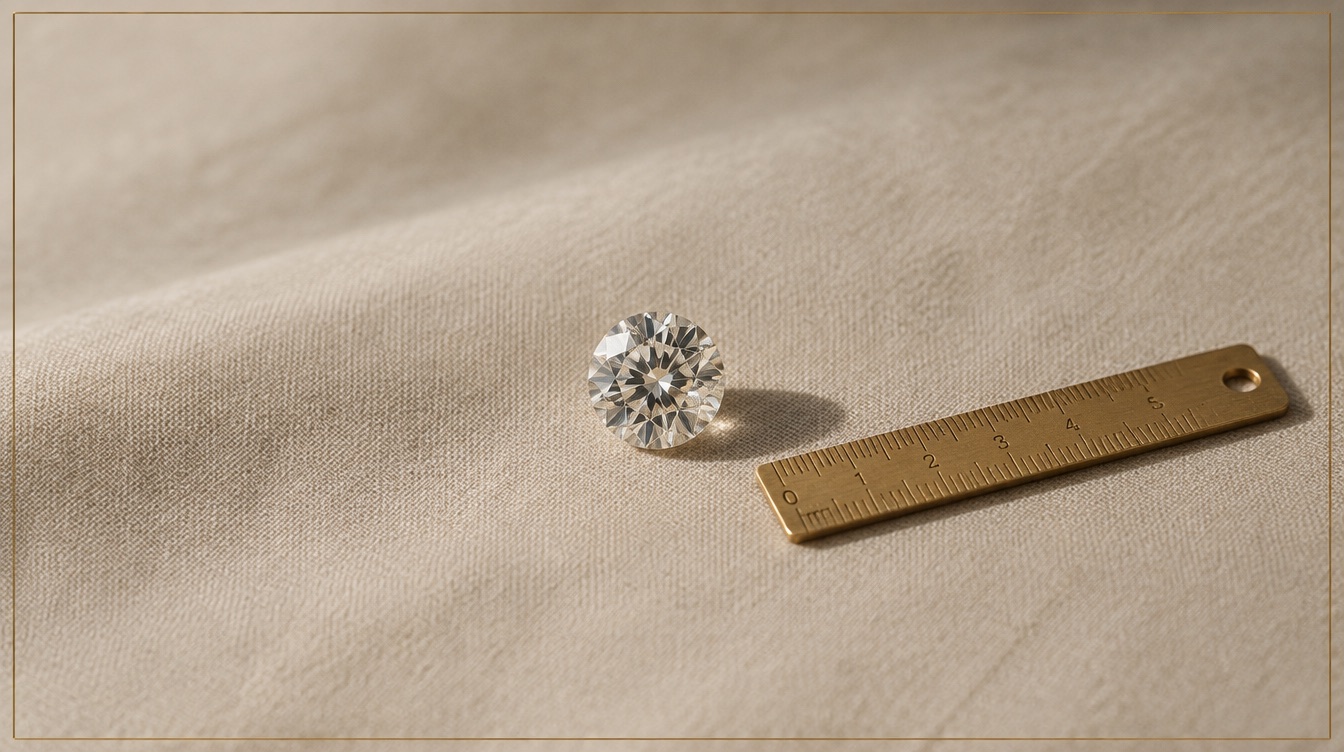

Wholesale diamond jewelry refers to finished, diamond-set pieces — rings, earrings, pendants, and bracelets — purchased at trade pricing directly from a manufacturer or supplier rather than assembled piece by piece from loose stones and separate metalwork. Retailers buy it to stock a case, fulfill a custom order, or build a private-label line without carrying the production risk themselves.
For an independent jeweler, retailer, or designer, "wholesale diamond jewelry" covers a wider range of buying decisions than the phrase suggests at first glance. It includes catalog reorders of standard bridal styles, one-off custom builds around a specific center stone, and private-label collections sold under a retailer's own brand with no indication of who actually manufactured them. Each of those buying patterns has a different cost structure, turnaround expectation, and supplier relationship attached to it. This guide walks through what wholesale diamond jewelry sourcing actually means in practice, how it differs from buying loose stones and having them set separately, how pricing and margin work at the retail level, the natural-versus-lab-grown decision as it applies to finished pieces specifically, certification on set stones, private-label considerations, and what to check before committing to a supplier.
What "Wholesale Diamond Jewelry" Actually Means
At its simplest, wholesale diamond jewelry is a finished product: a diamond (or diamonds) already set into a completed metal piece, sold to a trade buyer at a wholesale price point rather than a retail one. The buyer receives a ready-to-sell item — no separate stone-setting step, no coordination between a stone supplier and a bench jeweler, no assembly on the retailer's end. This distinguishes it from two adjacent categories that retailers sometimes conflate:
- Loose diamond wholesale — buying certified or uncertified stones on their own, with setting handled separately, either in-house or through a third-party bench or manufacturer.
- Custom jewelry manufacturing — commissioning a one-off piece built to a specific design brief, which may or may not use a stone the retailer already owns. This overlaps with finished-jewelry wholesale but is its own buying pattern, closer to a build-to-order relationship than a catalog purchase.
Wholesale diamond jewelry sourcing sits between those two: it's buying the finished output rather than the inputs, whether that output comes from a standing catalog of styles or a custom build finished to a retailer's specification and then treated, from a purchasing standpoint, the same way a catalog reorder would be.
Wholesale Jewelry vs. Buying Loose Stones and Setting Them Yourself
The core tradeoff retailers weigh is control versus convenience. Buying loose stones and arranging setting separately gives a retailer full control over the exact stone, the exact setting style, and the exact bench doing the work — at the cost of managing two (or more) vendor relationships, absorbing the coordination time between them, and taking on the risk of a stone being damaged or mismatched during setting. Buying finished wholesale jewelry collapses that into one transaction and one point of accountability, at the cost of some flexibility over the specific stone in a catalog piece.
| Factor | Loose stones + separate setting | Finished wholesale jewelry |
|---|---|---|
| Vendor relationships | Two or more (stone supplier, bench/setter, sometimes a caster) | One |
| Turnaround for a standard piece | Days to weeks, depending on setter availability and queue | Same-day for in-stock catalog styles; 4-6 days for a custom build |
| Control over exact stone | Full — retailer selects the specific stone | High on custom builds; fixed on catalog SKUs unless a stone swap is offered |
| Risk during setting | Borne by retailer if setter damages or chips a stone | Borne by the manufacturer before the piece ships |
| Best fit for | Rare or unusual stones, exact-match requests, retailers with an in-house bench | Fast reorders, case stock, custom orders without an in-house setting operation |
| Pricing basis | Stone cost plus separate labor/setting fee, tracked independently | Single wholesale price covering stone, metal, and labor together |
Neither approach is categorically better — a retailer with an in-house bench and a customer who wants a specific, unusual stone is often better served buying loose and setting in-house. A retailer without bench capacity, or one filling a routine reorder or a standard custom-ring request, is generally better served by finished wholesale jewelry, since it removes the coordination overhead entirely.
How Wholesale Pricing and Margin Structures Work for Retailers
Wholesale diamond jewelry pricing is typically quoted as a single per-piece cost that already bundles the stone, the metal, and the labor to produce the finished item — unlike loose-stone-plus-setting purchasing, where those cost components are tracked and negotiated separately. From that wholesale cost, a retailer applies their own markup to arrive at a retail price, and the margin that markup produces is what determines whether a given SKU is worth carrying.
A few structural factors shape that margin more than any single pricing decision:
Keystone and Beyond
Traditional jewelry retail markup follows a rough keystone model — doubling wholesale cost to arrive at retail price — though bridal and diamond-set pieces often carry a somewhat different multiple than fashion jewelry, since diamond content is a larger share of total cost and buyers are more price-sensitive on a bigger-ticket item. A retailer's actual achievable multiple depends heavily on local market positioning, competition, and whether the piece is sold at full price or through a promotion cycle.
Metal Cost Volatility
Because finished-jewelry wholesale pricing bundles metal into the per-piece cost, gold and platinum price movements affect wholesale jewelry pricing directly and can shift between when a retailer quotes a piece to a customer and when it actually ships, particularly on a custom order with a multi-day production window. Retailers who quote firm customer pricing on a custom piece should confirm with their supplier whether the wholesale quote is locked at order time or subject to metal-market adjustment before delivery.
Reorder Frequency and Case Turn
A SKU that sells quickly and reorders easily supports a lower per-unit margin because it turns over faster; a slow-moving or highly specific custom style needs a higher margin to be worth the shelf space and capital tied up in it. This is a standard retail-inventory principle that applies to diamond jewelry the same way it applies to any other retail category, and it's a useful lens for deciding which parts of a wholesale catalog to stock deeply versus order only against a confirmed customer request.
Certification's Effect on Price and Margin
A certified center stone in a finished piece carries a documentable cost basis that supports the retail price to a skeptical customer, which can justify a somewhat tighter margin on the stone itself in exchange for an easier, faster sale — certification reduces the retailer's own sales friction, which has its own value distinct from the raw cost of the paperwork.
Natural vs. Lab-Grown (CVD) Diamond Jewelry: The Finished-Piece Comparison
The natural-versus-lab-grown decision plays out differently in finished jewelry than it does for loose stones, because the setting, metal, and labor costs are identical either way — the entire price gap between a natural and a lab-grown version of the same finished piece comes down to the diamond itself. That makes the comparison simpler for a retailer to reason about at the SKU level than it might first appear.
| Factor | Natural diamond jewelry | Lab-grown (CVD) diamond jewelry |
|---|---|---|
| Price basis | Driven by finite, depleting natural supply; scarcity premium scales with carat weight | Driven by production capacity; costs generally compress as carat weight scales up |
| Typical retail price gap (equivalent cut/color/clarity) | Baseline | Substantially lower, with the gap widening at larger carat weights |
| Setting and metal cost | Identical to lab-grown equivalent | Identical to natural equivalent |
| Certification | GIA, IGI, GCAL — labeled natural | GIA, IGI, GCAL — labeled laboratory-grown |
| Resale/appraisal value trajectory | Generally holds a resale premium tied to scarcity | Generally does not carry the same resale premium; priced closer to production cost over time |
| Customer segment | Buyers prioritizing traditional origin and long-term scarcity value | Buyers prioritizing size-for-budget and willing to trade resale premium for larger visible carat weight |
Neither option is a "better" finished-jewelry product in an absolute sense — the material is genuine diamond either way, graded on the same 4Cs framework by the same labs. The decision for a retailer is really about which customer segment a given SKU or collection is built for, and increasingly the answer is both: many retailers now stock or offer both natural and lab-grown versions of a popular setting style side by side, letting the customer's budget and priorities decide rather than pre-selecting for them.
Certification on Finished Jewelry: What It Actually Covers
Certification works differently once a stone is set than it does loose. A loose diamond above roughly 0.30 carats is typically submitted to a lab — GIA, IGI, or GCAL — and graded on the full 4Cs before it's ever mounted, producing a standalone report tied to that specific stone. Once a stone is set into a finished piece, a few things change:
Center Stones Usually Retain Their Original Report
A certified center stone set into a finished ring, pendant, or pair of earrings generally keeps the grading report it received while loose — the report was issued for the stone itself, not for the mounting, so setting it doesn't invalidate the certification. A laser inscription on the girdle, where present, remains checkable under magnification even after setting, giving a retailer a way to confirm a set stone matches its paperwork.
Melee and Accent Stones Are Not Individually Certified
Small accent and pavé stones used around a center stone or along a band are sourced and priced as parcel goods against a quality baseline (a color and clarity range, rather than a per-stone grade) and are not individually or parcel-certified the way a center stone is. This is standard trade practice, not a shortcut specific to any one supplier, because certifying dozens of sub-0.30-carat melee stones individually isn't practical at the volume finished jewelry requires.
What to Ask a Supplier
Before ordering a finished piece with a certified center stone, confirm which lab issued the report, whether the report will ship with the piece or needs to be requested separately, and whether the report specifies growth method for a lab-grown stone (labeled simply "laboratory-grown" versus explicitly stating CVD) — some retailers' own customers ask specifically, and having that answer ready avoids a follow-up delay after the sale.
The Main Categories of Wholesale Diamond Jewelry
Buying patterns differ meaningfully across the major finished-jewelry categories, and a supplier's strength in one doesn't automatically carry over to another.
Engagement Rings and Bridal
The highest-value category per unit and the one most likely to involve a custom build around a specific center stone, setting style, and band detail rather than a straight catalog reorder. Turnaround and certification transparency matter most here, since it's typically a one-time purchase for the end customer with a real deadline attached (a proposal date, an anniversary).
Diamond Stud and Drop Earrings
Earrings are almost always sold in matched pairs, which introduces a sourcing consideration that doesn't apply to a single-stone ring: the two stones need to match closely enough in size, color, and cut that the pair reads as a set to the eye, even when they're not literally the same stone split in two. A supplier with dedicated matched-pair inventory removes this matching work from the retailer's side entirely.
Pendants and Necklaces
Generally the most catalog-driven category — solitaire pendants, tennis-style diamond necklaces, and drop pendants tend to be reordered from a standing style rather than custom-built, which makes fast case-stock turnaround more important than custom production speed for this category specifically.
Diamond Bracelets
Tennis bracelets and diamond bangles carry a higher total diamond count per piece than almost any other jewelry category, which makes consistent melee quality across the full length of the piece — matched color, clarity, and cut across dozens of small stones — a bigger factor in finished quality than it is for a ring or a pair of studs.
Private-Label and White-Label Wholesale Jewelry
A significant share of wholesale diamond jewelry sold to independent retailers ships without any manufacturer branding at all — no maker's mark, no manufacturer hallmark beyond the required metal-purity stamp, no packaging that identifies who actually produced the piece. This is what "white-label" or "private-label" means in this context: the retailer sells the piece under their own name, and the customer has no way of knowing (or reason to know) which wholesale supplier actually manufactured it.
This matters to retailers for a straightforward reason: a customer's trust and repeat business attaches to the retailer's name, not the manufacturer's, and a retailer building a brand around bespoke or exclusive-feeling product doesn't want a competitor's customer discovering the exact same piece, with the manufacturer's name on it, at a different store across town. Retailers evaluating a wholesale jewelry supplier should confirm explicitly whether pieces ship unbranded by default or whether white-labeling is a special request or add-on — the two arrangements have very different implications for how freely a retailer can build a private collection around a supplier's production capability.
Minimum Orders, Reorder Cycles, and Inventory Planning
Wholesale jewelry suppliers vary widely in minimum order requirements, and matching a supplier's model to a retailer's actual buying pattern avoids two common mismatches: committing to volume minimums that don't fit a smaller independent retailer's turn rate, or working with a supplier only set up for single-piece custom orders when a retailer actually needs to stock a small collection at consistent depth. A few practical planning questions worth resolving before placing a first order:
- Is there a minimum order quantity per style, or are single pieces accepted?
- How quickly can a popular SKU be reordered once it sells, and is that reorder treated as in-stock (fast) or built-to-order (slower)?
- Does the supplier hold consistent inventory on core styles, or does availability fluctuate piece to piece?
- What's the practical difference in cost and turnaround between a catalog reorder and a one-off custom request built around the same base setting?
Retailers stocking a case benefit from a supplier who can commit to consistent depth on a handful of proven styles; retailers filling mostly custom, made-to-order requests are better served by a supplier optimized for fast custom turnaround rather than standing inventory volume. Many retailers ultimately need both, which is one reason working with a single supplier who covers both models tends to simplify operations compared to splitting catalog and custom orders across two vendors.
What to Look for in a Wholesale Diamond Jewelry Supplier
A handful of concrete, checkable factors separate a reliable long-term wholesale relationship from one that creates ongoing friction:
- Breadth across categories. A supplier who covers rings, earrings, pendants, and bracelets — plus both catalog and custom production — reduces the number of separate vendor relationships a retailer has to manage.
- Certification transparency. Clear documentation of which lab certifies center stones, and whether growth method is disclosed explicitly on lab-grown reports.
- Natural and lab-grown options side by side. A supplier limited to only one origin restricts a retailer's ability to serve both customer segments from a single relationship.
- Realistic, quoted turnaround. A specific number for a comparable past order carries more weight than a general marketing claim, and finished-jewelry turnaround should be clearly distinguished from same-day shipping on in-stock loose or catalog goods, which is a separate, faster commitment.
- White-label clarity. Whether unbranded shipping is standard or a special request, confirmed up front rather than assumed.
- Matched-pair capability for earrings. Dedicated matched-pair sourcing removes a genuine coordination burden from the retailer's side.
- Stable, published shipping cutoffs. A supplier who states clearly when an order needs to be placed to ship same-day (rather than a vague "usually fast") makes it possible to give an accurate delivery promise to the end customer.
Where Wholesale Diamonds Actually Come From
Most wholesale diamond jewelry — natural and lab-grown alike — is built around stones that are cut and polished overseas, commonly in India, before final grading, setting, and shipment happen at a supplier's US-based operation. This is standard, widely used practice across the trade rather than something specific to one supplier, and it's worth understanding as part of the supply chain rather than treating cutting location as a quality signal on its own: a stone's grade and finish are determined by the skill and equipment behind the cut, not by where on the map the cutting facility happens to sit.
Common Pitfalls When Sourcing Wholesale Diamond Jewelry
- Assuming a single wholesale price covers everything. Confirm whether a quoted price includes certification paperwork, resizing, or shipping, since these are sometimes itemized separately.
- Not distinguishing in-stock speed from custom-build speed. A supplier's same-day shipping claim applies to in-stock catalog and loose inventory; a custom build with a center stone and specific setting request runs on a different, longer timeline even at a fast supplier.
- Overlooking melee consistency on multi-stone pieces. A tennis bracelet or pavé setting is only as good as its least consistent stone — ask specifically how a supplier controls color and clarity matching across a full piece, not just the center stone.
- Treating natural and lab-grown as a quality hierarchy. Both are graded on the same 4Cs scale by the same labs; the decision is about price point and customer segment, not which one is "the real diamond."
- Not confirming white-label terms before the first order. Assuming unbranded shipping is standard, without confirming it, risks an unpleasant surprise on the first delivery.
Sourcing Wholesale Diamond Jewelry at Guru Diam
Guru Diam is a trade-only wholesale supplier serving independent jewelers, designers, and manufacturers, carrying natural diamonds, a CVD-only lab-grown catalog, certified loose stones, and finished jewelry together — one supplier for antique cuts, fancy colors, fancy color melee, custom engagement rings, and finished jewelry, rather than a narrow specialization in any single category. Both natural and CVD lab-grown options are available across standard, antique, and exotic diamond shapes, with IGI, GIA, and GCAL certification all available on center stones, and reports specify growth method rather than leaving lab-grown origin ambiguous.
In-stock loose and catalog inventory ships same-day from Guru Diam's New York and Los Angeles locations — before 6pm EST out of New York, before 4pm PST out of Los Angeles — and custom engagement rings finish in 4-6 days from approved design, well ahead of the multi-week turnaround typical of custom bridal production elsewhere in the trade. Custom rings ship unbranded by default, so jewelers resell finished work under their own name without confirming white-label terms as a separate negotiation. Retailers sourcing matched pairs for earrings can work from a dedicated matched-pair inventory rather than sourcing and matching stones themselves, and Guru Diam supports over 2,000 active trade accounts across both catalog reorders and custom production.
Buyers can browse certified center-stone inventory in the certified diamonds category, source matched sets for earrings and side-stone work through matching pairs, or explore natural fancy color options via fancy color loose diamonds. Start a custom build through custom jewelry, review current trade terms at the wholesale hub, or apply for a trade account through trade partner.
Frequently Asked Questions
What does "wholesale diamond jewelry" mean exactly?
Wholesale diamond jewelry means finished, diamond-set pieces — rings, earrings, pendants, and bracelets — purchased at trade pricing directly from a manufacturer or supplier, as opposed to buying loose stones and having them set separately, or paying full retail on an already-finished piece.
Is it cheaper to buy loose diamonds and have them set, or to buy finished wholesale jewelry?
It depends on the piece and the retailer's setup. A retailer with in-house bench capacity and an unusual stone request may do better buying loose and setting in-house. For standard styles, reorders, and most custom requests, finished wholesale jewelry usually works out more efficient overall once coordination time and setting risk are factored in, even when the raw stone-plus-labor math looks similar on paper.
What's the difference in price between natural and lab-grown diamond jewelry?
The metal, setting, and labor costs are identical either way — the price gap comes entirely from the diamond itself. Lab-grown (CVD) center stones typically run substantially below natural stones of equivalent cut, color, and clarity, with the gap widening at larger carat weights, because natural supply is fixed by geology while lab-grown production scales with reactor capacity.
Are diamonds in finished jewelry certified the same way as loose diamonds?
Center stones above roughly 0.30 carats generally carry the same GIA, IGI, or GCAL certification they received while loose, and setting doesn't invalidate that report. Small melee and accent stones are sourced and priced as parcel goods against a quality baseline rather than individually certified, which is standard trade practice.
What does "white-label" or "private-label" mean in wholesale jewelry?
It means the finished piece ships with no manufacturer branding — no maker's mark or identifying packaging beyond the required metal-purity stamp — so the retailer can sell it entirely under their own name. Retailers should confirm whether this is standard or a special request before placing an order.
How fast can a wholesale jewelry supplier turn around a custom order?
Industry norm for a genuinely custom engagement ring runs roughly two to six weeks from approved design to finished piece; a smaller number of suppliers with tightly controlled in-house production have compressed that significantly for standard custom-ring builds. This is a separate timeline from same-day shipping on in-stock catalog inventory, which applies only to goods already on hand.
What should I check before choosing a wholesale diamond jewelry supplier?
Confirm category breadth (rings, earrings, pendants, bracelets, both catalog and custom), certification transparency, availability of both natural and lab-grown options, a realistic quoted turnaround rather than a general marketing claim, and whether white-label shipping is standard.
Guru Diam is a trade-only wholesale diamond supplier with locations in New York and Los Angeles, carrying natural diamonds, a CVD-only lab-grown catalog, certified loose stones, and finished jewelry across standard, antique, and exotic diamond shapes. Browse the certified diamonds category, review matched-pair inventory at matching pairs, or start a custom build through custom jewelry. Trade accounts can review terms at the wholesale hub or apply through trade partner.