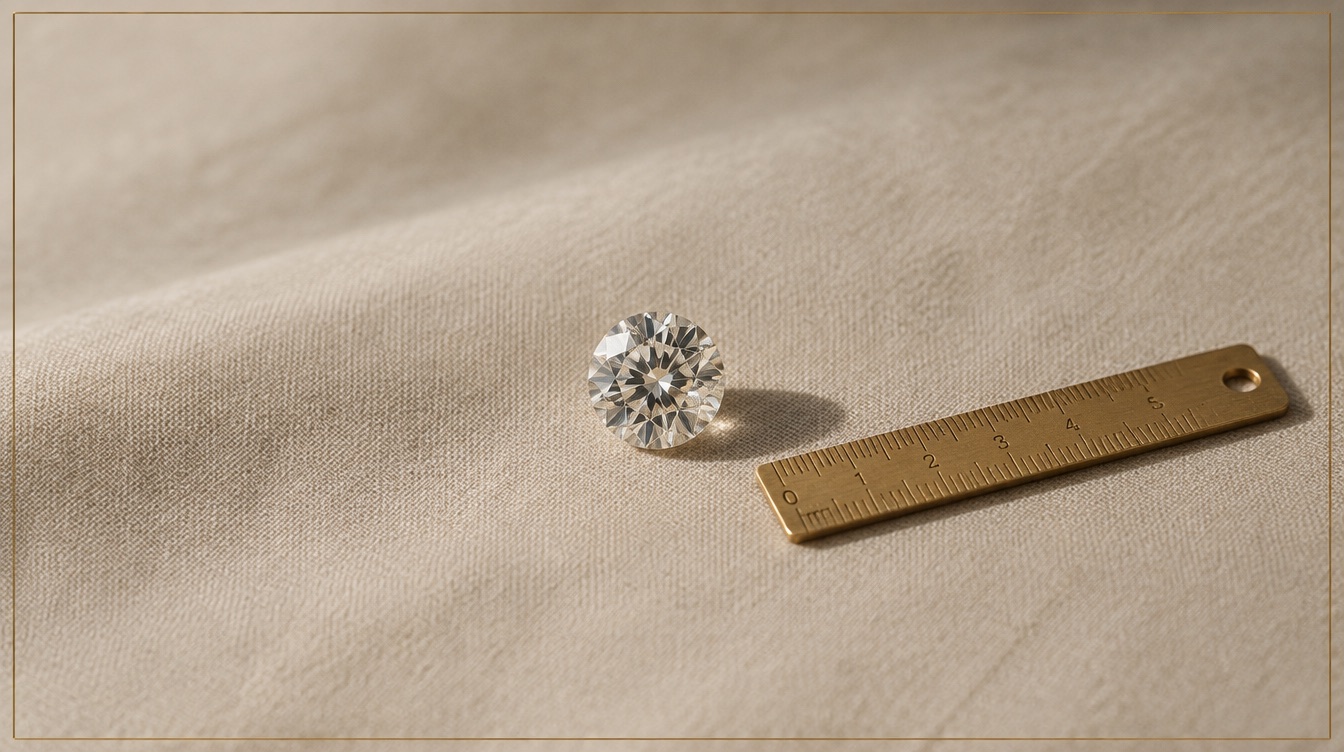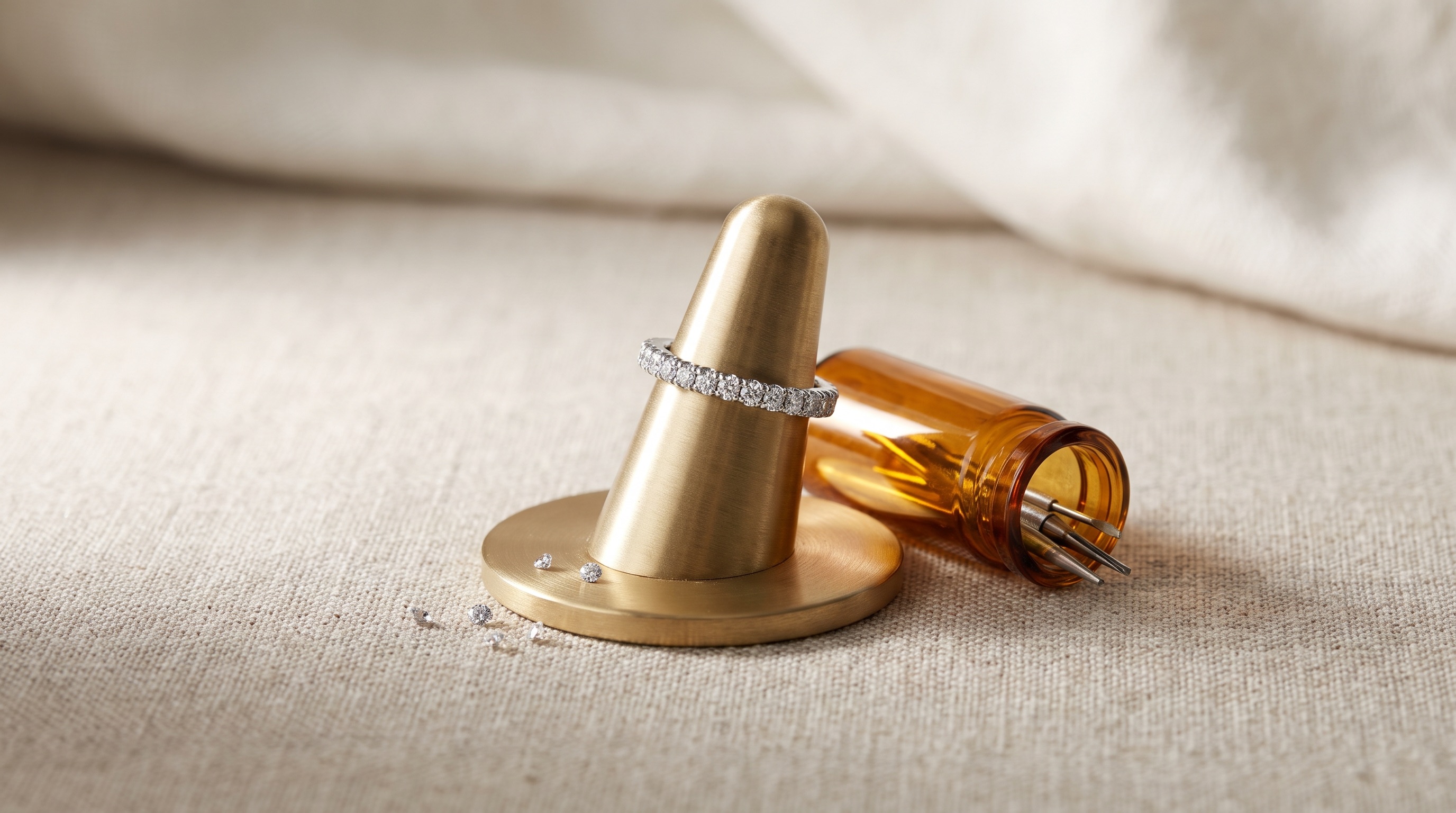
Pavé setting (from the French for "paved," pronounced pah-VAY) is a technique where many small diamonds are set closely together across a metal surface, held in place by tiny metal beads or shared prongs, so the surface reads as a continuous field of sparkle rather than individual stones in separate settings. The metal disappears visually behind the density of small stones — the defining look of a pavé band, halo, or shank — which is why the technique is named for how it "paves" a surface, much like cobblestones pave a street.
How Pavé Setting Is Made
A pavé setting starts with a metal surface — a ring shank, a halo band, an earring's outer edge — into which a setter drills a grid of small holes sized to each melee stone. Each stone is seated into its hole, and tiny beads of metal are raised and pushed over the stone's edge using a graver or beading tool, pinching it in place at multiple points around its girdle. Because each bead typically secures the edges of two or more adjacent stones at once (a "shared bead"), a pavé surface uses far less metal per stone than an equivalent number of individual prong settings would, which is part of what gives pavé its dense, all-diamond appearance.
Main Pavé Styles
Micro-Pavé
Micro-pavé uses the smallest melee, typically well under 1mm to around 1.3mm in diameter, set as densely as possible under magnification. It's the most delicate and labor-intensive pavé style, requiring the setter to work under a loupe or microscope for precision, and it produces the finest, most continuous-looking sparkle of any pavé variant. Micro-pavé is common on halo rings, delicate eternity bands, and any design meant to maximize perceived sparkle from small total carat weight.
French Pavé (or French-Cut Pavé)
French pavé cuts a small V-shaped groove between each stone rather than raising a simple round bead, exposing more of each stone's girdle to light and creating a slightly more open, sparkling look than standard bead-set pavé. It's more labor-intensive to execute well and is generally reserved for higher-end pieces where the extra brilliance justifies the added bench time.
Shared-Prong (or Shared-Claw) Pavé
Shared-prong pavé uses small individual prongs rather than beads, with each prong shared between two adjacent stones. It shows slightly more metal than bead-set or French pavé but is often considered marginally more secure for stones in the low-to-mid melee size range, since prongs grip a somewhat larger surface area of the stone's girdle than a single bead point does.
U-Pavé and Fishtail Pavé
U-pavé uses a U-shaped cutout between stones instead of a V-groove or round bead, offering a middle ground between French pavé's openness and standard bead-set's simplicity. Fishtail pavé, typically used on a ring's shank in a single row, tapers the setting design at each end like a fishtail, a decorative detail sometimes chosen for the way it visually elongates a finger.
Pavé vs. Channel Setting
Pavé and channel setting are both used to set a row or field of small stones, but they work differently. A channel setting holds stones between two parallel walls of metal with no visible prongs or beads on the surface, protecting the stones' girdles fully along the sides but blocking some light from entering there. Pavé, by contrast, exposes more of each stone's crown and sides to light through the gaps between beads or prongs, generally producing more overall sparkle than a channel-set row of the same stones, at the cost of slightly more exposed metal contact points that could, in theory, snag.
Pavé vs. Bezel Setting
Where pavé maximizes visible stone density and sparkle across a surface, bezel setting (see GD's bezel setting guide) takes the opposite approach for a single stone — enclosing it fully in a protective metal rim that reduces brilliance in exchange for maximum security. The two techniques are sometimes combined in one piece: a bezel-set center stone paired with a pavé-set halo or shank, giving a design that balances a highly protected center stone against a sparkling, low-profile field of accent stones around it.
Durability and Maintenance
Pavé settings are generally durable for normal daily wear, but the small size of each individual bead or prong means a single point of contact carries less structural margin than a larger prong on a solitaire center stone. A snag against fabric, a hard knock, or years of gradual wear can loosen or wear down an individual bead, which is the most common failure point on a pavé piece — a loose or lost melee stone, rather than a catastrophic failure of the whole setting. Because of this, pavé jewelry benefits from routine professional inspection more than a simple prong or bezel solitaire does; a jeweler can spot a worn bead and re-tip it before a stone is actually lost, which is a far cheaper and simpler fix than replacing a missing stone later. Cleaning also matters more on pavé than on more open settings, since debris and lotion residue tend to accumulate in the small gaps between closely set stones — a soft brush and mild solution, or a professional ultrasonic clean, keeps a pavé surface looking its best.
Cost Considerations
Pavé setting is generally more labor-intensive per carat of total stone weight than a single larger center stone in a simple prong setting, since drilling, seating, and securing dozens or hundreds of individual small stones takes significantly more bench time than mounting one. That said, because pavé uses small, lower-cost-per-stone melee rather than a single larger center stone, a pavé design can often deliver a large total visual sparkle footprint at a lower total material cost than an equivalent look built around fewer, larger stones — one reason pavé halos and pavé shanks are such a common way to add perceived size and sparkle to a design without proportionally increasing the cost of the center stone itself.
Melee Sourcing for Pavé Work
Consistent melee quality matters more for pavé than for almost any other setting style, because dozens or hundreds of stones sit side by side where any single outlier in color, clarity, or cut is immediately visible against its neighbors. Melee intended for pavé work is typically sourced as calibrated parcel goods against a consistent quality baseline (commonly DEF color, VS+ clarity) rather than individually certified stone by stone, since individual certification isn't practical at melee scale — see GD's diamond clarity chart guide for how clarity grading works at the stone level, which the parcel baseline is built from. Consistent calibration (precise, matching diameters across the full parcel) is just as important as color and clarity consistency, since mismatched stone sizes are one of the most common causes of an uneven, visibly imperfect pavé surface once set.
Where Pavé Setting Is Most Commonly Used
- Engagement ring shanks — a pavé band under a solitaire or halo center stone is one of the most requested combinations in bridal jewelry, adding sparkle along the full band without competing visually with the center stone.
- Halo settings — a ring of pavé-set melee surrounding a center stone, increasing perceived size and overall sparkle.
- Eternity and half-eternity bands — a full or partial row of pavé stones around a wedding band; see GD's note on how eternity bands share the same underlying product structure as wedding bands more broadly.
- Earrings and pendants — pavé-set drop earrings, huggie hoops, and pendant surrounds all use the same core technique at a smaller total scale.
Pavé Setting Styles Compared
| Style | Look | Relative Labor | Best For |
|---|---|---|---|
| Micro-Pavé | Densest, finest sparkle | Highest | Halos, delicate bands |
| French Pavé | Most open, brightest | Highest | Premium pieces prioritizing brilliance |
| Shared-Prong | Slightly more visible metal | Moderate | Slightly larger melee, added security |
| U-Pavé | Balanced openness | Moderate-high | Middle ground design choice |
Metal Choice and Pavé Setting
Pavé is most commonly executed in white gold or platinum, since a white metal background lets the melee's brilliance read as continuous sparkle rather than being visually broken up by contrasting metal color between stones. Yellow and rose gold pavé are both achievable and increasingly popular in current designs, but the warmer metal tone shows more visibly in the small gaps between stones than a white metal does, which changes the finished look — some designers use this deliberately for a warmer, more textured effect rather than the cooler, more uniform sparkle of white-metal pavé. Platinum's density and strength also make it a durable choice for pavé specifically, since the beads or prongs holding each stone benefit from platinum's resistance to wear compared to a softer, lower-karat gold alloy that can thin out faster under the same repeated handling and cleaning over years of wear.
Signs of Quality (and Warning Signs) in Pavé Work
Well-executed pavé shows evenly sized, evenly spaced stones with consistent bead or prong work throughout, and no visible gaps, misalignment, or stones sitting at slightly different heights. Warning signs of lower-quality pavé work include stones that appear loose or rock slightly under gentle pressure, inconsistent stone sizing that creates a visibly uneven surface, beads that look overly large or crudely finished relative to the stone size, and any stone sitting noticeably lower or higher than its neighbors. Buyers and retailers evaluating a pavé piece — whether new inventory or a piece coming in for resale or trade-in — should check these details under magnification, since they're not always obvious to the naked eye but are strong indicators of overall setting quality and likely long-term durability.
Pavé Setting and Insurance Documentation
Because pavé pieces contain many individually small stones rather than one dominant center stone, insurance appraisals for pavé jewelry typically document total stone count and combined carat weight for the melee field as a group, alongside any center stone's individual grading. This distinction matters at claim time: replacing a single lost pavé stone is usually a straightforward, low-cost repair, whereas a full loss of the piece is valued against the documented total, not stone by stone. Retailers selling pavé-heavy designs should make sure customers understand this distinction and get an appraisal that reflects the piece's actual construction, rather than assuming standard single-stone appraisal language automatically covers a pavé design correctly.
Repairing and Re-Tipping Pavé Settings
Because the most common pavé failure is a single worn or lost bead rather than a structural failure of the whole piece, repair is usually localized — a jeweler re-raises or rebuilds the specific bead in question rather than reworking the full setting. This is a routine, low-cost repair when caught early (a worn bead before a stone is lost) but becomes more involved once a stone has actually gone missing, since matching a replacement melee stone's size, color, and clarity closely enough to blend in with its neighbors takes more sourcing effort than simply re-securing an existing stone. This is one of several practical reasons routine professional inspection of pavé jewelry — roughly annually for pieces in regular wear — is worth recommending to customers rather than waiting for a visible problem to appear.
Pavé Setting on Fancy Color and Antique-Style Pieces
Pavé isn't limited to white melee. Fancy color melee — yellow, pink, blue, and green, in round and calibrated fancy shapes — can be pavé-set to create a colored halo, colored shank accent, or a full color-graduated pavé effect moving from a colored center stone outward. Pavé also appears on antique and vintage-style designs, though historical pavé work (particularly Georgian and Victorian pieces) often used larger, less uniform stones and less refined beading than modern micro-pavé technique allows — a detail worth knowing when evaluating whether a piece is genuinely antique versus a modern piece designed in an antique style.
Origins and History of Pavé Setting
Pavé setting traces back to 19th-century French jewelry houses, developed as a way to maximize the appearance of diamond coverage on a piece using smaller, less expensive stones than a jeweler could otherwise afford to feature prominently. The technique's name and its association with French jewelry-making persist today, even though pavé is now used by workshops worldwide and is no longer tied to any specific country of manufacture. Early pavé work relied entirely on hand tools and a setter's eye for spacing, and while modern pavé still depends heavily on hand-finishing, laser-assisted hole-drilling and more precise melee calibration have made it possible to achieve a more uniform, denser finished look than 19th-century pavé typically achieved.
Current Demand Trends for Pavé Jewelry
Pavé has remained one of the most consistently requested setting styles across bridal and everyday fine jewelry, driven in large part by the halo engagement ring's enduring popularity and by a broader consumer trend toward stackable, layered jewelry where several pavé-set pieces are worn together. Retailers report particularly steady demand for pavé engagement ring shanks paired with a solitaire or halo center stone, pavé huggie earrings, and pavé tennis-style bracelets, all of which lean on the same core appeal — maximum visible sparkle relative to total carat weight and price. This demand pattern makes pavé a category worth stocking proactively in melee and pre-set mountings rather than treating it purely as a request-only custom option, particularly for retailers building out a bridal or stackable-jewelry assortment.
Pavé Setting Height and Comfort Considerations
Because pavé stones sit close to the metal's surface rather than raised on tall prongs, a well-executed pavé piece generally sits lower and flatter against the skin than an equivalent piece using taller individual prong settings — a practical comfort advantage for a ring shank or a bracelet worn daily. This lower profile also makes pavé less prone to snagging on clothing or hair than a prong-heavy design, though the tradeoff, as with any low-set stone, is slightly reduced light entry from the sides compared to a stone raised higher off the metal surface. Designers balancing a pavé shank against a taller halo or solitaire center should account for this height difference so the finished piece reads as visually cohesive rather than mismatched in profile.
Evaluating Pavé Work Under Magnification
Because pavé's flaws are often small-scale — a slightly uneven bead, a marginally misaligned stone — proper evaluation typically requires a jeweler's loupe or microscope rather than the naked eye. A buyer or retailer inspecting a pavé piece should look specifically at bead uniformity (consistent size and shape across every stone, not just the ones easiest to see), gap consistency between stones, and whether every stone sits at the same height and angle relative to its neighbors. This kind of close inspection is standard practice before a wholesale pavé order ships and is worth recommending to retail customers evaluating an expensive pavé piece for purchase, since surface-level polish can sometimes mask underlying inconsistency in the actual stone-setting work beneath it.
Sourcing Pavé-Ready Melee and Custom Pavé Builds Through Guru Diam
Guru Diam supplies calibrated CVD lab-grown melee from 0.8mm to 9.0mm in round brilliant and fancy calibrated shapes (emerald, radiant, pear, marquise, and other shapes on request), held to a DEF+/VS+ quality baseline, as well as fancy color melee in yellow, pink, blue, and green. Because melee sourcing and custom setting happen through the same account, jewelers building a pavé piece can source a full matched parcel and have it set into a custom design finished in 4-6 days, unbranded by default for resale under a jeweler's own name.
Browse melee parcels through the wholesale hub, start a custom pavé build through custom jewelry, and set up a trade account through trade partner. Fancy color melee for a colored pavé design is available under fancy color loose diamonds, and matched pairs for pavé-accented earrings can be sourced under matching pairs. For how pavé compares to a fully enclosed protective setting, see GD's bezel setting guide.
Frequently Asked Questions
What is pavé setting?
Pavé setting is a technique where many small diamonds are set closely together across a metal surface, secured by tiny beads or shared prongs, so the metal largely disappears behind a dense field of sparkle. The name comes from the French word for "paved," a reference to how the finished surface resembles cobblestones laid edge to edge rather than a series of individually mounted stones.
What's the difference between micro-pavé and regular pavé?
Micro-pavé uses the smallest melee, typically well under 1.3mm, set as densely as possible under magnification, producing the finest, most continuous sparkle. Standard pavé can use slightly larger melee and is somewhat less labor-intensive to execute.
Is pavé setting durable for everyday wear?
Generally yes for normal daily wear, though the small size of each bead or prong means individual points carry less structural margin than a larger prong setting. Routine professional inspection, roughly annually, helps catch a worn bead before a stone is actually lost.
Is pavé setting more expensive than a single center stone setting?
It's more labor-intensive per carat of total stone weight, since setting many small stones takes more bench time than mounting one. However, because pavé uses lower-cost-per-stone melee, it often delivers a large total sparkle footprint at a lower total material cost than fewer, larger stones would.
What happens if a pavé stone falls out?
A jeweler typically re-secures the loose bead or prong and sources a replacement melee stone matched closely in size, color, and clarity to the surrounding stones. Catching a worn bead before a stone is actually lost, through routine inspection, is a simpler and cheaper fix than replacing a missing stone later.
Can pavé setting be combined with a bezel setting?
Yes — a common design pairs a bezel-set center stone, which maximizes protection and security, with a pavé-set halo or shank around it, which maximizes sparkle across the surrounding surface. The two techniques serve different purposes and combine well in one piece.
What metal works best for pavé setting?
White gold and platinum are the most common choices, since a white metal background keeps the melee's sparkle reading as continuous rather than visually interrupted by warmer metal color between stones. Platinum's added durability also makes it a strong choice specifically for the small beads or prongs that hold each stone in place.